Billboards in Papillion, NE
No Minimum Spend. No Long-Term Contracts. Just Results.
Ready to turn heads in Papillion? Blip makes billboard advertising easy, flexible, and fun—pick your digital billboard, set your budget, upload your creative, and pay only when your ad plays. No minimums, no contracts, just bold visibility on your terms.
Trusted by Leading Brands


Billboard advertising
in Papillion has
never been easier
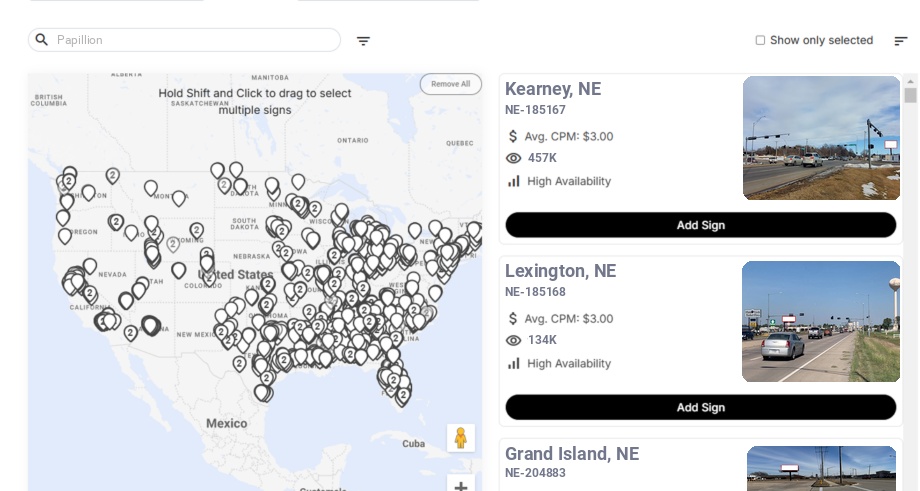
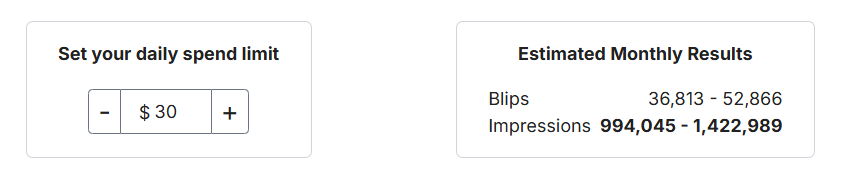
How much is a billboard in Papillion?
Why Choose Blip for Billboard Advertising in Papillion
Blip lets you launch fast on Papillion’s Highway 370 or I-80 commute corridors with self-serve control and no contracts.
Set flexible daily budgets in Papillion and reach repeat drivers from Bellevue, La Vista, and Gretna without overspending.
Use dayparting on Papillion routes to hit morning and evening commuters, plus Werner Park game nights and weekend shoppers.
Track real-time results in Papillion, then shift spend as traffic changes near US-75, Offutt, and Nebraska Crossing.
Blip’s creative tools make it easy to test bold Papillion ads for back-to-school, family dining, or winter service needs.
Frequently Asked Questions About Billboard Advertising in Papillion
How much does a billboard cost in Papillion with Blip?
Where can I advertise with Blip in Papillion to reach commuters and shoppers?
Why is Papillion a strong billboard market for Blip?
What kinds of advertisers work best in Papillion?
Do I need a contract to advertise with Blip in Papillion?
How fast can I launch a billboard campaign with Blip in Papillion?
Where can I advertise with Blip in Papillion?
Still have questions? Launch a campaign in minutes — no contracts, no commitments.
Start Your CampaignPapillion Billboard Advertising Guide
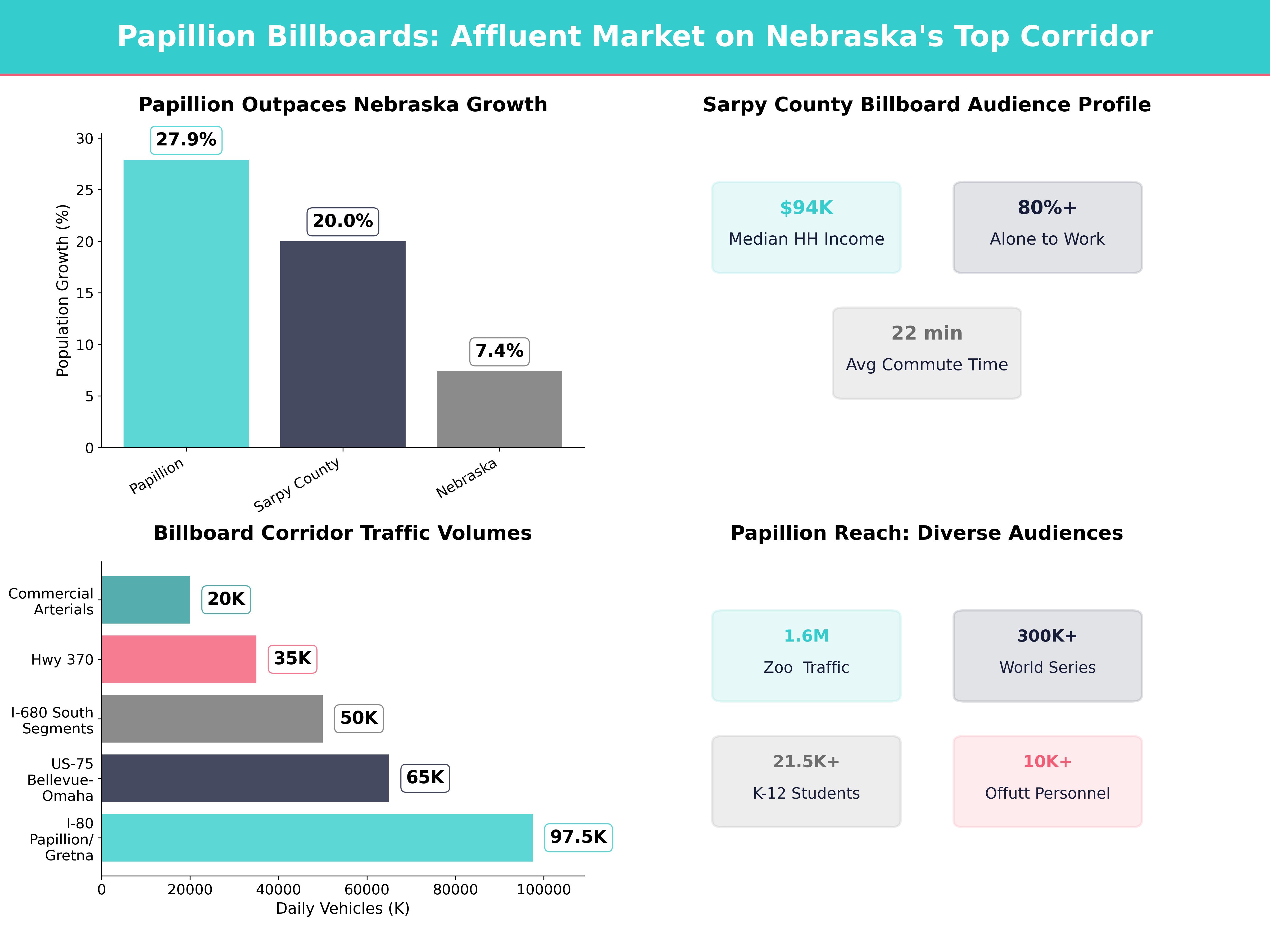
Papillion is a strong billboard market because it combines fast suburban growth, high daily driving levels, and easy access to the larger Omaha 12 miles southwest of downtown Omaha. Papillion grew from 18,894 residents in 2010 to 24,159 in 2020, an increase of 27.9%, while Sarpy County reached 190,604 residents after growing 20.0% in the same decade.
Papillion Market Overview for Billboard Advertising
Papillion and Sarpy County growth trends
When we advertise in Papillion, we are not buying a small, isolated suburb. We are buying into one of Nebraska’s strongest suburban growth zones, anchored by Papillion, La Vista, Bellevue, and nearby westward expansion toward Gretna 5,265 residents, and Sarpy County added 31,764 residents. Over the same decade, Nebraska as a whole grew by 7.4%, so Papillion and Sarpy County outpaced the state by a wide margin.
That growth matters because it increases both household density and commercial activity. The Greater Omaha Chamber 1 million residents and a labor force above 500,000, which means Papillion advertisers can reach well beyond city limits. A Papillion campaign can speak to local residents, but it can also influence people who live in Bellevue, work in Omaha, shop in Gretna, or drive in from other parts of the metro.
Economic profile and commuting behavior in Papillion
Papillion also benefits from the generally affluent profile of Sarpy County. State and local development profiles used by Grow Sarpy and the Nebraska Department of Economic Development place Sarpy County’s median household income at roughly $94,000, which gives many advertisers a solid base for home services, healthcare, dining, financial services, retail, and family recreation.
Just as important, this is an auto-oriented market. Regional planning by the Metropolitan Area Planning Agency and local commuting data show that more than 80% of workers in Sarpy County drive alone to work, and average travel time is about 22 minutes. Even with service from Metro, most trips in Papillion still happen by car, especially for work, school, errands, sports, and shopping. For billboard advertisers, that means our creative can build frequency quickly because the same audience often repeats the same corridor 5 days a week.
Key Traffic Corridors for Papillion Billboard Campaigns
Interstate 80 near Papillion and Gretna
According to traffic count maps from the Nebraska Department of Transportation, Interstate 80 on the southwest side of the Omaha metro generally carries about 75,000 to 120,000+ vehicles per day, depending on the segment. This is the regional gateway for travelers coming from Lincoln, western Sarpy County, west Omaha, and the broader interstate network.
For us, I-80 is the best reach corridor when we want scale. Regional retail, hospitals, colleges, entertainment venues, legal services, auto dealers, and destination businesses all benefit here because I-80 captures both routine commuters and higher-intent travelers. If we need awareness across a large geography, I-80 gives us volume first and local precision second.
Nebraska Highway 370 through Papillion and Bellevue
Nebraska Highway 370 is the signature Papillion corridor. NDOT counts commonly place key sections of Highway 370 in roughly the 25,000 to 45,000 AADT range as it moves through Gretna, Papillion, La Vista, and Bellevue. This route ties together residential neighborhoods, schools, shopping nodes, restaurants, medical offices, and access points to I-80 and US-75.
Because Highway 370 carries local intent, it is especially strong for advertisers who need action soon after exposure. Restaurants, urgent care clinics, orthodontists, childcare providers, gyms, banks, furniture stores, local events, and political campaigns all fit this corridor well. When we want proximity to decision-making, Highway 370 usually matters more than a broader interstate.
U.S. 75 and the Bellevue-to-Omaha commuter spine
U.S. 75 is one of the most important commuter routes for south-metro residents and workers. NDOT traffic volumes through the Bellevue-to-Omaha stretch typically land in the 50,000 to 80,000+ AADT range, with stronger counts closer to the urban core. This route is especially important for the military community, government-related commuters, and residents moving between Bellevue, Offutt-area neighborhoods, and job centers to the north.
Advertisers who benefit from this corridor include higher education, military-support services, cell and internet providers, healthcare, insurance, credit unions, and quick-service restaurants. US-75 also works well for campaigns that need high frequency among weekday commuters who pass the same signs morning and evening.
Interstate 680 and the 72nd, 84th, and 96th Street commercial grid near Papillion
South-metro access is not only about the big east-west and north-south freeways. NDOT counts show Interstate 680 on nearby south and southwest segments often carrying about 40,000 to 60,000 vehicles per day, while commercial arterials such as 72nd Street, 84th Street, and 96th Street frequently fall in the 15,000 to 25,000+ range on key stretches near La Vista, Papillion, and southwest Omaha.
These corridors are useful when we want neighborhood precision. Local retailers, supermarkets, family entertainment, dentists, real estate teams, home improvement companies, and community colleges can often get a better match here than on the interstates. The lower speed and more destination-oriented traffic also support slightly more detailed offers, especially if our business is only a few minutes away.
Audience Segments We Can Reach in Papillion
Daily commuters and cross-metro shoppers in Papillion
Papillion’s strongest billboard audience is still the daily driver. Residents move between Papillion, La Vista, Bellevue, southwest Omaha, and Gretna for work, errands, schools, and recreation. Because many households make the same trips repeatedly, our campaigns can build memory without needing a huge number of locations. This is one reason Papillion is such a practical market for healthcare groups, restaurants, service businesses, and retail brands that rely on repeated local awareness.
Military households and defense-related workers near Bellevue
The south-metro economy is also shaped by the Offutt community in nearby Bellevue. Local business groups such as the Bellevue Chamber of Commerce regularly highlight the base’s regional importance, and the Offutt area supports more than 10,000 military and civilian personnel. That creates a dependable audience for housing, storage, moving services, financial products, education, wireless service, medical care, and family-oriented businesses.
When we target this segment, tone matters. Straightforward value, reliability, convenience, and service-oriented messaging usually fit better than abstract brand language. Boards near Bellevue and US-75 should feel useful first and clever second.
Families, students, and youth sports audiences in Papillion
Papillion is a family-heavy market, and that changes what works on outdoor. Papillion-La Vista Community Schools serves more than 12,000 students, and Bellevue Public Schools serves more than 9,500. That gives us a large audience of parents making recurring decisions about food, healthcare, extracurriculars, tutoring, childcare, orthodontics, apparel, and family entertainment.
The higher education audience matters too. The University of Nebraska Omaha enrolls more than 15,000 students, and nearby institutions such as Bellevue University and Metropolitan Community College add more student traffic to the region. When we combine commuter boards with student-heavy routes, we can cover both household decision-makers and younger adults in the same campaign.
Entertainment, tourism, and event-driven visitors in Papillion
Papillion’s event economy gives us another valuable audience layer. Werner Park Omaha Storm Chasers, whose Triple-A schedule includes 75 home games in a typical season, and it also hosts Union Omaha. Nearby Nebraska Crossing 80+ stores, which strengthens weekend retail travel through western Sarpy County.
We also benefit from the broader regional draw of Omaha. Omaha’s Henry Doorly Zoo and Aquarium attracts about 1.6 million visitors annually, and the College World Series of Omaha Charles Schwab Field Omaha typically brings 300,000+ fans to the metro each year. Add in activity at the CHI Health Center Omaha, and we get a regional stream of visitors who may pass through Papillion-area roads on the way to shopping, hotels, dining, and entertainment.
Ready to reach your audience in Papillion?
Start Your Campaign →Seasonal and Timing Opportunities for Papillion Campaigns
Spring and summer in Papillion
Spring and summer are especially strong in Papillion because local recreation and regional tourism overlap. Baseball at Werner Park, soccer dates, concerts and events at city venues, Papillion Days City of Papillion all create reasons for families to be out more often. Home services also perform well during this stretch because spring storms, lawn care, exterior projects, pest control, HVAC tune-ups, and moving season all push demand.
Summer is also when regional visitors matter more. The College World Series, zoo traffic, and Gretna shopping make south-metro roads busier with nonresident audiences. For us, this is a good time to blend commuter boards with destination boards so we reach both locals and weekend visitors.
Fall routines and back-to-school timing in Papillion
Fall is when routine returns, and routine is excellent for billboard frequency. Between Papillion-La Vista Community Schools and Bellevue Public Schools, the immediate area includes 21,500+ K-12 students. That means August and September are prime months for after-school programs, tutoring, family dining, youth sports, urgent care, auto service, and retail.
We should also remember that college traffic resumes in late summer, and football season increases community movement on Friday nights and weekends. Businesses tied to tailgating, pizza, sports bars, orthopedics, urgent care, and event apparel can all benefit from fall flighting in Papillion and along the Bellevue-Omaha routes.
Winter shopping and weather-driven needs in Papillion
Winter in Papillion changes both behavior and creative. Holiday retail campaigns can benefit from Nebraska Crossing’s 80+ stores and the broader Omaha shopping pattern, while service advertisers can shift into snow removal, furnace repair, plumbing, collision repair, and insurance messaging. Because winter weather can slow traffic and extend drive times, boards with simple, high-contrast creative often gain extra practical visibility during darker morning and evening commutes.
January through March is also useful for tax preparation, gyms, healthcare, mental wellness, and financial planning. If we already built brand recognition during fall, winter boards can convert that familiarity into immediate action.
Papillion Billboard Design Tips That Fit the Local Market
Keep Papillion creative route-specific and practical
Papillion audiences respond well to clear utility. On Highway 370 and nearby arterials, we should use location cues that help people act quickly, such as “Next right off 84th,” “Minutes from Werner Park,” or “Near CHI Health Midlands
We should also tailor copy length to the road. Faster interstate placements near I-80 or US-75 usually need a very short message and one strong benefit. Slower, destination-oriented roads near Papillion retail clusters can support one extra line if the offer is still instantly readable.
Show family value, community pride, and event energy in Papillion
Papillion is not a market where every ad needs a downtown skyline or luxury tone. Family relevance often wins. Creative tied to youth sports, school seasons, homeownership, healthcare, dining, or weekend recreation feels native here because those are the rhythms of local life. Visuals inspired by baseball, soccer, shopping, community festivals, and active households usually fit the market better than abstract branding alone.
If we advertise near Bellevue, military-friendly language can also resonate. Messages about dependable service, discounts, convenience, and trust tend to feel more local than vague prestige claims.
Build Papillion creative around Nebraska weather and timing
Papillion campaigns can improve when we rotate seasonal versions instead of forcing one message year-round. Spring storm repair, summer patio dining, back-to-school family offers, fall maintenance, and winter emergency services all make sense in this climate. We should use imagery that looks believable for eastern Nebraska rather than generic warm-weather stock art, because local relevance signals credibility even at a glance.
Regional Strategies Around Papillion
Papillion and La Vista strategy
Within Papillion and La Vista Papillion Landing, and Werner Park work well when our goal is immediate consumer action. This is where neighborhood familiarity and repetition matter most.
Bellevue and the Offutt area strategy
Toward Bellevue and the Offutt area, our messaging should skew practical and service-oriented. Education, childcare, financial services, military-friendly housing, healthcare, auto sales, wireless providers, and quick dining concepts all fit well. US-75 and connecting arterials are especially useful when we want to reach workers on habitual weekday routes.
Gretna, I-80, and Nebraska Crossing strategy
West of Papillion, the Gretna side of the market is more regional and more destination-led. Nebraska Crossing
Northbound routes into Omaha from Papillion
Northbound travel from Papillion toward Omaha gives us access to a broader visitor economy. Brands tied to downtown events, the zoo, major concerts, conventions, or college sports can use these routes to catch people before they reach the urban core. This strategy works especially well when we want to intercept suburban residents heading toward Visit Omaha destinations or capture out-of-town visitors moving back south toward shopping and lodging.
Ready to reach your audience in Papillion?
Start Your Campaign →Using Blip Tools to Execute Papillion Billboard Strategy
Match dayparts to Papillion traffic patterns
Papillion is a natural dayparting market. We can emphasize weekday morning and evening windows on Highway 370, US-75, and I-80 when commuter repetition is strongest. We can also increase presence around lunch for local restaurants and clinics, or shift more budget to evenings and weekends when Werner Park, shopping areas, and family entertainment generate extra travel.
Test creative by corridor and audience in Papillion
Blip makes it easy for us to run one message near Bellevue, another near Papillion retail clusters, and a third on I-80 without building separate traditional outdoor buys. That is especially useful here because the market has distinct sub-audiences. A military-support message may work best near Bellevue, while a family dining or youth sports offer may fit Papillion better, and a broad brand awareness message may belong on I-80.
Real-time reporting also helps us learn quickly. After 1 to 2 weeks, we can compare which corridors are delivering the right mix of impressions, timing, and business results, then shift budget accordingly.
Scale around Papillion events without overcommitting
Papillion’s calendar rewards flexibility. We can add budget during Storm Chasers home stands, Union Omaha match nights, College World Series week, holiday retail season, or back-to-school periods, then pull back when demand softens. That ability matters in a market where event traffic can spike locally for a few days and then normalize again.
Getting Started With Billboard Rental in Papillion
Choose Papillion billboard locations based on purpose, not just price
The first step is deciding what we want the board to do. If our goal is broad awareness, we should start with the highest-volume corridors, especially I-80 or US-75. If our goal is store visits, patient appointments, or same-week traffic, we should focus on boards that sit within roughly 1 to 3 miles of our location or just ahead of a key turn from Highway 370 or a major arterial.
In Papillion, the best location is usually the one that matches the audience’s intent. A family dentist does not need the same board as a regional attraction. A weekend retailer does not need the same board as a weekday lunch spot.
Expect a faster process in Papillion than with traditional billboard buying
Traditional outdoor buying in a market like Omaha often involves longer commitments, more back-and-forth, and less flexibility when local conditions change. With Blip, we can launch quickly, select boards directly on a map, swap creative when school calendars or sports schedules shift, and adjust spend without waiting for a long contract cycle to end. That is especially useful in Papillion, where commuting patterns, event nights, and seasonal offers all influence performance.
Measure Papillion results and expand intelligently
We usually recommend starting with a focused 2 to 4 week test across a small cluster of relevant boards. From there, we can review traffic patterns, timing, and business outcomes, then expand into the corridors that are proving the strongest match. If a Papillion campaign works on Highway 370, we can add adjacent placements toward La Vista or Bellevue. If I-80 is building awareness but not enough immediate action, we can layer in a closer-to-destination board to help close the loop.
Papillion rewards disciplined local strategy. When we combine the city’s growth, Sarpy County’s strong household base, and the road network connecting Papillion to Bellevue, Gretna, and Omaha, we get a billboard market with both dependable commuter frequency and meaningful regional reach.