Billboards in Albuquerque, NM
No Minimum Spend. No Long-Term Contracts. Just Results.
Trusted by Leading Brands


Billboard advertising
in Albuquerque has never been easier



How much is a billboard in Albuquerque?
Why Choose Blip for Billboard Advertising in Albuquerque
-
Blip lets you launch in Albuquerque fast and self-serve, so you can reach I-25 and I-40 commuters without traditional billboard hassles.
-
Use Blip-optimized campaigns in Albuquerque to auto-target the Big I, Paseo del Norte, and westside routes for your goals and budget.
-
Albuquerque has 80% car commuters; Blip's flexible budgets help you adjust spend as traffic shifts from weekday drives to Balloon Fiesta crowds.
-
Daypart your Albuquerque ads around rush hour, UNM, and Sunport travel so Blip shows your message when the audience is on the road.
-
Track Albuquerque campaign results in real time and pause or scale fast, with no contracts holding you back during seasonal spikes like State Fair and Balloon Fiesta.
-
Blip's creative tools help your Albuquerque billboard stand out in bright desert light with bold, local messaging for Uptown, Old Town, or the Westside.
Frequently Asked Questions About Billboard Advertising in Albuquerque
How much does a billboard cost in Albuquerque with Blip?
With Blip, the cost of billboard advertising in Albuquerque is designed to stay flexible and affordable. You set a daily budget, and Blip’s algorithm uses it to bid on open ad slots for your ad’s 7.5-to-10-second display, called a blip, on rotating digital billboards. You only pay when your ad actually appears, with pricing starting at just $0.01 per display.
Where can I advertise with Blip in Albuquerque?
Albuquerque’s street hierarchy is essential because the market concentrates attention into a manageable set of high-value routes. I-25 is Albuquerque’s north-south spine, I-40 is the city’s dominant east-west freeway, and Paseo del Norte, Coors Boulevard, Unser Boulevard, and Central Avenue each capture important local traffic. If you want broader metro awareness, Blip can spread budget across these major corridors and supporting routes.
Is Albuquerque a good market for Blip billboard ads?
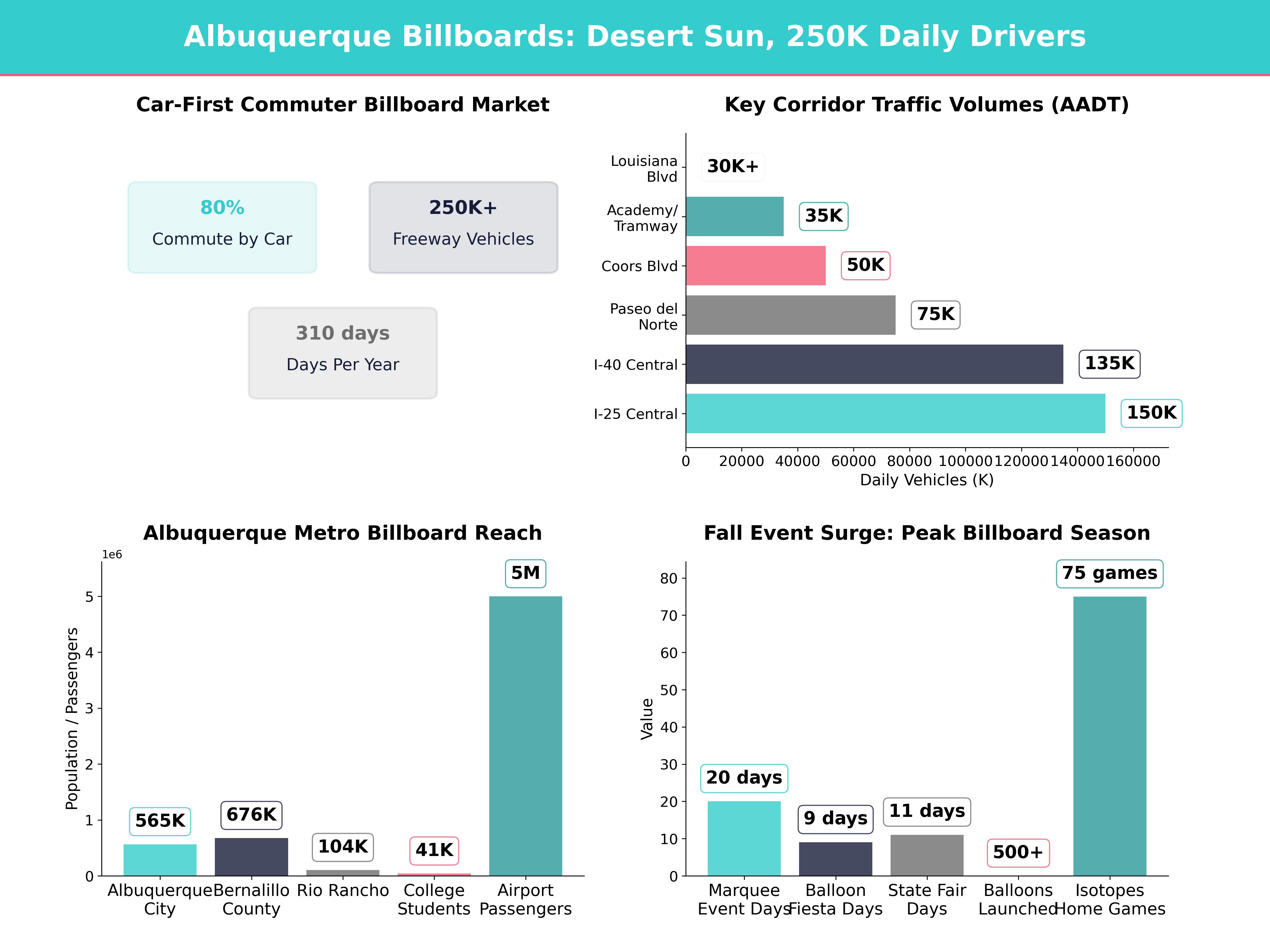
Albuquerque gives us a rare mix of scale, drivetime visibility, and year-round visitation. The city has 564,559 residents, Bernalillo County has 676,444, and nearby Rio Rancho adds another 104,046 people to the broader trade area. With roughly 4 out of 5 workers commuting by car, the market is built for roadside frequency.
When is the best time to run billboard ads in Albuquerque with Blip?
Fall is Albuquerque’s signature advertising season. The New Mexico State Fair runs 11 days in September, and the Albuquerque International Balloon Fiesta follows with 9 days of international attention in October, creating 20 days of marquee-event traffic in a six-week window. Spring and summer can also work well because tourism, entertainment, and outdoor activity increase.
Do I need a contract to advertise with Blip in Albuquerque?
No, Blip has no long-term contracts or minimum commitments. You can start, pause, or stop your campaign at any time.
How fast can I launch a billboard campaign with Blip in Albuquerque?
You can have your campaign live in minutes. Create a free account, select your locations, set your budget, upload your design, and start running once approved.
Where can I advertise with Blip in Albuquerque?
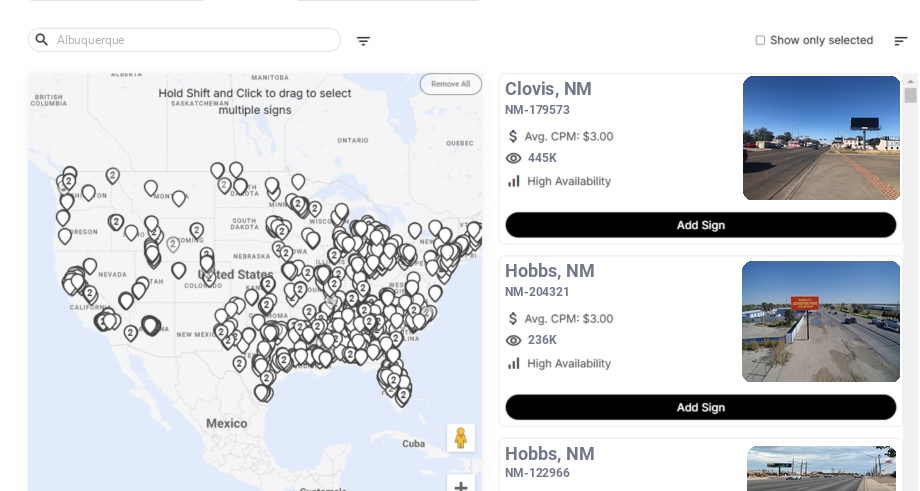
Blip has digital billboards in Albuquerque. You can browse available locations on a map, choose the ones that fit your audience, and start advertising right away.
Still have questions? Launch a campaign in minutes — no contracts, no commitments.
Start Your CampaignAlbuquerque Billboard Advertising Guide
Albuquerque gives us a rare mix of scale, drivetime visibility, and year-round visitation. The City of Albuquerque has 564,559 residents, Bernalillo County 676,444, and nearby Rio Rancho 104,046 people to the broader trade area. With roughly 4 out of 5 workers commuting by car (about 80%), the market is built for roadside frequency, especially around I-25, I-40, and the city’s high-volume arterials. Tourism strengthens that base, from the 9-day Albuquerque International Balloon Fiesta to more than 5 million annual passengers (roughly 13,700 a day on average) moving through the Albuquerque International Sunport.
Market Overview of Albuquerque
Albuquerque’s population, diversity, and growth
Albuquerque is New Mexico’s largest city, and its scale matters because billboard campaigns can build reach without spreading too far across disconnected suburbs. From 2010 to 2020, Albuquerque grew from 545,852 residents to 564,559, which was a 3.4% increase and an addition of about 18,700 residents. Over the same decade, Bernalillo County grew from 662,564 to 676,444, which was a 2.1% increase and an addition of about 13,900 residents. That pace is steady rather than explosive, which usually helps billboard advertisers because commuting habits and shopping routes remain consistent.
The market is also culturally layered. Roughly half of Albuquerque residents identify as Hispanic or Latino, or about 49%, and the city’s identity is shaped by Native, Hispanic, Anglo, and immigrant influences that show up in language, design, food, and neighborhood preferences. When we advertise here, local relevance matters more than generic Southwestern clichés.
Albuquerque’s economy, mobility, and what they mean for billboards
Albuquerque’s economy is broader than many advertisers expect. The Albuquerque Regional Economic Alliance and the Greater Albuquerque Chamber of Commerce
Mobility is the key media insight. Recent commuting patterns show that roughly 80% of workers get to work by car, whether driving alone or carpooling, which keeps road-facing media highly competitive. The city is organized around the intersection of I-25 and I-40, plus strong east-west flows on Paseo del Norte and westside connectors such as Coors and Unser. Even transit-oriented corridors, including ABQ RIDE and the ART line on Central Avenue
Several institutional anchors also keep traffic steady. The University of New Mexico enrolls more than 21,000 students, Albuquerque Public Schools 68,000 students, and Central New Mexico Community College serves more than 20,000 students. The Albuquerque Convention Center 600,000 square feet of meeting and exhibit space, which supports convention travel and downtown visitation. For us as advertisers, that means Albuquerque is not just a commuter market. It is a commuter, education, visitor, event, and lifestyle market all at once.
Key Traffic Corridors for Digital Billboards in Albuquerque
Understanding Albuquerque’s street hierarchy is essential because the market concentrates attention into a manageable set of high-value routes. New Mexico Department of Transportation traffic count maps and regional planning work from the Mid-Region Council of Governments 100,000 vehicles per day.
I-25 through Albuquerque
I-25 is Albuquerque’s north-south spine, and central segments near Downtown, the University of New Mexico, and the Big I interchange commonly run in the 140,000 to 160,000+ AADT range. This route connects north Albuquerque, Downtown, the university area, the Albuquerque International Sunport, and the South Valley.
We usually prioritize I-25 when we want broad metro awareness for categories such as healthcare, legal services, regional retail, auto dealers, higher education, and major events. It is especially valuable for brands that need repeated exposure across multiple trip purposes, because the same driver may encounter the corridor on work trips, airport trips, and weekend errands.
I-40 across Albuquerque
I-40 is the city’s dominant east-west freeway, and central segments commonly post 120,000 to 150,000+ AADT. It carries cross-town commuters, regional travelers, airport traffic, westside residents heading toward job centers, and visitors moving along the historic Route 66 corridor.
We like I-40 for advertisers that need mass reach quickly. Hospitality, entertainment, tourism, quick-service restaurants, regional healthcare, home services, and destination retail all benefit here. If we want to intercept travelers between westside neighborhoods, Old Town Albuquerque
Paseo del Norte, Coors Boulevard, and Unser Boulevard
North and west Albuquerque have become increasingly important for billboard strategy. Paseo del Norte is one of the city’s most important commuter and crosstown routes, with many segments running about 60,000 to 90,000 AADT depending on the interchange and lane configuration. Coors Boulevard, especially near I-40 and Montaño, often falls in the 40,000 to 60,000 AADT range. Unser Boulevard, which serves fast-growing westside residential areas, often lands around 25,000 to 35,000 AADT.
These corridors are especially effective for: Retail and family services, because they reach households on shopping, school, and recreation trips; Healthcare and urgent care, because they sit close to residential decision-making and repeat local travel; and Home improvement, furniture, and automotive services, because those categories perform well when we reach suburban drivers multiple times each week.
For advertisers trying to win westside households or commuters from Rio Rancho
Central Avenue, Uptown, and Northeast Heights arterials
Not every Albuquerque campaign should chase only the highest-speed freeways. Central Avenue, Louisiana Boulevard, Academy Road, and Tramway Boulevard capture different mindsets. Key commercial stretches of Central often run about 15,000 to 25,000 AADT, Louisiana near Uptown is often 30,000+ AADT, and Academy or Tramway segments can range from 25,000 to 45,000 AADT.
We use these routes when relevance matters as much as raw scale. Central is valuable near Nob Hill Main Street, UNM, and Downtown for nightlife, restaurants, entertainment, boutique retail, and student-targeted offers. Uptown and the Northeast Heights are strong for professional services, medical practices, mid-to-upscale retail, financial services, and household brands looking for higher-income residential audiences. Slower traffic and signalized intersections also give drivers more time to process creative.
Audience Segments in Albuquerque
Albuquerque commuters and household decision-makers
The largest billboard audience in Albuquerque is still the everyday driver. Because about 4 in 5 workers commute by car (about 80%), daily exposure builds quickly. The city’s roadway pattern creates repeat encounters on a short list of routes, which is ideal for brands that need frequency more than one-time novelty.
Families matter here as well. With 564,559 residents in the city and roughly 68,000 students in Albuquerque Public Schools 12% of the city’s population), school calendars, after-school trips, sports, shopping runs, and weekend recreation all shape travel. Family-focused advertisers such as pediatric clinics, tutoring centers, grocery stores, home services, and entertainment venues can do well when we stay close to residential corridors rather than only buying the biggest freeway faces.
Albuquerque students, faculty, and young professionals
The education audience is much larger than many out-of-state advertisers realize, with more than 41,000 students across UNM and Central New Mexico Community College alone. Those populations create demand for apartments, restaurants, financial services, healthcare, telecom, rides, nightlife, and part-time employment.
We typically reach this segment best near UNM, Central Avenue, I-25 by campus, and mixed-use districts such as Nob Hill. Messaging works best when it is immediate, local, and mobile-friendly. A student audience is often more responsive to short calls to action, simple offers, and memorable brand names than to broad corporate language.
Albuquerque tourists, convention attendees, and eventgoers
Tourism gives Albuquerque a second audience layer that peaks during major events but never disappears. The Albuquerque International Sunport now handles more than 5 million passengers a year. The Albuquerque Convention Center 600,000 square feet of space. Old Town Albuquerque 1706, remains one of the city’s most visited districts.
The flagship tourism engine is the Albuquerque International Balloon Fiesta. It runs for 9 days, uses a 365-acre park, and regularly launches 500+ balloons. The New Mexico State Fair adds another major audience wave over 11 days at Expo New Mexico, creating 20 days of marquee-event traffic in a six-week window. In spring, Gathering of Nations brings a major cultural audience for 3 days.
For hotels, attractions, restaurants, casinos, medical tourism, and retail, these event windows justify aggressive billboard scheduling.
Albuquerque culture, sports, and leisure audiences
Albuquerque is also a leisure market with strong local pride. The ABQ BioPark bundles 4 attractions, the Sandia Peak Tramway 2.7 miles, and the Indian Pueblo Cultural Center represents New Mexico’s 19 Pueblos. Those venues create steady weekend movement among residents and visitors.
Sports adds more repetition. The Albuquerque Isotopes play 75 home games in a typical minor league season, and New Mexico United adds another set of spring-to-fall event nights. We can use this audience for food and beverage, sports bars, family entertainment, ticketed events, and regional brands that want to feel plugged into local culture.
Seasonal and Timing Opportunities in Albuquerque
Spring in Albuquerque
Spring is one of our favorite launch windows because the weather improves, event calendars accelerate, and outdoor activity increases. Gathering of Nations usually lands in April and creates a strong cultural and visitor spike. Baseball season for the Albuquerque Isotopes also begins in spring, which gives entertainment and restaurant advertisers a dependable run of evenings and weekends.
Spring is also graduation and relocation season. Campaigns for apartments, colleges, healthcare, and financial services often perform well from April through early June because households are planning summer moves and fall commitments.
Summer in Albuquerque
Albuquerque’s summer visibility is strong because the city averages about 310 days of sunshine a year, according to Visit Albuquerque. That bright, high-desert light keeps digital boards visually impactful, although monsoon storms in July and August can shift travel into sharper morning and late-afternoon peaks.
Summer is ideal for tourism, entertainment, attractions, beverages, and family offers. We often lean into evening and weekend dayparts because leisure trips rise while school-year routines loosen. The ABQ BioPark, Old Town Sandia Peak Tramway
Fall in Albuquerque
Fall is Albuquerque’s signature advertising season. The New Mexico State Fair runs 11 days in September, and the Albuquerque International Balloon Fiesta follows with 9 days of international attention in October, creating 20 days of marquee-event traffic in a six-week window. If we want to look bigger than our budget, this is when Albuquerque gives us that chance.
Back-to-school timing also matters. UNM, CNM, and APS
Winter in Albuquerque
Winter is quieter than fall, but it is still useful. Holiday retail peaks, indoor entertainment rises, and ski-oriented travel begins when conditions line up at Sandia Peak Ski Area 5,000 feet above sea level, winter mornings can be crisp, but the market remains active and drivable compared with many colder metros.
For local advertisers, winter is a smart time to own share of voice with smaller budgets. We often see good value for healthcare, legal services, tax preparation, home services, and holiday retail from November through February.
Billboard Design Tips for the Albuquerque Market
Design for Albuquerque’s light, speed, and landscape
Albuquerque’s visual environment is different from that of greener, denser cities. With about 310 sunny days a year and intense high-desert light at 5,000+ feet elevation, contrast matters. We usually recommend bright backgrounds or very dark backgrounds with strong separation, large type, and restrained copy. Tiny details get washed up or ignored, especially on I-25 and I-40 where drivers have only a few seconds.
Color palettes that often feel local here include turquoise, adobe, chile red, deep blue, sandstone, and white. We can also use the pink-orange glow associated with the Sandia Mountains at sunset, because it feels immediately place-specific without becoming kitschy.
Use Albuquerque cultural references carefully and authentically
Local symbolism can help when it is handled respectfully. Balloon imagery works especially well in September and October. Route 66 neon cues can feel right on Central Avenue. References to local food culture, especially red and green chile, can be memorable when they are simple and playful.
We should be thoughtful with deeper cultural imagery. If we reference Pueblo or Hispanic heritage, we should do it accurately and with respect for living communities represented by organizations such as the Indian Pueblo Cultural Center and the National Hispanic Cultural Center. Authenticity usually performs better than imitation anyway.
Match the message to Albuquerque neighborhoods
Different Albuquerque audiences respond to different signals. In family-heavy westside areas, practical offers, trust cues, and service-oriented headlines tend to work well. Around UNM and Nob Hill, we can be more concise, more contemporary, and more event-driven. In Uptown and the Northeast Heights, polished creative with premium positioning often fits the surrounding retail and professional-service environment.
Local shorthand can also help. The 505 area code, references to the Sandias, or a familiar neighborhood name can make a board feel native to the market. We do not need to overdo it. One local cue is often enough.
Regional Strategies Across Albuquerque
Downtown Albuquerque, Old Town, and the convention core
Downtown is where we go for event traffic, conventions, nightlife, and civic visibility. The Albuquerque Convention Center Old Town Albuquerque 1706, adds visitor traffic and cultural credibility.
If our goal is to influence tourists, conference attendees, or people already in a spending mindset, this core is hard to beat.
Northeast Heights and Uptown Albuquerque
The Northeast Heights and Uptown districts are excellent for reaching established households and high-intent shoppers. ABQ Uptown Coronado Center, and surrounding office and medical zones create a polished commercial environment. We usually like this region for healthcare, finance, retail, home design, and professional services.
Boards here do not always have the raw freeway numbers of I-25 or I-40, but they often deliver stronger contextual fit for mid-market and premium brands.
Westside Albuquerque and Rio Rancho connections
The westside is one of the most important regional plays in the market. Coors, Unser, Paseo del Norte, and I-40 capture residents moving between neighborhoods, schools, shopping, and jobs. When we include Rio Rancho 104,046 residents with strong commuter ties back toward Albuquerque.
This submarket is especially good for household services, grocery, healthcare, furniture, automotive, and family entertainment. If our customer lives west of the Rio Grande, we usually need westside inventory in the mix.
University, airport, and Central Avenue Albuquerque
This zone connects students, young professionals, visitors, and travelers, anchored by more than 41,000 students at UNM and Central New Mexico Community College and more than 5 million annual passengers at Albuquerque International Sunport.
We use this region when the target audience is younger, more mobile, and more likely to respond to short-term offers. Restaurants, apartments, urgent care, nightlife, telecom, education, and event promotions can all perform well here.
North Albuquerque and Balloon Fiesta influence
North Albuquerque becomes exceptionally important in early fall. The Albuquerque International Balloon Fiesta takes over a 365-acre site and draws enormous local and visitor attention for 9 days. North I-25 placements can help us capture event traffic, affluent residential areas, and commuters traveling between Albuquerque and Sandoval County.
For seasonal brands, hospitality, and premium local businesses, this region is often worth a concentrated push rather than a light year-round buy.
Blip Tools and Capabilities for Albuquerque Campaigns
We can let Blip match Albuquerque’s corridor-driven geography
Albuquerque is a good fit for Blip because the market has clear route structure, with I-25 and I-40 alone carrying well over 250,000 combined daily vehicles through the core. If we want broad awareness, we can use a Blip-optimized campaign to spread budget across I-25, I-40, and major supporting corridors rather than guessing which single board will do all the work. That approach is useful for metro-wide launches, healthcare systems, consumer services, and regional retail.
If our audience is narrower, we can switch to a manual campaign and choose boards around specific submarkets such as UNM, Uptown, the airport zone, or westside commuter routes.
We can daypart around Albuquerque’s real traffic patterns
Because travel concentrates into repeat windows, dayparting is especially useful here. Morning commuter blocks around 6:00 to 9:00 a.m., lunch windows around 11:00 a.m. to 2:00 p.m., and afternoon commutes around 3:30 to 6:30 p.m. often align well with how people actually move through Albuquerque. Weekend dayparts make more sense when we are chasing shoppers, tourists, sports fans, or family outings.
During Balloon Fiesta, State Fair, and university move-in periods, we can also shift spend quickly instead of locking into one fixed schedule for months.
We can test local creative without overcommitting
Albuquerque rewards local nuance, so creative testing matters. We can rotate one version that leans into a broad metro message, another that uses a neighborhood cue such as “Uptown,” “Westside,” or “Near UNM,” and another that references seasonality such as Balloon Fiesta or back-to-school. Real-time reporting helps us see which mix deserves more budget.
Blip’s artwork tools are also useful in Albuquerque because we often need multiple creative versions for bilingual messaging, event timing, or neighborhood-specific offers.
Getting Started with Billboard Rental in Albuquerque
Start with the goal, not the board
The smartest Albuquerque billboard plans begin by asking what we actually need the campaign to do. If we need metro-wide awareness, we should start with I-25 and I-40. If we need suburban household reach, we should emphasize Paseo, Coors, Unser, and westside connectors. If we need students, airport travelers, or nightlife audiences, we should focus on Central, the university area, and key north-south routes near campus.
That objective-first approach keeps us from paying for impressive locations that do not match the audience.
Evaluate Albuquerque locations with a simple checklist
When we compare boards, we should look at more than traffic volume alone.
- We should ask whether the board faces inbound traffic, outbound traffic, or both, because direction can matter as much as raw volume.
- We should check vehicle speed and dwell time, because slower arterials such as Central or Louisiana can support more detailed creative than fast freeway faces.
- We should consider the surrounding context, because a board near ABQ Uptown Expo New Mexico or the Albuquerque International Sunport.
- We should map the board against our customer journey, because repeated weekly exposure often beats a one-time splash.
Use Blip to simplify the Albuquerque buying process
Traditional billboard buying in a market like Albuquerque can involve long conversations, limited flexibility, and too much guesswork before a campaign even launches. Blip makes it easier for us to test, learn, and adjust without treating every decision like a seasonal commitment. We can start small, prove which corridors or sub-areas respond, and then scale into the boards and dayparts that fit our goals.
That flexibility is especially helpful in Albuquerque because the market changes by season. A strong plan in March can look different from a strong plan in October. When we combine local knowledge, corridor selection, and flexible digital buying, Albuquerque becomes one of the more efficient billboard markets in the Southwest.