Location & Traffic Volume
The single biggest cost driver. High-traffic highways and city corridors command premium billboard pricing because of the sheer number of daily impressions delivered.
Billboard advertising costs anywhere from $250 to $100,000+ per month depending on location, format, and campaign length.
Blip's Pay-As-You-Go platform makes billboard advertising accessible for both local businesses and national brands. Launch campaigns on your budget, on your timeline, with no contracts and no minimum spend. Start your first campaign with Blip today.
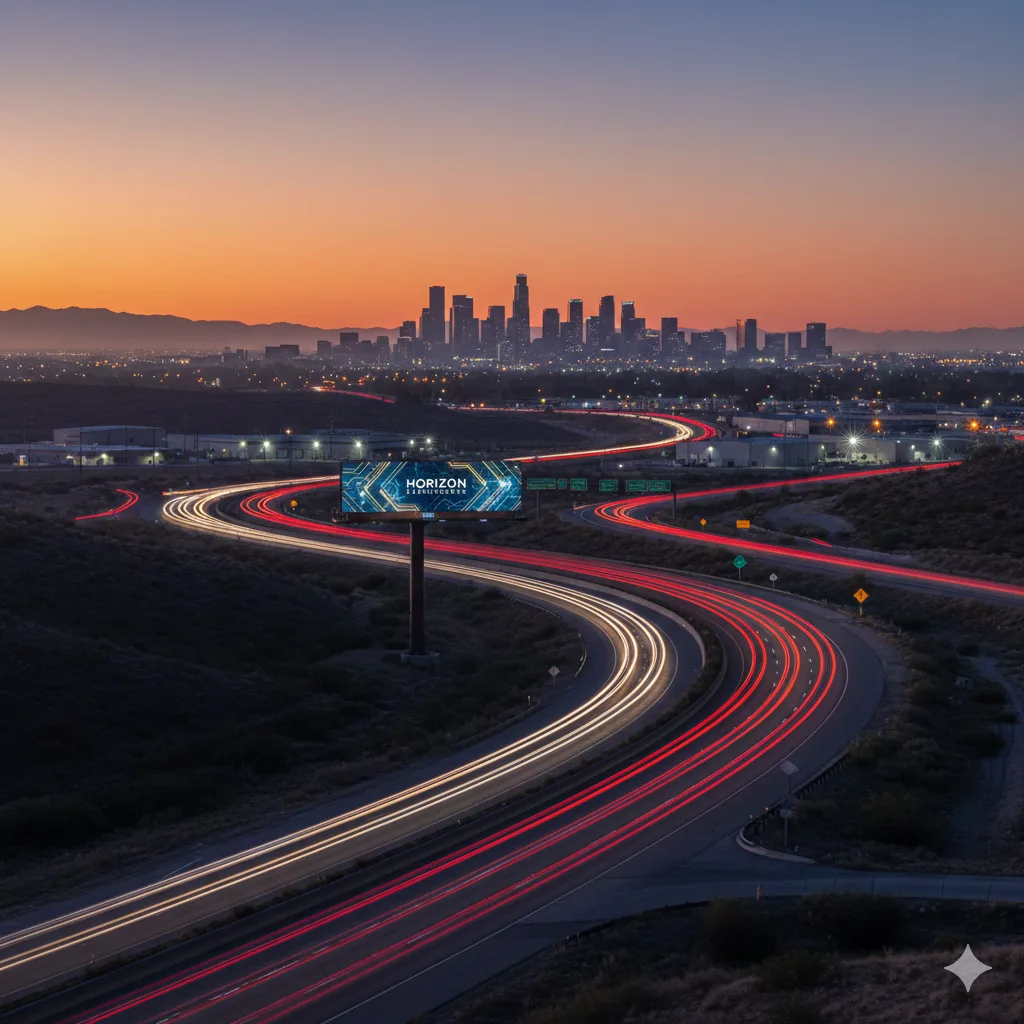
The national average cost of billboard advertising is $3,953 per month in 2025, but that number tells only part of the story. Billboard costs span from $250/month in rural markets to $100,000+/month in premium urban locations, which means there's a price point for virtually every business and budget.
Before locking in a budget, it helps to understand why billboard prices vary so dramatically, from $250/month in rural markets to $100,000+/month in premium cities. Six key factors drive how much a billboard costs to rent.
The single biggest cost driver. High-traffic highways and city corridors command premium billboard pricing because of the sheer number of daily impressions delivered.
Larger bulletins cost more than junior posters. Digital formats carry a 30-50% premium over static vinyl due to their flexibility and dynamic capabilities.
Most placements sell in 4-week cycles. Longer commitments with 12-month plans provide 10-20% discounts. Demand spikes around elections, holidays, and major local events.
A board reaching high-income suburban commuters costs more than one in a low-traffic rural corridor. Audience quality shapes billboard pricing just as much as quantity.
Static billboards offer a fixed continuous impression. Digital boards rotate multiple advertisers, lowering your share of voice but reducing your monthly billboard rental cost.
Design ($300-$1,500), vinyl printing ($200-$800), and installation ($200-$500) are common add-on costs beyond base rental, and on lower-priced boards they can equal a large share of your first month's spend, while on high-priced boards they may be closer to 15-25%.
The way billboard advertising is priced has evolved significantly. Here are the six models you'll encounter when planning your campaign.
The traditional standard. You lease a fixed board for a 28-day cycle. Most major providers use this model. Longer terms reduce per-cycle billboard prices by 10–20%.
You're only charged when your ad actually displays. Platforms like Blip use this model, making billboard advertising accessible to any budget, from just a few dollars per day.
Billboard CPM typically runs $3–$10, often below TV CPMs ($20–$40+), making outdoor one of the most efficient broad-reach channels.
Your ad shares a digital board's rotation with other advertisers. Typically 1 in 6–8 rotations. Lower monthly billboard rental cost, but less guaranteed visibility.
Buy impressions based on audience behavior and location data. Programmatic DOOH U.S. spend is projected to reach approximately $3–4 billion by 2030, driven by 18–20% CAGR amid rising adoption of AI targeting and connected inventory.
Unsold billboard slots are available close to the campaign date. These can yield 20–40% discounts, ideal for budget-conscious advertisers with flexible campaign timing.
The national average cost of billboard advertising is $3,953 per month in 2025. But that single number spans a massive range, from $250/month in rural markets to $100,000+/month in premium urban locations. Here's the full breakdown by market tier, location, industry, type, and additional fees.
Where your billboard sits is the #1 cost driver. Here's what to expect per month across the five main market tiers.
| Market Tier | Population | Monthly Billboard Cost | Example Markets |
|---|---|---|---|
| Rural / Small Town | Under 100K | $250 – $1,500 | Montana, rural Kentucky |
| Small City | 100K – 250K | $500 – $3,000 | Boise, Amarillo |
| Mid-Size Market | 250K – 500K | $1,000 – $8,000 | Tampa, Charlotte |
| Major Metro | 500K – 2M | $5,000 – $25,000 | Phoenix, Atlanta |
| Top-Tier Urban | 2M+ | $15,000 – $100,000+ | NYC, LA, Chicago |
Even within a given city, where your board sits greatly affects how much you pay to rent a billboard. Sightlines, read time, direction of traffic flow, and proximity to high-intent destinations like shopping centers or stadiums all impact billboard pricing.
| Location Type | Monthly Cost |
|---|---|
| Rural Highway | $250–$750/mo |
| Suburban Arterial | $1,000–$3,500/mo |
| Downtown Corridor | $5,000–$15,000/mo |
| Iconic / Times Square | $50,000–$500,000+/mo |
Cost estimates are aggregated from multiple sources. Precise costs will vary depending on your local market.
Sources:
Business.com,
FitSmallBusiness.com,
Management.org,
TimesSquareBillboard.com, and
Signs.com
The monthly billboard rental cost is just the starting point. Budget an extra 10-20% of your rental fee to cover these additional billboard advertising costs:
| Cost Item | Estimated Range |
|---|---|
| Design & Creative | $300 – $1,500 |
| Vinyl Printing | $200 – $800 |
| Installation & Removal | $200 – $500 |
| Permits & Regulatory Fees | $50 – $300 |
| Agency/Broker Fees | 10–15% of total spend |
| Creative Rotation (Digital) | $0 – $500+ |
How does the cost of billboard advertising stack up? When measured by CPM (cost per thousand impressions), outdoor advertising ranks among the most cost-efficient broad-reach channels available, outperforming broadcast TV, print, and most traditional media.
| Channel | Avg. CPM | Monthly Entry Cost | Key Tradeoff |
|---|---|---|---|
| Billboards (OOH) | $3–$10 | $250+/mo | Broad reach; no algorithmic targeting |
| Social Media (Meta/TikTok) | $3–$15 | $5/day | Targetable but skippable; rising costs |
| Google Search Ads | $38 CPM / $2.32 CPC | $300+/mo | High intent, high competition |
| Radio | $10–$20 | $500+/mo | Audio-only; declining younger audience |
| Cable TV | $19–$21 | $1,000+/mo | Shrinking viewership; fragmentation |
| Broadcast TV (Primetime) | $43+ | $200K+/spot | Mass reach, very expensive entry |
| Print / Newspaper | $25–$35 | $500+/insertion | Declining readership |
The vast majority of advertisers rent billboard space. But some businesses and investors consider ownership.
No upfront capital required
Start in days, not months
No maintenance, permits, or liability
Flexible, change locations as your needs evolve
Ongoing monthly cost
No equity or asset ownership
Subject to rate increases over time
Revenue-generating asset (sell ad space)
Full creative control, 24/7
Long-term cost savings if fully utilized
$30K–$500K+ purchase price
Zoning, permits, and insurance required
Maintenance, weather damage, vandalism risk
Location is fixed — can't pivot markets
Renting a billboard is typically more cost-effective in the short term due to its lower upfront investment and flexibility for testing campaigns or locations, while buying becomes advantageous after several years as cumulative rental fees surpass the initial purchase price plus ongoing maintenance, utilities, and potential upgrades.
Ownership offers full control and revenue potential from leasing ad space to others but requires handling repairs, permits, and zoning compliance. The break-even point usually falls around years 4-7 depending on location, billboard type (static vs. digital), and market rates.
Billboard pricing tells you what you’ll spend. Strategy determines how much value you get from every dollar. Billboard advertising ROI is estimated at $5.97 for every $1 spent when campaigns are well-planned and well-executed. These six strategies help you get there.
Test one location for 30-60 days before committing to a broader campaign. Measure lift in web traffic, calls, or store visits before expanding spend.
Focus on roads with the highest daily traffic counts relative to cost. A $2,000/mo board on a 50K-car highway may outperform a $10,000/mo board in a prestige district.
Drivers have 5-7 seconds. Use 7 words or fewer, high-contrast colors, and a single clear call to action. Simple creative outperforms complex designs consistently.
With platforms like Blip, you can adjust budgets daily, test multiple creatives, and shift spend to top-performing locations in real time.
Use unique URLs, promo codes, or call tracking numbers on your billboard creative. Tie billboard exposure to actual conversions to calculate true ROI.
If committing to traditional billboards, negotiate 3-6 month contracts for 10-20% discounts. Longer commitments give you better rates and consistent brand presence.
Start your billboard campaign today with Blip. No minimum spend, no contracts — just results.
Get StartedThe national average is $3,953/month in 2025. But costs range from $250/month in rural areas to $100,000+/month in top-tier urban markets like NYC or LA. Your actual cost depends on location, format (static vs. digital), and campaign length.
Pay-per-blip platforms like Blip let you start with any budget — even a few dollars per day. You only pay when your ad actually displays, making it the most accessible entry point into billboard advertising.
Digital billboards typically cost 20–40% more than static boards in the same location because they deliver higher visibility and more flexibility. However, digital boards allow creative rotation and real-time updates that static boards can't match.
Yes. With pay-as-you-go platforms like Blip, small businesses can start billboard campaigns with minimal budgets and scale as they see results. Billboard CPMs ($3–$10) are among the lowest of any broad-reach channel, making outdoor advertising highly cost-efficient.
The six main factors are: (1) Location & traffic volume, (2) Format — static vs. digital, (3) Billboard size, (4) Campaign duration, (5) Market demand & seasonality, and (6) Number of boards in your campaign. Location is by far the biggest cost driver.
Most experts recommend a minimum of 4–8 weeks for brand recall to build. For ongoing brand awareness, 3–6 month campaigns deliver the best results. With Blip, you can start and stop anytime, so there's no commitment risk.
Times Square digital billboard slots typically run $1,000–$25,000+ for a 15-second spot, depending on the screen size, exact location, and time of day. Premium screens around the bowtie can exceed $50,000 for prime-time slots during major events.
Plan for creative design ($500–$2,500), vinyl printing for static boards ($300–$1,500), installation ($300–$1,000), and digital file prep for digital boards ($150–$500). Some markets also charge production, posting, or permitting fees that can add 10–20% to your total spend.
Owning can pay back in 5–8 years with strong-traffic locations, but upfront costs ($25,000–$300,000+ for build and permitting) plus ongoing maintenance, electricity, insurance, and lease payments make it a long-horizon investment best suited to operators with existing advertiser demand or land they control.
Drivers typically have only about three seconds to read a billboard. The 3-second rule means your message — headline, image, and call to action — should be readable and understood in that window. Aim for seven words or fewer, high-contrast colors, and one clear focal point.

