Billboards in Yankton, SD
No Minimum Spend. No Long-Term Contracts. Just Results.
Give your brand a bright, attention-grabbing spot in Yankton with Blip’s digital billboards. Pick your screen, set any budget, choose your timing, and launch in minutes—no contracts, no minimums, just pay when your ad plays.
Trusted by Leading Brands


How much is a billboard in Yankton?
Why Choose Blip for Billboard Advertising in Yankton
Launch Blip in Yankton in minutes and reach U.S. 81/Broadway commuters and bridge traffic without contracts or minimums.
Use flexible budgets in Yankton to tap summer lake traffic on Lewis and Clark routes, then scale back after the 14-week season.
Daypart Yankton ads for 6-9 a.m. and 4-7 p.m. to catch daily drivers, healthcare staff, and school runs when roads are busiest.
Track Yankton performance in real time and shift spend between Broadway, Highway 50, and Discovery Bridge as traffic patterns change.
Create and swap Blip creatives fast for Yankton's Riverboat Days, archery events, and lake weekends without slowing your campaign.
Frequently Asked Questions About Billboard Advertising in Yankton
How much does a billboard cost in Yankton with Blip?
Where can I advertise with Blip in Yankton?
Why is Yankton a strong market for Blip billboard advertising?
What kind of people can I reach in Yankton with Blip?
When is the best time to run billboard ads in Yankton with Blip?
Do I need a contract to advertise with Blip in Yankton?
How fast can I launch a billboard campaign with Blip in Yankton?
Where can I advertise with Blip in Yankton?
Still have questions? Launch a campaign in minutes — no contracts, no commitments.
Start Your CampaignYankton Billboard Advertising Guide
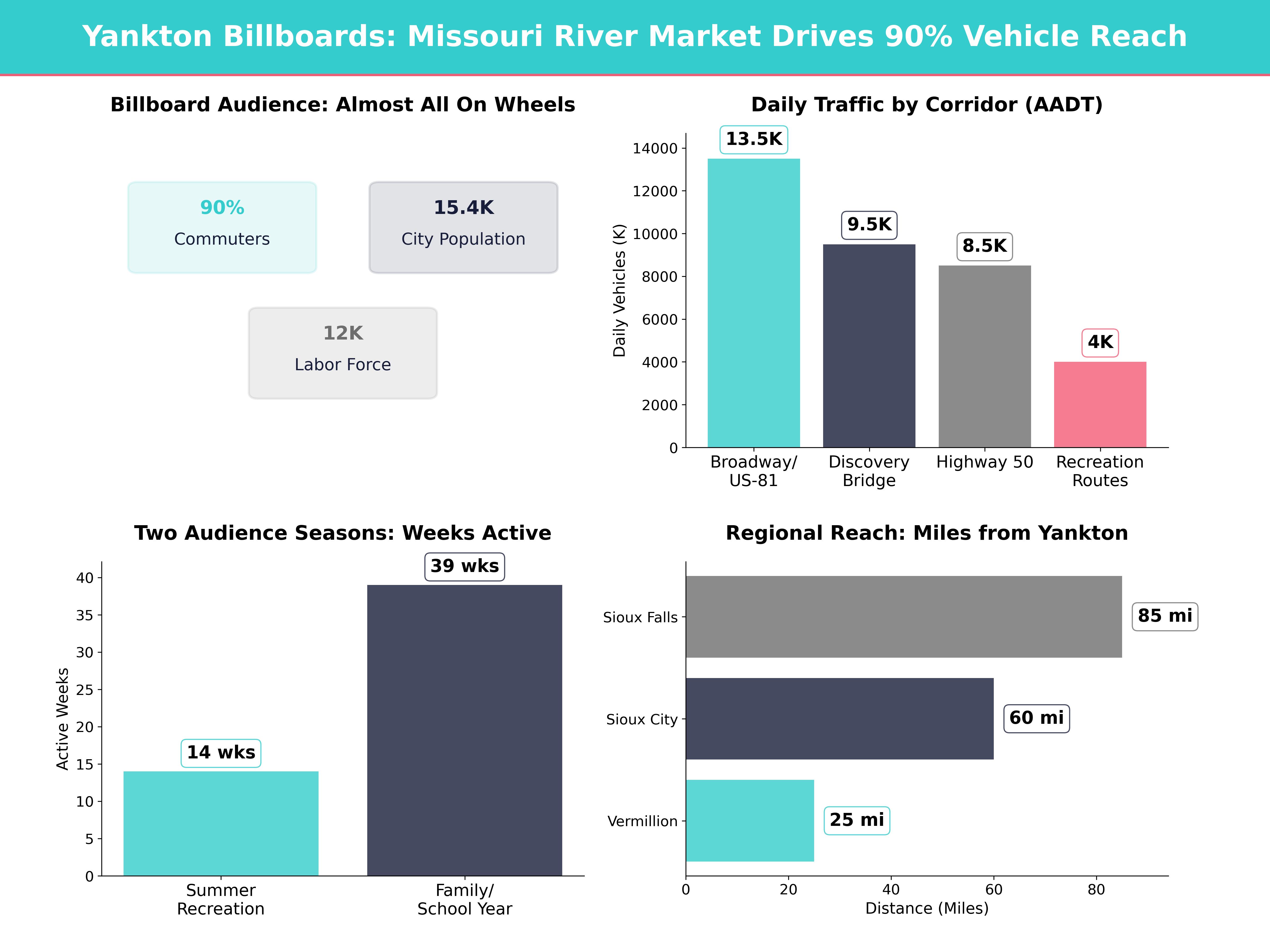
Yankton 3,000 to 15,000 vehicles per day, a regional service economy, and a meaningful summer recreation surge that lasts about 14 weeks. The City of Yankton 15,411 residents, while Yankton County 23,310 residents in 2020, which means a large share of the county’s activity concentrates in and around one primary trade center. Most daily trips happen by car, with roughly 9 out of 10 workers using a vehicle to get to work, so a relatively small set of highways and arterials delivers repeated exposure that outdoor advertising depends on. When we add lake tourism, cross-border travel from Nebraska, healthcare traffic, and year-round event activity, Yankton becomes a market where digital billboards can work harder than the population count alone might suggest.
Market Overview of Yankton
Yankton works best when we think of it as a regional hub, not just a standalone small city. The community sits on the Missouri River, near the Nebraska line, and it draws shoppers, patients, students, and recreation traffic from a broad part of southeast South Dakota and northeast Nebraska.
Why Yankton Functions as a Regional Trade Center
Yankton County 22,438 residents in 2010 to 23,310 in 2020, which was a gain of about 3.9% over the decade. The city itself accounts for roughly 66% of the county’s population, which tells us that a large share of area commerce, healthcare, and daily errands is funneled into a compact urban footprint.
That concentration matters for billboard advertisers because local frequency comes naturally. We do not need dozens of boards spread across a large metro to build awareness. We need a smart mix of placements on the routes that residents and regional visitors already use repeatedly.
Yankton also benefits from its location relative to nearby population centers. It sits about 25 miles from Vermillion, about 60 miles from Sioux City 85 miles from Sioux Falls. That geography supports a practical trade area for:
- Healthcare providers.
- Retailers and restaurants.
- Home services.
- Financial institutions.
- Event organizers.
- Employers recruiting from both South Dakota and Nebraska.
What Yankton’s Economy Means for Outdoor Advertising
According to the South Dakota Department of Labor and Regulation, Yankton County supports a labor force of roughly 12,000 people, and local unemployment has generally stayed in the low single digits in recent years. That is helpful for billboard planning because stable employment usually translates into stable commute patterns, reliable consumer routines, and consistent weekday impressions.
Yankton’s economy is diversified for a city its size. We can see that in the presence of Avera Sacred Heart Hospital 99-bed regional hospital, Mount Marty University, Trail King Industries, Vishay Intertechnology, Manitou Equipment America, and public-sector institutions such as the Yankton School District. For us, that means the market is not dependent on one narrow audience. We can reach professionals, shift workers, families, students, and recreation-minded visitors within the same campaign footprint.
Vehicle dependence is equally important. In a market like Yankton, well over 90% of workers use a vehicle to get to work when we combine solo drivers and carpools. That is exactly the environment where digital billboards shine. We can build awareness with repetition, and we can tailor our timing around morning commutes, lunch trips, after-school errands, and weekend lake travel.
Key Traffic Corridors for Digital Billboards in Yankton
Yankton’s travel patterns are shaped by a small number of high-value routes. Recent traffic mapping from the South Dakota Department of Transportation 3,000 to 15,000 AADT on the most relevant routes, from recreation roads to the busiest urban approaches. That concentration helps us choose boards with both reach and relevance.
U.S. Highway 81 and Broadway Avenue in Yankton
Broadway Avenue, which carries U.S. Highway 81 12,000 to 15,000 AADT range, depending on the exact location and year.
This route matters because it links north Yankton, central commercial districts, downtown destinations, and the river crossing to Nebraska. If we want broad everyday exposure, this is often the first corridor to evaluate.
Broadway is especially effective for:
- Retail, because repeated weekly errands drive frequency.
- Healthcare, because patients and staff use the corridor consistently.
- Restaurants, because lunch and dinner traffic is strong.
- Banks, insurers, and service providers, because trust builds through repetition.
South Dakota Highway 50 Around Yankton
South Dakota Highway 50 7,000 to 10,000 AADT range on major segments.
For advertisers, Highway 50 is valuable because it connects local neighborhoods with regional traffic coming from the west and with travelers moving toward the I-29 corridor to the east. It is a strong fit when we want to reach people planning a destination purchase rather than a purely impulse stop.
We usually favor this corridor for:
- Auto dealers and repair shops.
- Home improvement brands.
- Furniture, appliance, and farm-adjacent retailers.
- Community events with broad regional draw.
- Hiring campaigns for employers who recruit across county lines.
Discovery Bridge and Yankton’s Nebraska Connection
The river crossing south of town is essential because it turns Yankton into a two-state market. Discovery Bridge 2008, and it now carries the region’s day-to-day vehicle connection across the Missouri River. Recent traffic levels on the bridge approach and connected U.S. 81 segments are commonly in the 8,000 to 11,000 vehicles per day range.
That traffic is highly valuable because it is not random pass-through volume. A meaningful share consists of people intentionally coming into Yankton for work, shopping, healthcare, school activities, and services that are more concentrated on the South Dakota side.
This corridor is especially strong for:
- Medical and dental practices.
- Grocery, pharmacy, and general retail.
- Financial services.
- Nebraska-facing recruitment campaigns.
- Family entertainment and dining.
Lake and Recreation Routes Near Yankton
The tourism side of the market builds around routes leading toward Lewis and Clark Recreation Area and Chief White Crane Recreation Area. These roads are lower-volume than Broadway, often landing in the 3,000 to 5,000 AADT range on typical segments, but they carry high-intent traffic, especially from late spring through early fall.
That difference matters. A family heading to the lake, a camper stopping for supplies, or a boater looking for food, fuel, and lodging is often much closer to a spending decision than a general commuter is. For tourism and hospitality brands, those fewer but more intent-driven impressions can be extremely efficient.
Audience Segments We Can Reach in Yankton
One of Yankton’s strengths is the variety of audiences available in a compact market. We can reach daily residents and regional visitors without needing completely separate geographic strategies.
Commuters and Regional Shoppers in Yankton
The core audience is still the daily driver. Yankton’s compact street network means the same people often pass the same boards multiple times each week. In a city of about 15,411, that repeated exposure is powerful because brand familiarity builds fast.
Regional shopping also expands the audience beyond the city limit. Households from nearby communities make routine trips into Yankton for larger retail, medical appointments, school activities, and errands. Since Yankton is about 25 miles from Vermillion, around 60 miles from Sioux City
This audience is ideal for everyday categories such as:
- Grocery and convenience.
- Restaurants and coffee.
- Insurance, banking, and legal services.
- Home services.
- Retail sales and promotions.
Outdoor Tourists and Weekend Visitors Around Yankton
The recreation audience is what gives Yankton extra seasonal upside. Lewis and Clark Lake spans roughly 31,400 acres and stretches about 25 miles, which creates a major summer draw for boating, camping, fishing, and cabin travel. The lake area is supported by South Dakota Game, Fish and Parks facilities, marinas, campgrounds, beaches, and nearby state recreation areas.
Yankton also has a notable year-round destination in the NFAA Easton Yankton Archery Center, which covers 100 acres and is widely recognized as one of the largest archery complexes in the world. That gives us a sports and event audience that is unusually strong for a market this size.
For these visitors, billboard advertising works best when it is practical and immediate. We should emphasize food, fuel, lodging, outdoor gear, family attractions, ice, bait, beverages, and event reminders. Those are highly responsive categories when people are already on the road.
Students, Families, and School Communities in Yankton
The family audience is a steady part of the market for roughly 9 months of the year, from late August through May. The Yankton School District anchors K-12 activity, while Mount Marty University brings college students, faculty, staff, and visiting families into town.
This audience is especially useful for:
- Healthcare and orthodontics.
- Childcare and family services.
- Quick-service restaurants.
- After-school programs.
- Athletic events.
- Seasonal retail.
Because school schedules create consistent morning, afternoon, and evening routines, we can use billboard timing very intentionally in Yankton. The same roads carry parents to school drop-off, workers to jobs, and families to evening activities.
Healthcare, Manufacturing, and Public-Sector Workers in Yankton
Yankton’s workforce is broader than many small-city markets. Avera Sacred Heart Hospital 99 beds, and employers such as Trail King Industries, Vishay Intertechnology, and Manitou Equipment America support a meaningful industrial and manufacturing presence.
That matters because different work schedules create more than one useful billboard window. In Yankton, we are not limited to a classic 8 a.m. to 5 p.m. commuter profile. We can also target early shifts, lunch breaks, second-shift transitions, and appointment traffic. That makes the market attractive for recruiting, healthcare outreach, trade services, and retail categories that benefit from weekday frequency.
Ready to reach your audience in Yankton?
Start Your Campaign →Seasonal and Timing Opportunities for Yankton Campaigns
Yankton is not a one-season market, but timing matters a lot. We can improve performance by aligning creative and dayparts with weather, school routines, and the local event calendar.
Summer in Yankton Is the Biggest Tourism Window
The period from Memorial Day to Labor Day gives us about 14 weeks of peak recreation visibility. According to the South Dakota State Climate Office, average July highs in the Yankton area reach the mid-80s°F, which supports strong boating, camping, and outdoor dining demand.
That is when we should push:
- Lake-area restaurants.
- Convenience and fuel stops.
- Resorts, campgrounds, and cabins.
- Outdoor retailers.
- Family entertainment.
- Real estate and seasonal rental messages.
In summer, Thursday through Sunday usually matters more than Monday through Wednesday for tourism-focused campaigns. We should also think later into the day, because recreation traffic often extends into the afternoon and evening.
Back-to-School and Fall Routines in Yankton
Late August through October is a strong reset period. Families return to structured schedules, college activity stabilizes, and the market shifts from weekend leisure toward routine purchasing.
This is a smart time to advertise healthcare appointments, school-season retail, sports promotions, dining, and home services. Fall is also when practical messaging tends to outperform purely aspirational messaging. We can lead with deadlines, locations, and clear calls to action because people are back in task mode.
The Riverboat Days celebration, typically held in August, is also worth planning around. It gives us a concentrated local event window when visitor traffic and local attention both rise.
Winter and Early Spring Still Offer Useful Yankton Opportunities
Winter is quieter from a tourism standpoint, but it is not empty. Average January highs in the Yankton area are around 30°F to 31°F, and the region typically receives roughly 35 to 40 inches of snow in a normal year. That means road conditions, daylight, and practicality shape response more than leisure does.
In winter, we usually favor:
- Healthcare.
- Retail promotions.
- Financial services.
- Tax-season messaging.
- Hiring campaigns.
- Indoor entertainment and sports events.
This season is also a good fit for event-oriented creative tied to indoor draws such as tournaments at the NFAA Easton Yankton Archery Center.
Event-Based Bursts Work Well in Yankton
Because the market is compact, event promotion can build quickly if we time it well. We often do best by launching 2 to 3 weeks before a targeted event, then increasing intensity in the final 3 to 5 days.
Useful triggers include:
- Summer lake weekends.
- Riverboat Days.
- Archery tournaments.
- College move-in periods.
- Holiday shopping weeks.
- Local hiring pushes.
Watching the calendar at the Yankton Area Chamber of Commerce and the Yankton Daily Press & Dakotan helps us keep those bursts relevant.
Billboard Design Tips for the Yankton Market
Creative that works in Yankton usually feels grounded, local, and easy to process at driving speed. We should design for practical decision-making, but we should also reflect the market’s outdoor identity and regional pride.
Use Visual Cues That Feel Like Yankton
Yankton is a river and lake market, so imagery tied to water, shoreline recreation, parks, and open skies tends to feel natural. Colors such as lake blue, prairie gold, evergreen, and clean white often fit better here than highly polished urban palettes that feel imported from a much larger metro.
For local audiences, we should consider visuals such as:
- Boats, docks, and shoreline scenes in summer.
- Families at parks or on trails.
- Archery, camping, or fishing cues.
- Practical service imagery for healthcare, banking, and home services.
The key is not to overdo nostalgia. We still want the ad to feel current. We just want it to look like it belongs in Yankton.
Keep Yankton Copy Tight and Useful
Many of the market’s highest-value boards are read at 55 to 65 mph, especially on highway approaches. That means our best creative is concise. In Yankton, we should usually keep primary copy to about 6 to 8 words, use one clear headline, and give drivers one thing to remember.
Location-based wording often works especially well here. Phrases like “On Broadway,” “Near the bridge,” “At the lake turn,” or “West Yankton” can outperform generic branding because they help people act on the message quickly.
Speak to a Two-State Audience When Appropriate
Because Discovery Bridge creates a real South Dakota-Nebraska flow, some campaigns benefit from broader regional framing. If we serve customers from both sides of the river, we should say so. Messaging like “Serving Yankton and Northeast Nebraska” can increase relevance without adding much complexity.
This approach is especially useful for healthcare, financial services, legal services, large retail purchases, and hiring campaigns.
Change Creative With the Season, Not Just the Offer
In Yankton, seasonal context is visible enough that our design should evolve with it. Summer creative should feel bright and active. Fall should feel purposeful and routine-driven. Winter should emphasize reliability, comfort, safety, or convenience. Spring should focus on reopening, planning, or getting outside again.
Because the market changes visibly across the year, refreshing artwork even 3 to 4 times annually can make campaigns feel much more local and current.
Regional Strategies Across Yankton and Nearby Trade Areas
The most effective Yankton campaigns usually combine a core city strategy with one or two specialized route strategies. We do not need to treat every board the same.
Central Yankton and Broadway for Everyday Frequency
If our goal is broad local awareness, central Yankton is the foundation. Boards near Broadway and primary retail corridors give us the most repeat impressions among residents making routine trips.
We usually prioritize this zone for:
- Healthcare.
- Restaurants.
- Financial services.
- Retail.
- Schools and community programs.
- Local brand awareness.
This is the place where frequency wins. Even a modest campaign can accumulate value quickly because the same households travel these routes again and again.
Highway 50 Gateways for Regional Intent
The Highway 50 approaches are better for audiences entering or leaving town with a purpose. These travelers may not pass the board as often as city-core drivers do, but they are often on more intentional trips, such as shopping, appointments, or major purchases.
We like these placements for:
- Furniture, auto, and home improvement.
- Destination retail.
- Regional events.
- Healthcare systems.
- Employers recruiting from outside Yankton.
If we are deciding between city-core and gateway boards, the right answer depends on whether we want habitual local awareness or regional trip capture.
The Missouri River Connection for Cross-Border Reach
Yankton’s geography is inseparable from the river. Meridian Bridge 1924, now serves as a pedestrian landmark and downtown icon, while Discovery Bridge, opened in 2008, carries the bulk of vehicle traffic. That split helps define how people move through the market.
For advertisers, the Nebraska-facing approach is especially valuable when we want to widen the trade area without widening the budget too much. A single well-placed board on the south approach can help us reach daily cross-border traffic that would otherwise require additional placements.
The Lake Corridor for Visitor Spending
When our campaign depends on seasonal visitors, the lake corridor deserves its own strategy. These boards are not always the best choice for year-round awareness, but they can be excellent during recreation season.
We usually lean into this zone for:
- Food and beverage.
- Fuel and convenience.
- Lodging and campgrounds.
- Marine and outdoor services.
- Weekend events.
- Family attractions.
For many advertisers, the smartest regional plan is a split strategy: always-on coverage in central Yankton, plus seasonal support on tourism routes.
Ready to reach your audience in Yankton?
Start Your Campaign →Using Blip Tools Effectively in Yankton
Blip’s flexibility is especially useful in a market like Yankton because local demand changes by season, route, and daypart. We can use the platform’s tools to match those local patterns instead of buying a one-size-fits-all schedule.
Match Dayparts to Yankton’s Real Travel Windows
In Yankton, we should not treat every hour equally. Morning and late afternoon are strongest for commuters, midday is useful for errands and appointment traffic, and summer evenings can matter for recreation-driven audiences.
That means we can schedule differently for different goals:
- We can favor 6 a.m. to 9 a.m. and 4 p.m. to 7 p.m. for commuter-focused campaigns.
- We can push 11 a.m. to 2 p.m. for restaurants and service businesses.
- We can emphasize Thursday through Sunday afternoons and evenings for lake traffic.
Compare Routes, Not Just Boards
Because the city is compact, route strategy often matters more than raw board count. We should compare Broadway-centered boards against Highway 50 boards, and we should compare city-core boards against bridge and lake placements.
Blip’s real-time analytics help us see where our budget is actually earning attention. In Yankton, that makes it easier to answer practical questions, such as whether a healthcare message performs better on commuter routes or whether a summer dining message performs better closer to recreation traffic.
Use Flexible Budgets to Follow the Season
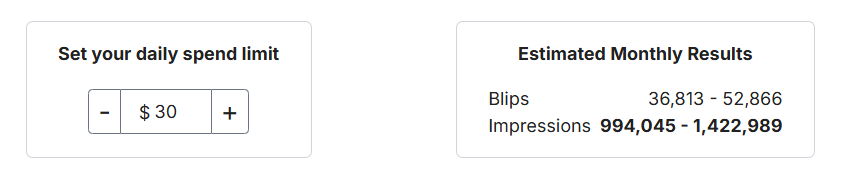
Yankton is an ideal market for budget pulsing. We can stay present all year on core commuter routes, then add more intensity in summer, around Riverboat Days, during college move-in, or ahead of a hiring push.
That approach is especially helpful for small and mid-sized advertisers. We do not need to overcommit in January just because we want stronger visibility in July. We can adjust as local demand changes.
Refresh Artwork Quickly When the Market Shifts
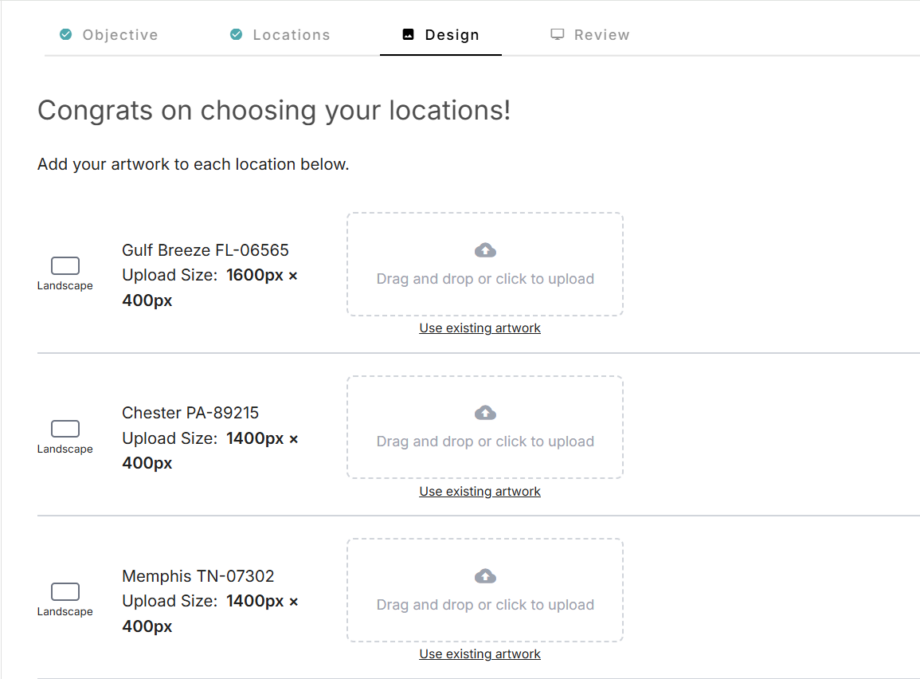
Because the area moves between school season, lake season, event season, and winter routines, we benefit from fast creative updates. Blip’s artwork tools make it easier to rotate seasonal messaging without rebuilding our campaign from scratch.
In a market as seasonal as Yankton, creative freshness is often a meaningful performance lever, not just a branding preference.
Getting Started With Billboard Rental in Yankton
Renting a billboard in Yankton is easier when we start with a clear local objective. The market is compact enough that strategic focus usually beats broad coverage.
Start With One Primary Goal for Yankton
Before we choose a board, we should decide what success looks like. In Yankton, the most common billboard goals are usually one of these:
- Building local awareness among daily residents.
- Reaching Nebraska and regional shoppers.
- Capturing summer visitors.
- Driving appointments.
- Supporting hiring.
Once we know the goal, the route decision becomes much simpler.
Evaluate Each Billboard Like a Local Driver Would
When we review available boards, we should ask practical questions. Is the audience commuting, shopping, or heading to the lake? Is the board readable far enough in advance for a turn decision? Is it on a route where traffic repeats daily, or does it depend on seasonal travel? Is the driver moving at 30 to 40 mph in town or 55 to 65 mph on a highway approach?
Those details matter more in Yankton than in a very dense urban market because each board often carries a distinct role.
Test a Small Footprint First
A smart way to begin is to launch on 2 to 4 carefully chosen boards for 2 to 3 weeks, using at least 2 versions of the creative. That gives us enough data to compare route types, dayparts, and messages without overspending.
For example, we might test:
- One Broadway placement for residents.
- One Highway 50 placement for regional traffic.
- One bridge or lake-route placement for seasonal reach.
That kind of structured test tells us quickly where our best local fit is.
Why Blip Simplifies Billboard Rental in Yankton
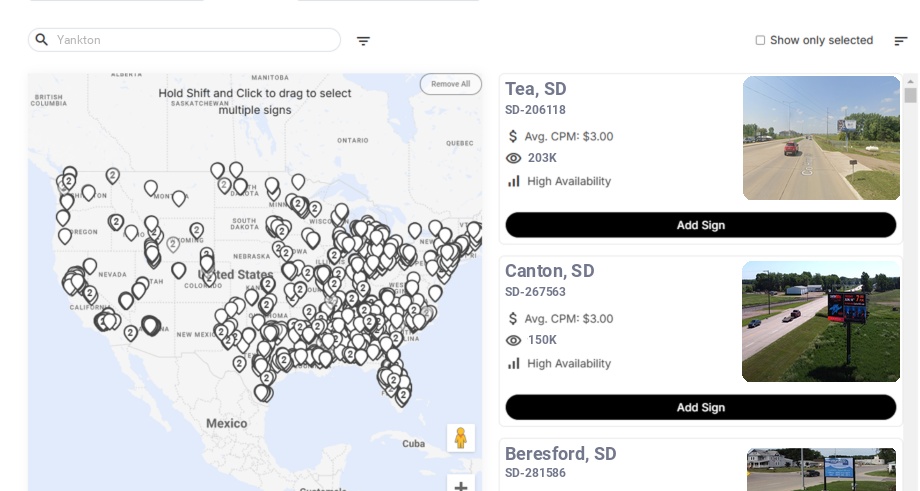
In a market like Yankton, the biggest advantage of Blip is control. We can review billboard options on a map, choose the routes that fit our audience, launch without a long contract cycle, and adjust as we learn. We can also scale up for summer weekends, pull back after an event, or swap artwork when the season changes.
Compared with a traditional billboard buying process, that is a much more practical way to advertise in a market where timing and route selection matter so much. When we combine that flexibility with Yankton’s concentrated traffic patterns, cross-border flow, and seasonal recreation demand, we get a billboard market that is approachable for first-time advertisers and still sophisticated enough for ongoing optimization.