Billboards in Newark, DE
No Minimum Spend. No Long-Term Contracts. Just Results.
Trusted by Leading Brands


Billboard advertising
in Newark has never been easier



How much is a billboard in Newark?
Why Choose Blip for Billboard Advertising in Newark
-
Blip lets you launch Newark billboards fast on I-95 and Route 896, reaching commuters, UD students, and campus traffic without the usual hurdles.
-
Choose a daily budget in Newark and scale up for UD move-in, football weekends, or Christiana Mall holiday surges—no contract needed.
-
Daypart your Newark ads for rush hours, class changes, or game nights, so Blip shows up when I-95 and Route 4 traffic is busiest.
-
Track Newark campaign results in real time and shift spend from campus corridors to commuter routes as student and family traffic changes.
-
Use Blip's creative tools to tailor Newark billboard copy for Blue Hen fans, Main Street visitors, and regional travelers in seconds.
Frequently Asked Questions About Billboard Advertising in Newark
How much does a billboard cost in Newark, Delaware with Blip?
With Blip, you choose your own daily budget, so advertising on Newark billboards can fit almost any marketing plan. Each 7.5 to 10-second “blip” is a brief ad display on digital billboards in Newark, Delaware, and you only pay for the blips you receive. Your total cost is simply the sum of those individual blips over time, giving you clear, predictable control.
Where can I advertise with Blip in Newark, Delaware?
Newark sits at a critical transportation node where local streets meet major interstates, so billboard placement can focus on several high-traffic corridors. I‑95 near Newark carries well over 150,000 vehicles per day in some segments, while Routes 896, 273, and 4 are the primary arteries into campus and downtown Newark. The Christiana Mall / Route 1 / I‑95 interchange is also one of Delaware’s busiest retail hubs and channels traffic from I‑95, DE‑1, and DE‑7.
When is the best time to run Newark, Delaware billboards with Blip?
Newark’s population shifts significantly with the University of Delaware calendar and regional tourism patterns, so timing matters. Late August through early October is strong for move-in and back-to-school, while September through November brings football and fall events. December through February can be effective for commuter-focused and holiday shopping messaging, and spring and summer each create their own spikes in traffic and demand.
Who can Newark, Delaware billboards reach around the city?
Newark offers a rare mix of a major university town, a dense commuter corridor, and affluent nearby suburbs. The University of Delaware’s Newark campus adds another 24,000+ students plus roughly 4,000–4,500 faculty and staff, and the daytime population commonly exceeds 55,000–60,000 people. Within a 10–15 mile radius, the larger New Castle County population exceeds 580,000 residents, creating strong commuter flows into the Newark area.
Why is Newark, Delaware a strong market for Blip billboard advertising?
Newark is one of Delaware’s most dynamic small cities, with a dense resident base, a major university, and major traffic corridors all concentrated in a compact footprint. For billboard advertisers, this means you’re intercepting a much larger flow of students, commuters, shoppers, and regional travelers that can easily reach 100,000+ individuals on a typical weekday. That combination of density and diversity makes the city especially efficient for out-of-home visibility.
Do I need a contract to advertise with Blip in Newark?
No, Blip has no long-term contracts or minimum commitments. You can start, pause, or stop your campaign at any time.
How fast can I launch a billboard campaign with Blip in Newark?
You can have your campaign live in minutes. Create a free account, select your locations, set your budget, upload your design, and start running once approved.
Where can I advertise with Blip in Newark?
Blip has digital billboards in Newark. You can browse available locations on a map, choose the ones that fit your audience, and start advertising right away.
Still have questions? Launch a campaign in minutes — no contracts, no commitments.
Start Your CampaignNewark Billboard Advertising Guide
Newark, Delaware offers a rare mix of a major university town, a dense commuter corridor, and affluent nearby suburbs—all concentrated in a compact footprint. When we plan digital billboard campaigns here, we can reach students, families, commuters, and visitors in very precise ways using Blip’s flexible budgeting, scheduling, and location targeting. For brands exploring Newark billboards for the first time, this mix of density and diversity makes the city especially efficient for out‑of‑home visibility.
Understanding the Newark Market
Newark is one of Delaware’s most dynamic small cities:
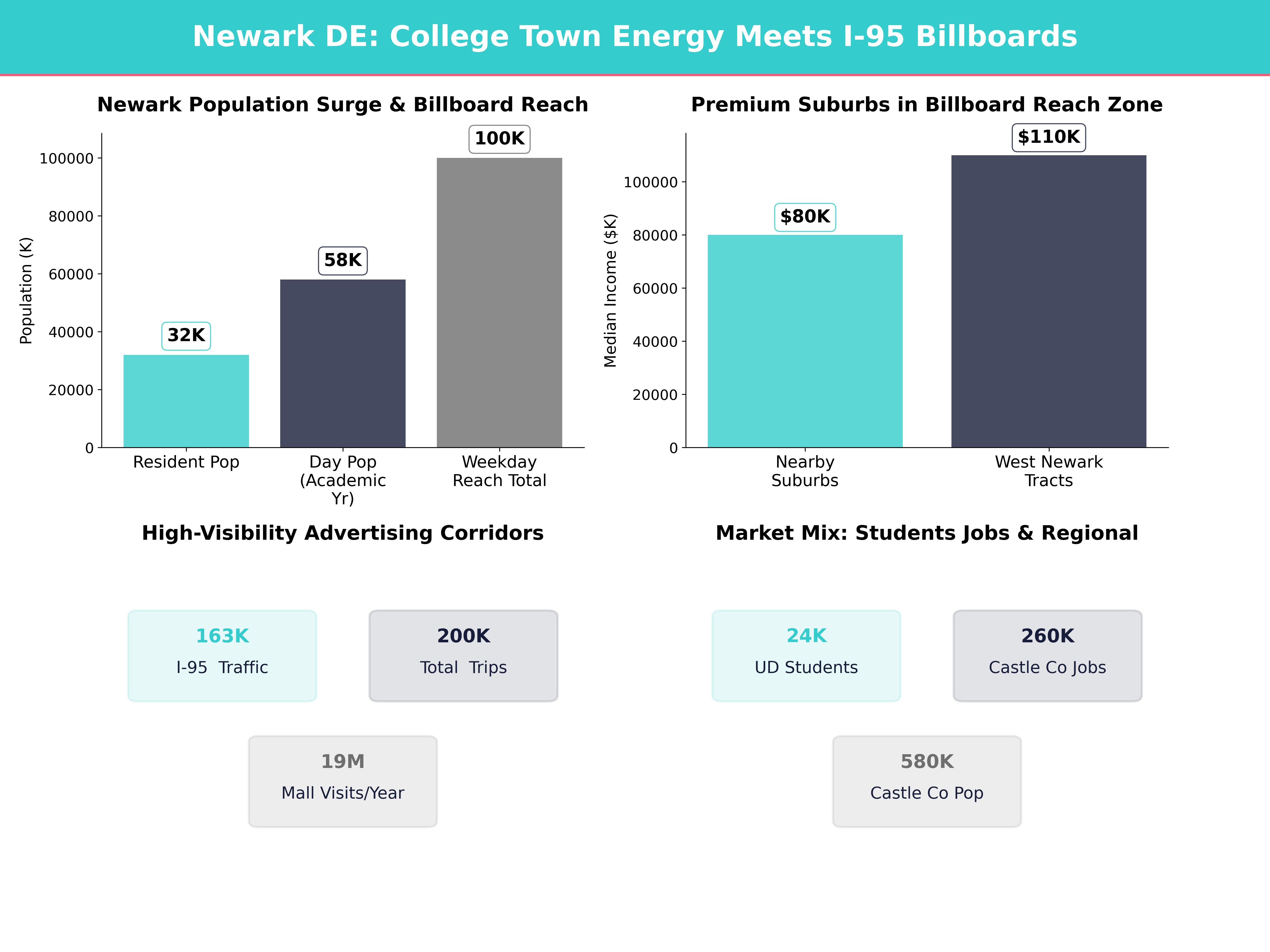
- The City of Newark reports a resident population of roughly 30,000–34,000 people within just 9 square miles, yielding a population density of more than 3,300 residents per square mile, one of the densest areas in northern Delaware outside of Wilmington.
- The University of Delaware’s Newark campus adds another 24,000+ students (about 18,000 undergraduates and 6,000 graduate students) plus roughly 4,000–4,500 faculty and staff, meaning that during the academic year the “daytime population” in and around Newark commonly exceeds 55,000–60,000 people (UD Fact Sheet).
- Within a 10–15 mile radius, we tap into the larger New Castle County population, which exceeds 580,000 residents, including households in Bear, Middletown, Wilmington, and Elkton, MD. Nearby New Castle County has more than 220,000 housing units and over 260,000 jobs, creating strong commuter flows into the Newark area.
Economically, Newark and surrounding New Castle County skew relatively affluent:
- Median household incomes in many nearby ZIP codes exceed $70,000–$90,000, particularly in Pike Creek, Hockessin, and Middletown, with some tracts topping $110,000+ in west‑of‑Newark suburbs.
- The City of Newark has consistently reported unemployment rates that trend 1–2 percentage points below national averages, helping support stable consumer spending ( City of Newark Economic Development
- Major employers around Newark include the University of Delaware, ChristianaCare health system, the STAR Campus, and logistics and distribution centers around I‑95, Route 273, and the Port of Wilmington tens of thousands of jobs within a short drive of downtown Newark ( Delaware Prosperity Partnership
For billboard advertisers, this means we’re not just speaking to 30,000 people—we’re intercepting a much larger flow of students, commuters, shoppers, and regional travelers that can easily reach 100,000+ individuals on a typical weekday when you combine residents, students, and inbound workers. Thoughtful Newark billboard advertising can tap into this full daytime population, not just city residents.
Key Traffic Corridors and Where Billboards Work Hardest
Newark sits at a critical transportation node where local streets meet major interstates:
- I‑95 near Newark carries well over 150,000 vehicles per day in some segments between the Maryland line and Wilmington, according to DelDOT traffic count data. Several count stations between Exits 1–4 regularly record 155,000–170,000 average annual daily traffic (AADT), making this one of the heaviest‑traveled stretches in Delaware.
- Routes 896, 273, and 4 are the primary arteries into campus and downtown Newark. Typical AADT volumes on busy segments range from 20,000 to 35,000 vehicles per day, with peak congestion on class days, weekday rush hours, and UD home game days (City of Newark Transportation).
- The Christiana Mall / Route 1 / I‑95 interchange, just east of Newark, is one of Delaware’s busiest retail hubs, with Christiana Mall alone attracting an estimated 18–20 million visits annually and serving a trade area that spans four states. This node channels traffic from I‑95, DE‑1, and DE‑7.
When we choose boards with Blip in and around Newark, we should think in terms of “corridor strategies” so that billboards in Newark align with the audience you care about most:
- I‑95 & major interchanges: Great for regional brands, recruitment, attractions, automotive, health care, and any offer that can pull from a 20–30 mile or even multi‑state radius.
- Route 896 & campus approaches: Ideal for student‑focused advertising, nightlife, food delivery, fitness, off‑campus housing, and game‑day promotions tied to Delaware Stadium and the Bob Carpenter Center.
- Route 4 & 273: Strong for everyday retail, health services, grocery, and quick‑serve restaurants, as well as family‑oriented offers for nearby neighborhoods and commuters coming from Bear, Glasgow, and Christiana.
Blip’s location controls let us test multiple boards on different corridors, then shift more budget to the ones that generate the strongest response (e.g., website visits, store traffic, phone calls). Because these corridors collectively account for well over 200,000 vehicle trips per day, even modest share‑of‑voice on the right boards can produce significant local reach in a short time window, making digital billboard rental in Newark highly efficient compared to many larger, more fragmented markets.
Seasonality: How Newark Changes Month by Month
Newark’s population shifts significantly with the University of Delaware calendar and regional tourism patterns. We can schedule Blip campaigns to line up with these cycles:
Late August – Early October: Back‑to‑School & Move‑In
- UD typically enrolls 24,000+ students, with residence halls and nearby apartments filling quickly during move‑in weeks (UD Housing & Residential Life). Tens of thousands of students and parents travel into Newark across just 2–3 peak weekends.
- UD orientation and welcome events can draw thousands of family members on top of student arrivals, driving spikes in hotel demand and local spending.
- Opportunities: off‑campus housing, banking, fitness centers, QSR and fast casual restaurants, school supplies, nightlife, rideshare, and local services.
- Strategy with Blip: Increase impressions during move‑in weeks and first 2–3 weeks of classes, particularly on Route 896, Route 4, and I‑95 near Newark, when Main Street merchants report some of their highest sales days of the year (Downtown Newark Partnership).
September – November: Football & Fall Events
- UD home football games at Delaware Stadium regularly bring 15,000–20,000+ fans on game days, with marquee matchups occasionally exceeding 21,000 in attendance (UD Athletics).
- Newark’s Main Street also sees strong weekend traffic during fall festivals and parents’ weekends (see the City of Newark events calendar). Events like Newark Community Day can attract 10,000+ visitors in a single day.
- Strategy: Daypart around Fridays and Saturdays, and focus on pre‑game and post‑game travel windows with promotions for dining, bars, retail, and entertainment.
December – February: Holidays and Commuters
- Student presence dips during winter break, but Christiana Mall and nearby centers experience holiday peaks, with some weekends generating tens of thousands of vehicle trips per day in the I‑95/DE‑1/DE‑7 triangle.
- Local news outlets like Delaware Online regularly highlight Christiana Mall as one of the region’s top holiday shopping draws because of Delaware’s 0% sales tax.
- Strategy: Shift messaging from student‑centric offers to holiday shopping, health care, winter services (auto repair, HVAC, tax prep), and professional services that appeal to the year‑round commuter base, which remains strong even when campus is quieter. This is also a cost‑effective window for brands to test Newark billboard advertising focused on commuters rather than students.
March – May: Spring Semester & Graduation
- Students return in large numbers after winter break, restoring that 50,000+ daytime population. Spring sports, student org events, and arts performances add steady weekend traffic (UD Events).
- Commencement and departmental graduations in May bring thousands of family members and visitors into Newark over several days, filling hotels from Newark to Wilmington and Elkton.
- Strategy: Promote graduation gifts, restaurants with group dining, event venues, photo services, and apartment leasing for the next school year. Concentrate spend in the 4–6 weeks before major ceremonies.
June – August: Summer & Tourism
- Student population is lighter, but tourism and regional travel increase across Delaware, with many travelers passing Newark en route to beaches or Philadelphia/Baltimore ( Visit Delaware – Newark millions of visitors each summer, much of that traffic funneled via I‑95 and DE‑1.
- Youth sports tournaments, summer camps, and conferences on the UD campus also keep hotel occupancy and restaurant traffic active through June and July.
- Strategy: Aim at regional travelers (attractions, casinos, beaches, hotels) and local families (camps, museums, health services, home improvement). Use boards on I‑95 and DE‑1 approaches to capture through‑traffic headed to popular coastal and urban destinations.
Blip’s ability to adjust schedules in near real time means we can pre‑load these shifts into the campaign plan, increasing or decreasing spend and changing creatives as the audience changes.
Audience Segments We Can Target Through Creative
Because we can’t “micro‑target” individuals with billboards, we target audience segments through message, timing, and location. Newark gives us several clear segments that can all be reached efficiently through billboards in Newark’s busiest corridors:
University Students (18–24)
- Approximately 18,000 undergrads and 6,000+ graduate students on or around campus, plus thousands more in non‑traditional and continuing‑education programs (UD Fact Sheet).
- A large share of these students live within 1–2 miles of campus in dense off‑campus housing along Cleveland Avenue, Elkton Road (896), South College Ave, and Main Street.
- Student surveys and local coverage from outlets like the Newark Post show that Main Street bars, coffee shops, and quick‑serve restaurants are among the most frequently visited businesses multiple times per week.
Creative tips for this segment:
- Use bold colors, large fonts, and short calls to action (e.g., “2‑FOR‑1 PIZZA – MAIN STREET TONIGHT”).
- Highlight student discounts, QR codes, and social handles; more than 95% of college‑age consumers regularly use smartphones, making QR engagement natural.
- Focus boards along Routes 896 and 4 and near campus access roads; daypart for late afternoon, evenings, and weekends, when student foot and vehicle traffic on Main Street peaks.
Commuters & Workers (25–54)
Thousands of people commute into and around Newark from Wilmington, Bear, Elkton, Middletown, and Pennsylvania. Key routes:
- I‑95, Route 273, Route 4, Route 896, and DE 72.
- New Castle County’s job base includes more than 250,000 positions, with significant clusters in education, health care, logistics, manufacturing, and finance (Delaware Department of Labor). Many of these workers either live or travel through the Newark area regularly.
Creative tips:
- Emphasize time‑sensitive value: “Same‑Day Urgent Care Exit 3B,” “Oil Change in 20 Minutes,” “Skip Mall Parking—Order Online.”
- Use clear directional cues: “NEXT EXIT,” “2 EXITS AHEAD,” “5 MINS OFF I‑95.”
- Schedule heavier impressions during morning (6–9 a.m.) and evening (3–7 p.m.) rush hours using Blip’s dayparting, when commuter volumes on the main corridors can be 2–3 times higher than mid‑day levels.
Families & Suburban Households
Nearby communities like Pike Creek, Hockessin, Bear, and Glasgow have strong concentrations of families with school‑age children:
- School districts serving the greater Newark area collectively enroll tens of thousands of K–12 students, driving daily peaks in before‑ and after‑school travel (Christina School District, Newark Charter School
- Many of these suburbs report homeownership rates above 65–70%, higher than many urban cores, and strong participation in youth sports, camps, and extracurricular activities.
What resonates:
- Education, health care, youth sports, summer camps, family attractions, and financial services.
- Promotions should be trust‑oriented (“Serving Newark Families Since 1995”) and benefit‑first (“Straight A Tutoring – Raise Grades in 8 Weeks”).
Focus:
- Boards on feeder roads used for school and activity runs (Route 4, 72, 896) and near shopping hubs such as Christiana Mall, College Square, and Suburban Plaza ( City of Newark Shopping & Dining
- Dayparting to after‑school hours (2–7 p.m.) and weekend daytime, when family‑oriented trips spike.
Regional Travelers & Visitors
Newark captures heavy through‑traffic:
- Visitors headed to Wilmington, Philadelphia, Baltimore, and Delaware beaches via I‑95 and DE‑1.
- Attendees for regional events at UD, Christiana Mall, and local venues like the Bob Carpenter Center, which can host 5,000+ attendees for concerts, graduation ceremonies, and tournaments.
- Northern Delaware tourism agencies, including Greater Wilmington & the Brandywine Valley, promote Newark as a hub with easy access to over 30 museums and attractions within a short drive.
Opportunities:
- Promote hotels, restaurants, casinos and entertainment, tourist attractions, and outlets/shopping.
- Use copy like “NEXT EXIT LODGING,” “KIDS BREAK STOP – 2 EXITS AHEAD,” or “TAX‑FREE SHOPPING THIS EXIT” (a unique Delaware advantage promoted by outlets like Delaware Online).
Crafting Billboard Creative That Works in Newark
Newark’s traffic patterns and speed limits dictate how much attention we get:
- On I‑95, vehicles move at 55–65 mph; we typically have 3–6 seconds of view time, which aligns with out‑of‑home industry guidance that drivers can comfortably read about 6–8 words at highway speed.
- On surface roads like 896 or 273, speeds range from 25–45 mph, allowing slightly longer viewing, but distractions are high (signals, pedestrians, campus activity, cyclists).
Creative best practices:
-
One Main Idea
- Limit to 7 words or fewer in the primary message.
- Example: “$10 STUDENT HAIRCUT – MAIN ST BARBER.”
- Aim for no more than 3–4 key visual elements (logo, headline, image, call to action) to avoid clutter.
-
High Contrast & School Colors
- UD’s primary colors (blue and gold) are highly recognizable across Newark.
- We can lean into these or deliberately contrast them (e.g., black/white/red) to stand out.
- Always ensure a dark background with light text or vice versa; tests across multiple markets show high‑contrast designs can increase recall by 20–30% versus low‑contrast layouts.
-
Local Anchors in Copy
- Reference “Main Street,” “Campus,” “I‑95 Exit X,” or “Across from Christiana Mall” to instantly orient drivers.
- Local references build trust and relevance; consumer studies consistently show that including a recognizable local landmark can lift ad relevance scores by double‑digit percentages.
-
Directional and Distance Cues
- “Next Light on Right,” “Across from UD Stadium,” or “1 Mile Ahead – Exit 1B” reduce friction and increase response, especially for first‑time visitors.
- Where appropriate, pair directional text with a simple arrow icon; eye‑tracking research on roadside ads shows directional arrows quickly draw attention and clarify message intent.
-
Dynamic & Rotating Messages with Blip
- Run different creatives for different times (student‑only offers after 4 p.m., commuter offers in the morning).
- Test multiple versions (e.g., “20% OFF” vs “$10 OFF”) and shift budget toward the version with better performance. Even a 5–10% improvement in response rate can translate into significant incremental revenue over a semester or season.
Using Timing and Dayparting Strategically
Blip allows us to purchase brief “blips” of time on a board and control when those blips run. In Newark, timing is as important as location:
- Morning drive (6–9 a.m.): Commuter and parent‑focused messages; promote coffee, transportation, news, health care, and quick services. I‑95 and 273 often see their highest hourly volumes in this window.
- Midday (11 a.m.–2 p.m.): Lunch specials, student dining, campus‑area retail, and health/beauty appointments. Many Main Street eateries report lunch as 25–35% of daily transactions on weekdays.
- Afternoon school and work let‑out (2–4 p.m.): After‑school programs, tutoring, pediatric care, family restaurants. Feeder routes near schools experience sharp volume increases around dismissal times (Christina School District Transportation).
- Evenings (4–9 p.m.): Entertainment, restaurants, bars, gyms, and events. This aligns with common game and event times at UD and downtown venues.
- Late night (after 9 p.m.): Relevant for nightlife, late‑night food, and rideshare promotions near campus, especially Thursday–Saturday when student activity peaks.
We can also schedule around specific local events:
- UD home games and major events listed on the University of Delaware events calendar.
- City events such as Newark Community Day, Thanksgiving Day Parade, and winter festivities from the City of Newark.
- Festivals and regional happenings tracked by local outlets like the Newark Post and regional broadcasters such as WDEL News.
By front‑loading impressions just before and during these events, we maximize the likelihood that our audience sees the message right when they are motivated to act—often within minutes of choosing where to park, eat, or shop.
Budgeting and Testing for Newark Campaigns
Because Newark is compact but highly trafficked, we can achieve strong frequency with modest budgets if we focus. This makes billboard rental in Newark an accessible option even for smaller businesses:
-
Start with One Clear Objective
- Drive foot traffic to a Main Street location.
- Promote a time‑bound event (concert, festival, open house).
- Build awareness for a new service or regional brand.
- When objectives are specific, advertisers often report 10–30% better alignment between billboard exposure and measurable outcomes (redemption, clicks, phone inquiries).
-
Test Multiple Boards, Then Consolidate
- Launch on 3–5 boards across key corridors (I‑95, 896, 273/4) for 1–2 weeks.
- Monitor your own metrics (web traffic by geography, promo codes, calls, walk‑ins) using tools such as geo‑filtered web analytics and in‑store surveys.
- Shift spend to the locations that correlate with the strongest lift. In many markets, advertisers find that 20–40% of boards drive the majority of measurable response—identifying these early improves efficiency.
-
Use Short “Bursts” Around Key Moments
- For events like UD games or school open houses, run intense bursts of impressions 3–7 days before.
- For evergreen businesses (health clinics, automotive), maintain baseline coverage and periodically add heavier bursts around seasonal demand (flu season, back‑to‑school, tax season). This “always‑on plus bursts” model balances reach with cost control.
-
Layer Offers with Brand Building
- Mix direct‑response creatives (coupon, discount) with brand creatives (logo, tagline, community message).
- Newark’s relatively small but dense market means repetition builds recognition quickly; multiple exposures per week to the same audience can significantly increase brand recall.
- Pairing billboards with digital or print in local outlets like Delaware Online or the Newark Post can create a cross‑channel lift where each medium reinforces the other.
Local Content and Community Alignment
Newark residents and students respond well to brands that show genuine local involvement. We can incorporate:
- References to UD Blue Hens, local high schools, or local causes (within trademark guidelines). UD sports and spirit events routinely attract thousands of participants and fans (UD Athletics).
- Mentions of sponsorships for community events listed on Newark’s community calendars, such as Newark Community Day, Wine & Dine Downtown Newark, or Winterfest, which each draw hundreds to several thousand attendees.
- Simple, community‑oriented messages: “Proud to Serve Newark Since 2005” or “Supporting Blue Hens All Season.”
Consider partnering creative with local media:
- Align billboard messaging with digital or print campaigns in the Newark Post or Delaware Online to increase recall and share of voice during key weeks.
- Time a Blip burst with a feature article, grand opening story, or sponsored content. Coordinated local visibility across billboards, news, and social media can make a new brand feel established very quickly in a market the size of Newark.
Putting It All Together
When we plan a digital billboard campaign in Newark with Blip, our best results come from aligning:
- Where we show (I‑95 for regional reach, 896/4/273 for campus and local neighborhoods).
- When we show (aligned with UD’s calendar, rush hours, and local events).
- What we show (short, high‑contrast, locally anchored messages tailored to students, commuters, families, or travelers).
By combining Newark’s unique characteristics—a major university, heavy interstate traffic, and a tight but affluent trade area—with Blip’s flexible scheduling and location control, we can build Newark billboard advertising campaigns that are both efficient and highly impactful, whether we’re launching a new brand, filling an event, or growing an established Newark business through smart billboard rental in Newark’s busiest corridors.