Billboards near New Albany, IN
No Minimum Spend. No Long-Term Contracts. Just Results.
Trusted by Leading Brands


Billboard advertising
near New Albany has never been easier
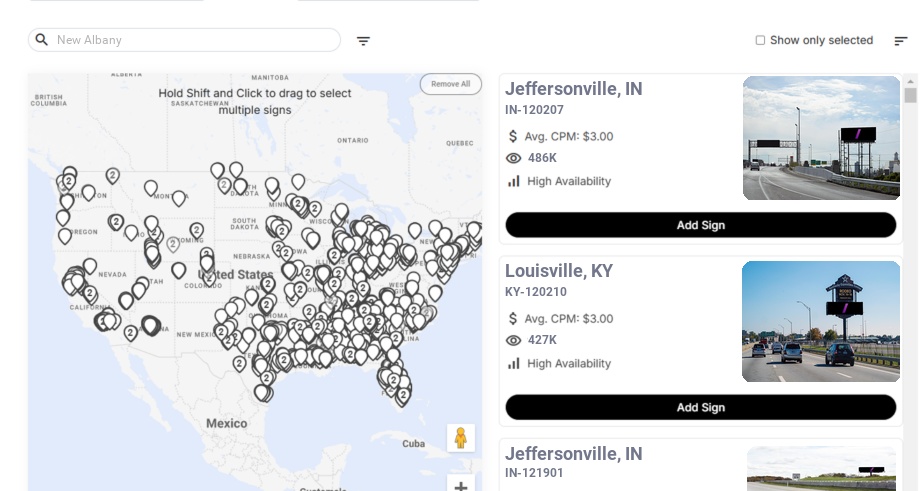



How much is a billboard near New Albany?
Why Choose Blip for Billboard Advertising near New Albany
Blip lets New Albany launch fast on I-64 and the Sherman Minton Bridge, reaching 80K+ daily commuters without a long media buy.
Use flexible budgets in New Albany to hit Clarksville retail and River Ridge workers during the rush hours that matter most.
No contracts means New Albany brands can test holiday, Derby, or back-to-school flights and pause anytime.
Track New Albany billboards in real time and shift spend when I-65 and I-265 traffic or visitor spikes climb.
Blip's creative tools help New Albany ads stand out with clear, local messages for Louisville cross-river drivers and students at IU Southeast.
Frequently Asked Questions About Billboard Advertising near New Albany
How much does a billboard cost near New Albany, Indiana with Blip?
With Blip, advertising on New Albany billboards is flexible and affordable because you set your own daily budget and only pay for the individual “blips” your ad receives. Each blip is a short 7.5 to 10-second display on digital billboards near New Albany, Indiana, and prices vary based on when and where your ad runs, along with advertiser demand. Your total cost over time is simply the sum of all those blips, so you stay in control whether you’re testing the waters or scaling up.
Where can I advertise with Blip near New Albany, Indiana?
There are 21 digital billboards near New Albany serving the area, with placements in Clarksville, Jeffersonville, and Louisville. The page says these boards are positioned along some of the region’s highest-traffic parts of Clarksville, Jeffersonville, and Louisville, giving advertisers access to major commuter and retail corridors. You do not have to buy every board, and Blip can build a custom mix that matches where your customers actually drive.
Why is the New Albany, Indiana area a strong market for billboard advertising with Blip?
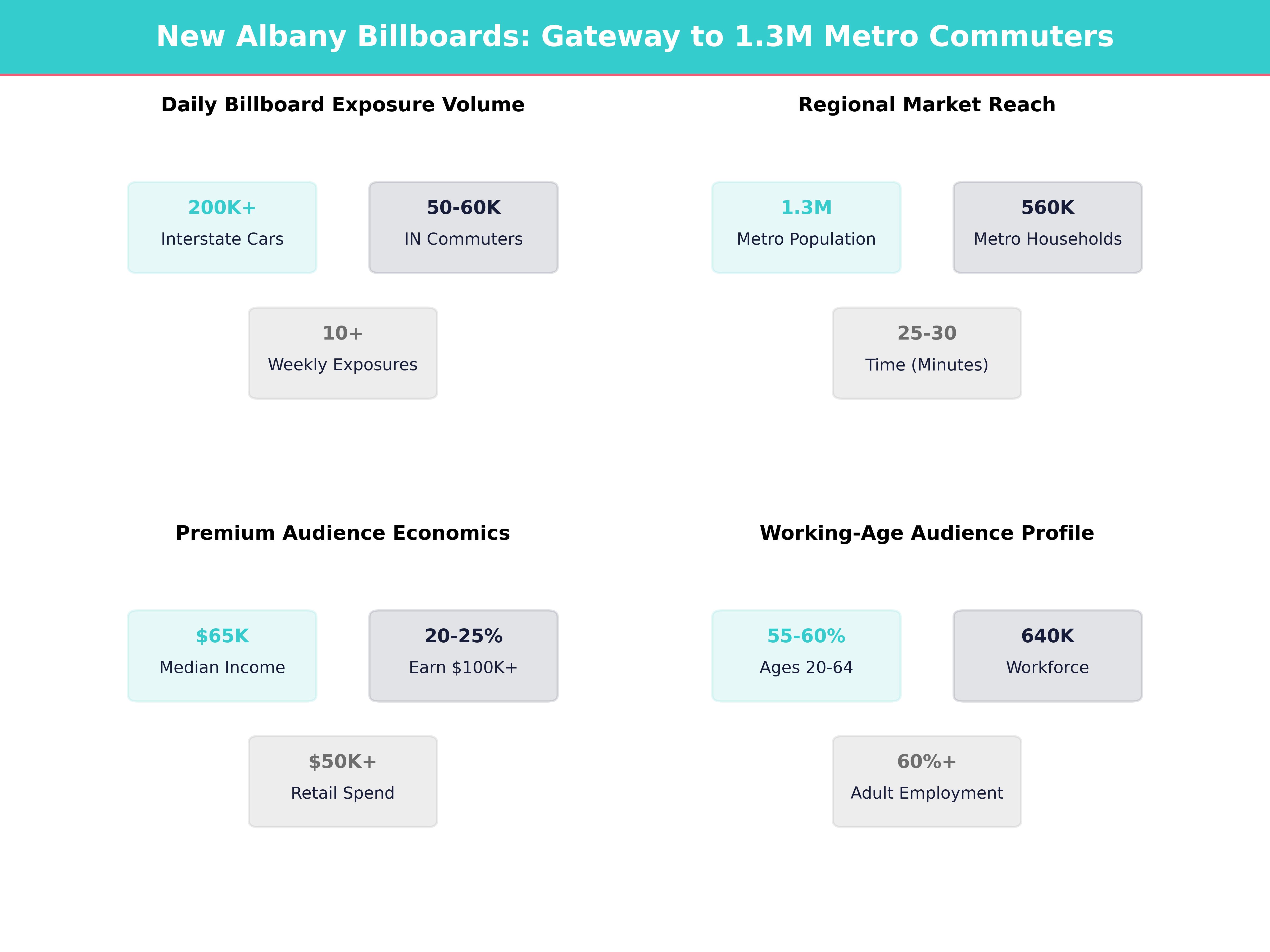
The New Albany area sits at a strategic crossroads of southern Indiana and the greater Louisville metro, making it an efficient, high-impact place to reach commuters, shoppers, and visitors with digital billboards. The broader region has more than 1.3 million residents and roughly 560,000 households, with a regional consumer base of 1.3–1.4 million people within a 25–30 minute drive. Strong cross-river commuting and more than 300,000 vehicle trips per day on major interstates make the area especially valuable for billboard campaigns.
What kinds of people does New Albany, Indiana billboard advertising reach?
New Albany has about 38,000 residents, Floyd County has more than 80,000 residents, and the greater Louisville region tops 1.3 million residents. The audience includes young families, commuters, students, and a sizable retiree segment, with more than 30,000 college students within easy driving distance. The page also notes that more than 60% of adults in the region are employed, which makes the market useful for service, retail, and healthcare advertisers.
When is the best time to run billboard ads near New Albany, Indiana?
Weekdays see heavy commuter flow into and out of Louisville between roughly 6–9 a.m. and 3:30–6:30 p.m., while evenings are strong for retail and dining clusters in Clarksville and New Albany, particularly 4–8 p.m. Weekends bring increased trips to malls, big-box retail, riverfront parks, and recreation areas, with retail foot traffic in major shopping corridors often rising 30–50% on Saturdays versus an average weekday. The page also recommends heavier rotations 2–3 weeks before events and during seasonal peaks like spring, summer, fall, and the holiday season.
Do I need a contract to advertise with Blip near New Albany?
No, Blip has no long-term contracts or minimum commitments. You can start, pause, or stop your campaign at any time.
How fast can I launch a billboard campaign with Blip near New Albany?
You can have your campaign live in minutes. Create a free account, select your locations, set your budget, upload your design, and start running once approved.
Where can I advertise with Blip near New Albany?
Blip has digital billboards near New Albany. You can browse available locations on a map, choose the ones that fit your audience, and start advertising right away.
Still have questions? Launch a campaign in minutes — no contracts, no commitments.
Start Your CampaignNew Albany Billboard Advertising Guide
The New Albany area sits at a strategic crossroads of southern Indiana and the greater Louisville metro, making it an efficient, high-impact place to reach commuters, shoppers, and visitors with digital billboards. With 21 digital billboards near New Albany—in Clarksville, Jeffersonville Louisville
Why the New Albany Area Is a High‑Value Billboard Market
The New Albany area is part of the bi-state Louisville–Jefferson County metropolitan region, which has more than 1.3 million residents and roughly 560,000 households. The City of New Albany 38,000 residents, while Floyd County is home to just over 80,000 residents and around 32,000 households. When we include nearby Clark County (about 122,000 residents) and Harrison County (about 40,000 residents), plus Louisville across the river ( City of Louisville/Jefferson County unified government 780,000 residents), advertisers are tapping into a regional consumer base of 1.3–1.4 million people within a 25–30 minute drive.
Several dynamics make the New Albany area particularly valuable for digital billboard campaigns and other billboard advertising near New Albany:
-
Strong cross-river commuting: Regional planning data show that more than 50,000–60,000 southern Indiana residents commute into Jefferson County, KY, on a typical weekday, and a significant share comes from Floyd and Clark counties. Indiana and Kentucky transportation counts show six-figure average daily traffic volumes on key bridge crossings:
- Sherman Minton Bridge (I‑64): Over 80,000 vehicles per day.
- Kennedy/Abraham Lincoln bridges (I‑65 crossings combined): Frequently 120,000–140,000 vehicles per day.
- Lewis and Clark Bridge (I‑265): Roughly 25,000–35,000 vehicles per day, and growing as development expands. This level of flow means commuters often see the same boards 10+ times per week, building frequency and recall for New Albany billboards and nearby placements.
- Diverse economic base: The local economy blends healthcare, logistics, manufacturing, education, and retail. Within a 20–25 minute drive, New Albany residents can reach major employers such as Baptist Health Louisville, Norton Healthcare UPS Worldport at Louisville Muhammad Ali International Airport 25,000 jobs in the Louisville area), and the River Ridge Commerce Center in Jeffersonville, which reports over 70 companies and more than 10,000 on‑site jobs with billions in private investment. That means billboards serve hourly workers, professionals, students, and business travelers.
- Active regional events calendar: The Louisville region attracts more than 16–17 million visitors per year, with visitor spending exceeding $3 billion annually, driven by attractions highlighted by Go To Louisville, while SoIN Tourism estimates hundreds of thousands of annual visitors across Floyd and Clark counties alone. From concerts and sports in downtown Louisville to events promoted by City of New Albany SoIN Tourism, there are consistent spikes in traffic and visitor numbers. Digital billboards can flex to match those peaks by increasing plays during large events or festival weeks.
By focusing placements near Clarksville, Jeffersonville, and Louisville, we can efficiently blanket the main gateways serving the New Albany area without overextending budget, tapping into daily traffic counts of 200,000+ vehicles across the key interstates and making billboard advertising near New Albany both efficient and scalable.
Understanding Local Audiences and Demographics
To design effective billboard campaigns near the New Albany area, it helps to understand who we’re talking to and how New Albany billboards fit into their daily routines.
Population & age mix
- New Albany: About 38,000 residents, with a balanced age profile—roughly 24–26% under age 20, around 55–60% between 20 and 64, and 15–18% ages 65+, reflecting both young families and a sizable retiree segment.
- Floyd County: More than 80,000 residents; median age around 38–39 years, which aligns closely with the national median. Approximately 50% of residents are in their prime working years (25–64), and households average around 2.4–2.5 persons.
- Clark County: Roughly 122,000 residents, with a similar age mix and a strong base of suburban families around Clarksville and Jeffersonville.
- Greater Louisville region: The Louisville–Jefferson County metro tops 1.3 million residents, with over 640,000 workers in the regional labor force, giving New Albany advertisers access to a large, commuting-heavy audience.
Implications for creatives:
- Feature family-oriented imagery (families, students, multigenerational households) to connect with the substantial number of parents and school-aged children; the combined K‑12 systems in Floyd and Clark counties enroll 40,000+ students.
- Include clear value propositions and everyday services for working-age commuters—auto service, healthcare, banking, dining, and home services—since more than 60% of adults in the region are employed.
- For 55+ audiences, emphasize trust, convenience, and accessibility (simple URLs, phone numbers, and clear directions), as nearly 1 in 5 Floyd County residents is nearing or at retirement age.
Income & spending power
Median household income in Floyd County sits around the mid‑$60,000s, with Clark County in the low‑ to mid‑$60,000s and Jefferson County (KY) around the low‑$60,000s. Key implications:
- Over 50% of households in Floyd and Clark counties earn $50,000+ per year, and roughly 20–25% earn $100,000+, pointing to strong middle-class and upper-middle-class purchasing power for big-ticket items like vehicles, home improvement, and healthcare services.
- Household retail spending per year in the Louisville metro typically exceeds $50,000 per household, including more than $3,000–$4,000 on dining out and $2,000+ on entertainment and recreation.
- Veterans Parkway and surrounding Clarksville corridors alone host millions of square feet of retail space and attract tens of thousands of shoppers on busy weekends, creating dense exposure zones for retail messaging and for billboards near New Albany targeting high-intent shoppers.
Positioning ideas:
- Highlight financing options or entry-level price points on billboards to reduce friction for mid-market buyers—e.g., “Payments from $199/mo” or “Plans Starting at $29.99.”
- Use short, benefit-driven headlines like “Same-Day Braces Near New Albany Area” or “$0 Down Solar for Southern Indiana Homes,” anchored to the reality that a large share of households can qualify for financing or subscription services.
Education & student audiences
Within 15–20 minutes, the New Albany area draws from institutions like:
- Indiana University Southeast in New Albany, with enrollment in the 3,500–4,000 student range.
- The University of Louisville across the river, serving more than 22,000 students and employing over 7,000 faculty and staff.
- Ivy Tech Community College – Sellersburg campus and other southern Indiana sites, educating several thousand students each year.
Combined, there are more than 30,000 college students within easy driving distance, plus recent graduates and young professionals. This means a sizable student and young professional population commuting daily. For them, consider:
- Creatives for apartments, mobile carriers, fast food, bars, and entertainment, especially along routes students use between campuses and residential neighborhoods.
- Time-targeted campaigns during move-in weeks, finals, and graduation seasons, when student spending on housing, electronics, and dining can spike 20–40% compared to typical months.
Mapping Traffic Flows and Prime Billboard Corridors
Our 21 digital billboards serving the New Albany area are positioned along some of the region’s highest-traffic parts of Clarksville, Jeffersonville, and Louisville—exactly where New Albany residents and visitors are already traveling. Major interstates around New Albany handle well over 300,000 vehicle trips per day combined, magnifying the reach of even modest budgets and making billboard rental near New Albany highly efficient for both local and regional brands.
Key corridors to think about:
I‑64 and the Sherman Minton Bridge
- Main artery linking the New Albany area to downtown Louisville and western Jefferson County.
- Daily traffic often exceeds 100,000 vehicles, with peak-hour flows of 5,000–6,000 vehicles per lane per hour during morning and evening rush.
- New Albany is only about 5 miles from downtown Louisville via I‑64, typically a 10–15 minute drive outside of peak congestion.
-
Ideal for:
- Campaigns targeting downtown workers and event-goers heading to the KFC Yum! Center, Waterfront Park, and nearby office cores.
- Messaging about businesses located on either side of the river (“5 Minutes from the Bridge” type creatives) for drivers who cross the bridge 10–20 times per week.
I‑65 and the Abraham Lincoln Bridge / JFK Bridge
- Major north–south interstate carrying commuter and through-traffic between Louisville, Jeffersonville, Clarksville, and points north to Indianapolis.
- Average daily traffic on I‑65 near the river regularly reaches 120,000–150,000 vehicles, including significant commercial truck traffic.
- Connects to Clarksville retail zones, downtown Jeffersonville, and the rapidly growing River Ridge Commerce Center area.
-
Use this corridor to:
- Reach distribution/logistics workers, shoppers headed to Clarksville, and cross-state travelers; tens of thousands of passenger vehicles plus thousands of trucks pass daily.
- Promote gas stations, hotels, restaurants, and attractions that benefit from traveler traffic, capturing a portion of the tens of millions of vehicle miles traveled each month along I‑65.
I‑265 (Lewis and Clark Parkway) and Outer Beltway Traffic
- Connects the New Albany area west of the river with Jeffersonville, Clarksville, and the East End of Louisville, forming an outer beltway option versus driving through downtown.
- I‑265/Airport–east-end segments in Indiana and Kentucky combine for 60,000–80,000 vehicles per day, with steady growth as new residential and commercial developments open.
- Captures suburban commuters and regional traffic bypassing downtown, especially residents in Floyd and Clark counties who work in east-end Jefferson County.
-
Great for:
- Suburban-centric brands—grocery, home improvement, car dealers, healthcare clinics—since many exits lead directly to suburban commercial nodes.
- Campaigns that emphasize easy on/off access (“Exit Now,” “Next Right”) for drivers who may be only 2–4 minutes away from your business.
Clarksville & Jeffersonville Retail Corridors
- Veterans Parkway / Lewis & Clark Parkway in Clarksville is one of the densest retail zones in southern Indiana, with several million square feet of retail, big-box, and restaurant space. Weekends and holiday periods can see tens of thousands of vehicles per day funneling through this corridor alone.
- Commercial strips in Jeffersonville and the River Ridge area continue to grow, with industrial, office, and retail development adding thousands of workers and shoppers over the last decade.
- The neighboring Town of Clarksville notes strong traffic around Green Tree Mall, Veterans Parkway, and nearby centers, reinforcing the value of last-mile reminders.
Here, our billboards can:
- Serve as last-mile reminders: “Turn Left at Next Light,” “Behind Target,” or “Next to [Landmark].”
- Drive impulse visits to restaurants, entertainment venues, and local shops, capitalizing on the fact that impulse food and retail purchases can represent 20–30% of on-site spending in busy corridors.
When planning a campaign, we recommend mapping your business location relative to these corridors and asking:
- Which bridge or interstate do my customers most frequently use?
- Are they typically headed toward Louisville, or staying on the Indiana side?
- Do I need more north–south (I‑65) or east–west (I‑64/I‑265) coverage?
- How many times per week is my typical customer likely to pass a given board—5, 10, or 20+ exposures?
Timing Your Campaign Around Local Rhythms
With digital billboards, we can adjust when ads show—down to specific hours and days—to align with the New Albany area’s patterns and to maximize the value of billboard rental near New Albany.
Weekday vs. Weekend Behavior
-
Weekdays (Mon–Fri): Heavy commuter flow into and out of Louisville between roughly 6–9 a.m. and 3:30–6:30 p.m. Traffic counts on the I‑64 and I‑65 bridges often jump 25–40% during those windows compared to mid-day.
- Ideal for service businesses, B2B messaging, healthcare, and job recruitment that benefit from reaching people as they plan their day or head home.
-
Evenings: Strong traffic toward retail and dining clusters in Clarksville and New Albany, particularly 4–8 p.m., when many households make dining and shopping decisions. Nationally, more than 60% of restaurant visits occur at dinner or evening hours, and the local pattern is similar.
- Great for restaurants, entertainment venues, gyms, and local events.
-
Weekends: Increased trips to malls, big-box retail, riverfront parks, and recreation areas promoted by SoIN Tourism and Go To Louisville. Retail foot traffic in major shopping corridors often rises 30–50% on Saturdays versus an average weekday.
- Perfect for tourism, events, family attractions, car dealers, and home improvement.
We can allocate a higher share of impressions during:
- Friday afternoons and evenings for weekend activities and sales, when many stores see 20–30% of weekly revenue.
- Saturday late mornings to early evenings for retail, auto, and family outings, targeting the 10 a.m.–6 p.m. window.
- Sunday afternoons for grocery, quick-service restaurants, and last-chance promotions before the work week.
Seasonal Patterns
Local behavior shifts in predictable ways through the year:
- Spring: With better weather and event calendars ramping up, traffic to downtown Louisville, Indiana parks, and festivals increases. Visitor and tourism organizations report noticeable upticks starting in March/April. This period is primed for tourism, outdoor recreation, and home services, especially as home-improvement spending typically climbs 10–20% versus winter.
- Summer: Festivals, Louisville Slugger Field Kentucky Kingdom & Hurricane Bay area, and riverfront events bring more visitors across the river. Hotel occupancy and attraction attendance can rise 15–30% in peak summer months. Target lodging, attractions, ice cream/quick-service food, and summer sales.
-
Fall: Back-to-school for IU Southeast and local K–12 systems like New Albany–Floyd County Consolidated Schools and Clark County districts such as Greater Clark County Schools, plus college football and fall festivals.
- Highlight education services, apparel, electronics, and after-school activities, especially in August and September when back-to-school spending surges.
-
Holiday season (Nov–Dec): Retail traffic spikes to Veterans Parkway, Jeffersonville outlets, and Louisville shopping districts. National trends show November–December can account for 20–30% of annual retail sales, and local malls and corridors mirror that pattern.
- Push gift buying, holiday events, seasonal restaurant menus, and year-end auto deals, increasing impression share around Black Friday, Cyber Monday, and the week before Christmas.
Digital billboards allow us to increase your presence during your key seasons without paying for continuous, always-on coverage year-round, making it easier to align spend with your highest-revenue months and to phase billboard rental near New Albany in and out as needed.
Crafting Creative That Resonates Near New Albany
The New Albany area’s blend of commuters, families, and students means we need clear, fast, and locally grounded creative.
Keep It Simple and Directional
Drivers near New Albany often know local landmarks better than specific addresses. Use:
-
“Near the New Albany area” plus clear directional cues:
- “5 Minutes from the Sherman Minton Bridge”
- “Off Exit 4, I‑265 – Clarksville”
- “Across the River from New Albany Area – Downtown Louisville”
- 6–8 words max in your main headline; research shows recall drops sharply beyond about 8–10 words at highway speeds.
- One clear call to action: “Exit Now,” “Schedule Today,” “Visit This Weekend,” or “Order Online.”
Lean Into Local Identity
Residents are proud of their Indiana roots and their connection to Louisville’s amenities. Consider:
-
Visual nods to:
- The Ohio River and bridges.
- Downtown New Albany storefronts or the historic district (no trademarks, just familiar aesthetics).
- Local sports culture (regionally beloved teams and colors, not copyrighted logos), especially around the Louisville and IU Southeast communities.
-
Language that references:
- “Southern Indiana”
- “Kentuckiana”
- “Serving the New Albany & Louisville Area”
These touches signal that your business is part of the local community, not an anonymous national brand. Localized creative can increase ad recognition by 10–20% versus generic messaging and can make New Albany billboards feel especially relevant to daily drivers.
Design for High-Speed Viewing
Interstate drivers generally have 2–4 seconds to process your message, and many state DOTs assume legibility at 55–70 mph. To maximize impact:
- Use large, high-contrast fonts (sans-serif, bold), with key words occupying at least 1/3–1/2 of the board height.
- Limit to 1 main image, 1 headline, and 1 supporting element (logo, phone, or URL). Keeping total elements to 7 or fewer (including logo and CTA) improves comprehension.
- Favor short URLs and simple phone numbers. When possible, use vanity URLs like “BrandNameNA.com” or “Visit[Brand].com/NA” so drivers can remember them in 2 seconds or less.
Using Blip Tools to Target the New Albany Area
Blip’s flexibility is especially powerful near the New Albany area, where traffic conditions and audiences vary by time, bridge, and corridor. Whether you’re testing one board or planning broader billboard advertising near New Albany, these tools let you scale on your terms.
Target by Specific Boards Near Key Routes
With 21 digital billboards serving the New Albany area, we can:
- Concentrate on Clarksville boards to hit shoppers on Veterans Parkway and Lewis & Clark Parkway, reaching daily traffic counts often above 30,000–40,000 vehicles on key surface roads.
- Use Jeffersonville boards to capture workers headed to and from River Ridge and I‑65 commuters, many of whom pass the same boards at least 10 times per week.
- Layer in Louisville boards near downtown and the interstates for maximum exposure to cross-river commuters from New Albany, where combined interstate volumes exceed 250,000 vehicles per day.
You don’t have to buy every board. Instead, we can build a custom mix that matches where your customers actually drive, balancing frequency (how often the same drivers see you) against reach (how many unique drivers see you), and keeping billboard rental near New Albany aligned with your budget.
Dayparting and Budget Control
We can:
- Show ads only during rush hours for commuter-focused brands, concentrating spend in the 6–9 a.m. and 3:30–6:30 p.m. windows.
- Run evening-only campaigns for restaurants, entertainment, and gyms, where most conversions happen after 4 p.m..
- Focus on weekends for tourism, real estate open houses, or major sales events, when corridor traffic around malls and attractions can increase 30–50%.
Because you pay per “blip” (a single play of your ad), you can:
- Start with modest daily budgets (even $5–$10 per day).
- Test which time slots and boards produce the most engagement, using store traffic, web analytics, or call volume as indicators.
- Increase spend where you see results while pausing lower-performing placements, improving your effective cost per thousand impressions (eCPM) over time.
Ideas and Playbooks for Key Industries
Here are practical frameworks for common advertisers near the New Albany area. Each can be adapted to single New Albany billboards or to a multi-board network.
Local Retail & Restaurants
Objectives: Foot traffic, brand awareness, promotions.
- Focus boards near Clarksville retail corridors and the I‑64/I‑265 interchange, where weekend traffic surges can generate thousands of incremental impressions per hour.
- Run lunch and dinner dayparts (11 a.m.–2 p.m., 4–8 p.m.), which collectively account for the majority of daily dining visits.
-
Messaging examples:
- “Dinner 10 Minutes from New Albany Area – Exit Now in Clarksville”
- “Kids Eat Free Tue – [Restaurant Name], Off I‑64 Next Exit”
-
Rotate creatives:
- Brand awareness (logo + “Now Open Near New Albany Area”).
- Offer-based ads (limited-time promotions like “Save 20% This Weekend”).
- Directional ads (landmark-based directions such as “Behind [Major Retailer] on Veterans Pkwy”).
By aligning heavy flights with paydays (typically the 1st and 15th of the month or bi-weekly Fridays), you can catch consumers when discretionary spending peaks.
Healthcare & Services
Objectives: New patients, appointment bookings.
- Target commuters crossing the bridges and residents using suburban arterials, especially around residential clusters in Floyd and Clark counties.
- Dayparts: Morning and early evening when people think about personal logistics outside work; nationally, more than 60% of appointments are booked outside core 9–5 hours.
-
Messaging examples:
- “Urgent Care Near New Albany Area – Walk-Ins Welcome, Exit 121 I‑64”
- “New Patients Accepted – Family Dentistry in Southern Indiana”
-
Emphasize:
- Convenience (extended hours, same-day appointments, telehealth).
- Insurance acceptance for major local employers.
- Short, trust-building phrases: “Locally Owned,” “Serving Southern Indiana Families,” or “Rated 4.8★ Online,” as ratings significantly influence more than 70% of healthcare decisions.
Automotive Dealers & Services
Objectives: Test drives, vehicle sales, service appointments.
- Position near I‑65 and I‑265 corridors that pass nearby auto rows and service centers, where daily traffic volumes and long sightlines maximize impressions.
- Boost impressions around weekends, month-end, and holiday sales, which often account for 40–50% of monthly unit sales.
-
Messaging examples:
- “0% APR – Trucks in Stock Near New Albany Area, Just Off I‑65”
- “Oil Change Today in Clarksville – Exit Now”
-
Rotate creatives showcasing:
- Seasonal promotions (tax refund sale, summer travel checks, winter tire specials).
- Service center reminders (“Time for an Oil Change?” “Free Brake Check This Week”).
- Key differentiators (warranty, trade-in offers, “No Doc Fees,” “Lifetime Powertrain Coverage”).
Using vanity URLs or short codes on boards can help you attribute a portion of the walk-in traffic lift that typically accompanies sustained billboard exposure.
Tourism, Entertainment, and Events
Objectives: Ticket sales, attendance, awareness.
- Coordinate with event calendars promoted by SoIN Tourism and Go To Louisville, which highlight festivals, museum exhibits, sports, and seasonal attractions.
- Run heavier rotations 2–3 weeks before events, plus day-of reminders. Many venues report that 30–50% of ticket sales can come in the final week before an event.
-
Messaging examples:
- “[Event Name] This Weekend – 15 Minutes from New Albany Area – Tickets at [Short URL]”
- “Family Fun Tonight in Downtown Louisville – Exit Now”
-
Use dynamic creative:
- Countdown messaging (“3 Days Left!” “Tonight Only!”) to create urgency.
- Different versions for weekdays vs. weekends, with family-focused creative on Saturdays/Sundays and nightlife-focused creative on Fridays.
Featuring proximity (“Just 10 Minutes from New Albany Area”) helps tap into the regional pattern where most day trips are under 30 minutes of drive time.
Hiring & Workforce Recruitment
Objectives: Job applications, brand awareness as an employer.
- Focus near industrial and logistics hubs (River Ridge, interstates, and commercial corridors) and primary commuter routes from Floyd, Clark, and Harrison counties.
- Dayparts: Early morning (5–8 a.m.) and late afternoon (3–7 p.m.) to catch shift workers. Many manufacturing and logistics operations run 2–3 shifts, making these windows highly valuable.
-
Messaging examples:
- “Now Hiring in Jeffersonville – Up to $22/hr, Benefits Day 1”
- “Work Near the New Albany Area – Apply at [ShortURL].com”
-
Rotate creatives for:
- Pay and benefits (wage rates, health coverage, bonuses).
- Shift flexibility (day, night, weekend options).
- Short application URLs or QR codes (only if high-traffic and safe viewing context). Short, memorable URLs matter because more than 50% of job seekers search on mobile devices after first seeing an opportunity.
Partnering with local news outlets such as Courier Journal, WAVE 3 News, WHAS11, WDRB, WLKY, or local papers like News and Tribune can amplify recruitment messaging when paired with high-frequency billboard exposure.
Measuring Success and Optimizing Over Time
To make the most of your investment, we recommend treating your New Albany area billboard campaign as an ongoing test-and-learn process.
Set Clear, Trackable Goals
Before launching, define:
-
Primary metrics:
- Website visits from the New Albany/southern Indiana area, tracked via geo-based reporting.
- Increases in branded search volume (trackable via analytics tools), aiming for double-digit percentage lifts during sustained campaigns.
- Store traffic or sales during campaign periods versus baseline.
- Phone calls or online bookings with “How did you hear about us?” fields, where even a 5–10% attribution to billboards can represent strong ROI.
-
Benchmarks:
- Compare campaign weeks against 4–8 prior weeks.
- Align with media coverage and promotions from local outlets like the Courier Journal, WAVE 3 News, WHAS11, or WDRB if you’re layering other media.
- Track against event calendars from City of New Albany SoIN Tourism, and Go To Louisville to see how traffic spikes align with your flights.
Test Creatives and Placements
Because digital billboards are flexible, we can:
-
Run A/B tests:
- One creative with a price-based offer, one with a brand message.
- One with “Near New Albany Area,” another with a more specific directional cue (“Off I‑65, Exit [#] in Jeffersonville”).
-
Shift spend toward boards that:
- Are closest to your highest-performing locations.
- Align with customer feedback (“I saw your sign on I‑64!”), which you can capture via point-of-sale surveys.
- Monitor performance in 2–4 week increments, adjusting dayparts and locations based on which combinations align with noticeable increases in calls, bookings, or store traffic.
Align With Local Partners and Calendars
Leverage local channels to enhance effects:
-
Sync campaigns with:
- City initiatives featured on City of New Albany
- Regional tourism pushes from SoIN Tourism or Go To Louisville.
- High-attention news cycles (back-to-school, Derby-related events, major concerts covered by local media).
- Community events highlighted by municipalities such as Floyd County Government, Clark County Government, and nearby city sites like Jeffersonville and Clarksville.
When billboard messaging reinforces what people already see in local news and digital channels, recall and response rates generally increase—multi-channel campaigns often yield 20–40% higher response than single-channel efforts.
By combining precise placements near Clarksville, Jeffersonville, and Louisville with data-informed timing and creative tailored to the New Albany area, we can build digital billboard campaigns that reach people where they actually drive and at the moments they’re most ready to act. With flexible budgeting, real-time adjustments, and a deep understanding of local traffic and culture, advertisers can turn the region’s bridges, interstates, and retail corridors into a powerful, measurable growth engine through billboard advertising near New Albany and surrounding communities.