Billboards in Decatur, IN
No Minimum Spend. No Long-Term Contracts. Just Results.
Trusted by Leading Brands


Billboard advertising
in Decatur has never been easier



How much is a billboard in Decatur?
Why Choose Blip for Billboard Advertising in Decatur
Blip lets you launch fast in Decatur on U.S. 27 and U.S. 224, reaching commuters, freight traffic, and Fort Wayne-bound drivers without a long-term contract.
Use flexible budgets in Decatur to boost spend before the Adams County 4-H Fair or Bellmont game nights, then dial back anytime.
Daypart your Decatur ads for 5:45-7:30 a.m. and 3:30-6:30 p.m. to catch manufacturing shifts and school traffic.
Track Decatur campaign results in real time and shift to the highest-traffic corridors near downtown, the courthouse, and retail areas.
Blip's creative tools make it easy to test different Decatur messages for families, commuters, and manufacturing workers, then update creative anytime.
Frequently Asked Questions About Billboard Advertising in Decatur
How much does a billboard cost in Decatur, Indiana with Blip?
With Blip, you control exactly what you spend on Decatur billboards by setting a daily budget that can be adjusted anytime, so your campaign always stays within your comfort zone. Each “blip” is a brief 7.5–10 second ad on rotating digital billboards in Decatur, Indiana, and you only pay for the individual blips you receive. Pricing for each blip changes based on when and where your ad runs and current advertiser demand, making it easy to start small and scale up as you see results.
Where can I advertise with Blip in Decatur, Indiana?
Decatur is at the crossroads of U.S. 27 and U.S. 224, about 20 miles southeast of Fort Wayne, and the page says billboard advertising is most effective on the highest-visibility corridors. U.S. 27 carries heavy commuter and freight traffic, while U.S. 224 connects Decatur with Bluffton and Ohio and sees strong cross-border and service-trip traffic. Local arterials around downtown, the courthouse, and retail areas also see concentrated local flows.
What kind of audience does Decatur, Indiana billboard advertising reach?
Decatur is described as a compact but highly engaged market with strong manufacturing roots, a steady commuter flow to nearby Fort Wayne, and a full calendar of community events. The local audience is stable, family-oriented, and highly community-focused, with about 70–75% family households and roughly 35–40% of households including children under 18. The page also notes a significant blue-collar workforce and a growing subgroup of middle-income commuters.
When is the best time to run Blip billboards in Decatur, Indiana?
The page recommends targeting the morning peak from 6:30–9:00 a.m. and the afternoon/evening window from 3:00–6:30 p.m. because many workers commute during those times. Midday from 11:00 a.m.–1:30 p.m. is also strong for lunch traffic, errands, and service calls. School-related travel windows like 7:00–8:15 a.m. and 2:30–4:00 p.m. are especially valuable for family-oriented campaigns.
How should I time a Blip campaign around events in Decatur, Indiana?
The page recommends increasing Blip budgets 2–3 weeks before major festivals or fairs to build anticipation and event awareness. It says a 25–50% temporary increase can dramatically boost message frequency on billboards in Decatur that sit along main access routes. For sports-driven campaigns, weekday afternoon and Friday evening bursts can deliver intense concentrations of local impressions.
Do I need a contract to advertise with Blip in Decatur?
No, Blip has no long-term contracts or minimum commitments. You can start, pause, or stop your campaign at any time.
How fast can I launch a billboard campaign with Blip in Decatur?
You can have your campaign live in minutes. Create a free account, select your locations, set your budget, upload your design, and start running once approved.
Where can I advertise with Blip in Decatur?
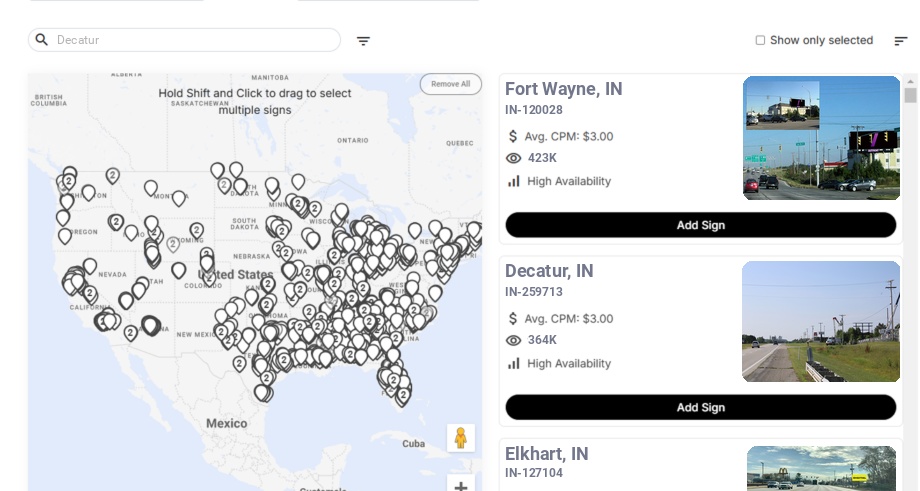
Blip has digital billboards in Decatur. You can browse available locations on a map, choose the ones that fit your audience, and start advertising right away.
Still have questions? Launch a campaign in minutes — no contracts, no commitments.
Start Your CampaignDecatur Billboard Advertising Guide
Decatur, Indiana, offers a compact but highly engaged market for digital billboard advertising. With strong manufacturing roots, a steady commuter flow to nearby Fort Wayne, and a full calendar of community events, we can use Blip’s flexibility to get in front of residents, regional visitors, and through-traffic at the right moments and locations with Decatur billboards placed on the highest-visibility corridors.
Understanding the Decatur Market
Decatur is the county seat of Adams County and sits at the crossroads of U.S. 27 and U.S. 224, about 20 miles southeast of Fort Wayne. According to recent population estimates, Decatur has roughly 9,800–10,000 residents, while Adams County as a whole has around 35,000–36,000 residents, with the broader Fort Wayne–Huntington–Auburn region exceeding 450,000 people. That small-city scale actually works in our favor for Decatur billboard advertising: local brands can quickly build strong name recognition, and regional brands can dominate share of voice with relatively modest budgets.
Key local characteristics to keep in mind:
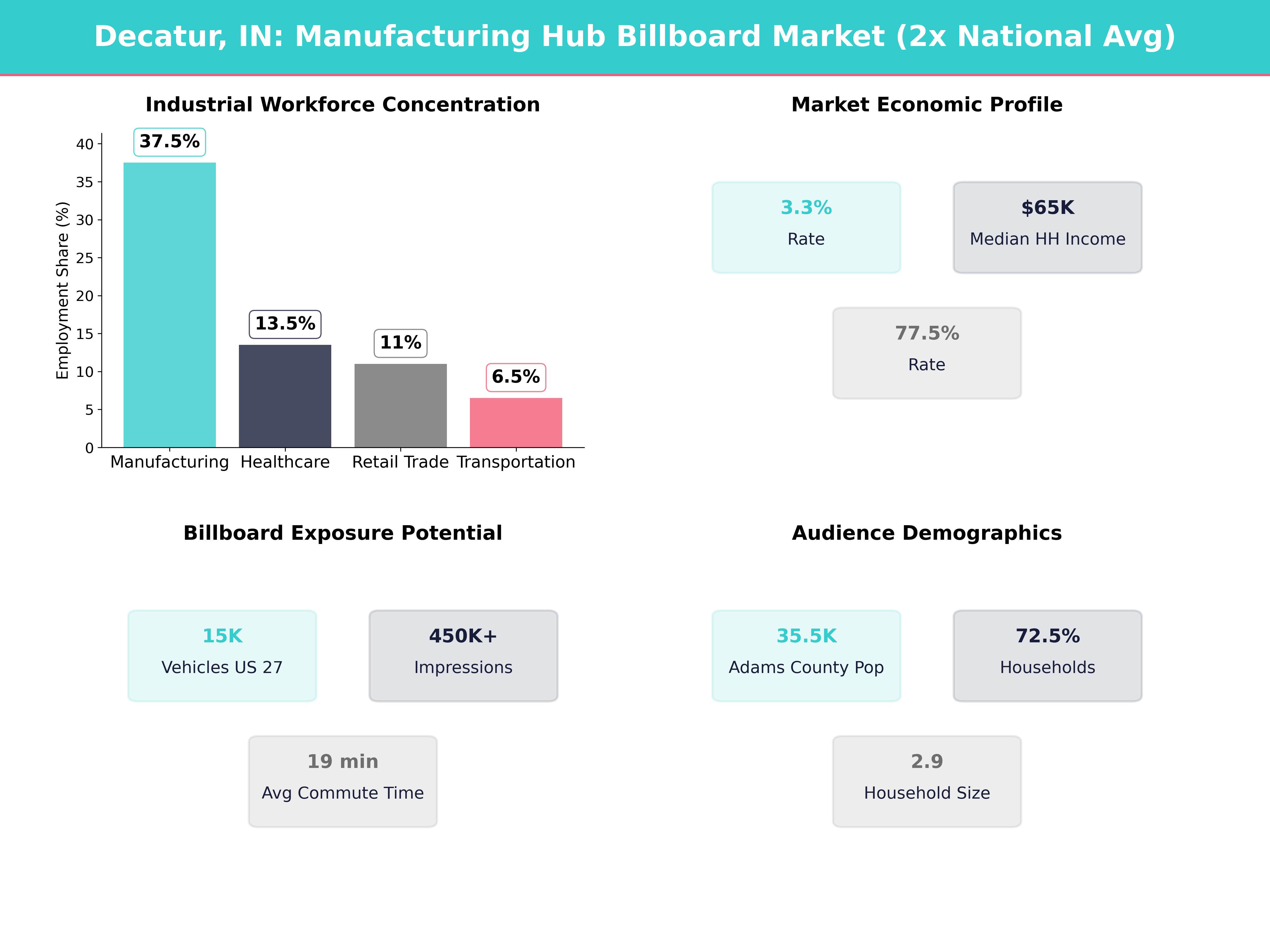
- Decatur’s economy is heavily driven by manufacturing, logistics, and agriculture. State labor figures show Adams County’s manufacturing employment share consistently in the 35–40% range—more than 2× the U.S. average—with large employers in metal fabrication, transportation equipment, and food processing supporting thousands of jobs.
- Unemployment in Adams County has recently trended in the 2.5–4.0% band, often below the statewide average, which signals a relatively tight labor market and stable consumer spending power.
- Median household income in Adams County sits in the $62,000–68,000 range, with a significant blue-collar workforce but also a growing subgroup of middle-income commuters who work in Fort Wayne (roughly 20–25% of employed residents commute to another county).
- Average commute times hover around 18–20 minutes, which means a substantial share of workers are on the road during the same morning and late-afternoon windows—ideal for dayparted billboard campaigns and efficient billboard rental in Decatur targeting those routines.
- Decatur is the government and service hub for the county, home to the Adams County Courthouse, government offices, and key civic institutions, which bring in daily traffic from surrounding rural communities. Courthouse and county office complexes can attract hundreds of visits per weekday for court dates, permits, and public services.
Official resources worth knowing:
- City government: City of Decatur, Indiana
- County government: Adams County, Indiana
- Local economic development: Adams County Economic Development Corporation
- Local chamber of commerce: Decatur Chamber of Commerce
- Local news: Decatur Daily Democrat, The Journal Gazette – Fort Wayne, WANE 15 – Fort Wayne
- Regional tourism: Visit Fort Wayne, Visit Indiana – Northeast Region
When we plan a campaign for Decatur, we’re thinking in terms of (1) core local households we can reach repeatedly, (2) commuters who move between Decatur and Fort Wayne, and (3) through-traffic using Decatur as a pass-through on regional routes. That framework helps decide which billboards in Decatur deliver the best reach for your message and how to distribute your budget across locations.
Who We’re Talking To: Audience & Demographics
Advertising in Decatur means speaking to a community that is stable, family-oriented, and highly community-focused.
Based on recent state and regional data, typical Adams County population characteristics include:
-
Age distribution
- Around 26–28% under age 18
- Roughly 56–59% between 18 and 64 (prime working age)
- Around 14–17% 65 and older
This skews slightly younger than some rural counties, thanks to strong family formation and multi-generational households.
-
Household composition
- Family households account for around 70–75% of all households.
- Average household sizes are typically 2.8–3.0 people, higher than large metro averages, which often sit closer to 2.4–2.6.
- Roughly 35–40% of households include children under 18, supporting a steady demand for youth-oriented services, healthcare, and activities.
-
Education & occupations
- A majority of adults hold at least a high school diploma (often 88–92% of residents age 25+), with many having some college, trade school, or technical credentials tied to manufacturing and healthcare.
- Around 15–20% of adults have a bachelor’s degree or higher, with those degrees concentrated in education, business, and health fields.
-
Top employment sectors:
- Manufacturing: 35–40% of jobs
- Health care and social assistance: 12–15%
- Retail trade: 10–12%
- Transportation, warehousing, and logistics: 5–8%
- Education, public administration, and local services make up much of the balance.
-
Income and cost of living
- Median household income: low-to-mid $60,000s, with some estimates edging toward $67,000–$68,000 in recent years as wages in manufacturing and healthcare have risen.
- Homeownership rates are typically 75–80%, well above many metro areas. This signals a rooted, long-term audience that values local businesses and services.
- Local housing costs are significantly below large-city norms: median home values often run 30–40% lower than the national median, and typical rents for a 2-bedroom apartment can be $800–$1,000 per month, versus $1,300+ in many metros.
- A lower overall cost of living—commonly cited at 10–15% below the U.S. average—means a dollar of marketing-driven spend can stretch further for local consumers.
Implications for creative and targeting:
- Family-focused messaging works. With roughly 1 in 3 households raising children, promotions for grocery, healthcare, insurance, home improvement, and family entertainment should highlight stability, savings, and trust on any Decatur billboards you use.
- Practical offers outperform hype. In value-conscious markets, clear promos—“Oil change $39.95” or “Dental exam + X-rays $79”—tend to resonate more than abstract brand messages.
- Community themes build loyalty. References to local schools, sports, churches, and events can drive emotional connection. For example: “Proud to serve Decatur families since 1998” or “Supporting Adams Central and Bellmont athletes.”
You can explore local school communities through North Adams Community Schools (Bellmont) and Adams Central Community Schools.
Traffic Patterns and Prime Billboard Corridors
Decatur’s traffic is concentrated on a few high-impact roadways. When we align our Blip scheduling with these flows, we maximize impressions per dollar and make Decatur billboard advertising more efficient.
Major routes and behavior patterns:
-
U.S. 27 (North–South spine)
- U.S. 27 connects Fort Wayne to Decatur and continues south toward Portland and Richmond.
- Indiana Department of Transportation counts near Decatur show annual average daily traffic (AADT) in the 13,000–19,000 vehicles per day range on key segments, with truck traffic often accounting for 15–25% of vehicles.
- Heavy use by daily commuters, freight trucks, and regional shoppers heading to Fort Wayne. A conservative working estimate of 15,000 vehicles per day yields over 450,000 vehicle impressions per month on a well-placed board.
-
U.S. 224 (East–West connector)
- Links Decatur with Bluffton to the west and Ohio to the east.
- Typical daily traffic volumes can fall in the 8,500–14,000 vehicles per day range near Decatur, depending on the segment and proximity to town.
- Strong for cross-border shoppers, service trips, and agricultural or industrial traffic moving between Indiana and Ohio.
-
Local arterials within Decatur
- Streets around downtown, the courthouse, and main retail areas (such as routes feeding into North 13th Street, Winchester Street, and corridors near the Decatur Plaza retail area) see concentrated local flows.
- School-related flows are notable: each school can generate hundreds of vehicle trips within a 30–45 minute window during drop-off and pick-up.
For up-to-date roadway data, advertisers can reference the state’s traffic counts via INDOT – Indiana Department of Transportation.
Rush-period insights we can use for scheduling:
- Morning peak: 6:30–9:00 a.m., led by manufacturing and school schedules. Early shifts often start at 6:00–7:00 a.m., so catching drivers between 5:45–7:30 a.m. can be especially effective. In manufacturing-heavy communities, as many as 30–40% of workers may start before 8:00 a.m.
- Midday: 11:00 a.m.–1:30 p.m. sees lunch traffic, errands, and service calls—prime time for quick-service restaurants, auto services, health clinics, and local retailers.
- Afternoon/evening: 3:00–6:30 p.m. combines school release, second-shift transitions, and after-work errands. Many local families combine school pickup with grocery, pharmacy, or drive-thru stops, increasing exposure to boards near shopping corridors.
How we can leverage this with Blip:
- Allocate higher bids during morning and evening commuting windows on U.S. 27 for any advertiser targeting working adults. Even a 20–30% bid premium in those windows can significantly increase share of rotations.
- Use midday emphasis on U.S. 224 for restaurants, health services, and retail, especially near Decatur’s main commercial clusters.
- If Blip boards are available closer to downtown corridors, focus school-year weekday afternoons for family services, tutoring, gyms, and youth-focused businesses. This makes billboard rental in Decatur highly adaptable to specific audience segments and times of day.
Seasonality, Weather, and Local Events
Decatur’s climate and community calendar strongly influence when and how people are on the roads.
Climate & seasonality
-
Average temperatures (30-year normals for the region):
- January: highs around 31–33°F (−0.5–0.5°C), lows near 17–19°F (−8 to −7°C)
- July: highs around 83–85°F (28–29°C), lows in the 62–65°F (17–18°C) range
-
Precipitation:
- Around 36–40 inches of annual precipitation.
- Average annual snowfall in northeast Indiana is typically 25–35 inches, creating periods of reduced speed and increased billboard dwell time as drivers slow down.
-
Daylight:
- Shortest days in December bring only about 9 hours of daylight, while June offers close to 15 hours. This affects how often boards are seen in darkness versus daylight and makes illumination and contrast important.
-
Seasonal behavior:
- Winter (Dec–Feb): Shorter daylight, more cautious driving. People minimize unnecessary trips, focusing on commuting, school, and essential shopping. Demand rises for auto repair, HVAC, healthcare, and home delivery.
- Spring (Mar–May): Surge in outdoor activity, home improvement, and vehicle maintenance. Hardware stores, landscapers, and contractors see increased demand; spring can account for 25–30% of annual sales in some home-service categories.
- Summer (Jun–Aug): Peak driving months, with local festivals, road trips, and youth sports. Many tourism and recreation-focused businesses can see 30–40% of their yearly revenue in this window.
- Fall (Sep–Nov): Back-to-school, harvest season, and holiday preparation. Retailers often generate 20–30% of annual sales in the November–December holiday period alone.
Key events and community touchpoints
While specific dates change annually, Decatur and Adams County host recurring events that draw significant local and regional traffic:
- Decatur Sculpture Tour – An ongoing public art initiative that brings visitors downtown and gives us a creative hook for artful or culture-friendly campaigns. Over the course of a season, the tour can attract several thousand visitors, including regional day-trippers. Details via the City of Decatur.
- Madison Street Plaza events – Concerts, markets, and seasonal events at the downtown plaza can bring hundreds of attendees on single evenings, creating concentrated traffic before and after events. Find schedules via the Decatur Parks & Recreation Department Madison Street Plaza
- Adams County 4-H Fair – Typically drawing thousands of attendees over multiple days, this fair is a major summer traffic driver for both in-county and neighboring-county residents. Event details are often listed through the Adams County 4-H Fair Adams County Purdue Extension.
- High school sports – Football and basketball seasons at Bellmont High School hundreds to over 1,000 spectators on game nights. Rivalry matchups and tournament games can push attendance even higher, creating pre- and post-game traffic along key corridors.
- Agricultural and 4-H events – Auctions, field days, and 4-H activities, often tied to the fairgrounds, bring in rural families and ag professionals who rely heavily on pick-ups and farm vehicles, increasing billboard exposure on county roads feeding U.S. 27 and U.S. 224.
How to use this information in campaigns:
- Increase Blip budgets 2–3 weeks before major festivals or fairs to build anticipation and event awareness. A 25–50% temporary increase can dramatically boost message frequency on billboards in Decatur that sit along main access routes.
-
Rotate creative seasonally:
- Spring: lawn care, contractors, tax prep, auto service, garden centers.
- Summer: family outings, dining, local attractions, recreation gear, tourism. Tie in to regional visitors using Visit Fort Wayne and nearby attractions.
- Fall: HVAC maintenance, back-to-school offers, insurance, home improvement, harvest and hunting-related products.
- Winter: healthcare, indoor activities, financial services, and holiday retail, with timely calls-to-action around events like Small Business Saturday or local church bazaars.
- For sports-driven campaigns, run weekday afternoon and Friday evening bursts targeting game audiences and school traffic; during varsity football season, 5–7 p.m. Fridays can deliver intense concentrations of local impressions.
Crafting Effective Creative for a Small-City Audience
In a market like Decatur, where drivers often see the same boards repeatedly, clarity and authenticity matter more than flashy gimmicks.
Creative best practices for Decatur:
-
Lead with one clear benefit or offer.
For a small business:- “New Patients: Exam + X-Ray $89 – Call Today”
- “Free Tire Rotation with Oil Change – This Month Only”
Calls-to-action with a specific dollar amount or percentage off tend to outperform vague savings claims by 10–30% in response tracking when paired with trackable URLs or phone numbers.
-
Use highly legible typography.
- Stick to 6–8 words max plus a logo and URL/phone.
- High contrast (white on dark, or dark on bright) works well in all seasons, including snowy or overcast days.
- Aim for letter heights of 18–24 inches or more on standard boards to maintain readability at typical speeds of 35–55 mph.
-
Feature local cues when possible.
- “Serving Adams County Since 1985”
- “Just 10 Minutes from Downtown Decatur on U.S. 27”
- References to Bellmont Braves or Adams Central Jets, when appropriate. Local sponsorship recognition—“Proud Sponsor of Bellmont Athletics”—can lift brand favorability among local families.
-
Account for winter lighting and weather.
- Avoid fine details that could get lost in snow glare or fog.
- Use bold colors that stand out against gray skies (deep blues, reds, bright yellows).
- Because winter sunset can be as early as 5:15 p.m., ensure designs read clearly in both daylight and after dark.
-
Highlight convenience and price.
- In a cost-conscious market, straightforward savings messages (“Save 15% This Week Only”) are powerful.
- Add simple directional info: “Next Right on 224” or “Across from Courthouse.” Basic directional cues can increase store visit intent by 10–20% compared with non-directional creative, based on common OOH industry tests.
-
Leverage rotation with multiple creatives.
-
Use Blip to A/B test different calls to action:
- Creative A: “Book Online – Same-Day Appointments”
- Creative B: “Call Now – Walk-ins Welcome”
- Run both for 1–2 weeks, then favor whichever aligns with observed performance metrics (website visits, phone calls, coupon redemptions, etc.). Even in small markets, advertisers often see 20–40% performance differences between top and bottom creative variations. This testing is especially valuable when you have a limited number of Decatur billboards in your mix and need each rotation to work hard.
-
Use Blip to A/B test different calls to action:
Timing and Budget Strategy with Blip in Decatur
Because Decatur’s traffic is concentrated in predictable waves and on a limited set of routes, we can be very strategic with dayparting and bidding.
Dayparting recommendations
-
Workforce and services
- Core windows: 6:30–9:00 a.m. and 3:30–6:30 p.m.
- Best for: auto dealers, service centers, healthcare, banking, insurance, logistics, recruitment.
- In a market where over 60% of adults are working-age, these windows can capture a majority of employed residents at least several times per week.
-
Retail and dining
- Focus: 11:00 a.m.–2:00 p.m. plus 4:30–7:30 p.m.
- Great for: restaurants, grocery stores, quick-service chains, hardware stores, local boutiques.
- Lunch and early dinner periods typically account for 50–70% of daily quick-service restaurant traffic.
-
Family and community services
- Augmented windows during school drop-off (7:00–8:15 a.m.) and pickup (2:30–4:00 p.m.).
- Useful for: childcare, tutoring, healthcare, extracurricular activities, family-oriented entertainment.
- With roughly one in three households including children, these school-related travel windows are especially valuable.
Budget considerations in a smaller market
- In a market the size of Decatur, a focused Blip budget can still generate high frequency among your target audience. For example, even a modest campaign delivering 10,000–20,000 weekly impressions across one or two boards can translate into 3–7+ exposures per week for a large share of local commuters.
-
For a local business, it’s often more effective to:
- Run fewer boards with higher frequency, rather than thin coverage across many boards.
- Concentrate spend around key weeks (e.g., the two weeks before a sale or event) instead of lightly advertising year-round.
Practical budgeting approaches:
- Always-on presence:
A modest daily budget allocated to morning and evening commutes to maintain awareness. For many small advertisers, this might look like a baseline spend that yields 5–10 impressions per driver per week along a primary route. -
Pulsed campaigns:
Increase bids and daily budgets 30–50% during:- Tax refund season (Feb–Apr)
- Back-to-school (Aug–Sep)
- Holiday shopping (Nov–Dec)
These periods typically correspond with 10–30% spikes in retail and service spending, giving more return on each impression.
- Event-specific bursts:
For festivals, grand openings, or sales, run short, high-intensity flights 5–10 days ahead of the date. A focused burst can double or triple your average daily impressions versus baseline, making billboard rental in Decatur during these key windows especially cost-effective.
Industry-Specific Tips for Decatur Advertisers
Different sectors can take advantage of Decatur’s patterns in distinct ways.
Local retailers and restaurants
- Use distance-based messaging: “2 Miles Ahead on 27” or “Next Left on 224.” Location-specific cues can improve store visit rates by 15–25% over generic brand messaging.
- Promote lunch specials around 11:00 a.m.–1:00 p.m., particularly for locations close to workplaces or downtown offices.
- Rotate weekly offers to keep content fresh for repeat commuters; a typical worker commuting 5 days per week may pass the same board 40–60 times per month.
Healthcare providers (clinics, dental, vision, urgent care)
- Emphasize convenience: same-day appointments, walk-ins, extended hours. In smaller markets, more than 70% of patients still book via phone, so clear phone numbers and “Call Today” CTAs remain effective.
- Target peak commuting times and winter months, when health concerns are top-of-mind and respiratory illnesses peak.
- Leverage trust language: “Locally owned,” “Trusted by Decatur families,” “Serving Adams County for 20+ years.” In community surveys, 60–80% of residents in small towns report preferring local providers when available, making locally focused Decatur billboard advertising particularly persuasive.
Auto dealers and service centers
-
Align campaigns with seasonal maintenance cycles:
- Spring: “Road Trip Ready – Free Inspection”
- Summer: “AC Check & Recharge Specials”
- Winter: “Winter Tire Specials – Book Today” or “Free Battery Check”
- Focus on through-traffic on U.S. 27 and U.S. 224, especially for regional dealerships drawing from multiple counties and nearby Ohio communities.
- Consider including payment or financing hooks (“Payments from $299/month” or “0% APR for 36 Months”) which are strong motivators in mid-income markets.
Home services (HVAC, roofing, plumbing, contractors)
-
Hyper-seasonal creative:
- Summer: AC tune-ups, new system financing.
- Fall: furnace checks, insulation, roofing.
- Spring: roofing and exterior upgrades after winter.
- Highlight financing options and free estimates; these are key decision drivers in a value-conscious market where many projects exceed $3,000–$5,000.
- Pair your billboard messaging with local credibility signals: “Licensed & Insured in Adams County” or “Proud Member – Decatur Chamber of Commerce.”
Recruitment and workforce marketing
- Manufacturing, logistics, and healthcare employers can use billboards to capture applicants who already commute through Decatur. In manufacturing-heavy counties, 20–30% of workers may be open to new opportunities within the next year, even if currently employed.
-
Include:
- Starting wages (“$22/hr starting pay”)
- Shift info (“Day & Night Shifts Available”)
- Simple application path (“Apply at [short URL]” or “Text JOBS to ####”). Short, memorable URLs can improve response rates by 20%+ compared with long or complex web addresses.
- Coordinate messaging with listings on local employer and community sites, including the Adams County Economic Development Corporation and local news outlets, to reinforce your message seen on billboards in Decatur.
Integrating Billboards with Local Media and Community Presence
Decatur’s residents are strong consumers of local news and community information, especially via print/online newspapers, TV, and community Facebook pages.
To amplify results:
-
Coordinate billboard messaging with:
- Ads or mentions in the Decatur Daily Democrat.
- Regional TV coverage via WANE 15 The Journal Gazette – Fort Wayne.
- City or county announcements posted on Decatur’s official site or Adams County’s site.
- Community calendars and event pages via Decatur Chamber of Commerce or local parks and recreation.
-
Mirror the same core message:
- Billboard: “Grand Opening – This Saturday – 10% Off Storewide”
- Social media: event details, RSVP, giveaways, and behind-the-scenes content.
- In-store: signage echoing the “10% Off” and tying back to “Seen on U.S. 27” or “Mention this billboard for your discount.” Clear message consistency across channels can increase recall by 20–30%.
-
Participate in community events:
- Sponsor local sports teams, fairs, or school programs and reference those partnerships in your creative:
“Proud Sponsor of Local 4-H” or “Supporting Bellmont Athletics.” - With hundreds to thousands attending major local events, even a single-season sponsorship can generate tens of thousands of impressions through on-site signage plus billboard reinforcement.
- Sponsor local sports teams, fairs, or school programs and reference those partnerships in your creative:
Measuring and Optimizing Your Campaign
Even in a small market, we should treat billboard campaigns as test-and-learn opportunities.
Ways to track and refine:
-
Use unique URLs or QR codes on your creatives:
- Example: “example.com/27” vs. “example.com/224” to compare corridors.
- QR codes are now familiar to most drivers and can be scanned by passengers; businesses often see 5–10% of tracked billboard responses come via QR.
-
Use unique phone numbers or extensions:
- A dedicated tracking line or extension (“Press 2 for our Decatur special”) lets you attribute calls directly to the campaign.
-
Match campaign dates to business KPIs:
- Monitor store traffic, phone calls, or online bookings during and immediately after your Blip flights. Even a 5–10% lift in weekly sales or leads can be meaningful in a small market.
-
Test sequential creative:
- Week 1–2: Brand awareness (“Meet Your New Local HVAC Team”).
- Week 3–4: Offer-focused (“$79 Furnace Tune-Up – This Month Only”).
- Week 5–6: Urgency (“Last Week for $79 Furnace Tune-Up”).
Tracking changes in inquiries across these waves can show which message type delivers the best return.
-
Adjust schedules based on performance:
- If you notice more calls or walk-ins during certain hours, reweight your Blip spend to those windows; shifting even 20–30% of impressions into top-performing dayparts can significantly improve ROI.
- If a particular board location correlates with better response, favor it in your rotation while testing a second-best option for comparison.
By combining Decatur-specific insights—its commuter flows, event calendar, family-oriented demographics, and strong manufacturing base—with Blip’s flexible scheduling and creative rotation, we can build Decatur billboard advertising campaigns that punch well above their budget. The result is a visible, measurable presence along the routes Decatur residents use every day, at the times they are most ready to act, and a smarter approach to billboard rental in Decatur that matches your goals and resources.