Billboards in Kendallville, IN
No Minimum Spend. No Long-Term Contracts. Just Results.
Trusted by Leading Brands


Billboard advertising
in Kendallville has never been easier
How much is a billboard in Kendallville?
Why Choose Blip for Billboard Advertising in Kendallville
Blip lets Kendallville brands launch fast on U.S. 6, SR 3, and SR 9—no contracts, just flexible local reach.
Set budgets that fit Kendallville's commuter traffic and only pay when your ad flashes. Blip keeps spend under control.
Daypart your Kendallville ads for school pickup, 6-9 a.m. commutes, or summer lake weekends near Chain O' Lakes.
Track Kendallville campaign results in real time and shift creative as traffic swings between Fort Wayne routes and local errands.
Use Blip's creative tools to build bold Kendallville billboards for families, hospital traffic, and Noble County drivers.
Frequently Asked Questions About Billboard Advertising in Kendallville
How much does a billboard cost in Kendallville with Blip?
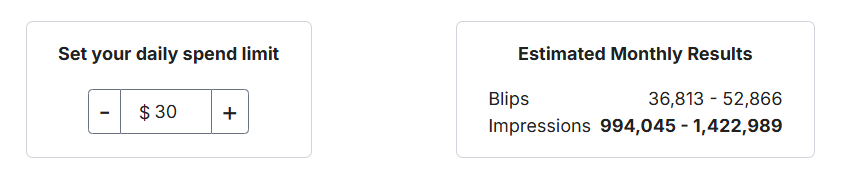
With Blip, the cost of a billboard in Kendallville can be surprisingly manageable because you only pay when your ad actually appears. Each “blip” is a 7.5-to-10-second display on a rotating digital billboard, and pricing starts at just $0.01 per display. Since pricing is dynamic, the cost per blip can vary based on time of day, location, and advertiser demand, but Blip is designed to maximize your visibility for the budget you choose.
Where can I advertise with Blip in Kendallville for the most traffic?
Kendallville’s value comes from a small number of roads that carry a very large share of local movement. U.S. 6 is Kendallville’s main east-west commercial spine, State Road 3 is the north-south workhorse, and State Road 9 also matters for local and community-oriented reach. These routes capture local errands, commute traffic, county movement, and regional pass-through travel.
Why is Kendallville a strong market for billboard advertising?
Kendallville is a strong billboard market because it combines a stable local population with countywide draw, regional commuter traffic, and warm-weather tourism. The city has just under 10,000 residents, and it serves as the largest population center in Noble County. It also sits at the meeting point of U.S. 6, State Road 3, and State Road 9, while remaining only about 30 miles north of Fort Wayne.
When is the best time to run Blip ads in Kendallville?
Timing matters in Kendallville because traffic patterns change with school schedules, recreation seasons, and winter driving conditions. The clearest seasonal opportunity runs from Memorial Day to Labor Day, and back-to-school advertising is especially strong from late July into mid-August. In winter, lower light and earlier sunsets make high-contrast digital creative even more important.
What kind of drivers and audiences can I reach in Kendallville with Blip?
Commuters are one of the strongest billboard audiences in Kendallville because well over 90% of workers rely on cars and average trips are around 25 minutes. You can also reach families, students, tourists, lake visitors, and weekend travelers through the area’s local routes and seasonal traffic patterns. The market works well for repeat impressions because people see messages on the same practical roads they already use for work, school, shopping, healthcare, and recreation.
Do I need a contract to advertise with Blip in Kendallville?
No, Blip has no long-term contracts or minimum commitments. You can start, pause, or stop your campaign at any time.
How fast can I launch a billboard campaign with Blip in Kendallville?
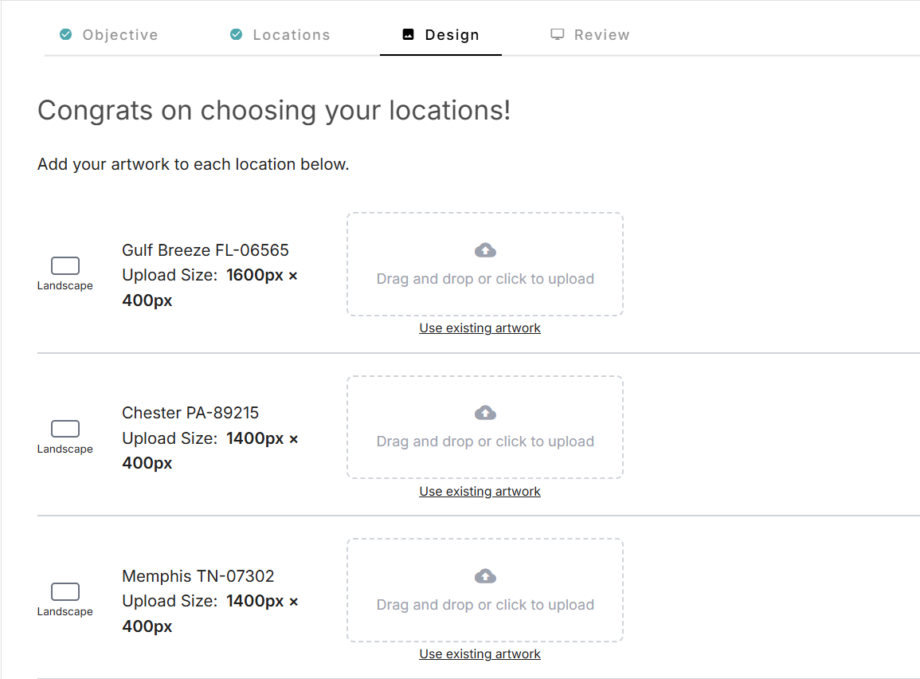
You can have your campaign live in minutes. Create a free account, select your locations, set your budget, upload your design, and start running once approved.
Where can I advertise with Blip in Kendallville?
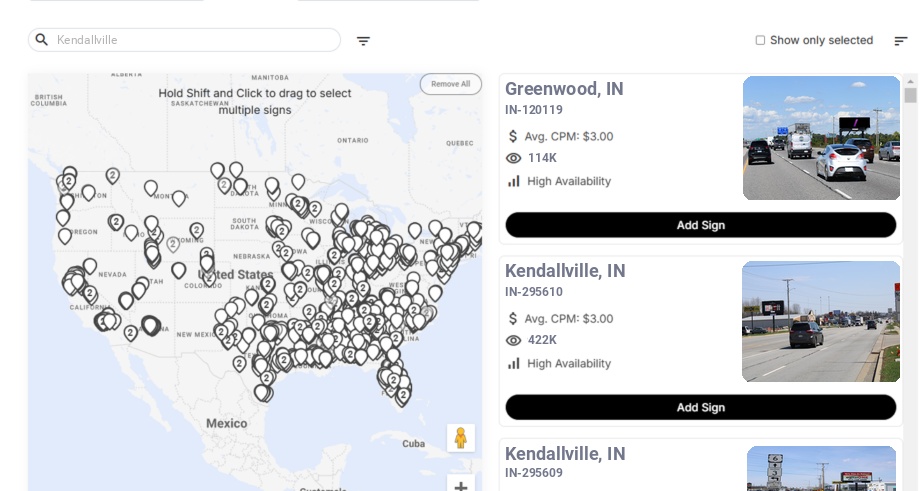
Blip has digital billboards in Kendallville. You can browse available locations on a map, choose the ones that fit your audience, and start advertising right away.
Still have questions? Launch a campaign in minutes — no contracts, no commitments.
Start Your CampaignKendallville Billboard Advertising Guide
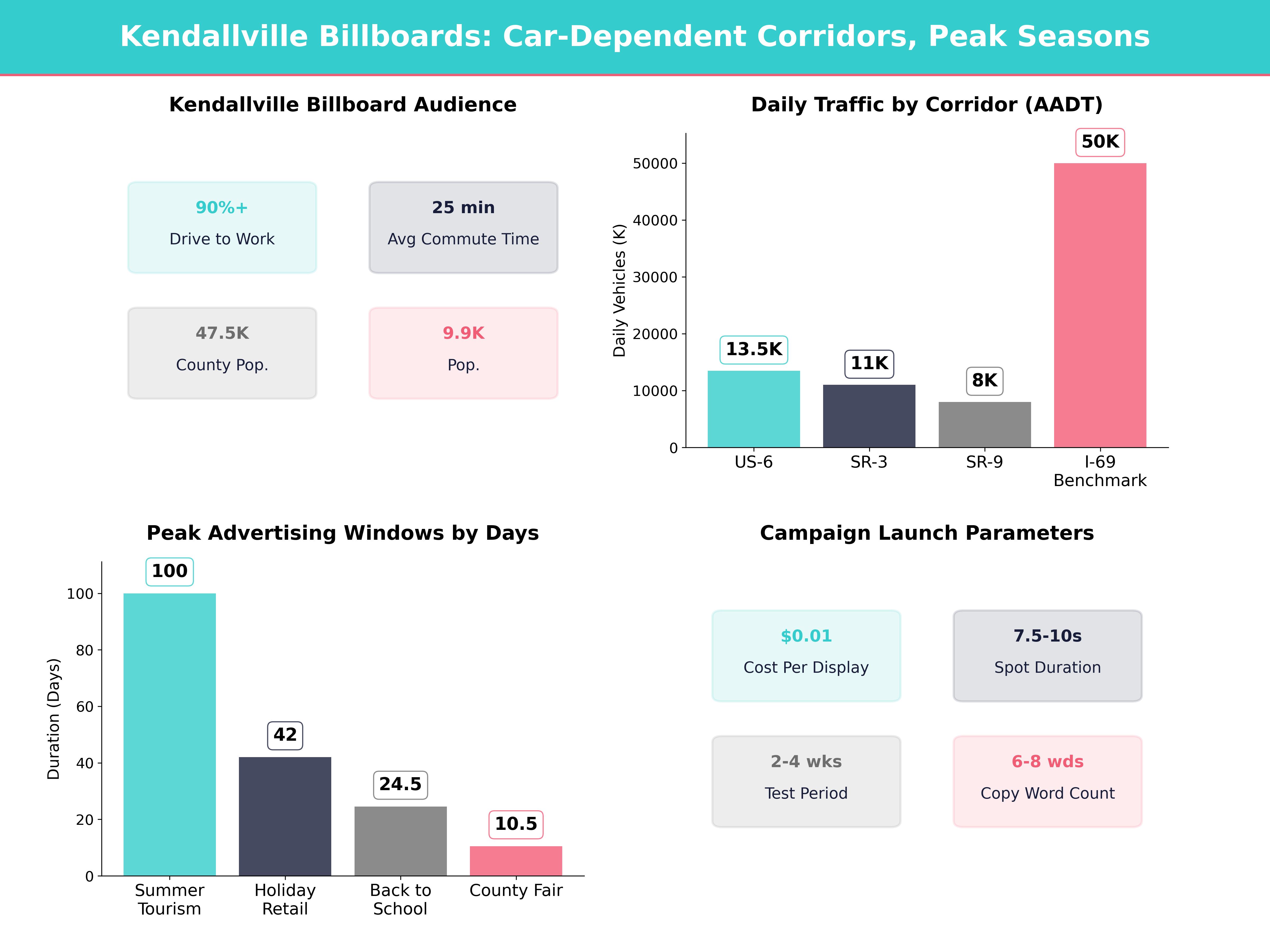
Kendallville just under 10,000 residents (about 9,900), and it serves as the largest population center in Noble County 47,457 residents in the 2020 count reported through STATS Indiana. We also benefit from the fact that Kendallville sits at the meeting point of U.S. 6, State Road 3, and State Road 9, while remaining only about 30 miles north of Fort Wayne. In a market where daily life depends heavily on cars and pickups, billboard advertising works because people see messages repeatedly on the same practical routes they already use for work, school, shopping, healthcare, and recreation.
Kendallville Market Overview
Kendallville gives us the rare combination of small-city familiarity and regional mobility. The city functions as a service hub for a broad rural trade area, and its location puts it within easy reach of Auburn 11 counties. That matters for billboard advertisers because our audience is not limited to city residents. We can also reach county residents, southbound commuters, weekend visitors, and people making cross-county shopping trips.
Demographics and local scale in Kendallville
Noble County is not a giant metro, but that is part of its advantage. In a smaller market, repeated impressions are easier to build, and local names become familiar faster. A business does not need to dominate a million-person media market to be remembered in Kendallville. It needs strong placement, practical messaging, and steady visibility along the routes people already trust.
Kendallville also benefits from being close enough to larger destinations to capture pass-through movement. The city is about 15 miles north of Auburn, about 20 miles west of Angola, and roughly 45 miles east of Elkhart. Those distances are close enough to support regular intercity trips, but far enough that roadside reminders still influence where people stop, shop, and schedule services.
Economic context and what it means for advertisers
The local economy is anchored by the kinds of sectors that naturally create repeat road traffic, including manufacturing, agriculture, healthcare, education, retail, and regional services. Indiana Department of Workforce Development data consistently show that northeast Indiana counties rely heavily on production, logistics, and service-sector employment, which tends to create fixed commute patterns and repeat trip behavior. For advertisers, that is ideal. Consistent routes produce consistent exposure.
Healthcare is also an important local draw thanks to Parkview Noble Hospital, and education contributes steady family traffic through East Noble School Corporation, West Noble School Corporation, and Central Noble Community School Corporation. Those 3 public school districts create recurring peaks around drop-off, pickup, athletics, and back-to-school periods. When we combine those family routines with work commutes and errands, the result is a market where well-placed digital billboards can deliver frequency without requiring a huge budget.
Car dependence and commuting in Kendallville
Kendallville is exactly the kind of market where out-of-home performs well because personal vehicles dominate local travel. Commuting profiles published through STATS Indiana show that the overwhelming majority of workers in counties like Noble travel by car, and in practice that means well over 90% of workers are in personal vehicles rather than using fixed-route transit. Average commute times in this part of northeast Indiana are typically around 25 minutes, which is long enough for roadside media to matter and short enough for repeated daily exposure.
For us as advertisers, that translates into three practical advantages: We can build frequency with the same drivers on the same weekday routes. We can target decision moments near retail, restaurants, healthcare, and service businesses. We can expand beyond Kendallville city limits and still stay relevant to the local buying area.
Key Traffic Corridors for Kendallville Billboard Advertising
Kendallville’s value comes from a small number of roads that carry a very large share of local movement. INDOT count maps and corridor data consistently point us toward three primary local routes and one important regional connector. When we understand what each route does, we can choose locations that match our goals instead of simply buying the nearest screen.
U.S. 6 in Kendallville
U.S. 6 is Kendallville’s main east-west commercial spine, and it is usually the first corridor we evaluate. On the busier in-town segments, INDOT traffic counts generally place U.S. 6 in the 12,000 to 15,000 AADT range. That is excellent volume for a city this size because it combines local errands, crosstown trips, county traffic, and regional pass-through movement.
This corridor works especially well for: Restaurants and convenience brands, because drivers often decide quickly where to stop on an east-west route; Retailers and grocery-adjacent businesses, because U.S. 6 is tied to practical shopping trips rather than one-off destination travel; Healthcare and pharmacy advertisers, because the route captures recurring appointment and errand traffic; and Auto services and home services, because everyday vehicle use makes these categories highly relevant.
U.S. 6 is also a strong frequency route. If we want local name recognition, this is often the place to start.
State Road 3 in Kendallville
State Road 3 is Kendallville’s north-south workhorse, especially for trips toward Auburn and the Fort Wayne area. Through the main commercial approach, INDOT counts typically put SR 3 in the 10,000 to 12,000 AADT band. The route is valuable because it captures both local trips and longer work-related travel.
This corridor is a smart fit for: Employers and staffing firms, because it reaches workers during routine commute periods; Healthcare systems, because it connects residential areas with medical destinations such as Parkview Noble Hospital; Banks, insurance agencies, and legal services, because commuters often respond to trust-based messages seen repeatedly over time; and Regional retailers in Auburn or Fort Wayne, because the road helps pull shoppers south.
If our goal is to influence people before they choose where to spend money beyond Kendallville, SR 3 is especially important.
State Road 9 in Kendallville
State Road 9 carries lower traffic than U.S. 6 or SR 3, but it still matters. In and around Kendallville, the corridor often falls in roughly the 7,000 to 9,000 AADT range, which is still meaningful in a market this size. SR 9 tends to feel more local and community-oriented, which makes it useful for advertisers who want neighborhood credibility rather than broad pass-through reach.
We typically like SR 9 for: Local service businesses, because the audience is more likely to be county residents than long-distance passersby; Community events and nonprofit promotions, because the route feels locally grounded; and Schools, childcare providers, and family attractions, because families use this corridor for routine county movement.
A lower-volume road is not a weaker road if the audience is closer to our ideal customer. In Kendallville, SR 9 can be highly efficient.
The Auburn and Fort Wayne connector
Even though I-69 is south of Kendallville, it still matters for strategy because many regional trips funnel from Kendallville to Auburn and Fort Wayne. South of Auburn, I-69 segments commonly rise above 50,000 vehicles per day, which is several times the volume of Kendallville’s local corridors. That makes the Kendallville-to-Auburn-to-Fort Wayne movement pattern especially valuable for businesses that want to expand beyond Noble County.
This strategy is effective for: Colleges and trade schools, including Purdue University Fort Wayne, Indiana Tech, Ivy Tech Community College Fort Wayne, and Trine University; Regional healthcare providers, because patients frequently travel south for specialized care; Major retail, entertainment, and event venues, because weekend and evening trips often extend into Auburn and Fort Wayne; and Auto dealers and housing-related businesses, because shoppers are willing to travel for high-consideration purchases.
Kendallville Audience Segments We Can Reach
The best Kendallville campaigns are built around real movement patterns, not generic demographics. We can reach several distinct audiences here, and each one responds to different routes, timing, and creative.
Kendallville commuters and local workers
Commuters are one of the strongest billboard audiences in Kendallville. With well over 90% of workers relying on cars and average trips around 25 minutes, we have a classic roadside-advertising environment. Shift workers, office staff, healthcare employees, school staff, and tradespeople all create dependable morning and afternoon impression windows.
This audience responds well to clear, useful messages such as: “Open before work.” “Same-day appointments.” “Now hiring.” “Minutes south on SR 3.” “Call today for an estimate.”
When we advertise to commuters in Kendallville, relevance usually beats cleverness.
Kendallville families and household decision-makers
Families are central to the local market. Noble County’s 47,457 residents are spread across small communities that rely on Kendallville for many day-to-day needs, and the county’s 3 public school districts create a dependable family calendar. Parents travel for school, sports, shopping, pediatric care, groceries, faith communities, and recreation. Community anchors such as the Cole Center Family YMCA, Parkview Noble Hospital, and local school campuses reinforce those weekly routines.
Family-oriented advertisers should focus on convenience, trust, and location. A message about flexible hours, weekend availability, financing, or proximity to a familiar intersection will often outperform abstract branding in this market.
Students and education communities around Kendallville
Kendallville is not a classic college town, but it does sit inside a practical education corridor. We can reach K-12 families locally and college-bound or commuter students regionally. Trine University in Angola is about 20 miles away, while major higher-education options in Fort Wayne are roughly 30 to 40 miles south depending on the campus. That means education advertisers can use Kendallville boards for awareness, deadline reminders, open-house promotion, and recruitment messaging.
This audience is especially relevant for: Colleges recruiting first-generation students from Noble County; Trade schools and workforce programs tied to regional manufacturing; Student housing, financial services, and mobile carriers; Quick-service food and coffee brands around start-of-term periods.
Tourists, lake visitors, and weekend travelers in Kendallville
Tourism is a meaningful bonus audience in this market, especially from late spring through early fall. Chain O’ Lakes State Park 2,700 acres with 9 connected lakes, which makes it one of the area’s most important warm-weather draws. Nearby attractions such as the Gene Stratton-Porter State Historic Site, Black Pine Animal Sanctuary Mid-America Windmill Museum Auburn Cord Duesenberg Automobile Museum broaden the regional visitor base.
Tourism-oriented billboard campaigns work well for: Lodging, campgrounds, and short-stay accommodations; Casual dining, ice cream, coffee, and family entertainment; Boat, RV, outdoor gear, and bait-and-tackle retailers; Museums, seasonal attractions, and local events.
Seasonal and Timing Opportunities in Kendallville
Timing matters in Kendallville because traffic patterns change with school schedules, recreation seasons, and winter driving conditions. We usually get better results when we align campaigns with the local calendar instead of running the same message all year.
Summer in Kendallville, from Memorial Day to Labor Day
The clearest seasonal opportunity runs from Memorial Day to Labor Day. That roughly 100-day window brings lake traffic, park visitation, family outings, and more spontaneous stop decisions. Chain O’ Lakes State Park Gene Stratton-Porter State Historic Site and nearby attractions promoted by Visit Fort Wayne and Indiana Destination Development Corporation.
Summer campaigns should often weight more heavily toward: Thursday through Sunday, when recreational travel increases; Late morning through early evening, when visitors are making activity and meal decisions; and Food, fuel, lodging, and family entertainment categories.
July also matters because county fair season and midsummer events create unusually dense local movement. If we serve families, food, or retail, a one- to two-week burst around fair timing can be very efficient.
Back-to-school and fall in Kendallville
K-12 calendars in northeast Indiana typically restart in early August, which creates a reliable 3- to 4-week back-to-school advertising window from late July into mid-August. That is the moment for pediatric care, orthodontics, clothing, after-school programs, internet providers, and family restaurants. It is also a good time for hiring campaigns because parents reset their routines and older students start looking for part-time work.
Fall remains strong through September and October because local travel stays steady even after summer tourism cools. Home services, HVAC, tires, brakes, and healthcare messages tend to perform well in this stretch.
Holiday and winter timing in Kendallville
The holiday retail window typically runs about 6 weeks from mid-November through year-end. In a practical market like Kendallville, that period is less about luxury branding and more about useful reminders, giftable experiences, and local convenience. Retail, jewelry, restaurants, toy stores, healthcare gifting, and charitable campaigns can all perform well.
Winter also shifts driving behavior. December commutes happen in lower light, and sunsets in Indiana arrive before 5:30 p.m. for much of the month. That makes high-contrast digital creative even more important. Snow, ice, and heating season also increase urgency for auto repair, emergency services, insurance, healthcare, and HVAC advertisers.
Billboard Design Tips for the Kendallville Market
Good creative in Kendallville feels local, direct, and useful. We do not need to overcomplicate the message because this market rewards clarity and relevance.
Use practical copy for Kendallville drivers
Kendallville drivers are often on roads posted around 45 to 55 mph, especially on the main approaches. That means we should build copy for quick recognition, not long reading. In most cases, 6 to 8 words of primary copy is enough.
The best Kendallville messages usually emphasize one of these ideas: Location, such as “On U.S. 6.” Time savings, such as “15 Minutes South.” Convenience, such as “Open Saturdays.” Immediate value, such as “Free Estimate.” Local trust, such as “Serving Noble County.”
Match imagery to Kendallville life
Creative should reflect what people actually value here. Outdoor recreation, hardworking households, local schools, healthcare access, and family time all feel more believable than abstract lifestyle stock photos. Visuals tied to lakes, summer weekends, pickup-truck practicality, school nights, or community events often fit the market better than big-city imagery.
Color choices should also stay bold and simple. Blues and greens work well for lake, healthcare, and family themes. Red, orange, and yellow can be effective for food, automotive, and retail urgency. What usually fails is low-contrast subtlety. With digital boards, we want legibility first.
Make the offer feel local
Specific local references often outperform generic slogans. A Kendallville audience responds well to phrases that signal place and familiarity, including references to U.S. 6, SR 3, downtown, Auburn, Angola, Noble County, or nearby recreation. If we genuinely serve Spanish-speaking households, bilingual creative can also be worth testing because it reflects real community diversity in northeast Indiana.
Regional Strategies Around Kendallville
A Kendallville campaign gets stronger when we think in zones instead of treating every board the same way. Different parts of the area support different goals.
In-town Kendallville strategy
For local awareness, we usually start with in-town Kendallville. The priority is frequency on U.S. 6 and near the SR 3 and SR 9 commercial approaches. This is where we reach residents making everyday decisions about food, healthcare, errands, banking, and services.
This zone is best for: Local retail; Restaurants; Medical and dental practices; Insurance, legal, and financial services; Community events.
Southbound strategy toward Auburn and Fort Wayne
If our goal is regional draw, southbound messaging becomes more important. Kendallville residents regularly travel toward Auburn Fort Wayne, and those trips often take 20 minutes to Auburn and roughly 35 to 45 minutes to Fort Wayne depending on destination. That gives us room to promote bigger-ticket decisions before the shopper reaches competing options.
This zone is best for: Auto dealers; Colleges and workforce training; Regional healthcare systems; Destination retail and entertainment; Employers recruiting across county lines.
Eastbound recreation and Angola strategy
The eastbound and lake-oriented strategy works best in warm weather. Traffic moving toward Chain O’ Lakes State Park Angola
This zone is best for: Campgrounds and lodging; Family attractions; Casual dining and treats; Outdoor recreation brands; Fuel, convenience, and travel services.
Countywide Noble County strategy
Countywide campaigns should remember that Kendallville is the anchor, but not the whole audience. Residents from Albion Rome City, Ligonier
Using Blip Tools in Kendallville
Blip is especially useful in Kendallville because this is a market where timing and route selection matter as much as raw budget. We can use the platform’s map-based buying approach to focus on the corridors that fit our audience instead of overbuying the entire area.
Dayparting for Kendallville traffic patterns
We can schedule around the times that matter most in this market. 6:00 a.m. to 9:00 a.m. works well for commuter, coffee, breakfast, staffing, and healthcare campaigns; 11:00 a.m. to 1:00 p.m. works well for lunch, errands, banks, and same-day service offers; 3:00 p.m. to 6:00 p.m. captures school pickup, after-work traffic, and family decision-making; and Friday noon through Sunday evening is often the best window for lake, dining, and tourism-related promotions in summer.
Testing messages in Kendallville
Kendallville is an excellent market for A/B testing because the audience is concentrated and behavior is repeatable. We can run 2 or 3 different creative variations, compare performance by route and time of day, and keep the version that produces the best response. One message might emphasize convenience, while another focuses on price or location. In a smaller market, those differences become visible quickly.
Budget control and local optimization
We do not need a massive launch to learn something useful here. A modest campaign can still generate meaningful insight because repeat exposure matters in Kendallville. Blip’s flexibility lets us pulse harder during summer weekends, fair week, back-to-school, or holiday retail bursts without committing to a rigid long-term schedule.
Getting Started With Billboard Rental in Kendallville
Renting a billboard in Kendallville should start with the objective, not the screen. Once we know what success looks like, the right locations become much easier to choose.
Start with a clear Kendallville goal
We should first decide whether we want one of three things. Local awareness within about 5 to 10 miles of Kendallville. Countywide reach across Noble County. Regional pull from 20 to 40 miles away, especially from Auburn, Angola, or Fort Wayne-bound traffic.
A local restaurant, dental office, or HVAC company usually benefits most from close-in frequency. A college, auto dealer, or regional healthcare brand may get better value by pairing Kendallville visibility with southbound commuter routes.
Evaluate each Kendallville billboard by context
When we compare locations, we should ask practical questions. Is the board on U.S. 6, SR 3, or SR 9. Is the traffic mostly local or pass-through. Is the ad close to a decision point, such as food, fuel, shopping, or a turn toward our business. Are drivers moving at highway speed or slowing for signals and commercial activity.
In Kendallville, context often matters more than sheer count. A board with slightly lower volume can outperform a busier board if it speaks to the right audience at the right moment.
Launch simply and optimize quickly
A good first campaign in Kendallville is usually straightforward. We recommend one clear offer, one strong visual, and a test period of 2 to 4 weeks. After that, we can adjust the route mix, dayparts, and creative based on what the data shows. With Blip, we can do that without the long contracts and limited flexibility that often come with traditional billboard buying.
For many advertisers, the easiest path is to start with a few boards on the main Kendallville corridors, set a comfortable daily budget, and learn from live results. Because digital ads on Blip run in 7.5- to 10-second spots and pricing starts at $0.01 per display, we can scale carefully, watch performance in real time, and expand only where Kendallville traffic proves our message is working.