Billboards near Derby, KS
No Minimum Spend. No Long-Term Contracts. Just Results.
Trusted by Leading Brands


Billboard advertising
near Derby has never been easier



How much is a billboard near Derby?
Why Choose Blip for Billboard Advertising near Derby
-
Blip lets Derby advertisers launch fast on K-15, Rock Road, and I-35, reaching commuters without buying into long contracts.
-
In Derby, daypart Blip ads for school drop-off, McConnell pay-week, or evening rush to catch families and military households when they’re on the road.
-
Start with a small Derby budget and let Blip follow your daily limit, so you can test commute-heavy traffic without overcommitting.
-
Track Derby campaign results in real time and shift spend toward the K-15 and Rock Road windows driving the most response.
-
Use Blip’s creative tools to build bold Derby ads for fast-moving drivers, shoppers, and Wichita-bound commuters in seconds.
Frequently Asked Questions About Billboard Advertising near Derby
How much does a billboard cost near Derby, Kansas with Blip?
With Blip, you can run ads on digital Derby billboards on any budget, because you set a daily amount that Blip automatically follows while your messages appear on rotating screens serving the Derby area. Each blip is a short 7.5 to 10-second display, and you only pay for the blips you actually receive, similar to pay-per-click ads online. The price of billboards near Derby, Kansas shifts based on the times you choose, the locations you select, and local advertiser demand, so you stay flexible and in control.
Where can I advertise with Blip in Derby, Kansas?
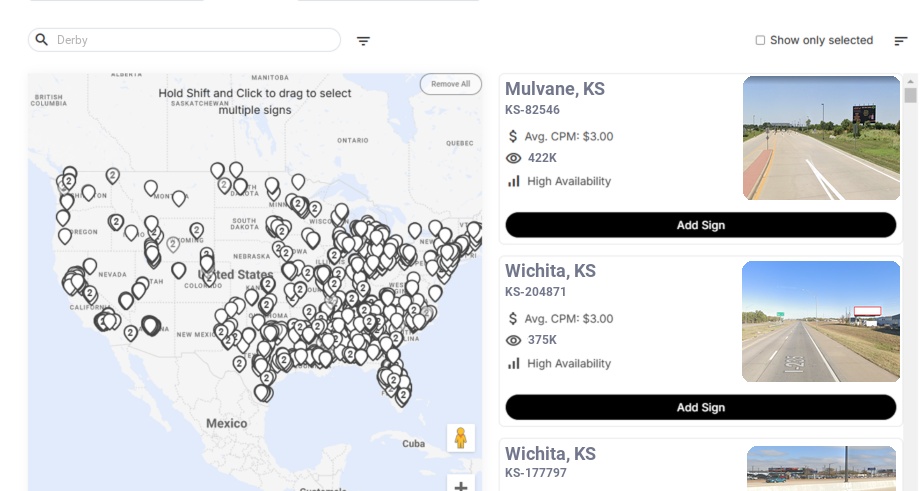
Blip’s 12 digital billboards serving the Derby area are located in Wichita, within about 10 miles of Derby. Strategically, that’s an advantage: it puts your message where Derby-area residents actually drive the most, on corridors that routinely handle tens of thousands of vehicles per day. For advertisers looking specifically for billboards near Derby, these placements provide a concentrated way to intercept daily traffic between home, work, school, and shopping.
What kind of people can I reach with Blip billboards near Derby, Kansas?
The Derby area has a few standout audience segments that respond especially well to digital billboard advertising near Derby. These include commuting families and homeowners, military and defense-related households, and healthcare and education professionals. With messages placed on high-volume corridors, advertisers can put their messages in front of commuting families, military personnel, and shoppers moving between Derby and the wider Wichita region.
When is the best time to run a billboard campaign in Derby, Kansas?
With digital, we can schedule “blips” precisely when Derby-area travelers are on the road or in a buying mindset. Morning drive from 6:30–9:00 a.m. captures school drop-offs plus arrivals at workplaces and McConnell AFB, while evening drive from 4:00–6:30 p.m. is often the single busiest window of the day. Fridays and Saturdays from 10:00 a.m.–8:00 p.m. are especially strong for retail promotions, entertainment, and family attractions.
Which roads in Derby, Kansas get the most billboard traffic?
Key commuter routes include K-15, Rock Road, and the Kansas Turnpike (I-35), which together carry tens of thousands of vehicles per day between Derby, south Wichita, and east Wichita. K-15 is the primary route between the Derby area and south Wichita, with daily traffic often in the 18,000–25,000 vehicles per day range. Rock Road segments commonly carry 25,000–35,000 vehicles per day, and urban interstate segments in the Wichita area often exceed 55,000–65,000 vehicles per day.
Do I need a contract to advertise with Blip near Derby?
No, Blip has no long-term contracts or minimum commitments. You can start, pause, or stop your campaign at any time.
How fast can I launch a billboard campaign with Blip near Derby?
You can have your campaign live in minutes. Create a free account, select your locations, set your budget, upload your design, and start running once approved.
Where can I advertise with Blip near Derby?
Blip has digital billboards near Derby. You can browse available locations on a map, choose the ones that fit your audience, and start advertising right away.
Still have questions? Launch a campaign in minutes — no contracts, no commitments.
Start Your CampaignDerby Billboard Advertising Guide
Derby, Kansas sits just south of Wichita and combines small‑city feel with metro‑area access. With 12 digital billboards serving the Derby area from nearby Wichita, advertisers can put their messages in front of commuting families, military personnel, and shoppers moving between Derby and the wider Wichita region—on flexible budgets and precise schedules. Those 12 boards, positioned on high‑volume corridors in and around Wichita, can collectively generate hundreds of thousands of weekly impressions, depending on schedule and share of rotations, giving even modest campaigns substantial visibility from billboards near Derby.
Understanding the Derby Area Market
Derby is one of the fastest‑growing communities in south‑central Kansas and a key suburban market near Wichita, making Derby billboards a natural way to reach both local residents and metro‑area commuters.
-
Population scale
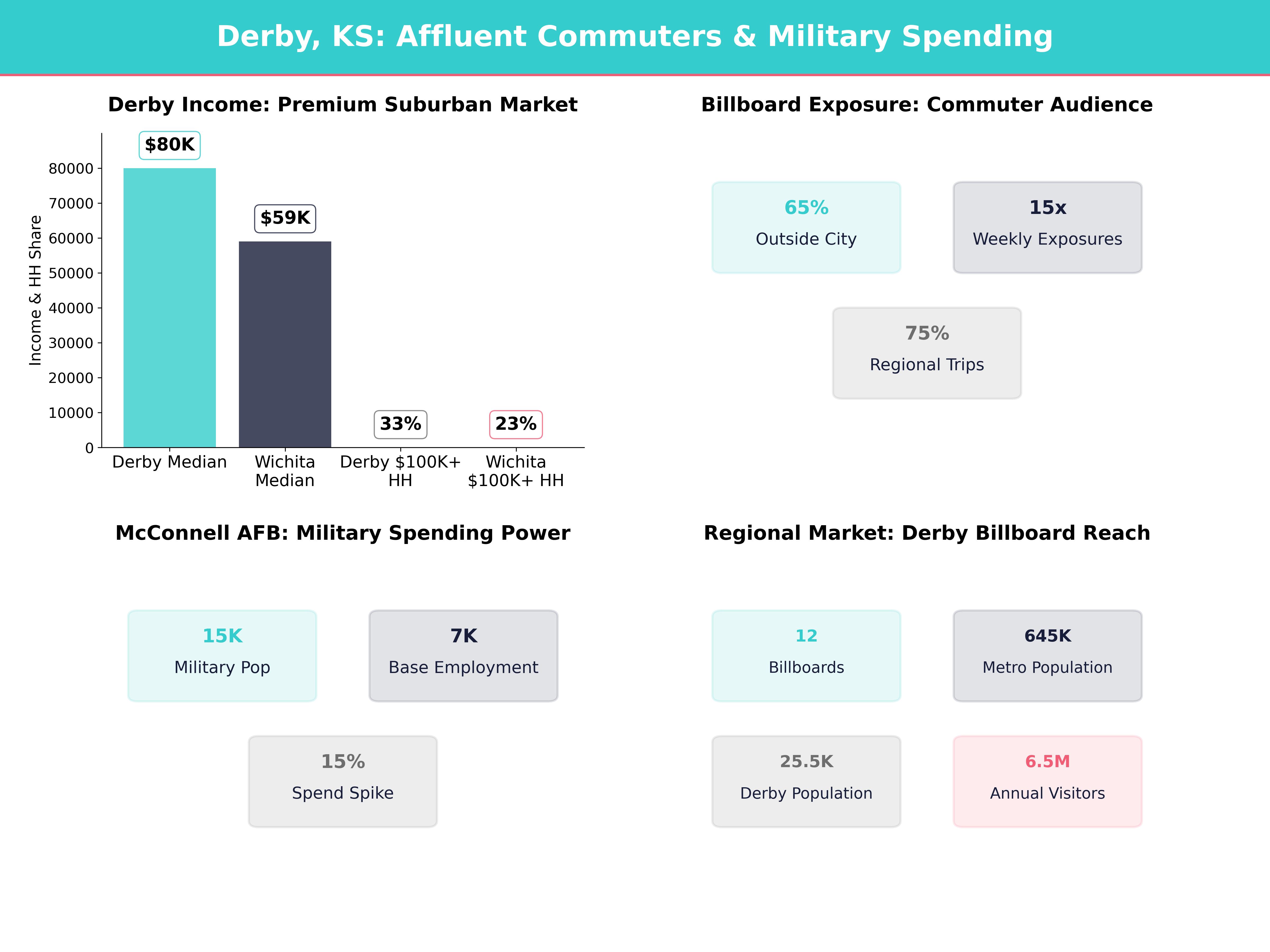
- Derby’s population is roughly 25,000–26,000 residents, and local estimates from the City of Derby put the figure at just over 25,000 in recent years, up from about 17,000 in 2000—an increase of roughly 45–50% over two decades.
- Derby is Sedgwick County’s second‑largest city after Wichita, which has about 395,000–400,000 residents according to recent city and county planning figures.
- The broader Wichita metro area (Sedgwick, Butler, Harvey, and surrounding counties) exceeds 640,000–650,000 people, giving advertisers access to a regional labor and shopping shed far larger than Derby alone through efficient billboard advertising near Derby.
- Sedgwick County population is a little over 520,000, according to Sedgwick County, underscoring how much of the county’s activity is concentrated in and around Wichita and Derby.
-
Income and spending power
- Derby’s median household income is commonly reported in the $75,000–$85,000 range in recent community profiles—around 25–35% higher than Wichita’s, which typically falls between $55,000 and $62,000.
- More than 30–35% of Derby households earn $100,000 or more per year, compared with roughly 20–25% in Wichita, giving Derby residents above‑average purchasing power for big‑ticket items.
- Owner‑occupied housing in Derby is typically around 70–75% of all occupied housing units, higher than many urban neighborhoods in Wichita; this supports strong demand for home improvement, landscaping, roofing, and HVAC that can be driven by well‑placed Derby billboards.
- Retail trade and food services alone account for thousands of local jobs in the Derby–south Wichita area, with annual retail sales reaching into the hundreds of millions of dollars across nearby shopping corridors, according to local economic development and Derby Chamber of Commerce figures.
-
Commuter dynamics
- Derby functions as a classic commuter suburb: local transportation and planning data show that 60–70% of employed Derby residents work outside the city limits, with a large share commuting north toward Wichita.
- Key commuter routes include K‑15, Rock Road, and the Kansas Turnpike (I‑35), which together carry tens of thousands of vehicles per day between Derby, south Wichita, and east Wichita.
- Many Derby‑area residents work at or around major employers such as McConnell Air Force Base, Spirit AeroSystems, healthcare systems, and higher‑education institutions in Wichita.
- This daily movement means that a typical Derby commuter can see the same billboard 10–20 times per workweek if you concentrate impressions during rush hours on their primary route, significantly boosting recall for brands using billboard advertising near Derby.
For a deeper feel of the community, it’s helpful to scan local resources like the City of Derby, the Derby Chamber of Commerce, and local news from The Derby Informer and the Wichita Eagle
Who You Can Reach Near Derby
The Derby area has a few standout audience segments that respond especially well to digital billboard advertising near Derby:
1. Commuting Families and Homeowners
- Derby is a heavily residential community, with subdivisions and single‑family homes dominating the housing stock; roughly 7 in 10 occupied housing units are owner‑occupied, and multi‑car households are very common.
- Derby Public Schools (USD 260), serving the Derby area and nearby communities, enrolls over 7,000 students across multiple elementary schools, two middle schools, and Derby High School, according to USD 260. That translates into several thousand parents and caregivers in predictable, drive‑heavy school routines each weekday.
- School‑day traffic patterns mean many households pass the same major corridors multiple times daily—drop‑off and pick‑up trips, plus work commutes and after‑school activities—creating frequent billboard touchpoints.
- These families frequently travel to Wichita for shopping, work, healthcare, and entertainment, passing digital billboards multiple times per week; local household travel surveys in similar suburbs often show 70–80% of families making at least one weekly trip to a major regional center like Wichita.
Best fits: Family services, dentists, pediatric care, after‑school programs, quick‑service restaurants, auto dealers, home services, and financial institutions.
2. Military and Defense‑Related Households
-
McConnell Air Force Base, lying between Wichita and the Derby area, employs more than 7,000 active‑duty and reserve airmen and civilian employees, according to the base’s public fact sheets. Including spouses and dependents, the total McConnell‑connected population in the area likely exceeds 15,000 people.
- Many McConnell families live in or near the Derby area due to its proximity, schools, and housing options, creating a dense cluster of military households along the K‑15 and Rock Road corridors that can be efficiently reached with billboards near Derby.
- Military‑connected households tend to have stable incomes and predictable pay cycles (twice‑monthly active‑duty paydays). Advertisers can time billboard flights to “pay‑week” windows, where consumer spending on dining, retail, and auto services typically spikes 10–20% versus off‑pay weeks in many military communities.
- Permanent Change of Station (PCS) seasons—especially late spring and summer—bring waves of new arrivals who are actively searching for housing, banking, childcare, and local services within their first 30–60 days.
Best fits: Housing and apartments, auto sales and service, banks/credit unions, insurance, healthcare, education, and local attractions.
For more background, see the official McConnell AFB site
3. Healthcare and Education Professionals
- Wichita’s role as a regional healthcare center—with major systems such as Wesley Healthcare and Ascension Via Christi—draws patients and professionals from across south‑central Kansas. These systems employ thousands of physicians, nurses, and staff, many of whom choose to live in quieter suburbs like the Derby area.
- Higher education institutions like Wichita State University, which enrolls around 16,000–17,000 students and employs several thousand faculty and staff, add another professional commuter base traveling between campus, hospitals, and home communities such as Derby.
- These workers commute primarily on I‑35, K‑15, and major arterials where Wichita billboards are located, often driving during off‑peak shifts (early morning, late evening) as well as typical rush hours.
Best fits: Real estate, higher‑end retail, financial services, professional services, and specialty medical practices near Derby and Wichita.
Key Roadways and Billboard Flow Serving the Derby Area
Blip’s 12 digital billboards serving the Derby area are located in Wichita, within about 10 miles of Derby. Strategically, that’s an advantage: it puts your message where Derby‑area residents actually drive the most, on corridors that routinely handle tens of thousands of vehicles per day. For advertisers looking specifically for billboards near Derby, these placements provide a concentrated way to intercept daily traffic between home, work, school, and shopping.
When planning campaigns, think in terms of traffic flows, not city limits.
-
K‑15 (south Wichita corridor)
- Primary route between the Derby area and south Wichita, also connecting to McConnell AFB.
- Recent average daily traffic counts on K‑15 between Derby and Wichita often fall in the 18,000–25,000 vehicles per day range, according to corridor data summarized by the Kansas Department of Transportation
- Morning northbound (toward Wichita and McConnell) and evening southbound (toward Derby) are prime times for Derby‑bound and Derby‑origin traffic.
-
Rock Road corridor
- One of the busiest retail and commuter corridors in the region, with major shopping centers, dining, and services in east Wichita and the Derby retail strip.
- In south and east Wichita, several Rock Road segments commonly carry 25,000–35,000 vehicles per day, feeding into major retail destinations and big‑box centers.
- Derby’s main retail strip connects seamlessly to Rock Road in Wichita, so boards on or near Rock Road capture Derby shoppers heading to regional malls, specialty retail, and dining.
-
Kansas Turnpike (I‑35)
- Connects the Derby area and Wichita with the broader Kansas Turnpike system operated by the Kansas Turnpike Authority
- Urban interstate segments in the Wichita area often exceed 55,000–65,000 vehicles per day, blending daily commuters with long‑distance travelers.
- Strong for reaching through‑traffic as well as Derby‑area residents making longer‑distance trips for work, sports tournaments, or leisure travel.
According to traffic counts published by the Kansas Department of Transportation tens of thousands of vehicles per day, providing a strong impression base for Derby‑oriented campaigns. Exact counts vary by segment, but many urban stretches in south and east Wichita exceed 25,000–35,000 vehicles per day, with some interstate segments surpassing 60,000 vehicles per day—ideal volumes for sustaining ongoing billboard rental near Derby that still feels locally targeted.
When to Advertise: Timing Strategies for the Derby Area
With digital, we can schedule “blips” precisely when Derby‑area travelers are on the road or in a buying mindset. Here are data‑informed timing ideas.
Weekday Commuter Focus
-
Morning drive (6:30–9:00 a.m.)
- In many commuter corridors, 25–35% of weekday vehicle trips occur during the morning and evening peaks. For Derby‑to‑Wichita commuters, 6:30–9:00 a.m. captures school drop‑offs plus arrivals at workplaces and McConnell AFB.
- Strong for coffee shops, breakfast spots, daycare, school‑related services, and daily needs like fuel and convenience stores.
- Messaging should be concise and action‑oriented: “On your way to Derby? Grab breakfast at…”.
-
Evening drive (4:00–6:30 p.m.)
- Often the single busiest window of the day, when traffic volumes can be 10–20% higher than midday on commuter corridors.
- Ideal for restaurants, grocery, fitness centers, and home services, as households plan dinner and errands on the way back to the Derby area.
- Commuters driving back toward the Derby area are more open to messages about dinner, errands, or appointments they can schedule that evening or within the next 24–48 hours.
You can use Blip’s dayparting tools to buy only these rush‑hour windows, stretching modest budgets further by concentrating impressions when Derby‑area residents are most likely to be on the road.
Weekend and Shopping Patterns
- Many Derby‑area residents head toward Wichita on weekends for major shopping, events, and dining. Regional tourism data from Visit Wichita notes that millions of visitors come into the Wichita area each year—recent figures often top 6–7 million annual visitors, generating well over $1 billion in direct spending—many of whom move through the same retail corridors used by Derby residents.
-
Fridays and Saturdays (10:00 a.m.–8:00 p.m.) are especially strong for:
- Retail promotions
- Entertainment and events
- Family attractions and sports
- Foot‑traffic analyses for regional malls and big‑box centers typically show that Saturday can account for 20–25% of weekly visits, with Friday and Sunday also elevated, so heavier weekend billboard schedules can align with this surge.
This aligns with foot‑traffic patterns to Wichita’s major retail centers, which often see their highest visitor counts on Saturdays.
Event‑Driven Spikes
The Derby area and Wichita host regular events that temporarily spike traffic:
- Local festivals and parades in the Derby area promoted by the City of Derby and the Derby Chamber of Commerce, such as Derby’s major summer and holiday events, can draw thousands of visitors over a weekend.
- Regional events, sports, and concerts promoted via Visit Wichita—including college sports, air shows, and large‑scale festivals—routinely pull in tens of thousands of attendees per event from across Kansas and neighboring states.
By aligning short, intense flights around these dates, you can capture heightened visitor volumes moving between Derby and Wichita and potentially lift awareness by 20–40% compared with “normal‑week” schedules for event‑oriented brands.
Crafting Creative That Works for Drivers Near Derby
The Derby area’s audience composition should shape your art and copy. Across work in similar suburban‑metro corridors, a few creative principles consistently perform well.
Design for Fast, Family‑Oriented Commuters
- Use large, high‑contrast type. Aim for 6–8 words or fewer on the main line. At typical speeds of 40–65 mph, drivers often have only 3–5 seconds to view your board; limiting copy can increase recall by 20–30% compared with cluttered designs.
- Feature one primary image or icon. For example, a crisp product shot, a smiling family, or a strong logo. Eye‑tracking research on roadside media consistently shows that single‑image layouts draw and hold attention better than collage‑style designs.
-
Color choices:
- Derby and Wichita roads can see bright sun and reflective conditions; high contrast (e.g., dark text on light background or vice versa) improves readability and can increase legibility distance by 50–100 feet.
- Avoid busy gradients and low‑contrast color combinations (e.g., red on black) unless heavily tested.
Speak to Local Identity
The Derby area has a distinct community feel even as part of the Wichita metro:
- Reference well‑known local anchors: “Minutes from the Derby water park,” (such as Rock River Rapids), “Just north of Derby on K‑15,” or “Short drive from the Derby area.”
- Use imagery that matches local life: family ballgames, Friday‑night lights, neighborhood gatherings, and community parks. Derby and south‑central Kansas residents report high participation in youth sports and school events, making those themes relatable.
- School pride matters—Derby High School’s Panthers identity and green/white color palette can be useful themes when targeting families, though avoid implying official affiliation unless you have it.
Offer Clear Next Steps
Because your billboards are located near Wichita but speak to people from the Derby area:
- Include a short directional cue: “5 miles south,” “Next exit to Rock Rd,” or “Just off K‑15 near the Derby area.” Simple directional language can improve “intent to visit” responses by 10–15% in many out‑of‑home tests.
- Pair digital billboards with easy‑to‑remember URLs or short domains, especially for time‑sensitive promotions or events; short URLs can see 30–40% higher direct‑visit rates than long, complex ones.
- Phone numbers should be used sparingly and only if they are short and easy to remember—ideally 7–10 digits with strong patterning (repeating or sequential numbers).
Using Blip’s Flexibility to Target the Derby Area Precisely
Blip’s platform lets you buy single “blips” on those 12 digital billboards serving the Derby area, adjusting by time of day, days of week, budget, and boards. This gives even small businesses access to flexible billboard rental near Derby without long‑term contracts or minimum‑spend requirements.
Budget Strategy
- Start with a modest daily budget that focuses on peak times (e.g., weekday rush hours and Saturday midday). For many small businesses, this might translate to reallocating the cost of one or two print ads per month in a regional paper like the Derby Informer or Wichita Eagle
- Digital billboard CPMs (cost per thousand impressions) are often competitive with or lower than many traditional local media channels; even a modest campaign can deliver tens of thousands of impressions per month when carefully dayparted.
- Increase bids slightly for the most in‑demand time blocks (evening rush, Friday afternoons) to win a higher share of available rotations; bumping bids during these windows can increase your share of voice by 20–50%, depending on competition.
Geographic Targeting
- Select boards in south and east Wichita to catch Derby‑area commuters, especially on approaches commonly used by Derby residents such as K‑15, I‑35, and Rock Road. This is where Derby billboards will most often intersect with daily routines.
- If you have a physical location in or near Derby, prioritize boards on the main approach roads that your customers use—many retailers find that boards within 5–8 miles of their store can drive measurable lifts in foot traffic.
- Consider layering boards on both the outbound and inbound sides of key routes to reach Derby residents traveling in both directions; mirror exposure like this can improve message recall by 30% or more.
A/B Testing Creative
With digital, it’s simple to test multiple designs:
- Run two or three versions simultaneously with small variations in headlines or imagery. Even minor changes—such as swapping a price point versus a benefit statement—can create 10–25% performance differences.
- After 1–2 weeks, review which design produces more web visits, calls, or store traffic (tracked via offer codes, URLs, or time‑bound promotions).
- Shift more budget to the higher‑performing design while rotating in a new challenger, using a basic “test and learn” cycle every 30 days to steadily improve results.
Sector‑Specific Ideas for the Derby Area
Some industries are especially well‑positioned to use billboards serving the Derby area.
Local Retail and Restaurants
- Derby‑area and south Wichita households typically spend thousands of dollars per year on food away from home; in many suburban communities, restaurant spending can account for 40–50% of total food dollars.
- Promote limited‑time specials or weekly deals tied to pay periods (e.g., military and public‑sector paydays) when discretionary spending spikes.
- Use callouts like “On your way back to the Derby area? Dinner ready in 10 minutes.”
- Run heavier on Thursdays–Saturdays when dining‑out and shopping activity peaks; many restaurants see 25–35% of their weekly revenue on Friday and Saturday alone, making those days ideal for targeted billboard advertising near Derby.
Home Services and Contractors
- With homeownership rates around 70–75% in Derby, there is steady demand for roofing, HVAC, remodeling, lawn care, and exterior improvements.
- Focus on reassuring messages: “Trusted in the Derby area since 19XX,” “Free estimates to Derby‑area homes,” or “Licensed and insured in Sedgwick County,” reinforcing credibility with local homeowners.
- Use spring and early summer flights for outdoor services—when project inquiries typically rise 20–40%—and late summer/fall for HVAC and roofing, when weather changes prompt maintenance and replacement projects.
Healthcare and Dental Practices
- Many Derby‑area families choose care either near Derby or in south/east Wichita corridors they travel often; pediatric, dental, and primary‑care practices can draw from a regional radius of 10–20 miles.
- Highlight convenience: “Evening appointments for Derby‑area families,” or “10 minutes from Derby via Rock Rd.” Reduced drive time and after‑work appointments are common decision factors for busy households.
- Time campaigns with back‑to‑school and benefits‑renewal periods (e.g., August–October, November–January), when demand for physicals, immunizations, and elective services often rises 15–30%.
Real Estate and Apartments
- The Derby area’s growth over the last two decades—adding roughly 8,000–9,000 residents—illustrates strong housing demand. Families moving from elsewhere in the Wichita metro often cite schools, parks, and perceived safety as top reasons to choose Derby.
- Use messaging that emphasizes schools, parks, and safety: “New homes minutes from Derby schools,” “Quiet community near McConnell AFB and the Derby area,” or “Walking distance to Derby parks.”
- Run heavier in late spring and summer, when moves peak; many markets see 40–50% of annual residential moves between May and August. For new developments, pairing open‑house weekends with short‑burst billboard rental near Derby can help quickly build awareness.
Aligning With Local Calendars and Media
You can amplify your digital billboard campaign by coordinating it with local media and community rhythms:
-
Community Calendars:
- Follow event listings from the City of Derby and Derby Chamber of Commerce for fairs, parades, and city events that may bring thousands of people into parks, downtown areas, and sports complexes.
- Use these as anchors for short, high‑intensity billboard flights, starting 7–14 days before each event to build awareness.
-
Regional Tourism & Events:
- Visit Wichita highlights concerts, sports, conventions, and festivals that bring increased visitors through corridors serving the Derby area. Large‑scale events can drive hotel occupancy toward 80–90% on peak nights and fill major roads before and after.
- When a major event is in south or east Wichita, adjust your boards and schedule to capture that spike, targeting pre‑event and post‑event travel windows (typically 2–3 hours before and after).
-
Local News Cycles:
- The Derby Informer and Wichita Eagle
- Aligning campaigns with news‑driven themes—such as property tax deadlines, school sports playoffs, or local election seasons—can make your creative feel more relevant and timely, potentially lifting ad recall by 10–20%.
Practical Checklist for a Derby‑Area Billboard Campaign
To pull everything together, here’s a concise planning checklist:
-
Define your Derby‑area audience.
- Families, military households, commuters, or another niche.
- Estimate how many potential customers you have (e.g., “Derby‑area families with school‑aged kids,” “McConnell‑connected households”).
-
Map their routes.
- Identify whether they’re more likely to use K‑15, Rock Road, I‑35, or other corridors linking the Derby area with Wichita.
- Focus on routes that see tens of thousands of vehicles per day and overlap the times your audience is most likely to travel, then select Derby billboards placed along those paths.
-
Choose campaign windows.
- Rush‑hour only? Weekends? Event‑focused bursts? Use Blip’s dayparting to match.
- Aim for at least 4–6 weeks for awareness campaigns and 2–3 weeks for event‑specific pushes.
-
Design clear, local creative.
- 6–8 word headline, large fonts, one strong visual, and a simple call to action referencing the Derby area.
- Test at least one version that mentions a specific route, exit, or landmark familiar to Derby‑area drivers.
-
Set and test your budget.
- Start modest, center spend on the most valuable hours, and adjust bids based on performance.
- Monitor impressions and basic response metrics weekly; shift 10–20% of spend toward the best‑performing times and boards.
-
Run A/B tests.
- Rotate at least two creatives. Measure impact via website traffic, coupon codes, call volume, or store visits.
- Keep a simple log of which messages and visuals perform best in the Derby area to guide future campaigns.
-
Refine and scale.
- Increase visibility around proven high‑response time slots, boards, and messages.
- As results improve, consider expanding to additional boards or longer hours to reach a broader share of Derby‑area commuters and shoppers through ongoing billboard advertising near Derby.
By combining Derby’s strong household incomes, high homeownership, and community feel with the metro‑scale reach of 12 digital billboards serving the Derby area from Wichita, advertisers can build campaigns that are both precise and powerful. With smart timing, locally tuned creative, and Blip’s flexible tools for billboard rental near Derby, your brand can stay top‑of‑mind for the people who live, work, and shop in and around the Derby area.