Billboards in Hugoton, KS
No Minimum Spend. No Long-Term Contracts. Just Results.
Trusted by Leading Brands


Billboard advertising
in Hugoton has never been easier

How much is a billboard in Hugoton?
Why Choose Blip for Billboard Advertising in Hugoton
-
Blip lets you launch in Hugoton fast, reaching U.S. 56 drivers and county-seat traffic with self-serve control.
-
No contracts in Hugoton mean you can test ads on K-25 and U.S. 56, then shift budget as rural routes change.
-
Use Blip's dayparting in Hugoton to hit 6-9 a.m. farm crews and 3-7 p.m. school-family commuters.
-
Track real-time results in Hugoton and optimize for harvest, school sports, or cross-county trips to Liberal and Ulysses.
-
Blip's creative tools help you build bold, readable ads for Hugoton's long sightlines, farm traffic, and bright High Plains sun.
Frequently Asked Questions About Billboard Advertising in Hugoton
How much does a billboard cost in Hugoton with Blip?
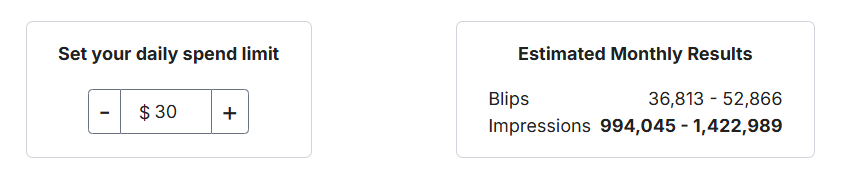
With Blip, billboard advertising in Hugoton can fit a wide range of budgets because you only pay when your ad actually appears. Each “blip” is a 7.5-to-10-second display on a rotating digital billboard, with pricing starting at just $0.01 per display. Your daily budget guides Blip’s algorithm as it bids for open ad slots, and the cost per blip can change based on time of day, location, and advertiser demand.
Where can I advertise with Blip in Hugoton, Kansas?
Hugoton’s traffic pattern is simple, which is good for advertisers. Most meaningful daily movement funnels through a few routes, including U.S. 56, K-25, and K-51. U.S. 56 is Hugoton’s east-west spine, K-25 is the north-south route, and K-51 and nearby in-town connectors are useful for very local, high-intent trips.
Why does billboard advertising work in Hugoton, Kansas?
Hugoton is a small city with an outsized role in far southwest Kansas, which is exactly why billboard advertising can work well here. The practical market is larger because shoppers, farm operators, energy crews, and school families all drive into town by car across a county of about 728 square miles and only 7.2 residents per square mile. In a place where U.S. 56, K-25, and K-51 organize daily life, outdoor ads stay visible on repeat trips instead of getting buried in heavy urban media clutter.
What kind of audience can I reach in Hugoton with Blip?
Hugoton advertising works best when we think in audience groups rather than in generic “traffic.” Local roads can reach county-seat commuters and daily errand drivers, agricultural and energy workers, families, students, and school communities. The trade area around Hugoton also matters more than the city limits alone, with regional shoppers and cross-border travelers coming in from nearby communities.
When is the best time to run billboard ads in Hugoton, Kansas with Blip?
Hugoton is a year-round advertising market, but the strongest campaigns respect the area’s seasonal rhythms. Spring runs from March through May, summer is especially strong during wheat harvest in June and July, and fall from August through November is one of the most commercially active stretches. Winter from November through February shifts the message mix toward holiday retail, tax preparation, financial planning, healthcare, heating, tires, batteries, and essential home services.
Do I need a contract to advertise with Blip in Hugoton?
No, Blip has no long-term contracts or minimum commitments. You can start, pause, or stop your campaign at any time.
How fast can I launch a billboard campaign with Blip in Hugoton?
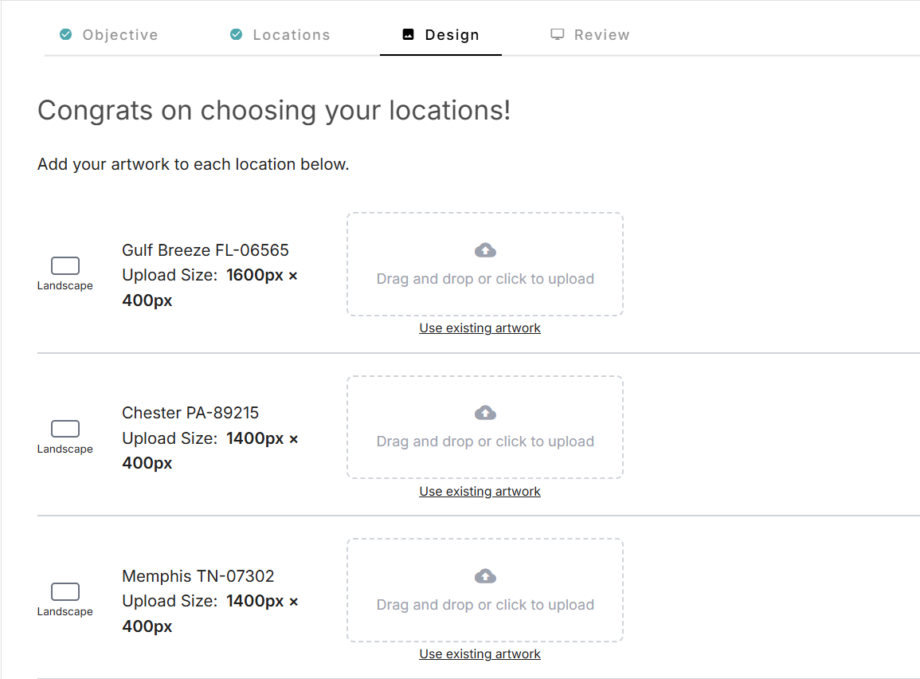
You can have your campaign live in minutes. Create a free account, select your locations, set your budget, upload your design, and start running once approved.
Where can I advertise with Blip in Hugoton?
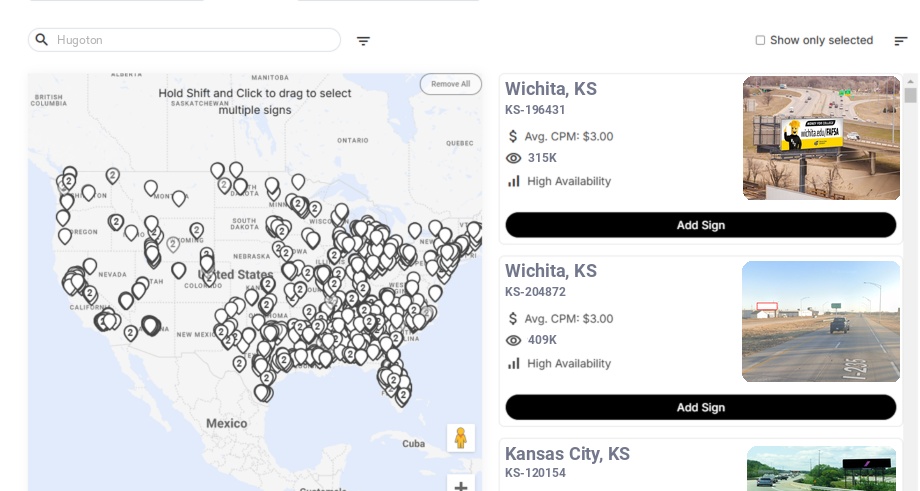
Blip has digital billboards in Hugoton. You can browse available locations on a map, choose the ones that fit your audience, and start advertising right away.
Still have questions? Launch a campaign in minutes — no contracts, no commitments.
Start Your CampaignHugoton Billboard Advertising Guide
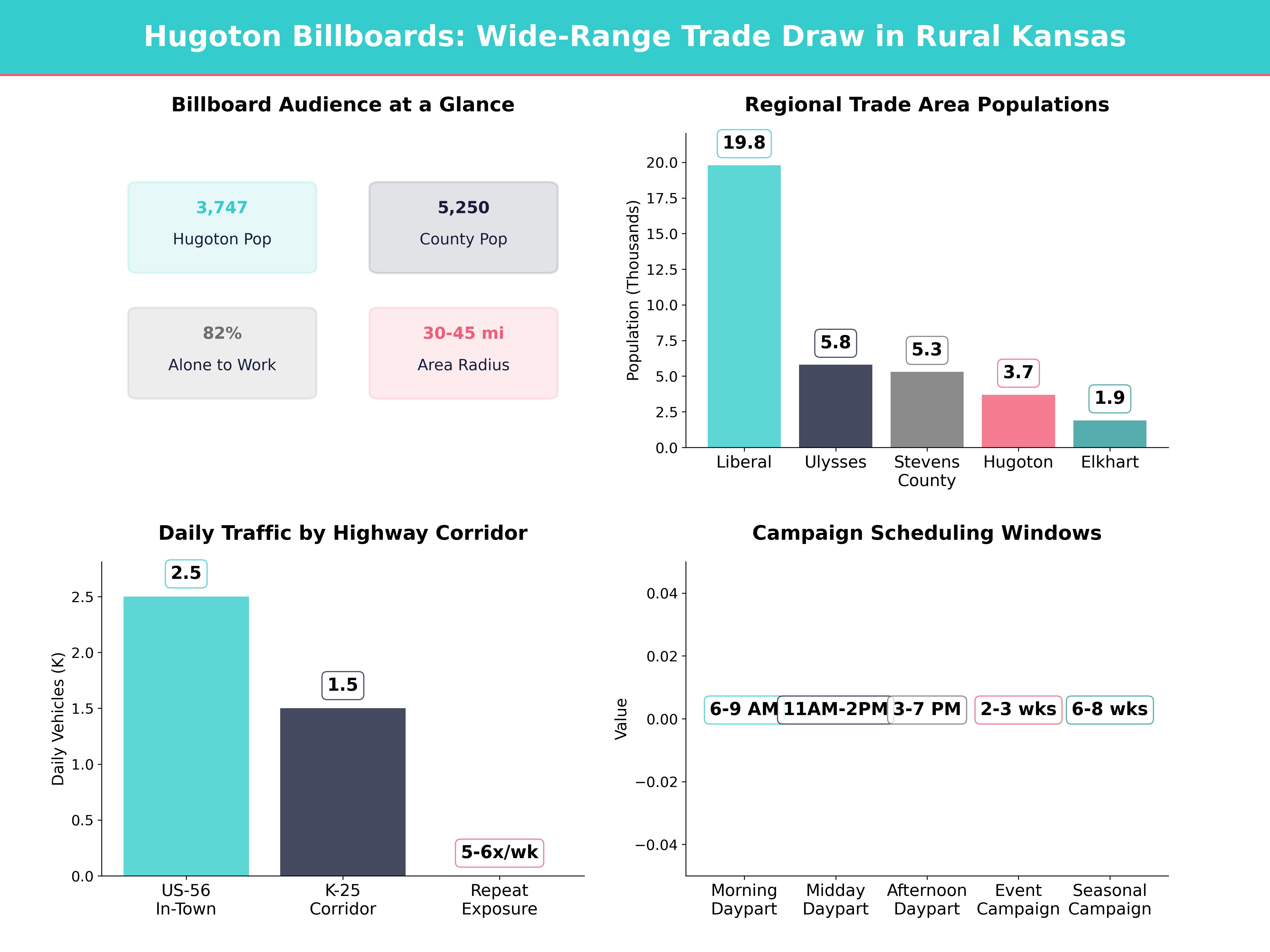
Hugoton is a small city with an outsized role in far southwest Kansas, which is exactly why billboard advertising can work well here. The city had 3,747 residents in the 2020 Census, and Stevens County had 5,250, but the practical market is larger because shoppers, farm operators, energy crews, and school families all drive into town by car across a county of about 728 square miles and only 7.2 residents per square mile. In a place where U.S. 56, K-25, and K-51 organize daily life, outdoor ads stay visible on repeat trips instead of getting buried in heavy urban media clutter. We can use that repeat visibility to build awareness, drive store visits, and influence customers who often travel 30 to 45 miles for services.
Hugoton Market Overview
Hugoton is the county seat of Stevens County, and that county-seat role matters for advertisers. Even though the city is small, it concentrates government, schools, healthcare, utilities, retail, and service activity for a broad rural area. That makes local roads more valuable than raw population alone might suggest.
The city’s population moved from 3,904 in 2010 to 3,747 in 2020, a decline of 157 residents, or about 4.0%. Stevens County moved from 5,724 residents in 2010 to 5,250 in 2020, a decline of 474, or about 8.3%. Those numbers tell us that Hugoton is not a fast-growth metro, but they do not make the market weak. They tell us that advertisers should prioritize frequency, familiarity, and practical messaging over flashy mass-reach branding.
Geography reinforces that point. Stevens County covers about 728 square miles, so residents rely on vehicles for everyday movement, with only about 7.2 residents per square mile. Across Kansas, about 4 in 5 (roughly 82%) workers commute by driving alone, and far southwest Kansas is even more auto-oriented because shopping, school, work, and recreation are spread across long distances. For billboard advertisers, that means roadside visibility is not optional media here. It is one of the clearest ways to stay present in daily routines.
The local economy also fits billboard advertising. Kansas Department of Commerce K-State Research and Extension regularly highlight southwest Kansas strengths in agriculture, livestock, energy, and rural business services. In Hugoton, that translates into a dependable base of farm and ranch traffic, natural-gas and field-service traffic, school-family traffic through Hugoton Public Schools USD 210, and healthcare traffic connected to Stevens County Hospital
A final market advantage is the regional pull from surrounding communities. Liberal Ulysses, Elkhart
Key Traffic Corridors for Digital Billboards in Hugoton
Hugoton’s traffic pattern is simple, which is good for advertisers. Most meaningful daily movement funnels through a few routes, and that concentration makes placement strategy much more straightforward than it is in a larger city.
U.S. 56 through Hugoton
Kansas Department of Transportation low-thousands of vehicles per day, with in-town segments commonly around the 2,000 to 3,000 AADT range and lighter counts as the highway moves west toward Elkhart
U.S. 56 is Hugoton’s east-west spine. It connects local businesses to Liberal
- Retailers that need regular reminder impressions from repeat drivers.
- Restaurants, convenience stores, and fuel brands that benefit from immediate action.
- Healthcare providers, banks, and insurance agencies that want county-wide visibility.
- Telecom, internet, and home-service companies that serve rural households.
Because many drivers on U.S. 56 are making intentional trips, directional copy performs especially well here. Messages such as “Next right,” “2 miles east,” or “Open today” match how people travel this corridor.
K-25 north and south of Hugoton
K-25 is the north-south route that ties Hugoton to Ulysses, Grant County 1,000 to 2,000 AADT range, depending on the exact count point and year.
This route is especially useful when we want to reach drivers whose trips are tied to work, errands, agriculture, and county services. K-25 is a strong fit for:
- Farm supply companies, seed dealers, irrigation services, and equipment brands.
- Workforce recruiting campaigns for operations, field crews, and skilled trades.
- Auto repair, tire, truck service, and parts businesses.
- Financial, legal, and medical services that draw customers from outside city limits.
K-25 also offers a frequency advantage. In rural markets, a driver who sees the same board 5 or 6 times a week can become highly familiar with a brand even if the daily traffic count is lower than metro advertisers are used to seeing.
K-51 and local access routes in Hugoton
K-51 and nearby in-town connectors typically show traffic in the hundreds to low 1,000s of vehicles per day, depending on the segment, season, and count year. Those lower numbers can still be valuable because they represent very local, high-intent trips.
We often like K-51-adjacent placements for community-oriented advertisers. Local clinics, pharmacies, churches, schools, grocery stores, home-services companies, and event promoters can benefit when they appear close to where residents make daily turns. In a town like Hugoton, proximity can matter as much as raw volume.
These routes are also helpful for advertisers who want to separate “broad awareness” from “action boards.” We can use a U.S. 56 board for wide-area reach, then pair it with a closer in-town location that reinforces the final turn or offer.
Audience Segments We Can Reach in Hugoton and Stevens County
Hugoton advertising works best when we think in audience groups rather than in generic “traffic.” The same board can reach several segments, but our creative and timing should reflect who is most likely to be on the road.
County-seat commuters and daily errand drivers
With 3,747 residents in Hugoton and 5,250 in Stevens County, a large share of local movement is built around routine services. Residents come into town for schools, healthcare, banking, groceries, government business, and household errands. That makes billboard advertising very effective for businesses that depend on reminders rather than one-time discovery.
This audience is ideal for local retailers, clinics, dentists, telecom providers, grocery stores, pharmacies, gyms, and community events. We should not underestimate how powerful repetition can be in a rural county-seat market.
Agricultural and energy workers
Southwest Kansas is defined by agriculture, livestock, and energy. K-State Research and Extension, Kansas State University, and the broader regional business community consistently point to those sectors as core drivers of western Kansas commerce. In practical terms, that means pickups, service trucks, and work vehicles are central to the local audience.
This group often starts early. Campaigns that emphasize morning visibility from 6 a.m. to 9 a.m. and return traffic from 3 p.m. to 7 p.m. can work well for fuel, tools, equipment, tires, workwear, insurance, farm credit, and hiring messages. Straightforward language usually beats abstract branding for this audience.
Families, students, and school communities
Hugoton Public Schools USD 210 anchors a major share of local family activity, and the school calendar shapes spending patterns throughout the year. The most active family-focused window runs from August through May, with especially important stretches around back-to-school shopping, fall sports, holiday programs, spring activities, and graduation.
Messages for this audience often perform best when they feel useful and local. Healthcare, orthodontics, after-school programs, family dining, banking, internet service, and community events all align well with school-driven traffic. Kansas State High School Activities Association schedules also reinforce fall sports traffic, especially on Friday evenings.
Regional shoppers and cross-border travelers
The trade area around Hugoton matters more than the city limits alone. Nearby Liberal 19,825 residents in 2020, Ulysses had 5,788, and Elkhart 1,888. Parts of Seward County Grant County
That regional audience is especially important for specialty services. Attorneys, hospitals, colleges, auto dealers, farm lenders, telecom companies, and larger retailers can use Hugoton boards to stay visible among people who may not live in town but still pass through for work or services. Advertisers from Liberal Seward County Community College can also use Hugoton placements to extend their reach westward into Stevens County.
We should also remember the bilingual reality of southwest Kansas. Not every campaign needs Spanish copy, but businesses serving broad household markets should consider bilingual or bicultural creative because it can improve relevance and response.
Seasonal and Timing Opportunities in Hugoton
Hugoton is a year-round advertising market, but the strongest campaigns respect the area’s seasonal rhythms. Agriculture, schools, weather, and community events all change what people notice and what they need.
Spring in Hugoton
From March through May, local attention shifts toward planting, field preparation, graduation planning, home projects, and spring sports. This is a strong season for irrigation services, ag suppliers, home improvement, lawn and garden, healthcare checkups, and retail promotions tied to warmer weather.
May is especially useful for family-oriented messaging because graduations, school wrap-up activities, and travel planning begin to stack together. A spring billboard should feel optimistic, practical, and timely.
Summer in Hugoton
Summer is one of the best billboard seasons in Hugoton. Wheat harvest typically arrives in June and July, which increases the visibility of fuel, restaurants, cold drinks, equipment repair, tire service, wireless plans, and banking offers. Summer road travel on U.S. 56 also brings incremental visitor and through-traffic exposure.
Community schedules matter too. County fair activity often lands in late July or early August, and that can create short but meaningful spikes in local attention. If we are promoting events, food service, entertainment, or family retail, summer timing can be especially productive.
Summer is also a good fit for tourism-adjacent messaging tied to southwest Kansas travel. Even if Hugoton is not a major tourist destination by itself, it sits within a broader regional travel pattern that includes attractions promoted by Kansas Tourism and Visit Liberal
Fall in Hugoton
From August through November, Hugoton moves into one of its most commercially active stretches. Back-to-school spending arrives in August. Football and school activities intensify from late August into October or November.
Fall harvest activity picks up from September through November, and hunting traffic becomes relevant in autumn and early winter through the calendars promoted by Kansas Department of Wildlife and Parks
Winter in Hugoton
From November through February, the messaging mix changes. Holiday retail peaks in November and December, then tax preparation, financial planning, healthcare, heating, tires, batteries, and essential home services become more relevant in January and February.
Winter also makes simple, high-contrast creative even more important because glare, weather, and early darkness can reduce attention span. In a smaller market, winter boards often benefit from lower competitive clutter, which gives well-timed advertisers a better chance to stand out.
Billboard Design Tips for the Hugoton Market
Good billboard design in Hugoton should look local, read fast, and feel useful. We are speaking to drivers on practical trips, not to pedestrians browsing entertainment districts.
Design for long sightlines and bright High Plains light
Hugoton’s open terrain gives us long visual approaches, but it also brings bright sunlight, dust, weather swings, and fewer surrounding visual cues. That means bold contrast matters. Dark text on a light field, or bright text on a dark field, usually works better than subtle palettes.
We also want images that remain legible in a quick roadside glance. Large product shots, simple logos, and one focal image perform better than crowded layouts. If we only have 7.5 to 10 seconds of display time in a digital rotation, clarity has to do the heavy lifting.
Lead with utility, not abstraction
Hugoton drivers often respond best to practical messages. A board that says “New Tires in Hugoton,” “Same-Day Clinic,” or “2 Miles East on U.S. 56” usually works harder than a clever slogan with no action cue.
Distance and direction are especially useful in this market because many trips are planned and many businesses are approached by highway. Giving drivers a clear next step can meaningfully improve results.
Use local imagery and cultural fluency
Generic city skylines do not belong on a Hugoton billboard. We tend to get better results with visuals tied to local life, including wheat, cattle, pickups, school spirit, family scenes, and clean rural landscapes. Those cues help people recognize that the message is for them.
For businesses that serve broad household audiences, bilingual creative is worth testing. We do not need to translate every campaign, but in southwest Kansas, culturally fluent messaging can improve recall and response.
Keep copy disciplined
In a market like Hugoton, short copy feels more trustworthy and more readable. A memorable 3-word to 7-word headline is easier to retain than a full promotional paragraph. We also recommend short URLs, easy phone numbers, and one clear offer per board.
Regional Strategies Around Hugoton
The right strategy depends on whether we want tight local repetition, county-wide awareness, or regional pull from nearby communities. Hugoton’s size makes it tempting to treat the whole area as one zone, but advertisers usually perform better when we divide the market by travel pattern.
In-town Hugoton strategy
In-town Hugoton placements are best for immediate local action. We use them for grocery, medical, dental, pharmacy, banking, internet service, restaurants, churches, and community events. These boards should emphasize turn-by-turn convenience, current promotions, and strong local relevance.
If our goal is local foot traffic, this is where proximity matters most. A board close to the business or close to the key turn can outperform a higher-volume board that is too far away.
Eastbound and westbound U.S. 56 strategy
U.S. 56 lets us separate eastbound and westbound intent. Eastbound traffic can capture drivers heading toward Liberal Seward County Community College, and the larger Seward County service market. Westbound traffic can help us reach people moving toward Elkhart Morton County
For businesses in Hugoton, these approaches are strong for fuel, food, hospitality, healthcare, ag retail, and convenience-based stops. For businesses outside Hugoton, they are useful for extending a regional brand into Stevens County.
K-25 north-south strategy
K-25 is where we focus if we want to reach the rural service economy. Traffic tied to Ulysses, Grant County
If our business depends on customers from outside Hugoton city limits, K-25 deserves serious attention.
Using Blip Tools Effectively in Hugoton
Blip’s platform is especially useful in a market like Hugoton because we can adjust around real local behavior instead of buying a rigid schedule and hoping it fits.
Use dayparting to match rural routines
In Hugoton, traffic patterns often reward targeted scheduling. Morning runs from 6 a.m. to 9 a.m. can be smart for fuel, breakfast, recruiting, and field-service messages. Midday windows from 11 a.m. to 2 p.m. can help restaurants, clinics, and retail. Late afternoon blocks from 3 p.m. to 7 p.m. often work for grocery, dining, healthcare, and school-family offers.
We can also tighten campaigns around Friday sports, county fair week, harvest periods, or holiday shopping bursts instead of spending evenly every day.
Build frequency without a metro-sized budget
Hugoton is not a market where we need giant budgets to matter. Because the audience is smaller and routes are concentrated, a modest budget can still produce strong repetition. We can start small, monitor performance, and lean into the boards and times that match our customer behavior.
That flexibility is especially helpful for local businesses that want to advertise for 2 to 3 weeks around an event or for 6 to 8 weeks around a seasonal selling cycle.
Test creative by audience and season
Hugoton gives us a strong case for creative testing. We can run one version aimed at school families, another aimed at harvest traffic, and another aimed at bilingual household outreach. We can also switch from spring service messaging to summer fair messaging to fall football or hunting messaging without rebuilding an entire media plan.
Let analytics guide the next move
Because travel patterns are route-driven here, location-level learning matters. If one U.S. 56 board produces stronger engagement than a more local board, we can shift spend quickly. If morning dayparts outperform evenings for recruiting, we can adapt. That kind of control is valuable in a practical, repetition-based market like Hugoton.
Getting Started with Billboard Rental in Hugoton
Renting a billboard in Hugoton should be straightforward when we begin with the local travel pattern and a clear business objective. This market rewards relevance more than scale.
Start with the goal
Before choosing a board, we should decide whether we want store visits, phone calls, event attendance, hiring applications, or broad awareness. A restaurant opening, a clinic, a farm supplier, and a school event all need different locations, timing, and creative.
A good Hugoton campaign usually has one primary objective and one simple action. Simplicity makes board selection much easier.
Evaluate Hugoton billboard locations by route fit
When we compare boards, we should ask a few practical questions. Is the board on U.S. 56, K-25, or a more local route. Is the driver approaching the correct turn. Is the message visible early enough for a decision. Is the business 1 mile, 2 miles, or 5 miles from the board. Does the location speak to local traffic, regional traffic, or both.
Those questions matter more in a rural market than broad “impression” language alone. The best board is often the one that aligns with the actual trip we want to influence.
Expect fewer boards, but stronger repetition
Hugoton will not offer the same inventory depth as Wichita, Kansas City Liberal
That is also where Blip simplifies the process versus traditional billboard buying. We can review available digital boards on a map, launch without a long contract, update artwork quickly, and optimize as local conditions change.
Launch, learn, and expand
For many advertisers, the smartest first step is a focused test. We can start with 1 or 2 well-matched boards, run for a few weeks, and watch how traffic, calls, or store activity responds.
If performance is strong, we can extend the campaign, add a second corridor, or rotate creative by season. In Hugoton, successful billboard rental is usually not about buying the most faces. It is about choosing the route that matches the customer, using creative that feels local, and staying visible long enough for repetition to do its job.