Billboards near Gretna, LA
No Minimum Spend. No Long-Term Contracts. Just Results.
Trusted by Leading Brands


Billboard advertising
near Gretna has never been easier



How much is a billboard near Gretna?
Why Choose Blip for Billboard Advertising near Gretna
-
Blip lets you launch fast in Gretna and hit the Crescent City Connection or West Bank Expressway commuters without contracts.
-
Use Gretna billboards on Blip with flexible budgets to reach locals, tourists, and Port NOLA traffic across the West Bank.
-
Daypart your Gretna campaign for the 6:30–9 a.m. and 3:30–6:30 p.m. peaks, when commuters pass the same routes twice.
-
Track Gretna results in real time and shift spend to the I-10, LA-23, or Metairie corridors that drive the best response.
-
Blip's creative tools make it easy to test bold, bilingual ads for Gretna's diverse audience and busy festival weekends.
Frequently Asked Questions About Billboard Advertising near Gretna
How much does a billboard cost near Gretna, Louisiana with Blip?
With Blip, advertising on Gretna billboards is flexible enough for almost any budget, because you choose your own daily spend and only pay for the individual “blips” your ad receives. Each blip is a brief 7.5–10 second display on digital billboards near Gretna, Louisiana, and Blip automatically keeps your campaign within the budget you set. The cost of each blip varies based on the times you select, the locations serving the Gretna area, and overall advertiser demand, so you stay in control and can adjust your budget whenever you like.
Where can I advertise with Blip in Gretna, Louisiana?
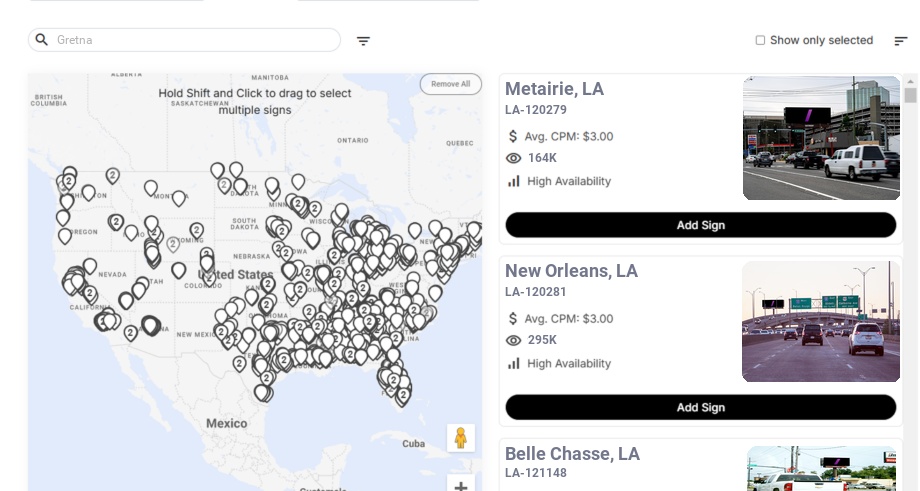
There are 32 digital billboards serving the Gretna area from nearby Belle Chasse, New Orleans, Chalmette, and Metairie. Because all 32 boards are within roughly 10 miles of Gretna, your message can surround the market from multiple directions and reach West Bank residents, East Bank commuters, airport travelers, and tourists. You can concentrate budget on boards closest to your store, event venue, or service area, or spread your campaign across New Orleans, Metairie, and Belle Chasse to blanket the region.
Who can a billboard in Gretna, Louisiana reach?
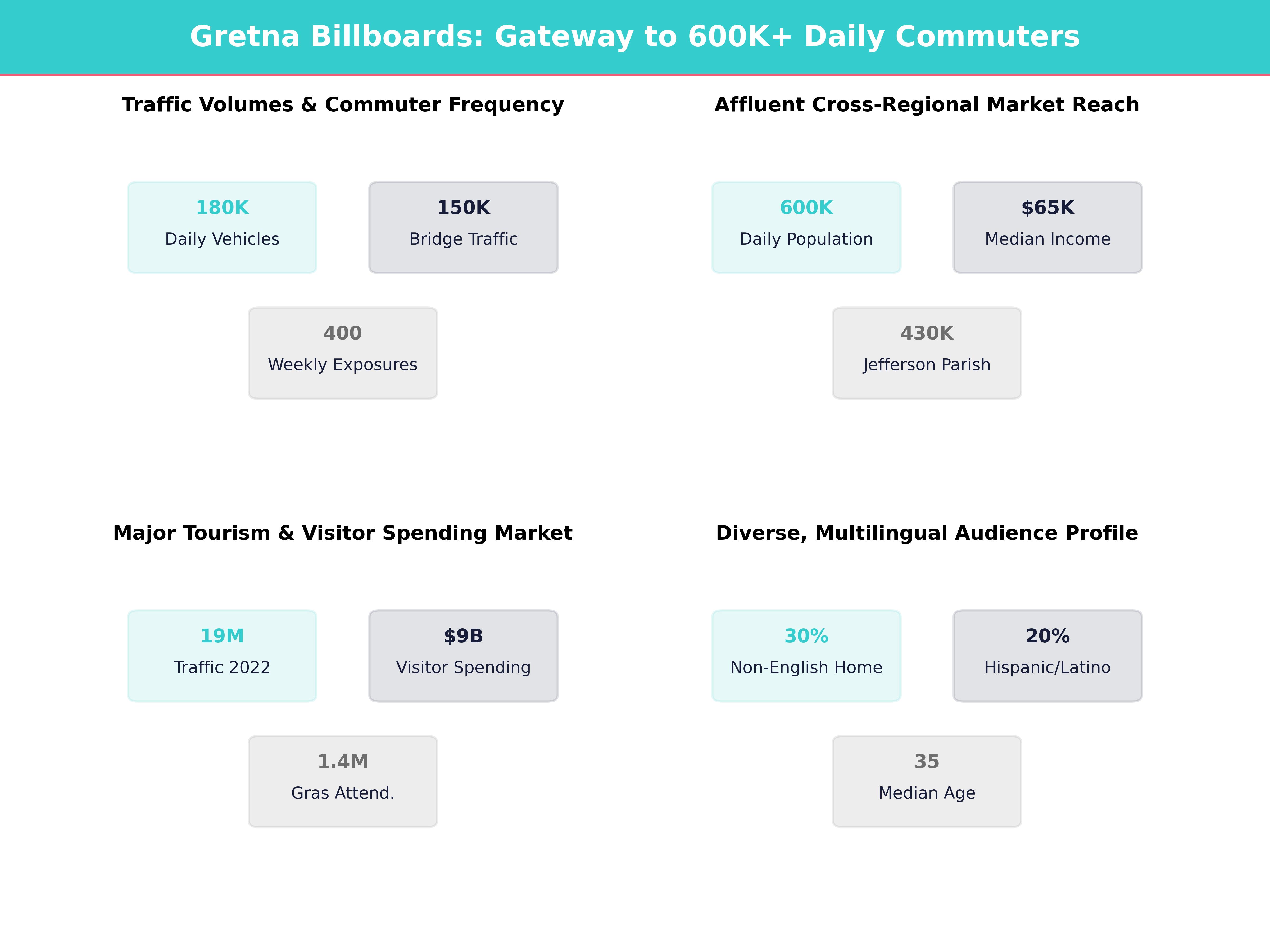
The Gretna, Louisiana area sits at a powerful crossroads of West Bank neighborhoods, regional commuters, and New Orleans tourism. Within a 10-mile radius of Gretna, advertisers can realistically reach a daily population of 600,000+ residents and workers who move through this core employment and retail hub. Many of these corridors routinely see 50,000–180,000 vehicles per day, giving even modest campaigns the ability to generate tens of thousands of impressions daily.
When is the best time to run billboards near Gretna, Louisiana with Blip?
Morning peak is 6:30–9:00 a.m., with heavy flow West Bank to New Orleans CBD/Uptown, and evening peak is 3:30–6:30 p.m., with strong return flow New Orleans to the West Bank. Midday from 10:00 a.m.–3:00 p.m. sees strong traffic from retail, delivery, and appointment-based trips, while weekends shift the mix from commuters to shoppers and leisure travelers. With Blip, you can day-part your campaign to run only during the hours that matter most to you.
What kind of creative works best for billboard advertising in Gretna, Louisiana?
Drivers typically have 3–6 seconds to absorb your message at highway speeds, so the page recommends 7 words or fewer in your main headline and large, high-contrast fonts. It also suggests making your logo and call-to-action large and simple, with no fine print and no more than 1–2 key pieces of information. Residents near Gretna are proud of local identity and West Bank culture, so references to the Crescent City Connection, the Mississippi River, West Bank Expressway, or nearby landmarks can help your message connect quickly.
Do I need a contract to advertise with Blip near Gretna?
No, Blip has no long-term contracts or minimum commitments. You can start, pause, or stop your campaign at any time.
How fast can I launch a billboard campaign with Blip near Gretna?
You can have your campaign live in minutes. Create a free account, select your locations, set your budget, upload your design, and start running once approved.
Where can I advertise with Blip near Gretna?
Blip has digital billboards near Gretna. You can browse available locations on a map, choose the ones that fit your audience, and start advertising right away.
Still have questions? Launch a campaign in minutes — no contracts, no commitments.
Start Your CampaignGretna Billboard Advertising Guide
The Gretna, Louisiana area sits at a powerful crossroads of West Bank neighborhoods, regional commuters, and New Orleans tourism. With 32 digital billboards serving the Gretna area from nearby Belle Chasse, New Orleans, Chalmette, and Metairie, we can help you put your message in front of both everyday locals and out‑of‑town visitors—often multiple times a day—on major commuter and visitor routes. Many of these corridors routinely see 50,000–180,000 vehicles per day, giving even modest campaigns on billboards near Gretna the ability to generate tens of thousands of impressions daily.
Understanding the Gretna Area Market
To build an effective campaign near Gretna, it helps to understand who lives, works, and drives through the area before you invest in billboard advertising near Gretna.
Population and household profile
- The City of Gretna has roughly 18,000 residents, within a broader Jefferson Parish population of about 430,000+ spread across the West Bank and East Bank suburbs, according to recent parish planning and economic development summaries from Jefferson Parish Government and JEDCO (Jefferson Parish Economic Development Commission).
- Across Jefferson Parish, there are roughly 175,000–185,000 households, with average household sizes around 2.5–2.7 people. Owner‑occupied housing typically accounts for 55–60% of homes, with the balance renter‑occupied—ideal for campaigns targeting both long‑term residents and more transient renters using Gretna billboards to build brand familiarity.
- Median age in the Gretna area is in the mid‑30s, while Jefferson Parish overall trends slightly older (around 38–40 years), producing a strong mix of working‑age adults, young families, and multigenerational households.
- Median household incomes in Gretna tend to run in the low‑ to mid‑$40,000s, while nearby Metairie and other Jefferson Parish communities skew higher, often into the $55,000–$65,000 range. Across Jefferson Parish, per‑capita income is typically in the mid‑$30,000s, supporting both value‑focused and mid‑to‑upper income consumer segments. That means campaigns can effectively target both budget‑conscious households and more affluent shoppers using different creatives on the same network.
- Within a 10‑mile radius of Gretna (capturing most of the West Bank, downtown New Orleans, and portions of Metairie), advertisers can realistically reach a daily population of 600,000+ residents and workers who move through this core employment and retail hub, all accessible through digital billboard advertising near Gretna.
For more local background, you can explore the City of Gretna Jefferson Parish Government sites, which highlight residential growth, economic development, and community programs. Business‑focused users can also review JEDCO’s data resources
Diversity and languages
- The Gretna area is racially and ethnically diverse, with Black, White, Hispanic/Latino, and Vietnamese communities all well‑represented along the West Bank and across Jefferson Parish. In parish‑level breakdowns, no single racial or ethnic group typically accounts for more than about 55–60% of the population, creating a genuinely mixed marketplace.
- Local education and parish planning reports often show Jefferson Parish’s Hispanic/Latino population in the 15–20% range, and the Vietnamese community—especially concentrated around the West Bank and certain New Orleans East areas—at several thousand residents within the metro.
- In Jefferson Parish, roughly 25–30% of residents speak a language other than English at home, and Spanish and Vietnamese are among the largest groups. In some school catchment areas, 40%+ of students come from multilingual households, reinforcing the value of inclusive creative.
Implication for your creative: English‑dominant messages work well for broad coverage, but short bilingual headlines (English/Spanish) or imagery that reflects the area’s diversity can significantly increase relevance—especially for service businesses, healthcare, education, real estate, and quick‑serve restaurants using Gretna billboards to build trust with local audiences.
Commuting and traffic flows
The Gretna area is heavily commuter‑oriented and tied into the greater New Orleans metro roadway grid:
- More than 75% of workers in Jefferson Parish commute by car alone, and another 10–12% carpool, according to transportation data summarized in regional plans by the Regional Planning Commission for Jefferson, Orleans, Plaquemines, St. Bernard & St. Tammany Parishes
- Typical one‑way commute times for West Bank–to–New Orleans workers are in the 25–30 minute range, with many spending 40–60+ minutes in the car daily when you include the evening return.
- The Crescent City Connection (US‑90 Business) bridges between the West Bank and New Orleans carry an estimated 150,000–180,000 vehicles per day, based on LA DOTD traffic counts and regional mobility reports.
- The West Bank Expressway (US‑90 Business) regularly registers 60,000–90,000 vehicles per day on key segments between Gretna, Harvey, and Marrero, while LA‑23 toward Belle Chasse often carries 25,000–35,000 vehicles per day, including military, industrial, and energy‑sector commuters.
- I‑10 around New Orleans and Metairie is among the region’s most heavily traveled corridors, with many inner‑city segments sustaining 120,000–160,000 vehicles per day, ensuring that boards along I‑10 repeatedly reach both East Bank and airport traffic.
These patterns make roadside digital billboards particularly effective: you’re catching the same people twice daily—heading into work and coming home—plus additional impressions from midday errands and weekend activity. For many workers, that translates to 300–400+ potential weekly billboard exposures along their standard commute route, making well‑placed billboards near Gretna a reliable way to build ongoing familiarity.
Tourism and regional visitors
While Gretna feels like a close‑knit community, it sits next to one of America’s most powerful visitor markets:
- New Orleans welcomed around 18–19 million visitors in 2022, who spent roughly $9 billion, according to New Orleans & Company. That visitor volume is approaching pre‑pandemic levels, when the city routinely saw 18–19.75 million visitors and visitor spending upwards of $10 billion annually.
- From local tourism summaries, visitor spending in the New Orleans region translates into roughly $25 million per day in direct expenditures on lodging, food, entertainment, and shopping—much of it from people traveling along I‑10, the Crescent City Connection, and West Bank routes that your ads can reach.
- Annual tent‑pole events such as Mardi Gras, Jazz Fest, the Sugar Bowl, and major conventions and sporting events routinely draw hundreds of thousands of additional visitors during peak weeks. For example, tourism officials often estimate total Mardi Gras–season attendance in the 1–1.4 million range across parades and related events.
- Gretna’s proximity to downtown New Orleans, the Port of New Orleans and Port NOLA cargo and cruise traffic, and Jefferson Parish’s own attractions (highlighted by Visit Jefferson Parish) means a constant flow of visitors drives on the corridors serving the Gretna area. Port NOLA reports supporting 20,000+ jobs region‑wide and moving tens of millions of tons of cargo annually, with associated truck and workforce traffic routinely using West Bank and I‑10 corridors.
- Louis Armstrong New Orleans International Airport
If you’re marketing hospitality, dining, entertainment, or retail, those 32 digital billboards serving the Gretna area let you reach both locals and visitors as they move between New Orleans, the airport, and West Bank neighborhoods. For tourism‑oriented businesses, even capturing 0.1–0.2% of daily visitor traffic can translate into dozens of incremental customers per day, especially when you leverage consistent billboard advertising near Gretna on these high‑volume routes.
For more tourism context, explore the visitor resources from New Orleans & Company, Visit Jefferson Parish, and local event listings on NOLA.com.
Where Our Digital Billboards Reach the Gretna Area
Our digital boards are positioned in nearby cities that funnel traffic through and around the Gretna area, all within a roughly 10‑mile radius, creating a dense cluster of Gretna billboards and adjacent coverage:
- New Orleans (3.9 miles from Gretna) – Boards near downtown, major surface streets, and I‑10/I‑610 reach commuters moving between the Central Business District, Uptown, and the West Bank, as well as tourists staying in and near the French Quarter and CBD. New Orleans itself has about 380,000+ residents, but daytime population swells with tens of thousands of commuters and visitors, substantially increasing daily impression opportunities.
- Metairie (8.8 miles) – High‑traffic boards along I‑10, Causeway, and busy commercial corridors tap into Jefferson Parish’s major retail, office, and restaurant districts—ideal for driving affluent shoppers toward Gretna‑area businesses. Metairie is one of the largest unincorporated communities in the U.S., with 140,000–150,000 residents, and hosts multiple regional shopping centers and medical hubs that draw visitors from across southeast Louisiana.
- Chalmette (5.3 miles) – Boards near Chalmette reach St. Bernard Parish residents (population roughly 43,000–45,000) commuting into New Orleans and occasionally crossing toward the West Bank for shopping, entertainment, or visiting friends and family.
- Belle Chasse (3.8 miles) – Coverage on LA‑23 and nearby routes targets military personnel at Naval Air Station Joint Reserve Base New Orleans
Because all 32 boards are within roughly 10 miles of Gretna, your message can surround the market from multiple directions—reaching:
- West Bank residents driving to New Orleans jobs (tens of thousands cross the Crescent City Connection daily).
- East Bank commuters heading to West Bank industrial sites, shipyards, and distribution centers located along the river.
- Airport travelers moving between Louis Armstrong New Orleans International Airport
- Tourists bouncing between hotels, the French Quarter, the Garden District, and nearby riverfront or cruise terminals.
Think of this network as a ring of visibility around the Gretna area. You can concentrate budget on boards closest to your store, event venue, or service area, or spread your campaign across New Orleans, Metairie, and Belle Chasse to blanket the region and tap into an effective trade area of 500,000–700,000 people. For many advertisers, this functions like a turnkey billboard rental near Gretna that also extends into the rest of the metro.
For additional local maps and traffic patterns, advertisers can review transportation resources from LA DOTD and regional studies via the Regional Planning Commission
Audience Patterns & Best Times to Run Your Blips
Digital billboards are most powerful when they mirror real traffic patterns. Here are timing insights for the Gretna area and nearby corridors.
Weekday commute windows
Based on regional commuting behavior and Louisiana Department of Transportation & Development traffic counts (see LA DOTD):
-
Morning peak: 6:30–9:00 a.m.
- Heavy flow West Bank → New Orleans CBD/Uptown via Crescent City Connection and US‑90 Business.
- Service workers, port and industrial staff, and office employees heading to downtown, hospitals, hospitality, and port operations.
- On high‑volume days, you can expect 5,000–7,000+ vehicles per hour in each direction on certain key segments.
-
Evening peak: 3:30–6:30 p.m.
- Strong return flow New Orleans → West Bank, including Gretna, Harvey, Marrero, and Belle Chasse.
- Shoppers considering dinner, groceries, and errands on the way home.
- In many commuter corridors, p.m. peak volumes are 5–15% higher than a.m. peaks as people run errands and make discretionary stops.
Best for:
- Restaurants, coffee shops, quick service: emphasize “on your way to work” and “tonight only” offers—these windows often account for 40–50% of daily drive‑by impressions on commuter corridors.
- Professional services and healthcare: awareness and location messages during both peaks to build repeated exposure (the typical daily commuter may see the same board 20+ times per month).
- Hiring campaigns: “Now Hiring in the Gretna Area – Starting at $X/hr” works well when commuters are already thinking about job satisfaction and commute times.
Midday and evening
- 10:00 a.m.–3:00 p.m. sees strong traffic from retail, delivery, and appointment‑based trips. In many urban arterials, midday volumes stay at 60–80% of peak levels, providing substantial impression density at often lower ad competition.
- 7:00–10:00 p.m. remains active on I‑10 and key arterials with dining, entertainment, and shift‑change traffic, especially around hospitals, casinos, and hospitality districts.
Best for:
- Retailers and grocery stores promoting same‑day shopping, especially for consumers who tend to shop between 11:00 a.m. and 7:00 p.m., the dominant window for many brick‑and‑mortar categories.
- Entertainment and nightlife aimed at locals and visitors staying in New Orleans hotels; downtown and French Quarter visitor counts commonly spike after 5:00 p.m.
- Healthcare, education, and financial services focused on consideration and brand building, where consistent midday exposure supports research‑stage decision‑making.
Weekends
Weekends shift the mix from commuters to shoppers and leisure travelers:
- Saturday tends to produce all‑day steady traffic on I‑10, the West Bank Expressway, and LA‑23 as people shop, visit family, and attend events. For many corridors, Saturday traffic volumes are within 5–10% of weekday peaks—sometimes exceeding weekday levels near malls and big‑box retail.
- Sundays see a spike around church services, brunch, sporting events, and airport departures, especially between 9:00 a.m.–2:00 p.m. and early evening. Local sports and festival weekends, frequently covered in calendars on NOLA.com and Visit Jefferson Parish, can further lift weekend travel.
Best for:
- Regional attractions, festivals, and special events in Gretna and Jefferson Parish, where a single festival weekend can draw tens of thousands of visitors.
- Car dealers, boat/RV dealers, and big‑ticket retail, which often see 30–40% of weekly foot traffic on Saturdays and Sundays.
- Faith‑based organizations and community programs promoting service times, special events, or outreach initiatives.
With Blip, you can day‑part your campaign to run only during the hours that matter most to you—maximizing impressions during commuter windows, weekends, or lunch breaks near your business.
Creative Strategies That Resonate Near Gretna
Once we understand who we’re talking to and when, the artwork becomes critical. Consider the following for Gretna‑area campaigns.
Design for quick understanding
Drivers typically have 3–6 seconds to absorb your message at highway speeds:
- Aim for 7 words or fewer in your main headline; studies of roadside readability consistently show recall rates drop sharply beyond 8–10 words.
- Use large, high‑contrast fonts (white or yellow on dark backgrounds; dark type on light, bold backgrounds). Fonts should generally be at least 18–24 inches tall on the physical display to remain legible at typical viewing distances.
- Make your logo and call‑to‑action elements large and simple—no fine print and no more than 1–2 key pieces of information (e.g., “Exit X – Today Only 20% Off”).
- Limit yourself to one main image; cluttered creatives can reduce message retention by 30–50% compared to simple, bold designs.
Highlight local identity and landmarks
Residents near Gretna are proud of local identity and West Bank culture:
- Reference recognizable elements such as the Crescent City Connection skyline, the Mississippi River, or events like the Gretna Heritage Festival City of Gretna
- Mention West Bank Expressway, Belle Chasse Highway (LA‑23), or proximity to landmarks like Gretna City Hall, Oakwood Center, or the riverfront to orient locals quickly.
- Position your business as “Right across the river,” “Just off West Bank Expressway,” or “Minutes from the Crescent City Connection” instead of giving full directions, which are harder to process at speed.
Use distance‑based calls to action
Because boards are clustered within 3–10 miles of Gretna:
- “Exit in 2 Miles – Gretna Location”
- “5 Minutes Across the Bridge – West Bank Store”
- “Near Gretna City Hall – Walk‑In Today”
This works especially well when your boards on I‑10 or US‑90 Business are leading directly to a nearby exit or arterial. Simple distance‑based CTAs can increase response rates because they reduce perceived effort for the driver and make the most of your billboard advertising near Gretna.
Tailor messaging to driver intent
- Morning commuters: Focus on coffee, breakfast, traffic‑beating services, and professional branding. Many commuters decide breakfast and coffee stops within 5–10 minutes of their exit, making last‑minute messaging powerful.
- Evening commuters: Promote dinner, groceries, gym, childcare pick‑ups, and home services, when household decision‑making is top of mind.
- Tourists: Use simple orientation like “West Bank Gem,” “Local Favorite Near Gretna,” or “Only 10 Minutes from the Quarter.” Visitors often rely on drive‑by discovery for secondary dining and entertainment decisions beyond their main itinerary.
Consider bilingual or culturally resonant creative
Given Gretna’s and Jefferson Parish’s diverse communities:
- Short Spanish sub‑headlines can broaden appeal (e.g., “Open Late – Abierto hasta tarde”).
- Businesses serving Vietnamese, Hispanic/Latino, or other communities can test rotating bilingual boards during key hours or along corridors with high concentrations of their target demographic.
- Imagery that reflects a mix of ages and backgrounds can strengthen local connection and trust, particularly for healthcare, education, and financial services.
Just remember: keep any second language succinct so it doesn’t clutter your design.
Using Blip Tools to Target the Gretna Area
Blip’s flexibility allows you to adapt your Gretna‑area campaign as conditions change and to fine‑tune your billboard rental near Gretna for budget and reach.
Start with a clear geographic strategy
You can choose specific boards that best serve your objective:
- Gretna‑focused local retail or services: Emphasize boards closest to the West Bank—Belle Chasse, West Bank‑accessible New Orleans locations, and any units near the Crescent City Connection and West Bank Expressway. These corridors alone can deliver tens of thousands of impressions per board per day.
- Regional draw businesses (auto, medical specialists, attractions): Spread your budget across New Orleans, Metairie, and Chalmette to capture a wider radius of drivers who will travel to you, tapping into a potential customer pool of 500,000+ residents within an easy 20–30 minute drive.
- Tourism and hospitality: Focus on boards near downtown New Orleans, I‑10 from the airport, and key visitor corridors to intercept travelers before they plan their day. Many visitors decide where to eat, shop, or explore day‑of, making timely messaging extremely influential.
For broader planning, you can reference local tourism and business guidance from New Orleans & Company, Visit Jefferson Parish, and JEDCO.
Use day‑parting to match open hours
Because you only pay for the “blips” you run, you can:
- Run breakfast and coffee ads only from 6:00–10:00 a.m., when many coffee and QSR locations see 30–40% of their daily transactions.
- Shift copy to lunch specials from 10:30 a.m.–2:00 p.m., coinciding with dense office and service‑worker breaks.
- Feature happy hour or dinner from 3:30–8:30 p.m., when restaurants and bars often generate 50%+ of daily revenue.
- Promote late‑night or 24‑hour services after 9:00 p.m. near nightlife corridors, hospitals, and transportation hubs.
Budget intelligently for the Gretna area
Digital billboards are typically a fraction of the cost of static boards:
- Instead of a single static board, you might rotate across 10–20 boards serving the Gretna area for the same daily spend, dramatically increasing geographic reach and frequency.
- You can start with modest daily budgets and ramp up around high‑impact dates (festivals, grand openings, seasonal sales). For example, a small business might allocate a baseline of $10–$20 per day, then temporarily increase to $50–$100 per day during key event weeks like the Gretna Heritage Festival
- Because our 32 digital billboards are all within 10 miles of Gretna, even small budgets can achieve high frequency among the same daily commuters. Seeing a message 7–10 times within a week significantly increases recall and brand recognition compared to one‑off exposures, making flexible billboard rental near Gretna especially efficient.
A/B test multiple creatives
Test up to 2–4 variations:
- Version A: Price‑driven (“Oil Change $34.99 – Gretna Area”)
- Version B: Speed/benefit‑driven (“In & Out in 20 Minutes – No Appointment”)
- Version C: Location‑driven (“Across the River on the West Bank – Free Parking”)
- Version D: Event‑ or season‑driven (“Pre‑Trip Checkup Before Mardi Gras – Gretna Area”)
Track performance by:
- Monitoring website sessions, call volume, and map searches from Gretna and West Bank ZIP codes.
- Comparing weeks when certain creatives run against baseline weeks. Even a 5–10% lift in calls or visits can justify reallocating spend toward your best‑performing messages.
Campaign Ideas for Key Gretna Area Industries
Different sectors can use the same Gretna‑area network in tailored ways.
Local restaurants, bars, and coffee shops
- Use boards near downtown New Orleans and Metairie to promote “Local’s Favorite on the West Bank – Just 10 Minutes from CBD.” With more than 18–19 million annual visitors and hundreds of thousands of metro residents, capturing a tiny share of diners can significantly impact revenue.
- Target morning commuters for coffee and breakfast; evenings for dinner, live music, and happy hour. Many eateries report that drive‑time windows can account for 30–50% of daily foot traffic.
- Tie in with major New Orleans events listed on NewOrleans.com—for example: “Escape the Crowds – Dine on the West Bank Tonight.” Festival and event weeks often increase restaurant demand by 20–40% near tourist zones, which you can tap into with timely billboard advertising near Gretna.
Retail & shopping centers
- Promote anchor tenants, sales, and seasonal events (back‑to‑school, holiday shopping). Back‑to‑school and Q4 holiday periods typically represent 30–40% of annual retail sales for many categories.
- Use time‑limited offers: “This Weekend Only in the Gretna Area – Extra 20% Off.” Limited‑time messaging can increase urgency and redemption rates.
- Showcase free parking and easy access compared to downtown. West Bank and Metairie centers often offer hundreds to thousands of free parking spaces, a meaningful differentiator versus CBD parking costs.
Healthcare providers & clinics
- Emphasize convenience and proximity: “Urgent Care Near the Gretna Area – Open 7 Days.” Many urgent‑care centers see 60–70% of visits occur outside traditional 9–5 hours, so off‑peak and evening billboards can be critical.
- Use clear icons for ER, urgent care, pediatrics, or specialty services. Simple, recognized symbols improve comprehension within the 3–6 second viewing window.
- Focus on directional phrasing: “Across from [Local Landmark] on West Bank Expressway.” Proximity to major roads and landmarks builds trust and reduces perceived travel time, which is key for time‑sensitive healthcare decisions.
Auto dealers and repair shops
- I‑10 and West Bank Expressway boards are ideal for auto campaigns, capturing a daily flow of tens of thousands of vehicles whose drivers are constantly evaluating their own transportation.
- Highlight inventory (“Over 300 Vehicles In Stock on the West Bank”), financing offers, and trade‑in programs. New and used car buyers often research for 60–90 days, so sustained visibility matters.
- Align campaigns with seasonal maintenance (“Hurricane Season Checkup,” “Holiday Road Trip Inspection”) and local weather patterns—especially during the June–November hurricane season and peak summer heat, when tire, battery, and A/C services see spikes in demand.
Tourism, entertainment, and events
- Promote festivals, concerts, casinos, and attractions across the entire New Orleans–Jefferson Parish corridor. A single major festival can attract tens of thousands to hundreds of thousands of attendees, many of whom rely on roadway signage to discover nearby food, lodging, and entertainment.
- For Gretna and Jefferson Parish events, coordinate messaging with calendars from Visit Jefferson Parish and local news outlets like NOLA.com and WWL‑TV.
- Use countdown creatives: “Gretna Heritage Fest – 3 Days Left,” “Tonight Only on the West Bank.” Countdown‑style messages tap into urgency and can increase last‑minute attendance, especially when they appear on high‑traffic billboards near Gretna.
Recruiting and workforce campaigns
With strong industrial, maritime, and service employment around the Gretna area:
- Promote open roles to the 150,000+ daily bridge and corridor commuters crossing between the West Bank and East Bank.
- Highlight starting pay, benefits, and location clarity (“Jobs on the West Bank – Near Gretna”). Clear pay and location details help you stand out in a competitive labor market where local unemployment can fluctuate between 3–6%.
- Adjust day‑parts to reach both day‑shift and night‑shift workers, including those in healthcare, hospitality, and industrial operations that run 24/7. Evening and overnight exposures can be particularly effective for shift‑based roles.
For broader workforce and employer resources, businesses can reference information from JEDCO and parish workforce programs promoted through Jefferson Parish Government.
Measuring & Optimizing Your Gretna Area Campaign
To make the most of Blip’s flexibility, set up simple measurement loops.
Connect billboards to trackable actions
- Use short URLs or landing pages unique to your billboard campaign (e.g.,
/gretnaor/westbank). Even without complex analytics, seeing a 10–20% traffic lift on these pages during billboard flights is a strong indicator of impact. - Add promo codes like “GRETNA10” redeemable online or in‑store, and compare redemption counts by week or month.
- Ask new customers “How did you hear about us?” and track “billboard” mentions. Many local businesses find that 10–30% of new customers come from offline awareness like billboards, word of mouth, and local media.
Even rough tracking can show which date ranges, creatives, or board clusters drive the best response.
Align with news and seasonal trends
Local news and weather strongly affect behavior:
- During severe weather or hurricane season, prioritize messaging about preparedness, insurance, or essential services. Insurance, home repair, and generator providers often see inquiry spikes of 50–100% around major storms.
- Tie promotions to local sports, holidays, and major events covered by outlets such as NOLA.com, WWL‑TV, WDSU, and the City of New Orleans event calendars. Big game days at the Caesars Superdome and Smoothie King Center regularly bring tens of thousands of fans downtown, boosting restaurant, bar, and rideshare demand.
Iterate, don’t set‑and‑forget
Because digital campaigns can change quickly:
- Refresh creative every 4–8 weeks to prevent “banner blindness” among daily commuters. People crossing the same bridge or highway 20+ times per month can tune out unchanging messages over time.
- Shift budget toward boards and time slots that correspond with your busiest response periods, such as pre‑payday weekends, festival weeks, or seasonal peaks.
- Test bold new messages on a subset of boards before expanding to the full Gretna‑area network. Even a small‑scale test (e.g., 3–5 boards over 2–3 weeks) can produce enough data to refine your broader strategy.
By combining localized creative, smart timing, and the flexibility of Blip’s 32 digital billboards serving the Gretna area, we can help you reach commuters, families, and visitors as they cross the river, move along I‑10, and travel through New Orleans, Metairie, Belle Chasse, and Chalmette. With clear goals, data‑informed strategy, and ongoing optimization rooted in local traffic, tourism, and economic data, your Gretna‑area campaign can become a consistent driver of awareness, foot traffic, and revenue for your business through targeted billboard advertising near Gretna and the broader West Bank.