Billboards in Brooklyn Park, MN
No Minimum Spend. No Long-Term Contracts. Just Results.
Make your message pop on Brooklyn Park billboards with Blip, the self-serve way to snag prime digital billboards near Brooklyn Park, Minnesota, serving the Brooklyn Park area on any budget, whenever you’re ready to shine.
Trusted by Leading Brands


Billboard advertising
in Brooklyn Park has
never been easier
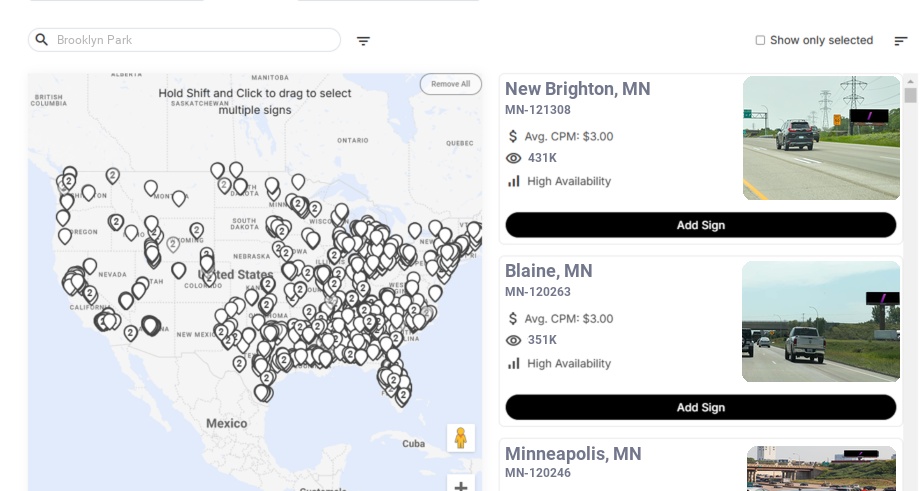
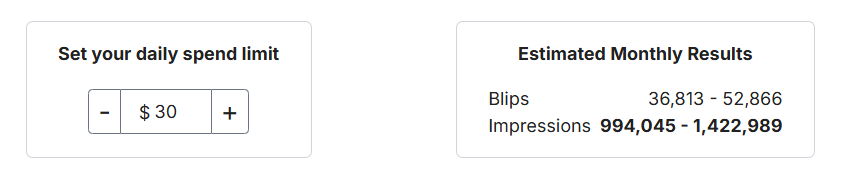
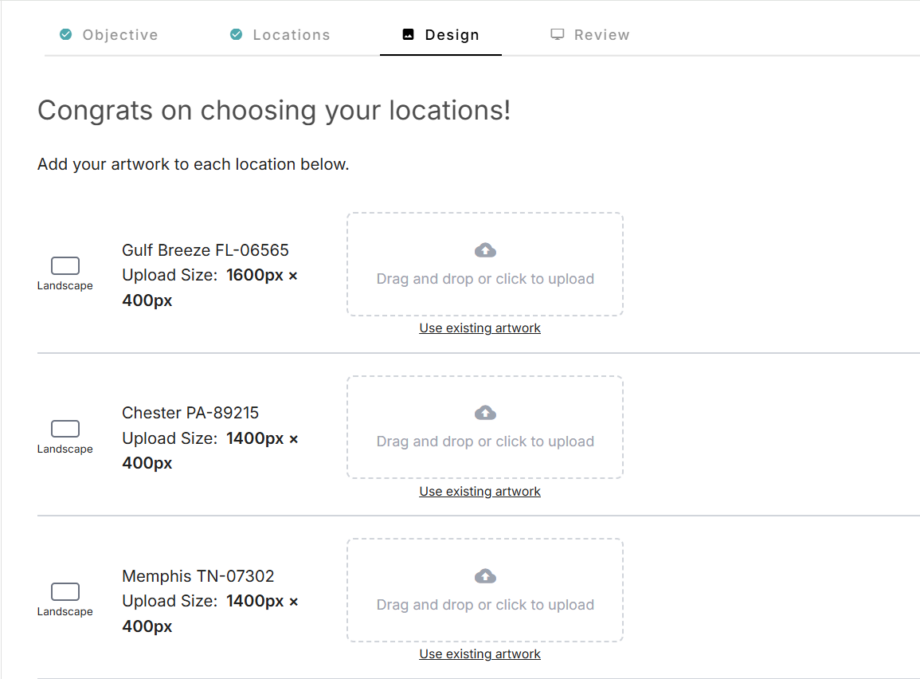
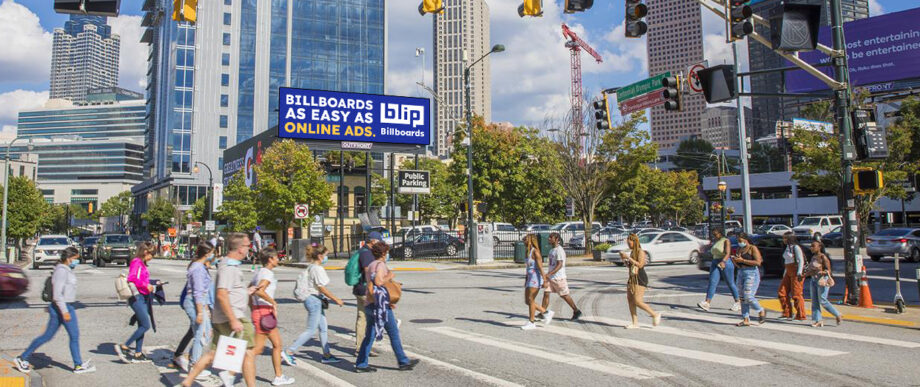
How much is a billboard in Brooklyn Park?
Why Choose Blip for Billboard Advertising in Brooklyn Park
Blip lets you launch in Brooklyn Park fast, reaching US-169 and MN-610 commuters without traditional billboard barriers.
Set a flexible budget for Brooklyn Park and follow weekday rush hours, school runs, or weekend Arbor Lakes shoppers.
No contracts means Brooklyn Park advertisers can test campaigns across Minneapolis, Maple Grove, and Blaine, then shift quickly.
Track Brooklyn Park billboard performance in real time and optimize for the city’s diverse, car-heavy commuter audience.
Use Blip creative tools to rotate bilingual, family-focused ads that fit Brooklyn Park’s multicultural neighborhoods.
Frequently Asked Questions About Billboard Advertising in Brooklyn Park
How much does a billboard cost near Brooklyn Park, Minnesota with Blip?
Where can I advertise with Blip near Brooklyn Park, Minnesota?
Why is Brooklyn Park, Minnesota a good market for billboard advertising with Blip?
What kind of audience can Brooklyn Park, Minnesota billboards reach?
When is the best time to run billboard ads near Brooklyn Park, Minnesota with Blip?
Do I need a contract to advertise with Blip in Brooklyn Park?
How fast can I launch a billboard campaign with Blip in Brooklyn Park?
Where can I advertise with Blip in Brooklyn Park?
Still have questions? Launch a campaign in minutes — no contracts, no commitments.
Start Your CampaignBrooklyn Park Billboard Advertising Guide
Brooklyn Park sits at the crossroads of the northwest Twin Cities suburbs, with fast-growing neighborhoods, busy commuter corridors, and strong cultural diversity. With 15 digital billboards serving the Brooklyn Park area from nearby cities like Spring Lake Park Minneapolis, Blaine, Maple Grove, and New Brighton, we can help advertisers tap into one of Minnesota’s most dynamic suburban markets with flexible, data-driven campaigns and highly visible billboards near Brooklyn Park.
Why the Brooklyn Park Area Is a High-Value Billboard Market
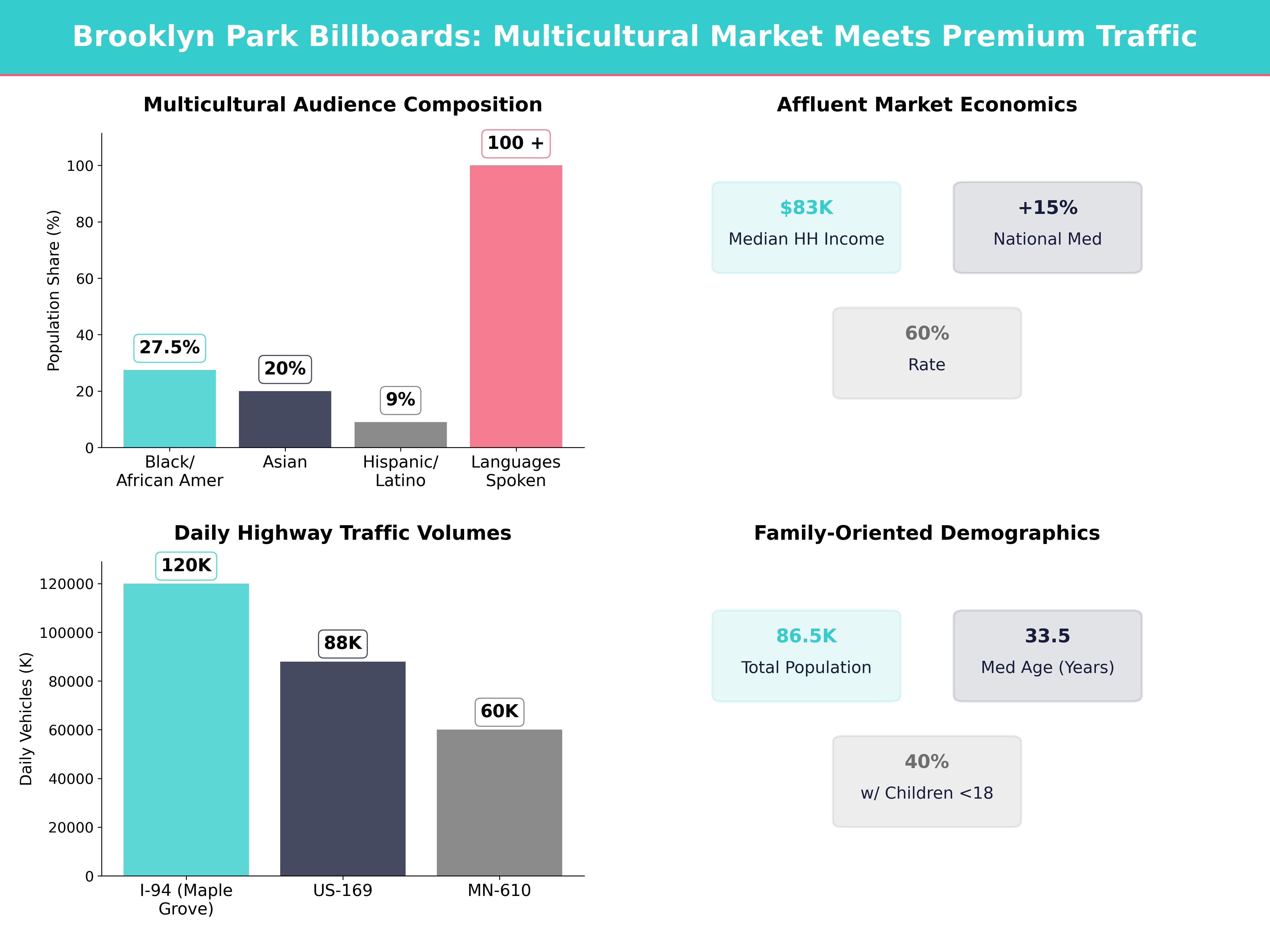
Brooklyn Park is one of Minnesota’s largest cities by population, with roughly 86,000–87,000 residents and steady growth over the last decade (up more than 12% since 2010). It lies along major regional routes connecting the northwest suburbs to downtown Minneapolis, making it ideal for reaching both residents and daily commuters across the broader Twin Cities metro of more than 3.7 million people. For brands looking for Brooklyn Park billboards that can efficiently reach this mix of residents and commuters, nearby highways and arterials offer especially strong exposure.
Key reasons the Brooklyn Park area is attractive for digital billboard advertising:
-
Large, growing population center
- Population near 86,000–87,000 residents, placing Brooklyn Park among the top 10 largest cities in Minnesota.
- Median age around 33–34, significantly younger than the statewide median of about 38–39, meaning a higher concentration of working-age adults and young families.
- About 65–70% of residents are in prime consumer age bands (18–64), ideal for retail, auto, financial, and service advertisers evaluating billboard advertising near Brooklyn Park.
-
Strong regional connectivity
The Brooklyn Park area is framed by key corridors:- U.S. Highway 169 and MN-610 run directly through the area.
- I-94/I-694 to the west and south connect to Maple Grove and Minneapolis.
-
According to the Minnesota Department of Transportation (MnDOT), segments of:
- I-94 near Maple Grove carry around 110,000–130,000 vehicles per day.
- U.S. 169 between Brooklyn Park and Maple Grove sees 80,000–95,000 vehicles per day.
- MN-610 in the Brooklyn Park area carries roughly 50,000–70,000 vehicles per day.
- Nearby arterials like County Road 81, Noble Parkway, and 85th Avenue N also move tens of thousands of vehicles per day, feeding traffic to major shopping and employment nodes.
Our nearby billboards on these and connecting routes allow you to repeatedly reach the same drivers as they commute, shop, and travel between suburbs, generating high weekly frequency from billboards near Brooklyn Park.
-
Economic strength and spending power
- Median household income in the Brooklyn Park area is roughly $80,000–$85,000, with many neighborhoods above the national median by 10–20%.
- More than 60% of households are owner-occupied, supporting demand for home services, financial services, and larger-ticket retail.
- A large share of residents work in healthcare, manufacturing, logistics, tech, and professional services tied to the broader Twin Cities economy, where unemployment rates have often tracked around 2.5–3.5% in recent years—among the lower rates for major U.S. metros.
-
Diverse, multicultural audience
Brooklyn Park is one of the most diverse cities in Minnesota:- Roughly 60%+ of residents identify as Black, Asian, Hispanic/Latino, multiracial, or another non‑white group, while under half identify as white alone.
-
Estimates indicate:
- Around 25–30% Black or African American,
- Around 18–22% Asian,
- Around 8–10% Hispanic or Latino,
- And a fast-growing share of residents born outside the U.S. (around 20–25%).
- Significant African, Asian, and immigrant communities support a mix of local restaurants, grocery stores, faith communities, and services that can benefit greatly from localized billboard messaging and culturally aware creative.
For more local background and economic context, advertisers can explore the City of Brooklyn Park website and Brooklyn Park Economic Development pages, which highlight business districts, workforce data, tax incentive zones, and redevelopment projects. Regional tourism and visitor trends for Brooklyn Park, Maple Grove, and neighboring suburbs are also available via Minneapolis Northwest Tourism. These resources can help refine where Brooklyn Park billboards or nearby placements will most effectively intersect with your ideal customers.
Understanding the Brooklyn Park Area Audience
When we plan campaigns near Brooklyn Park, we think in terms of distinct audience segments, each with different schedules and message triggers. The city’s mix of commuters, families, students, and culturally specific communities makes it possible to run tightly targeted creative while still achieving scale through billboards near Brooklyn Park and nearby suburbs.
1. Commuters to Minneapolis and other suburbs
- A large share of residents commute to jobs in Minneapolis, Maple Grove, Plymouth 3 in 4 workers (roughly 75–78%) commute by car, truck, or van, and over 70% commute alone.
- Average one-way commute times run around 25–28 minutes, which can mean 200+ minutes per week spent in vehicles—prime time for roadside media.
- Metro-wide, regional freeways such as I‑94, I‑694, US‑169, and MN‑610 carry a combined hundreds of thousands of vehicles per weekday, providing repeated impressions to regular commuters.
- Our boards in Minneapolis (approx. 6.2 miles away), Maple Grove (8.2 miles), and New Brighton (9.1 miles) allow you to catch Brooklyn Park area commuters at multiple points along their daily routes, often generating 3–5 exposures per week per regular driver when using a cluster strategy for billboard advertising near Brooklyn Park.
Messaging tips:
- Use fast, benefit-driven headlines for rush hour (“Save 15 Minutes on Dinner Tonight – Exit at…”)
- Add clear calls-to-action that can be acted on quickly (turn here, visit today, call now, short URL).
2. Young families and households with kids
- The Brooklyn Park area has a high share of family households; about 40%+ of households have children under 18, compared with roughly 30–32% statewide.
- The local school district, Osseo Area Schools (ISD 279), is one of the larger districts in Minnesota, serving more than 20,000 students across 30+ schools from Brooklyn Park, Maple Grove, Brooklyn Center
- District enrollment includes a student body where over 60% are students of color and dozens of home languages are represented, making family-oriented, inclusive messaging especially effective.
Messaging tips:
- Highlight family value, convenience, and kid-friendly features (after-school activities, healthcare, grocery, quick food).
- Align with school calendars—back-to-school, sports seasons, and graduation-related services (tutoring, dental care, photographers).
3. Culturally diverse communities
Brooklyn Park’s diversity includes large African, Asian, and immigrant communities, supported by ethnic businesses and cultural organizations. City-level data shows that more than 100 languages are spoken in homes and schools across the area. Many households maintain strong ties to East and West Africa, Southeast Asia, and Latin America, which influences shopping patterns, financial services needs (such as remittances), and education and healthcare decisions.
Messaging tips:
- Consider inclusive imagery and language; avoid overly narrow cultural assumptions.
- Service-based advertisers (banks, clinics, colleges, legal services) can emphasize trust, community, and language support, which are especially important for first-generation and immigrant audiences.
- If your creative can legally and ethically include multiple language variants, Blip’s ability to rotate multiple creatives makes this easy, allowing you to show English-only during some dayparts and bilingual messages during others.
4. Students and workforce trainees
Two major institutions serve the Brooklyn Park area:
- North Hennepin Community College in neighboring Brooklyn Park/Maple Grove zone, serving 5,000–7,000 students annually in credit and non-credit programs.
- Hennepin Technical College – Brooklyn Park Campus, with strong technical and trades programs serving thousands of students each year across programs in manufacturing, construction, IT, and more.
Together, these institutions feed into regional employers along the I‑94, I‑694, and US‑169 corridors, where thousands of skilled and semi-skilled jobs are concentrated. Strategically placed Brooklyn Park billboards and nearby digital boards can help education and training providers stay visible to these students on their daily routes.
Messaging tips:
- Focus on short programs, job placement, affordability, and flexible schedules.
- Use billboards near Minneapolis and Maple Grove to reach both current students and prospective students commuting from neighboring suburbs.
- Emphasize outcomes (job placement rates, average starting wages) when appropriate to capture attention in 6–8 words.
Where Our Billboards Are and How They Reach the Brooklyn Park Area
We have 15 digital billboards serving the Brooklyn Park area within roughly 10 miles, strategically located in:
- Spring Lake Park – great for capturing traffic on Highway 65, where daily volumes commonly exceed 40,000–50,000 vehicles, and commuting patterns between northern suburbs and Minneapolis.
- Minneapolis (6.2 miles) – ideal for targeting Brooklyn Park area residents who work, shop, or attend events downtown or in surrounding neighborhoods. The city hosts hundreds of major events annually, drawing millions of visitors to venues like downtown theaters and sports stadiums.
- Blaine (7.2 miles) – excellent for sports, recreation, and shopping trips, particularly around the National Sports Center, which hosts more than 4 million visitors per year for tournaments and events.
- Maple Grove (8.2 miles) – a premier retail and dining destination, including the Arbor Lakes area, which clusters over 200 shops and restaurants and attracts visitors from across the northwest metro.
- New Brighton (9.1 miles) – strategically placed near I‑35W and interstate junctions catching cross-metro traffic moving between the northwest suburbs, Minneapolis, and St. Paul.
Because traffic flows between these suburbs and the Brooklyn Park area all day, advertisers can:
- Reach daily commuters heading into downtown Minneapolis in the morning and returning through Maple Grove, Spring Lake Park, or Blaine in the evening.
- Capture weekend shopping and dining trips between Brooklyn Park and Maple Grove or Blaine, where retail hubs routinely record thousands of visits per hour during peak periods.
- Reinforce brand awareness across multiple touchpoints by appearing on several boards throughout the driver’s journey; research on out-of-home (OOH) often shows that exposure on 2–3 locations significantly boosts ad recall compared with a single location.
We recommend using a cluster strategy: choose multiple boards in nearby cities that represent the most-used corridors for your audience (for example, Minneapolis + Maple Grove + Spring Lake Park to blanket the northwest commute pattern). This approach essentially creates a virtual ring of billboards near Brooklyn Park that keep your brand in front of local drivers throughout the week.
Ready to reach your audience in Brooklyn Park?
Start Your Campaign →Timing Your Campaign: Daily and Seasonal Patterns
The Brooklyn Park area’s rhythms are shaped by work commutes, school schedules, and strong seasonality typical of the Upper Midwest climate.
Daily patterns
-
Weekday morning peak: ~6:30–9:00 a.m.
- Commuters heading toward Minneapolis and other job centers; many Twin Cities freeways see 30–40% of their daily volume in the combined morning and evening peaks.
- Great for coffee shops, breakfast QSRs, transit services, and professional services (reminders to call, schedule, enroll).
-
Midday: ~11:00 a.m.–2:00 p.m.
- Local errand runs, lunch breaks, shift workers, and service appointments.
- Ideal for healthcare, fast casual dining, banking, and retail promotions.
-
Evening peak: ~3:30–7:00 p.m.
- Return commuters, after-school pickups, and evening activities; school dismissal and after-school sports add additional local traffic on arterials.
- Perfect for restaurants, grocery, gyms, entertainment, and service businesses open late.
Using Blip’s dayparting tools, you can bid only during the windows that matter most for your offer (for instance, 4–7 p.m. for a restaurant near Maple Grove, or 7–9 a.m. for a commuter-focused service near Minneapolis).
Weekly and weekend patterns
- Monday–Thursday: strong commuter and school traffic, with consistent retail and service demand. Focus on routine needs: banking, childcare, clinics, grocery, and drive-time media or podcasts.
- Friday: spike in evening leisure traffic—movies, restaurants, sporting events, and weekend shopping. Many regional shopping districts report 10–20% higher sales on Fridays and Saturdays vs. midweek.
- Saturday–Sunday: higher midday and afternoon volumes toward retail hubs like Maple Grove’s Arbor Lakes and recreational areas in Blaine and Minneapolis parks. Weekend days are crucial for categories like furniture, auto, and big-box retail that depend heavily on 2–3 peak shopping days per week.
Seasonal considerations
Brooklyn Park shares the broader Twin Cities’ strong seasonal swings, with winter temperatures routinely below freezing and summer highs in the 70s and 80s:
-
Winter (Dec–Feb):
- Shorter daylight means more impressions during dark hours; in December, the metro often sees under 9 hours of daylight, making bright digital creatives very impactful.
- Emphasize indoor activities, auto service, heating/energy services, and ecommerce.
- Weather events can cause traffic slowdowns—good for brand recall as dwell times increase.
-
Spring (Mar–May):
- Home improvement, lawn care, car dealerships, and tax-related services see spikes; many home-service businesses report 30–40% of annual demand in spring and early summer.
- Promote local events and spring sports; check community calendars on the City of Brooklyn Park events page.
-
Summer (Jun–Aug):
- High engagement with parks, festivals, and outdoor dining; local tourism agencies note that summer months account for a significant share of annual visitor spending across the Twin Cities.
- Traffic to lakes, regional parks, and destinations highlighted by Explore Minnesota
- Ideal for tourism, attractions, quick service restaurants, and seasonal hiring.
-
Fall (Sep–Nov):
- Back-to-school and college recruitment, healthcare (flu shots), and early holiday shopping.
- Sports (high school, college, and pro) drive movement around Minneapolis and suburban fields, with tens of thousands attending football games and other events each week.
We encourage aligning creative and budgets with these seasonal behaviors—Blip’s flexible budgets allow you to increase spend temporarily around peak periods (e.g., tax season for accountants, back-to-school for tutoring centers, or holiday shopping for retailers). This flexibility is especially useful for advertisers coordinating billboard rental near Brooklyn Park with other seasonal marketing.
Creative Best Practices for the Brooklyn Park Area
With fast-moving traffic on major corridors around the Brooklyn Park area, your creative needs to be instantly readable and locally relevant. OOH studies consistently show that messages with 8 words or fewer and a single focal point can boost comprehension and recall by double-digit percentages.
1. Design for at-a-glance readability
- Aim for 6–8 words or fewer in your main message.
- Use large, high-contrast fonts (e.g., white/yellow on dark, or dark on light).
- Make a single, clear call-to-action (CTA): “Exit 169 at 85th,” “Order at [short URL],” “Call 763‑XXX‑XXXX.”
- Avoid clutter—limit to 1 key image, 1 logo, and 1 offer to keep comprehension under the typical 3–5 seconds drivers have to process your ad.
2. Lean into local relevance
- Reference familiar routes or landmarks (e.g., “Just off 169 & 85th,” “Minutes from Arbor Lakes,” “Near North Hennepin CC”).
- For Brooklyn Park area residents commuting through Minneapolis, localize by neighborhood (“Downtown Mpls,” “North Loop,” “Uptown”) where appropriate.
- Use hyper-local cues (“On Zane Ave next to Hy‑Vee”) to signal proximity and reduce friction—location relevance can significantly increase response rates versus generic messaging.
3. Reflect the community’s diversity
- Use imagery that reflects multi-ethnic families and professionals, consistent with Brooklyn Park’s demographics where a majority of residents are people of color.
- If relevant, highlight multilingual support (“Hablamos Español,” “Services in English, Hmong, and Somali,” where accurate and legally compliant).
- For community-based organizations, consider rotating creatives for different events or groups using Blip’s multiple-creative capability.
4. Make offers time-sensitive and actionable
- “Tonight only,” “This weekend,” “Limited-time enrollment” perform well, especially when paired with dayparting so they show near the relevant time.
- For restaurants and retail in Maple Grove or Blaine, emphasize proximity (“5 minutes ahead,” “Next exit”).
- Tie deadlines to real behaviors (“Enroll by Sept 1,” “Sale ends Sunday”) to create urgency.
5. Use multiple creatives to tell a mini-story
With Blip, you can upload several creatives and rotate them:
- Creative 1: Brand awareness (“Trusted Dental Care in the Brooklyn Park Area”)
- Creative 2: Offer (“New Patient Exam $X – This Month Only”)
- Creative 3: Directional (“Next Right off 169 at 85th Ave N”)
This sequence reinforces memory while giving viewers new reasons to respond over time. Advertisers that rotate 3–5 creatives often see stronger engagement than those using a single static design for months. This is true whether you’re using Brooklyn Park billboards directly in the city or a cluster of boards just outside its borders.
Sample Campaign Strategies by Business Type
Local retail and restaurants
- Objective: Drive foot traffic from nearby corridors.
- Audience context: Brooklyn Park and Maple Grove together serve well over 150,000 residents plus visitors from across the metro, with retail and dining hubs drawing thousands of cars daily.
-
Tactics:
- Focus boards near Maple Grove and Minneapolis to capture shoppers and workers who also live in the Brooklyn Park area.
- Run heavier on Thursday–Sunday and during lunchtime and evening when restaurant and retail visits peak.
- Rotate creatives for lunch specials, dinner promotions, and weekend events.
- Use short URLs or local maps on landing pages so mobile users can quickly get directions after viewing billboards near Brooklyn Park.
Home services (HVAC, roofing, landscaping, cleaning)
- Objective: Reach homeowners across the northwest metro.
- Audience context: With 60%+ owner-occupied housing in Brooklyn Park and even higher rates in neighboring suburbs, the northwest corridor concentrates tens of thousands of homeowner households.
-
Tactics:
- Target commuter boards near Minneapolis, Maple Grove, and Blaine, where higher-income households travel daily.
- Emphasize trust (“Locally Owned Since 2005 in the Brooklyn Park Area”) and urgent benefits (“Same-Day Service”).
- Increase impression frequency in spring and fall, when maintenance spikes and storms can generate sudden surges in demand for roofing and restoration.
Healthcare and dental practices
- Objective: Build local patient base.
- Audience context: With tens of thousands of residents under age 18 and a high share of working-age adults, primary care, dental, eye care, and urgent care services are in steady demand year-round.
-
Tactics:
- Highlight convenience (“Evenings & Saturdays,” “Walk-Ins Welcome”), insurance acceptance, and family-friendly care.
- Time campaigns around back-to-school, flu season, and new year benefits resets, which often drive double-digit increases in appointment volume.
- Use boards in Minneapolis and Maple Grove to catch Brooklyn Park area workers who might prefer appointments near home or along their route.
Education and training
- Objective: Boost enrollment for colleges, training centers, and K‑12 services.
- Audience context: Between local colleges, technical schools, and a large K‑12 district, the northwest metro hosts tens of thousands of students making frequent trips along US‑169, I‑94, and MN‑610.
-
Tactics:
- Run campaigns heavily 6–10 weeks before semester starts and ahead of major application deadlines.
- Focus near Minneapolis, Maple Grove, and Spring Lake Park to reach young adults commuting for work or school.
- Use short URLs or QR codes (large and simple) tied to enrollment landing pages; keep QR codes large enough to be scanned from typical viewing distances.
Events, arts, and community organizations
- Objective: Increase attendance and awareness.
- Audience context: Local festivals, sports tournaments, cultural events, and community gatherings can each draw from hundreds to tens of thousands of attendees, especially when promoted regionally.
-
Tactics:
- Start promoting 3–4 weeks before major events, increasing frequency in the final 7–10 days.
- Use dynamic countdown-style messaging (“Festival This Saturday,” “2 Days Left”) with rotating creatives.
- Coordinate with community calendars and local coverage on outlets like CCX Media and the Star Tribune – Local section to time your promotions with news/features.
- For city-hosted or community events, cross-reference listings on the Brooklyn Park community events calendar to align billboards with other marketing and ensure your billboard advertising near Brooklyn Park peaks when residents are actively planning their weekends.
Ready to reach your audience in Brooklyn Park?
Start Your Campaign →Using Blip’s Tools to Target the Brooklyn Park Area Smartly
Blip’s on-demand model—paying only for the “blips” (ad plays) you want—pairs well with the Brooklyn Park area’s mix of commuter, retail, and neighborhood traffic. This is especially important in a corridor where daily freeway volumes routinely exceed 80,000–100,000 vehicles on key segments.
1. Geographic selection
- Choose boards in Spring Lake Park, Minneapolis, Blaine, Maple Grove, and New Brighton that map to your customers’ real routes.
-
For a Brooklyn Park area business, a typical starter configuration might be:
- 2–4 boards in Minneapolis along commuter paths.
- 3–5 boards near Maple Grove for retail and weekend traffic.
- 2–3 boards in Spring Lake Park/Blaine to cover northern suburbs where many Brooklyn Park area residents travel.
- Add or remove boards over time as you learn where your customers are most likely to come from, using sales and web analytics by ZIP code. This makes it easy to fine-tune a network of billboards near Brooklyn Park without committing to long-term static placements.
2. Budget control
- Set a daily or monthly budget that fits your goals; even modest budgets can achieve strong presence when focused on specific times and boards. For example, concentrating spend on 2–3 peak dayparts can deliver higher effective frequency than spreading the same budget thinly all day.
-
Increase spend temporarily for:
- Special events or sales.
- Peak seasonal windows (e.g., spring home services, holiday shopping).
- New location openings or rebrands, where you may want 2–4 weeks of elevated exposure.
3. Dayparting and scheduling
-
Turn your ads on only during:
- Commute times (7–9 a.m., 4–7 p.m.).
- Lunch (11 a.m.–1 p.m.) for quick-service restaurants.
- Weekends for retail and entertainment.
- For time-sensitive messages, schedule creatives to expire automatically after your promotion ends so only current offers run.
4. Creative testing
- Upload multiple creatives and monitor which time and location combinations correlate with web traffic, calls, or store visits.
-
Test variables:
- Headline A vs. Headline B.
- Price-focused vs. value/benefit-focused messaging.
- Brand-only vs. offer-based designs.
- Use A/B testing cycles of 2–4 weeks to gather enough impressions for meaningful comparisons.
Measuring and Optimizing Your Brooklyn Park Area Campaign
While billboards are a top-of-funnel medium, we can align them with measurable outcomes and iterate based on data.
1. Use trackable elements
- Short, memorable URLs (e.g., “brand.com/BP”) that are only used on billboards.
- Unique phone numbers or extensions.
- Promo codes specific to the Brooklyn Park area campaign (“BP10”, “NWMETRO”).
- If you have multiple locations, use separate codes for “Maple Grove,” “Blaine,” or “Minneapolis” creatives to see which corridors perform best.
2. Monitor correlated metrics
- Website traffic by city/region during your campaign; look for percentage lifts vs. baseline.
- Store foot traffic and sales trends around locations nearest the routes you’re targeting—many retailers see 5–15% sales lifts during strong OOH flights when other marketing is held constant.
- Call volume spikes during specific dayparts that align with your billboard schedule.
- For events, track pre-registrations or ticket sales by date to see if increases align with your flight start.
3. Iterate over time
- Reinvest in boards and time windows that correlate with higher engagement.
- Refresh creative every 4–8 weeks to keep frequent commuters from tuning out.
- Use local news and government sources—like Hennepin County, Metro Transit, the City of Brooklyn Park, and regional planning updates from the Metropolitan Council—to anticipate infrastructure changes, new transit lines, and developments that could shift traffic flows and open new opportunities.
By pairing an understanding of Brooklyn Park’s demographics, commuting patterns, and cultural diversity with Blip’s flexible digital billboard tools, we can help you build campaigns that reach the right people at the right times on the right roads. The 15 digital billboards serving the Brooklyn Park area from nearby cities form a powerful, customizable network—ready to drive awareness, traffic, and measurable results for your brand, whether you need short-term billboard rental near Brooklyn Park or an always-on regional presence.