Billboards in Plymouth, MN
No Minimum Spend. No Long-Term Contracts. Just Results.
Trusted by Leading Brands


Billboard advertising
in Plymouth has never been easier



How much is a billboard in Plymouth?
Why Choose Blip for Billboard Advertising in Plymouth
Blip lets Plymouth advertisers launch fast and self-serve, reaching I-494 and Highway 169 commuters without traditional buying hassle.
Set a flexible daily budget for Plymouth billboards and focus spend on morning and evening drives when west-metro traffic is busiest.
No contracts means Plymouth brands can test weekends on Arbor Lakes shopping runs, then scale what works.
Track real-time results in Plymouth and adjust flights as family errands, school traffic, and holiday shopping patterns shift.
Use Blip's creative tools to build bold Plymouth messaging for affluent, professional households and high-speed freeway views.
Frequently Asked Questions About Billboard Advertising in Plymouth
How much does a billboard cost near Plymouth, Minnesota with Blip?
With Blip, advertising on Plymouth billboards is flexible and affordable because you set your own daily budget and only pay for the individual ad displays, or “blips,” your campaign receives. Each blip is a brief 7.5 to 10-second slot on digital billboards near Plymouth, Minnesota, giving you control over how often your message appears and how much you spend each day. Your cost per blip changes based on when and where you choose to appear and on overall advertiser demand in the Plymouth area, and you can adjust your budget whenever you like.
Where can I advertise with Blip near Plymouth, Minnesota?
While our two digital billboards are located in Maple Grove, about 9.4 miles from Plymouth, their placement along major regional corridors lets us effectively serve the Plymouth area and the broader northwest metro. Maple Grove sits directly north of Plymouth, connected via I-494, Highway 169, and County Road 101. Typical Twin Cities freeway travel times between central Plymouth and Maple Grove shopping areas are often 10–15 minutes outside of peak congestion, so billboard rental near Plymouth in Maple Grove still reaches daily Plymouth commuters.
What kind of audience do Plymouth billboards with Blip reach?
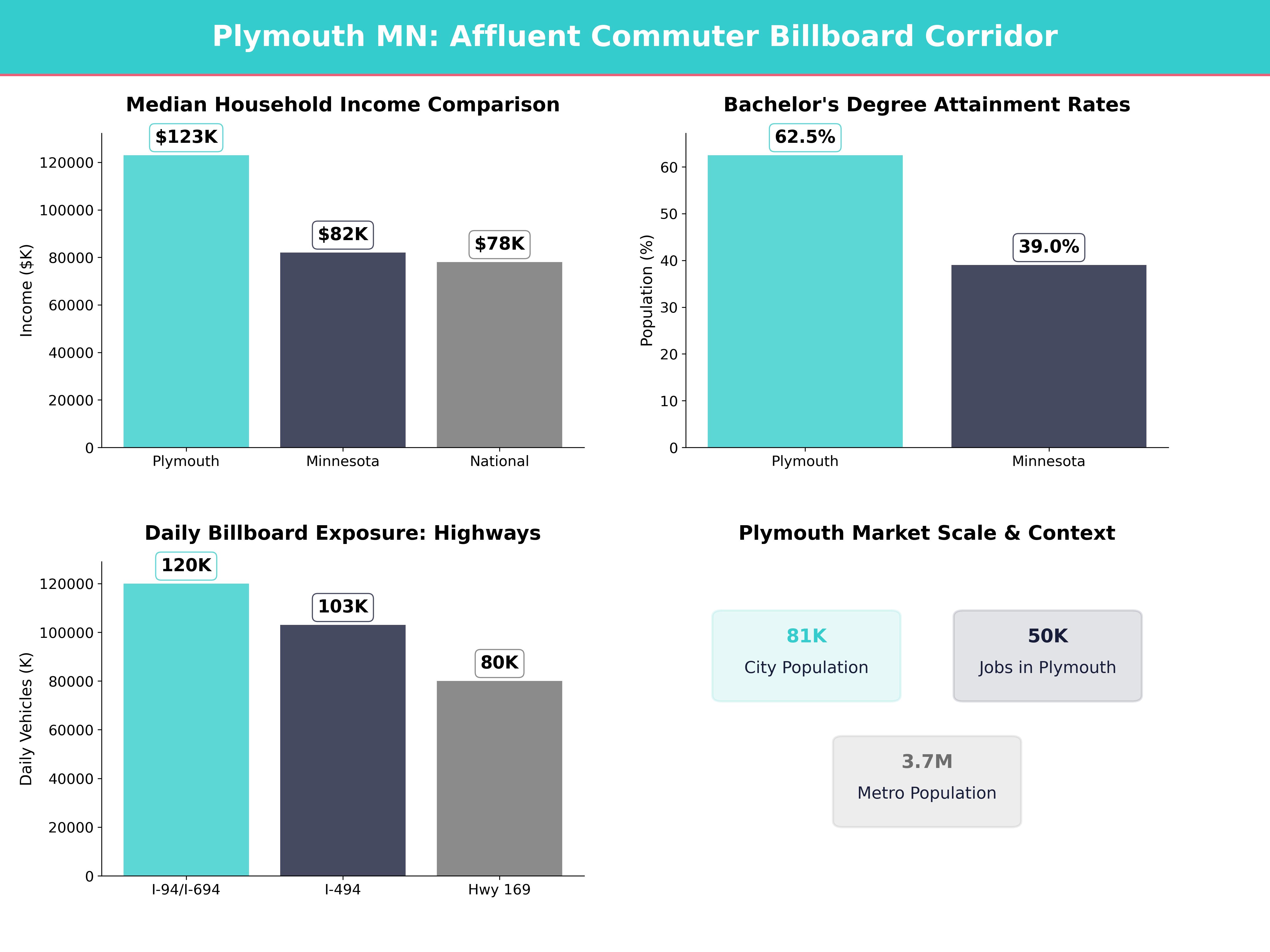
Plymouth is one of Minnesota’s largest suburbs and a major employment and residential hub in Hennepin County, which makes it a prime location for Plymouth billboards and other out-of-home media. The City of Plymouth reports a population of roughly 81,000 residents and more than 36,000 households, and local households are affluent with median household income around $120,000–$125,000. The audience is digitally savvy but still highly mobile, with average one-way commute times around 22–25 minutes and more than 75% of workers driving alone to work.
When is the best time to run billboards near Plymouth, Minnesota with Blip?
Morning commute, midday, evening peak, and weekend surges all create strong opportunities for billboard advertising near Plymouth. Morning and evening peaks together often represent 35–45% of daily traffic, while midday slices often represent 25–30% of daily volume. Weekend retail trips can make up a significant share of household spending, and many retail corridors see 10–25% higher Saturday traffic compared with weekday off-peak periods.
Why is Plymouth, Minnesota a strong market for billboard advertising?
Plymouth residents are affluent, and recent city and regional estimates place median household income around $120,000–$125,000, compared with roughly $82,000 statewide. Educational attainment is high, with roughly 60–65% of adult residents holding a bachelor’s degree or higher, and Plymouth alone supports more than 50,000 jobs across major sectors. This means advertisers are speaking to high-spend households, a digitally savvy commuter base, and a large daytime employment center all in one market.
Do I need a contract to advertise with Blip in Plymouth?
No, Blip has no long-term contracts or minimum commitments. You can start, pause, or stop your campaign at any time.
How fast can I launch a billboard campaign with Blip in Plymouth?
You can have your campaign live in minutes. Create a free account, select your locations, set your budget, upload your design, and start running once approved.
Where can I advertise with Blip in Plymouth?
Blip has digital billboards in Plymouth. You can browse available locations on a map, choose the ones that fit your audience, and start advertising right away.
Still have questions? Launch a campaign in minutes — no contracts, no commitments.
Start Your CampaignPlymouth Billboard Advertising Guide
Plymouth, Minnesota Maple Grove serving the Plymouth area, we can help brands tap into this high‑value audience with flexible, data‑driven campaigns and highly visible billboards near Plymouth that complement your other local marketing.
Understanding the Plymouth Area Market
Plymouth is one of Minnesota’s largest suburbs and a major employment and residential hub in Hennepin County, which makes it a prime location for Plymouth billboards and other out‑of‑home media.
- The City of Plymouth reports a population of roughly 81,000 residents and more than 36,000 households, making it one of the state’s top 10 cities by population.
– Source: City of Plymouth – Community Profile - Plymouth residents are affluent: recent city and regional estimates place median household income around $120,000–$125,000, compared with roughly $82,000 statewide and around $75,000–$80,000 nationally, meaning local households often have 40–60% more income to spend.
- Educational attainment is high; roughly 60–65% of adult residents hold a bachelor’s degree or higher, versus about 38–40% statewide. That concentration of degree‑holders supports strong demand for professional services, healthcare, financial products, and high‑end retail.
- The broader Minneapolis–St. Paul metro has about 3.7 million residents and an employment base topping 1.9 million jobs, providing a large commuter and regional shopping audience that moves through the Plymouth area every day.
– Metro context: Metropolitan Council – Twin Cities Region - Plymouth alone supports more than 50,000 jobs across major sectors such as professional and technical services, manufacturing, healthcare, and finance, according to city economic development summaries, making it both a bedroom community and a daytime employment center.
- Hennepin County, where Plymouth is located, recorded an unemployment rate in the 2.5–3.5% range in recent years, indicating a tight labor market and steady consumer spending.
– County info: Hennepin County
For advertisers, this means:
- You’re speaking to high‑spend households that can support premium products, private education, elective healthcare, and B2B services. Households with incomes above $100,000 typically account for a disproportionate share of discretionary spending in categories like travel, dining, and home improvement, making billboard advertising near Plymouth a smart way to capture that spend.
- The audience is digitally savvy but still highly mobile, with average one‑way commute times around 22–25 minutes and more than 75% of workers driving alone to work, feeding daily impressions for roadside media.
- The Plymouth area is family‑oriented—about 30–35% of residents in nearby west‑metro suburbs are under age 20, and local school districts collectively serve more than 40,000 students, creating strong demand for youth‑focused services and activities.
- Safety and quality of life scores are high, with Plymouth frequently ranking among Minnesota’s safest cities, which attracts stable, long‑term residents and repeat shoppers.
– Local context and rankings are often highlighted by Plymouth Magazine Star Tribune
Where Our Billboards Reach Drivers Near Plymouth
While our two digital billboards are located in Maple Grove (about 9.4 miles from Plymouth), their placement along major regional corridors lets us effectively serve the Plymouth area and the broader northwest metro. This network functions much like having dedicated Plymouth billboards along the busiest approach routes into the city.
Key geographic considerations:
- Maple Grove sits directly north of Plymouth, connected via I‑494, Highway 169, and County Road 101. Typical Twin Cities freeway travel times between central Plymouth and Maple Grove shopping areas are often 10–15 minutes outside of peak congestion, so billboard rental near Plymouth in Maple Grove still reaches daily Plymouth commuters.
- Maple Grove’s Arbor Lakes retail district is one of the largest shopping destinations in the northwest metro, drawing shoppers from Plymouth, Brooklyn Park, Rogers, and beyond, with hundreds of acres of retail and entertainment and more than 6 million square feet of commercial space.
– Learn more: City of Maple Grove – Community & Business -
According to MnDOT, typical urban freeway segments in the northwest metro carry 80,000–130,000 vehicles per day:
- I‑94/I‑694 through Maple Grove: often 110,000–130,000+ AADT (Average Annual Daily Traffic).
- I‑494 near Plymouth: commonly 90,000–115,000 AADT.
- Highway 169 near Plymouth and Maple Grove: roughly 70,000–90,000 AADT on busy segments.
- Even conservative digital‑out‑of‑home planning benchmarks often assume that 60–70% of vehicles on these corridors are unique daily drivers, giving you access to tens of thousands of unique viewers every day.
Practically, this means:
- Plymouth residents heading to Arbor Lakes, Costco, Target, or restaurants in Maple Grove—a retail cluster that draws millions of visits annually—regularly pass our signage, generating repeated exposures over the course of a month.
- Commuters from outer suburbs like Rogers, Dayton, and Otsego pass the Maple Grove boards as they travel toward job centers near the Plymouth area and Minneapolis. Many of these communities have population growth rates in the 2–4% per year range, expanding your potential audience each year.
- Weekend shopping and dining traffic greatly boosts impressions on Fridays, Saturdays, and Sundays; MnDOT data often show 10–20% higher volumes on key shopping corridors during peak retail seasons such as November–December.
When planning campaigns, think about:
- North–south flows: traffic between the Plymouth area and Maple Grove, especially along I‑494, Highway 169, and local arterials that channel drivers into the freeway network. This is where strategically placed billboards near Plymouth can repeatedly reach the same high‑value households.
- Regional flows: drivers using Maple Grove as a gateway to downtown Minneapolis via I‑94/694 and to the northern exurbs, where population growth and new housing developments are adding thousands of new residents.
- Event‑based surges: Maple Grove and Plymouth community events, concerts, sports tournaments, and holiday shopping can spike traffic volumes by 10–30% on certain days.
– Check community calendars from the City of Plymouth City of Maple Grove to align with these surges.
We can use Blip’s flexible scheduling to emphasize the times of day and days of week when these flows are strongest for your target audience and make your billboard advertising near Plymouth as efficient as possible.
Who You’ll Reach: Demographics & Lifestyles
Understanding the Plymouth area audience helps shape messaging, imagery, and offers.
Key demographic traits (with Plymouth and Maple Grove showing similar profiles):
- Affluent households
– Median household incomes generally in the $110,000–$125,000 range for Plymouth and $100,000+ for Maple Grove, compared to around $70,000–80,000 for the overall Twin Cities metro.
– In many west‑metro ZIP codes, more than 40% of households earn $100,000+, and around 15–20% earn $150,000+, creating robust demand for discretionary and premium categories.
– High homeownership rates, often 75–80%+, meaning strong demand for home improvement, landscaping, roofing, HVAC, and financial services such as refinancing and wealth management. - Family‑centric population
– Around 30–35% of residents are under age 20 in many northwest suburbs, versus about 25% nationally, indicating a large base of families with children.
– Strong school districts such as Wayzata Public Schools (ISD 284) and Osseo Area Schools (ISD 279) anchor community life and activities. Together they serve tens of thousands of students across the west and northwest metro, with graduation rates that commonly exceed 90%.
– District info: Wayzata Public Schools and Osseo Area Schools – Youth participation in organized activities is high; local parks and recreation programs routinely report thousands of enrollments per season in sports, camps, and enrichment programs.
– Local programming: Plymouth Parks & Recreation Maple Grove Parks & Recreation - Professional workforce
– Large shares of residents work in management, business, healthcare, IT, and education, with professional and related occupations accounting for 40–50% of the workforce in many nearby ZIP codes.
– Major nearby employers include Cargill (Wayzata), General Mills (Golden Valley), UnitedHealth Group (Minnetonka), and numerous medical and technology firms throughout the west metro, each employing thousands locally.
– Daytime population swells as workers commute into area employment centers, boosting impressions for lunchtime and after‑work messaging.
Implications for creative:
- Feature clean, modern visuals that appeal to professionals who are used to polished digital and corporate branding.
- Highlight family benefits (safety, convenience, education, wellness) to connect with households managing busy schedules and multiple activities.
- Promote time‑saving, quality‑of‑life improvements—premium services do well here when framed around efficiency, quality, and reliability.
- Emphasize trust and expertise (e.g., “Board‑Certified,” “25+ Years Serving the West Metro”), especially in higher‑consideration categories like healthcare, finance, home services, and education.
- Where appropriate, reference local awards or recognition from outlets like CCX Media Sun Sailor (a local community newspaper) to reinforce credibility.
Key Commuter Patterns & Traffic Peaks
The Plymouth area sits along several of the Twin Cities’ busiest suburban corridors. This helps digital billboards near Maple Grove capture daily routines and extend your reach as if you had multiple Plymouth billboards along the main routes.
Typical patterns to keep in mind (based on regional traffic counts and commute data):
- Morning commute (6:30–9:00 a.m.)
– West and northwest‑suburb residents heading toward job centers near the Plymouth area, downtown Minneapolis, and the I‑494 corridor.
– On many Twin Cities freeways, 35–45% of daily traffic occurs during morning and evening peaks combined, with morning often accounting for 15–20% of daily volume.
– Good window for B2B services, professional services, and coffee/breakfast QSR when decision‑makers are in planning mode. - Midday (11:00 a.m.–2:00 p.m.)
– Errand runs, medical appointments, business lunches, and midday shift workers.
– Many corridors see a more even distribution of traffic here, with midday slices often representing 25–30% of daily volume.
– Ideal for healthcare, retail, lunchtime restaurants, and local services looking for same‑day or near‑term action. - Evening peak (3:30–6:30 p.m.)
– Commuters returning to the Plymouth area and outer suburbs.
– Evening peaks frequently rival or exceed morning volumes, often accounting for 20–25% of daily traffic on busy arterials.
– Strong opportunity for after‑work dining, fitness, entertainment, and home services (“Call Tonight,” “Schedule for Tomorrow”). - Weekend surges
– Heavy traffic toward Maple Grove’s Arbor Lakes and big‑box shopping areas; weekend retail trips make up a significant share of household spending, especially for categories like home improvement and family entertainment.
– Many retail corridors see 10–25% higher Saturday traffic compared with weekday off‑peak periods, with additional spikes around major holidays and back‑to‑school.
With Blip, we can purchase ad “blips” only during these high‑value windows, rather than paying for 24/7 coverage. This lets you:
- Concentrate budget on drive‑time peaks that may represent 40–50% of daily traffic.
- Run day‑parted messages (e.g., different morning vs. evening creatives) to align with mindset and likely actions at different times of day.
- Align your spend with when your audience is most likely to take action, using your own web analytics and call data to confirm which windows perform best.
Crafting High‑Impact Creative for the Plymouth Area
Because we’re appealing to a sophisticated, family‑oriented audience, we recommend a few creative best practices tailored to the Plymouth area:
-
Lead with clarity and trust
- Use a short, benefit‑driven headline:
– “Same‑Day Orthopedic Care Near You”
– “Remodel Your Kitchen Before the Holidays”
– “Private Tutoring That Boosts Test Scores” - Include credibility signals: “Locally Owned Since 1995,” “Rated 4.9★ on Google,” or recognizable local affiliations (e.g., “Proud Sponsor of Wayzata Hockey” or “Trusted by Osseo Area Families”).
- Research shows that clear, benefit‑focused headlines can increase ad recall by 20–30% versus vague or clever wording, especially in fast‑moving out‑of‑home environments.
- Use a short, benefit‑driven headline:
-
Use localized messaging without overcomplicating
- Reference the west metro or northwest suburbs to speak broadly:
– “Serving the Plymouth & Maple Grove Area”
– “West Metro’s Trusted Roofers” - Mention recognizable local landmarks or corridors when relevant: “Just off I‑494 & 55,” “Near Arbor Lakes.”
- Local references help improve perceived relevance; out‑of‑home studies frequently show double‑digit lifts in engagement and recall when creative uses familiar place names or landmarks.
- Reference the west metro or northwest suburbs to speak broadly:
-
Design for fast‑moving traffic
- Limit text to 7 words or fewer when possible; many out‑of‑home best‑practice guides recommend staying under 10–12 total words to maximize readability at 55–65 mph.
- Use high‑contrast colors and bold fonts; avoid detailed background images that reduce legibility.
- Emphasize one clear action: “Book Online,” “Call Today,” or a simple URL. Calls‑to‑action that are easy to remember (short URLs, short phone numbers) are especially important when average viewing time is only 5–8 seconds.
-
Align visuals with local lifestyles
- Professional families, youth sports, lakes and parks (Plymouth has over 1,800 acres of parkland and 150+ miles of trails, according to the City of Plymouth Parks & Recreation
- Nearby regional amenities such as Elm Creek Park Reserve and Medicine Lake see hundreds of thousands of visits annually, underscoring the community’s love of the outdoors.
- Outdoor activities, health, and education all resonate well in this community; imagery reflecting these themes can increase emotional connection and message relevance.
Using Blip Tools to Target the Plymouth Area Smartly
Blip’s flexibility makes it easy to tailor your presence near Plymouth even though the physical faces are in Maple Grove. It gives you many of the benefits of traditional billboard rental near Plymouth while keeping the ability to scale up or down quickly.
Strategic tactics to consider:
-
Dayparting by audience type
- B2B or professional services: Concentrate on weekday morning and evening commutes, which together often represent 35–45% of daily traffic on key freeways.
- Family services (daycare, pediatric care, tutoring): Emphasize afternoons and early evenings, plus weekend days, when parents are driving to and from activities or errands.
- Retail and restaurants: Invest in Friday–Sunday, with boosted frequency Saturday afternoons and evenings, when household spending on dining and entertainment typically peaks.
-
Budget pacing
- Start with a test period of 2–4 weeks, allocating enough budget to secure at least 2–6 plays per hour per face during your chosen dayparts. This can translate into hundreds to a few thousand daily plays, depending on budget and competition.
- Over a month, this approach can easily deliver tens of thousands of impressions, based on traffic counts and rotation share.
- As you see which days/times drive the most web traffic or calls, reallocate spend toward those windows and consider increasing frequency to drive frequency of 5–10+ exposures per viewer per month, a common branding target in out‑of‑home.
-
Rotating creative
-
Use 2–4 creative variations:
- Branding message (who you are).
- Offer message (sale, discount, or promotion).
- Directional / location message.
- Seasonal or event‑driven message (back‑to‑school, holidays, summer.)
- Rotating creatives helps prevent fatigue and allows you to test which themes perform best; advertisers often see 10–30% swings in response rates between different offers and calls‑to‑action.
-
Use 2–4 creative variations:
-
Short bursts around local events
-
Increase frequency during:
- Plymouth community events listed on the City of Plymouth Events Calendar
- Maple Grove festivals and events scheduled by the City of Maple Grove.
- Regional happenings promoted by Meet Minneapolis or Explore Minnesota
- Tie creative to key events (e.g., “Game‑Day Specials Tonight,” “Back‑to‑School Sale Ends Sunday”). Aligning offers to specific dates can create urgency and has been shown in many campaigns to drive higher short‑term response versus generic messaging.
-
Increase frequency during:
Industry‑Specific Ideas for the Plymouth Area
Because the Plymouth area has distinct economic strengths, some sectors can especially benefit from well‑planned digital billboard campaigns. When these are placed on billboards near Plymouth and Maple Grove, they can efficiently reach both residents and commuters.
Healthcare & Wellness
With a highly insured, high‑income population, elective healthcare and wellness services are in strong demand.
- In high‑income suburbs, private insurance coverage rates often exceed 95%, and spending on healthcare and wellness services can be 20–30% higher than national averages.
- The west metro is home to large healthcare systems and specialty clinics, many of which attract patients from a wide radius; digital billboards can help smaller or newer providers stand out in this competitive landscape.
Ideas:
- Promote orthopedic, dental, dermatology, and eye care with appointment‑driven messages: “New Patients Welcome,” “Same‑Day Appointments.” Emphasize short wait times, which surveys show are a top decision factor for more than 50% of patients.
- Align creatives with seasonal needs: sports physicals in late summer, flu shots in fall, LASIK or cosmetic services in winter, allergy care in spring.
- Target morning and evening commutes, when people think about lingering health to‑dos and can more easily call or book online after seeing your ad.
- Highlight proximity to major corridors (“5 Minutes from I‑494 in Plymouth”) to reduce perceived friction.
Home Services & Real Estate
High homeownership and ongoing development in the west and northwest metro support steady demand for home‑related services.
- With 75–80%+ homeownership and a large stock of homes built in the 1980s–2000s, many properties are entering prime years for roof replacement, exterior updates, and major remodels.
- Regional building permit data for Hennepin County consistently shows thousands of residential projects annually, from additions to full new builds.
Ideas:
-
For roofers, remodelers, landscapers, and HVAC companies, highlight:
- “Free Estimate,” “0% Financing,” or “Book Before Winter.” Financing options can be a key trigger for high‑ticket projects often totaling $10,000–$50,000+.
-
Time campaigns around:
- Spring (March–May) for landscaping, roofing, exterior painting, decks, and concrete—often when contractors see 30–40% of annual lead volume.
- Late summer/fall (August–October) for interior remodels and HVAC maintenance before cold weather, which can help reduce emergency call volume in January–February.
-
Real estate agents and builders can promote:
- “New Construction in the West Metro,” “Move‑In Ready Homes,” or “Upsize Before School Starts.” Back‑to‑school timelines strongly influence moving decisions for families.
- Pair billboard messaging with open‑house weekends and digital listing pushes on local real estate sites and community outlets like CCX Media
Education, Youth Activities, and Camps
Families in the Plymouth area invest heavily in their children’s development.
- Households with children typically allocate 10–20% of their budgets to education, childcare, and activities, and this share often runs higher in affluent suburbs.
- Local districts and private schools collectively serve tens of thousands of students; even capturing a fraction of this audience can sustain strong enrollment for niche programs.
Ideas:
-
Tutoring centers, private schools, and music/arts academies can run:
- Back‑to‑school campaigns (July–September) when families make decisions about academic support; many programs see 30–50% of annual enrollments during this window.
- Summer camp promotions (February–May), aligning with early‑bird registration deadlines and school communications.
-
Youth sports programs can advertise:
- “Registration Now Open,” “Try‑Out Dates,” or “Early‑Bird Discounts,” using specific dates and URLs to track billboard‑driven sign‑ups.
- Focus on evening and weekend impressions, when parents are most likely in “family planning” mode, driving to activities, practices, and games across the west and northwest metro.
Restaurants, Entertainment, and Retail
Maple Grove’s Arbor Lakes and Plymouth’s retail hubs attract strong destination traffic.
- Regional tourism and retail reports note that dining and entertainment can account for 25–35% of discretionary spending for higher‑income households, making these categories prime candidates for impulse‑driven billboard messaging.
- Weekend restaurant volumes often spike 30–50% compared with weekdays, especially during patio season and around holidays.
Ideas:
-
Promote:
- Happy hours, weekend brunch, and special events.
- Limited‑time offers (e.g., “Kids Eat Free Tuesday,” “Weekend Live Music,” “Buy One, Get One Appetizers Tonight”).
- Use simple, eye‑catching food imagery and focus on one main message; food and beverage visuals typically outperform text‑heavy creative in driving cravings and quick decisions.
- Boost frequency on Thursday–Sunday, especially around paydays and major holidays, and consider heavier rotations during local events promoted by City of Plymouth City of Maple Grove. This is when billboard advertising near Plymouth can most effectively convert weekend plans into in‑store visits.
Seasonal Timing for the Plymouth Area
The Twin Cities’ four seasons noticeably shape traffic patterns and consumer needs.
-
Winter (December–February)
- Darker commutes and more indoor activities; sunrise can be as late as 7:45–8:00 a.m. and sunset as early as 4:30 p.m., increasing the visual impact of illuminated digital billboards.
-
Effective for:
- Fitness centers (New Year’s resolutions often drive 30–40% of annual new memberships in January alone).
- Healthcare (cold/flu, elective procedures that can be done during slower work periods).
- Home heating and energy services, including emergency furnace repair and insulation upgrades.
-
Spring (March–May)
- Rising traffic for home improvement, landscaping, and youth sports; as snow melts and temperatures climb into the 50s–70s, outdoor projects and sports schedules accelerate.
-
Ideal for:
- Contractors, landscapers, window/roofing services.
- Graduation venues, photographers, and event services, as high school and college graduations drive substantial seasonal spending on events and gifts.
-
Summer (June–August)
- Family trips, camps, and outdoor events; Twin Cities tourism agencies report millions of summer visits to regional attractions, lakes, and festivals.
-
Strong for:
- Ice cream shops, restaurants with patios.
- Camps, attractions, and local tourism.
- Coordinate with broader tourism promotion from Explore Minnesota Meet Minneapolis.
-
Fall (September–November)
- Back‑to‑school rush transitions into prep for winter and holidays; households often shift spending toward education, clothing, home maintenance, and early holiday shopping.
-
Effective for:
- Back‑to‑school retail and tutoring.
- HVAC tune‑ups, roofing, and insulation before winter weather and heating costs peak.
- Holiday shopping and events (start messaging in early November, when many retailers see the beginning of a 30–40% year‑end sales surge).
Aligning your Blip flights with these seasonal patterns can help ensure your message appears when local residents are naturally thinking about your category and make your billboard rental near Plymouth work harder for you.
Measuring and Optimizing Your Campaign
To make billboard advertising near the Plymouth area as accountable as your digital channels, we recommend clear measurement strategies:
-
Use trackable URLs and promo codes
- Create short, memorable URLs or unique promo codes only shown on billboards.
- Example: “Visit WestMetroDental.com/SignUp” or code “PLYMOUTH10.”
- Businesses often see 5–15% of total conversions attributed to these “offline” sources when tracking is set up correctly.
-
Watch web and call data
-
Monitor:
- Direct and branded search volume (your name + “Plymouth,” “Maple Grove,” etc.).
- Spikes in website traffic during and immediately after your flights—compare week‑over‑week or year‑over‑year patterns.
- Call volume, form fills, and appointment bookings.
- Compare performance for periods with active Blip campaigns versus similar periods without campaigns. Many advertisers report 10–30% lifts in branded search and direct traffic during well‑executed out‑of‑home flights.
-
Monitor:
-
Coordinate with other media
-
Pair billboard flights with:
- Local digital buys on StarTribune.com ( Star Tribune CCX Media
- Social media campaigns targeting residents in ZIP codes covering the Plymouth and Maple Grove area.
- Consistent visuals and messages across channels significantly increase recall; cross‑channel studies frequently show 20–50% higher ad recall when out‑of‑home is combined with digital and social.
-
Pair billboard flights with:
-
Iterate creatives based on performance
- If one design drives more web sessions or calls during its run, lean into that style and message.
-
Test variations around:
- Headline language (benefit‑driven vs. price‑driven).
- Offer strength (e.g., 10% vs. 15% off, or dollar vs. percentage discounts).
- Calls to action (call vs. web visit vs. walk‑in).
- Even small tweaks can yield meaningful differences; advertisers often see 5–20% improvements in response after optimizing creative and dayparting.
Putting It All Together
When we blend local knowledge of the Plymouth area with Blip’s flexible, pay‑as‑you‑go digital billboard platform, advertisers gain a powerful channel to reach one of Minnesota’s most desirable suburban markets. By:
- Targeting prime commuter and shopping windows that account for a large share of daily traffic,
- Tailoring creatives to affluent, family‑oriented, and professional audiences,
- Aligning campaigns with local seasons and events highlighted by cities and regional tourism groups, and
- Measuring response with simple yet effective tracking,
we can build billboard campaigns near Plymouth that not only boost awareness but also drive measurable results for your business.