Billboards in Madison, MS
No Minimum Spend. No Long-Term Contracts. Just Results.
Trusted by Leading Brands


Billboard advertising
in Madison has never been easier



How much is a billboard in Madison?
Why Choose Blip for Billboard Advertising in Madison
-
Blip lets Madison brands launch fast on I-55, reaching north-south commuters without contracts or minimums.
-
Use Madison's 24-minute drive patterns to daypart ads for morning Jackson-bound and evening homebound traffic.
-
Madison budgets stay flexible with Blip—test local feeders like U.S. 51 and scale up when ads perform.
-
Track real-time results in Madison and adjust creative for affluent households, parents, and commuters on the go.
-
Blip's creative tools help Madison ads stand out with clear, local messaging for Exit 105, 108, 114, and 119 traffic.
Frequently Asked Questions About Billboard Advertising in Madison
How much does a billboard cost in Madison, Mississippi with Blip?
Blip lets you set a daily amount, and you only pay when your ad actually appears. Each 7.5-to-10-second display is called a blip, starting at just $0.01 per display. Pricing changes based on time of day, location, and advertiser demand, and there are no minimums or contracts.
Where should I advertise with Blip in Madison, Mississippi if I want the most traffic?
Interstate 55 is the dominant spine for Madison-area traffic, with key segments through Ridgeland and Madison often in the range of roughly 70,000 to 95,000+ vehicles per day. The exits that matter most are Exit 105 for Madison Avenue, Exit 108 for Main Street, Exit 114 for Gluckstadt Road, and Exit 119 for the Nissan Parkway and Canton area. This corridor is ideal for healthcare, legal, professional services, restaurants, grocery, retail, auto dealers, home services, and regional events.
Why is Madison, Mississippi a strong billboard market for Blip?
Madison combines affluent suburban households, steady commuter movement, and easy access to the broader Jackson region. The city had 29,298 residents in the 2020 Census, and surrounding Madison County had 109,145, which gives advertisers a sizable local audience. It is also about 15 miles north of downtown Jackson, directly on the Interstate 55 corridor.
When is the best time to run billboard ads in Madison, Mississippi?
Spring is one of the best windows for Madison campaigns because home-service needs rise after winter, severe-weather concerns can increase urgency, and families begin planning for summer activities. Late July and August are also critical because school and commuter patterns tighten at the same time. Holiday campaigns in November and December can work well for premium retail, dining, financial planning, and trust-based service categories.
Who can Blip reach with billboard advertising in Madison, Mississippi?
Madison is attractive because the audience is not one-dimensional. You can reach affluent households, metro commuters, parents, students, industrial workers, and leisure travelers without leaving one county. The area also supports repeat weekday exposure because roughly 84% of workers drive alone to work and public transit use is under 1%.
Do I need a contract to advertise with Blip in Madison?
No, Blip has no long-term contracts or minimum commitments. You can start, pause, or stop your campaign at any time.
How fast can I launch a billboard campaign with Blip in Madison?
You can have your campaign live in minutes. Create a free account, select your locations, set your budget, upload your design, and start running once approved.
Where can I advertise with Blip in Madison?
Blip has digital billboards in Madison. You can browse available locations on a map, choose the ones that fit your audience, and start advertising right away.
Still have questions? Launch a campaign in minutes — no contracts, no commitments.
Start Your CampaignMadison Billboard Advertising Guide
Madison, Mississippi is a strong billboard market because it combines affluent suburban households, steady commuter movement, and easy access to the broader Jackson City of Madison had 29,298 residents in the 2020 Census, and surrounding Madison County had 109,145, which gives us a sizable local audience before we even account for regional pass-through traffic.
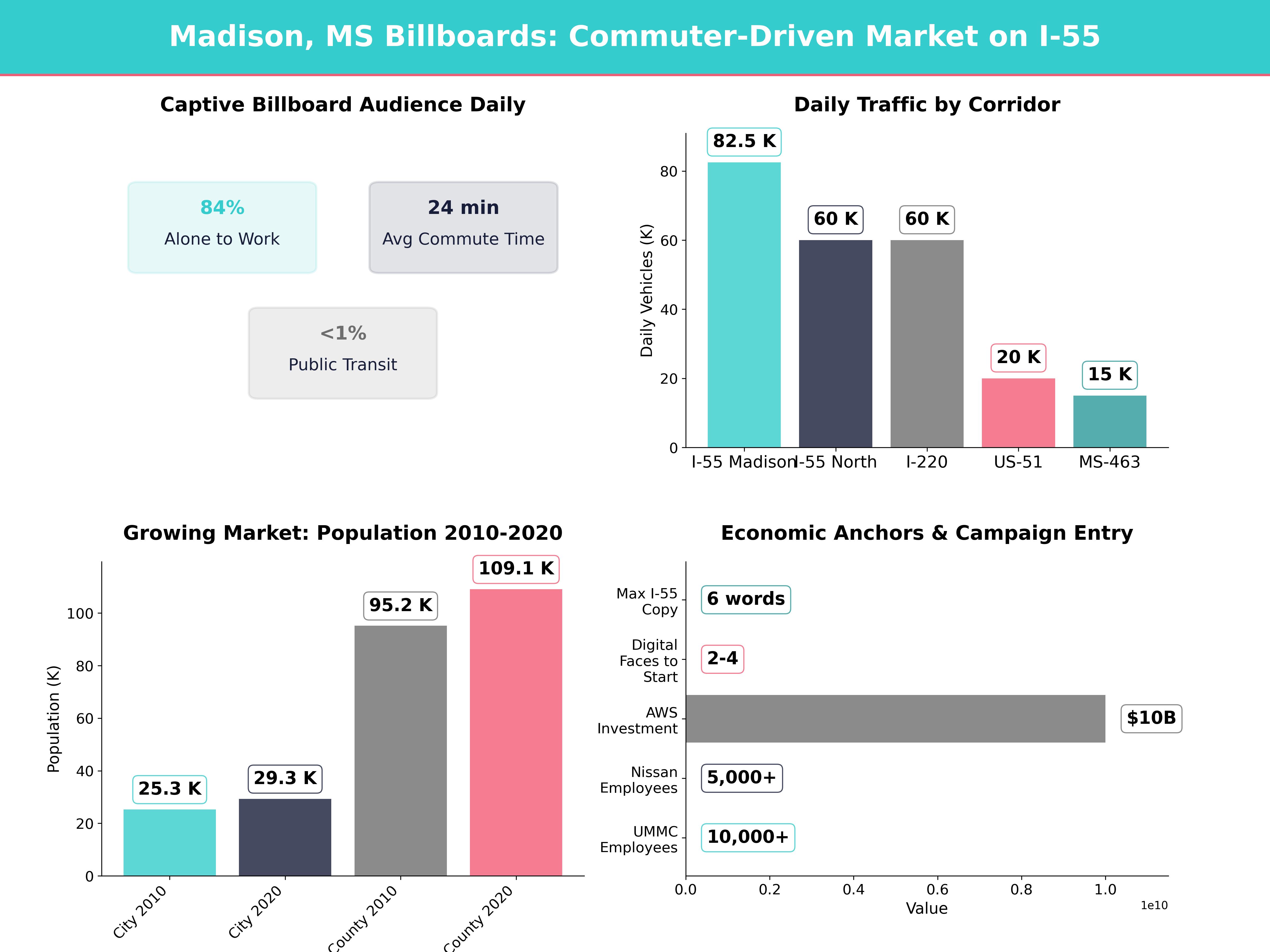
Madison also sits about 15 miles north of downtown Jackson, directly on the Interstate 55 corridor, so daily visibility is built into how people move. In a market where most trips are made by car, with roughly 84% of workers driving alone to work and public transit use under 1%, digital billboards can deliver both broad reach and strong repetition.
Madison Market Overview
Madison growth, demographics, and household profile
Madison is not a static suburb. It is a growth market with a high-value consumer base. Between 2010 and 2020, Madison grew from 25,311 residents to 29,298, which was a gain of 15.8%. Over the same period, Madison County grew from 95,203 to 109,145, which was a gain of 14.6%.
Those growth rates matter for billboard advertisers because they usually signal three things at the same time. We are seeing more rooftops, more school and errand traffic, and more competition for local attention. Madison is also widely recognized as one of Mississippi’s most affluent communities, so categories such as healthcare, financial services, home services, legal services, education, automotive, and premium retail tend to fit the market well.
Madison’s position inside the north Jackson metro also expands our effective audience. A billboard here does not only reach Madison residents. It also reaches drivers moving between Ridgeland, Gluckstadt, Canton
Madison economy, commuting, and what it means for advertisers
Madison is a commuter-heavy market, and that is exactly why roadside advertising works so well here. Recent ACS estimates show that roughly 84% of Madison workers drive alone to work, public transit use is under 1%, and average commute time is about 24 minutes. That means repeated weekday exposure is realistic, especially along I-55 and the city’s main feeder roads.
The economic base is broader than many advertisers expect. The Nissan Canton Vehicle Assembly Plant more than 5,000 people, which creates a substantial industrial and manufacturing commute in northern Madison County. To the south, the University of Mississippi Medical Center has more than 10,000 employees, which supports strong healthcare, professional, and service-sector movement through the Jackson core. The Mississippi Development Authority also announced an Amazon Web Services investment of at least $10 billion in Mississippi, including major data-center activity in Madison County, which reinforces the area’s long-term business-growth story.
For billboard advertisers, this mix is valuable. We can run campaigns that target affluent homeowners in Madison, shift-workers and industrial employees near Canton, and professionals commuting into Jackson, all within one connected road network.
Key Traffic Corridors for Madison Billboards
Madison’s travel patterns are shaped by a small number of roads that do a lot of work. When we understand which corridor serves which audience, we can choose placements that match the real purpose of the campaign instead of just chasing broad impressions.
Interstate 55 through Madison
According to the Mississippi Department of Transportation 70,000 to 95,000+ vehicles per day, with heavier counts closer to the Jackson gateway and solid volumes continuing north toward Gluckstadt and Canton. North of Madison, some segments still post 60,000+ AADT, which is substantial for a suburban market.
The exits that matter most for local advertisers are Exit 105 for Madison Avenue, Exit 108 for Main Street, Exit 114 for Gluckstadt Road, and Exit 119 for the Nissan Parkway and Canton area. Those exits help us think about intent, not just traffic.
This corridor is ideal for several advertiser types. Healthcare, legal, and professional services perform well on I-55 because we can reach weekday commuters headed toward Jackson in the morning and back toward Madison in the afternoon. Restaurants, grocery, and retail benefit from northbound evening traffic because drivers are making after-work decisions close to home. Auto dealers, home services, and regional events benefit from I-55’s broad geographic draw because the corridor carries both habitual commuters and weekend travelers.
U.S. 51 in Madison and north county
U.S. 51 is slower than I-55, but that is precisely why it matters. MDOT counts on Madison-area segments commonly fall in the 15,000 to 25,000 vehicles per day range, depending on location. That is lower than the interstate, but the route offers more local intent, more stop-and-go visibility, and more time for drivers to absorb details.
We usually like U.S. 51 for destination-oriented advertisers. Local medical offices, dentists, and urgent care providers benefit because drivers are already moving through neighborhood-scale decision zones. Banks, gyms, schools, and churches fit well because the road reflects routine local patterns rather than long-distance pass-through. Quick-service restaurants, coffee, and convenience retail can use short, directional messages effectively because turning opportunities are closer at hand.
If we want a campaign to feel like part of daily Madison life instead of part of the larger metro commute, U.S. 51 is often where that happens.
Madison Avenue, Main Street, and Mississippi 463
Madison’s core connectors matter as much as the interstate exits that feed them. MDOT counts on Mississippi 463 and related Madison-area feeder segments often land in the 10,000 to 20,000 AADT range, depending on the exact segment. Those roads capture the trips that happen after drivers leave I-55 and before they arrive at schools, neighborhoods, restaurants, medical offices, and shopping centers.
We use these routes when proximity matters more than sheer volume. Family-oriented services do well here because we are closer to school pickups, youth sports, and daily household errands. Home improvement, roofing, landscaping, and pest control fit this corridor because homeowners are already inside the local trade area. Community events and admissions campaigns can work especially well because the audience is more local and repeat exposure builds quickly.
For Madison-specific campaigns, these are often the roads that separate a “regional awareness” buy from a true “local conversion” buy.
Interstate 220 and the Jackson gateway
I-220 is not inside Madison itself, but it is highly relevant to Madison advertisers because it helps move traffic between north Jackson, west Jackson, and I-55. MDOT traffic volumes near the I-55 interchange generally run in the 50,000 to 70,000 AADT range. That makes I-220 useful for advertisers who want to intercept suburban commuters before they fully enter or leave the Jackson core.
We especially like this corridor for regional campaigns tied to major Jackson destinations such as the Jackson Convention Complex, the Mississippi State Fairgrounds Belhaven University, Jackson State University, and the medical district anchored by UMMC.
Audience Segments We Can Reach in Madison
Madison is attractive because the audience is not one-dimensional. We can reach affluent households, metro commuters, parents, students, industrial workers, and leisure travelers without leaving one county.
Madison families and high-value household decision makers
Madison’s reputation is built on quality-of-life appeal, strong schools, and well-established neighborhoods. That makes it a particularly good market for advertisers with higher-value transactions. We often see strong fit for pediatric and specialty healthcare, orthodontics, family law, banking, insurance, real estate, remodeling, HVAC, landscaping, and private education.
Because Madison grew 15.8% in the last census decade and the county grew 14.6%, we should assume there are both established households and newer movers in the market. Newer households often need service providers, while established households have the income base to respond to premium offers and reputation-driven messaging.
Madison commuters and regional professionals
Commuters are one of the most reliable billboard audiences in Madison. Roughly 84% of workers driving alone means a large share of the market is literally facing the road every weekday. That creates strong frequency for campaigns that need memorability rather than a one-time impression.
The southbound morning audience tends to include professionals headed toward Jackson employers, medical facilities, state offices, universities, and downtown destinations. The northbound late-afternoon audience tends to be more receptive to near-home offers such as restaurants, grocery, urgent care, retail, home services, and local events.
This audience also extends beyond Madison residents. Business travelers arriving through the Jackson-Medgar Wiley Evers International Airport and driving north, as well as regional residents traveling between Jackson and north Madison County, add to weekday and weekend exposure.
Students, parents, and education-oriented households in Madison
Education has outsized importance in this market. The Madison County School District, Madison-Ridgeland Academy, St. Andrew’s Episcopal School Holmes Community College all contribute to recurring parent, student, faculty, and activity traffic. Even when we are not advertising a school directly, we can still use that pattern.
Family entertainment, tutoring, healthcare, youth sports, after-school programs, and college-prep services all benefit from these routines. In practice, this means our billboard timing can follow the school year.
Back-to-school, holiday concerts, admissions windows, sports seasons, and spring enrollment pushes all create natural bursts of attention.
Shoppers, diners, and leisure travelers in and around Madison
Madison’s billboard audience is not only commuting to work. It is also moving toward shopping, dining, recreation, and regional attractions.
The Pearl River Valley Water Supply District Ross Barnett Reservoir 33,000 surface acres with roughly 105 miles of shoreline. That makes warm-weather leisure traffic especially relevant for boats, marinas, restaurants, sporting goods, beverage brands, medical clinics, and home-improvement categories tied to lake living.
The nearby Natchez Trace Parkway is another useful context signal. The parkway spans 444 miles and maintains a 50 mph speed limit, which means surrounding advertisers can think differently about pace, scenic messaging, and weekend-travel intent than they would on faster interstate segments.
Madison County also benefits from destination events. The Canton Flea Market is held twice a year, in May and October, and it brings additional visitor traffic into the county. That kind of event-driven travel can be very attractive for restaurants, boutiques, attractions, hotels, and service businesses looking for short-term bursts of awareness.
Seasonal and Timing Opportunities in Madison
Spring and early summer in Madison
Spring is one of the best windows for Madison campaigns because several demand patterns overlap. Home-service needs rise after winter, severe-weather concerns can increase urgency for roofing and restoration, and families begin planning for summer activities. Graduation, moving, and spring sports also create more decision-making moments.
We usually like spring for: Home services, because storm season and yard season both increase relevance; Healthcare and wellness, because families are planning summer appointments and electives; and Events, dining, and tourism, because weather improves and weekend travel increases.
By early summer, the reservoir becomes even more important. Mississippi highs regularly climb into the 90s°F, so beverage, cooling, HVAC, pool, patio, and recreation campaigns tend to feel seasonally appropriate.
Back-to-school and fall in Madison
Late July and August are critical in Madison because school and commuter patterns tighten at the same time. Parents return to weekday routines, local sports resume, and after-school schedules become more predictable. This is a strong period for healthcare, tutoring, childcare, restaurants, gyms, apparel, and technology offers.
Fall also brings high-interest event traffic across the county and metro. The Canton Flea Market returns in October, and the Mississippi State Fairgrounds
Holiday and winter timing in Madison
Holiday campaigns in Madison should lean into convenience, gifting, dining, and healthcare. Affluent suburban households are often making decisions about family meals, travel, retail, elective care, and year-end appointments. That makes November and December useful for premium retail, jewelry, salons, med spas, restaurants, and financial planning.
Winter is also a good time for trust-based service categories. Tax preparation, estate planning, insurance, orthopedic care, and post-holiday health campaigns can all benefit from Madison’s stable household base and strong commuter repetition.
Madison Billboard Design Tips
Creative approaches that fit the Madison market
Madison creative usually performs best when it feels polished, credible, and locally aware. This is not a market where overly cluttered bargain messaging always leads. Clean layouts, confident typography, and premium but approachable visuals tend to match the audience better.
We often see strong local fit from creative that uses: Family-oriented imagery, because Madison is heavily driven by households, schools, and community routines; Home and lifestyle visuals, because homeownership and neighborhood identity are central to the local mindset; Professional trust cues, such as doctors, attorneys, financial advisors, or craftsmen presented clearly and confidently; and Outdoor and water imagery, especially in warmer months, because the reservoir lifestyle is familiar and aspirational.
For Madison, we also like creative that feels geographically grounded. References to Madison, Gluckstadt, Canton, Ridgeland, the reservoir, or specific exits often outperform generic metro-wide copy because they signal relevance immediately.
Message structure and local cues for Madison roads
On I-55, we should assume drivers are moving quickly and making decisions fast. That means short headlines, a clear brand name, and one memorable call to action. In practice, we usually keep the main line to about 6 words or fewer on high-speed boards and use supporting details only when the board location gives us enough reading time.
Local cues work especially well here. We can make the message more useful by including: Exit references, such as 105, 108, 114, or 119, when the business is truly close; Directional language, such as “Next Exit,” “Madison,” or “North of Jackson,” when location is part of the offer; and Seasonal cues, such as “Lake Weekend,” “Back to School,” or “Friday Night,” when the local calendar is driving behavior.
On slower corridors like U.S. 51 or neighborhood connectors, we can afford slightly more detail. That is where a phone number, a sharper offer, or a more descriptive service line can make sense.
Regional Strategies Across Madison and Madison County
Madison core strategy
The Madison core is where we focus on high-income households, family services, and premium local brands. Campaigns near the Madison Avenue and Main Street exits work well when we want relevance to established neighborhoods, schools, medical offices, and everyday retail patterns.
This part of the market is usually best for healthcare, real estate, legal services, home improvement, private education, finance, and family dining.
Gluckstadt growth strategy
Gluckstadt is one of the most important growth stories in the county. The 2020 Census counted 3,208 residents there, and the city incorporated in 2021. That makes Gluckstadt especially interesting for advertisers who want to get ahead of northward suburban expansion.
We usually approach Gluckstadt with growth-oriented categories such as new-home services, grocery, banking, urgent care, childcare, and quick-service dining. This area also benefits from northbound commuter timing because it captures drivers headed farther up the corridor.
Canton and industrial corridor strategy
Canton 13,189 residents in the 2020 Census, and it anchors a different kind of audience than Madison proper. With Nissan more than 5,000 people, this submarket can support workforce-oriented messaging, automotive, recruitment, financial services, occupational healthcare, and everyday consumer categories.
If our goal is to reach plant employees, support industries, or event traffic tied to Canton, we should think about commute direction, shift timing, and the difference between local Canton boards and broader I-55 regional boards.
Ridgeland and Jackson gateway strategy
To the south, Ridgeland and Jackson function as Madison’s commercial and institutional gateway. This zone is important when we want to connect Madison households to regional shopping, museums, and event destinations such as the Mississippi Crafts Center, the Mississippi Agriculture and Forestry Museum, the Mississippi Children’s Museum, and the Mississippi Museum of Natural Science
This strategy works especially well for entertainment, tourism, healthcare systems, colleges, conventions, and major retail destinations. It is less about neighborhood specificity and more about intercepting cross-metro movement.
West county and leisure-corridor strategy
The western side of Madison County and the roads that connect to scenic recreation require a different tone. Here we often think less about dense commuter frequency and more about weekend intent, slower travel, and destination appeal. Campaigns tied to the reservoir, outdoor recreation, dining, agritourism, or day trips can benefit from that shift.
Using Blip Tools in Madison
Dayparting and budgeting for Madison traffic patterns
Madison is a market where timing can be just as important as location. We can use Blip’s scheduling tools to lean into the daily rhythm of the area instead of paying for the exact same emphasis all day long. Morning southbound windows are strong for Jackson-bound commuters. Late afternoon and early evening northbound windows are strong for Madison-bound household decisions. Thursday through Sunday can be especially useful for dining, retail, entertainment, and reservoir-oriented campaigns.
Because Madison has both local and regional movement, we can also split our budget by purpose. We can give more weight to I-55 when we need scale, then reserve part of the spend for U.S. 51 or Madison-area connectors when we need neighborhood-level relevance.
Creative testing and optimization in Madison
Blip is especially useful in Madison because the market has distinct sub-audiences that respond to different messages. We can run one creative for commuters, another for families, and another for weekend leisure traffic, then compare performance and adjust quickly.
We also like using creative versioning to localize by corridor. A southbound I-55 ad might emphasize professional credibility and brand recall. A northbound Madison-area ad might emphasize convenience and location. A Canton-area ad might highlight value, recruiting, or practical services. Real-time analytics help us see which mix is earning the most traction so we can refine the plan instead of waiting for a long contract cycle to end.
Getting Started with Billboard Rental in Madison
What to expect when renting a billboard in Madison
The first step is deciding what kind of attention we want. If our goal is broad awareness across the north Jackson metro, I-55 should usually be the starting point. If our goal is local conversion inside Madison, U.S. 51 and the city’s main feeder routes often deserve more weight. If we need industrial or north-county reach, Canton and Gluckstadt become more important.
A practical Madison test often starts with 2 to 4 digital faces rather than a huge launch. We can choose one interstate location for scale, one local corridor for relevance, and one additional board near either Gluckstadt, Canton, or the Jackson gateway depending on the audience. That approach gives us enough variety to learn without overcommitting.
How Blip simplifies Madison billboard rental and how we evaluate fit
Traditional billboard buying can feel rigid, especially when we only want to test a market, adjust timing, or compare corridors. Blip simplifies that process because we can select boards on a map, control the budget directly, change creative as conditions change, and optimize based on actual delivery patterns.
When we evaluate Madison boards, we usually ask four practical questions. Does the road match the audience’s routine? A commuter service belongs on commuter roads, while a neighborhood service often belongs closer to local connectors. Does the direction of travel match the decision moment? Southbound morning traffic and northbound evening traffic often serve different purposes. Does the message fit the speed of the road? High-speed I-55 boards need sharper simplicity than slower local routes. Does the location reflect the right submarket? Madison, Gluckstadt, Canton, Ridgeland, and the leisure corridors each have different buying triggers.
If we start with those questions, Madison becomes a very manageable billboard market. It has enough traffic to scale, enough affluence to support premium categories, and enough local identity to reward smart creative. That combination gives us a lot to work with.