Billboards in North Las Vegas, NV
No Minimum Spend. No Long-Term Contracts. Just Results.
Trusted by Leading Brands


Billboard advertising
in North Las Vegas has never been easier
How much is a billboard in North Las Vegas?
Why Choose Blip for Billboard Advertising in North Las Vegas
Blip lets you launch on North Las Vegas I-15 and US 95 fast, so you can reach commuters and travelers without traditional buy-in.
In North Las Vegas, Blip's flexible budgets help you test around Apex Industrial Park, Craig Rd, and Cheyenne Ave with no contracts.
Daypart your North Las Vegas ads for rush hour, convention surges, or LVMS event nights—Blip matches timing to traffic.
Track North Las Vegas performance in real time and shift spend from suburban beltway boards to higher-response corridors fast.
Use Blip's creative tools to build bold North Las Vegas billboards that speak to families, industrial workers, and visitors alike.
Frequently Asked Questions About Billboard Advertising in North Las Vegas
How much does a billboard cost in North Las Vegas with Blip?
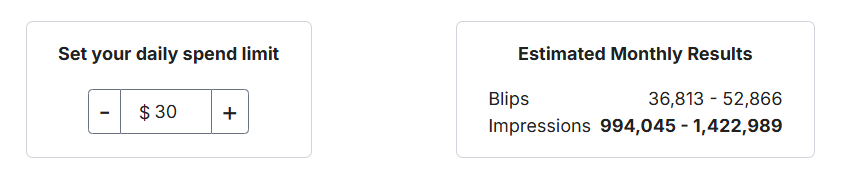
With Blip, billboard advertising in North Las Vegas can fit a wide range of budgets because you only pay when your ad actually appears. Pricing starts at just $0.01 per display, and your total cost is simply the sum of the blips you receive, with no minimums or contracts to hold you back. You set a daily budget, and Blip’s algorithm uses it to bid on open ad slots, adjusting for time of day, location, and advertiser demand.
Where can I advertise with Blip in North Las Vegas to get the most traffic?
Interstate 15 through North Las Vegas is one of the most important corridors to plan around, with many segments in the 130,000-plus vehicles-per-day range and nearby sections near the Spaghetti Bowl exceeding 200,000 vehicles per day. US 95 is another major reach corridor, with major urban segments often landing in the 100,000 to 150,000-plus range. The I-215 Bruce Woodbury Beltway and major arterials like Craig Road, Cheyenne Avenue, Lake Mead Boulevard, and North 5th Street also serve different audience and trip patterns.
Why is North Las Vegas a strong billboard market for Blip?
North Las Vegas is a strong billboard market because it combines a fast-growing city audience with the reach of the broader Las Vegas Valley. The city counted 262,527 residents in 2020, up from 216,961 in 2010, which works out to roughly 21% growth in one decade. It also benefits from Clark County’s roughly 2.3 million people and Southern Nevada’s heavy tourism, convention, and airport traffic.
What kinds of audiences can Blip reach in North Las Vegas?
North Las Vegas gives advertisers several distinct groups, including commuters and working households, tourists and convention visitors, students and young adults, and industrial workers and commercial drivers. The city’s industrial side is especially strong because Apex Industrial Park spans about 18,000 acres, while the region also has more than 30,000 students at both the College of Southern Nevada and UNLV. That mix makes the market useful for healthcare, staffing, restaurants, retail, and B2B services.
When is the best time to run billboard ads in North Las Vegas with Blip?
The strongest business-travel windows usually cluster around January, March, April, October, and November, when Las Vegas hosts many of its largest trade shows. Summer from June through September can also be effective because triple-digit temperatures increase urgency for HVAC, plumbing, urgent care, beverages, and indoor entertainment. Back-to-school and holiday periods are also important, especially late July through early September and mid-November through December.
Do I need a contract to advertise with Blip in North Las Vegas?
No, Blip has no long-term contracts or minimum commitments. You can start, pause, or stop your campaign at any time.
How fast can I launch a billboard campaign with Blip in North Las Vegas?
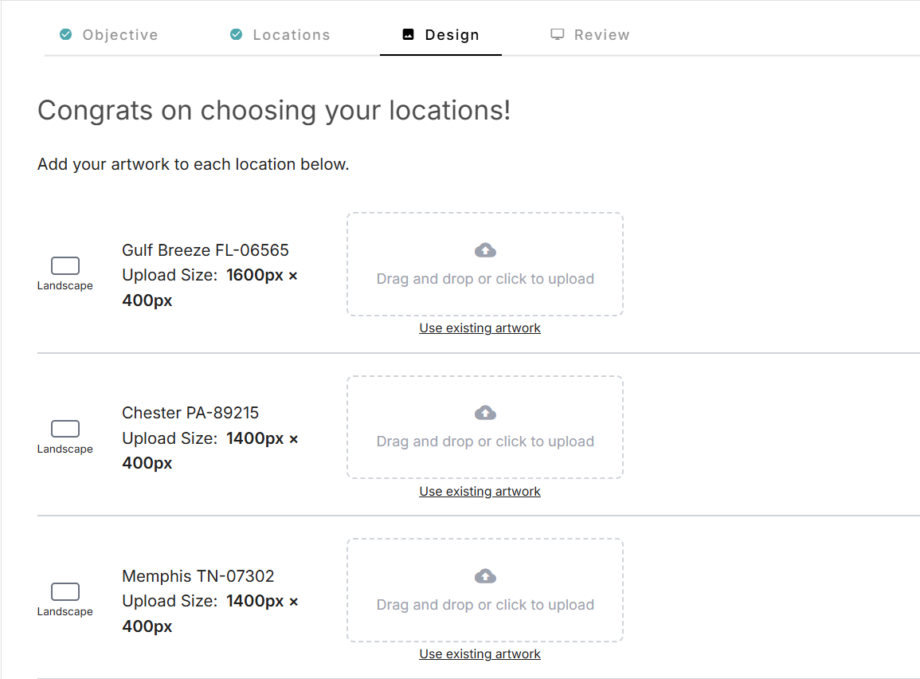
You can have your campaign live in minutes. Create a free account, select your locations, set your budget, upload your design, and start running once approved.
Where can I advertise with Blip in North Las Vegas?
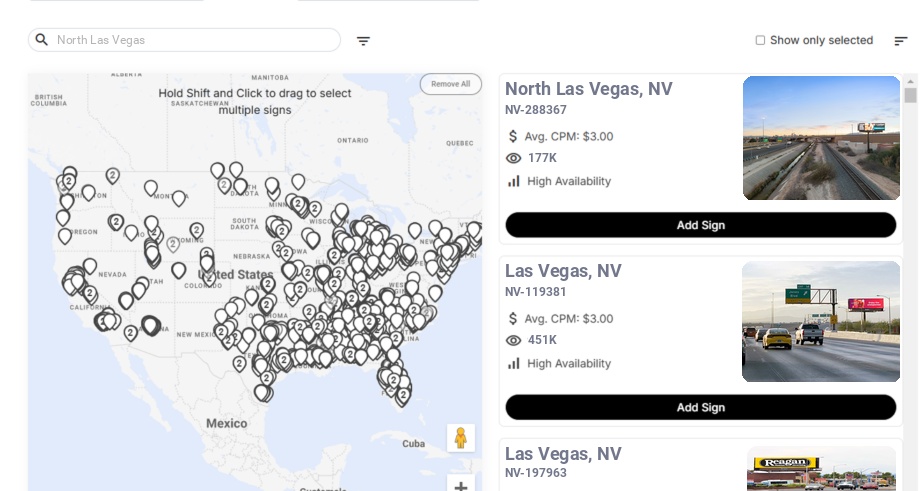
Blip has digital billboards in North Las Vegas. You can browse available locations on a map, choose the ones that fit your audience, and start advertising right away.
Still have questions? Launch a campaign in minutes — no contracts, no commitments.
Start Your CampaignNorth Las Vegas Billboard Advertising Guide
North Las Vegas Las Vegas Valley. The City of North Las Vegas 262,527 residents in 2020, up from 216,961 in 2010, which works out to roughly 21% growth in one decade.
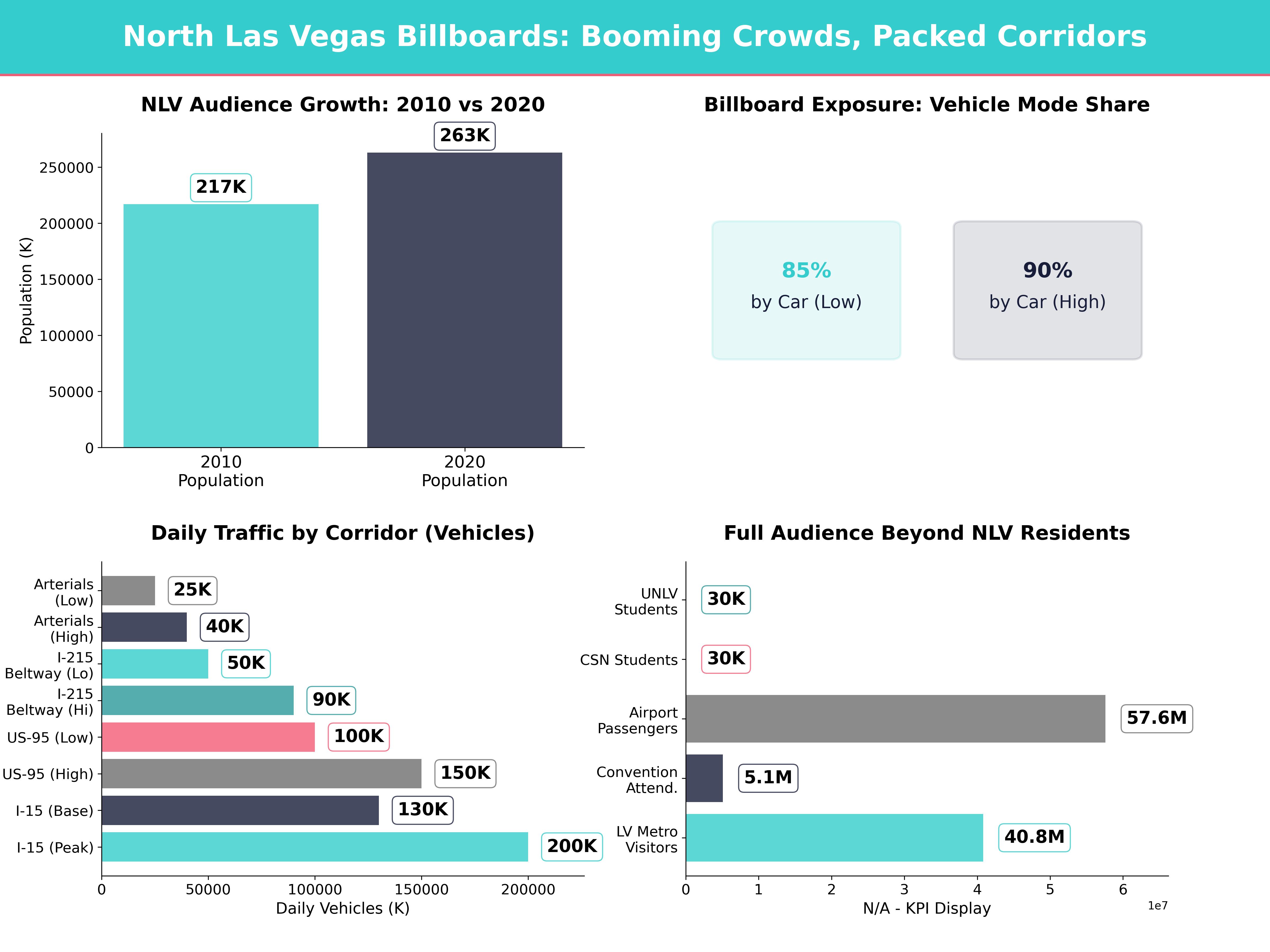
We also benefit from the scale of Clark County, which is home to roughly 2.3 million people, and from a regional transportation pattern that is overwhelmingly car-based. When we add in tourism, conventions, logistics growth, and major event traffic—backed by 40.8 million visitors, about 5.1 million convention attendees, and roughly 57.6 million airport passengers in 2023—North Las Vegas becomes a practical place to build frequency with locals while still catching visitors moving through Southern Nevada.
North Las Vegas Market Overview for Billboard Advertisers
North Las Vegas is not just a suburb on the edge of the metro. It is the fourth-largest city in Nevada, and it sits inside one of the most visited urban regions in the country, with Las Vegas drawing 40.8 million visitors in 2023.
That combination matters because billboard advertising performs best where we have repeat exposure, daily road travel, and a steady mix of local and out-of-market audiences. The population story is especially useful for advertisers.
A jump from 216,961 residents in 2010 to 262,527 in 2020 means we are working in a city that added more than 45,000 people in ten years. That kind of growth usually brings new rooftops, more household formation, more school traffic, more retail demand, and more service spending.
It also means newer neighborhoods in the north and northwest parts of the city are still developing their brand loyalties, which gives billboard campaigns room to shape awareness early. The economic backdrop is bigger than North Las Vegas city limits.
According to the Las Vegas Convention and Visitors Authority, Las Vegas welcomed 40.8 million visitors in 2023, and convention attendance reached about 5.1 million. Harry Reid International Airport handled roughly 57.6 million passengers in 2023, which shows just how much movement flows through Southern Nevada.
Even though North Las Vegas is not the Strip, it benefits from the regional churn created by tourism, hospitality employment, airport traffic, and event travel. We also have a strong industrial and logistics angle.
The city’s Apex Industrial Park 18,000 acres, making it one of the most important industrial growth areas in Southern Nevada. That matters for advertisers in staffing, trucking, fuel, fleet services, workwear, healthcare, quick-service food, and B2B services.
A market with tourism on one side and logistics on the other gives us unusual flexibility in campaign targeting. Commuting patterns make outdoor especially relevant here.
In Southern Nevada, regional travel is dominated by private vehicles, and local planning data from RTC of Southern Nevada 85% to 90% of work trips are made by car when drive-alone and carpool commuting are combined. For advertisers, that means daily exposure still happens on roads, interstates, beltways, and major arterials, not just inside apps or social feeds.
For local brands, the takeaway is simple. North Las Vegas gives us a resident base large enough for neighborhood-focused campaigns, a metro context large enough for mass reach, and road use patterns that make repeat billboard visibility a practical media strategy.
Key Traffic Corridors in North Las Vegas
North Las Vegas advertising works best when we match the billboard location to the trip purpose. Some roads are commuter-first, and some are retail-and-errand routes.
Some pick up tourism spillover, event traffic, or industrial travel. Interstate 15 through North Las Vegas is one of the most important corridors to plan around.
Interstate 15 through North Las Vegas
I-15 Nevada Department of Transportation 130,000-plus vehicles-per-day range.
On the broader system near the Spaghetti Bowl 200,000 vehicles per day. This corridor is ideal when we want scale.
It connects North Las Vegas to downtown, the resort corridor, industrial areas, and long-distance travelers moving between California, Utah, and the northern valley. We typically prioritize I-15 for these advertiser types:
- Casinos, entertainment venues, and attractions can use I-15 to catch visitors moving between the Strip, downtown, and north valley destinations like Las Vegas Motor Speedway.
- Healthcare systems, legal services, and colleges can use I-15 for broad reach because commuters see the message repeatedly during weekday drives.
- Recruiting and staffing brands benefit from the corridor’s mix of warehouse workers, service employees, and commercial drivers.
If a business wants metro-wide awareness, I-15 is usually the first place we look. US 95 and the downtown connection is another major reach corridor.
US 95 and the downtown connection
US 95 100,000 to 150,000-plus range, with heavier volumes closer to the downtown interchange network.
This route captures travelers heading between northwest Las Vegas, downtown, and the north side of the valley. US 95 is especially strong for brands that need both local relevance and cross-market reach.
We like it for:
- Auto dealers, repair shops, and tire brands because the corridor carries routine commuter traffic and practical errand trips.
- Retail, grocery, and healthcare providers because it intersects with major residential zones.
- Universities, training programs, and job fairs because it reaches both working adults and younger audiences moving around the metro.
For many advertisers, US 95 is the bridge between citywide awareness and neighborhood action. The I-215 Bruce Woodbury Beltway in the north valley can also help balance local and cross-valley traffic.
The I-215 Bruce Woodbury Beltway in the north valley
The northern portion of the Bruce Woodbury Beltway 50,000 to 90,000 AADT range.
That is less massive than I-15, but it is still highly valuable because the audience is often local, repeat, and intent-driven. We like the north beltway for:
- Family services, pediatric care, dental groups, and home services targeting growing neighborhoods.
- Regional retailers and restaurants that want to intercept consumers before they reach a shopping center.
- Real estate, apartments, and financial services because the beltway audience includes movers, homeowners, and suburban households.
If we want a cleaner suburban audience rather than a heavy tourism mix, the beltway is usually the smarter buy. Craig Road, Cheyenne Avenue, Lake Mead Boulevard, and North 5th Street serve a different role than freeways.
Craig Road, Cheyenne Avenue, Lake Mead Boulevard, and North 5th Street
Major arterials do a different job than freeways. Craig Road Cheyenne Avenue Lake Mead Boulevard North 5th Street 25,000 to 40,000-plus vehicles per day on key commercial segments, according to local and state transportation maps.
Those volumes are lower than interstate counts, but the intent can be stronger because these roads catch shoppers, school trips, service appointments, and neighborhood errands. These corridors are usually best for:
- Urgent care, dental, and primary care clinics because people can act on a nearby location immediately.
- Quick-service restaurants, grocery stores, and value retail because the audience is already in decision mode.
- Local events, churches, schools, and community services because neighborhood roads build familiarity close to the point of action.
When the goal is store visits rather than sheer impressions, arterial boards often outperform. North Las Vegas Audience Segments We Can Reach depends on which people you want to prioritize.
North Las Vegas Audience Segments We Can Reach
A good North Las Vegas campaign starts with the audience, not the format. The city gives us several distinct groups that respond to different locations, creative styles, and timing windows.
Commuters and working households in North Las Vegas
The first audience is the daily commuter. With roughly 85% to 90% of commute trips happening by private vehicle across Southern Nevada, roadway advertising remains one of the most dependable ways to generate frequency.
Working households in North Las Vegas often move along I-15, US 95, the beltway, and east-west arterials such as Craig and Cheyenne. This audience responds best to practical categories.
We usually see strong local-market fit for healthcare, insurance, legal services, auto repair, home improvement, staffing, grocery, and restaurants. Because commuting is repetitive, even a modest digital schedule can build useful recall over time.
Tourists, convention visitors, and event travelers
North Las Vegas is also influenced by the regional visitor economy. LVCVA reported 40.8 million visitors and 5.1 million convention attendees in 2023, while Harry Reid International Airport handled 57.6 million passengers.
Many of those travelers never stay in North Las Vegas, but they absolutely drive through, work nearby, visit attractions nearby, or attend events that push traffic north. This segment is strongest for:
- Entertainment and attractions near downtown or the north side of the valley.
- Sports books, casinos, and hospitality that want to catch visitors outside the resort core.
- Restaurants, outlets, and destination retail such as Las Vegas North Premium Outlets AREA15, The Neon Museum, and Fremont Street Experience
The key is to remember that visitor traffic in North Las Vegas is usually moving, not lingering. That means simple, directional, high-contrast creative works best.
Students, young adults, and education-focused households
North Las Vegas also gives us a meaningful education audience. The College of Southern Nevada serves more than 30,000 students, and UNLV enrolls more than 30,000 students as well.
On the K-12 side, the Clark County School District serves 300,000-plus students, which reinforces just how family-centered the region is. This segment is attractive for community colleges, trade schools, apartments, quick-service food, wireless providers, entertainment, and entry-level recruiting.
In neighborhoods near schools and parks, we also like healthcare, tutoring, orthodontics, and youth activities. A good local cue here is recreation.
Craig Ranch Regional Park 170 acres, and places like that represent the everyday lifestyle side of North Las Vegas that many advertisers overlook. This connects well with local family and education routines.
Industrial workers, commercial drivers, and military-adjacent households
North Las Vegas has an unusually strong blue-collar and industrial audience. Apex Industrial Park 18,000 acres, and the city also benefits from warehouse corridors, manufacturing growth, truck traffic, and proximity to Nellis Air Force Base.
That creates demand for staffing firms, CDL schools, work boots, safety gear, mechanics, medical clinics, fuel brands, and affordable food options. This is one of the best billboard audiences in the market because it is road-based by default.
It is also highly responsive to straightforward value messaging, clear directions, and immediate calls to action. Seasonal and Timing Opportunities in North Las Vegas is where planning can improve results.
Seasonal and Timing Opportunities in North Las Vegas
North Las Vegas campaigns get better when we time them to the city’s event calendar, weather reality, and family routines. The audience composition can shift quickly depending on the month.
Convention season and event-heavy months in North Las Vegas
The strongest business-travel windows usually cluster around January, March, April, October, and November, when Las Vegas hosts many of its largest trade shows at the Las Vegas Convention Center, the Mandalay Bay Convention Center The Venetian Expo
Because the metro recorded 5.1 million convention attendees in 2023, these months often bring extra ride-share traffic, rental cars, airport trips, and after-hours spending. For North Las Vegas advertisers, this is a strong time to run campaigns for nightlife, dining, recruiting, off-Strip gaming, industrial vendors, and B2B services.
Spring motorsports, festivals, and stadium-driven traffic
North Las Vegas has a direct event asset in Las Vegas Motor Speedway, a 1,200-acre complex that drives noticeable surges on the north side of the valley during major race weekends and festivals. We also have the influence of Allegiant Stadium, which seats 65,000 for football and major concerts.
Even though the stadium is south of North Las Vegas, game days and concerts expand vehicle movement across the valley. We like short, high-intensity flights around these events.
Restaurants, dispensaries, rideshare alternatives, entertainment venues, sports bars, and hotels can all benefit from timing their messaging to event arrival and departure windows. Summer heat and local-service urgency is another planning driver.
Summer heat and local-service urgency
Summer in Southern Nevada changes consumer behavior. From June through September, triple-digit temperatures push more activity indoors and increase urgency for categories like HVAC, plumbing, urgent care, beverages, indoor entertainment, casinos, and family attractions.
This is the season when simple, action-oriented copy tends to work well. Messages like “Open Late,” “Same-Day Service,” or “Cool Off Nearby” feel native to the market.
For local businesses, summer can actually be a very efficient time to own mindshare with residents while tourist attention remains concentrated on air-conditioned destinations. Back-to-school and holiday retail periods follow after summer.
Back-to-school and holiday retail periods
The Clark County School District school year typically begins in August, which makes late July through early September an excellent period for back-to-school retail, dental care, tutoring, after-school programs, and family dining. Commute rhythms also become more predictable again once classes resume.
Holiday campaigns usually build from mid-November through December. That is the right window for retail, gift cards, toy stores, seasonal events, family entertainment, and restaurants.
If we sell to locals, these are often the months when arterial boards near neighborhoods become more important than pure interstate reach. Billboard Design Tips for North Las Vegas Campaigns should align to these patterns.
Billboard Design Tips for North Las Vegas Campaigns
Creative should reflect the way North Las Vegas actually moves. This is not a market where overly subtle design does the heavy lifting.
Use high contrast for desert light and fast roads
Bright sun, long sightlines, and high-speed driving mean contrast matters more here than in many cloudier markets. We usually favor dark backgrounds with bright white, yellow, or vivid accent text.
On I-15, US 95, and the beltway, a simple 5- to 7-word headline often works better than a longer message because drivers are processing the board at speed. We also like bold numerals in this market.
Price points, mileage, event dates, and “Open 24/7” style offers cut through quickly. Match the message to North Las Vegas trip purpose for best relevance.
Match the message to North Las Vegas trip purpose
North Las Vegas traffic is often practical. Many trips are work trips, school trips, retail runs, service visits, or event drives.
Because of that, practical language generally outperforms vague brand poetry. For example, these approaches usually fit the market better:
- “Craig Rd Exit. Tacos Open Late.”
- “Hiring CDL Drivers in North Las Vegas.”
- “ER Wait Times Online.”
- “AC Repair Today.”
Each of those messages matches a real local trip context. Build separate creative for residents and visitors when you want to improve response.
Build separate creative for residents and visitors
A single campaign can still have multiple versions. For local-family corridors near Aliante, Craig Road, or neighborhood retail centers, we usually lean into trust, convenience, and value.
For I-15 and event corridors, we lean into urgency, entertainment, and directionality. We also recommend considering bilingual creative where it fits the customer base.
North Las Vegas is one of the most diverse cities in Nevada, and service businesses often benefit from rotating English and Spanish versions rather than trying to force both into one crowded design. Use local cues instead of generic Vegas clichés to avoid mismatch.
Use local cues instead of generic Vegas clichés
North Las Vegas is close to the Strip, but it is not the Strip. We often get better results when creative reflects everyday local life rather than defaulting to casino stock art.
Parks, neighborhoods, speedway traffic, mountain backdrops, pickup trucks, logistics imagery, and family recreation can all feel more authentic depending on the advertiser. If the audience is industrial, we should look industrial.
If the audience is suburban families, we should look trustworthy and local. If the audience is event traffic, we should look immediate and directional. Regional Strategies Across North Las Vegas help with sub-area planning.
Regional Strategies Across North Las Vegas
Not every part of North Las Vegas should be approached the same way. We usually break strategy down by sub-area and trip pattern.
Downtown-adjacent North Las Vegas and the south gateway
The south edge of North Las Vegas benefits from connectivity to downtown Las Vegas Fremont Street Experience The Mob Museum, The Neon Museum, and the broader urban core.
This is where we often favor legal services, healthcare, local restaurants, nightlife, community colleges, and staffing campaigns. Boards here can work for both residents and visitors, especially if the message is direct and place-aware.
Northwest North Las Vegas, Aliante, and family-focused neighborhoods
The northwest side, including Aliante and nearby master-planned communities, is where we focus on families, homeowners, and steady suburban spending. This is a strong zone for dental, pediatrics, home services, grocery, furniture, insurance, and family entertainment.
We typically value neighborhood arterials and the north beltway more in this part of the city than pure downtown-bound reach. East North Las Vegas, Nellis-adjacent areas, and working households are another distinct zone.
East North Las Vegas, Nellis-adjacent areas, and working households
The east side is strong for military-adjacent households, value retail, auto services, wireless, healthcare, and practical dining. This part of the city also supports recruitment and trade-school messaging because the audience includes many working households and service members’ families.
Simple offers and location-specific calls to action usually outperform image-heavy branding here. Apex, the I-15 north gateway, and industrial corridors are built for industrial intent.
Apex, the I-15 north gateway, and industrial corridors
The industrial north is one of the most distinctive billboard zones in the market. With 18,000 acres at Apex Industrial Park
When we advertise here, the best messages are usually direct, numeric, and credibility-driven. Certifications, pay ranges, same-day service, and easy contact paths matter.
Tourism spillover routes outside the Strip
Some advertisers want Las Vegas visitors without paying for the heart of the resort corridor. North Las Vegas can support that strategy on the right boards, especially those catching traffic toward downtown, the speedway, Valley of Fire State Park, or Lee Canyon
These placements work well for attractions, dining, off-Strip casinos, and destination retail. The key is to treat these boards as directional and timely rather than purely brand-focused. Using Blip Tools Effectively in North Las Vegas can help campaigns test faster.
Using Blip Tools Effectively in North Las Vegas
North Las Vegas is a good market for testing because the audience breaks cleanly into commuter, residential, industrial, and visitor segments. We can use that structure to build smarter campaigns without overcommitting up front.
We can test corridor by corridor
A strong first move is to split a campaign between 2 or 3 corridor types, such as I-15, a neighborhood arterial, and the north beltway. That lets us compare broad-reach boards against closer-to-action placements.
If a local clinic gets stronger response from Craig Road than from I-15, we can reweight quickly. We can daypart to match local traffic rhythms is another lever.
We can daypart to match local traffic rhythms
North Las Vegas is especially well suited to dayparting. We often separate messaging into commuter windows like 6 a.m. to 10 a.m. and 3 p.m. to 7 p.m., midday retail windows like 11 a.m. to 2 p.m., and event-night windows for concerts, racing, or downtown entertainment.
Summer heat, school schedules, and convention surges also create moments when a creative swap can improve relevance. We can rotate creative by audience type to match who you are targeting.
We can rotate creative by audience type
Because the market is so mixed, creative rotation matters. A recruiting message can run on industrial corridors, a family-services message can run near residential zones, and an entertainment message can run during event traffic.
Blip’s artwork tools make it easy for us to produce these local variants without rebuilding a campaign from scratch. We can optimize with real-time performance feedback as data comes in.
We can optimize with real-time performance feedback
North Las Vegas has enough variation in road type and audience mix that analytics become genuinely useful. We can compare which boards create better website traffic, call spikes, coupon redemption, or branded-search lift, and then shift spend toward the better-performing sub-areas.
Getting Started with Billboard Rental in North Las Vegas
Renting a billboard in North Las Vegas gets easier when we begin with a clear objective. We should decide first whether we want mass awareness, store visits, recruiting leads, event turnout, or neighborhood-level frequency.
That decision influences everything else, from corridor choice to time of day. Start with the geography that matches the goal for better placement.
Start with the geography that matches the goal
If the goal is broad awareness, we should usually start with I-15 or a major metro connector. If the goal is local action, we should look harder at Craig Road, Cheyenne, Lake Mead, or residential beltway routes.
If the goal is hiring, industrial corridors and commuter boards often deserve priority. A simple planning checklist helps:
- We should ask where the customer is coming from, not just where the business is located.
- We should ask whether the trip is routine, urgent, or leisure-based.
- We should ask whether the message needs metro reach or only a 3- to 10-mile trade area.
Expect digital billboard pricing to vary by time and demand
In North Las Vegas, high-demand commute windows, event periods, and top interstate locations will usually cost more than lower-demand residential periods. That is normal.
The advantage with Blip is that we do not need to lock into the rigid buying process that traditional billboard companies often require. We can start smaller, see what the market gives us, and scale the placements that fit our audience.
Evaluate locations the way a driver experiences them
The best billboard is not always the board with the highest raw traffic count. We also care about direction of travel, distance from the exit or intersection, nearby decision points, and whether the audience can act on the message soon after seeing it.
A restaurant near Craig Road may get more useful results from a nearby arterial board than from a farther-away interstate board with bigger numbers. Launch, learn, and refine quickly with an iterative approach.
Launch, learn, and refine quickly
We usually recommend launching with a focused set of boards, running at least 2 creative versions, and reviewing results after the first 2 to 4 weeks. North Las Vegas gives us enough corridor diversity that useful patterns tend to emerge quickly.
Once we know whether commuters, families, industrial workers, or visitors are responding best, we can expand with much more confidence. For advertisers who want a market with growth, daily vehicle exposure, strong local neighborhoods, and constant regional movement, North Las Vegas is one of the more versatile billboard opportunities in Nevada.
If we approach it by corridor, audience, and season, we can build campaigns that feel local while still benefiting from the scale of the Las Vegas metro.