Billboards near Spring Valley, NV
No Minimum Spend. No Long-Term Contracts. Just Results.
Trusted by Leading Brands


Billboard advertising
near Spring Valley has never been easier



How much is a billboard near Spring Valley?
Why Choose Blip for Billboard Advertising near Spring Valley
Blip lets you launch Spring Valley billboards in minutes, reaching I-15, US-95, and Flamingo Rd commuters without a long lease.
Use Spring Valley to catch Strip-bound traffic at rush hour or weekend shoppers near Rainbow and Decatur with Blip dayparting.
Spring Valley's locals and 40M+ Vegas visitors mean Blip's flexible budgets help you test, learn, and scale fast.
No contracts in Spring Valley, so you can spike spend for Allegiant Stadium games, CES, or holiday retail surges, then pause anytime.
Track Spring Valley billboard results in real time and shift creative or budget toward the routes driving the best response.
Blip's easy creative tools help tailor Spring Valley ads for commuters, families, and Chinatown-bound drivers on busy corridors.
Frequently Asked Questions About Billboard Advertising near Spring Valley
How much does a billboard cost near Spring Valley, Nevada with Blip?
With Blip, you choose your own daily budget, and our platform automatically keeps your Spring Valley billboards campaign within that limit, so you only pay for the digital billboard exposure you actually receive. Each ad display, or “blip,” is a short 7.5 to 10-second spot on rotating digital billboards near Spring Valley, Nevada, and the cost of each blip varies based on when you run your ads, where they appear, and real-time advertiser demand. Over time, your total cost is simply the sum of those individual blips, giving you complete flexibility and control.
Where can I advertise with Blip near Spring Valley, Nevada?
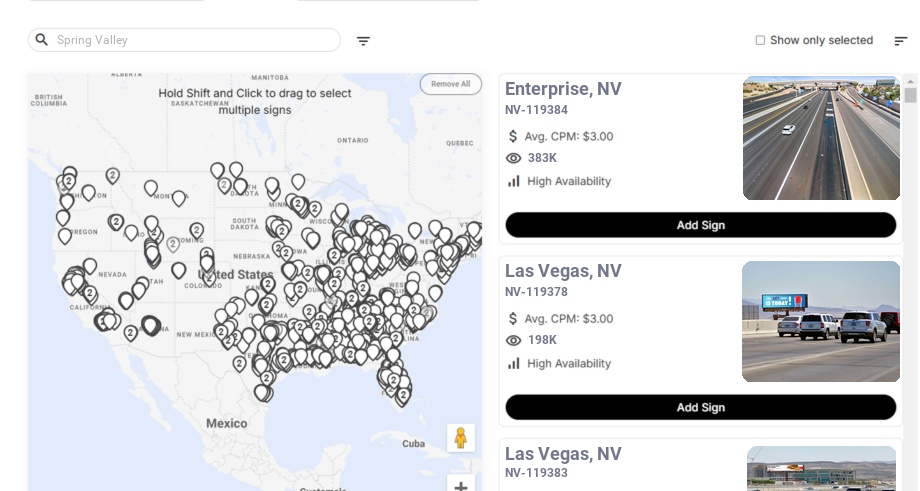
Our 17 digital billboards serving the Spring Valley area are located in nearby Las Vegas and Paradise, within 10 miles of the Spring Valley core. These placements allow us to reach commuters traveling between Spring Valley neighborhoods and the Las Vegas Strip or Downtown Las Vegas, shoppers heading to major centers, and visitors and hospitality staff moving between Strip resorts and residential neighborhoods to the west. This cluster of digital boards effectively functions as a network of billboards near Spring Valley, giving you coverage in every main direction drivers are heading.
What kind of audience do Spring Valley, Nevada billboards reach?
Spring Valley is an unincorporated town in Clark County, just west of the Las Vegas Strip, and the area has over 220,000–230,000 residents, making it one of the densest suburban hubs in the valley. The audience includes working-age adults and young families, with roughly two-thirds of residents in the prime 18–64 working age band. The area also sees strong tourist influence, with many visitors staying or driving through nearby hotel corridors.
When should I run a Blip campaign in Spring Valley, Nevada for the most traffic?
Morning peaks are roughly 6:30–9:00 a.m., as residents head east to the Strip and central employment centers. Evening peaks are roughly 3:30–7:00 p.m., as traffic flows back toward Spring Valley’s residential neighborhoods, retail centers, and restaurants. For retail, dining, and entertainment, the page also recommends focusing on lunch and early evening, plus Thursdays through Sundays.
What kinds of roads get the most billboard visibility near Spring Valley, Nevada?
Key roadway environments near the Spring Valley area include the I‑15 and US‑95 corridors, which carry heavy traffic through the Las Vegas area. Major east-west routes like Flamingo Rd, Tropicana Ave, Spring Mountain Rd, and Sahara Ave can see 40,000–60,000 vehicles per day on busy sections, while Rainbow Blvd, Decatur Blvd, and Jones Blvd handle 30,000–45,000 vehicles daily. Drivers coming from or going to Spring Valley often use interchanges near Tropicana, Flamingo, and Spring Mountain.
Do I need a contract to advertise with Blip near Spring Valley?
No, Blip has no long-term contracts or minimum commitments. You can start, pause, or stop your campaign at any time.
How fast can I launch a billboard campaign with Blip near Spring Valley?
You can have your campaign live in minutes. Create a free account, select your locations, set your budget, upload your design, and start running once approved.
Where can I advertise with Blip near Spring Valley?
Blip has digital billboards near Spring Valley. You can browse available locations on a map, choose the ones that fit your audience, and start advertising right away.
Still have questions? Launch a campaign in minutes — no contracts, no commitments.
Start Your CampaignSpring Valley Billboard Advertising Guide
The Spring Valley area sits at the heart of suburban Las Vegas life—minutes from the Strip, packed with families and professionals, and crossed by some of Southern Nevada’s busiest corridors. With 17 digital billboards serving the Spring Valley area from nearby Las Vegas and Paradise, we can help you tap into a fast-growing, high-spend audience at the exact moments they’re driving, commuting, and shopping. For brands searching for highly visible billboards near Spring Valley without committing to long-term leases, these digital placements create a flexible, targeted way to get in front of both locals and tourists.
Understanding the Spring Valley Area Market
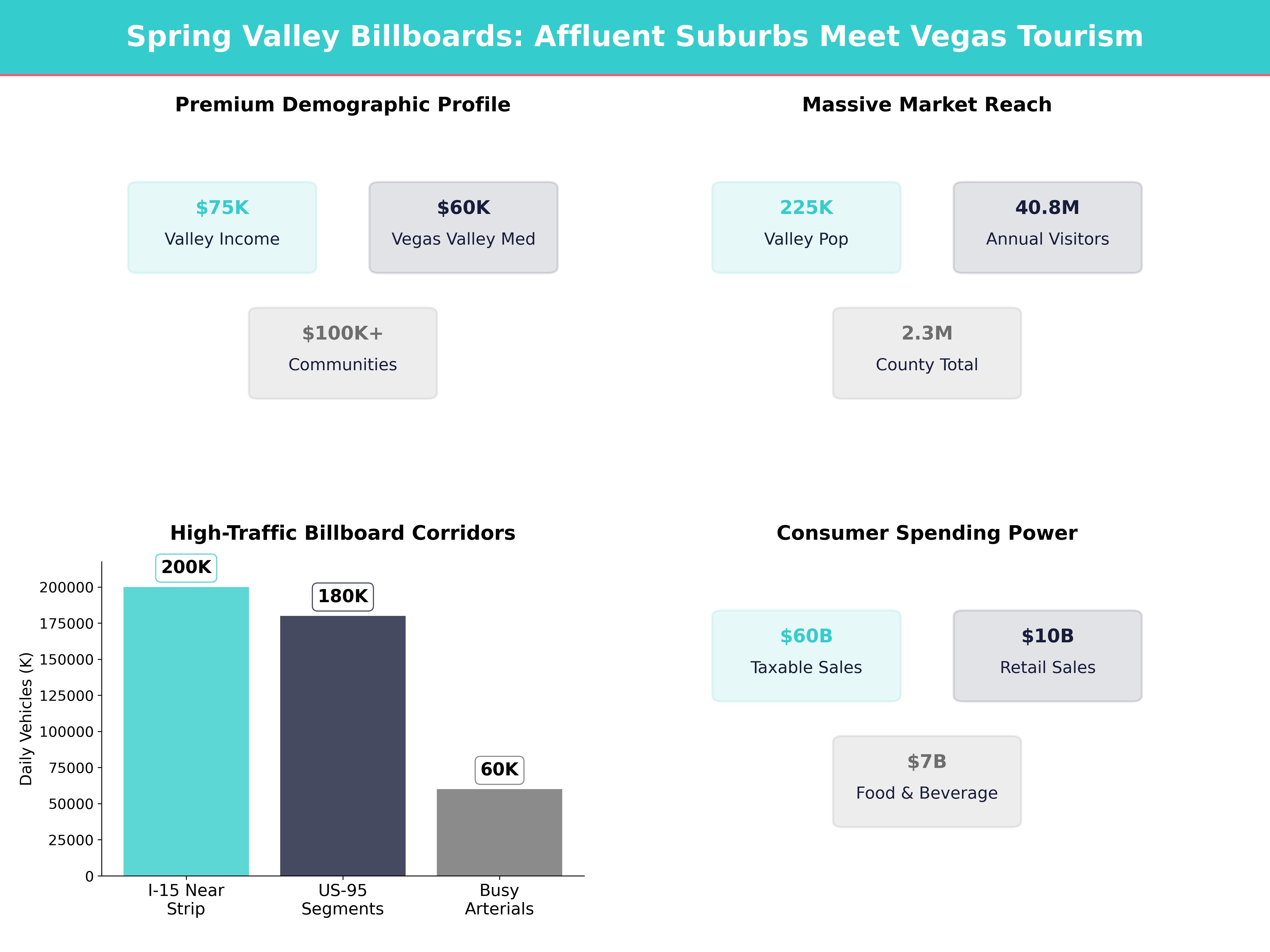
Spring Valley is an unincorporated town in Clark County, just west of the Las Vegas Strip and overseen by Clark County. According to Clark County planning data and local estimates, the Spring Valley area has over 220,000–230,000 residents, making it one of the densest suburban hubs in the valley. Clark County overall has surpassed 2.3 million residents, and has been one of the fastest‑growing large counties in the U.S. for decades, adding roughly 40,000–50,000 new residents in some recent years.
Key characteristics of the Spring Valley area audience:
-
Age & households
- The median age in nearby City of Las Vegas is around 38 years, and Spring Valley’s age profile is similar—heavy on working-age adults and young families, with roughly two‑thirds of residents in the prime 18–64 working age band.
- Average household sizes in the west valley typically range from 2.6–3.0 people, reflecting a mix of singles, young couples, and family households. Around 55–60% of households are family households, which supports strong demand for schools, healthcare, and family‑oriented services.
-
Income & spending
- Median household income across the Las Vegas Valley is in the mid‑$60,000s, but many Spring Valley neighborhoods—especially near Summerlin South and the southwest—trend higher, into the $70,000–$80,000+ range. In some newer master‑planned communities, a significant share of households earn $100,000+.
- According to Clark County $60 billion annually, with more than $6–7 billion per year in food services and drinking places and over $10 billion in general merchandise, clothing, and specialty retail—exact sectors that benefit from persistent billboard visibility.
- The Las Vegas area hosts more than 25,000+ active business licenses in retail, food, professional services, and personal care, giving billboard advertisers a large B2B and consumer service audience that can be reached efficiently through Spring Valley billboards.
-
Tourist influence
- The Las Vegas Convention and Visitors Authority reported 40.8 million visitors in 2023, up from 38.8 million in 2022—an increase of about 5% year‑over‑year and approaching pre‑pandemic peaks.
- Total visitor spending in greater Las Vegas has been estimated at more than $45–50 billion annually, including lodging, gaming, retail, dining, and entertainment.
- Many of those visitors stay or drive through hotel corridors immediately east of Spring Valley (Strip, Chinatown, and southwest resort areas), generating a mix of locals and tourists on the roads you can reach with our boards.
- Hotel occupancy in Las Vegas routinely averages 80–90% on weekends and major event/convention periods, increasing the density of out‑of‑town drivers on Spring Valley‑adjacent routes.
For advertisers, this means the Spring Valley area offers a powerful blend of stable local demand (residents who see your message repeatedly) and transient visitor traffic (people making purchase decisions on the fly). Well-placed billboard advertising near Spring Valley lets you speak to both groups as they move through the same key corridors.
Where Our Billboards Reach Drivers Near Spring Valley
Our 17 digital billboards serving the Spring Valley area are located in nearby Las Vegas and Paradise, within 10 miles of the Spring Valley core. These placements allow us to reach:
- Commuters traveling between Spring Valley neighborhoods and the Las Vegas Strip or Downtown Las Vegas
- Shoppers heading to major centers like Chinatown Plaza Spring Valley Town Center, and regional malls such as the Boulevard Mall and Downtown Summerlin
- Visitors and hospitality staff moving between Strip resorts and residential neighborhoods to the west
This cluster of digital boards effectively functions as a network of billboards near Spring Valley, giving you coverage in every main direction drivers are heading.
Key roadway environments near the Spring Valley area that matter for your campaign:
- I‑15 & US‑95 corridors (Las Vegas area)
According to the Nevada Department of Transportation 200,000 vehicles per day, and some US‑95 segments in the Las Vegas Valley carry more than 160,000–180,000 vehicles per day. Drivers coming from or going to Spring Valley often use interchanges near Tropicana, Flamingo, and Spring Mountain. -
Arterial streets connecting Spring Valley with Las Vegas and Paradise
- Flamingo Rd, Tropicana Ave, Spring Mountain Rd, Sahara Ave: major east‑west routes carrying commuters from Spring Valley to the Strip, Chinatown, UNLV, and the airport area. On busy sections, these arterials can see 40,000–60,000 vehicles per day.
- Rainbow Blvd, Decatur Blvd, Jones Blvd: major north‑south arteries packed with neighborhood retail, medical, banking, and service businesses, with many stretches handling 30,000–45,000 vehicles daily.
By using Blip’s campaign tools, you can pick boards that line up with the directions your ideal customers are actually driving—toward the Strip, toward residential pockets, or toward specific commercial hubs—making your Spring Valley billboards feel highly relevant and timely.
Commuter & Traffic Patterns to Leverage
Understanding how people move around the Spring Valley area helps you decide when and where to show your messages.
Workforce commuting
- Clark County employment exceeds 1 million jobs, with heavy clustering along the Strip, in resorts, health care, logistics, and service industries. The Strip corridor alone supports roughly 250,000+ jobs.
- Thousands of hospitality, retail, and service workers live in or near Spring Valley and commute daily toward the Strip, Paradise, and central Las Vegas. In some Spring Valley ZIP codes, more than 70% of working residents commute by car alone.
- Average one‑way commute times for west valley residents run around 25–30 minutes, keeping drivers in view of roadside media for extended periods.
- Morning peaks: roughly 6:30–9:00 a.m., as residents head east to the Strip and to central employment centers.
- Evening peaks: roughly 3:30–7:00 p.m., as traffic flows back toward Spring Valley’s residential neighborhoods, retail centers, and restaurants.
Shopping & errand trips
- Clark County’s high car ownership rate (well above 85% of households with at least one vehicle, and in some west valley neighborhoods over 92%) means most Spring Valley area residents rely on cars for errands, shopping, and dining.
- Local surveys and retail performance data indicate that more than 70% of retail and restaurant visits in the valley are made by auto rather than transit or walking.
-
Retail traffic is particularly strong:
- Weekday lunch and early evening (around 11:00 a.m.–1:30 p.m. and 4:00–7:30 p.m.)
- Weekend mid‑days (especially 10:00 a.m.–3:00 p.m. on Saturdays), when shopping centers and big‑box clusters along Rainbow, Decatur, and Flamingo see noticeable spikes in parking occupancy.
Transit context
- The Regional Transportation Commission of Southern Nevada 49 million transit boardings in 2023 across the valley, with key routes serving the Strip, Spring Mountain/Chinatown, Tropicana, Flamingo, and Sahara.
- Even drivers who don’t use transit share the same corridors: major routes like Tropicana, Flamingo, and Sahara carry both buses and heavy private vehicle traffic, keeping eyes on nearby billboards for long dwell times at signals. On some signalized arterials, average red‑light wait times can exceed 60–90 seconds, which is ideal for digital billboard legibility.
- The Deuce and Strip & Downtown Express (SDX replacement) routes concentrate large volumes of visitors; many transfer via east‑west corridors that run along the northern edge of Spring Valley.
With Blip, we can concentrate your spend during these known high-volume windows—showing your message more often in rush hour, or heavier on weekends if you’re retail, dining, or entertainment.
Seasonal & Event Timing in the Spring Valley Area
Las Vegas is an event-driven city, and the Spring Valley area sits right next to the action. By pairing your campaigns with the local calendar, we can capture not just locals’ daily routines, but also spikes in demand.
Tourism & convention cycles
- The LVCVA reports convention attendance of over 5 million annually, with major shows individually drawing 50,000–180,000 attendees.
- Big convention months—typically January–May and September–November—often push average daily visitor counts above 120,000–130,000 per day across the valley.
- Major conventions and trade shows at the Las Vegas Convention Center Mandalay Bay Convention Center The Venetian Expo
Sports & entertainment
- Professional sports and major events at Allegiant Stadium, T‑Mobile Arena, and Sphere regularly bring tens of thousands of attendees per event.
- Allegiant Stadium alone can host 65,000+ people for NFL games and concerts and has held 40+ major events per year, including Raiders games, UNLV football, concerts, and international sports.
- T‑Mobile Arena hosts more than 100 events annually, including Vegas Golden Knights games, concerts, and special events, with capacities around 17,000–20,000.
- Many attendees travel through or stay near Spring Valley, especially west of I‑15, using Tropicana, Russell, Hacienda, and Flamingo for access and parking.
Local seasonality
- Summer (June–August): High daytime heat (often 100–110°F, with peak days exceeding 115°F) pushes many locals to drive during early morning or evening hours—great for drive‑time campaigns and message rotation after sunset. Energy use and HVAC service calls spike, supporting home‑services messaging.
- Winter & shoulder seasons (October–April): More comfortable all-day driving and walking conditions. Visitor volumes remain strong across holidays and long weekends (New Year’s, Super Bowl, March Madness, Memorial Day, Labor Day). The Super Bowl, major fight nights, and NCAA tournaments can each lift Strip‑adjacent traffic and gaming revenue by double‑digit percentages over non‑event weeks.
- Holiday shopping between November and late December significantly boosts traffic around regional retail hubs, with some centers reporting 20–30% higher sales than average months.
We can increase your impressions during key citywide events and align creative with what’s happening: game-day messages, concert tie‑ins, or convention-specific offers.
Creative Strategies That Resonate in the Spring Valley Area
Drivers in the Spring Valley area are a mix of locals who know the city well and visitors who don’t. Your creative approach should speak to both, depending on your goal.
1. Speak like a local for resident-focused campaigns
- Reference recognizable cross‑streets and neighborhoods:
“Just west of Rainbow & Flamingo” or “5 minutes from Chinatown Plaza.” - Highlight convenience and everyday benefits: fast service, easy parking, local ownership. Local consumer research shows that over 60% of residents say they are more likely to try a business that feels “neighbor‑owned” or “locally operated.”
- Use simple geographic anchors (e.g., “Near the Strip, in the Spring Valley area”) rather than detailed directions that drivers can’t process at 45 mph.
- Emphasize time savings: the typical Las Vegas driver spends 200+ hours per year in traffic—messages focused on “closer,” “faster,” and “on your way home” perform well.
2. Use visitor-friendly landmarks for tourist targeting
- Visitors understand “5 minutes from the Strip” or “Near Allegiant Stadium” more than specific neighborhood names.
- Focus on must-do experiences: shows, attractions, casinos, dining, and unique local services (ATV tours, wedding chapels, nightlife). Tourism surveys regularly find that 70–80% of visitors spend on at least one show or paid attraction, and more than 90% dine off‑property at least once.
- Include clear directions from major resorts (“West on Tropicana, 3 miles”) and emphasize free parking or easy rideshare access.
3. Design for high-speed, high‑brightness environments
Billboards serving the Spring Valley area often sit along busy, multilane roads, near resorts and neon signage. That environment demands:
- Big type: aim for 7–10 words total. Drivers typically have only 6–8 seconds to absorb a message at 40–50 mph.
- High contrast: white or bright text on dark backgrounds, or vice versa. Studies of out‑of‑home (OOH) effectiveness show that high‑contrast creative can improve ad recall by 20–30% over low‑contrast designs.
- Simple offers: “$29 Oil Change,” “Happy Hour 3–6 PM,” “Free Consultation.”
- Brand anchoring: strong logo or icon that’s legible at a glance; large logos can increase brand recognition by up to 50% versus small corner tags.
- Keep QR codes large and simple; they are most effective when vehicles are stopped at signals and within 100–150 feet of the board.
4. Use bilingual or multicultural elements strategically
Spring Valley and western Las Vegas have significant Asian, Hispanic, and other multicultural communities.
- In many Spring Valley‑area ZIP codes, Hispanic/Latino residents account for 30–40%+ of the population, and Asian communities (especially Chinese, Filipino, and Korean) can comprise 15–20% or more near Chinatown and along Spring Mountain.
-
For selected boards and time blocks:
- Consider bilingual English/Spanish creatives for household services, food, and retail aimed at local residents. National advertising studies show bilingual Spanish/English campaigns can increase response among Hispanic audiences by 20–40%.
- For Chinatown‑adjacent audiences, incorporate culturally resonant visuals and straightforward English (and where appropriate, Chinese characters) that can be legible at speed.
Timing Your Message With Blip’s Dayparting Tools
Because Spring Valley area traffic patterns vary by time of day and day of week, using Blip’s scheduling tools thoughtfully can dramatically improve your ROI.
Commuter-focused campaigns
Ideal for: auto dealers, insurance, financial services, healthcare, education, B2B, hiring campaigns.
-
Run heavier weekdays, especially:
- 6:30–9:00 a.m. (eastbound commuters toward the Strip and central job centers)
- 3:30–7:00 p.m. (westbound commuters heading back toward the Spring Valley area)
- Commuters account for a significant share of weekly impressions; in many OOH studies, weekday peak‑hour impressions can represent 40–50% of total weekly exposure on commuter corridors.
-
Messaging ideas:
- Morning: “Switch your auto insurance this week—save in minutes.”
- Evening: “Tired of your commute? Now hiring closer to home.”
Retail, dining, and entertainment
Ideal for: restaurants, coffee shops, bars, casinos, attractions, mall tenants.
-
Focus on lunch and early evening:
- 11:00 a.m.–2:00 p.m. and 4:00–8:00 p.m.
-
Increase play counts:
- Thursdays–Sundays, when locals eat out more and visitor volume is higher. Restaurant data in Las Vegas shows Friday and Saturday dinner sales can be 30–40% higher than early‑week nights.
-
Messaging ideas:
- “Happy Hour tonight 3–6 PM, 2 miles west of the Strip.”
- “Late‑night dining near the Spring Valley area—open till 2 AM.”
Seasonal & event-based bursts
Using Blip’s flexibility, you can:
- Boost budget during NFL home games, concerts, or big fight weekends at Allegiant Stadium, T‑Mobile Arena, or Sphere—each of which can add 50,000–100,000+ additional visitors to the immediate area.
- Run special creatives during CES, SEMA, and other major conventions, when room rates, taxi/rideshare trips, and restaurant waits all spike noticeably.
- Launch weekend-only campaigns for limited-time offers, shows, or events.
- Take advantage of the fact that digital OOH campaigns with event‑based bursts have been shown to lift short‑term sales 10–20% more than flat schedules, especially in entertainment and dining.
Instead of locking into a static schedule, you can adjust daily or weekly based on performance, inventory, or your own internal promotions.
Matching Board Selection to Audience Goals
We can help you choose boards in nearby Las Vegas and Paradise that best align with your target customers in the Spring Valley area, whether you’re exploring billboard rental near Spring Valley for the first time or expanding an existing OOH mix.
If your business is physically in or near Spring Valley:
- Prioritize boards on east–west arterials that drivers use to head home or to shop, such as Flamingo, Tropicana, Russell, and Sahara.
-
Focus on directions leading into your trade area:
- Example: if you’re near Flamingo & Rainbow, favor boards that face drivers traveling westbound in late afternoon; these drivers are more likely to live or shop within a 3–5 mile radius.
- Use simple proximity messages: “Next Right,” “3 Lights Ahead,” “2 Miles West.”
- Consider that most local retail customers travel 10–15 minutes or less for everyday purchases—select boards that fall within that realistic drive‑time.
If your business is on or near the Strip or in Paradise:
- Target drivers leaving Spring Valley toward the Strip in the morning and early evening. These are primarily locals who may be receptive to “locals’ deals” or “avoid the tourist traps” messaging.
- Use hook messages: “Free Parking by the Strip,” “Locals’ Discount—Show Your NV ID.”
- Consider rotating multiple creatives: one general brand message, one locals’ offer, one event‑specific (game nights, concerts, conventions).
- Tourism data suggests that 30–40% of Las Vegas visitors venture off the main Strip at least once per trip; your creative should give them a clear reason to do so.
If you’re an online or regional brand:
-
Focus on high‑volume commuter routes rather than pure proximity:
- Boards near major interchanges and heavily traveled arterials like I‑15, US‑95, and the Flamingo, Tropicana, and Sahara corridors.
-
Use clear brand and performance messaging:
- “Get mortgage pre‑approval in 10 minutes—scan the QR when you stop.”
- “Order today, delivered to your door in the Spring Valley area.”
- Research on digital‑enabled OOH shows that adding simple calls to action (“Scan now,” “Visit today”) plus a vanity URL or QR can increase measurable response by 15–25% compared to brand‑only boards.
Industry-Specific Strategy Ideas
Here are some concrete ways different advertisers can use billboards serving the Spring Valley area effectively:
Restaurants & nightlife
- Use countdown or distance messaging:
“Tacos & Margaritas – 1 Mile Ahead on Tropicana”
“Late‑Night Sushi Near the Spring Valley Area – Exit Flamingo.” -
Run heavier impressions:
- Thursdays–Saturdays, 4:00 p.m.–midnight, to catch both locals and tourists. Las Vegas restaurant and nightlife revenues often peak on these days, accounting for 50% or more of weekly nighttime sales.
-
Highlight specials that match local behavior:
- “Graveyard specials” (midnight–6 a.m.) can target hospitality workers whose shifts end after midnight.
- “Locals’ 15% Off with NV ID” works well in a market where roughly 70% of the Strip’s gaming revenue still comes from visitors but many service businesses rely heavily on locals.
Healthcare, dental, and clinics
-
Emphasize convenience and trust for residents:
- “Same‑Day Appointments Near the Spring Valley Area.”
- “Open Late & Weekends—Family Practice at [Cross Streets].”
-
Increase impressions during:
- Early morning (before 9 a.m.) and evening, when workers are commuting and considering appointments.
- Healthcare consumption data shows that over 60% of primary‑care and dental visits are scheduled within a 10‑mile radius of home; geo‑anchored billboard messages can directly influence that decision.
Real estate & home services
- Clark County regularly records tens of thousands of home sales per year, with transaction volumes bouncing back strongly in growth years. Investor and relocation activity remains high, driven by relatively low taxes and continued in‑migration.
- Home improvement and repair spending tends to rise in fast‑growing suburban areas like Spring Valley and the southwest, where a large share of homes have been built since the early 2000s.
-
Use bold, benefit-led lines:
- “Sell Your Spring Valley Area Home for Top Dollar.”
- “A/C Not Keeping Up? 24/7 Repair – Call Now.”
- Run heavier from March–October, peak moving and repair season in Southern Nevada, when temperatures climb and HVAC, roofing, and landscaping needs spike.
- For solar, energy, and efficiency services, note that Southern Nevada averages over 290 sunny days per year, making ROI messages particularly compelling.
Education & training
- The Clark County School District serves over 300,000 students and is the fifth-largest school district in the U.S., with dozens of campuses in and around Spring Valley.
- Local higher education options—including UNLV, College of Southern Nevada, and private colleges and trade schools—collectively enroll more than 70,000–80,000 students in the valley.
-
Private schools, charter schools, colleges, trade programs, and bootcamps can focus on:
- Back-to-school periods (July–September) and January for mid‑year enrollment.
- License or certification renewal cycles, often every 6–24 months, depending on profession.
-
Messages:
- “Career Training Near the Spring Valley Area—Classes Start July 8.”
- “Now Enrolling – Limited Spots at Our K‑8 Academy.”
- Parent and adult‑learner surveys indicate that OOH near home and work ranks among the top 3 offline channels for discovering new school and training options.
Hiring & workforce recruitment
- Las Vegas’ service economy is dynamic; many employers are consistently hiring. Local unemployment tends to track near national averages but with high turnover in hospitality and retail, leading to frequent open positions.
-
Use direct, bold statements:
- “Servers & Bartenders: $X/hr + Tips – Apply Today.”
- “Hiring Warehouse Associates—10 Minutes from the Spring Valley Area.”
-
Run heavy during known hiring surges:
- Pre‑summer (April–May) for pools, attractions, and tourism.
- Pre‑holiday (September–November) for retail, logistics, and events.
- Workforce studies show that clear wage information in recruiting ads can increase application rates by 20–30%; including pay ranges and shift details on billboards can help drive qualified traffic to your online application forms.
Leveraging Local News & Community Moments
The Spring Valley area is heavily influenced by regional news and events centered in Las Vegas.
-
Local news outlets like the Las Vegas Review‑Journal, Las Vegas Sun, KTNV Channel 13, KSNV News 3, and KLAS 8 News Now
- Economic trends, major openings, new attractions, and infrastructure projects.
- Traffic changes, road construction, and safety campaigns that affect Spring Valley drivers.
-
Tie your creative to big local narratives:
- “New to the Valley? We help Spring Valley area families settle in.”
- “Beat the Heat – Check Your A/C Before July.”
- “Game Day Near Allegiant? Pre‑Party in the Spring Valley Area.”
You can also time campaigns around:
- Major road changes or openings reported by the RTC of Southern Nevada Nevada Department of Transportation
- Community events, park openings, and county initiatives promoted via Clark County’s official site and neighborhood updates shared by Las Vegas City Hall.
- Cultural festivals and Asian and Hispanic heritage events frequently promoted through Chinatown business associations and local media.
This keeps your brand feeling “plugged in” and relevant to residents’ daily lives and capitalizes on moments when attention to local news is highest—often during major weather events, big sports wins, or infrastructure announcements.
Compliance, Local Context, and Best Practices
Because Spring Valley is governed by Clark County, not an incorporated city, it’s important to stay aligned with county guidelines.
- Clark County information and local governance details are available through the Clark County, Nevada website, including zoning, business licensing, and sign regulations.
-
While we handle billboard compliance, you should ensure:
- Your advertised offers match any gaming, cannabis, alcohol, healthcare, financial, or professional regulations that apply to your specific industry.
- Disclaimers are legible but not overpowering—placed in a consistent location on each creative and large enough to be read within 2–3 seconds.
- For age‑restricted products (alcohol, cannabis, certain entertainment), align your messaging with state and county standards and avoid content that might be interpreted as targeting minors.
- For campaigns that mention “near schools” or family‑focused messaging, consider the broader educational landscape managed by the Clark County School District, and keep visuals and language family‑appropriate on boards that are likely to be seen by students, especially near major school routes on Rainbow, Decatur, and Flamingo.
Measuring, Testing, and Optimizing With Blip
Digital billboards serving the Spring Valley area give us the flexibility to think more like digital marketers and less like traditional out‑of‑home buyers.
We can:
-
Rotate multiple creatives:
- Test Version A and Version B simultaneously—different offers, headlines, or images.
- Many OOH case studies show that creative testing and rotation can improve campaign effectiveness by 15–30% versus a single static creative.
-
Compare performance via:
- Direct response (unique URLs, QR codes, promo codes).
- Correlated metrics (store traffic, Google search volume, web sessions from the Las Vegas area).
-
Adjust budgets in real time:
- Shift spend toward boards that align with your best-performing trade zones (for example, boards closest to ZIP codes where you see the highest sales per capita).
- Increase impressions during critical weeks (product launches, sales, events) and dial back during slower periods.
-
Use geographic and time-based segmentation:
- Morning commuters vs. evening diners.
- Weekday business traffic vs. weekend leisure.
- Event‑driven spikes (NFL games, UFC fights, major concerts) vs. normal weeks.
- Incorporate third‑party location analytics or your own CRM data to estimate that lifted exposure on targeted boards translates into incremental foot traffic or online sessions, then use that to refine budget allocation.
By watching how your audience responds—online and at your physical locations—you can continuously refine copy, visuals, and scheduling until you’re getting the maximum impact per dollar from your billboard advertising near Spring Valley.
The Spring Valley area offers a rare combination: a large, stable local population; immediate proximity to one of the world’s busiest tourist corridors; and dense roadway networks that bring both groups past the same digital billboards every day. With more than 40 million annual visitors, 220,000+ nearby residents, and corridors carrying tens of thousands to over 200,000 vehicles per day, advertisers get repeated, high‑quality exposures. By pairing local insights with Blip’s flexible buying model for billboard rental near Spring Valley, we can craft campaigns that meet your audience where they actually are, at the moments they’re most ready to act.