Billboards in Peoria, AZ
No Minimum Spend. No Long-Term Contracts. Just Results.
Turn heads in the Peoria area with flexible, self-serve digital advertising. Blip makes it easy to launch eye-catching campaigns on Peoria billboards and billboards near Peoria, Arizona—set your budget, pick your times, upload creative, and start shining.
Trusted by Leading Brands


How much is a billboard in Peoria?
Billboards in other Arizona cities
Peoria Billboard Advertising Guide
Peoria, Arizona sits at the heart of the fast‑growing northwest Phoenix metro, making it a powerful market for digital billboard advertisers. With strong population growth, high household incomes, and constant movement along Bell Road and Loop 101, campaigns on nearby boards in places like Sun City West can efficiently reach shoppers, commuters, and visitors across the Peoria area. For brands looking for billboards near Peoria without paying core‑freeway premiums, these positions offer a cost‑effective way to stay visible where locals actually drive every day.
Understanding the Peoria Area Market
Peoria is one of the largest cities in the Valley of the Sun and an economic anchor for the northwest suburbs.
- The City of Peoria 200,000 residents and more than 190 square miles of land area, stretching from urban corridors to master‑planned communities and Lake Pleasant regional recreation. The city has added more than 25,000 residents since 2010, a growth rate of roughly 15–20% over the last decade, outpacing many nearby West Valley communities.
- Peoria’s median age is about 39 years, balancing younger family households with a sizable retiree population in nearby age‑restricted communities like Sun City and Sun City West. In many surrounding retirement ZIP codes, 40–60% of residents are age 65+, creating a dense senior audience within a 10–15 minute drive of Peoria’s retail and medical clusters that Peoria billboards can reach multiple times per week.
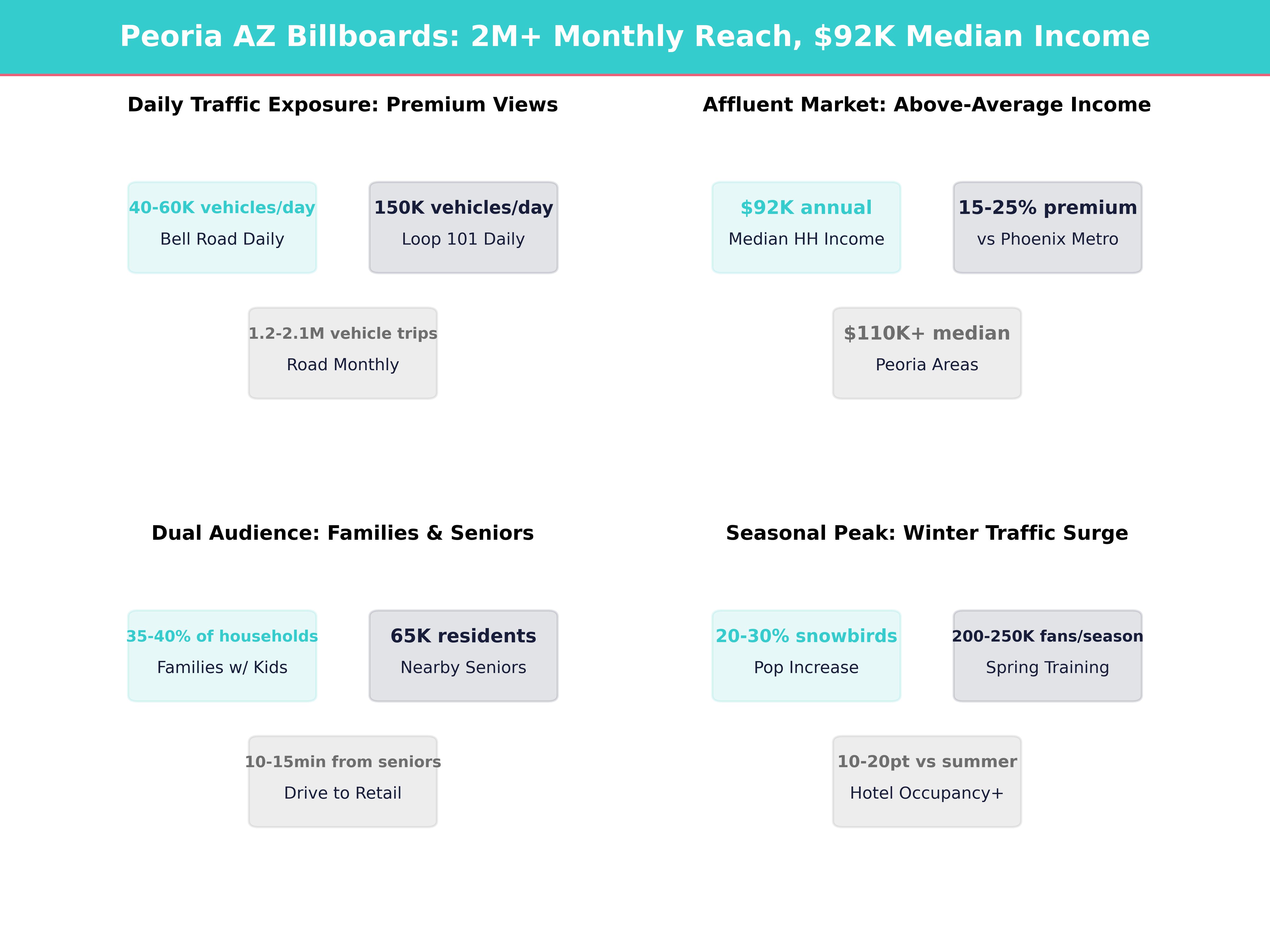
- Median household income in the Peoria area is around $90,000–$95,000, well above national levels and roughly 15–25% higher than the broader Phoenix‑Mesa metro median, indicating strong discretionary spending on retail, dining, home improvement, recreation, and professional services. Several northern Peoria neighborhoods post median incomes above $110,000.
- The Peoria Unified School District serves more than 36,000 students across 40+ schools, generating substantial weekday traffic from parents, staff, and students. With more than 4,000 employees, the district is also one of the largest employers in the West Valley.
- Peoria’s economy is diversified across healthcare, retail, education, hospitality, and professional services. The city notes over 4,000 registered businesses and a local unemployment rate that has often trended 1–1.5 percentage points below national averages, signaling a stable, working‑household customer base ( Peoria Economic Development
For advertisers, this profile supports campaigns for:
- Family‑oriented products (schools, healthcare, attractions, quick‑serve restaurants)
- Higher‑ticket items (vehicles, real estate, financial services, elective healthcare)
- Lifestyle and leisure (fitness, golf, boating, events, and dining)
By placing digital billboards near Peoria along key approaches and activity corridors, we can tap into a steady, diverse flow of high‑value audiences.
Where Our Boards Are and How They Reach the Peoria Area
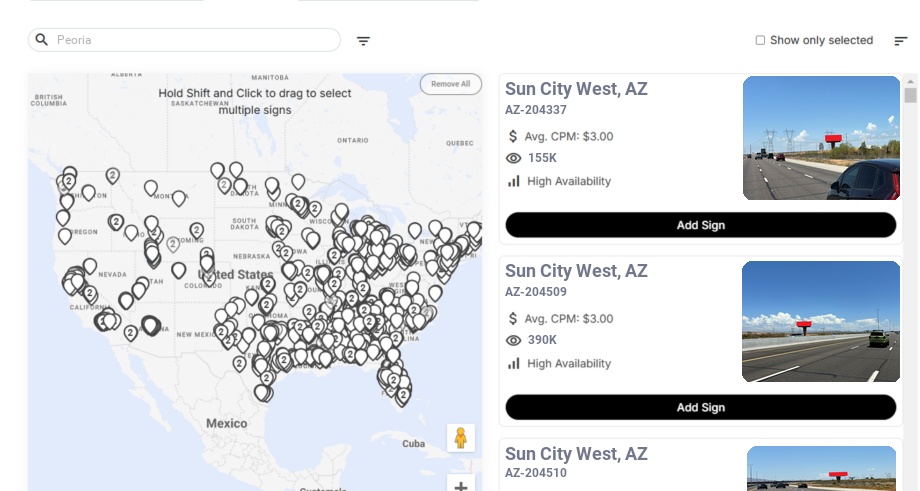
We operate 3 digital billboards near the Peoria area, located in Sun City West, approximately 7.2 miles from Peoria. While the faces themselves are in Sun City West, they serve:
- Daily commuters traveling between retirement communities, Peoria retail centers, and job hubs across the northwest Valley
- Shoppers headed to Peoria’s major commercial corridors such as Bell Road, Union Hills Drive, and Lake Pleasant Parkway
- Visitors and seasonal residents traveling between Sun City West, Surprise, and Peoria for dining, healthcare, and entertainment
For advertisers specifically comparing Peoria billboards and nearby alternatives, these boards function as a strategic “halo,” intercepting traffic just before it flows into Peoria’s busiest shopping and medical zones.
Key dynamics that make these locations especially valuable for reaching the Peoria area:
- Bell Road Corridor: Bell Road carries heavy cross‑regional traffic connecting Surprise, Sun City West, Sun City, and the Peoria retail zones near Arrowhead. Arizona Department of Transportation (ADOT) traffic counts in nearby segments often exceed 40,000–60,000 vehicles per day, with some stretches in the northwest Valley topping 70,000 vehicles per day. Over the course of a month, that equates to 1.2–2.1 million vehicle trips along key sections of the corridor, giving billboard advertising near Peoria strong frequency and repeat exposure.
- Retiree & Snowbird Movement: Sun City West hosts more than 27,000 residents in an age‑restricted environment (Sun City West Property Owners and Residents Association). Neighboring Sun City adds another 38,000+ residents, creating a combined retirement belt of more than 65,000 older adults within a short drive of Peoria’s shopping and medical districts. Community surveys consistently show that a majority of these residents make multiple trips per week to nearby grocery, healthcare, and dining destinations in Peoria, passing our billboards near Peoria repeatedly throughout the week.
- Event & Healthcare Trips: Residents and visitors frequently move between Sun City West and key Peoria‑area destinations such as Arrowhead Towne Center, the P83 Entertainment District ( P83 Peoria Banner Boswell Medical Center in Sun City ( Banner Boswell millions of annual visits, increasing exposure opportunities for nearby billboard campaigns and making these Peoria billboards a valuable piece of a regional media plan.
Because our boards refresh every few seconds and sell by the “blip,” we can help you specifically target these flows during the times and days that matter most for your business, giving you flexible billboard rental near Peoria without long‑term, fixed‑vinyl commitments.
Who You Can Reach Near Peoria
The Peoria area combines three powerful audience segments: families, affluent professionals, and older adults/retirees.
1. Families and Youth
- With more than 36,000 students in the Peoria Unified School District and additional charter/private enrollment, school‑related trips create thousands of daily vehicle movements across the area. Assuming even 1.5 vehicle trips per student per school day (drop‑off, pick‑up, activities), that’s 50,000+ daily school‑related trips across the district—ideal for billboards near Peoria along major arterials feeding neighborhood schools.
- Youth athletics are a major draw—Peoria is a regional hub for club sports and tournaments at facilities like the Peoria Sports Complex several hundred thousand visitors annually outside of Spring Training. The city’s visitor bureau, Visit Peoria
- Peoria’s family presence is strong: in many neighborhoods, 35–40% of households include children under 18, creating consistent demand for family‑focused goods, services, and entertainment.
Ideal advertisers for this segment:
- After‑school programs, youth sports, tutoring, and childcare
- Pediatric healthcare, family dentistry, and urgent care
- Family dining, quick‑serve restaurants, and entertainment venues
- Auto dealers and service centers targeting family vehicles and SUVs
2. Affluent Professionals and Homeowners
- Household income in the Peoria area sits in the $90,000+ range, with a significant share of households earning $100,000 or more. In some northern Peoria ZIP codes, nearly 1 in 2 households surpass the $100,000 threshold.
- Housing is dominated by owner‑occupied single‑family homes. Owner‑occupancy rates in many Peoria neighborhoods exceed 70%, which correlates strongly with demand for home improvement, landscaping, roofing, and similar services that can be effectively promoted with billboard advertising near Peoria shopping corridors.
- Northern Peoria near Lake Pleasant continues to see new master‑planned developments and custom homes. The Lake Pleasant area and Vistancia corridor have added thousands of new housing units over the past decade, supporting a growing base of higher‑income homeowners.
- Commuting data show that a large share of Peoria residents work across the Phoenix metro, with typical one‑way commute times in the 25–35 minute range—driving daily exposure to roadside media.
Ideal advertisers:
- Real estate teams, new home communities, mortgage and financial advisors
- Home improvement and services (HVAC, landscaping, roofing, pools, solar)
- Auto dealers, power sports, and RV sellers
- Professional services (attorneys, CPAs, insurance)
3. Retirees and Snowbirds
- Nearby Sun City West, Sun City, and other age‑restricted communities contain tens of thousands of older adults—many with stable retirement income and time for travel, recreation, and healthcare. In some of these communities, more than 75% of residents are age 65+.
- Seasonal “snowbird” residents swell these populations in winter months (often 20–30%+ seasonal increases across retirement areas in the West Valley). Community organizations and HOAs report that winter occupancy in some neighborhoods nearly doubles compared with summer, driving a surge in weekday traffic to medical offices, golf courses, and retail. Well‑placed Peoria billboards along these routes can maintain top‑of‑mind awareness during the months when demand is highest.
- Golf and recreation are major lifestyle drivers: Sun City West alone offers 7 golf courses, and the broader Sun City/Sun City West area manages 40+ recreation facilities, pools, and clubs, creating frequent cross‑community travel patterns.
Ideal advertisers:
- Healthcare providers (cardiology, orthopedics, imaging, primary care)
- Senior living, in‑home care, and specialized services
- Golf courses, clubs, and recreational activities
- Travel agencies, cruise operators, and financial planners
By adjusting your Blip campaign to focus on specific times and messages for these segments, we can continuously refine who you reach and when.
Seasonal Patterns and Event‑Driven Opportunities
Peoria’s rhythms change significantly across the year. We can use those patterns to time your campaigns for maximum impact.
Winter & Spring (January–March)
- Peak snowbird season: Retirement communities near Peoria see significant population bumps as winter residents arrive. Local tourism and hospitality data indicate that West Valley hotel occupancy can rise by 10–20 percentage points compared with summer lows during this period.
- Spring Training: The Peoria Sports Complex roughly 200,000–250,000 fans per season across all games and events. On game days, traffic spikes several hours before and after first pitch along Bell Road and Loop 101, boosting the value of billboard rental near Peoria for hospitality, dining, and retail brands.
- Average high temperatures are in the 60s–70s°F (Peoria’s typical January high is around 67°F, rising into the mid‑70s by March), making outdoor activities, dining, and shopping particularly popular ( City of Peoria – Parks & Recreation
- Local event calendars show dozens of festivals, art fairs, and community gatherings from January through March, including events in Old Town Peoria and the P83 Entertainment District, attracting thousands of attendees each weekend ( Visit Peoria Events
Campaign implications:
- Promote golf, tourism, entertainment, and restaurants that benefit from visitor traffic.
- Healthcare, financial services, and home services aimed at retirees perform well.
- Use Blip’s scheduling to increase impressions on game days, weekends, and late afternoons when fans are on the move.
Summer (June–September)
- Temperatures frequently exceed 105°F, with July and August often reaching 110°F and heat wave days surpassing 112°F. Peoria typically records 80–100 days per year with highs above 100°F.
- Many residents adjust schedules to avoid midday heat, increasing early‑morning and evening travel. Traffic data from ADOT and local transportation studies show a noticeable shift in trip timing, with higher relative volumes in the 6–9 a.m. and 5–9 p.m. periods during peak summer.
- Indoor entertainment, home cooling services, and e‑commerce see spikes. HVAC companies often report 20–30% higher service demand during prolonged heat waves.
- Utility providers in the region have documented summer electricity usage rising 25–40% compared with mild‑weather months, underscoring consumer demand for energy‑efficient products and home comfort solutions.
Campaign implications:
- Target early morning (6–9 a.m.) and evening (5–9 p.m.) blips when people commute or head for dinner and shopping.
- Rotate creative for HVAC, pool services, indoor attractions, and back‑to‑school promotions. Local districts typically return to school in late July or early August, creating a 2–3 week window for back‑to‑school messaging.
- Emphasize heat relief, safety, and comfort in messaging.
Fall (October–December)
- Temperatures moderate to the 70s–80s°F for daytime highs, prime weather for local events, outdoor shopping, and recreation. October averages highs in the low 80s°F, falling into the 60s–70s°F by December.
- Fall and holiday shopping, youth sports, and local festivals drive traffic around major commercial nodes in the Peoria area. Regional retail reports show that November–December can account for 20–30% of annual sales for some merchants.
- Youth sports leagues and tournaments ramp back up after the summer heat, leading to more weekend traffic near parks, fields, and the Peoria Sports Complex.
Campaign implications:
- Launch multi‑month campaigns for holiday retail, automotive sales events, and year‑end financial or healthcare appointments. Many medical offices see a 10–20% increase in elective procedures and checkups as patients use remaining insurance benefits.
- Use A/B creative (e.g., “Black Friday” vs. “Holiday Sale Extended”) and compare performance by time of day or week.
- Highlight “shop local” or “West Valley” messaging to capture residents who prefer staying closer to home rather than driving into central Phoenix or Scottsdale. Billboards near Peoria are especially effective at reminding shoppers to support nearby West Valley businesses.
Daily Traffic and Commuter Flows You Can Leverage
The Peoria area is tightly connected to the rest of the Phoenix metro by major arterials and freeways:
- Loop 101 (Agua Fria Freeway) passes along the eastern edge of the Peoria area, with segments near the Arrowhead region carrying 150,000+ vehicles per day according to ADOT traffic counts. Annualized, that equates to more than 50 million vehicle trips along this key stretch each year.
- Bell Road is one of the busiest east‑west surface arterials in the West Valley, with segments near the Peoria–Sun City corridor carrying 40,000–60,000+ vehicles per day. That means 1.2–1.8 million monthly vehicle trips moving along this corridor where digital boards can capture repeated exposure.
- Grand Avenue (US‑60) carries commuters and freight traffic between the West Valley and central Phoenix. In many sections between Surprise, Sun City, and Peoria, daily volumes exceed 50,000 vehicles, with a strong mix of commuter and commercial traffic ( ADOT Traffic Counts
- Major north–south routes like Lake Pleasant Parkway and 75th Avenue also serve as high‑volume connectors between Peoria’s neighborhoods and the regional freeway network, with key segments handling 25,000–35,000 vehicles per day.
Our Sun City West boards are strategically positioned to capture:
- Morning flows heading from retirement communities and Surprise toward Peoria and other job centers
- Midday and afternoon shopping and healthcare trips into Peoria retail and medical clusters
- Evening flows as residents return home from P83 Entertainment District, Arrowhead area restaurants, and shopping centers
This traffic mix makes our billboards near Peoria a strong option for advertisers who want metro‑level reach while focusing specifically on northwest Valley commuters.
By using Blip’s dayparting tools, we can:
- Concentrate your budget during commute peaks (e.g., 6–9 a.m., 3–7 p.m.)
- Create lunch‑hour only campaigns for restaurants and quick‑serve concepts
- Schedule clinic or urgent care messages during evenings and weekends when patients most often seek care
Creative Strategy for the Peoria Area
Peoria‑area drivers typically view your message for 4–8 seconds at 40–55 mph on major roads. Effective creative must be instantly readable and locally relevant.
1. Keep the Message Simple and Bold
- Limit copy to 7 words or fewer.
- Use high‑contrast colors (e.g., dark text on a light background or vice versa).
- Focus on one primary call to action: “Exit on Bell,” “5 Minutes Ahead,” “Walk‑In Today,” etc.
- Keep logo usage clean and sized so it’s legible at 300–500 feet viewing distance.
Examples tailored to the Peoria area:
- “Arrowhead Auto Sale – 5 Min Ahead”
- “Sun City West Dentistry – Same‑Day Appointments”
- “Beat the Heat: $49 A/C Tune‑Up”
- “Lake Pleasant Boat Rentals – Book Now”
These types of messages work well on Peoria billboards and neighboring Sun City West faces because they quickly communicate value and proximity.
2. Use Local Cues and Landmarks
Referencing recognizable local points helps your ad feel relevant:
- “Near P83 Entertainment District”
- “Just off Loop 101 & Bell”
- “Serving Peoria & Sun City West”
- “Minutes from Arrowhead Towne Center”
These small cues reassure drivers that your business is nearby and easy to reach. Local surveys consistently show that including a clear location cue (such as a cross‑street or well‑known center) can increase visit intent by 10–20% compared with generic location messaging.
3. Design with Retirees and Families in Mind
Given the strong presence of both seniors and families:
- Use larger fonts and high legibility to accommodate older eyes—aim for at least 15–18 inch letter height on the board, which translates to readability at highway speeds.
- Avoid clutter; clear icons (phone, tooth, house, car) communicate quickly. Tests across digital OOH campaigns often show higher recall rates (5–10 percentage points) for ads with simple iconography versus text‑heavy layouts.
- For family‑oriented ads, consider imagery of families or kids—but keep faces large and simple so they’re visible from distance.
4. Align Imagery with the Desert Lifestyle
Use visuals that resonate with the region:
- Desert sunsets, golf courses, pools, and lake scenes for leisure products
- Cool colors (blues, greens) for heat‑relief messaging during summer
- Clean, modern graphics for professional services aimed at higher‑income households
- Lake Pleasant imagery tied to boating, fishing, and watersports—Lake Pleasant Regional Park sees hundreds of thousands of visitors annually, especially on spring and fall weekends
Using Blip’s Flexibility to Test and Improve
Digital billboards near the Peoria area are ideal for ongoing testing. We can:
Run Multiple Creatives Simultaneously
- Show Version A and Version B at alternating blips.
- Change a single variable (headline, color, offer) and monitor downstream metrics (website visits, call volume, walk‑ins) by time period.
- Over a 2–4 week test, even modest budgets can deliver tens of thousands of impressions, enough to identify which creative resonates more strongly.
Day‑Specific and Time‑Specific Messaging
Tie your messages to the way Peoria‑area residents live:
- Weekday morning: “Peoria Commuters – Coffee 2 for 1 Until 10 a.m.”
- Midday: “Walk‑In Clinic – Seen Today, No Appointment”
- Weekend: “Sunday Brunch Near P83 – Reservations Recommended”
- During Spring Training home games: “Game‑Day Parking & Dining – Next Exit”
These types of executions are where flexible billboard rental near Peoria really shines, allowing advertisers to adapt messaging as events and demand change.
Seasonal Swaps Without Print Costs
Because you’re not locked into static vinyl:
- Run a “Spring Training Special” creative during Cactus League season.
- Switch to a “Summer A/C Tune‑Up” or “Back‑to‑School” message mid‑year.
- Launch “Year‑End Tax Planning” or “Holiday Deals” in Q4.
- Quickly adjust creative in response to local news or events reported by outlets like the Peoria Independent ( YourValley Peoria azcentral’s Peoria coverage ( azcentral Peoria
This agility lets you keep your advertising synced with real‑world events, weather, and demand in the Peoria area.
Budgeting and Scaling for the Peoria Area
With Blip, you can start small and scale as you see results.
Start with Focused Coverage
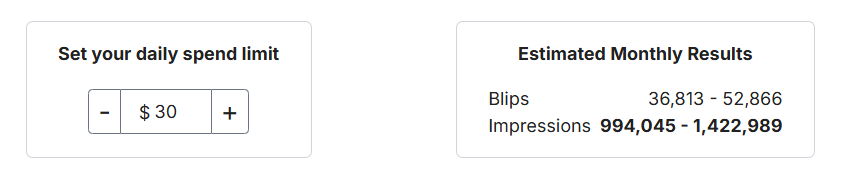
- Set a daily or monthly budget that matches your goals (for example, a few dollars per day to test basic reach, then scale up). Many local advertisers begin with budgets in the $10–$30 per day range to establish a baseline presence.
- Concentrate your blips on the highest‑value dayparts for your category (commute hours for auto and healthcare, evenings for restaurants, etc.).
- Expect that even a modest, well‑targeted campaign can generate thousands to tens of thousands of weekly impressions in the Peoria/Sun City West corridor, depending on bid level and competition.
For businesses exploring billboard advertising near Peoria for the first time, this approach provides an easy way to understand what kind of exposure and response you can earn before committing to larger buys.
Expand Once You See What Works
- Increase your bid or budget during the best‑performing times.
- Add additional creatives for specific sub‑segments (e.g., one for retirees, one for families).
- Layer in event‑based pushes (Spring Training, holiday shopping, back‑to‑school).
- Tie billboard flight dates to your other major media buys in the Phoenix/West Valley market for cumulative reach.
Because you only pay for the blips you choose, campaigns serving the Peoria area can remain efficient while still tapping into tens of thousands of daily impressions.
Integrating Billboards with Your Other Marketing
Billboards near the Peoria area perform best when integrated with digital and offline channels.
Use Short, Memorable URLs and Handles
- Create simple vanity URLs: “YourBrandPeoria.com”
- Highlight recognizable social handles: “@YourBrandAZ”
- Keep URLs to 15 characters or fewer when possible; OOH research shows shorter URLs can improve recall by 20–30% compared with longer, complex domains.
Reinforce TV, Radio, and Digital Campaigns
- If you’re running local TV or streaming ads in the Phoenix/West Valley market, echo the same core message and visuals on billboards to increase recall. Cross‑channel campaigns typically see lift in ad recall and brand search volume compared with single‑channel efforts.
- Coordinate promotions mentioned in local media like the Arizona Republic’s Peoria coverage on azcentral Peoria Independent
- Work with local business organizations such as the Peoria Chamber of Commerce to time billboard campaigns around community events, ribbon cuttings, or seasonal promotions.
Measure Response Carefully
- Track spikes in website visits, calls, coupon redemptions, or in‑store traffic when you increase your blip frequency.
- Use unique offer codes or landing pages on your billboard creative (e.g., “Use code PEORIA10”).
- Monitor Google Analytics or call‑tracking dashboards during specific flight dates and time blocks to correlate exposure with response. Many advertisers see noticeable upticks in branded search volume within the first 2–4 weeks of sustained billboard presence.
By combining detailed local knowledge of the Peoria area with the flexibility of Blip’s digital billboards near Sun City West, we can design campaigns that are timely, targeted, and cost‑effective. Whether you’re trying to reach families around Arrowhead, retirees in Sun City West, or commuters crisscrossing the Bell Road corridor, dynamic billboard advertising near Peoria gives you a prominent presence in the everyday lives of Peoria‑area audiences.