Billboards in Surprise, AZ
No Minimum Spend. No Long-Term Contracts. Just Results.
Trusted by Leading Brands


Billboard advertising
in Surprise has never been easier




How much is a billboard in Surprise?
Why Choose Blip for Billboard Advertising in Surprise
Blip lets you launch fast in Surprise and target Grand Ave/US-60 and Bell Rd commuters without long-term leases.
Set flexible budgets in Surprise and scale up for Spring Training, snowbirds, or summer heat when traffic shifts.
Use dayparting in Surprise to hit 6:30-9 a.m. commuters, midday retirees, or evening Bell Road shoppers.
Blip's real-time analytics help you track Surprise campaigns near Sun City West and El Mirage, then move spend to what works.
Build and swap creative fast for Surprise with bilingual ads, golf visuals, or 110° heat offers that fit local families and retirees.
Frequently Asked Questions About Billboard Advertising in Surprise
How much does a billboard cost near Surprise, Arizona with Blip?
With Blip, you control exactly what you spend on Surprise billboards by setting a daily budget that can be as small or as large as you like. Each ad plays for 7.5 to 10 seconds on digital billboards near Surprise, Arizona, and you only pay for each individual “blip” that runs. Costs per blip vary based on the time of day, location, and local advertiser demand, so your total spend is simply the sum of all the blips your campaign receives in the Surprise area.
Where can I advertise with Blip in Surprise, Arizona?
We serve the Surprise area with 7 digital billboards in two nearby cities: Sun City West and El Mirage. These locations sit along major commuter and commercial routes that Surprise residents use daily. For brands comparing options for billboard advertising near Surprise, this cluster provides broad coverage without needing signs in every single neighborhood.
Who can Blip billboards near Surprise, Arizona reach?
The Surprise area blends several distinct lifestyle segments, including retirees and snowbirds, commuters and working families, and sports, events, and tourism traffic. Large 55+ communities in Surprise and Sun City West, along with families and workers in nearby neighborhoods, create a broad audience for billboard advertising. Digital billboards near Surprise put your message in front of these visitors while they travel between hotels, restaurants, and ballparks, as well as on the way to and from the airport via the northwest corridors.
When is the best time to run Blip billboards in Surprise, Arizona?
The Surprise area has distinct seasonal patterns driven by weather, tourism, and local life. Winter and early spring, especially November through March, are a peak period because of snowbirds, Spring Training, and golf tourism. Late spring and summer still see strong weekday traffic, so advertisers often emphasize heat-related needs and time-of-day specific messages.
What roads and traffic areas matter most for billboard advertising in Surprise, Arizona?
Grand Avenue is a primary arterial connecting the Surprise area to Peoria, Glendale, and Downtown Phoenix, with traffic counts of 45,000 to 60,000 vehicles per day near the area. Bell Road is the main east-west commercial spine and often reaches 50,000 to 65,000 vehicles per day, especially near major intersections and shopping centers. The growing Loop 303 corridor is also increasing cross-traffic between Surprise and nearby communities.
Do I need a contract to advertise with Blip in Surprise?
No, Blip has no long-term contracts or minimum commitments. You can start, pause, or stop your campaign at any time.
How fast can I launch a billboard campaign with Blip in Surprise?
You can have your campaign live in minutes. Create a free account, select your locations, set your budget, upload your design, and start running once approved.
Where can I advertise with Blip in Surprise?
Blip has digital billboards in Surprise. You can browse available locations on a map, choose the ones that fit your audience, and start advertising right away.
Still have questions? Launch a campaign in minutes — no contracts, no commitments.
Start Your CampaignSurprise Billboard Advertising Guide
Surprise, Arizona sits at the fast‑growing northwest edge of Greater Phoenix (Visit Phoenix), where master‑planned communities, retirement neighborhoods, young families, and major spring training traffic all converge. With 7 digital billboards serving the Surprise area from nearby Sun City West and El Mirage, we can help you reach residents, commuters, snowbirds, and visitors at key chokepoints they travel every day. If you’re looking for high‑impact billboards near Surprise without having to commit to long‑term leases, these locations provide flexible, targeted visibility across the Northwest Valley.
Understanding the Surprise Area Market
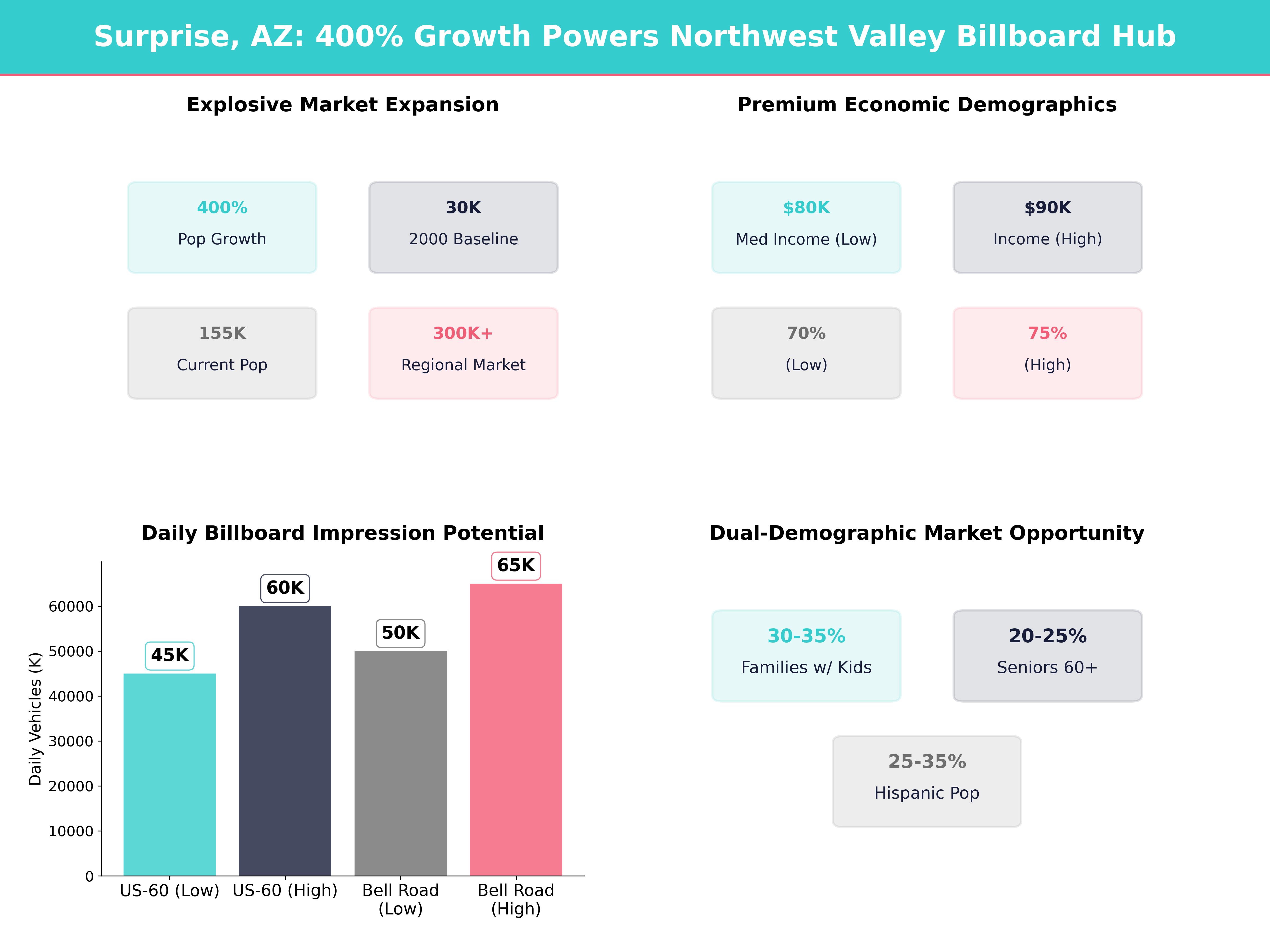
Surprise has transformed from a small agricultural town into one of Arizona’s fastest‑growing suburbs. According to the City of Surprise, the city’s population has surged from about 30,000 residents in 2000 to more than 150,000 today—an increase of over 400% in just two decades. City demographic snapshots indicate current estimates in the 155,000–160,000 range as new housing continues to come online, especially north of Bell Road and along the Loop 303 corridor.
Maricopa County, which includes Surprise, now has 4.5–4.7 million residents, adding roughly 750,000–800,000 people since 2010, and remains one of the fastest‑growing counties in the U.S. Much of that growth has taken place in outer suburbs like Buckeye Goodyear Maricopa Association of Governments 2–3% annual population growth through the 2030s.
Key demographic realities in the Surprise area:
-
Population size & growth
- City of Surprise: 150,000+ residents, with official city materials often citing figures in the 155,000 range in recent years.
- The broader Northwest Valley (Surprise, El Mirage, Sun City, Sun City West) collectively represents 300,000+ residents within a 10–15‑minute drive—an ideal base for Surprise billboards that can reach multiple communities with a single placement.
- Maricopa County overall has grown by more than 750,000 residents since 2010, with county population growth exceeding 15% over that period.
- Surprise consistently ranks among the top 10 fastest‑growing cities in Arizona by percentage growth (City of Surprise community profiles and regional planning reports), and has expanded its land area to more than 100 square miles.
-
Age & household mix
- Surprise has a higher‑than‑average median age compared with the Phoenix metro, largely because of large active‑adult communities such as Sun City Grand and nearby 55+ neighborhoods in Sun City West and Sun City.
- City data show that roughly 20–25% of Surprise residents are age 60+, compared with around 18–20% statewide, creating a large base of retirees and near‑retirees.
- At the same time, families with children are a significant and growing segment; in many Surprise ZIP codes, 30–35% of households include children under 18.
- Local school districts like Dysart Unified School District 24,000 students across Surprise, El Mirage, and surrounding communities and have added new campuses as enrollment has shifted northwest.
- This creates a barbell market: a sizable retiree audience with disposable income plus a growing base of working‑age parents and commuters that can all be reached through well‑placed billboard advertising near Surprise.
-
Income & spending power
- City and regional economic profiles place median household income in Surprise in the $80,000–$90,000 range, notably higher than both the Arizona and U.S. medians.
- In many master‑planned neighborhoods, median household incomes exceed $95,000, supported by dual‑income households and higher‑value housing stock.
- Homeownership rates in Surprise are typically above 70–75%, compared with roughly 65% nationally, indicating a stable, investment‑minded population.
-
The Northwest Valley also has strong consumer spending in categories such as:
- Home improvement and landscaping (homeowners routinely spend thousands of dollars per year on upkeep, pools, and desert landscaping).
- Healthcare and medical services, with multiple major medical centers and specialty clinics serving tens of thousands of visits annually.
- Automotive, RV, and golf‑related purchases; Arizona consistently ranks among the top states for golf participation, and the Surprise area alone has access to a dozen+ courses within a short drive.
- Dining, entertainment, and local services, especially along Bell Road and near Surprise’s major retail centers.
-
Language & culture
- The northwest Valley, including the Surprise area, has a significant Hispanic population. In many nearby ZIP codes, 25–35% of residents are Hispanic or Latino, and some corridors in El Mirage and western Glendale are over 40% Hispanic.
- At home, Spanish is spoken by a substantial share of households; in certain neighborhoods, 20–25% of households speak Spanish as a primary language.
- Bilingual English/Spanish creatives can notably expand your reach, particularly for consumer services, retail, healthcare, and food concepts.
For advertisers, this combination means the Surprise area offers a diverse, growing, and relatively affluent audience that is highly car‑dependent—ideal for digital billboard campaigns. Regional transportation data show that more than 85–90% of workers in the Northwest Valley commute to work by car, with average commute times often exceeding 30 minutes. That kind of drive‑time makes flexible billboard rental near Surprise especially cost‑effective for building repeated exposure.
Where Our Billboards Reach Drivers Near Surprise
We serve the Surprise area with 7 digital billboards in two nearby cities:
- Sun City West (about 5.0 miles from Surprise)
- El Mirage (about 9.5 miles from Surprise)
These locations sit along major commuter and commercial routes that Surprise residents use daily. Both Sun City West and El Mirage are part of the same west‑Valley commuting shed outlined in regional travel surveys, where tens of thousands of trips per day cross city boundaries for work, shopping, and medical care. For brands comparing options for billboard advertising near Surprise, this cluster provides broad coverage without needing signs in every single neighborhood.
Key corridors and traffic patterns:
-
Grand Avenue / US‑60 corridor
- Grand Avenue is a primary arterial connecting the Surprise area to Peoria Glendale, and Downtown Phoenix, with multiple grade‑separated intersections and commercial nodes.
- Arizona Department of Transportation (ADOT) traffic count data in the northwest Valley show typical Average Annual Daily Traffic (AADT) volumes of 45,000–60,000 vehicles per day on segments of US‑60 near the Surprise area and adjacent suburbs.
- On some stretches closer to Peoria and Glendale, AADT can exceed 65,000 vehicles per day, as commuters converge toward central Phoenix.
- Many Surprise residents use Grand Avenue for work commutes, shopping trips, and access to medical and service providers, creating repeated daily exposures to billboard locations.
-
Bell Road
- Bell Road is the main east‑west commercial spine for the Surprise area, continuing through Sun City, Sun City West, and Glendale, and serving as one of the best‑known retail corridors in the entire West Valley.
- ADOT traffic counts on Bell Road in the northwest Valley often reach 50,000–65,000 vehicles per day, especially near major intersections and shopping centers such as the Surprise Marketplace area and retail nodes in Sun City West.
- In peak retail seasons (November–December and Spring Training months), localized counts near major shopping centers can climb even higher during weekends and early evenings.
- Shoppers from Surprise regularly travel east along Bell Road to visit big‑box retail, auto dealerships, and service providers in Sun City West and beyond, giving businesses along the corridor access to consumers from multiple communities and making Bell Road one of the most valuable corridors for Surprise billboards.
-
Loop 303 influence
- While many billboards sit closer to legacy arterials like Grand Avenue and Bell Road, the growing Loop 303 corridor has led to more cross‑traffic between Surprise and nearby communities such as Goodyear and Buckeye.
- Loop 303 has seen traffic volumes increase by double‑digit percentages in recent years as new industrial, logistics, and residential projects open along the corridor.
- Residents using the 303 typically still rely on Bell Road or US‑60 to complete trips, exposing them to digital billboards placed along these routes.
- As master‑planned communities and employment centers continue to cluster near Loop 303, daily trip volumes feeding into Surprise’s surface streets are expected to rise.
Our boards in Sun City West and El Mirage give you visibility to:
- Surprise residents heading to work in Glendale, Peoria, Phoenix, or at nearby facilities like Luke Air Force Base ( Luke AFB thousands of active‑duty personnel and civilian employees and generates significant daily traffic.
- Retirees and snowbirds driving between Surprise, Sun City West, and medical / retail hubs, including multiple Banner, HonorHealth, and independent medical offices that collectively see hundreds of thousands of patient visits annually.
- Shoppers making regional trips across the northwest Valley, where retail centers in Surprise, Sun City West, Peoria, and Glendale capture a large share of the West Valley’s multi‑billion‑dollar annual retail spending.
When you build campaigns with Blip, you can selectively target the signs that best intersect with the specific audiences you care about (e.g., retirees in Sun City West versus younger commuters closer to El Mirage). This makes it easy to build customized billboard advertising near Surprise that follows real commute paths instead of relying on guesswork.
Who You Can Reach in the Surprise Area
Because the Surprise area blends several distinct lifestyle segments, it’s useful to think about audiences by behavior:
1. Retirees and Snowbirds
- Large 55+ communities in Surprise and Sun City West, with many residents on fixed incomes but substantial assets. Communities like Sun City West alone have 25,000+ residents, while Sun City Grand and other Surprise 55+ neighborhoods add tens of thousands more.
- Seasonal influx: winter visitors from colder states and Canada, typically November–March, significantly increase traffic; local tourism and winter‑resident estimates often suggest West Valley population bumps of 10–20% during peak season.
-
Retirees are high utilizers of:
- Healthcare providers (primary care, cardiology, orthopedics, eye care, hearing aids).
- Golf courses and country clubs; the Surprise/Sun City/Sun City West area offers access to a dozen or more golf courses within a 10–15‑minute drive.
- Financial services and estate planning; older households control a disproportionate share of household net worth, often 2–3x that of younger households.
- Home maintenance, pool services, and security systems, reflecting higher homeownership and “aging in place” patterns.
-
Common driving patterns:
- Shorter, more frequent local trips for shopping, dining, and recreation rather than long cross‑metro commutes.
- Heavy daytime driving (mid‑morning to mid‑afternoon) rather than late‑night travel, which aligns well with daylight billboard visibility.
2. Commuters and Working Families
- Many residents work in Glendale, Phoenix, Peoria, and at major employers along US‑60 and Loop 303, including logistics centers, healthcare facilities, school districts, and retail.
- In many Surprise and El Mirage neighborhoods, 70–80% of employed adults commute outside their home city for work, making freeway and arterial billboards highly effective.
-
Typical rush hours:
- 6:30–9:00 a.m. eastbound.
- 3:30–6:30 p.m. westbound, with increased Friday afternoon volumes.
-
High interest in:
- Childcare and education, including charter schools and after‑school programs.
- Quick‑service restaurants and coffee; drive‑through usage is especially high in auto‑oriented corridors like Bell Road and Grand Avenue.
- Gyms and fitness studios; local and regional chains compete for members within a 5–10‑minute drive time radius.
- Auto repair, insurance, and financial services tied to commuting and everyday family needs.
3. Sports, Events, and Tourism Traffic
- Surprise Stadium ( Surprise Stadium Kansas City Royals and Texas Rangers Spring Training, draws tens of thousands of visitors each March. The City of Surprise has reported around 190,000–200,000 Spring Training attendees in strong seasons, with visitors traveling from across the Midwest and Texas as well as from within Arizona.
- The stadium complex also hosts college baseball, minor‑league events, and community activities, adding thousands of additional visitors outside of Spring Training.
- Regional tournaments and youth sports at Surprise’s multi‑field complexes bring in families from across Arizona and neighboring states; multi‑day tournaments can generate hundreds to thousands of additional room nights in nearby hotels and vacation rentals.
- Local tourism and events are promoted via Discover Surprise Surprise Independent on YourValley.net
- West Valley visitors also use Surprise corridors when traveling to and from Greater Phoenix attractions, Westgate Entertainment District Phoenix Sky Harbor International Airport.
Digital billboards near Surprise put your message in front of these visitors while they travel between hotels, restaurants, and ballparks, as well as on the way to and from the airport via the northwest corridors.
Seasonality: When to Turn Up (or Down) Your Blips
The Surprise area has distinct seasonal patterns driven by weather, tourism, and local life. With Blip’s ability to adjust budgets and scheduling in real time, you can align spend with these cycles.
Winter & Early Spring (November–March)
- Peak population due to snowbirds and winter visitors; in some West Valley communities, local officials estimate winter population increases of 15–25% compared with summer.
-
Major period for:
- Spring Training (February–March), which alone can add thousands of extra daily trips near Surprise Stadium.
- Golf tourism; course utilization and tee‑time occupancy rates are highest from January through March.
- Outdoor festivals and community events promoted by the City of Surprise and Discover Surprise
-
Strategy:
- Increase frequency and budgets to capitalize on higher out‑of‑home traffic and visitor spending. Travel and tourism data for Greater Phoenix show that visitor spending often peaks in the first quarter of the year.
- Promote tourism‑related offerings, seasonal services (e.g., home rentals, events), and high‑margin products.
- Shift more impressions to daytime and early evening when visitors are most active on the roads and in retail corridors.
Late Spring & Summer (April–September)
- According to climatological normals from the National Weather Service Phoenix office, West Valley communities frequently see high temperatures above 100°F on 90–110 days per year, especially June–August, with many days reaching 105–110°F.
- Even with high heat, locals still drive extensively for work, errands, and indoor activities like malls, gyms, and restaurants; weekday traffic volumes remain strong on Bell Road, US‑60, and Loop 303.
-
Strategy:
- Emphasize heat‑related needs: HVAC services, pool maintenance, indoor entertainment, summer promotions, and water‑related products.
-
Concentrate impressions on:
- Morning commute: escape‑the‑heat messaging, iced drinks, coffee, breakfast, and day‑care/child activity promotions.
- Late evening (after sunset): dining, entertainment, and events, when temperatures drop but residents are still out.
- Use more time‑of‑day specific messages (e.g., “Beat today’s 110° heat – free A/C check”) that reflect real‑time weather conditions residents feel every day.
Fall (October)
- Transition month when temperatures become more comfortable, often dropping back into the 80s and low 90s for daytime highs.
- Back‑to‑school and “return to local routines” period; Dysart Unified and other local schools are fully in session, influencing traffic peaks around drop‑off and pick‑up times.
-
Strategy:
- Promote ongoing services and new‑customer offers as families settle into fall schedules.
- Re‑engage residents returning from summer travel, including those who may have left the area during extreme heat.
- Begin ramping up spend in anticipation of winter visitors and early holiday shopping, which typically accelerates from late October into November.
Blip’s scheduling tools let you program these seasonal shifts without committing to fixed long‑term contracts, so your Surprise area campaign can flex with real‑world demand and take full advantage of billboards near Surprise during peak months.
Crafting Effective Creative for the Surprise Area
Because drivers in the Surprise area are usually traveling at 45–55 mph on arterials like Bell Road and US‑60 (and even higher on segments approaching freeway interchanges), we recommend extremely clear, high‑contrast creative.
Several geography‑specific tips:
1. Design for Sun & Glare
- Surprise and the Greater Phoenix region average 300+ sunny days per year and more than 3,800 hours of sunshine annually, according to long‑term climate data from the National Weather Service.
- Intense brightness and low‑angle sun (especially during winter mornings and evenings) can wash out low‑contrast visuals.
-
Use:
- High‑contrast color combinations (dark backgrounds with bright text, or vice versa).
- Bold fonts with large letter heights; on many digital boards, keeping main text above 18–24 inches in letter height equivalent helps readability at 45–55 mph.
- Minimal fine detail that could wash out in direct sunlight.
-
Avoid:
- Pastel color palettes with low contrast.
- Small secondary text, such as legal disclaimers or extra bullet points, that drivers will not have time to read safely.
2. Keep Copy Local and Specific
Leverage place names and local habits so drivers in the Surprise area instantly recognize your relevance:
-
Use directional targeting:
- “Just 10 minutes west on Bell Road”
- “Next to Surprise Stadium”
- “Across from the Walmart on Bell”
-
Name nearby communities and landmarks:
- “Proudly serving Surprise, Sun City West, and El Mirage”
- “Minutes from Luke Air Force Base and Surprise Stadium”
-
For retirees:
- “Trusted by Sun City West & Sun City Grand residents since 2005”
-
For families:
- “After‑school tutoring for Surprise area students”
- Keep total words to 7 or fewer for maximum readability; out‑of‑home industry best practices show that shorter copy dramatically increases recall at highway speeds.
3. Consider Bilingual Messaging
With a significant Spanish‑speaking population in the northwest Valley:
-
Test bilingual creative:
- English headline, Spanish subline (or vice versa).
- Split campaigns: one English‑only creative, one Spanish‑forward creative.
-
Example:
- “Need a new family dentist?” / “¿Buscas dentista para tu familia?”
- For services that rely on walk‑in or call‑in traffic from Hispanic households (restaurants, auto repair, family clinics), allocating 20–50% of impressions to Spanish‑inclusive creative in certain corridors can improve response.
- Monitor performance using Blip’s impression and time‑of‑day data; if Spanish creatives perform well at certain times or days, you can allocate more budget to those blips during those windows.
4. Align Visuals with Local Lifestyle
Appeal to what residents actually do:
- Golf imagery, desert landscapes, and resort‑style visuals for retirees and winter visitors.
- Youth sports, school themes, and family activities for working‑age households; local fields and parks host dozens of leagues and tournaments annually.
- Cooling, water, and indoor comfort themes in summer campaigns.
-
Event tie‑ins:
- Spring Training: “Show your Royals/Rangers pride – 10% off with stadium ticket.”
- Holiday events promoted through City of Surprise and Discover Surprise
- Incorporate local media references where appropriate, such as “As seen in the Surprise Independent” to build social proof via YourValley’s Surprise Independent
Using Blip’s Flexibility to Target the Surprise Area
With Blip, you buy individual “blips” (ad plays) rather than long fixed slots. That flexibility is particularly powerful in the Surprise area, where audiences and traffic patterns change by season, day, and time. It also means you can experiment with different Surprise billboards and locations without committing to a single board for months at a time.
Here are practical ways to use our tools:
1. Dayparting (Time‑of‑Day Targeting)
Match impressions to audience behavior:
-
Morning commute (6:30–9:00 a.m.)
- Target working professionals with coffee, breakfast, auto services, and healthcare.
- Emphasize offers that can be acted on the same day: “Today only”, “This morning”, “Before work”.
- Capture traffic heading toward major employment centers in Peoria, Glendale, Phoenix, and Luke AFB.
-
Midday (10:00 a.m.–3:00 p.m.)
- Focus on retirees, remote workers, and stay‑at‑home parents.
- Promote medical appointments, financial consultations, lunch specials, and retail shopping.
- This block aligns with peak usage of medical offices and shopping centers in Sun City West and Surprise.
-
Afternoon & evening (3:00–7:00 p.m.)
- Capture school pickup and workers heading home; regional traffic counts often show a second peak in this window.
- Highlight dinner, takeout, kid activities, gyms, and home services.
- During major sports seasons (NFL, NBA, MLB, Spring Training), evening pre‑game travel adds additional traffic bursts.
-
Event‑specific blocks
- During Spring Training or major events listed on local calendars
- For city‑sponsored festivals, parades, and concerts, mirror the advertised start and end times promoted on City of Surprise event pages.
2. Geographic Targeting Across Our 7 Boards
Because our boards are clustered in Sun City West and El Mirage:
-
Use Sun City West boards to:
- Target 55+ communities and healthcare consumers, tapping into a resident base of 30,000+ seniors between Sun City West and adjacent 55+ neighborhoods.
- Promote retirement planning, senior living, medical clinics, home health care, and golf‑related businesses.
- Align with traffic coming from communities managed by organizations like the Recreation Centers of Sun City West.
-
Use El Mirage area boards to:
- Reach younger families and working‑age commuters in El Mirage, Surprise, and Youngtown, where median ages are lower and household sizes are higher.
- Promote automotive services, quick‑service restaurants, everyday retail, education, and youth activities.
- Capture traffic heading toward employment centers along Grand Avenue, Loop 101, and Loop 303.
You can run a single campaign using all 7 billboards or create separate campaigns for each audience segment and board cluster, adjusting budgets and creative independently. This approach lets you compare which billboard rental near Surprise performs best for each audience and shift budget accordingly.
3. A/B Testing Creative
Leverage the digital nature of Blip to test what works best in the Surprise area:
-
Run two creatives simultaneously:
- Version A: English‑only, price‑focused.
- Version B: Bilingual, benefit‑focused or community‑focused.
-
Compare:
- Website traffic from the Surprise area (via analytics & location data).
- Call volumes or coupon redemptions tied to each creative.
- In‑store mentions of specific billboard messaging (“Saw us on Bell Road?”).
- After a test period (e.g., 2–4 weeks), allocate more budget to the top performer and refine further. Continuous small tests can generate 10–30% improvements in response over time.
4. Budget Control Around Peaks
Because you can start with very modest daily budgets and increase or decrease anytime:
-
Ramp up spend:
- February–March (Spring Training season), when Surprise area hotel occupancy and restaurant traffic typically spike.
- November–January (snowbird and holiday shopping season), when Greater Phoenix retail sales volumes rise and winter visitor counts climb.
-
Scale down:
- Periods when your business is typically slower or less seasonal, such as post‑holiday weeks for certain retail categories.
-
Short bursts:
- Launch campaigns for just a few key days (e.g., grand openings, sales weekends, or event sponsorships) and aim them at peak traffic windows.
- Coordinate bursts with earned media coverage from local outlets like YourValley’s Surprise Independent
Strategic Ideas by Business Type in the Surprise Area
To help you translate all this into action, here are tailored approaches for common business categories near Surprise.
Home Services & Contractors
The Surprise area has a large base of homeowners and a mix of both newer and older housing stock:
-
Focus messaging on:
- HVAC, roofing, solar, landscaping, pool service, pest control, and home security—categories where Greater Phoenix households collectively spend thousands of dollars per year on average.
-
Seasonal strategies:
- Spring: “AC tune‑ups before 100° hits – $79” (run heavily in March–May when first 100° days typically occur).
- Summer: “Emergency A/C repair – 24/7 service in Surprise & Sun City West.”
- Monsoon season (typically July–September): “Roof leaks? 24/7 emergency repairs – call today.”
-
Use neighborhood names:
- “Serving homes from Surprise Farms to Sun City Grand and Sun City West.”
- “Local technicians based right here in the Northwest Valley.”
Healthcare, Dental, and Specialty Clinics
With both older residents and young families, healthcare demand is high:
-
Emphasize:
- Convenience (“Same‑day appointments near Surprise area”).
- Insurance acceptance and new‑patient offers (“Most major plans accepted”).
- Proximity to landmarks (“Across from Surprise Stadium” or “Minutes from Bell & Reems”).
-
Daypart:
- Heavy midday and early afternoon presence for retirees, who often book appointments between 9 a.m. and 3 p.m..
- Some morning and evening coverage for commuters needing before‑ or after‑work visits.
- Consider bilingual creatives, especially for family medicine, pediatric dentistry, urgent care, and OB/GYN services, in corridors where 25–35% of residents are Hispanic or Latino.
Restaurants, Coffee Shops, and QSR
The Surprise area’s car‑centric layout favors drive‑through and casual dining:
-
Use appetite‑driving visuals and short CTAs:
- “Exit now for $1 coffee refills.”
- “Kids eat free tonight – Bell Rd & [cross street].”
- “Lunch combo under $10 – 5 minutes ahead.”
-
Time‑specific creatives:
- Breakfast deals in the morning commute window.
- Lunch combos from 10:30 a.m.–2:00 p.m., aligned with typical work schedules and school lunch breaks.
- Family meals and happy hour offers from 3:00–7:00 p.m., when families and commuters are on the road.
-
Consider tying campaigns to sports seasons and events:
- “Game‑day wings special – on your way to Surprise Stadium.”
- “Show your Spring Training ticket and save 10%.”
Auto Dealers, Repair Shops, and Car Washes
Many residents commute long distances, increasing vehicle wear:
-
Prominent price points and offer‑driven headlines:
- “Oil change $39 – 10 minutes from Surprise Stadium.”
- “Free tire rotation with brake service – Bell Rd & Grand Ave.”
- “Lifetime warranty car wash passes – ask for Surprise special.”
-
Run heavier schedules:
- Before holiday travel and long weekends (Memorial Day, Independence Day, Labor Day, Thanksgiving).
- During tax refund season (February–April), when auto sales often rise.
-
Use local familiarity:
- “Trusted by Surprise & El Mirage drivers for 20+ years.”
- “Fleet services for Luke AFB and Northwest Valley businesses.”
Local Events, Attractions, and Entertainment
If you manage events or attractions promoted through outlets like Discover Surprise Surprise Independent on YourValley.net
-
Build countdown creatives:
- “3 days until Surprise Fall Festival.”
- “Tonight: Free concert in the park – 7 p.m.”
- “This weekend only: Surprise BBQ & music fest.”
- Concentrate impressions in the days leading up to the event and during peak arrival times (often 1–2 hours before start).
- Highlight parking, family‑friendliness, and cost (“Free entry”, “Kids under 12 free”, “$5 parking”) to improve attendance from price‑sensitive households.
Measuring and Refining Your Campaign
To get the most from your digital billboards near Surprise, treat your campaign as an ongoing test‑and‑refine process:
-
Set clear objectives
- Decide whether you’re optimizing for calls, website traffic, in‑store visits, form fills, or event attendance.
- For example, a local dental office might set a goal of 20–30 new patient calls per month attributable to billboard exposure.
-
Use trackable touchpoints
- Dedicated URLs or landing pages (e.g.,
yourbusiness.com/surprise). - Unique phone numbers and call‑tracking lines.
- Promo codes mentioning “Surprise” or “Sun City West” and asking customers how they heard about you at checkout.
- Dedicated URLs or landing pages (e.g.,
-
Align with other local marketing
- Coordinate digital billboards with social media campaigns targeted to Surprise and nearby ZIP codes (85374, 85379, 85375, 85378, 85335, etc.).
- Mirror imagery and offers across channels so drivers recognize your brand when they see your billboard and later encounter your ads online.
- Sync major pushes with PR efforts through local outlets like YourValley’s Surprise Independent Surprise Regional Chamber of Commerce
-
Adjust based on performance
- Shift budgets to the days, times, and boards that align with stronger results, such as higher call volumes or website conversions.
- Move spend from underperforming creative to the best‑performing variants after each 2–4 week test cycle.
- Refresh creative frequently (every 4–8 weeks) to avoid “banner blindness” among residents who drive the same routes daily.
By combining detailed knowledge of the Surprise area with Blip’s flexible, data‑driven platform, we can help you build a campaign that reaches the right people—retirees, families, commuters, and visitors—at the right times along the major routes they use every day. Whether you need always‑on visibility on billboards near Surprise or short‑term billboard rental near Surprise for a specific promotion, you can tailor your approach to match your goals and budget.