Billboards in Prescott Valley, AZ
No Minimum Spend. No Long-Term Contracts. Just Results.
Trusted by Leading Brands


Billboard advertising
in Prescott Valley has never been easier
How much is a billboard in Prescott Valley?
Why Choose Blip for Billboard Advertising in Prescott Valley
Blip lets Prescott Valley advertisers launch fast on SR 69 and SR 89A, reaching daily commuters, shoppers, and arena traffic without a rep or delay.
With no contracts, Prescott Valley brands can test budgets around Findlay Toyota Center events and pause anytime as weekend traffic shifts.
Prescott Valley campaigns stay flexible: set a daily budget and let Blip bid for plays on the Quad Cities routes without overspending.
Use Blip’s real-time analytics in Prescott Valley to see what works on car-heavy corridors and adjust your creative mid-flight.
Blip’s creative tools help Prescott Valley ads stand out for retirees, families, and visitors with simple, high-contrast visuals built for fast-moving roads.
Frequently Asked Questions About Billboard Advertising in Prescott Valley
How much does a billboard cost in Prescott Valley with Blip?
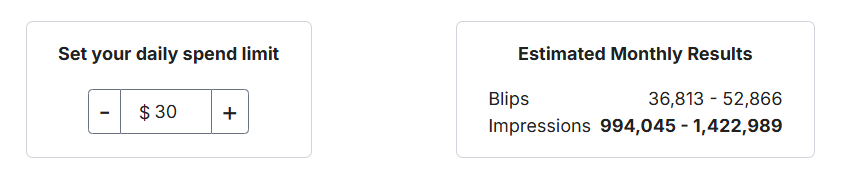
With Blip, billboard advertising in Prescott Valley can fit a wide range of budgets because you only pay when your ad actually appears. Each “blip” is a 7.5-to-10-second display on a rotating digital billboard, starting at just $0.01 per display. Pricing is dynamic, so the cost per blip can change based on time of day, location, and demand, but you stay in control the whole time.
Where can I advertise with Blip in Prescott Valley to reach the most traffic?
State Route 69 is the dominant commercial spine in Prescott Valley, and many segments carry roughly 30,000 to 45,000 vehicles per day. State Route 89A connects Prescott Valley with Prescott, the airport, and the higher-education cluster, and Fain Road ties SR 69 to SR 89A around the Findlay Toyota Center and airport area. These corridors are the most strategic places to reach commuters, shoppers, eventgoers, and visitors.
Is Prescott Valley a good billboard market for Blip if I want to reach local residents?
Prescott Valley works well for billboard advertising because it combines steady local demand with regional draw. The town counted 46,785 residents in 2020, and neighboring Prescott added 45,827, which gives advertisers immediate access to a combined 92,612 people. The four Quad Cities communities totaled 109,660 residents in 2020, so one campaign can reach several towns at once.
When is the best time to run Prescott Valley billboard ads with Blip?
Prescott Valley rewards advertisers who match campaign timing to local behavior, and the market has strong seasonal moments. Spring is a good setup season, summer brings rodeo season and tourism, and back-to-school campaigns should be live before many schools return in late July or early August. Winter also stays active, with holiday shopping, dining, and year-end promotions performing well from November through December.
Do I need a contract to advertise with Blip in Prescott Valley?
No, Blip has no long-term contracts or minimum commitments. You can start, pause, or stop your campaign at any time.
How fast can I launch a billboard campaign with Blip in Prescott Valley?
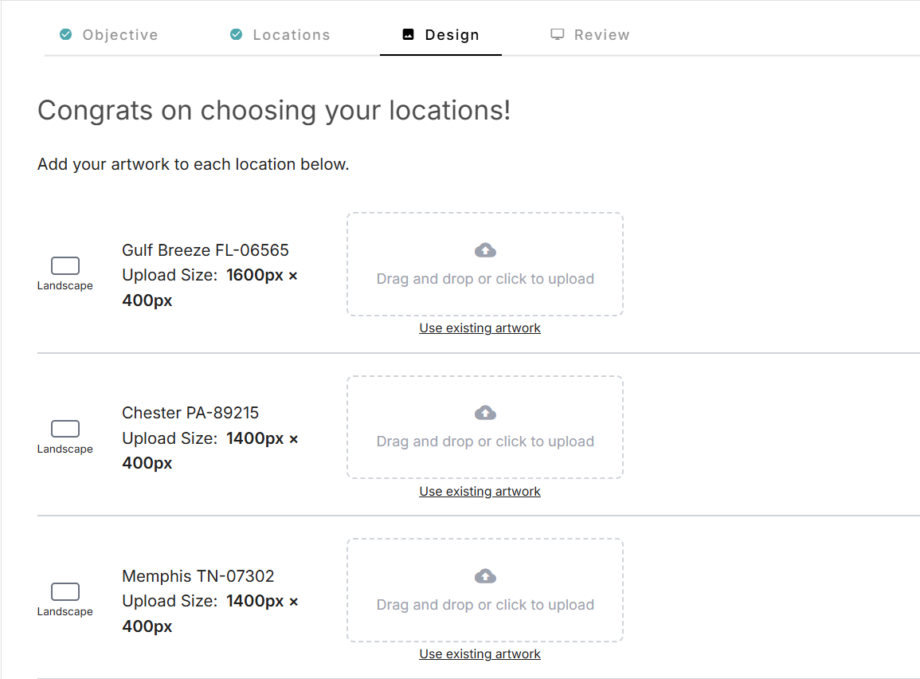
You can have your campaign live in minutes. Create a free account, select your locations, set your budget, upload your design, and start running once approved.
Where can I advertise with Blip in Prescott Valley?
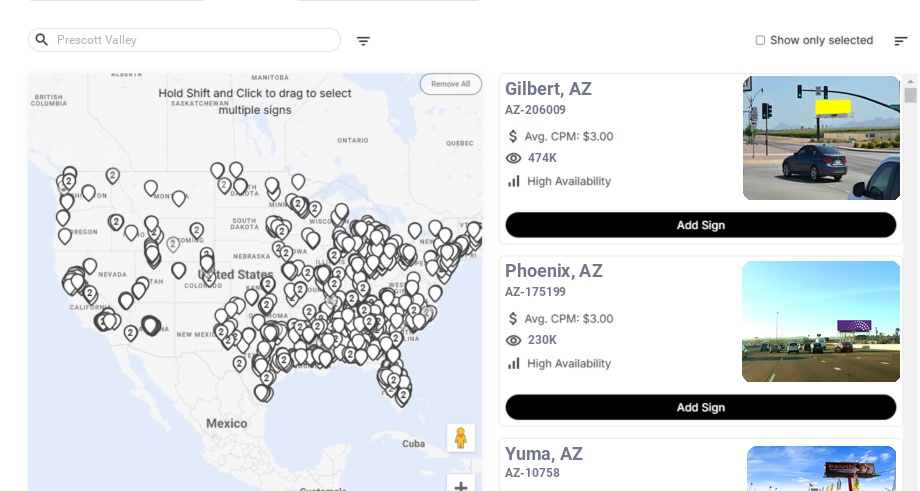
Blip has digital billboards in Prescott Valley. You can browse available locations on a map, choose the ones that fit your audience, and start advertising right away.
Still have questions? Launch a campaign in minutes — no contracts, no commitments.
Start Your CampaignPrescott Valley Billboard Advertising Guide
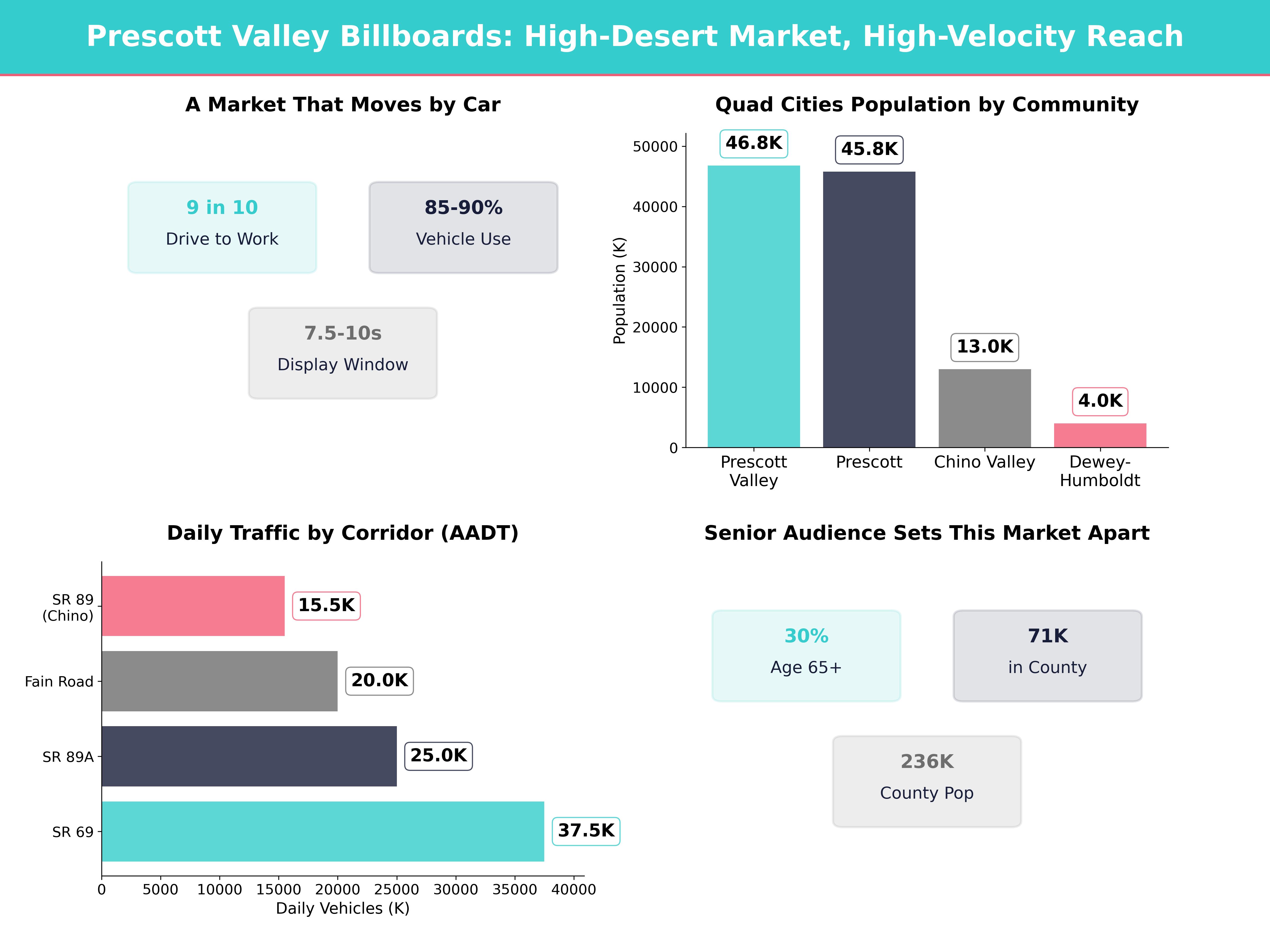
Prescott Valley is a strong billboard market because it sits at the center of Yavapai County’s growing Quad Cities trade area and captures daily movement between Prescott Valley, Prescott, Chino Valley Dewey-Humboldt 46,785 residents in 2020, and neighboring Prescott added 45,827, which gives advertisers immediate access to a combined 92,612 people before we even add the rest of the county or the broader Quad Cities total of 109,660. Travel here is heavily car-based, with roughly 85% to 90% of workers in the area getting to work by private vehicle, so roadside visibility matters. We also benefit from year-round events, arena traffic, outdoor recreation, and weekend visitors who move through a relatively small number of highly visible corridors.
Prescott Valley Market Overview
Prescott Valley works well for billboard advertising because it combines steady local demand with regional draw. We are not relying on one audience. We are reaching local residents, cross-town shoppers, commuters, retirees, students, and visitors moving through the same road network.
Population growth and regional scale in Prescott Valley
Prescott Valley grew from 38,822 residents in 2010 to 46,785 in 2020. That was a strong 20.5% increase in one decade. Prescott grew from 39,843 to 45,827 over the same period, which was roughly 15.0% growth. Chino Valley also expanded from 10,817 to 13,020, another gain of about 20.4%.
Those numbers matter because they show that the broader market is expanding, not standing still. The four Quad Cities communities, Prescott Valley, Prescott, Chino Valley, and Dewey-Humboldt, totaled 109,660 residents in 2020. Yavapai County as a whole reached 236,209 residents in 2020, up from 211,033 in 2010, which was roughly 12% countywide growth.
For advertisers, that means Prescott Valley is bigger than a single-town buy. It is a regional service center. A well-placed campaign can reach shoppers and decision-makers from several towns in one rotation.
Car dependence and daily mobility in Prescott Valley
Prescott Valley is a classic auto-oriented market. Recent survey data for the area typically places drive-alone plus carpool commuting at roughly 9 in 10 workers. Public transit options are limited compared with larger metros, even with services such as Yavapai Regional Transit, so people rely on personal vehicles for work trips, shopping, school runs, healthcare appointments, and entertainment.
That travel pattern makes billboard frequency especially valuable. In a market where the same households use State Route 69, State Route 89A, Fain Road, and local arterials repeatedly, even modest digital billboard schedules can build strong recall.
Economic signals that matter for advertisers in Prescott Valley
Prescott Valley’s economy is broad enough to support many billboard categories. Healthcare, education, public services, retail, construction, home services, and aviation all play visible roles in the area. Institutions such as Dignity Health Yavapai Regional Medical Center Embry-Riddle Aeronautical University, Yavapai College, Humboldt Unified School District, and Prescott Unified School District help keep year-round economic activity steady.
The region also skews older than many Arizona markets. In Yavapai County, about 30% of residents are age 65 or older — roughly 71,000 people — which makes healthcare, financial services, hearing care, mobility products, home improvement, and leisure brands especially relevant. At the same time, growth in Prescott Valley and Chino Valley signals a meaningful family audience that responds to schools, activities, retail, and value-driven services.
Key Traffic Corridors for Prescott Valley Digital Billboards
Prescott Valley travel patterns are concentrated on a few major corridors. That concentration is good news for billboard advertisers, because it lets us reach a high share of the market without needing a huge number of placements.
State Route 69 through Prescott Valley
According to traffic count maps from the Arizona Department of Transportation, State Route 69 is the dominant commercial spine in Prescott Valley. Through town, many segments carry roughly 30,000 to 45,000 vehicles per day, and the busiest central stretches are often above 40,000 AADT.
This is the corridor for broad-reach advertising. It connects the eastern approach from Dewey-Humboldt, the main Prescott Valley retail core, and the westbound route toward Prescott. It is especially effective for the following advertiser types:
- Retail, restaurants, and entertainment brands benefit because SR 69 captures routine shopping and dining trips.
- Healthcare, urgent care, and specialty clinics benefit because patients and caregivers repeatedly use this route for appointments.
- Auto dealers, tire shops, and service providers benefit because drivers are already in a car-centered mindset on the corridor.
- Home services benefit because homeowners along the Quad Cities loop use SR 69 for everyday errands and comparisons.
If we want scale in Prescott Valley, we usually start here.
State Route 89A between Prescott Valley and Prescott
SR 89A is critical because it connects Prescott Valley with Prescott, Prescott Regional Airport, medical services, and the higher-education cluster around Embry-Riddle Aeronautical University. ADOT counts on this route commonly fall in the 20,000 to 30,000 AADT range, depending on the segment.
This corridor is ideal when we want to reach people moving between the suburban growth of Prescott Valley and the employment, education, and tourism destinations to the west. It works especially well for the following advertiser types:
- Colleges, trade schools, and training programs benefit because students, faculty, staff, and families use this connection.
- Airport parking, travel, and hospitality brands benefit because Fain-area travelers pass through this route.
- Downtown Prescott restaurants, attractions, and lodging providers benefit because visitors often approach from the east.
- Professional services and healthcare providers benefit because the corridor connects multiple residential and employment nodes.
Fain Road and the arena-airport access zone
Fain Road is one of Prescott Valley’s most strategic connectors. Depending on the segment, ADOT counts often place it in the 15,000 to 25,000 vehicles per day range. It ties SR 69 to SR 89A and concentrates travel around Findlay Toyota Center
This route is especially useful for event-driven advertisers. Findlay Toyota Center 5,000-seat venue that brings in concertgoers, sports fans, expo attendees, and families throughout the year. Campaigns here can support the following goals:
- Event promotion works well because audiences are time-sensitive and location-aware.
- Hotels, bars, and restaurants benefit because people often make last-minute decisions before or after arena events.
- Automotive, power sports, and outdoor recreation brands benefit because the corridor attracts both local residents and regional visitors.
State Route 89 toward Chino Valley
State Route 89 is the northbound corridor serving Chino Valley 13,000 to 18,000 AADT. That is lower than SR 69, but the traffic is still highly useful because it tends to be purpose-driven.
This corridor is a strong fit for the following advertiser types:
- Agriculture-adjacent and rural services benefit because the audience includes landowners, truck owners, and property-focused households.
- Home improvement, hardware, and building suppliers benefit because Chino Valley growth brings demand for remodeling, fencing, landscaping, and equipment.
- Regional healthcare and retail brands benefit because many north-area residents drive south for services and shopping.
Audience Segments We Can Reach in Prescott Valley
One of Prescott Valley’s biggest strengths is that the same road network reaches several distinct customer groups. We can target by corridor, by timing, and by message without needing separate metro-scale buys.
Prescott Valley commuters and everyday errand traffic
The core audience is the daily driver. Prescott Valley and Prescott alone total 92,612 residents, and the full Quad Cities market reaches 109,660. Because private vehicle commuting dominates local mobility, advertisers can build frequency with repeated impressions on the same commuter paths.
This audience is valuable for the following categories:
- Consumer services such as insurance, dental care, tax preparation, and wireless services perform well because commuters make repeat trips.
- Quick-service restaurants and coffee brands perform well because drive-time decisions are often immediate.
- Retail and grocery-adjacent businesses perform well because SR 69 is the area’s main shopping path.
Families and household decision-makers in Prescott Valley
Prescott Valley’s 20.5% population growth from 2010 to 2020, along with Chino Valley’s 20.4% growth, tells us the region is adding households, not only retirees. Family audiences respond well to school-season offers, youth activities, healthcare, orthodontics, furniture, home improvement, value retail, and weekend entertainment.
Institutions such as Humboldt Unified School District and Prescott Unified School District help shape seasonal routines. School calendars typically restart in late July or early August, which creates reliable windows for family-oriented billboard campaigns.
Retirees and healthcare consumers in Prescott Valley
Yavapai County’s age profile is one of the clearest reasons to advertise here. With about 30% of county residents age 65+ — roughly 71,000 people — the area has a large audience for healthcare, wellness, hearing, vision, orthopedics, financial planning, estate services, and mobility-related products.
This audience is often highly local and highly repeatable. Brands connected to Dignity Health Yavapai Regional Medical Center
Students, cadets, and education audiences around Prescott Valley
Prescott Valley is not only a retirement market. Embry-Riddle Aeronautical University in Prescott enrolls about 3,000 students on its Prescott campus, and Yavapai College adds another important student and workforce-training audience across the region. That creates opportunities for apartments, retail, food service, fitness, entertainment, banking, and telecom brands.
The airport-89A-Fain Road corridor is especially useful here because it touches education, aviation, and commuter travel at the same time.
Tourists, eventgoers, and weekend visitors near Prescott Valley
Tourism matters in this market even though Prescott Valley is not a resort town in the typical Arizona sense. The area benefits from its higher elevation, outdoor access, western heritage, and event calendar. Prescott Valley sits at about 5,100 feet above sea level, which helps make summer feel more comfortable than lower-elevation desert markets.
Nearby draws include Findlay Toyota Center Visit Prescott, Heritage Park Zoological Sanctuary, Mortimer Farms Prescott Frontier Days traces its history to 1888, giving the region a powerful summer tourism and heritage hook, and the World’s Oldest Rodeo typically run in late June and early July.
Seasonal and Timing Opportunities in Prescott Valley
Prescott Valley rewards advertisers who match campaign timing to local behavior. The market does not shut off in any season, but the reasons people are on the road do change throughout the year.
Spring campaign windows in Prescott Valley
Spring is a strong setup season. Weather improves, local event calendars fill out, and households start planning projects and travel. This is a good time for home services, landscaping, roofing, real estate, garden centers, and healthcare screenings.
Prescott Valley’s community calendar also becomes more active in spring, including town events and business promotions from the Prescott Valley Chamber of Commerce and Prescott Chamber of Commerce. We can use short bursts around event weekends to gain efficient reach.
Summer tourism and event timing in Prescott Valley
Summer is one of the most distinctive advertising seasons here. Average July highs are around 90°F, which is warm but much milder than lower-elevation Arizona cities. That creates an opening for hospitality, dining, entertainment, and outdoor brands targeting weekend visitors.
The biggest seasonal window is rodeo season. Prescott Frontier Days and the World’s Oldest Rodeo typically run in late June and early July, and they bring strong visitation to the greater Prescott area. Summer is also active at Findlay Toyota Center
Monsoon season usually runs from July through September, which creates timely opportunities for:
- Roofing, restoration, and home repair brands that can speak to storm-readiness.
- Tire, auto service, and windshield repair brands that can connect with wet-road concerns.
- Urgent care and healthcare providers that can stay visible during busy summer movement.
Back-to-school and fall opportunities in Prescott Valley
The back-to-school period starts earlier here than some advertisers expect. Many local schools return in late July or early August, so August campaigns should already be live before classes begin. This is an ideal season for family restaurants, youth activities, tutoring, orthodontics, apparel, electronics, and vehicle services.
Fall is also strong for destination and agritourism messaging. Mortimer Farms Yavapai County Fair
Holiday and winter timing in Prescott Valley
Winter in Prescott Valley is cooler but still active. Average January highs are around 52°F, and the area can see occasional snow, which changes driving behavior and sharpens the value of practical messaging. Holiday shopping, dining, gift cards, healthcare enrollment, automotive services, and year-end promotions all perform well from November through December.
Prescott’s holiday tourism also supports regional traffic. Visit Prescott promotes a strong winter event calendar, which gives nearby advertisers a chance to capture both locals and visitors making seasonal trips.
Billboard Design Tips for Prescott Valley Campaigns
Prescott Valley creative should look and sound like the high-country market it is. We should not design for Phoenix and assume it transfers.
Use high-country Arizona imagery, not low-desert clichés
Prescott Valley does not read like the Sonoran Desert. Locals identify more with pines, granite, lakes, open skies, trails, western heritage, and mountain silhouettes than with giant saguaro clichés. Creative that feels visually local usually performs better.
The strongest visual cues often include:
- Granite, forest green, navy, and copper tones, because they fit the landscape and still create strong digital contrast.
- Outdoor, rodeo, or arena-adjacent imagery, because the region’s identity is practical, active, and community-oriented.
- Clean directional references, such as SR 69, Glassford Hill Road, Prescott Valley, Prescott, or “minutes away,” when the board location supports it.
Match the message to Prescott Valley’s mixed-age audience
A campaign aimed at retirees should not look like a campaign aimed at arena-goers or college students. In a market with a meaningful 65+ population and a growing family base, we should segment creative whenever possible.
For example, the following approaches often fit well:
- Healthcare and professional services should use larger type, simpler offers, and strong trust signals such as years in business, same-day availability, or local reputation.
- Family brands should emphasize value, convenience, and timing, such as after-school, weekend, or back-to-school relevance.
- Tourism and entertainment brands should lead with immediacy, such as tonight, this weekend, or next exit.
Design for distance, speed, and weather in Prescott Valley
Prescott Valley drivers often see ads on open stretches with bright sun, sudden cloud cover, or monsoon rain. That means contrast matters more than clever complexity. We should keep copy short, use one idea per board, and make the call to action obvious.
Creative that works well here usually does three things:
- It gives the audience a reason to care within 1 to 2 seconds.
- It names the offer or destination clearly.
- It uses local context, such as “off SR 69,” “near Findlay Toyota Center,” or “serving Prescott Valley and Prescott.”
Regional Strategies Across Prescott Valley and the Quad Cities
The best Prescott Valley campaigns usually think regionally. The market is compact enough that one message can travel, but different sub-areas still behave differently.
Central Prescott Valley strategy
The central Prescott Valley retail and event core is the broadest-reach zone. This is where we prioritize SR 69, the Findlay Toyota Center
If the goal is overall awareness, this is usually our first move.
Prescott strategy from the eastbound and westbound corridors
Prescott has a different feel than Prescott Valley. It is more historic, more tourism-centered, and more institution-heavy. Boards along SR 89A are useful when we want to speak to downtown visitors, Embry-Riddle Aeronautical University, Yavapai College, airport users, or medical audiences moving west.
This is a strong zone for hospitality, attractions, dining, arts, education, and destination retail.
Chino Valley strategy for northern growth
Chino Valley is smaller, but it is growing and has a more rural-residential consumer profile. We often use northbound approaches when the advertiser serves property owners, families, land buyers, agricultural users, contractors, or shoppers who travel south for larger purchases.
Because Chino Valley reached 13,020 residents in 2020, it is no longer a negligible fringe market. It is a meaningful extension of the Quad Cities audience.
Dewey-Humboldt and Phoenix-route strategy
Dewey-Humboldt may have only 4,028 residents on its own, but its location makes it more important than that number suggests. The eastern SR 69 approach captures Phoenix-bound and Phoenix-origin traffic, as well as local movement tied to Dewey, Cordes Junction, and rural Yavapai County.
This zone works especially well for fuel, food, lodging, travel stops, attractions, auto services, and any advertiser trying to intercept weekend or seasonal traffic before it reaches the main Prescott Valley retail core.
Using Blip Tools in Prescott Valley
Blip is especially useful in Prescott Valley because the market has clear timing patterns and concentrated traffic routes. We can use that structure to advertise more precisely.
Dayparting for Prescott Valley commuting and events
We usually get the most strategic control by aligning campaigns with how people actually move through town. Morning commuting often concentrates between about 6:00 a.m. and 9:00 a.m., and afternoon traffic often builds from about 3:00 p.m. to 7:00 p.m. Event nights around Findlay Toyota Center
That means we can do the following:
- We can weight budgets toward morning and evening drive windows for commuter-heavy categories.
- We can add concentrated flighting 60 to 90 minutes before arena events for dining, entertainment, and retail.
- We can shift more delivery to Thursday through Sunday when tourism and leisure traffic rise.
Flexible budgeting for Prescott Valley seasons
Because Prescott Valley has clear seasonal moments, we do not need to buy the same way every month. We can stay always-on at a modest level, then increase spend around rodeo week, fall festivals, school start, holiday shopping, or a major local sale.
That flexibility matters in a market where a short campaign tied to the right event can outperform a generic full-month schedule. Even advertisers with small budgets can test corridor differences because digital displays start at $0.01 per play and run in short 7.5- to 10-second blips.
Real-time analytics and creative testing in Prescott Valley
Prescott Valley is a good market for message testing because audiences are distinct enough to compare. We can run one creative version focused on healthcare trust along commuter routes, and another focused on immediacy or nightlife near the arena zone. Then we can watch results and reallocate.
Blip’s artwork tools also make local adaptation easier. We can create one base design, then swap headlines for Prescott, Prescott Valley, or the Quad Cities without rebuilding the entire campaign.
Getting Started with Billboard Rental in Prescott Valley
Renting a billboard in Prescott Valley is simpler when we start with the travel pattern, not the map alone. We want to know who we are trying to reach, when they are on the road, and what action we want them to take next.
How to evaluate Prescott Valley billboard locations
We usually assess locations by five practical questions:
- How much traffic does the corridor carry? Traffic volume helps us estimate reach, especially on SR 69 and SR 89A.
- Who is on that road? A commuter route, an arena approach, and a Phoenix-bound travel corridor do not deliver the same audience.
- What decision can the driver make next? The best locations often sit before a turn, an exit, a shopping node, or an event destination.
- How fast is the environment? Slower, signalized retail corridors often support more detailed messaging than faster open-road segments.
- Does the board match the advertiser’s geography? A Prescott Valley clinic, a Prescott hotel, and a Chino Valley builder may each need a different directional strategy.
What to expect when renting a billboard in Prescott Valley
Traditional billboard buying often involves fixed periods, rep negotiations, and longer commitments. In a smaller regional market like Prescott Valley, that can lead advertisers to overbuy or accept placements that are not tightly aligned with their goals.
A self-serve digital approach is easier because we can start with the locations that matter, set a daily budget, and adjust based on actual performance. In many cases, 2 to 4 carefully chosen digital boards are enough to generate strong repetition in the Quad Cities trade area.
How Blip simplifies Prescott Valley billboard campaigns
Blip makes Prescott Valley campaigns more manageable because we can launch quickly, test messages, and make location decisions based on audience logic instead of packaged inventory. We can start with a commute-focused SR 69 plan, add 89A for Prescott reach, or layer in event-driven inventory around Findlay Toyota Center
If we are just getting started, a practical approach is to choose one primary corridor, one secondary corridor, and one clear objective. Then we monitor results after the first 7 to 10 days, refine the creative, and expand only where the local travel patterns support it. In a market as concentrated and car-driven as Prescott Valley, that disciplined approach often goes a long way.