Billboards in Cave Creek, AZ
No Minimum Spend. No Long-Term Contracts. Just Results.
Trusted by Leading Brands


Billboard advertising
in Cave Creek has never been easier
How much is a billboard in Cave Creek?
Why Choose Blip for Billboard Advertising in Cave Creek
Blip lets you launch Cave Creek ads fast, so you can catch Loop 101 and I-17 commuters heading into the north Valley.
Set flexible budgets in Cave Creek and only pay when your ad runs—ideal for testing seasonally busy winter and spring traffic.
Use dayparting on Blip to reach Cave Creek hikers, diners, and weekend visitors when they’re actually on Scottsdale and Cave Creek roads.
No contracts means Cave Creek brands can pause or pivot as heat, rodeos, and event crowds shift.
Real-time analytics help you see what works in Cave Creek, from Carefree Highway drivers to Scottsdale and Phoenix destination traffic.
Blip's creative tools make it easy to tailor Cave Creek billboards with desert visuals, patio vibes, and clear route-to-visit messaging.
Frequently Asked Questions About Billboard Advertising in Cave Creek
How much does a billboard cost in Cave Creek with Blip?
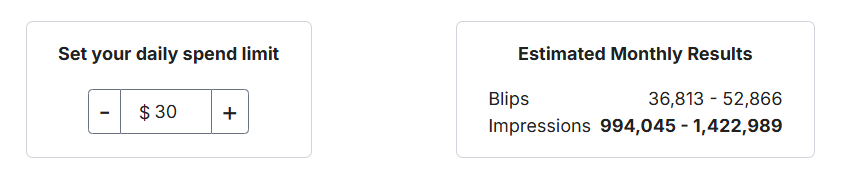
With Blip, billboard advertising in Cave Creek can fit a wide range of budgets because you only pay when your ad actually appears. Each “blip” is a 7.5-to-10-second display on a rotating digital billboard, starting at just $0.01 per display. You set a daily budget, and Blip’s algorithm uses it to bid for open ad slots, helping maximize your reach based on time of day, location, and advertiser demand.
Where can I advertise with Blip in Cave Creek to reach the most drivers?
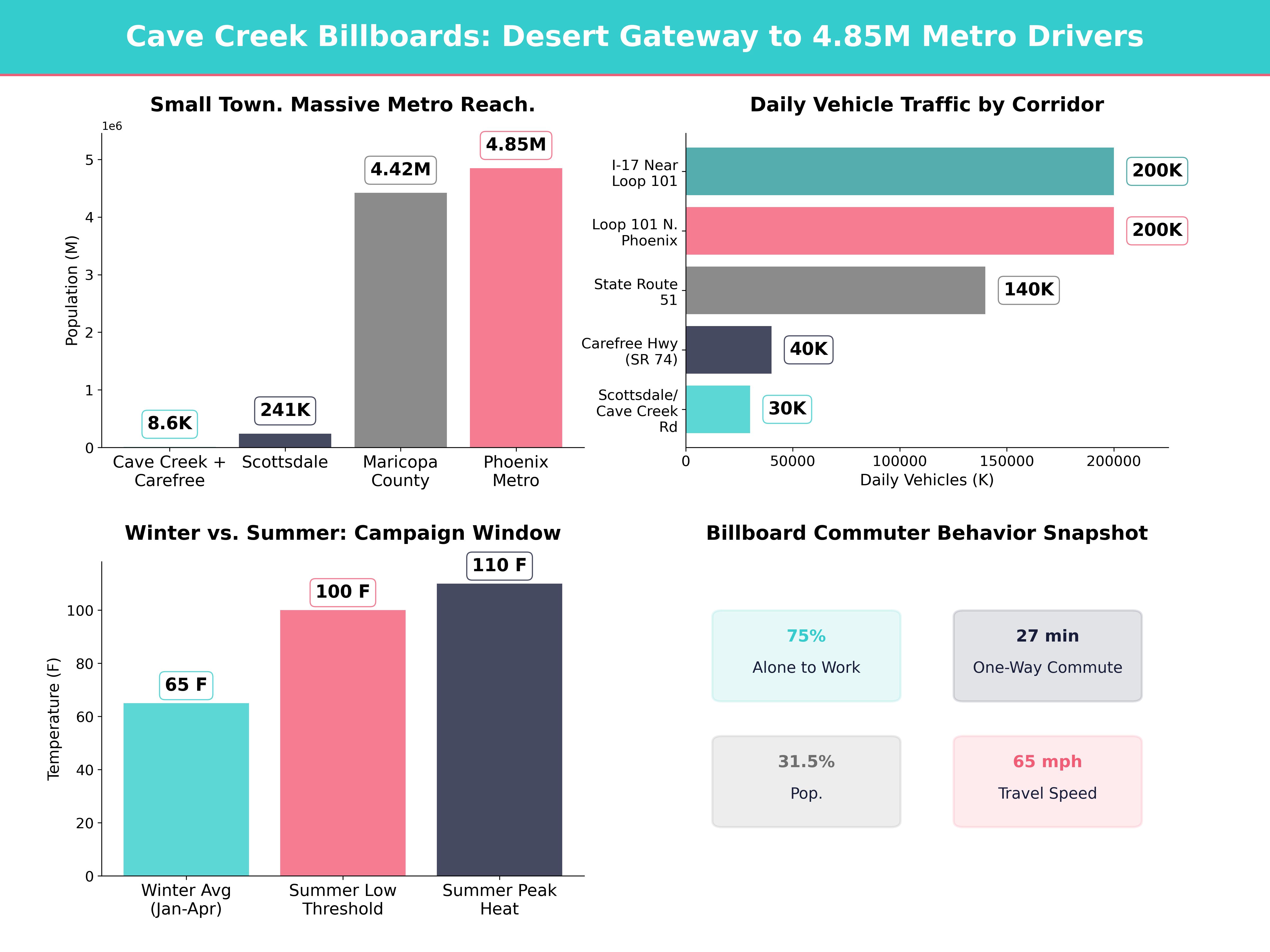
Cave Creek’s billboard value comes from a handful of north Valley corridors that move very different types of audiences. Loop 101 through north Phoenix and north Scottsdale is a 180,000 to 220,000+ vehicles-per-day environment on many of its busiest segments, while I-17 near Loop 101 commonly carries 180,000 to 220,000 vehicles per day. Scottsdale Road and Cave Creek Road also often land in the 20,000 to 40,000 vehicles-per-day range, depending on location.
Is Cave Creek a good billboard market for Blip if my customers are in Scottsdale and Phoenix?
Cave Creek gives us a rare billboard market: a small town of 4,892 residents with a brand identity far bigger than its population, positioned inside the northern edge of the 4,420,568-person Maricopa County economy. We are also reaching drivers, shoppers, recreation seekers, and winter visitors moving between Cave Creek, Carefree, Scottsdale, and Phoenix. Because the north Valley is strongly car-dependent, digital billboards can deliver both local relevance and regional scale.
When is the best time to run Cave Creek billboards with Blip?
Cave Creek shines from roughly January through April. Daytime highs are often in the 60s and 70s during winter, patios fill up, hiking volume climbs, and visitors are active across the north Valley. March and April remain strong as the Cactus League schedule, Cave Creek Rodeo Days, and Arizona Bike Week bring more event traffic.
What kind of audience can I reach with Cave Creek billboards?
Cave Creek is not a dense urban walking market, it is a driving market. Across the Phoenix metro, about 75% of workers commute by driving alone, and Cave Creek billboards can build repetition quickly for residents of Cave Creek, Carefree, north Scottsdale, Phoenix, and communities along I-17. The market also reaches visitors, outdoor travelers, winter tourists, families, and event-driven audiences.
Do I need a contract to advertise with Blip in Cave Creek?
No, Blip has no long-term contracts or minimum commitments. You can start, pause, or stop your campaign at any time.
How fast can I launch a billboard campaign with Blip in Cave Creek?
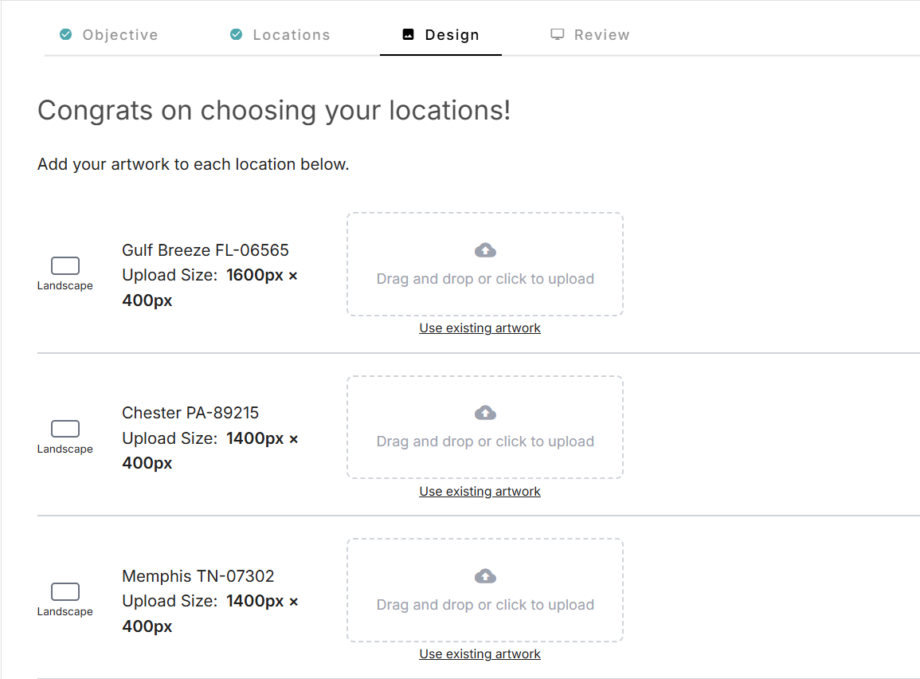
You can have your campaign live in minutes. Create a free account, select your locations, set your budget, upload your design, and start running once approved.
Where can I advertise with Blip in Cave Creek?
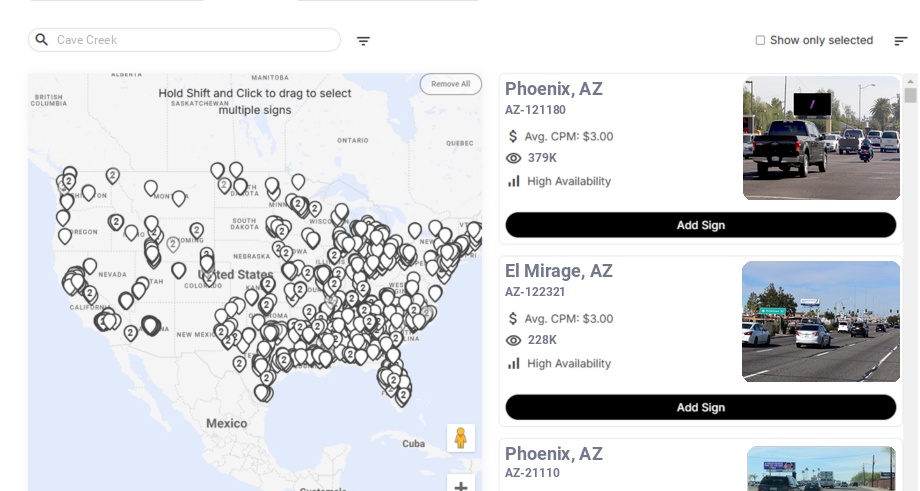
Blip has digital billboards in Cave Creek. You can browse available locations on a map, choose the ones that fit your audience, and start advertising right away.
Still have questions? Launch a campaign in minutes — no contracts, no commitments.
Start Your CampaignCave Creek Billboard Advertising Guide
Cave Creek 4,892 residents with a brand identity far bigger than its population, positioned inside the northern edge of the 4,420,568-person Maricopa County economy. We are not only speaking to local residents here. We are also reaching drivers, shoppers, recreation seekers, and winter visitors moving between Cave Creek Carefree, Scottsdale, and Phoenix. Because the north Valley is strongly car-dependent, with major routes in this market carrying roughly 20,000 to 220,000+ vehicles per day depending on the corridor, and Cave Creek is a destination for western dining, equestrian culture, hiking, and events, digital billboards can deliver both local relevance and regional scale. That combination makes Cave Creek especially effective for advertisers that want to build awareness, drive visits, and stay flexible with timing.
Market Overview for Cave Creek
Cave Creek is small, but its trade area is large
When we advertise in Cave Creek, we are really tapping into a broader north Valley trade area rather than relying on town population alone. Cave Creek 4,892 residents in 2020, and neighboring Carefree had 3,690, but those two communities sit within a metro that reaches nearly 4.85 million people in the Phoenix-Mesa-Chandler area. Scottsdale alone had 241,361 residents in 2020, and Phoenix had 1,608,139.
The growth story is even more important than the raw town count. Between 2010 and 2020, Maricopa County added 604,451 residents, which was about 15.8% growth. The broader Phoenix metro added 652,945 residents over the same decade, growing from about 4.19 million to 4.85 million people, which was about 15.6% growth. Cave Creek itself was essentially flat over that period, slipping by 123 residents, or about 2.5%, but the surrounding consumer base expanded sharply.
For billboard advertisers, that means we should think in layers. Cave Creek gives us a distinctive local identity, while the north Scottsdale, north Phoenix, Anthem
Demographics and travel behavior matter in Cave Creek
Cave Creek is not a dense urban walking market. It is a driving market. Across the Phoenix metro, about 75% of workers commute by driving alone, and average one-way commute times are roughly 27 minutes, according to commonly used regional planning data from the Maricopa Association of Governments Valley Metro
The north Valley also includes a strong mix of homeowners, retirees, professionals, and service-based households. Cave Creek and Carefree skew older than Arizona overall, which helps categories like healthcare, financial services, home improvement, dining, real estate, and recreation. At the same time, the wider county is diverse. Maricopa County is roughly 31.5% Hispanic or Latino, so bilingual or Spanish-language creative can be especially useful when we want to reach regional commuters rather than only local destination traffic.
The Cave Creek economy benefits from both tourism and metro spending
Cave Creek’s local identity is built around western culture, outdoor recreation, dining, and events, but the area also benefits from the much larger north Valley economy. Nearby employment and spending drivers include Mayo Clinic, HonorHealth, north Scottsdale retail, residential development, and year-round visitor traffic in a metro of nearly 4.85 million people promoted by Experience Scottsdale, Visit Phoenix, and the Arizona Office of Tourism
That is why Cave Creek billboards work well for more than cowboy bars and trail rides. We can also use them for elective healthcare, legal services, luxury home services, golf-adjacent retail, resorts, event marketing, destination dining, and regional consumer brands that want to borrow Cave Creek’s memorable personality.
Key Traffic Corridors for Cave Creek Billboards
Cave Creek’s billboard value comes from a handful of north Valley corridors that move very different types of audiences. When we match the corridor to the goal, we get much stronger performance.
Loop 101 Pima Freeway near Cave Creek and North Scottsdale
According to traffic patterns tracked by the Arizona Department of Transportation and regional planners, the Loop 101 corridor through north Phoenix and north Scottsdale is a 180,000 to 220,000+ vehicles-per-day environment on many of its busiest segments. Near major interchanges, some stretches exceed 200,000 AADT.
This corridor matters even though it is south of Cave Creek proper. Many people who dine, shop, recreate, or book services in Cave Creek approach from Scottsdale or Phoenix via Loop 101 and then connect north on Scottsdale Road, Tatum Boulevard, or Cave Creek Road.
This is a strong corridor for several advertiser types.
- Retail, dining, and entertainment brands can use Loop 101 placements to intercept shoppers headed toward Scottsdale Quarter Kierland Commons, Desert Ridge Marketplace
- Healthcare and professional services can benefit because the route ties together dense residential areas and medical nodes near Mayo Clinic and HonorHealth.
- Event marketers and tourism businesses can build awareness before drivers make their final route choice toward Cave Creek, Carefree, or north Scottsdale.
Interstate 17 and Carefree Highway for north Valley regional reach
I-17 is one of the most important approach routes into the north Valley. North Phoenix segments near Loop 101 commonly carry 180,000 to 220,000 vehicles per day, making it a high-frequency corridor for regional awareness. When we pair I-17 with State Route 74, also known as Carefree Highway, we reach east-west traffic flowing toward Anthem
Carefree Highway is not as large as the freeways, but it is still meaningful. Key segments near I-17 often exceed 40,000 vehicles per day, and that traffic includes commuters, contractors, delivery drivers, service technicians, recreation travelers, and weekend visitors.
This corridor is especially useful for the following groups.
- Home services, automotive, legal, and healthcare brands benefit because they often serve wide trade areas and need broad household reach.
- Outdoor recreation, events, and hospitality brands benefit because SR 74 captures people moving toward parks, trailheads, golf, and second-home communities.
- Regional restaurants and destination retailers benefit because they can redirect weekend drivers before those drivers settle into a local destination.
State Route 51 for east-side access into the Cave Creek market
State Route 51 is another important feeder into the north Valley. Near its northern end, traffic often approaches 130,000 to 150,000 vehicles per day, depending on the segment and year. It is a particularly useful route for advertisers that want to connect Paradise Valley, northeast Phoenix, north Scottsdale, and Cave Creek-area destinations.
We should think of SR 51 as a quality-access corridor rather than only a quantity corridor. Drivers on this route are often heading toward medical, office, retail, and higher-income residential areas, so it can work especially well for healthcare specialists, financial services, real estate, education, and premium lifestyle brands.
Scottsdale Road, Cave Creek Road, and local arterial routes
Once drivers leave the freeway network, the market becomes more targeted. Major arterial segments on Scottsdale Road and Cave Creek Road often land in the 20,000 to 40,000 vehicles-per-day range, depending on location. That is less about raw scale and more about intent.
These roads are valuable because they help us reach people who are actually entering the Cave Creek trade area, not just passing through the metro.
- Restaurants, boutiques, galleries, and nightlife venues can use these routes to capture near-term visitation.
- Local healthcare clinics, dentists, and urgent care centers can use these boards to stay visible in decision windows close to destination.
- Real estate agents, builders, and home service providers can benefit because these roads touch established neighborhoods as well as growth areas.
Audience Segments We Can Reach in Cave Creek
North Valley commuters and everyday drivers
The first audience is the daily commuter. With about 75% of metro workers driving alone and long north Valley travel patterns shaped by freeways and arterials, Cave Creek billboards can build repetition quickly. These drivers include residents of Cave Creek Carefree, north Scottsdale, Phoenix, and communities along I-17.
For these audiences, categories like banking, healthcare, home services, insurance, automotive, legal, and everyday retail tend to perform well because they align with recurring local needs.
Visitors, outdoor travelers, and winter tourists in Cave Creek
Cave Creek is also a destination market. Cave Creek Regional Park covers 2,922 acres, and Spur Cross Ranch Conservation Area adds another 2,154 acres of recreation-focused draw. Just beyond town, the 2.9 million-acre Tonto National Forest expands the area’s outdoor appeal even further.
That outdoor identity brings in hikers, bikers, horseback riders, jeep-tour customers, and day-trippers, especially when weather is mild. We can speak to them with boards promoting restaurants, western wear, lodging, guided tours, events, and experience-led retail.
Event-driven audiences from Scottsdale to Cave Creek
The north Valley’s event calendar creates another strong audience segment. WestWorld of Scottsdale is a 386-acre event campus that pulls in equestrian, collector-car, festival, and motorcycle audiences throughout the year. Major annual demand generators nearby include Barrett-Jackson WM Phoenix Open in February, the Cactus League spring training season with 15 Major League Baseball teams each year, Cave Creek Rodeo Days as a 3-day March event, and Arizona Bike Week
That gives us repeated opportunities to reach visitors who already expect to spend on entertainment, food, nightlife, apparel, and experiences.
Families, students, and local service buyers
Even though Cave Creek has a strong adult and retiree profile, families remain important. Scottsdale Unified School District serves more than 20,000 students, and Cave Creek Unified School District serves roughly 5,000. Those households create steady demand for tutoring, orthodontics, youth sports, restaurants, grocery, urgent care, family entertainment, and back-to-school retail.
For local service advertisers, this is useful because the family audience is not seasonal. It is present all year, even when tourism fluctuates.
Seasonal and Timing Opportunities in Cave Creek
Winter and spring are peak Cave Creek billboard seasons
Cave Creek shines from roughly January through April. Daytime highs are often in the 60s and 70s during winter, patios fill up, hiking volume climbs, and visitors are active across the north Valley. This is the best stretch for restaurants, boutiques, western experiences, galleries, events, golf-related brands, healthcare specialists, and premium home services.
January and February are especially valuable because north Scottsdale and the Cave Creek area benefit from event spillover. Barrett-Jackson WM Phoenix Open, and the winter tourism season promoted by Visit Phoenix and Experience Scottsdale all push more affluent, experience-seeking visitors into the area.
March and April remain strong. The Valley’s Cactus League schedule brings baseball travelers, Cave Creek Rodeo Days adds a distinctly local western crowd, and Arizona Bike Week WestWorld of Scottsdale.
Summer in Cave Creek requires a different message, not silence
From June through September, daytime temperatures in the north Valley routinely exceed 100°F, and some stretches push well above 110°F. That changes how people spend, but it does not eliminate demand. It shifts demand toward indoor dining, air-conditioned entertainment, medical services, home improvement, pools, HVAC, hydration products, and local convenience purchases.
Summer boards in Cave Creek work best when we acknowledge the season directly. Heat-aware offers, indoor comfort messaging, and short-distance convenience claims usually outperform generic brand awareness during the hottest weeks.
Fall brings outdoor activity and local spending back
By October and November, the market becomes highly active again. Outdoor dining, events, hiking, and shopping return, and households begin holiday planning. This is a strong window for retailers, restaurants, arts and crafts events, medical providers, luxury gifting, nonprofits, and home-focused businesses.
School calendars help us sharpen timing too. Both Scottsdale Unified School District and Cave Creek Unified School District typically begin classes in late July or early August, so family-oriented campaigns often benefit from a back-to-school flight in July and August, then another burst around holiday programs and year-end activities in November and December.
Billboard Design Tips for the Cave Creek Market
In Cave Creek, creative should reflect place, not just product
Cave Creek has a genuine identity, and our boards perform better when they respect it. Generic suburban creative can feel out of place here. Imagery tied to Sonoran Desert terrain, horses, boots, trails, patios, mountain silhouettes, and rustic architecture tends to feel more natural for destination and lifestyle brands.
That does not mean every ad needs a cowboy hat. It means we should use visual cues that feel locally believable. A polished medical ad can still fit Cave Creek if it feels calm, premium, and desert-aware. A restaurant ad can feel stronger if it suggests patio weather, western atmosphere, or a clear route from Scottsdale or Carefree.
Desert visibility matters in the Cave Creek area
The local light is intense for much of the year, with roughly 299 sunny days per year in the Phoenix area, so high-contrast design is essential. Clean typography, bold color separation, and one dominant visual usually work better than busy layouts. Earth tones, turquoise accents, sunset oranges, deep blacks, and bright whites often read well against desert surroundings.
Speed matters too. On freeways like Loop 101 and I-17, where traffic commonly moves at 65 mph, we should keep copy exceptionally short. On arterial roads that often run around 45 mph, we can support slightly more directional messaging, especially when the goal is a near-term visit.
Cave Creek audiences respond well to authenticity and specificity
Cave Creek is a place where specific offers often beat abstract branding. “Live music tonight in Cave Creek,” “Trail rides 10 minutes ahead,” or “North Scottsdale urgent care open late” tends to feel more useful than a vague slogan.
Specificity also helps with the market’s older, homeowner-heavy audience. Clear offers, appointment prompts, local directions, and tangible benefits resonate well for healthcare, home services, financial planning, and real estate.
Bilingual and variant creative can expand reach
Because Maricopa County is about 31.5% Hispanic or Latino, we should not assume that a single English-only execution is always the best option for broad regional reach. If we are targeting freeway commuters from across the Valley, bilingual variants or Spanish-language versions can improve relevance. If we are targeting downtown Cave Creek visitors specifically, an English-first western lifestyle approach may be more appropriate.
Regional Strategies Across the Cave Creek Market
Historic Cave Creek and Carefree for destination intent
The core Cave Creek Carefree area, with just 8,582 residents combined, is best for businesses that need a visit soon after exposure. Restaurants, bars, galleries, boutiques, spas, event venues, western outfitters, and tourism operators benefit most here. We should use creative with place names, directional cues, and immediate reasons to stop.
North Scottsdale for affluent households and event traffic
The Scottsdale side of the market is ideal for upscale retail, elective healthcare, home design, luxury services, and event-driven campaigns. Boards around the Loop 101 belt can also capture traffic flowing to WestWorld of Scottsdale, Scottsdale Quarter Kierland Commons, and Mayo-area medical destinations.
I-17, Anthem, and Carefree Highway for broad regional services
The western side of the trade area, especially along I-17 and Carefree Highway, is excellent for advertisers with larger service radii. Home services, auto repair, personal injury law, hospitals, colleges, storage, and family entertainment fit well because the corridor reaches households spread across north Phoenix and beyond.
North Phoenix healthcare and retail nodes for everyday demand
The southeast edge of the Cave Creek market overlaps with important north Phoenix demand centers. Desert Ridge Marketplace Mayo Clinic, HonorHealth, and nearby residential neighborhoods create strong everyday traffic. We should treat this zone as a practical service market rather than a purely tourist market.
Using Blip Tools Effectively in Cave Creek
We should daypart around actual Cave Creek travel patterns
In Cave Creek, timing matters almost as much as location. Morning windows around 6 a.m. to 9 a.m. are strong for commuter categories. Midday and afternoon windows can work well for restaurants, healthcare, retail, and local services. Weekend blocks from about 10 a.m. to 4 p.m. are often especially relevant for destination traffic heading to Cave Creek, Carefree, parks, and north Scottsdale events.
We can test multiple Cave Creek strategies without overcommitting
Because Cave Creek includes both local-destination traffic and major regional approach routes, we often learn the most by testing more than one zone. We might compare 2 to 4 boards across Loop 101, I-17, and local arterials, then shift budget toward the best performer. That is much harder to do with traditional static contracts than with a flexible digital platform.
Creative changes should follow the season in Cave Creek
Cave Creek is a great market for rotating creative. We can swap winter patio messaging for summer indoor messaging, promote rodeo and bike-week specials during event windows, or shift from tourism creative to family-service creative around school starts. Real-time analytics also help us see whether a Cave Creek-focused message is outperforming a broader north Scottsdale version.
Getting Started with Billboard Rental in Cave Creek
We should start with the goal before we choose the Cave Creek board
The best Cave Creek billboard is not always the closest one to downtown. If our goal is broad awareness, freeway boards on Loop 101 or I-17 may outperform a tighter local placement. If our goal is immediate visits, boards on Scottsdale Road, Cave Creek Road, or Carefree Highway are usually more useful.
A simple way to begin is to define the campaign in one of three lanes.
- Awareness campaigns should prioritize the highest-volume approach corridors.
- Visit-driven campaigns should prioritize local arterials and directional relevance.
- Event or seasonal campaigns should prioritize the routes most connected to the event audience and the dates that matter most.
Renting a billboard in Cave Creek does not need to feel like traditional media buying
Traditional billboard buying often requires long conversations, fixed packages, and larger commitments than many local advertisers want. A self-serve digital approach is better suited to a market like Cave Creek because demand changes with weather, tourism, and events. We can launch quickly, adjust quickly, and stop when the timing no longer makes sense.
That flexibility is especially valuable in Cave Creek because seasonal swings are real. A board strategy that is perfect in February may need a very different message in July.
We should evaluate Cave Creek locations with a local lens
When we compare billboard options, we should look at more than traffic count alone. We should consider route direction, destination proximity, likely audience intent, daypart behavior, and whether the board sits in a commuter flow or a leisure flow. We should also think about whether the creative matches the board’s context. A luxury medical message may be better on a Scottsdale commuter route, while a western dining message may be stronger on a Cave Creek destination route.
For many advertisers, the smartest way to start is with a focused first flight, a few distinct locations, and a clear success metric such as awareness, website traffic, event attendance, or store visits. From there, we can let performance guide expansion across the wider Cave Creek and north Valley market.