Billboards in Arizona City, AZ
No Minimum Spend. No Long-Term Contracts. Just Results.
Trusted by Leading Brands


Billboard advertising
in Arizona City has never been easier
How much is a billboard in Arizona City?
Why Choose Blip for Billboard Advertising in Arizona City
Blip lets you self-serve Arizona City billboard ads in minutes, reaching I-10 Exit 200 commuters and Phoenix-Tucson travelers without sales delays.
Set flexible budgets in Arizona City and let Blip auto-pick billboards and timing to reach commuter-heavy I-10 traffic and Casa Grande shoppers.
No contracts in Arizona City mean you can test ads for winter travelers, then pause or shift spend as monsoon or weekend traffic changes.
Use Blip dayparting in Arizona City to hit 6-9 a.m. commuters and 3-7 p.m. return traffic along the I-10 corridor.
Track Arizona City performance in real time and optimize for local households, freight drivers, and Picacho-bound visitors as results come in.
Blip's creative tools help Arizona City ads stay bold and simple for 75 mph freeway views on I-10 and SR 84.
Frequently Asked Questions About Billboard Advertising in Arizona City
How much does a billboard cost in Arizona City with Blip?
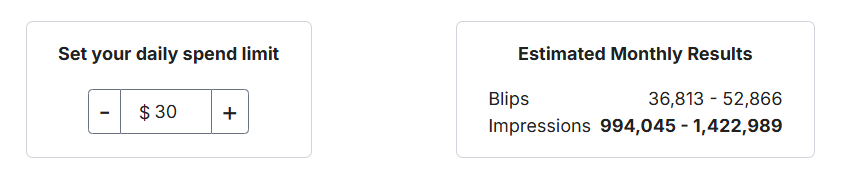
Blip only charges when your ad actually appears as a 7.5-to-10-second “blip” on a rotating digital billboard, starting at just $0.01 per display. Pricing is dynamic, so the cost per blip can change based on time of day, location, and advertiser demand, while Blip’s algorithm works to get the most reach from your budget. Since your total cost is simply the sum of each blip over time, it’s an easy, accessible way to try billboard advertising in Arizona City without overspending.
Where can I advertise with Blip in Arizona City along I-10?
Arizona City lies along the I-10 corridor between Phoenix and Tucson, with nearby segments commonly carrying 60,000 to 75,000 AADT. Arizona City sits at Exit 200 on Sunland Gin Road, which gives us a clear decision zone where drivers choose whether to stop for fuel, food, services, or retail. Northbound boards are especially useful when we want to catch drivers heading toward Phoenix, and southbound boards are strong for Tucson-bound traffic, weekend leisure trips, and returning freight drivers.
Why is Arizona City a good billboard market for Blip?
Arizona City gives us a billboard market that is much stronger than its small-town image suggests. The community itself has about 10,000 residents, but it sits in Pinal County, which reached 425,264 residents in 2020 and grew 13.2% from 2010 to 2020. In a county where roughly 80% of workers drive alone and average commutes are about 32 minutes, digital billboards can build repeated visibility quickly.
What kinds of businesses should advertise in Arizona City with Blip?
Arizona City’s strength comes from layered audiences, and we are not limited to one narrow demographic. We can run local service campaigns for HVAC, plumbing, pest control, roofing, dental, and urgent care, along with regional retail campaigns that pull shoppers toward Casa Grande. We can also run traveler-focused campaigns aimed at food, gas, lodging, roadside attractions, and convenience stops.
When is the best time to run billboard ads in Arizona City?
From roughly November through March, Arizona City benefits from Arizona’s strongest weather season, and that is when we should lean into tourism, restaurants, retail, recreation, healthcare checkups, and home improvement. Summer changes the message, not the value of the market, and average July highs around 105°F make HVAC and auto A/C services especially relevant. We should also use back-to-school, school-year, and weekend travel windows because those create predictable campaign opportunities.
Do I need a contract to advertise with Blip in Arizona City?
No, Blip has no long-term contracts or minimum commitments. You can start, pause, or stop your campaign at any time.
How fast can I launch a billboard campaign with Blip in Arizona City?
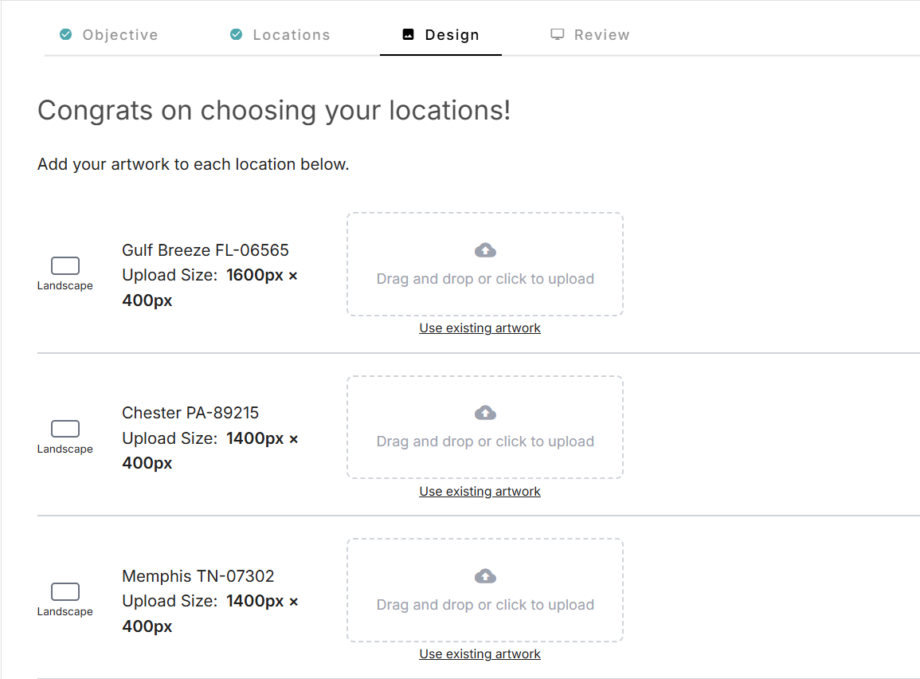
You can have your campaign live in minutes. Create a free account, select your locations, set your budget, upload your design, and start running once approved.
Where can I advertise with Blip in Arizona City?
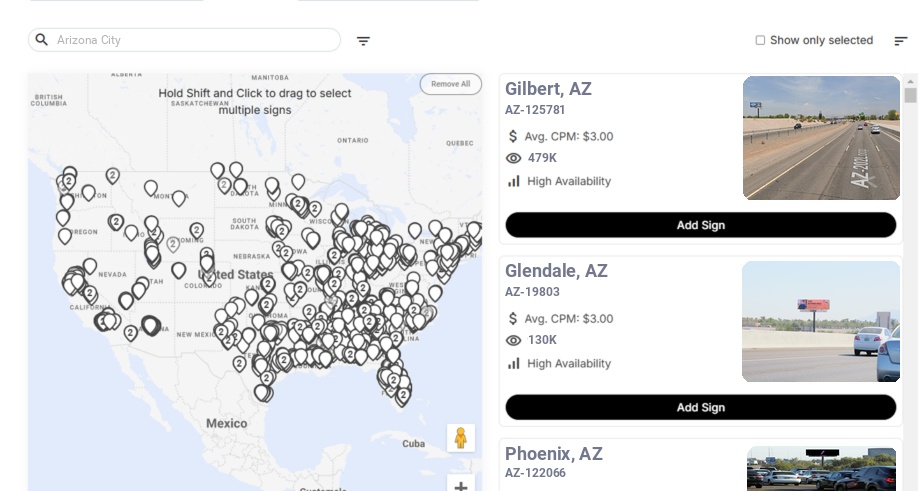
Blip has digital billboards in Arizona City. You can browse available locations on a map, choose the ones that fit your audience, and start advertising right away.
Still have questions? Launch a campaign in minutes — no contracts, no commitments.
Start Your CampaignArizona City Billboard Advertising Guide
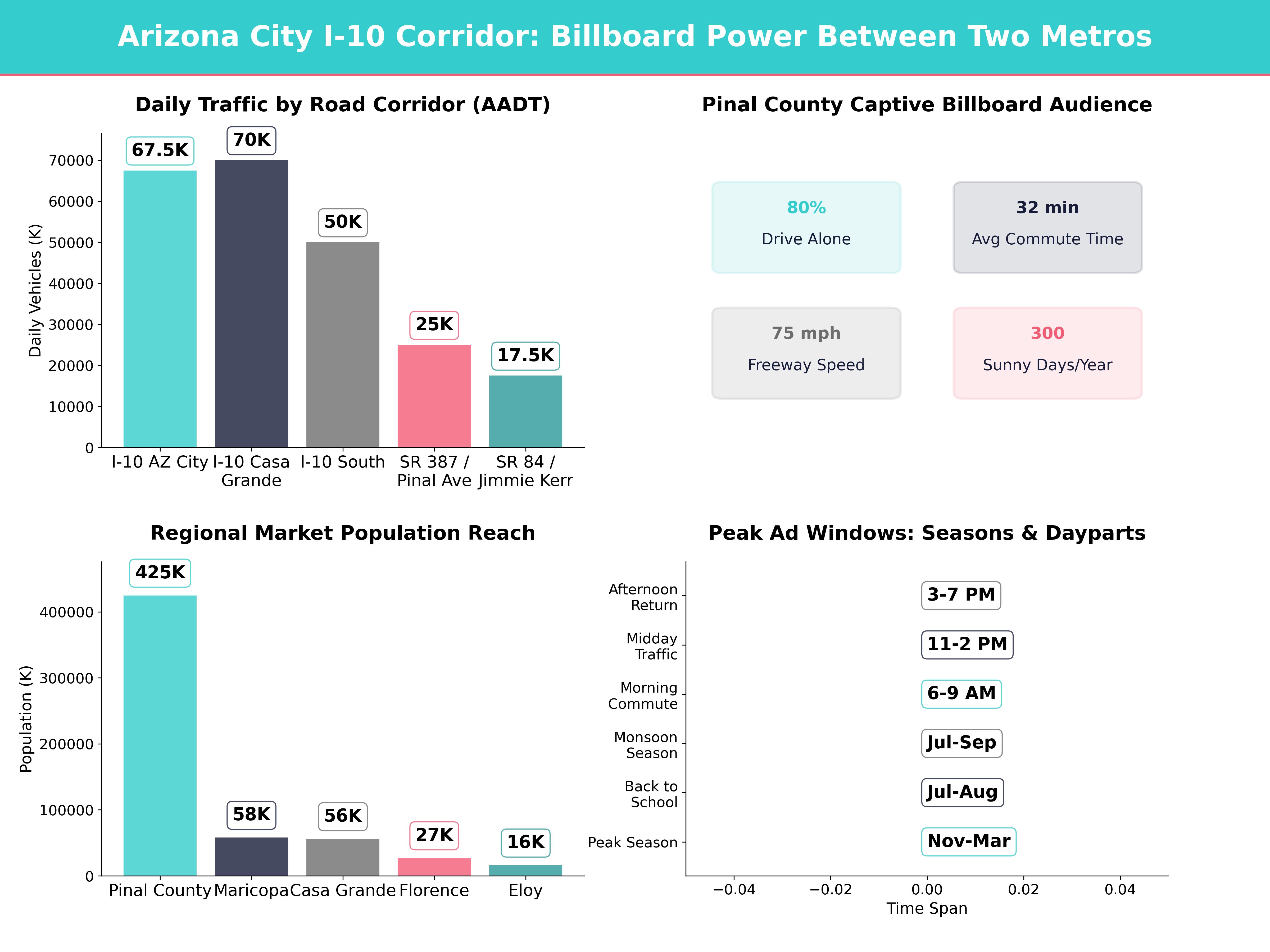
Arizona City gives us a billboard market that is much stronger than its small-town image suggests. The community itself has about 10,000 residents, but it sits in Pinal County, which reached 425,264 residents in 2020 and grew 13.2% from 2010 to 2020. Because Arizona City lies along the Arizona Department of Transportation I-10 corridor between Phoenix and Tucson, with nearby segments commonly carrying 60,000 to 75,000 AADT, we can reach local households, regional commuters, freight traffic, and tourism-driven travelers with the same campaign. In a county where roughly 80% of workers drive alone and average commutes are about 32 minutes, digital billboards can build repeated visibility quickly.
Arizona City Market Overview
Arizona City works best when we view it as a corridor market instead of a stand-alone community. It sits roughly 60 miles south of Phoenix and about 65 miles north of Tucson, placing it near the middle of Arizona’s most important intercity travel route. That location gives us access to local residents, but it also gives us a constant stream of pass-through impressions from drivers moving between the state’s two largest metros on one of the state’s busiest freeway corridors.
Arizona City’s regional trade area
The immediate trade area is larger than Arizona City alone. Nearby Casa Grande 55,653 residents in 2020, Maricopa had 58,125, Florence 26,785, and Eloy 15,635. Those four nearby municipalities alone total 156,198 residents, and they all contribute to the shopping, healthcare, dining, and employment patterns that flow past Arizona City.
That broader context matters because Pinal County is Arizona’s third-largest county by population. We are not advertising in an isolated desert outpost. We are advertising in a fast-growing county that sits between two major metros and includes several expanding communities.
Demographics and what they mean for billboard advertisers
Arizona City has a stable, residential feel, while the broader county adds families, industrial workers, students, and retirees. Pinal County is also roughly 30% Hispanic or Latino, which makes bilingual or Spanish-friendly creative a practical option for many campaigns.
For advertisers, that mix creates several advantages:
- We can run local service campaigns for HVAC, plumbing, pest control, roofing, dental, and urgent care.
- We can run regional retail campaigns that pull shoppers toward Casa Grande.
- We can run traveler-focused campaigns aimed at food, gas, lodging, roadside attractions, and convenience stops.
- We can run brand-awareness campaigns that benefit from repeated commuter and through-traffic exposure.
Arizona City’s economic backdrop
Arizona City also benefits from the surrounding county economy. Nearby employers and institutions such as Lucid Motors, Nikola, Banner Casa Grande Medical Center Central Arizona College Promenade at Casa Grande create all-day traffic instead of a single rush-hour pattern.
That is important for billboard strategy. In some small markets, we only get a narrow commuter window. In Arizona City, we can reach:
- Residents heading to Casa Grande for shopping and healthcare.
- Workers traveling to industrial and logistics sites.
- Long-distance travelers on I-10.
- Seasonal visitors moving through central Arizona in cooler months.
Key Traffic Corridors for Arizona City Billboards
Arizona City’s billboard value is driven by movement. The strongest placements are the ones that match local decision points, regional shopping trips, and long-distance freeway travel.
I-10 through Arizona City and Casa Grande
Recent ADOT traffic maps commonly show I-10 through the Arizona City-Casa Grande area in the 60,000 to 75,000 AADT range, with the busiest nearby segments around Casa Grande topping 70,000 AADT. Arizona City sits at Exit 200 on Sunland Gin Road, which gives us a clear decision zone where drivers choose whether to stop for fuel, food, services, or retail.
This is the highest-value corridor for broad reach because it carries both local and regional traffic. It also benefits from freeway speeds that can reach 75 mph, which means our creative must be simple and immediate.
Advertisers that benefit most from this stretch include:
- Travel services such as gas stations, quick-service restaurants, convenience stores, and hotels.
- Healthcare providers that want regional awareness before drivers reach Casa Grande.
- Attorneys, insurance providers, and roadside assistance brands that benefit from repeated interstate exposure.
- Retail destinations that want to pull Arizona City, Eloy, and through-traffic shoppers toward Casa Grande.
Northbound boards are especially useful when we want to catch drivers heading toward Phoenix. Southbound boards are strong for Tucson-bound traffic, weekend leisure trips, and returning freight drivers.
State Route 84 and Jimmie Kerr Boulevard near Arizona City
State Route 84, including Jimmie Kerr Boulevard on the Casa Grande side, is one of the most useful connectors for Arizona City campaigns. Recent ADOT counts on busier stretches commonly fall around 15,000 to 20,000 AADT. That is far below I-10, but the audience is often more valuable for local conversion because these drivers are already moving toward shopping districts, medical appointments, schools, and neighborhood errands.
This corridor is especially effective when we want to influence local choices rather than pure awareness. A driver on SR 84 is much closer to a decision than a driver still cruising on a rural interstate.
We should prioritize SR 84 for:
- Grocery, furniture, and home improvement promotions.
- Medical, dental, and urgent care messaging tied to Casa Grande destinations.
- Local events at Pinal County Fairgrounds & Event Center.
- Community colleges and training programs tied to Central Arizona College
Pinal Avenue and SR 387 in Casa Grande
Pinal Avenue, which aligns with SR 387 in key segments, is Casa Grande’s main urban spine. ADOT traffic maps often place busy sections in the 20,000 to 30,000 AADT range. This route serves neighborhoods, retail districts, restaurants, medical facilities, schools, and employment centers.
When we use Arizona City billboards as part of a wider county strategy, Pinal Avenue gives us an excellent frequency corridor. It is not as broad as I-10, but it is stronger for repeat local exposure.
This corridor is ideal for:
- Auto dealers and service centers.
- Restaurants and fast casual concepts.
- Healthcare and wellness services.
- Real estate, banking, and insurance.
- School, college, and workforce training campaigns.
Because drivers on Pinal Avenue are typically in town rather than passing through, we can use slightly more localized messaging here than we would on I-10.
I-10 south toward Picacho and Eloy
As we move south from Arizona City toward Picacho Peak State Park and Eloy 50,000 AADT. On parts of the Phoenix-to-Tucson corridor, ADOT has long noted that trucks make up roughly 1 in 4 vehicles. That mix gives us access to freight traffic, long-haul drivers, and leisure travelers at the same time.
This southern stretch is particularly strong for:
- Travel plazas, fuel, and convenience retail.
- Truck services, tires, and repair.
- Injury law, urgent care, and roadside assistance.
- Tourism advertisers tied to Skydive Arizona, Picacho Peak State Park, and regional attractions.
If we want statewide-style exposure without paying for Phoenix or Tucson core inventory, this corridor is a smart compromise.
I-8 access through Casa Grande
Arizona City also benefits from its proximity to the I-10 and I-8 junction near Casa Grande. Traffic on I-8 is lighter than I-10, but counts near Casa Grande still commonly run in the 20,000s. That westbound connection matters because it extends Arizona City campaigns toward western Arizona and Southern California traffic.
For advertisers with a wider footprint, the I-8 connection works well for:
- Regional retail and chain locations.
- Travel and hospitality.
- Automotive and roadside services.
- Tourism and destination marketing.
Audience Segments We Can Reach in Arizona City
Arizona City’s strength comes from layered audiences. We are not limited to one narrow demographic.
Commuters and regional shoppers in Arizona City
Pinal County is highly auto-oriented, with roughly 80% of workers driving alone and average commutes near 32 minutes. That makes everyday road exposure especially valuable. Many Arizona City residents drive north toward Casa Grande for shopping, healthcare, services, and employment, and many county residents travel through the area on routine regional trips.
This audience is a strong fit for:
- Grocery and retail promotions.
- Healthcare and dental reminders.
- Home services.
- Financial services.
- Real estate and community announcements.
Families, homeowners, and active adults around Arizona City
Arizona City is a residential community first, which makes it a practical market for household-driven categories. We can also tap into nearby active-adult demand through communities such as Robson Ranch Arizona, where healthcare, home improvement, recreation, and financial planning messages tend to resonate.
This audience responds well to billboard messaging that emphasizes:
- Trust.
- Convenience.
- Local relevance.
- Clear offers.
- Easy-to-remember phone numbers or web addresses.
Industrial, logistics, and shift workers in the Arizona City region
The broader Casa Grande, Coolidge, and Eloy area has become a manufacturing and logistics corridor. Employers such as Lucid Motors and Nikola help create shift-based traffic patterns that extend beyond the classic morning and evening commute.
This audience is especially useful for:
- Quick meals and convenience retail.
- Occupational healthcare.
- Staffing and workforce recruiting.
- Tool, tire, and automotive brands.
- Wireless, banking, and paycheck-cycle promotions.
Tourists, outdoor visitors, and winter travelers near Arizona City
Arizona City also picks up traffic from Arizona’s visitor economy. Cooler-weather travelers move through the corridor on the way to Picacho Peak State Park, Skydive Arizona, Casa Grande retail, and other central Arizona stops. Winter visitors are especially important because the weather is far more comfortable from late fall through spring, typically November through March.
That audience is a strong fit for:
- Dining and hospitality.
- Attractions and entertainment.
- Gas, snacks, and convenience.
- RV, campground, and travel-related services.
- Tourism campaigns with directional messaging.
Students, parents, and healthcare users in the Arizona City trade area
We can also reach education and healthcare audiences through Central Arizona College Casa Grande Union High School District, Casa Grande Elementary School District, and Banner Casa Grande Medical Center 15 minutes from Casa Grande by car, so billboards can support appointment-based and enrollment-based campaigns very effectively.
Seasonal and Timing Opportunities in Arizona City
Arizona City is a year-round market, but it is not the same market every month. The desert climate changes movement patterns in ways we can use.
Arizona City’s winter and spring advantage
From roughly November through March, Arizona City benefits from Arizona’s strongest weather season. Daytime highs in the cooler months are commonly in the 60s and 70s, which encourages road trips, outdoor recreation, and daytime errands. This is when we should lean into tourism, restaurants, retail, recreation, healthcare checkups, and home improvement.
Spring is especially useful because it combines comfortable weather with event traffic. We can monitor calendars from Pinal County Fairgrounds & Event Center, Casa Grande Chamber of Commerce, and PinalCentral Pinal County Fairgrounds & Event Center typically hosts a 4-day county fair in the spring, which creates a concentrated window for event, dining, and retail messaging.
Arizona City’s summer heat and monsoon timing
Summer changes the message, not the value of the market. Nearby lower-desert climate patterns tracked by the Arizona State Climate Office show average July highs around 105°F. The area gets under 10 inches of rain in a typical year, but most of that moisture arrives during monsoon season in July, August, and September.
That climate profile makes summer ideal for:
- HVAC and auto A/C services.
- Cold drinks, ice, and convenience offers.
- Indoor entertainment and retail.
- Pool, shade, and patio products.
- Roof repair, insurance, and storm-response services during monsoon weeks.
School calendars and family decision windows in Arizona City
Most area school districts begin classes in late July or early August and finish in May. That gives us several predictable campaign windows:
- Early July to early August for back-to-school.
- September for tutoring, after-school activities, and family healthcare.
- May for summer camps, recreation, and youth programs.
- January for midyear enrollment and educational services.
Because Arizona City households often drive into Casa Grande for school-related needs, roadside awareness can be very effective during these periods.
Weekend and holiday travel around Arizona City
Arizona City’s position between Phoenix and Tucson makes weekends especially useful. A trip of about 1 hour in either direction puts drivers into one of the state’s largest urban markets, which means Friday afternoons, Sunday afternoons, and holiday travel periods can deliver strong extra impressions.
We should use those windows for:
- Restaurants and quick-serve promotions.
- Fuel and convenience offers.
- Entertainment and attractions.
- Hotels and overnight stays.
- Directional messaging tied to specific exits or miles ahead.
Billboard Design Tips for the Arizona City Market
Arizona City campaigns work best when the creative respects both the desert environment and freeway driving behavior.
Design for Arizona City’s highway speeds
On I-10, drivers are often moving at 75 mph. That means we should use one idea, one offer, and one call to action. We should favor short headlines, bold numerals, and highly legible typography.
In this market, numerals usually outperform words. “Exit 200,” “2 Miles,” “24/7,” and “$99” are easier to absorb than longer written phrases. If we want immediate action from a traveler, directional language is often more effective than brand poetry.
Use colors that survive the Arizona City desert backdrop
Central Arizona gets about 300 sunny days a year, so subtle palettes can wash out quickly. Beige backgrounds often disappear into the landscape, especially around Arizona City’s desert tones and open sky. We usually do better with dark navy, black, bright white, deep red, turquoise, or saturated orange.
Local visual cues that can feel authentic in this market include:
- Desert and mountain silhouettes.
- Clean road-trip imagery.
- Simple, modern industrial visuals.
- Family-home imagery for residential services.
- Recreational imagery that fits Picacho Peak State Park or regional travel.
Match the message to Arizona City’s audience mix
Because the area combines local households, retirees, bilingual families, and interstate travelers, our messaging should match the placement.
For Arizona City and Casa Grande residential routes, we should emphasize:
- Trust and reliability.
- Local credentials.
- Same-day or fast service.
- Convenience.
- Clear business categories.
For I-10 traveler routes, we should emphasize:
- Distance to exit.
- Open-now convenience.
- Food, fuel, rest, and speed.
- Immediate need-solving language.
Consider bilingual creative for Arizona City campaigns
With Pinal County at roughly 30% Hispanic or Latino, bilingual strategy can be smart when our target audience is broad consumer households. We do not need to force Spanish into every campaign, but we should seriously consider Spanish-only or bilingual variants for healthcare, retail, education, and community-service messaging.
Regional Strategies Around Arizona City
Arizona City campaigns are strongest when we tailor them to the sub-area instead of treating every board the same.
Arizona City core and Exit 200 strategy
When our goal is local leads, we should focus on boards closest to Arizona City’s residential access points and the I-10 interchange at Exit 200. This strategy works well for plumbers, HVAC companies, dentists, family medicine, pest control, internet providers, local restaurants, and real estate agents.
This is where we should use:
- Local place names.
- Specific service offers.
- Strong phone-number recall.
- Immediate convenience messaging.
Northbound Arizona City to Casa Grande strategy
Arizona City is roughly 15 minutes from Casa Grande, and that short drive makes the northbound route one of the best conversion paths in the market. We should use this zone when we want to pull Arizona City and Eloy residents toward shopping, medical appointments, restaurants, auto dealers, and entertainment in Casa Grande.
This corridor is ideal for campaigns tied to Promenade at Casa Grande, Banner Casa Grande Medical Center Central Arizona College Casa Grande Chamber of Commerce.
Southbound Arizona City to Eloy and Picacho strategy
Southbound placements work well when we want traveler capture and tourism visibility. Eloy Skydive Arizona, and Picacho Peak State Park add recreation and roadside-stop value that complements the freight-heavy I-10 audience.
This is the right sub-area for:
- Fuel and convenience.
- Fast food and casual dining.
- Adventure tourism.
- Legal, insurance, and roadside services.
- Truck-oriented products and services.
Wider Pinal County strategy from an Arizona City base
If we want county-scale reach, Arizona City should be one layer rather than the whole plan. Adding Maricopa, Florence Coolidge, and Casa Grande 425,264 people with very different movement patterns.
Our best countywide approach is usually:
- I-10 for broad awareness.
- Casa Grande urban routes for frequency.
- Arizona City access points for local relevance.
- Eloy or Picacho routes for traveler and tourism capture.
Using Blip Tools in Arizona City
Blip works especially well in Arizona City because the market has clear route types and highly variable demand by time of day, direction, and season.
When we should use Blip-optimized campaigns in Arizona City
If our goal is broad awareness across Arizona City, Casa Grande, and the I-10 corridor, Blip-optimized campaigns are usually the simplest approach. They let us tell the system our audience and budget goals, then let it find the best mix of inventory across local and regional routes.
This approach is especially useful when we want to test whether our message performs better on:
- Interstate traveler inventory.
- Casa Grande local inventory.
- Arizona City residential access routes.
- Southbound tourism and freight routes.
When manual billboard selection makes sense in Arizona City
If we care deeply about a specific corridor, such as Exit 200, SR 84, or a commuter-heavy northbound route into Casa Grande, manual campaign setup gives us tighter control. That is helpful for local businesses that know exactly where their customers are coming from.
We should usually choose manual selection when:
- We want boards closest to a single exit or destination.
- We need different creative for northbound and southbound traffic.
- We are promoting a local event with a precise geographic draw.
- We want to compare one corridor against another in a controlled test.
Dayparting and creative rotation for Arizona City
Arizona City is a good market for dayparting. We can focus on:
- 6 a.m. to 9 a.m. for commuters and shift workers.
- 11 a.m. to 2 p.m. for lunch, healthcare, and errand traffic.
- 3 p.m. to 7 p.m. for return commutes and regional shoppers.
- Weekend midday blocks for tourism and leisure travel.
We should also rotate creative by season. A winter tourism message should not look like a July HVAC message, and a Casa Grande retail promotion should not necessarily be the same as an I-10 travel-stop ad.
Analytics and testing in the Arizona City market
Arizona City is ideal for test-and-learn advertising. We can compare interstate-heavy placements with local placements, monitor how dayparts perform, and swap creative as we learn which audience responds best. Blip’s analytics are especially helpful in a market like this because small changes in route mix can make a big difference.
Getting Started with Billboard Rental in Arizona City
Renting a billboard in Arizona City is easiest when we start with the goal, not the map. Once we know what outcome we want, the right locations become much clearer.
Match our Arizona City billboard choices to our real objective
We should first decide whether we want:
- Local lead generation in Arizona City.
- Regional customer capture in Casa Grande.
- Traveler awareness on I-10.
- Tourism or event promotion tied to weekends and seasonal traffic.
- Countywide branding across multiple Pinal County communities.
A home-service company should usually prioritize Arizona City access routes and Casa Grande commuter boards. A restaurant, gas station, or travel center should usually prioritize I-10 decision points. A hospital, college, or retail center may need both.
How to evaluate Arizona City billboard locations
Before we launch, we should look at each board through a local-use lens:
- Which direction of travel does it face?
- How close is it to an exit, turn, or shopping destination?
- Is the audience mostly local, mostly through-traffic, or a mix?
- Are drivers moving at freeway speed or slower urban speed?
- Does the location support awareness, directional action, or repeat frequency?
In Arizona City, those questions matter more than raw geography. Two boards only a few miles apart can behave very differently if one is on I-10 and the other is on a local connector.
Why Blip simplifies billboard rental in Arizona City
Traditional billboard buying often involves more sales coordination, less flexibility, and slower testing. Blip makes Arizona City easier because we can launch online, adjust budgets, swap creative, compare routes, and scale what works without locking ourselves into a rigid process.
That flexibility matters in this market because Arizona City has several distinct audiences packed into one geography. We can start with a narrow local test, expand into Casa Grande, layer in I-10 traveler inventory, and then keep refining based on actual performance.
A practical Arizona City launch plan
For most advertisers, a smart starting plan looks like this:
- We define whether our campaign is for local residents, regional shoppers, or interstate travelers.
- We choose either a Blip-optimized campaign for broader coverage or a manual campaign for key routes such as Exit 200, SR 84, or Casa Grande commuter paths.
- We build at least 2 versions of our creative, such as one traveler-focused message and one local-service message.
- We monitor results and shift spend toward the boards, directions, and dayparts that fit our actual audience.
That approach lets us learn quickly while staying flexible, and it fits Arizona City especially well because the market combines a local residential base with one of Arizona’s most important highway corridors.