Billboards in Fountain Hills, AZ
No Minimum Spend. No Long-Term Contracts. Just Results.
Trusted by Leading Brands


Billboard advertising
in Fountain Hills has never been easier
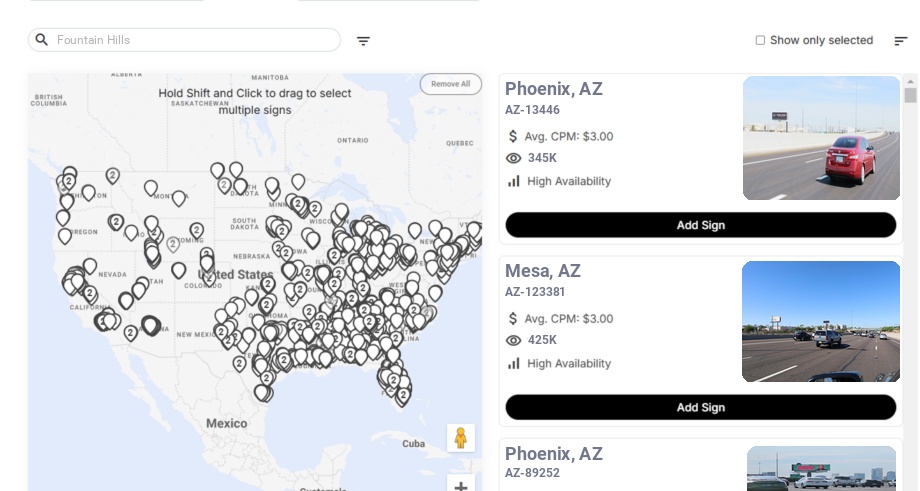



How much is a billboard in Fountain Hills?
Why Choose Blip for Billboard Advertising in Fountain Hills
Blip lets you launch fast in Fountain Hills and target Shea or SR 87 commuters when they're deciding where to eat, shop, or book.
Set any budget in Fountain Hills and pay only when ads play—ideal for testing affluent, homeowner-heavy audiences without contracts.
Use dayparting in Fountain Hills to hit morning Scottsdale-bound drivers and weekend golf or fountain visitors at the right times.
Track Fountain Hills campaigns in real time, then shift spend toward corridors like Shea and the Beeline as traffic patterns change.
Blip's creative tools make it easy to tailor Fountain Hills billboards with local cues like Fountain Park, the 560-foot fountain, or We-Ko-Pa.
Frequently Asked Questions About Billboard Advertising in Fountain Hills
How much does a billboard cost in Fountain Hills with Blip?
With Blip, the cost of billboard advertising in Fountain Hills is flexible and easy to control. You set a daily budget, and Blip’s pay-per-play model means you only pay when your ad actually appears as a 7.5-to-10-second blip on a rotating digital billboard, starting at just $0.01 per display. Pricing changes based on time of day, location, and advertiser demand, while Blip’s algorithm works to stretch your budget and maximize reach.
Where can I advertise with Blip in Fountain Hills?
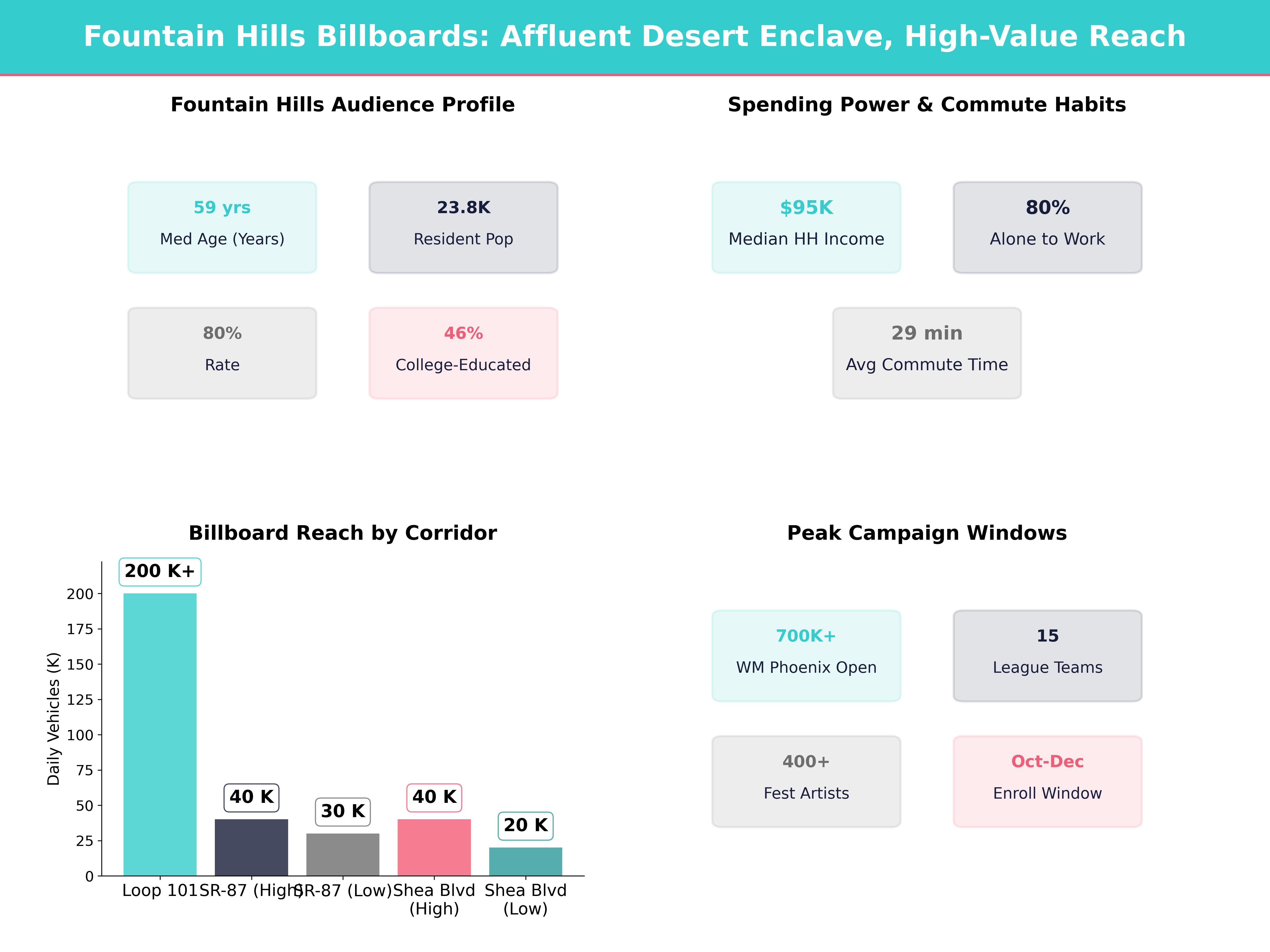
Fountain Hills advertising works best when we think in corridors rather than just in ZIP codes. Shea Boulevard is the town’s primary west-to-east gateway, and State Route 87, the Beeline Highway, is the other defining corridor. Nearby Loop 101 segments in northeast Scottsdale also carry 200,000+ vehicles per day and can help reach Fountain Hills residents before they turn east on Shea.
Why is Fountain Hills a good market for Blip billboard ads?
Fountain Hills combines local affluence with regional accessibility, which creates a strong advertising opportunity. The town has a median household income around $95,000, homeownership near 4 in 5 occupied housing units, and a median age of roughly 59. It also sits inside fast-growing Maricopa County and along car-oriented routes connecting Scottsdale, Mesa, and the Fort McDowell Yavapai Nation.
When is the best time to run Blip ads in Fountain Hills?
The strongest tourism window generally runs from November through April. During this period, Fountain Hills benefits from snowbird traffic, patio weather, golf demand, and the broader event calendar in nearby Scottsdale. Summer changes behavior dramatically, so from June through September, campaigns often work better for practical services like HVAC, plumbing, roofing, and urgent care.
What kind of people will see my Fountain Hills Blip billboard ads?
Fountain Hills skews older and more established than much of metro Phoenix, with a median age near 59 and a high homeownership rate. Roughly 80% of workers commute by driving alone, and average travel time is about 29 minutes, so roadside exposure matters a lot here. The town also draws tourists, golfers, and recreation visitors, especially around Fountain Park and nearby destination attractions.
Do I need a contract to advertise with Blip in Fountain Hills?
No, Blip has no long-term contracts or minimum commitments. You can start, pause, or stop your campaign at any time.
How fast can I launch a billboard campaign with Blip in Fountain Hills?
You can have your campaign live in minutes. Create a free account, select your locations, set your budget, upload your design, and start running once approved.
Where can I advertise with Blip in Fountain Hills?
Blip has digital billboards in Fountain Hills. You can browse available locations on a map, choose the ones that fit your audience, and start advertising right away.
Still have questions? Launch a campaign in minutes — no contracts, no commitments.
Start Your CampaignFountain Hills Billboard Advertising Guide
Fountain Hills $95,000 and homeownership near 4 in 5 occupied housing units, steady commuter movement into the northeast Valley, with about 80% of workers driving alone and average commute times near 29 minutes, and year-round visitor traffic tied to golf, desert recreation, and the town’s signature 560-foot fountain. The town itself had 23,820 residents in 2020, but its real marketing footprint is much larger because it sits inside fast-growing Maricopa County and along heavily car-oriented routes connecting Scottsdale, Mesa, and the Fort McDowell Yavapai Nation. In a market where most trips happen by car rather than by transit or on foot, digital billboards can deliver repeated visibility at exactly the moments when people are deciding where to shop, eat, play, or book an appointment. When we match creative, timing, and location to local travel patterns, Fountain Hills becomes a strong market for retail, healthcare, home services, real estate, hospitality, and tourism brands.
Fountain Hills Market Overview
Fountain Hills is a small town with an outsized commercial opportunity because it combines local affluence with regional accessibility. According to 2020 population counts, Fountain Hills grew from 22,489 residents in 2010 to 23,820 in 2020, which is a gain of 1,331 people or about 5.9% over the decade. That growth was slower than Maricopa County, which rose from 3,817,117 residents in 2010 to 4,420,568 in 2020, an increase of 603,451 people or about 15.8%. For advertisers, that difference matters because Fountain Hills is not a mass-scale city by itself, but it sits inside a very large regional customer base.
Demographics and household profile
Fountain Hills skews older and more established than much of metro Phoenix. The town’s median age is roughly 59, which gives us a meaningful audience for healthcare, retirement planning, home remodeling, travel, dining, and automotive brands. Homeownership is high, at about 4 in 5 occupied housing units, which supports campaigns for roofing, landscaping, pest control, solar, remodeling, insurance, and other home services. Educational attainment is also strong, with roughly 46% of adults age 25 and older holding a bachelor’s degree or higher, and median household income is around $95,000, which supports premium positioning and higher-ticket offers.
Car dependence and commute behavior
Fountain Hills is a driver-first market. Among workers, roughly 80% commute by driving alone, and average travel time is about 29 minutes, which means advertisers can rely on roadway exposure rather than dense pedestrian traffic or rail ridership. The town’s limited transit footprint compared with central Phoenix or Tempe
What the local economy means for advertisers
Fountain Hills functions as both a residential town and a gateway to northeast Valley recreation. Residents spend heavily on local services, but many also commute west toward Scottsdale, medical campuses, retail nodes, and business districts. At the same time, visitors flow through the area for golf, casino entertainment, hiking, scenic drives, and seasonal events. That combination gives us two valuable billboard audiences at once: repeat local drivers and incremental regional visitors.
Key Traffic Corridors for Fountain Hills
Fountain Hills advertising works best when we think in corridors rather than just in ZIP codes. A handful of roads control most local access, and each one serves a different kind of decision-making moment.
Shea Boulevard
Shea Boulevard is Fountain Hills’ primary west-to-east gateway, linking the town to northeast Scottsdale, the Loop 101 Pima Freeway, and the broader metro area. Arizona Department of Transportation traffic counts on this corridor generally show 20,000 to 40,000+ vehicles per day depending on the segment, with heavier western volumes closer to the freeway network. Because Shea is the default access route for many residents and visitors, it is one of the best places to build broad awareness.
This corridor is especially useful for the following advertiser types:
- Restaurants and retail can reach drivers before they commit to a dinner stop, grocery trip, or shopping errand.
- Healthcare providers can capture patients traveling toward Mayo Clinic HonorHealth
- Real estate and home services can stay in front of owner-heavy neighborhoods on their daily in-and-out routes.
State Route 87, the Beeline Highway
State Route 87 is the town’s other defining corridor. It connects the area south toward Mesa, the Loop 202 Red Mountain Freeway, and the East Valley, while also carrying traffic northeast toward recreation destinations and mountain communities. On metro-facing segments, ADOT traffic counts often run in the 30,000 to 50,000+ AADT range, with volumes tapering farther from the urban edge.
This route is a strong fit for brands that depend on destination travel:
- Casinos, golf courses, and resorts benefit from travelers heading to the Fort McDowell Yavapai Nation, We-Ko-Pa Casino Resort, and We-Ko-Pa Golf Club
- Outdoor recreation brands can reach hikers, off-roaders, campers, and boaters heading toward the desert and mountain recreation corridor.
- Quick-service restaurants, convenience retail, fuel, and automotive services can win business from drivers making longer trips.
Loop 101 and northeast Scottsdale feeder routes
Fountain Hills brands should not think only inside town limits. Nearby Loop 101 segments in northeast Scottsdale regularly carry 200,000+ vehicles per day, making them valuable feeder placements for businesses that want to reach Fountain Hills residents before they turn east on Shea. This is also the corridor serving the Scottsdale Airport, major retail centers, corporate offices, and event venues such as WestWorld of Scottsdale.
These boards are ideal when we want to reach:
- Affluent consumers already traveling through premium retail and business districts.
- Healthcare and senior-care audiences headed toward major hospitals and specialty clinics.
- Event-driven visitors attending high-profile Scottsdale attractions and then extending their trip eastward.
Saguaro Boulevard, Fountain Hills Boulevard, and local arterials
Inside town, the most useful local streets are Saguaro Boulevard Fountain Hills Boulevard Palisades Boulevard 35 to 45 mph range, giving us more read time and better support for local frequency campaigns.
These placements work well for:
- Local restaurants, salons, fitness brands, and medical offices that need repeated exposure close to the point of action.
- Community events and nonprofit campaigns that benefit from familiarity rather than one-time awareness.
- Real estate and local service companies that want to stay visible inside the town’s daily circulation pattern.
Audience Segments in Fountain Hills
The best Fountain Hills campaigns speak to distinct audiences, not just to “the general public.” This market is strongest when we separate who is driving, why they are driving, and what decision they are likely to make next.
Affluent year-round residents and seasonal homeowners
Fountain Hills is a mature, homeowner-heavy market with strong discretionary spending power. A population of 23,820 might look modest on paper, but the town’s high homeownership rate, median age near 59, and median household income around $95,000 create a valuable audience for premium services. Financial advisors, remodelers, elective healthcare providers, senior services, golf brands, and upscale dining all fit well here.
Seasonal households also matter. Winter residents and long-stay visitors increase local spending from roughly November through April, and they often respond to messages about convenience, quality, trust, and local reputation rather than deep-discount urgency.
Commuters to Scottsdale and the northeast Valley
A large share of Fountain Hills workers head west for employment, medical appointments, shopping, and regional errands. With roughly 80% of workers driving alone and an average commute near 29 minutes, billboards can intercept decision-makers during repeat trips. This audience is especially attractive for:
- Healthcare providers near Mayo Clinic HonorHealth
- Auto dealers, repair shops, and insurance brands that benefit from repeated commuter exposure.
- Retailers and restaurants in northeast Scottsdale that want to pull customers east or west along Shea.
Tourists, golfers, and recreation visitors
Fountain Hills draws leisure travelers even though it is not a giant resort city. Fountain Park 28-acre lake in a 64-acre park, and the famous fountain can shoot water 560 feet into the air, which gives the town instant brand recognition. Nearby recreation assets add even more pull. McDowell Mountain Regional Park covers more than 21,000 acres, and We-Ko-Pa Golf Club 36 holes of destination golf.
This visitor segment responds well to categories such as lodging, dining, entertainment, golf retail, spas, outdoor gear, and local attractions. It is also highly responsive to directional copy, because many visitors are navigating unfamiliar roads.
Families, local shoppers, and school-year routines
Fountain Hills is older than the metro average, but it is not only a retirement market. Families still drive frequent local routines tied to Fountain Hills Unified School District
Seasonal and Timing Opportunities in Fountain Hills
Fountain Hills advertising improves when we align campaigns with the Valley’s seasonal rhythms. Weather, events, and visitor migration all change who is on the road and what they are ready to buy.
Winter visitor season in Fountain Hills
The strongest tourism window generally runs from November through April. During this period, Fountain Hills benefits from snowbird traffic, patio weather, golf demand, and the broader event calendar in nearby Scottsdale. The WM Phoenix Open alone typically draws 700,000+ attendees across tournament week, and those visitors circulate through the northeast Valley. Brands in hospitality, dining, entertainment, healthcare, and real estate should usually increase visibility during this stretch.
Spring training and event season
Greater Phoenix spring training is a major regional demand driver. The Cactus League features 15 Major League Baseball teams playing at 10 ballparks, which brings tourists, part-time residents, and day-trippers into the Valley every spring. Fountain Hills can benefit from that overflow, especially for dining, attractions, golf, and lodging-adjacent campaigns.
Fountain Hills also has its own event strength. The Fountain Hills Chamber of Commerce promotes the community’s art and festival calendar, and the signature arts festivals are known for hosting 400+ artists and artisans. Event-focused advertisers should tighten geographic relevance and use creative that clearly signals parking, timing, and proximity.
Summer heat and monsoon season
Summer changes behavior dramatically. From June through September, local residents still drive, but discretionary outdoor activity shifts toward early morning, evening, and indoor destinations. That is a strong window for HVAC, plumbing, roofing, water mitigation, urgent care, indoor entertainment, takeout dining, grocery, and home improvement campaigns. It is also a good time to lean more heavily into commuter dayparts because many leisure visitors thin out.
Back-to-school and fall planning
Late July and August are ideal for school-year services, while fall works well for healthcare, financial services, and holiday retail. For Medicare-focused advertisers, the annual enrollment window from October 15 through December 7 is especially important in a town with a relatively older population. We can also use early fall to build local awareness ahead of the winter visitor surge.
Billboard Design Tips for the Fountain Hills Market
Creative that works in downtown Phoenix is not automatically right for Fountain Hills. We should design for the town’s visual environment, audience age profile, and route structure.
Use desert contrast and recognizable local cues
Fountain Hills is filled with tan desert landscapes, bright sky, and intense sunlight. High-contrast palettes such as deep blue, white, charcoal, emerald, and strong red tend to stand out better than muted earth tones that can disappear into the background. Local imagery can help, but it should be selective. The 560-foot fountain plume, mountain silhouettes, fairways, or upscale patio scenes can instantly signal relevance without making the design feel cluttered.
Keep copy extra readable for an older, driving audience
Because the median age is near 59 and many ads are seen at 35 to 45 mph locally or faster on regional approaches, readability matters even more than usual. We should use fewer words, larger type, strong contrast, and one clear action. For Fountain Hills, credibility cues often outperform hype. “Locally trusted,” “minutes away on Shea,” “near Fountain Park,” or “Scottsdale care, closer to home” can be more persuasive than generic slogans.
Match the message to the corridor
Route context is especially important here. A board on Shea should often answer a commuter question, while a board on the Beeline should often answer a traveler question. For example, an ad aimed at weekend recreation traffic can lean into fuel, food, golf, or entertainment. An ad aimed at weekday westbound commuters can focus on appointments, shopping, or evening dining.
Reflect seasonality in the artwork
Winter creative should feel open-air, scenic, and social. Summer creative should feel practical, cool, and immediate. That shift is especially useful in Arizona, where the same billboard can serve very different audiences in January and July.
Regional Strategies for Fountain Hills Advertisers
We usually get better results in Fountain Hills when we split the market into functional zones and build a message for each one.
Fountain Hills town core
The town core around Fountain Park
The Shea approach from Scottsdale
This is the strongest zone for intercepting residents before they leave the regional shopping and employment belt. Brands in Scottsdale can use these boards to pull Fountain Hills customers west, and Fountain Hills businesses can use them to remind returning drivers where to stop once they are back in town. Healthcare, grocery, automotive, and casual dining all perform well in this strategy.
The Beeline and Fort McDowell corridor
This zone is ideal for visitor capture and destination messaging. Travelers heading toward the Fort McDowell Yavapai Nation, We-Ko-Pa Casino Resort, We-Ko-Pa Golf Club
Northeast Scottsdale medical and event nodes
For businesses with regional ambitions, nearby boards around northeast Scottsdale, Mayo Clinic HonorHealth WestWorld of Scottsdale, and the Scottsdale Airport area can extend reach beyond town residents. This is a smart regional layer for healthcare, luxury services, events, B2B firms, and premium retail.
Using Blip Effectively in Fountain Hills
Blip’s tools are especially useful in a market like Fountain Hills because traffic patterns are predictable, but demand changes by season, time of day, and corridor.
Daypart around commuter and leisure peaks
We can lean into morning and late-afternoon commuter windows on Shea and regional approach roads, then shift toward midday and weekend emphasis for tourism, golf, dining, and event campaigns. That matters in Fountain Hills because weekday purpose and weekend purpose are often very different.
Test corridor-specific creative
We do not need one message for the whole area. We can run one creative version on the Shea commuter approach, another on the Beeline recreation corridor, and a third in-town near local retail. Real-time analytics help us see which message and which geography are actually producing traction.
Scale with the season
Because Fountain Hills demand rises and falls with winter visitors, arts festivals, golf season, and summer heat, flexible budgeting is practical here. We can increase spend ahead of major event periods, reduce it during softer windows, and restart quickly when demand returns.
Use artwork tools to localize fast
Fountain Hills campaigns benefit from local references, such as “near Fountain Park,” “off Shea,” or “minutes from We-Ko-Pa.” If we want several localized variations without rebuilding artwork from scratch each time, Blip’s creative tools make that much easier.
Getting Started with Billboard Rental in Fountain Hills
Renting a billboard in Fountain Hills starts with choosing the audience, not the board. We should first decide whether we want to reach local residents, Scottsdale-bound commuters, recreation travelers, winter visitors, or some combination of the four. Once that is clear, location choices become much easier.
What to expect in the Fountain Hills market
This is not a market where one board magically reaches everyone. Fountain Hills works best with a corridor strategy, because daily traffic is concentrated on a few key approaches. In practice, that means we usually evaluate boards by asking four questions:
- Who is driving here at this time of day?
- Are they heading into Fountain Hills, out toward Scottsdale, or through toward recreation destinations?
- Is our goal immediate action, repeated awareness, or both?
- Does the creative match the speed and purpose of the route?
How Blip simplifies the rental process
Traditional out-of-home buying often involves fixed packages, longer commitments, and slow changes. Blip makes Fountain Hills campaigns more manageable because we can choose digital boards on a map, control timing, adjust budgets, and update artwork without waiting on a long contract cycle. That flexibility is useful in a town where winter demand, event traffic, and local seasonality change quickly.
How we should evaluate Fountain Hills billboard locations
When we compare locations, we should look beyond raw traffic counts. A board with slightly lower traffic can outperform a bigger corridor if it sits closer to a decision point, such as a turn into town, a retail cluster, a medical district, or a leisure destination. We should also look at direction of travel, likely dwell time, and whether the surrounding environment supports our brand positioning.
A practical way to begin is to launch a focused campaign on 2 to 4 boards serving different audiences, run for 2 to 4 weeks, and compare performance. One board might target inbound local traffic on Shea, another might target the Beeline leisure corridor, and another might reinforce frequency in town. From there, we can shift spend toward the locations and dayparts that prove their value.
In Fountain Hills, billboard advertising works best when we stay local in our strategy but regional in our thinking. The town’s 23,820 residents, older and affluent demographic profile, 560-foot landmark fountain, and car-dependent access routes create a market where strong creative and smart timing can travel a long way.