Billboards in Flagstaff, AZ
No Minimum Spend. No Long-Term Contracts. Just Results.
Trusted by Leading Brands


Billboard advertising
in Flagstaff has never been easier
How much is a billboard in Flagstaff?
Why Choose Blip for Billboard Advertising in Flagstaff
Blip lets you launch fast in Flagstaff and reach I-40/I-17 travelers without contracts. Great for hotels, fuel, and food stops before drivers leave the interstate.
Set flexible daily budgets in Flagstaff and lean into NAU move-in, graduation, or football weekends. Blip helps you spend more when student traffic spikes.
Daypart your Flagstaff ads for Friday arrivals, Saturday ski runs, or Sunday returns on I-17 and Snowbowl routes. Show up when visitor intent is highest.
Track real-time results in Flagstaff and shift spend from US 89 to Milton Road if needed. Blip makes it easy to follow local, campus, and regional traffic patterns.
Use Blip's creative tools to tailor Flagstaff billboards for pine forests, Route 66, and winter snow scenes. Keep your message local, clear, and high-contrast.
Frequently Asked Questions About Billboard Advertising in Flagstaff
How much does a billboard cost in Flagstaff with Blip?
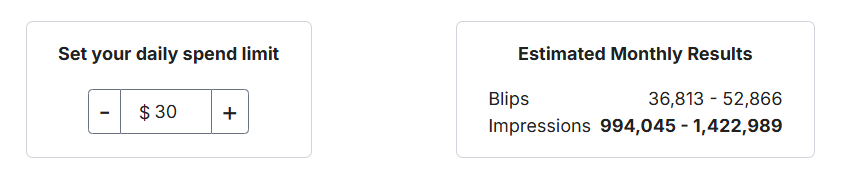
With Blip, billboard advertising in Flagstaff can be surprisingly affordable because you only pay when your ad actually appears. Prices start at just $0.01 per display, and each “blip” is a 7.5-to-10-second display on a rotating digital billboard. You set a daily budget, and Blip’s algorithm uses it to bid for open ad slots based on time of day, location, and advertiser demand.
Where can I advertise with Blip in Flagstaff for the best reach?
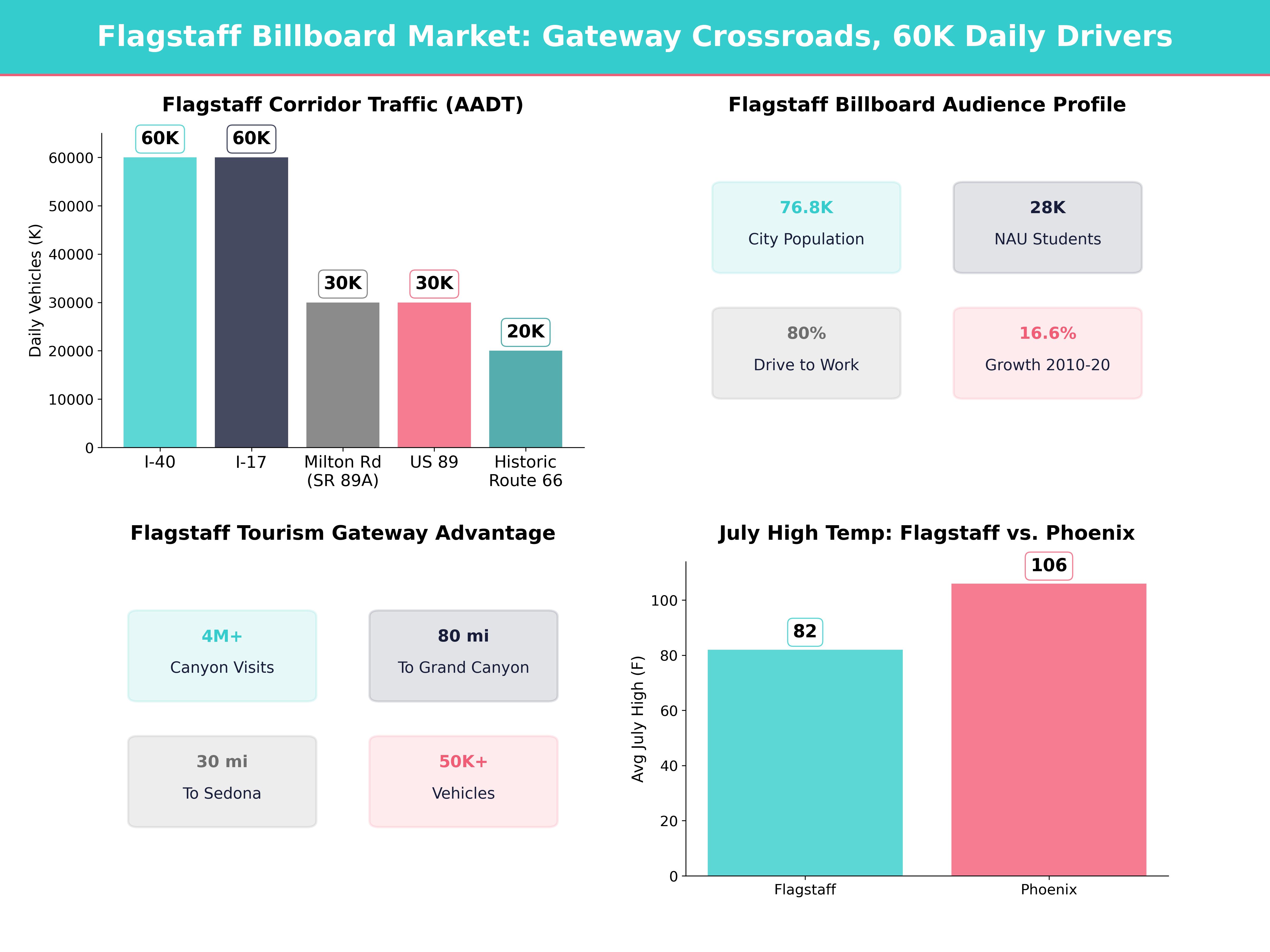
Flagstaff gives us one of the Southwest’s most effective billboard markets because it combines a local population of 76,831 with regional traffic that can exceed 50,000 vehicles per day on the interstates. Interstate 40 offers the broadest reach, while I-17 is a major north-south link for Phoenix-area traffic. Milton Road and Historic Route 66 are especially strong for local frequency near Northern Arizona University and downtown access points.
Why is Flagstaff a strong billboard market for Blip campaigns?
Flagstaff is not a giant metro, but it behaves like a regional center. The city grew from 65,870 residents in 2010 to 76,831 in 2020, and Northern Arizona University enrolls about 28,000 students. It also serves as a shopping, healthcare, education, and travel hub for a huge portion of Northern Arizona.
When is the best time to run a billboard campaign in Flagstaff?
Summer is one of Flagstaff’s biggest advertising opportunities because the climate itself becomes a selling point. Winter creates a second major season, especially for Arizona Snowbowl and other snow-related travel. NAU also creates recurring timing anchors in August, May, and December, with football weekends and event calendars adding more windows throughout the year.
Which Flagstaff roads work best for Blip ads targeting visitors and locals?
I-40 and I-17 are strong for visitors, travelers, and immediate-stop categories like fuel, food, lodging, and hospitality. Milton Road, Route 66, and downtown routes work better for repeated exposure among residents and students. US 89 is especially useful for regional relevance, including healthcare, retail, and travel services serving a broad Northern Arizona trade area.
Do I need a contract to advertise with Blip in Flagstaff?
No, Blip has no long-term contracts or minimum commitments. You can start, pause, or stop your campaign at any time.
How fast can I launch a billboard campaign with Blip in Flagstaff?
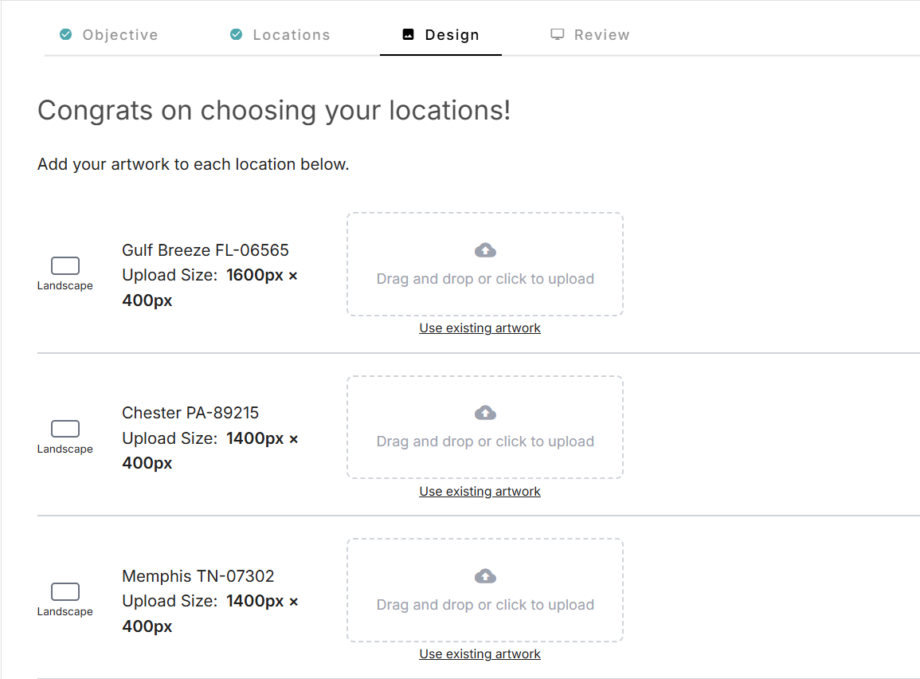
You can have your campaign live in minutes. Create a free account, select your locations, set your budget, upload your design, and start running once approved.
Where can I advertise with Blip in Flagstaff?
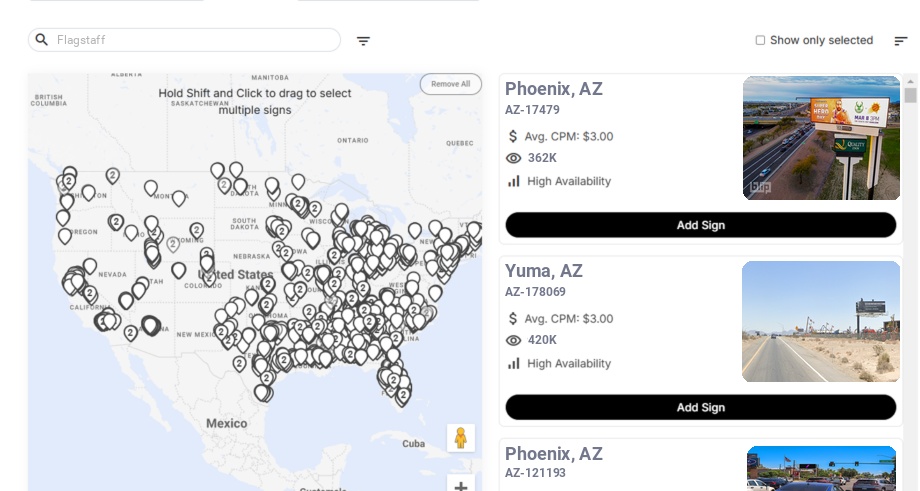
Blip has digital billboards in Flagstaff. You can browse available locations on a map, choose the ones that fit your audience, and start advertising right away.
Still have questions? Launch a campaign in minutes — no contracts, no commitments.
Start Your CampaignFlagstaff Billboard Advertising Guide
Flagstaff, Arizona 76,831 with regional traffic that can exceed 50,000 vehicles per day on the interstates, higher education, and year-round tourism. As the county seat of Coconino County 145,101 residents in the 2020 count across 18,661 square miles, Flagstaff
At 6,910 feet above sea level, the city attracts residents, students, outdoor travelers, and road trippers heading toward Sedona and the South Rim of Grand Canyon. Because daily life and visitor movement here still rely heavily on the road network, we can use digital billboards in Flagstaff to build awareness with both local frequency and gateway-scale reach.
Flagstaff Market Overview
Why Flagstaff punches above its population
Flagstaff is not a giant metro, but it behaves like a regional center. The city grew from 65,870 residents in 2010 to 76,831 in 2020, which was an increase of about 16.6% over the decade. That growth matters because it reflects steady demand for housing, retail, healthcare, education, and local services in a market that already pulls in outside traffic every day across a county of 145,101 residents.
We also get a much larger effective audience than the city limit number suggests. Northern Arizona University 28,000 students, which keeps the local age profile young and gives us a recurring cycle of move-ins, football weekends, graduation periods, and semester-based spending. Coconino Community College, Northern Arizona Healthcare Flagstaff Pulliam Airport
What Flagstaff’s travel behavior means for billboard campaigns
Flagstaff is still an auto-oriented market. Recent American Community Survey estimates generally place drive-alone commuting near 70%, and private-vehicle commuting above 80% when we include carpools. Even with service from Mountain Line
That is good news for billboard advertisers because road visibility is not a niche channel here. It is a core local medium. When we place creative on the right route, we are not only reaching people on one commute to one office district. We are often reaching residents headed to retail corridors, Phoenix visitors arriving on weekend trips, students moving between campus and housing, and travelers stopping for fuel, food, and lodging.
Economic engines that support ad demand in Flagstaff
Flagstaff’s economy is diversified enough to support many billboard categories. Higher education, healthcare, hospitality, outdoor recreation, regional retail, construction, and light manufacturing all play visible roles in a county that spans 18,661 square miles. Visit Flagstaff, the Flagstaff Chamber of Commerce, Downtown Flagstaff Arizona Office of Tourism
For us, that means Flagstaff is usually strongest when we align boards with intent. Interstate boards work well for immediate-stop categories such as hotels, restaurants, dispensaries where permitted, urgent care, fuel, and attractions. In-town boards can work better for apartments, local events, colleges, healthcare systems, retail, and recurring service businesses that want repetition.
Key Traffic Corridors in Flagstaff
Flagstaff’s road network is unusually important because the city sits at the meeting point of major interstate and regional travel flows. Recent traffic maps from the Arizona Department of Transportation show why corridor selection matters so much here.
Interstate 40 through Flagstaff
I-40 is the broadest-reach corridor in the market. ADOT count maps commonly show the busiest Flagstaff segments in the mid-50,000s to above 60,000 AADT, especially around the I-17 interchange and major commercial access points. That gives us a mix of local drivers, cross-state travelers, freight movement, and tourism traffic all on the same roadway.
This corridor is especially effective when we want scale and urgency. Fuel, food, and lodging campaigns perform well here because travelers often make stop decisions while still on the interstate. Attractions and tourism campaigns benefit because I-40 captures people moving between California, New Mexico, Northern Arizona, and the Grand Canyon region. Healthcare, legal, and consumer services can also work well when we want broad awareness among local and regional drivers.
- Fuel, food, and lodging campaigns perform well here because travelers often make stop decisions while still on the interstate.
- Attractions and tourism campaigns benefit because I-40 captures people moving between California, New Mexico, Northern Arizona, and the Grand Canyon region.
- Healthcare, legal, and consumer services can also work well when we want broad awareness among local and regional drivers.
Interstate 17 approaching Flagstaff
I-17 is the direct north-south link between Flagstaff and the Phoenix metro tourism market. Near its northern end, recent ADOT counts are generally in the 50,000 to 60,000 AADT range. That is a major volume stream for weekend leisure traffic, student travel, second-home trips, family visits, and residents moving between the mountain climate and the Valley.
We should pay close attention to this corridor when our audience includes people arriving from central Arizona. Hospitality, event venues, winter recreation, restaurants, breweries, urgent care, and university messaging all benefit from I-17 placements. Because many of these travelers are already destination-minded, directional copy and timely offers usually outperform brand-only creative on this route.
US 89 and the east-side regional gateway
US 89 does not match the interstates for total volume, but it is still one of Flagstaff’s most strategically useful roads. ADOT counts on key north-side and east-side stretches are often in the upper-20,000s to low-30,000s AADT range. This corridor connects Flagstaff with communities to the north and northeast, including travel toward Page Navajo Nation, and the Hopi Tribe
That audience mix makes US 89 valuable for advertisers that need regional relevance rather than only citywide awareness. Healthcare systems can use this route to reach patients who travel into Flagstaff for specialty care. Big-box retail, auto services, and home improvement brands can use this corridor because Flagstaff functions as a service hub for a wide trade area. Hotels, restaurants, and travel services can capture visitors before they spread into town or continue north.
- Healthcare systems can use this route to reach patients who travel into Flagstaff for specialty care.
- Big-box retail, auto services, and home improvement brands can use this corridor because Flagstaff functions as a service hub for a wide trade area.
- Hotels, restaurants, and travel services can capture visitors before they spread into town or continue north.
Milton Road, Route 66, and the in-town commercial core
For local frequency, Milton Road and Historic Route 66 matter enormously. Milton Road, which is part of SR 89A, commonly carries 30,000-plus vehicles per day on major commercial stretches near Northern Arizona University high-teens to 20,000-plus range, depending on the exact location.
These are not just pass-through roads. They are decision corridors. Drivers here are choosing restaurants, retail, apartments, medical offices, and entertainment in real time.
We usually prefer this zone when our goal is repeated exposure among residents and students rather than one-time interstate reach. It is especially strong for: Quick-service restaurants, coffee shops, and retailers because many trips here are immediate purchase trips. Apartment communities and student housing because NAU-related traffic is concentrated nearby. Local healthcare, gyms, entertainment venues, and events because these advertisers need frequency in the everyday path of life.
- Quick-service restaurants, coffee shops, and retailers, because many trips here are immediate purchase trips.
- Apartment communities and student housing, because NAU-related traffic is concentrated nearby.
- Local healthcare, gyms, entertainment venues, and events, because these advertisers need frequency in the everyday path of life.
Audience Segments We Can Reach in Flagstaff
Commuters, local households, and regional errand traffic
Flagstaff’s core resident base is not large by Phoenix standards, but it is active and road-dependent. With drive-alone commuting near 70% and total private-vehicle commuting above 80%, we can expect local residents to encounter billboard messages repeatedly during work, shopping, school, and service trips. Because Flagstaff is also the county seat, we reach more than just city residents. We also reach countywide visitors coming in for healthcare, retail, government services, and education.
This audience is valuable for banks, insurance firms, home services, healthcare providers, attorneys, grocery, furniture, and year-round local retail.
Students, faculty, and young adults
NAU 28,000 students, plus faculty and staff, the university creates a young, mobile, event-responsive audience that advertisers can reach near Milton Road, downtown, and other campus-adjacent routes. NAU Athletics
This segment responds well to entertainment, food, mobile apps, healthcare, apartment leasing, tutoring, telecom, apparel, and career-focused services. The key is relevance. Student creative should usually feel current, price-aware, and specific to the semester rhythm.
Tourists and outdoor travelers
Flagstaff is one of Arizona’s best tourism billboard markets because the city functions as a gateway. The South Rim of Grand Canyon National Park typically records more than 4 million recreational visits per year, and Flagstaff is roughly 80 miles away. Sedona is about 30 miles south, which means we also catch visitors moving between red-rock tourism and mountain-town lodging, dining, and attractions.
Local attractions strengthen that visitor base. Arizona Snowbowl 777 skiable acres, 55 trails, and 8 lifts. Lowell Observatory 1894, and the Museum of Northern Arizona add cultural travel demand. For tourism campaigns, billboard messaging works best when it is immediate, directional, and tied to an experience the traveler can enjoy that same day.
Healthcare, industry, and service workers
Flagstaff is also a practical-services market. Northern Arizona Healthcare
When we want to reach these audiences, commute windows and route-specific placements usually matter more than broad weekend visibility. In Flagstaff, the right board can feel much closer to a business district than the city’s size might suggest.
Seasonal and Timing Opportunities in Flagstaff
Summer escape season in Flagstaff
Summer is one of Flagstaff’s biggest advertising opportunities because the climate itself becomes a selling point. The average July high in Flagstaff is about 82°F, while Phoenix is around 106°F, which creates a difference of roughly 24 degrees. That gap helps explain why summer weekend traffic from central Arizona stays strong.
For us, that means May through September is prime time for hotels, restaurants, breweries, festivals, outfitters, local attractions, and family entertainment. We should emphasize cool temperatures, outdoor patios, pine forests, trail access, and same-day experiences. Friday outbound traffic from Phoenix and Sunday return traffic often deserve different messages.
Winter snow and ski timing in Flagstaff
Winter creates a second major season. Arizona Snowbowl 9,200 feet and a summit elevation of 11,500 feet. When snow conditions improve, we often see strong intent-based travel on the city’s west and south approaches, especially from weekend visitors.
This is where timing becomes critical. Ski, lodging, tire, apparel, coffee, breakfast, and après-ski campaigns often perform best when we tighten dayparts around Thursday evening arrivals, Friday arrivals, early Saturday morning ski traffic, and Sunday afternoon departures. Weather-aware creative is especially useful in this market because a fresh snow cycle can change travel behavior quickly.
Academic, event, and family-calendar windows
NAU gives us recurring timing anchors even outside peak tourism months. Student move-in typically hits in August, while graduation creates major parent and visitor traffic in May and December. Fall also brings football weekends, alumni visits, and back-to-school spending patterns around campus and Milton Road.
Flagstaff’s event calendar adds more pulses. The Coconino County Fair typically runs over 4 days on Labor Day weekend. The Flagstaff Festival of Science is known for its 10-day format, and summer concerts at the Pepsi Amphitheater Fort Tuthill High Country Conference Center events and Downtown Flagstaff
Billboard Design Tips for Flagstaff
Use visual language that actually fits Flagstaff
Flagstaff is not a generic Arizona desert market. We should avoid overusing saguaros, Sonoran color palettes, and hot-weather imagery that feels more like Phoenix or Tucson. Flagstaff creative usually works better when it reflects pine forests, mountain silhouettes, snow scenes, dark skies, campus energy, Route 66 nostalgia, and outdoor recreation.
That gives us a clear visual palette. Pine green, navy, snow white, sunset orange, and retro neon often feel native to the market. If we are advertising in winter, snow texture and cold-weather gear look credible. If we are advertising in summer, patios, trails, and alpine air feel more authentic than cactus stock photos.
Match the message to the route
The creative that works on I-40 is not always the creative that works on Milton Road. On the interstates, we usually want direct offers, distance cues, or a single destination promise. In town, we can lean a little more into brand personality, event messaging, and repeated local reminders.
A few route-specific principles usually help: On I-40 and I-17, we should lead with one action, such as “Exit for Hot Breakfast,” “Stay Tonight in Flagstaff,” or “ER Care Ahead.” On Milton Road and Route 66, we can use more lifestyle-driven lines for restaurants, apartments, events, and student offers because repetition is higher. On US 89, we should think regionally, especially for healthcare, retail, and service businesses that serve a broad Northern Arizona trade area.
- On I-40 and I-17, we should lead with one action, such as “Exit for Hot Breakfast,” “Stay Tonight in Flagstaff,” or “ER Care Ahead.”
- On Milton Road and Route 66, we can use more lifestyle-driven lines for restaurants, apartments, events, and student offers because repetition is higher.
- On US 89, we should think regionally, especially for healthcare, retail, and service businesses that serve a broad Northern Arizona trade area.
Design for bright sun, snow glare, and driving speed
Flagstaff’s high-altitude light can be intense, and winter glare can wash out weak creative. That is why high contrast matters here. Bold type, dark backgrounds, and one dominant image usually read better than subtle palettes or low-contrast photography.
Speed matters too. Drivers may be moving around 35 mph on the busiest commercial stretches of Milton Road, but they can be moving 65 to 75 mph on interstate approaches. On the fastest boards, we should usually stay in the 6 to 8 words range and focus on one idea. Extra lines, small legal copy, and multiple offers are much more likely to disappear in this market than in a slower urban core.
Lean into Flagstaff’s identity when it helps the brand
Flagstaff became the world’s first International Dark Sky City 2001, and that astronomy-and-night-sky identity is real. It can inspire strong creative for observatories, science events, breweries, hotels, wellness brands, and premium local experiences. The same principle applies to ski season, Route 66 heritage, and NAU
When our creative feels like it belongs in Flagstaff, it usually feels more trustworthy.
Regional Strategies Across Greater Flagstaff
Downtown Flagstaff, Southside, and the NAU core
This area is where we focus on local repetition and younger audiences. Downtown Flagstaff
If our audience is students, faculty, hospital staff, or downtown shoppers, boards near Milton Road and other central commercial routes usually outperform far-out interstate boards on frequency. This is where we build familiarity.
West Flagstaff, US 180, and recreation-oriented travel
West Flagstaff is where the outdoor and leisure identity becomes especially powerful. Traffic moving toward Arizona Snowbowl Museum of Northern Arizona, and west-side lodging and dining makes this area strong for hotels, gear shops, family attractions, breweries, coffee, and winter-specific services.
This zone is also useful when we want to catch visitors before they commit to the rest of their day. In winter, ski messaging can be timely and tactical. In summer, outdoor recreation and family attraction ads can benefit from the same directional logic.
East Flagstaff, US 89, and I-40 east access
East Flagstaff is often a better fit for regional-service categories than casual tourism brands. Healthcare systems, auto dealers, home improvement, big-box retail, quick-service dining, and logistics-related services can all perform well here because this side of town captures practical travel into the city. It also works well for brands that want exposure to both locals and travelers continuing toward northeastern Arizona.
If we serve a trade area much larger than city limits, east-side placements can be more efficient than they first appear on a population map. In Flagstaff, regional pull matters.
South Flagstaff, I-17 arrivals, and airport-business travel
The south approach is where we catch Phoenix-area arrivals and other inbound travelers before they spread across the market. That makes it useful for hotels, event venues, restaurants, urgent care, winter recreation, and destination retail. It is also relevant for advertisers targeting conference or business travelers through Flagstaff Pulliam Airport High Country Conference Center, and nearby hotels.
When we want to win the visitor before another business does, south-approach boards are often our best first test.
Using Blip Effectively in Flagstaff
Plan around intent, not just map coverage
In Flagstaff, a smart campaign usually starts by separating audiences by purpose. We can use one set of boards for interstate reach, another for NAU and central-city repetition, and another for regional service traffic on the east side. That approach is usually better than spreading a budget evenly across every available location.
We also do not need to overcommit from day one. In Flagstaff, it often makes sense to test 2 or 3 corridor types first, then shift spend toward the routes that best match our goal. A hotel might favor I-17 and I-40. A student apartment brand might favor Milton Road. A healthcare provider might need US 89 plus an in-town reinforcement board.
Use dayparting and seasonal bursts
Flagstaff is one of the clearest examples of why timing matters. We can daypart for weekday commuter windows, Friday arrival traffic, Saturday ski mornings, Sunday return trips, lunch periods near downtown, or late-afternoon retail runs. We can also pulse budgets around snowstorms, summer weekends, move-in, graduation, or conference dates instead of treating every week the same.
That flexibility is especially valuable in a market where weather and event calendars change behavior quickly. A board that is average on a random Tuesday can become extremely valuable on a snowy Friday or a graduation weekend.
Refresh creative as the audience changes
Because Flagstaff’s audience shifts with the season, our creative should shift too. We can rotate student-focused ads in August, ski-focused creative in winter, tourism offers in summer, and holiday retail messages in November and December. We can also compare creative styles in real time, then keep the best-performing versions in market longer.
Blip’s artwork tools and quick creative updates make this practical. In a place like Flagstaff, where the difference between “local errand traffic” and “weekend visitor traffic” can be dramatic, fast creative swaps are not just convenient. They are strategic.
Getting Started with Billboard Rental in Flagstaff
Start with one clear objective
Before we rent a billboard in Flagstaff, we should decide what success looks like. Are we trying to drive immediate stops from I-40, build semester-long awareness near NAU, reach regional healthcare users, or promote a short event window? The answer determines almost everything else, including corridor choice, budget pacing, and creative style.
A simple rule helps here. If we need broad awareness fast, we should begin with interstate visibility. If we need repeated local exposure, we should start closer to Milton Road, downtown, or other everyday commercial routes.
Evaluate each Flagstaff billboard with local context
When we compare boards on the map, we should not look only at price or raw traffic. We should also judge how the location fits real Flagstaff travel behavior.
A practical checklist usually includes these questions. Is the board aimed at inbound visitors, outbound locals, or daily in-town traffic? Does the route support immediate action, such as food, gas, lodging, or urgent care, or does it support awareness and repetition? Is the board close to NAU, Downtown Flagstaff interstate speed or on a slower commercial corridor? Is our timing aligned with summer tourism, winter ski travel, move-in, graduation, or a local event weekend? Does our creative match what people are actually doing on that road?
Those questions matter more in Flagstaff than in many larger cities because each corridor carries a distinct blend of locals, students, and visitors.
- Is the board aimed at inbound visitors, outbound locals, or daily in-town traffic?
- Does the route support immediate action, such as food, gas, lodging, or urgent care, or does it support awareness and repetition?
- Is the board close to NAU, Downtown Flagstaff
- Will our audience be driving at interstate speed or on a slower commercial corridor?
- Is our timing aligned with summer tourism, winter ski travel, move-in, graduation, or a local event weekend?
- Does our creative match what people are actually doing on that road?
Expect a simpler process than traditional billboard buying
Traditional billboard companies often push fixed packages, long lead times, or bundled locations that do not match our real objective. With Blip, we can evaluate boards directly, start with a modest test, change schedules quickly, and avoid committing to a rigid 4-week package before we learn what works.
That is especially useful in Flagstaff, where tourism, weather, and campus cycles can shift demand fast. We can launch with a focused plan, watch performance, and then expand into the best-performing corridors instead of guessing up front.
Launch, measure, and optimize
Once our campaign is live, we should give it enough time to learn, then refine. A 2-week test across a few targeted boards can tell us a lot about route quality, timing, and creative fit.
After that, we can increase spend on strong placements, pause weak ones, and swap artwork for the next seasonal window. In Flagstaff, the advertisers who usually get the best billboard results are not the ones who buy the most boards first. They are the ones who match the city’s real rhythms, including interstates, students, climate, and tourism, then keep optimizing as those rhythms change.