Billboards in Indian Trail, NC
No Minimum Spend. No Long-Term Contracts. Just Results.
Turn daily drives into mini marketing moments with Indian Trail billboards powered by Blip. Launch flexible, budget-friendly campaigns on digital billboards near Indian Trail, North Carolina, serving the Indian Trail area with eye-catching ads you control in real time.
Billboard advertising
in Indian Trail has
never been easier
HERE'S HOW IT WORKS
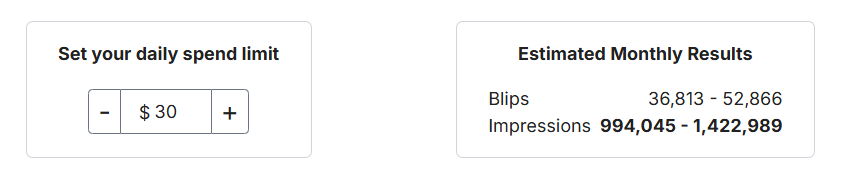
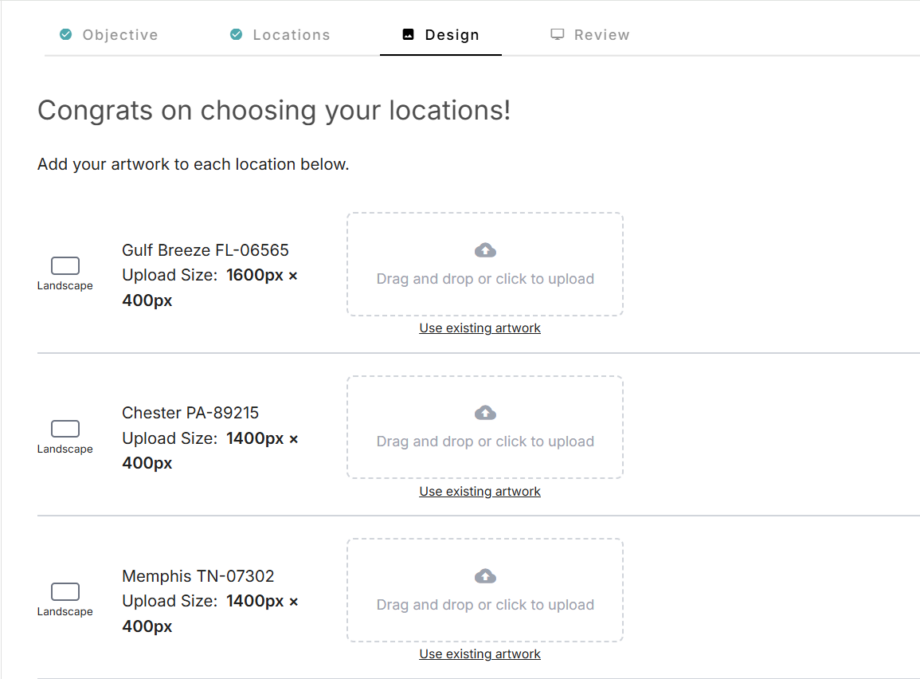
How much is a billboard in Indian Trail?
Billboards in other North-carolina cities
Indian Trail Billboard Advertising Guide
The Indian Trail area is one of the fastest‑growing suburban markets outside Charlotte, making it a powerful place to build awareness, drive local foot traffic, and support regional campaigns. With Blip’s digital billboards near Indian Trail, including locations in nearby Monroe, we can help you target daily commuters, families, and shoppers moving between Union County communities and the greater Charlotte region.
Understanding the Indian Trail Area Market
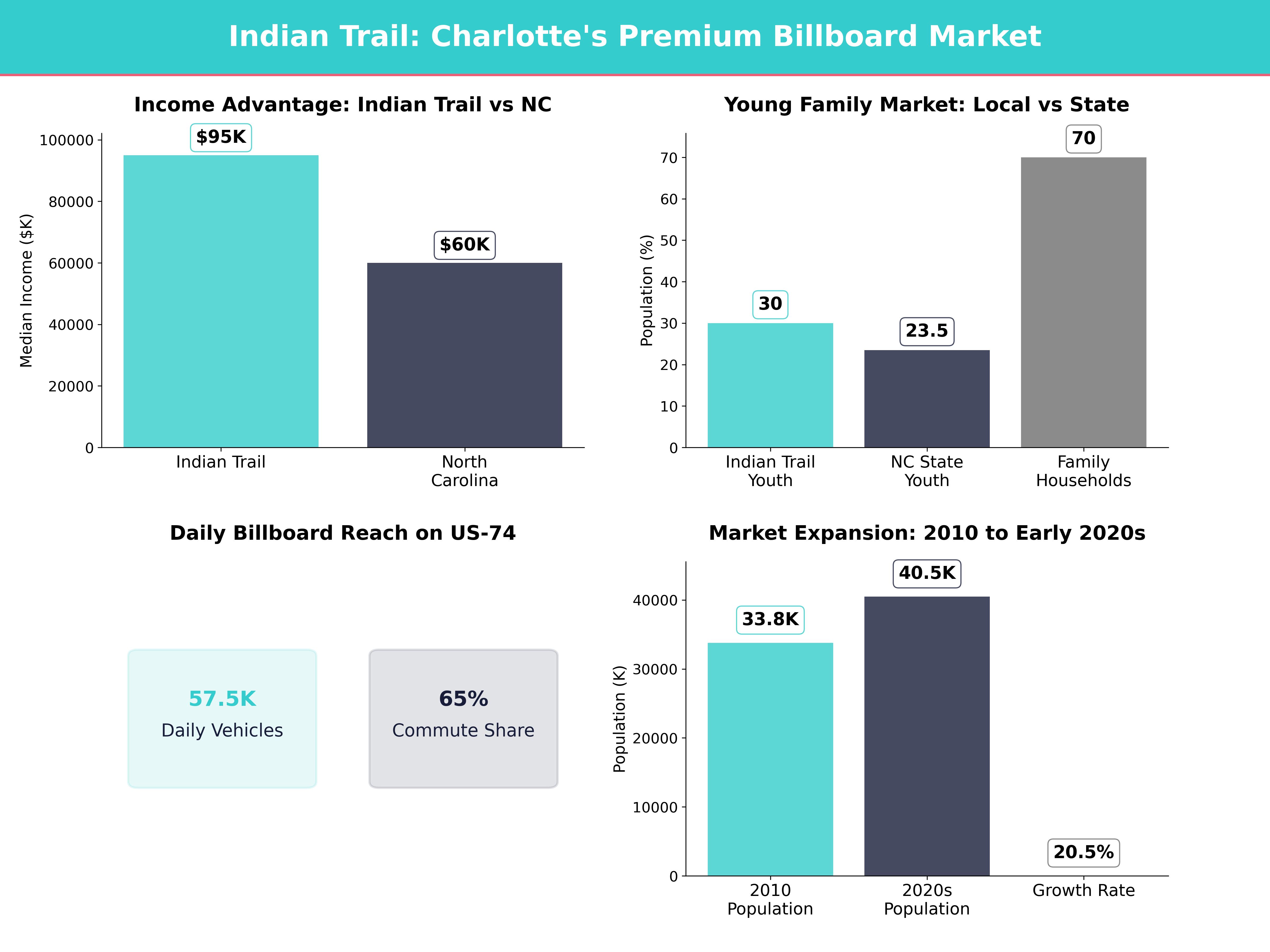
Indian Trail sits in western Union County, about 15–20 miles southeast of Uptown Charlotte along the US‑74 corridor. According to recent local planning and demographic estimates, the town has grown from roughly 33,500–34,000 residents in 2010 to around 40,000–41,000 residents in the early 2020s—a jump of roughly 18–23% in just over a decade. Neighboring Union County has expanded from just over 200,000 residents in 2010 to approximately 255,000–260,000 residents today, and routinely ranks among North Carolina’s top 10 fastest‑growing counties in long‑term growth analyses.
Key market characteristics:
- Family‑oriented community: Recent local demographic profiles show that about 28–32% of Indian Trail‑area residents are under age 18–20, compared with roughly 23–24% statewide, and more than 70% of households are family households. This produces strong, consistent demand for family services, youth activities, pediatric and family healthcare, education, and everyday retail.
- Affluent suburb: Median household incomes in and around Indian Trail are commonly reported in the $90,000–$100,000 range, compared with a North Carolina median closer to the mid‑$60,000s. That means many Indian Trail‑area households have 30–40% more income than the state average, supporting higher‑end retail, automotive, home improvement, financial services, and travel/experiential brands.
- Highly commuter‑based: Regional commuting analyses for Union County indicate that well over 60–70% of employed residents travel outside their immediate town for work, with a large share commuting toward Charlotte, Monroe, and other job centers in Union and Mecklenburg counties. Many travel along US‑74, the Monroe Expressway, and Old Charlotte Highway, which is exactly where nearby Monroe billboards capture daily impressions.
- Homeownership and stability: Western Union County suburbs typically report homeownership rates above 75–80%, compared with roughly 65% statewide. High ownership and a large base of single‑family homes translate into long‑term residents who repeatedly see and remember recurring billboard messages, making frequency‑based branding especially effective.
For more detail on local growth, investment, and development priorities, advertisers can review the Town of Indian Trail, Union County Union County Economic Development
Where Our Billboards Serve the Indian Trail Area
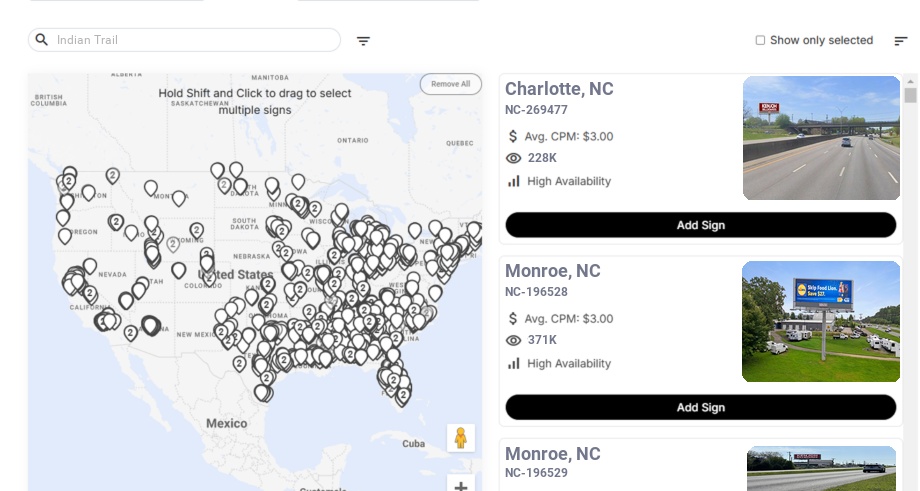
We have 2 digital billboards serving the Indian Trail area for billboard advertising near Indian Trail, both located in Monroe—just about 2 miles from Indian Trail’s southern boundary and within a 10‑mile radius of much of the community. These locations position your message along the core east‑west spine that residents use for shopping, commuting, and errands, making them some of the most efficient Indian Trail billboards for reaching local drivers.
Why Monroe is strategically important for reaching the Indian Trail area:
- Regional retail draw: Monroe is a primary commercial hub for Union County. The City of Monroe reports multiple regional shopping centers, auto dealerships, and big‑box retailers along US‑74 that pull shoppers from Indian Trail, Stallings, Wesley Chapel, and other nearby communities. Weekends and late afternoons often see peak traffic volumes around these centers, driving higher billboard impressions.
- US‑74 / Monroe Expressway visibility: According to North Carolina Department of Transportation (NCDOT) traffic counts, key segments of US‑74 through Monroe and western Union County frequently carry 50,000–65,000 vehicles per day, with some interchanges trending even higher as development intensifies. The parallel Monroe Expressway also attracts thousands of daily commuters seeking faster trips toward Charlotte. Boards positioned along or near these arterials put your brand in front of tens of thousands of potential impressions every day.
- Workforce and service hub: Monroe is home to Union County’s government complex, regional healthcare facilities, and numerous industrial and logistics employers. A significant share of Indian Trail‑area residents travel into Monroe for county services, hospital and specialist appointments, retail, and employment, meaning they pass the same billboard locations multiple times per week—ideal for building familiarity and recall.
Before planning a campaign, we recommend reviewing regional transportation and traffic data via NCDOT’s traffic resources and local plans available from the City of Monroe to understand which corridors best match your target audience’s travel patterns and how specific billboards near Indian Trail align with your customer routes.
Who You’re Reaching: Demographic & Lifestyle Insight
The Indian Trail area sits at the intersection of several valuable audience segments that drive Union County’s economy.
1. Young families and parents
- The Indian Trail area feeds into one of the state’s larger school systems, Union County Public Schools, which serves more than 40,000 students countywide across 50+ schools. Local elementary and middle schools around Indian Trail and Stallings typically operate near or above capacity, signaling dense concentrations of school‑aged children.
-
In neighborhoods around Indian Trail, it’s common for 1 in 3 households to include children under 18. Combined with strong youth sports participation—local leagues and travel programs regularly report hundreds to thousands of registrants per season—this creates a prime market for:
- After‑school programs, sports, and arts
- Pediatric and family healthcare
- Quick‑service and fast‑casual restaurants
- Family entertainment venues (trampoline parks, bowling, cinemas, etc.)
- Use simple, family‑centric visuals: kids playing sports, family dinners, safe neighborhoods, or “weekend fun” imagery, knowing that parents will likely see your messages multiple times per week during school and activity runs.
2. Commuters & professionals
- Professional and white‑collar occupations are common among Indian Trail‑area residents, with a high share working in healthcare, finance, logistics, manufacturing, technology, and professional services clustered in Charlotte and Union County industrial parks.
- Regional workforce profiles show that a majority of Union County commuters spend 25–44 minutes per trip, with many using US‑74 and the Monroe Expressway daily. That sustained, repetitive exposure window makes large, bold billboard messages especially powerful as a break from heavy digital‑screen usage (phones, tablets, laptops).
-
Ideal for:
- Financial services (banks, credit unions, insurance)
- Real estate and new developments
- Career training, colleges, and certification programs
- Professional services (dentists, orthodontists, attorneys, medical specialists)
3. Suburban homeowners and DIYers
- High homeownership (often 75–80%+ in western Union County suburbs) and a heavy concentration of single‑family homes mean that a large portion of your audience makes or influences home‑improvement decisions.
-
Many local subdivisions were built in waves from the early 2000s through the mid‑2010s, which corresponds to roughly 10–20‑year‑old homes now reaching key replacement cycles for roofs, HVAC systems, water heaters, and exterior work. This significantly increases demand for:
- HVAC, roofing, plumbing, landscaping, pest control
- Kitchen and bath remodelers, flooring companies
- Solar installation, windows, insulation, and security systems
- Imagery that highlights “before/after,” curb appeal, energy savings, and “local, trusted, fast response” messaging resonates strongly with Indian Trail‑area homeowners.
4. Faith‑based and community‑oriented audiences
- Union County and the Indian Trail‑Monroe corridor have a strong faith and civic culture, with dozens of churches and multiple denominations operating within a short drive of Indian Trail. Weekend church attendance and mid‑week activities generate consistent traffic on Sundays and weekday evenings.
- Civic engagement is reinforced by frequent events featured on the Town of Indian Trail and Union County hundreds to several thousand attendees.
-
Nonprofits, churches, schools, and local initiatives can leverage digital billboards to:
- Promote events and services
- Raise awareness for drives and fundraisers
- Recruit volunteers and program participants
You can tune your creative and scheduling to these segments, using multiple Blip creatives to speak differently to parents, homeowners, commuters, or church‑going audiences who regularly drive past Indian Trail billboards.
Traffic Patterns: When to Run Your Blips
One of Blip’s biggest advantages is the ability to buy only the times that matter most. In the Indian Trail area and Monroe corridor, traffic flows line up with typical suburban commuter and shopping patterns.
Weekday morning drive (6:30–9:00 a.m.)
- NCDOT and regional commute data show that the bulk of outbound trips toward Charlotte and Monroe cluster in this window, with peak volumes often reaching 60–70% of daily directional traffic on commuter corridors.
- Commuters are heading west toward Charlotte job centers and east toward Monroe employers and industrial sites.
-
Ideal for:
- Coffee shops, breakfast QSR, and convenience stores
- Healthcare reminders (“Don’t forget your annual checkup”)
- School, church, and event announcements
- Recruiting, staffing, and “Now Hiring” messages tied to Monroe industrial and logistics parks
Midday / school & errand window (10:00 a.m.–3:00 p.m.)
- Midday traffic volumes are somewhat lower than peak, but still generate steady impressions from stay‑at‑home parents, retirees, remote workers, and service professionals.
- For many local shopping centers along US‑74 and in Monroe, late morning to mid‑afternoon accounts for a significant share of daily transactions, especially on Tuesdays–Thursdays.
-
Best suited for:
- Grocery stores and retailers
- Medical, dental, and wellness providers
- Home services (showing availability “Today” or “This Week”)
- Senior services and healthcare
Afternoon pickup and evening drive (3:00–7:00 p.m.)
- Afternoon school dismissals and end‑of‑workday traffic create a second major peak; on some corridors, volumes in this window rival or exceed the morning rush.
- Parents picking up children, families heading to practices, and evening commuters make repeated weekly trips, especially during youth sports seasons.
-
Strong for:
- Restaurants and takeout (“Dinner solved in 15 minutes”)
- Family entertainment and youth activities
- Gyms and fitness studios
- Retail promotions with “Tonight” or “This Weekend” framing
Weekends
- Retail and leisure surveys across the Charlotte region show that Saturday often accounts for the single highest shopping day of the week, with extended traffic around big‑box and regional centers.
- Sundays see a mix of morning church traffic and afternoon family outings, as well as return‑from‑weekend travel.
-
Great for:
- Event promotions (festivals, concerts, tournaments)
- Auto dealerships and furniture stores, which frequently report weekend sales spikes
- Tourism and attractions in the wider Charlotte region, supported by resources like Charlotte Regional Visitors Authority / Visit Charlotte and Visit Union County
Because Blip lets you adjust bids by hour and day, you can concentrate your budget on these high‑value windows rather than paying for low‑impact overnight impressions, ensuring your billboard advertising near Indian Trail is focused on moments when your audience is actually on the road.
Creative Strategy for the Indian Trail Area
To stand out on digital billboards serving the Indian Trail area, design with both the audience and the drive environment in mind.
1. Make it instantly readable
- Aim for 6–10 words max of primary text, which aligns with typical 6–8‑second glance times at highway speeds.
- Use large, high‑contrast fonts (white/yellow on dark backgrounds or dark text on light backgrounds).
- Avoid long URLs; use short domains or keywords plus “Search: [Brand]” so drivers can remember it after a 20–30 minute commute.
2. Lead with what matters locally
Tie your headline to recognizable habits and places in the Indian Trail area:
- “Dinner on the way home from the Monroe bypass?”
- “Indian Trail area families: braces made easy.”
- “New roofs for Union County homeowners in 24 hours.”
References to “Union County,” “US‑74,” or “near Indian Trail” help cement local relevance and match what residents see in local outlets such as The Charlotte Observer Enquirer‑Journal.
3. Show people like your audience
- Feature real‑looking families, youth athletes, or homeowners.
- Diversity matters: Union County demographic profiles typically show a mix that includes substantial White, Black, and Hispanic/Latino populations, as well as growing Asian and multiracial communities. Inclusive imagery widens appeal and reflects what residents see in local schools and neighborhoods.
4. Use urgency and proximity
The Indian Trail area is very drive‑oriented. Call‑to‑action ideas:
- “2 miles ahead in Monroe – Exit for Savings”
- “Call today, installation this week”
- “Enroll by Friday – Classes near Indian Trail area”
Including time‑bound language (“today,” “this weekend,” “by Friday”) reinforces action while the message is fresh during a 15–40‑minute drive.
5. Take advantage of digital flexibility
With Blip, you can upload multiple creatives and rotate them. Suggestions:
- Time‑based offers: Breakfast vs. dinner menu, weekday vs. weekend specials tied to peak dayparts.
- Event countdowns: “Soccer registration ends in 5 days,” then 4, 3, etc.—especially effective when parents see the same board multiple times per week.
- Weather‑responsive concepts: While Blip doesn’t automatically change creative for weather, you can schedule season‑specific designs (AC repair in summer, heating and roofing in fall/winter), aligning with local patterns where average summer highs sit in the upper 80s–low 90s°F and winter cold snaps can stress older HVAC and plumbing systems.
Campaign Strategies by Industry
Here are practical approaches for specific advertiser types targeting the Indian Trail area via nearby Monroe billboards:
Local restaurants & QSR
- Target 6–9 a.m., 11 a.m.–2 p.m., and 4–7 p.m. on weekdays; 11 a.m.–7 p.m. on weekends, mirroring peak meal and shopping trips.
- Local and regional restaurant reports frequently show 20–30% higher transaction volumes during these dayparts compared with off‑peak hours.
- Use mouth‑watering food imagery plus a short hook: “Kids eat free Tuesday,” “Order online, pick up on US‑74.”
- Rotate creatives by day: family specials on Sundays, “kids’ night” mid‑week, game‑day wings on Fridays/Saturdays timed with high‑school, college, and pro sports seasons covered by outlets like WCNC Charlotte.
Home services (HVAC, roofing, plumbing, lawn, pest)
- Focus on weekday/daytime and early evening (7 a.m.–7 p.m.), when homeowners are more likely to call or visit your website.
- In a market where three‑quarters or more of households own their homes and many are entering 10–20‑year maintenance cycles, clear offers drive response: “Union County’s fastest AC repair,” “Roof inspections in 24 hours.”
- Make your phone number huge and easy to read; emphasize speed, reliability, and local presence.
- Use seasonal campaigns: spring pest and lawn, summer AC, fall roofs and gutters, winter heating and emergency plumbing.
Healthcare and dental
- Healthcare is a major employment and service sector in the Monroe–Charlotte corridor, with multiple clinics, urgent care centers, and specialty practices. Busy families value access and convenience.
- Highlight convenience and family‑friendly care: “Evening appointments for busy Indian Trail area families,” “Walk‑ins welcome on US‑74 in Monroe.”
- Promote new locations, open houses, or free consultation offers.
- Use friendly face imagery (doctors, hygienists, kids) to build trust quickly—especially effective in a suburban market where word‑of‑mouth and local reputation play a big role in provider choice.
Retail & auto dealers
- Auto dealers and big‑box retailers along US‑74 and in Monroe typically report heavier traffic Thursday–Sunday, with weekend sales often accounting for a disproportionate share of weekly volume.
- Run heavier schedules in these windows, and align creative with major sales events (holiday weekends, model‑year clearance).
- Promote new inventory, financing deals, or “this weekend only” sales.
- Use strong directional cues: “On US‑74 in Monroe – 5 minutes ahead,” “Next right – 1 mile.”
Education, camps, and youth programs
- Union County’s large K–12 population drives strong demand for camps, tutoring, and extracurriculars, especially in the spring and early summer when parents plan activities.
- Advertise heavily 4–7 p.m. on weekdays and throughout weekends when parents are with kids in the car.
- Use simple, bold copy: “STEM Summer Camp – Grades 3–8,” “Soccer sign‑ups now open.”
- Build a countdown campaign: start 4–6 weeks before your deadline, increasing frequency as the date approaches and aligning with community calendars on the Town of Indian Trail events calendar.
Events, churches, and nonprofits
- Combine long‑lead awareness (4–6 weeks out) with a final push in the last 7–10 days.
- Include date, time, and a very short web or search call‑to‑action.
- Reference well‑known venues, parks, or intersections (“at Chestnut Square Park,” “near Monroe’s Downtown Square”) to orient drivers.
- Local news outlets like The Charlotte Observer Enquirer‑Journal, and regional TV stations such as WSOC‑TV are helpful for tracking community events and seasonal moments you can align with your creative so your Indian Trail billboards stay timely and relevant.
Using Blip’s Tools to Your Advantage
Blip’s platform is built for flexibility, which is especially valuable in a dynamic suburban market like the Indian Trail area.
1. Start with a test flight
- Begin with a 7–14 day test across your chosen Monroe boards.
- Spread your budget across key dayparts (morning + evening commute, plus a slice of weekend).
- Review impression delivery (e.g., total plays vs. estimated traffic volumes) and any linked metrics (website traffic, calls, in‑store results) from ZIP codes around Indian Trail, Monroe, Stallings, and Wesley Chapel to understand which billboards near Indian Trail are performing best.
2. Optimize by time of day and day of week
- Increase bids for hours that correlate with your conversions (e.g., dinner orders, form fills, quote requests).
- Reduce or pause off‑peak hours (late night/very early morning) to stretch your budget while still maintaining consistent weekly presence.
3. Rotate creatives and A/B test
-
Run two versions of your ad:
- Version A: “Price/Offer‑led” (e.g., “$49 new patient exam”).
- Version B: “Benefit‑led” (“Pain‑free family dentistry near Indian Trail area”).
- Rotate them evenly at first, then allocate more budget to the better‑performing version based on downstream metrics such as call volume, appointment requests, or coupon redemptions.
4. Align with the local calendar
Use local sources like the Town of Indian Trail events calendar, Union County Visit Union County
- School start/end dates and major breaks
- Youth sports seasons and tournament weekends
- Festivals, parades, concerts, and holiday events that regularly draw hundreds or thousands of attendees
- Road construction that may shift traffic flows or create new high‑exposure choke points
Then, adjust your messaging and scheduling to capture these high‑attention moments and get more value from your billboard rental near Indian Trail.
Measuring Success in the Indian Trail Area
Because billboards serving the Indian Trail area are part of a broader local marketing mix, we recommend multiple measurement approaches:
-
Direct response cues
- Use a unique URL or landing page (e.g., yoursite.com/ITrail).
- Track calls from a dedicated phone number used only on your billboards.
- For events, use a simple promo code (“ITRAIL10”) to estimate how many registrations came from billboard viewers.
-
Website analytics
- Watch for lifts in direct traffic and “brand + near me” or “in Indian Trail/Monroe” searches from ZIP codes in and around the Indian Trail area and Monroe.
- Compare sessions and conversions from those ZIP codes in the 4–8 weeks after your campaign launches to the 4–8 weeks prior.
-
In‑store feedback
- Train staff to ask, “How did you hear about us?” and tally “billboard” responses weekly. After a consistent flight, it’s common for local businesses to start seeing billboard mentions appear regularly alongside search and word‑of‑mouth.
-
Campaign benchmarks
- For small local businesses, hitting consistent weekly leads/sales from the Indian Trail area within 4–8 weeks of starting a steady flight is a solid success indicator.
- For brand/awareness campaigns, track recognition via informal surveys, social media mentions from local residents, and coverage or listings in community outlets such as the Enquirer‑Journal or town event pages.
Putting It All Together
The Indian Trail area combines rapid population growth, strong household incomes, and heavy commuter traffic flowing along the US‑74/Monroe corridor—conditions that are ideal for well‑planned digital billboard campaigns. By using Blip’s boards in nearby Monroe, you can:
- Reach tens of thousands of local drivers daily on their most common routes.
- Speak directly to families, homeowners, and commuters that power the area’s economy.
- Start small, test creative and timing, and scale what works over time.
With thoughtful targeting, strong creative, and consistent presence, billboards serving the Indian Trail area can become a cornerstone of your local marketing strategy and a reliable driver of long‑term growth, whether you are testing billboard advertising near Indian Trail for the first time or expanding existing billboard rental near Indian Trail into a larger, multi‑channel campaign.