Billboards in New Bern, NC
No Minimum Spend. No Long-Term Contracts. Just Results.
Trusted by Leading Brands


Billboard advertising
in New Bern has never been easier
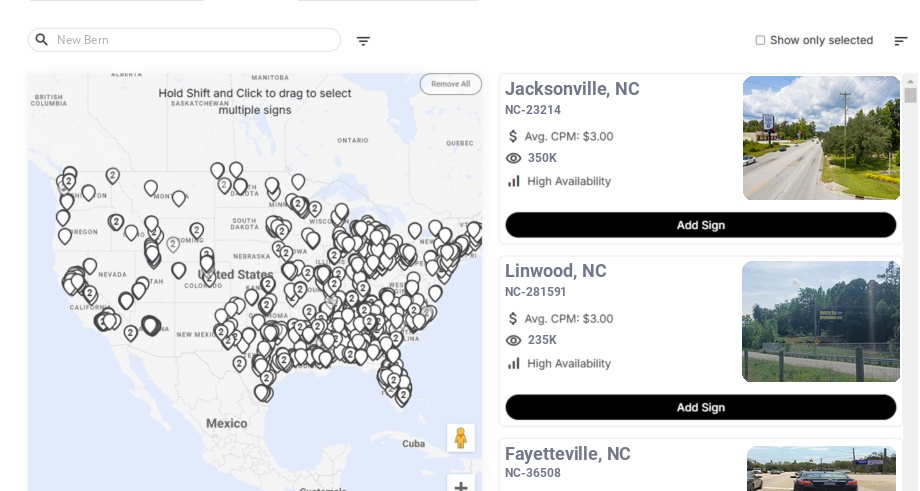



How much is a billboard in New Bern?
Why Choose Blip for Billboard Advertising in New Bern
-
Blip lets you launch New Bern billboards self-serve in minutes, reaching US-17 and US-70 commuters without traditional ad-buy friction.
-
Set any budget in New Bern and pay only for the blips you get—ideal for testing campaigns with tourists, retirees, and Cherry Point families.
-
Daypart your New Bern ads for 7-9 a.m. and 4-6 p.m. to catch commuter surges on Neuse Blvd, MLK Jr. Blvd, and Glenburnie Rd.
-
No contracts mean you can scale New Bern campaigns for April-October tourism, then dial back in the off-season without getting locked in.
-
Use Blip's real-time analytics to shift spend as New Bern traffic spikes for Beary Merry Christmas, bridge crossings, and weekend waterfront trips.
-
Create and rotate fresh New Bern creatives fast—perfect for Tryon Palace visitors, downtown events, and route-specific messages like 'Next exit.'
Frequently Asked Questions About Billboard Advertising in New Bern
How much does a billboard cost in New Bern, North Carolina with Blip?
With Blip, you choose your own daily budget for New Bern billboards, and our system automatically keeps your digital ads within that limit, whether you want to start small or scale up. Each “blip” is a 7.5–10 second display, and you only pay for the blips you receive, so your total cost simply adds up based on when and where your ad shows and current advertiser demand. That means you can test billboards in New Bern, North Carolina without a large upfront commitment and adjust your budget anytime.
Where should I advertise with Blip in New Bern, North Carolina to reach the most traffic?
New Bern’s geography funnels vehicles onto a few key corridors, including US‑17, US‑70 (future I‑42), NC‑55, Dr. Martin Luther King Jr. Blvd, Neuse Blvd, and Glenburnie Rd. Portions of US‑70 near the US‑17 interchange frequently measure 35,000–45,000 vehicles per day, while busy sections of US‑17 Business/Neuse Blvd and MLK Jr. Blvd register in the 25,000–35,000 vehicles per day range. Heavier urban stretches of Glenburnie Rd and connector routes commonly show 15,000–20,000 vehicles per day.
What kind of audience can Blip reach in New Bern, North Carolina?
New Bern gives advertisers a rare mix of small-city intimacy and regional reach, with roughly 31,000–32,000 residents in the city and a much larger trade area beyond it. The area pulls in tourists, military families, retirees, and day-trippers, and more than 50% of New Bern’s workers live outside city limits but travel in for work. Nearby MCAS Cherry Point also adds thousands of active-duty personnel, civilian employees, and contractors who shop, dine, and seek services in New Bern.
When is the best time to run billboards in New Bern, North Carolina with Blip?
New Bern’s peak months typically run from April through October, when hotel occupancy can be 15–30% higher than winter months and transient boater traffic is strongest. Commuter surges are usually 7–9 a.m. and 4–6 p.m., and weekend traffic on retail corridors can be elevated as well. The holiday season also brings major spikes, with Beary Merry Christmas events and special shopping nights raising downtown foot traffic by 30–50% compared with typical weeks.
What areas in New Bern, North Carolina work best for local business billboards?
Approach corridors such as US‑17, US‑70, and NC‑55 are best for tourism, lodging, destination dining, attractions, and larger regional retailers. Retail strips like MLK Jr. Blvd and Neuse Blvd are strong for grocers, big box, QSR, healthcare, gyms, salons, and everyday services. Downtown and waterfront approaches are ideal for restaurants, bars, boutiques, tours, galleries, and historic downtown events.
Do I need a contract to advertise with Blip in New Bern?
No, Blip has no long-term contracts or minimum commitments. You can start, pause, or stop your campaign at any time.
How fast can I launch a billboard campaign with Blip in New Bern?
You can have your campaign live in minutes. Create a free account, select your locations, set your budget, upload your design, and start running once approved.
Where can I advertise with Blip in New Bern?
Blip has digital billboards in New Bern. You can browse available locations on a map, choose the ones that fit your audience, and start advertising right away.
Still have questions? Launch a campaign in minutes — no contracts, no commitments.
Start Your CampaignNew Bern Billboard Advertising Guide
New Bern, North Carolina, gives us a rare mix of small‑city intimacy and regional reach. As the first state capital and the birthplace of Pepsi, it pulls in tourists, military families, retirees, and day‑trippers, all moving along a compact network of highways and historic streets. That makes it an ideal environment for agile, data‑driven digital billboard campaigns with Blip—especially if we align our creative and scheduling with the way people actually live, work, and travel here and use New Bern billboards to stay continuously visible across these patterns.
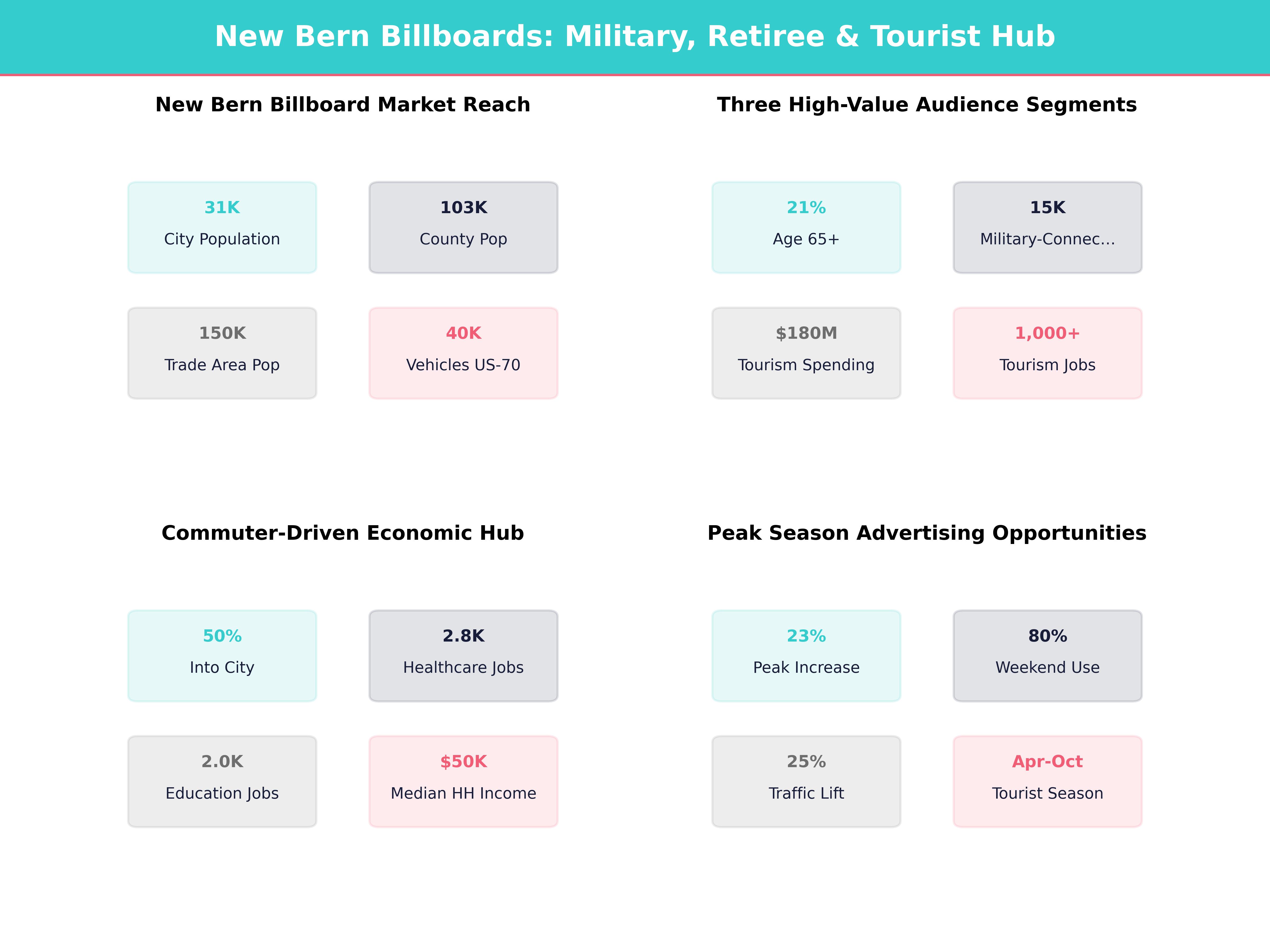
New Bern Market Snapshot: Why This Small City Punches Above Its Weight
New Bern’s core population is modest, but its influence area is much larger:
- The City of New Bern reports a population of roughly 31,000–32,000 residents within city limits and a daytime population that swells with commuters and visitors.
- Craven County lists about 100,000–105,000 residents countywide, with New Bern as the commercial and healthcare hub for a broader trade area of 150,000+ people when you include nearby counties.
- The city notes that New Bern regularly attracts shoppers and workers from Jones County, Pamlico County, and Carteret County, with commuting data showing that more than 50% of New Bern’s workers live outside city limits but travel in for work.
- Nearby Marine Corps Air Station (MCAS) Cherry Point in Havelock, about 17 miles away, reports roughly 9,000–10,000 active-duty Marines and sailors and 6,000–6,500 civilian employees and contractors according to MCAS Cherry Point—a combined base‑connected population comparable to nearly half the city of New Bern itself. Many of these households shop, dine, and seek services in New Bern.
Tourism further multiplies exposure:
- Visit New Bern highlights that tourism supports 1,000+ local jobs across lodging, dining, attractions, and retail, and that annual visitor spending in Craven County exceeds $170–$190 million in recent years, with tourism‑generated local and state tax revenues easing the tax burden on residents by hundreds of dollars per household.
- Hotel performance reports shared by local tourism partners show that New Bern’s peak months (typically April–October) can run 15–30% higher occupancy than winter months, meaning significantly more visitor impressions for billboard advertisers.
- New Bern is a major stop along the Inner Banks and on boating routes via the Neuse and Trent Rivers. The local marinas and transient docks routinely see their highest transient boater traffic from April through October, when slips and moorings can be 70–90% occupied on weekends.
For advertisers using Blip, this means:
- We can reach both 31,000+ year‑round residents and a constantly refreshed visitor pool of tens of thousands of overnight and day visitors each year with well‑placed billboards in New Bern.
- Campaigns can be tuned to weekdays vs. weekends and to high‑tourist seasons vs. off‑season locals, matching schedule and creative to very different audiences.
- Local businesses can extend their reach well beyond downtown, catching commuters and visitors arriving via US‑17 and US‑70 and connecting with the broader Craven–Pamlico–Carteret region through targeted New Bern billboard advertising.
Audience & Demographic Insights for Message Positioning
While we avoid duplicating full census tables, local and state economic profiles paint a clear picture of who we’re reaching:
- Age mix: City and county estimates show a median age in the 39–41 range in Craven County, compared with the U.S. median around 38, with about 20–22% of residents aged 65+ and roughly 23–25% under age 18. That creates a strong 45+ and retiree segment, alongside a sizable 25–44 working‑age group driven by healthcare, government, and military families.
- Household incomes: Recent state and county data show median household income in New Bern in the low‑to‑mid $50,000s, and Craven County countywide in the mid‑to‑upper $50,000s, with a meaningful middle‑income base and a growing retiree population with stable pensions, Social Security, and military retirement pay.
-
Education and employment:
- CarolinaEast Health System (anchored by CarolinaEast Medical Center) employs roughly 2,500–3,000 people, drawing patients and staff from multiple counties.
- Craven County Schools employs about 1,900–2,100 teachers and staff across more than 20 schools, generating strong family‑based traffic.
- Craven County government and the City of New Bern collectively employ 1,000+ workers in administrative, public safety, and public works roles.
- MCAS Cherry Point contributes thousands of additional jobs, while hospitality, retail, and service sectors employ several thousand more across the metro area.
Creative and targeting implications:
-
Retirees & empty nesters:
- Roughly 1 in 5 residents are 65 or older, many relocating from other states for coastal living.
- Emphasize healthcare, financial services, home improvement, leisure activities, riverfront dining, and live entertainment.
- Use clear fonts, simple offers, and trust‑building language (“local since…”, testimonials, awards, accreditation).
-
Military & families:
- Craven and neighboring Carteret counties together host tens of thousands of active‑duty, civilian, and dependent military residents linked to MCAS Cherry Point and other installations.
- Promotions for auto dealers, insurance, quick‑service and casual dining, child‑oriented services, and off‑base housing are powerful.
- Highlight value, reliability, and community support (“military discount,” “veteran‑owned,” “minutes from Cherry Point”).
-
Tourists & weekenders:
- Visitor surveys shared by Visit New Bern show strong interest in history, waterfront experiences, and walkable downtowns, with many visitors traveling from within a 1–3 hour drive radius (Raleigh, Greenville, Jacksonville, and the Crystal Coast).
- Focus on experiences—tours, museums, river cruises, bars and restaurants, boutiques, and lodging. Use strong visuals of the waterfront, Tryon Palace, and historic streets.
Traffic Patterns: Where and When Impressions Peak
Digital billboards live or die on traffic flow. New Bern’s geography funnels vehicles onto a few key corridors:
- US‑17: Major north–south artery bridging New Bern with Washington/Greenville to the north and Jacksonville/Wilmington to the south.
- US‑70 (future I‑42): Connects New Bern west to Kinston, Goldsboro, and Raleigh, and east toward Morehead City and the Crystal Coast.
- NC‑55: Brings traffic in from Bayboro, Oriental, and Pamlico County.
- Key local surface routes include Dr. Martin Luther King Jr. Blvd, Neuse Blvd (US‑17 Business), and Glenburnie Rd, which carry much of the city’s retail and commuter volume.
The NCDOT Traffic Survey Unit reports Annual Average Daily Traffic (AADT) volumes on these routes that often fall in the 20,000–40,000 vehicles per day range near New Bern, with specific segments such as:
- Portions of US‑70 near the US‑17 interchange frequently measuring 35,000–45,000 vehicles per day.
- Busy sections of US‑17 Business/Neuse Blvd and MLK Jr. Blvd registering in the 25,000–35,000 vehicles per day range.
- Heavier urban stretches of Glenburnie Rd and connector routes commonly showing 15,000–20,000 vehicles per day.
Even modest adjustments to Blip scheduling across high‑ and medium‑volume corridors can shift your message in front of hundreds of thousands of incremental weekly impressions, making billboard rental in New Bern an efficient way to extend your share of voice beyond what most local media alone can provide.
Practical takeaways for campaign planning:
- AM and PM peaks: Typical commuter surges are 7–9 a.m. and 4–6 p.m., with some corridors showing 20–30% higher volumes in these windows versus mid‑day averages. Inbound traffic on US‑70/US‑17 is strongest in the morning, outbound in the evening.
- Retail corridors: MLK Jr. Blvd and Neuse Blvd, home to big‑box stores, grocery chains, and quick‑service restaurants, often see elevated Saturday traffic, with NCDOT counts in similar corridors showing weekend volumes 5–15% above weekday mid‑day.
- Bridge and river crossings: Traffic over the Trent and Neuse River bridges spikes during commute hours and large events downtown; road closure and detour data from the City of New Bern confirm that even partial lane closures can shift thousands of daily vehicles to alternate routes.
With Blip, we can:
- Increase bid amounts and frequency during commute windows to dominate impressions when workers and military staff are on the road.
- Shift spend to midday/early evening on weekends to intercept shoppers and visitors heading to the waterfront or retail districts.
- Run location‑specific creatives on boards nearest your business or primary access route (e.g., “Next right on MLK”—vs. a generic citywide message) to capitalize on the final 30–120 seconds before a turn or exit.
Seasonality: Aligning Flights With New Bern’s Event & Tourism Calendar
New Bern is event‑heavy for its size, which changes who is on the road and when. The New Bern tourism calendar and the City of New Bern events listings show strong visitor spikes around:
-
Spring (March–May):
- Garden tours and arts events can draw hundreds to several thousand attendees each weekend.
- Warmer weather increases marina and boat‑launch usage, with some launch sites reporting double their winter traffic.
-
Summer (June–August):
- Peak family vacations, riverfront activities, and boating; hotel occupancy and short‑term rentals often run 10–20 percentage points higher than in shoulder seasons.
- Day‑tripper traffic from nearby beaches and inland metros pushes weekend volumes on US‑70 and US‑17 significantly above weekday baselines.
-
Fall (September–November):
- Festivals, heritage events, and comfortable temperatures draw both locals and regional visitors, with signature weekends bringing in thousands of extra visitors downtown.
-
Holiday season (late November–December):
- Beary Merry Christmas festivities, as promoted by Visit New Bern, run for several weeks and include parades and special shopping nights that can raise downtown foot traffic by 30–50% compared with typical weeks.
- Holiday flotillas and waterfront light displays increase evening traffic to the riverfront.
- Retailers frequently report their highest sales weeks of the year between Thanksgiving and New Year’s.
How to use this with Blip:
-
Tourism campaigns:
- Increase frequency from April through October, especially Thursdays–Sundays, when visitor counts, hotel occupancy, and event calendars all peak.
- Run “Welcome” and “Turn here today” creatives on boards serving highway approaches and main corridors into downtown.
-
Retail and dining:
- Run heavier schedules around pay periods (1st–5th and 15th–20th of each month), when local consumer spending consistently ticks up.
- Launch special bursts for Mother’s Day, Memorial Day, July 4th, Labor Day, and December holidays, when tourism data and local sales reports show elevated restaurant and retail spending of 10–25% over average weeks.
-
Service and professional firms:
- Focus more on consistent, always‑on presence with moderate budgets (e.g., a steady baseline of daily impressions), then use tactical boosts tied to events such as health fairs, open enrollment periods, tax season, or back‑to‑school, when demand for your services spikes.
Creative Strategy: What Works on New Bern Billboards
In a historic, riverfront city like New Bern, our billboard creative performs best when it fits the environment and the mindset of travelers. Thoughtful New Bern billboard advertising should reflect local culture while still standing out along busy corridors.
Key creative principles:
-
Local identity and pride
- Use recognizable imagery: Tryon Palace, Union Point Park, the Neuse and Trent Rivers, or historic downtown streetscapes along Middle Street and Pollock Street.
- Reference local icons like “Birthplace of Pepsi” – the Pepsi Store downtown is a common stop for visitors and appears in many travel guides.
- Mention neighborhood or corridor landmarks (“near the bridge,” “across from the mall,” “minutes from downtown”) to help both locals and visitors orient quickly.
-
High contrast, simple messaging
- Aim for 6–8 words max plus your logo and a single call‑to‑action; drivers typically have only 3–6 seconds to absorb your message.
- Use strong, contrasting colors that remain legible in full sun and at night; test artwork in both daylight and dusk mockups.
- Reserve detailed offers or disclaimers for your website/landing page; use the board to drive curiosity or immediate action.
-
Weather‑aware and contextual
- New Bern has hot, humid summers (average high temperatures 86–90°F in July–August) and mild but sometimes rainy winters, with annual rainfall around 50 inches.
-
Use weather‑relevant copy, for example:
- “Beat the heat – ice‑cold drinks on the riverfront” in July.
- “Storm damage? Call us now” after major weather events or during hurricane season (June–November).
- With Blip’s flexible scheduling, rotate in relevant creative any time a storm, heat wave, or cold spell hits.
-
Tourist vs. local messaging
- On highways (US‑17/US‑70) and approach roads, focus on visitors: “Exit now for historic downtown,” “Tonight on the riverfront,” “Stay with us in New Bern.”
- On inner‑city boards, focus on repeat behavior: loyalty programs, weekly specials, recurring events (“Every Thursday trivia night,” “Locals’ lunch special”).
-
Clear directional cues
- Use arrows, distance, and drive‑time: “Left in 1 mile,” “2 minutes ahead on MLK Blvd.”
- In a compact city like New Bern—where most key destinations are within a 5–10 minute drive of each other—a “2 minutes ahead” message feels very immediate and boosts response.
Smart Dayparting With Blip: Matching Messages to Mindsets
Blip lets us choose specific hours and days to show our ads. In New Bern, we can use that flexibility to match messages to audiences:
-
Weekday morning (6–10 a.m.)
- Audience: Commuters, military personnel, hospital and government workers, teachers, and staff.
- Best for: Coffee shops, breakfast spots, automotive repair, daycare, insurance, and service businesses.
- Messaging: “This morning,” “On your way to work,” “Drop off today,” “Open at 7 a.m.”
-
Weekday midday (10 a.m.–3 p.m.)
- Audience: Retirees, stay‑at‑home parents, shift workers, and visitors exploring downtown.
- Best for: Medical appointments, banking, retail, lunch specials, museums, and tours such as those offered by Tryon Palace and local river cruise operators.
- Messaging: “Walk‑ins welcome,” “Open now,” “Tour starts hourly,” “Same‑day appointments.”
-
Evening commute (3–7 p.m.)
- Audience: Workers heading home, families running errands, restaurant goers.
- Best for: Restaurants, grocery, big‑box retail, kids’ activities, entertainment venues, and fitness centers.
- Messaging: “Tonight only,” “Kids eat free,” “Happy hour now,” “Dinner 5 minutes ahead.”
-
Late evening (7–11 p.m.) and weekends
- Audience: Diners, nightlife, visitors exploring the waterfront, event attendees headed to concerts, festivals, and Beary Merry Christmas activities.
- Best for: Bars, live music, riverfront experiences, late‑night dining, and lodging.
- Messaging: “Live music tonight,” “Last hour of happy hour,” “Downtown tonight,” “Rooms available now.”
Schedule strategy examples:
- A downtown restaurant can target Thursday–Saturday 3–10 p.m., heavier during major events listed on Visit New Bern and neighborhood calendars like Downtown New Bern.
- A healthcare provider can focus on weekday 6 a.m.–6 p.m., with a separate creative for after‑hours urgent care, emphasizing “Walk‑in evenings & weekends.”
- A marine or boating business can increase impressions Friday–Sunday during boating season (April–September), particularly along US‑70 and NC‑55 where boaters travel between New Bern and coastal launches.
Geo-Targeting and Placement: Using Local Movement Patterns
Even in a relatively small city, location choice is critical. With Blip’s board‑by‑board selection, we can map creative to likely movement patterns:
-
Approach corridors (US‑17, US‑70, NC‑55)
- Best for: Tourism, lodging, destination dining, attractions, auto dealerships, and large regional retailers.
- Messaging: “Exit now for New Bern,” “Stay in historic New Bern tonight,” “10 minutes to our showroom,” “Next exit for riverfront dining.”
-
Retail strips (MLK Jr. Blvd, Neuse Blvd)
- Best for: Grocers, big box, QSR, healthcare, gyms, salons, and everyday services.
- Messaging: “Turn here today,” “Same‑day appointments,” “Sale ends Sunday,” “Walk‑ins welcome until 8 p.m.”
-
Near MCAS Cherry Point (via US‑70 toward Havelock)
- Best for: Car dealers, insurance, off‑base housing, family dining, entertainment, and education options such as community colleges and trade schools.
- Messaging: “Military discounts,” “5 minutes from base,” “Welcome Cherry Point families,” “PCS‑friendly leases.”
-
Downtown and waterfront approaches
- Best for: Restaurants, bars, boutiques, tours, galleries, and events in the historic downtown and along the waterfront parks promoted by New Bern Parks & Recreation.
- Messaging: “Park once, explore all day,” “Tonight on the waterfront,” “Shop local downtown,” “Turn now for historic district.”
We should also consider:
- Direction of travel: Tailor creative to inbound vs. outbound commuters. Inbound in the morning: “Stop in on your way,” outbound in evening: “Pick up dinner on the way home.”
- Proximity messaging: Use short, distance‑based calls (“Next light,” “One block ahead”) on boards closest to your entrance—particularly effective within the final 0.25–0.5 miles of your location.
Industry-Specific Tips for New Bern Advertisers
Because New Bern’s economy is particular—healthcare, government, military, tourism—some verticals can lean into local realities.
Healthcare & Wellness
- Leverage the presence of CarolinaEast Medical Center and many clinics: New Bern functions as a regional care hub, drawing patients from multiple surrounding counties and serving a daytime population larger than its resident base.
- Emphasize: same‑day appointments, urgent care, imaging, dentistry, and specialty practices—services that patients are willing to drive 20–40 minutes for.
- Daypart: Weekdays 7 a.m.–6 p.m.; peak just before and after common appointment windows (8–10 a.m., 3–5 p.m.).
- Creative: Simple “Call today” + phone/URL; avoid long service lists and focus on 1–2 key differentiators (e.g., “Same‑day orthopedic visits,” “24/7 emergency care”).
Auto Dealers & Services
- Corridor focus: US‑17 and US‑70, plus main retail strips where NCDOT counts suggest tens of thousands of daily vehicle impressions.
- Tie messaging to MCAS Cherry Point: “Military financing,” “PCS‑friendly trade‑ins,” “Service while you’re at work,” “0 down for active duty.”
-
Seasonal pushes around:
- Tax season (February–April), when refund‑driven purchases spike.
- PCS (Permanent Change of Station) cycles, which for many Marine units cluster in late spring and summer.
- Holiday sales (November–December), when auto promotions are heavily advertised across media.
Tourism, Lodging, and Attractions
- Target: US‑17, US‑70, and approaches to downtown and waterfront.
- Highlight: Proximity to Tryon Palace, boat tours, historic walking tours, New Bern Historical Society events, and waterfront parks.
- Creative: Strong imagery (river, historic streets, night lights), clear directions, and same‑day call‑to‑action (“Tours today,” “Rooms available tonight,” “Free parking downtown”).
- Coordinate campaigns with major event dates on Visit New Bern and Downtown New Bern to capture elevated demand and maximize the impact of billboards in New Bern during those peak periods.
Restaurants, Bars, and Nightlife
- Geofence: Boards closest to downtown, riverfront, and main retail corridors, where evening and weekend traffic is heaviest.
- Dayparting: Lunch 10 a.m.–2 p.m.; dinner/evening 4–10 p.m.; with heavier frequency on Thursdays–Saturdays, when visitor and local dining traffic both spike.
- Rotate creatives: lunch specials, dinner menu, events (live music, trivia, karaoke), seasonal drinks. Consider “table‑turn math”: even a 5–10% lift in nightly covers can justify a robust Blip schedule.
Home Services & Contractors
- New Bern’s coastal setting and aging housing stock in some neighborhoods mean weather‑related repairs and maintenance are frequent.
- Best for: roofing, siding, HVAC, plumbing, landscaping, dock and marine services, pest control, and tree services.
-
Strategy:
- Maintain an always‑on baseline presence to build brand recognition.
- Add surge campaigns immediately after major storms or during hurricane season reminders, when inbound call volumes can jump 2–3x.
- Messaging: “Locally owned,” “24/7 emergency service,” “Free estimates,” “Storm‑ready inspections.”
Leveraging Local Media & Community Context
Blip campaigns can complement other local channels. To stay in tune with what residents are thinking about and talking about:
- Follow the City of New Bern news and alerts for infrastructure projects, road work, and community events that may change traffic patterns or public concerns.
- Monitor Craven County updates at cravencountync.gov for information about schools, services, and emergency management that might affect messaging (e.g., storm preparation, shelter information, public health).
- Track local news at the New Bern Sun Journal and community outlets like New Bern Now to anticipate community conversations, major events, and public concerns.
- Stay connected to business trends and networking opportunities via the New Bern Area Chamber of Commerce, whose members include many of the area’s largest employers and small businesses.
We can then:
- Align campaign bursts with news cycles (e.g., promoting roof inspections after a widely reported storm, or special offers during widely publicized festivals).
- Support community causes or sponsorships and echo them on billboard creative (“Proud sponsor of…,” “See you at…”) to reinforce local goodwill and brand recognition.
- Use Blip boards to amplify messages first introduced on social media or in local news—turning a 24–48 hour news cycle into a multi‑week branding opportunity.
Measuring, Testing, and Optimizing Campaigns With Blip
To make the most of New Bern’s audience density and seasonal flows, we should treat campaigns as ongoing experiments:
-
Set clear objectives
- Foot traffic increase, calls, website visits, event attendance, or brand awareness.
- Tie billboard runs to trackable actions like unique URLs, QR codes, promo codes, or “mention this sign” offers. Even a simple “Show this screen for 10% off” and staff tallying can provide directional data.
-
Test multiple creatives
- Run 2–4 variations simultaneously with different headlines, images, or offers.
- After 2–4 weeks—long enough to gather meaningful data at local traffic volumes—shift more budget to the top performers (higher response, more redemptions or calls).
- Aim for each creative to gather at least several thousand impressions on relevant corridors before making final judgments.
-
Adjust by time and day
- Use analytics from your POS, call center, or website to identify peak response periods (e.g., a 30–40% call spike on Mondays, or higher online orders on Friday nights).
- Move Blip impressions toward those hours/days and monitor whether conversions improve over another 2–4 week window.
-
Seasonal iteration
- Compare spring, summer, fall, and holiday campaigns year‑over‑year.
- For example, if a summer tourist campaign yields a 20–30% higher response than winter, reallocate more budget to May–September next year while maintaining a lean off‑season presence for locals.
- Track event‑based lifts (e.g., revenue on Beary Merry Christmas weekends vs. ordinary December weekends) and mirror that ratio in future spend.
-
Integrate with digital and social
- Mirror billboard creative in paid social and search ads targeting New Bern and surrounding ZIP codes to reinforce recall; research shows that cross‑channel consistency can increase ad effectiveness by 20% or more.
- Use geo‑fenced digital campaigns along corridors like US‑17 and US‑70 and reinforce them with physical billboard presence, so the same travelers see your brand both on their phones and on the road.
- Encourage user‑generated content (“Snap a pic with our billboard and tag us”) during big events to extend your reach organically.
By understanding how people actually move through New Bern—when they commute, when they shop, when they visit historic sites and riverfront venues—we can use Blip’s flexibility to appear in the right place, at the right time, with the right message. With data‑informed scheduling, locally resonant creative, and continuous testing supported by local traffic, tourism, and economic data, digital billboards become one of the most efficient ways to stay visible in this high‑impact, highly personal coastal market, and billboard rental in New Bern becomes a repeatable, scalable part of your broader marketing strategy.