Billboards near Pineville, NC
No Minimum Spend. No Long-Term Contracts. Just Results.
Trusted by Leading Brands


Billboard advertising
near Pineville has never been easier
How much is a billboard near Pineville?
Why Choose Blip for Billboard Advertising near Pineville
-
Blip lets Pineville brands launch fast on nearby I-485 and I-77 corridors, reaching south Charlotte commuters without contracts.
-
Use Pineville dayparting to hit 6-9 a.m. commuters, 11-2 shoppers, and weekend Carolina Place traffic when it matters.
-
Flexible budgets make Pineville billboard tests easy, so you can scale up around Carowinds season or back-to-school demand.
-
Track Pineville campaigns in real time and shift spend toward the southside routes and messages driving the best response.
-
Blip's creative tools help Pineville ads stay bold and readable for fast-moving drivers on South Boulevard and NC 51.
Frequently Asked Questions About Billboard Advertising near Pineville
How much does a billboard cost in Pineville with Blip?
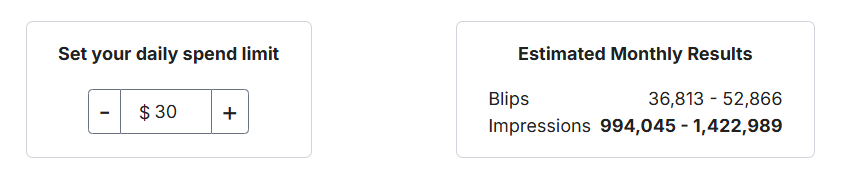
Blip makes billboard advertising in the Pineville area flexible and affordable. You choose a daily budget, and Blip’s algorithm uses it to bid for open ad slots on rotating digital billboards serving the Pineville area. You only pay when your ad actually displays, with each “blip” lasting 7.5 to 10 seconds and starting at just $0.01 per display.
Where can I advertise with Blip in the Pineville area?
Our network includes 20 digital billboards in nearby Charlotte, all within 10.0 miles of Pineville, and the closest is about 8.4 miles away. That gives advertisers efficient access to the Pineville area without needing inventory directly inside town limits. A digital billboard in nearby Charlotte can still be highly effective if it intercepts drivers on the southside approaches that serve Pineville’s retail and commuter patterns.
What kind of traffic and roadways serve Pineville, North Carolina?
The strongest billboard strategies serving the Pineville area usually start with the interstates. South Charlotte segments of I-485 near Pineville commonly carry about 110,000 to 130,000 vehicles per day, and I-77 near the Pineville area often carries roughly 120,000 to 150,000 vehicles per day. Secondary roads like South Boulevard / US 521, NC 51 / Pineville-Matthews Road, and Johnston Road also add important layers of reach.
When is the best time to run Blip ads in Pineville, North Carolina?
Spring is a strong launch window for campaigns serving the Pineville area, and weekend-heavy scheduling can be especially effective from May through August. Back-to-school is one of the best practical advertising windows near Pineville, with late July through early September being excellent for healthcare, retail, tutoring, youth activities, restaurants, and family services. The Pineville area also becomes especially valuable in November and December because of holiday shopping.
What kind of audience does Pineville, North Carolina billboard advertising reach?
The Pineville area is a strong family-and-errand market, with Carolina Place giving the area a large shopping draw and Atrium Health Pineville adding a year-round healthcare audience. Families matter here because Charlotte-Mecklenburg Schools serves about 140,000 students, and many of those households shop, dine, and run activities across south Charlotte and near Pineville. Mecklenburg County’s Hispanic or Latino population is roughly 15%, which means bilingual or Spanish-language creative can be effective for the right brand.
Do I need a contract to advertise with Blip near Pineville?
No, Blip has no long-term contracts or minimum commitments. You can start, pause, or stop your campaign at any time.
How fast can I launch a billboard campaign with Blip near Pineville?
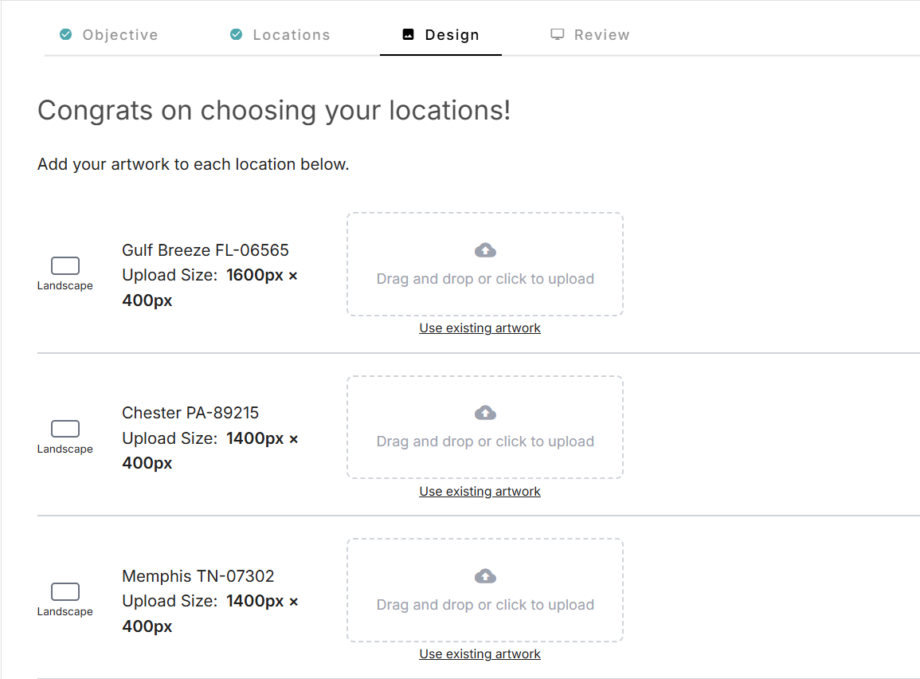
You can have your campaign live in minutes. Create a free account, select your locations, set your budget, upload your design, and start running once approved.
Where can I advertise with Blip near Pineville?
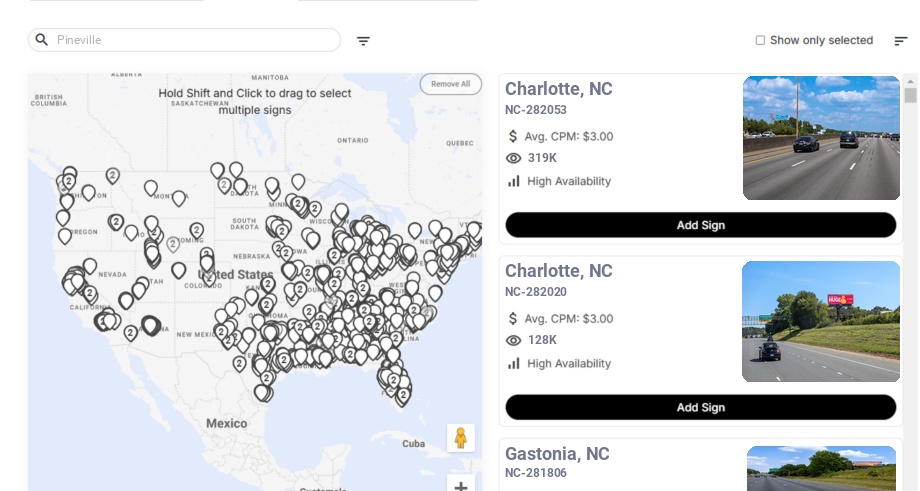
Blip has digital billboards near Pineville. You can browse available locations on a map, choose the ones that fit your audience, and start advertising right away.
Still have questions? Launch a campaign in minutes — no contracts, no commitments.
Start Your CampaignPineville Billboard Advertising Guide
The market near Pineville 10,600 residents (10,602 in the 2020 Census), but it sits inside the much larger south Charlotte consumer shed, beside major retail, healthcare, and commuter routes that pull from Mecklenburg County and the South Carolina line, including nearby interstate segments that carry roughly 110,000 to 150,000 vehicles per day. That is exactly why billboard advertising serving the Pineville area can work so well. Our network includes 20 digital billboards in nearby Charlotte, all within 10.0 miles of Pineville, and the closest is about 8.4 miles away, which gives advertisers efficient access to the Pineville area without needing inventory directly inside town limits.
Pineville Area Market Overview
A small town with a much larger trade area
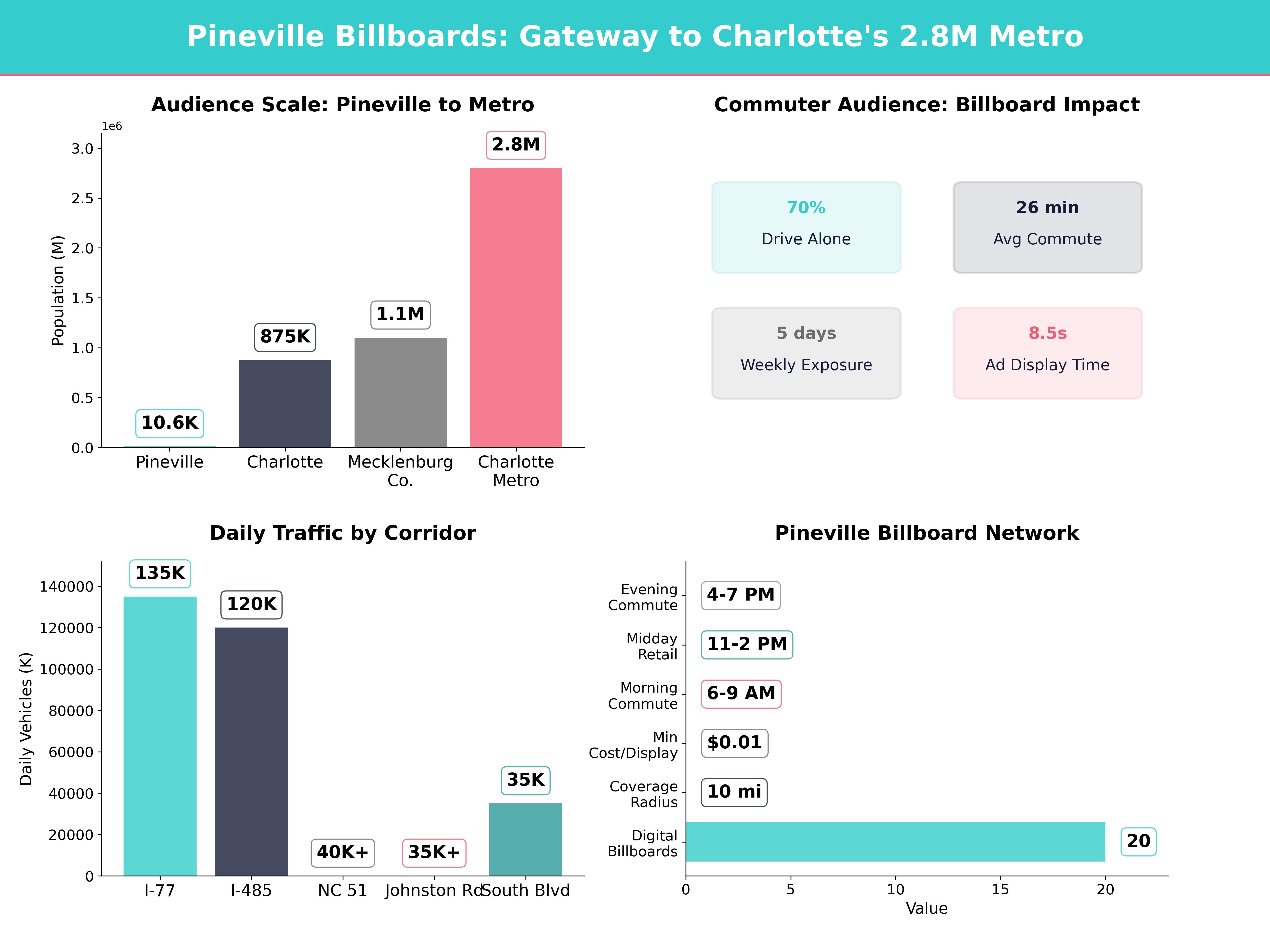
Pineville is a compact municipality, but the consumer market serving the Pineville area is regional. Pineville’s population is about 10,600 (10,602 in the 2020 Census), while Charlotte has about 875,000 residents (874,579 in the 2020 Census) and Mecklenburg County has roughly 1.1 million (1,115,482 in the 2020 Census). The broader Charlotte-Concord-Gastonia metro now exceeds 2.8 million people, which means businesses near Pineville often draw well beyond the town itself.
That regional pull is easy to understand on the ground. The Pineville area sits beside Carolina Place Atrium Health Pineville, just north of the South Carolina line, and within quick reach of employment centers such as Ballantyne and central Charlotte. For advertisers, that creates a market where resident population is only one piece of the story. Daily movement matters just as much.
Economic signals that support billboard demand
The south Charlotte economy that serves the Pineville area is diversified. Charlotte Regional Business Alliance promotes the region as a major center for finance, logistics, energy, healthcare, and professional services, and those sectors create reliable weekday commuter traffic. Healthcare is especially relevant near Pineville because Atrium Health Pineville draws employees, patients, and visitors throughout the day.
Retail is another major driver. Carolina Place 1.2 million square feet of shopping and entertainment space and more than 100 stores, which makes the Pineville area a destination market rather than a pass-through only. That is good news for restaurants, retail brands, automotive businesses, home services, entertainment venues, and healthcare providers that need repeated exposure close to decision points.
Commute habits matter near Pineville
The Pineville area is still an auto-first market. Commute data for Mecklenburg County shows that roughly 7 in 10 workers drive alone, another 8% to 9% carpool, and average travel time is about 26 minutes. Even with transit options, most consumers serving the Pineville area are still reached most efficiently from the road.
Transit still adds context. The Charlotte Area Transit System operates the LYNX Blue Line 18.9 miles through the south and north parts of Charlotte. However, the Pineville area’s strongest billboard opportunity remains roadside visibility because suburban households, cross-border commuters, retail shoppers, and service buyers continue to rely heavily on personal vehicles.
Pineville Area Key Traffic Corridors
Interstates that feed the Pineville area
The strongest billboard strategies serving the Pineville area usually start with the interstates. According to recent North Carolina Department of Transportation traffic maps, south Charlotte segments of I-485 near Pineville commonly carry about 110,000 to 130,000 vehicles per day. That loop matters because it connects the Pineville area to Ballantyne, Matthews, the airport side of Charlotte, and multiple suburban growth zones.
I-77 is the other major spine. South Charlotte and state-line segments near the Pineville area often carry roughly 120,000 to 150,000 vehicles per day. That makes I-77 especially valuable for advertisers targeting cross-border commuters from Fort Mill York County, and nearby South Carolina communities heading north toward Charlotte jobs and services.
Retail and commuter connectors near Pineville
Secondary roads around the Pineville area add important layers of reach. These routes matter because they collect consumers who are not simply driving through. They are going to work, shopping at Carolina Place, heading to medical appointments, or moving between neighborhoods and commercial districts near Pineville. That type of travel often produces higher local relevance than purely long-distance interstate travel.
- South Boulevard / US 521 near Pineville often carries around 30,000 to 40,000 vehicles per day, depending on the segment.
- NC 51 / Pineville-Matthews Road frequently pushes past 40,000 vehicles per day on busier stretches serving retail and suburban traffic.
- Johnston Road in the Ballantyne direction commonly exceeds 35,000 vehicles per day on key segments.
Why corridor selection matters more than municipal boundaries
For the Pineville area, route alignment is often more important than whether a billboard sits exactly inside town limits. A digital billboard in nearby Charlotte can still be highly effective if it intercepts drivers on the southside approaches that serve Pineville’s retail and commuter patterns. That is why our 20 nearby Charlotte billboards can cover the Pineville market so efficiently. We can focus on the roads people actually use rather than the map line around the town.
Pineville Area Audience Segments
Commuters and cross-border workers
One of the most valuable audiences serving the Pineville area is the daily commuter. Pineville sits at the edge of a two-state travel pattern, which means advertisers can reach workers moving between south Charlotte, Ballantyne, and South Carolina suburbs. If we want to reach that audience, we usually prioritize boards that line up with northbound morning traffic and southbound evening traffic.
This audience is especially useful for categories such as healthcare, legal services, financial services, quick-service restaurants, recruiting, and automotive. A commuter who sees a relevant offer 5 days a week can build recall quickly, even if each ad play lasts only 7.5 to 10 seconds.
Shoppers, families, and healthcare consumers
The Pineville area is also a strong family-and-errand market. Carolina Place Atrium Health Pineville adds a year-round healthcare audience. Those two anchors create a dependable mix of weekday and weekend traffic.
Families matter here because Charlotte-Mecklenburg Schools serves about 140,000 students, and many of those households shop, dine, and run activities across south Charlotte and near Pineville. That makes the Pineville area attractive for pediatric care, family entertainment, tutoring, orthodontics, home improvement, insurance, grocery, and local event promotions.
Tourists and leisure visitors
Tourism may not be the first thing people think about near Pineville, but it should be part of the media plan. Carowinds sits just south of the area and spans 407 acres with more than 60 rides and attractions. That brings seasonal visitor traffic, family groups, and out-of-town spending to the southside corridor.
The broader tourism machine also supports the market. Charlotte Douglas International Airport handled about 58.8 million passengers in 2023, and Visit Charlotte promotes a steady calendar of conventions, sports, and leisure travel. Not every visitor goes to Pineville, but the regional circulation boosts hotels, restaurants, attractions, and retail throughout the south Charlotte area.
Students and young adults
The Pineville area also benefits from the region’s student population. UNC Charlotte enrolls more than 31,000 students, and Central Piedmont Community College serves more than 40,000 students annually. That audience is not concentrated only near Pineville, but it matters for categories with region-wide reach such as apartments, entertainment, wireless, banks, quick-service food, and career-focused education.
Demographically, the market is also diverse. Mecklenburg County’s Hispanic or Latino population is roughly 15%, which means bilingual or Spanish-language creative can be effective for the right brand, especially in healthcare, retail, telecom, and community services.
Seasonal Opportunities Serving the Pineville Area
Spring and summer near Pineville
Spring is a strong launch window for campaigns serving the Pineville area. Warmer weather increases shopping, dining, and weekend travel, and Carowinds reactivates leisure traffic as its operating season ramps up. That makes spring and summer especially useful for family entertainment, outdoor recreation, restaurants, automotive service, moving, and home improvement.
Summer campaigns should also recognize school-break behavior. Families make more discretionary trips, and young workers and students are on the road at different times than the standard commuter crowd. Weekend-heavy scheduling can be especially effective from May through August.
Back-to-school and fall timing
Back-to-school is one of the best practical advertising windows near Pineville. With about 140,000 students in Charlotte-Mecklenburg Schools, plus large college populations at UNC Charlotte and Central Piedmont Community College, late July through early September can be excellent for healthcare, retail, tutoring, youth activities, restaurants, and family services.
Fall also tends to bring steadier commuter patterns after summer travel. That is useful for B2C service brands that depend on weekday repetition, including urgent care, dental, legal, and financial services.
Holiday retail and year-end pushes
The Pineville area becomes especially valuable in November and December because of holiday shopping. Carolina Place SouthPark
Holiday creative does not have to be limited to stores. Healthcare open enrollment, tax preparation, fitness, and self-improvement brands often gain momentum from late-year decision making. When the Pineville area is already seeing elevated retail and family traffic, those categories can ride the same visibility.
Daypart recommendations for the Pineville market
Timing by hour matters near Pineville because the market mixes commuters with destination traffic. Because the patterns overlap, scheduling can help match the message to when people are deciding and when they are traveling.
- 6 a.m. to 9 a.m. often works best for commuter-facing services.
- 11 a.m. to 2 p.m. can be useful for restaurants, retail reminders, and healthcare.
- 4 p.m. to 7 p.m. is typically strong for return commuters and evening errand traffic.
- Friday through Sunday often performs well for family entertainment, retail, and dining.
Because our platform allows flexible scheduling, we can align spend with those patterns instead of running the same intensity all day.
Pineville Area Billboard Design Tips
Match the south Charlotte and Pineville feel
Creative that serves the Pineville area usually performs best when it feels suburban, practical, and polished. This is not a market where every ad needs an Uptown skyline. Brands often do better with imagery that reflects shopping, family life, healthcare convenience, homes, cars, and everyday mobility around south Charlotte.
Color choices should also fit the category and geography. Clean blues, greens, blacks, and whites tend to work well for healthcare, finance, education, and home services. Brighter reds, oranges, and yellows often work better for restaurants, retail promotions, entertainment, and seasonal attractions near Carowinds.
Use local shorthand that drivers recognize
The Pineville area is route-driven, so local cues help. Messages that reference “South Charlotte,” “Carolina Place,” “State Line,” “Ballantyne,” or “Next Exit” often feel more relevant than generic metro language. If your business is easy to reach from the southside corridor, say so directly.
Good local examples include complete, direct lines such as these:
- “Urgent Care Near Carolina Place.”
- “Family Fun Off I-485.”
- “South Charlotte Orthodontics.”
- “Now Hiring Near the State Line.”
Those messages work because they match how people think while driving near Pineville.
Keep it readable at driving speed
The Pineville area includes roads where drivers move at 55 to 65 mph, so we recommend simple layouts. A good rule is 6 to 8 words, 1 clear image, and 1 obvious action. If the ad has to work for interstate traffic, it should be readable in a glance.
Bilingual creative can also be a smart test in this market. Because Mecklenburg County is about 15% Hispanic or Latino, a Spanish-only or bilingual version may improve relevance for some campaigns. We usually recommend testing those versions separately so the performance data stays clear.
Regional Strategies Near Pineville
South Charlotte suburban corridors
If your goal is broad household reach serving the Pineville area, we usually start with south Charlotte suburban corridors. These routes capture people heading to work, school, shopping, and healthcare appointments. They are especially strong for home services, healthcare, grocery, restaurants, and community businesses that rely on frequent local trips.
This approach works well when we want repetition over precision. Instead of betting on a single destination, we cover the flows that repeatedly feed the Pineville area during the week.
Highway interchange and state-line strategies
If your audience includes cross-border workers or regional travelers, interchange strategy becomes more important. I-77 and I-485 connections near the Pineville area are useful for brands that need scale across North Carolina and South Carolina commuters. Legal services, recruiting, automotive groups, and financial brands often benefit from this setup because their customer base is wider than one town.
The key is directionality. Morning traffic may require different boards than evening traffic. That is especially true for the Pineville area because work trips and retail trips do not always move in the same direction at the same time.
Commercial district and destination strategies
Destination-focused advertisers should lean into boards that support retail and activity clusters near Pineville. That includes the Carolina Place Atrium Health Pineville, and business-heavy zones in Ballantyne. Entertainment brands can also benefit from the leisure crossover created by Carowinds and regional tourism.
For these campaigns, geographic specificity matters. If you are asking a driver to make a near-term decision, the message should emphasize convenience, distance, or urgency, such as same-day appointments, a short drive, or a nearby exit.
Using Blip Tools for the Pineville Area
Test multiple southside approaches instead of guessing
Because we have 20 digital billboards serving the Pineville area from nearby Charlotte, we can test multiple route theories rather than making one fixed long-term bet. We can run one group of boards for interstate commuters, another for retail-heavy traffic, and another for general south Charlotte household reach. That kind of route testing is especially useful in a market like Pineville, where consumer movement is concentrated but not confined to one municipality.
Align budgets with local patterns
Flexible daily budgets are helpful near Pineville because demand changes with commuting, shopping, and seasonal travel. We can increase presence during holiday retail periods, Carowinds weekends, or back-to-school pushes, then pull back when demand is softer. Since ads can start at $0.01 per display, it is practical to test timing and board mix before scaling.
Refresh creative as the market shifts
The Pineville area is ideal for creative rotation. One brand might use a commuter message on weekdays, a family offer on weekends, and a holiday message in November and December. Another might switch between English and Spanish creative, or between recruiting and customer-facing campaigns.
Because performance data updates in real time, we can keep optimizing instead of waiting until the end of a fixed campaign to learn what worked.
Getting Started with Billboard Rental Near Pineville
How we recommend evaluating billboard locations
When renting digital billboards serving the Pineville area, we recommend evaluating locations with practical local criteria rather than choosing only by proximity. A billboard near Pineville is not “better” only because it is closest to town. It is better when it sits on the route your audience actually uses.
- Look at which corridor the board serves, such as I-485, I-77, South Boulevard, or NC 51.
- Check the direction of travel and ask whether you need morning, evening, weekday, or weekend traffic.
- Consider what the driver is doing at that point, such as commuting, shopping, heading to a medical appointment, or traveling toward the state line.
- Compare speed and dwell conditions. A board near slower, decision-heavy traffic may outperform one with higher raw volume.
- Note nearby anchors such as Carolina Place Atrium Health Pineville, Ballantyne, or Carowinds.
What to expect from the rental process
The biggest difference between this approach and a traditional billboard buy is flexibility. Traditional billboard companies often require negotiations, fixed terms, and less room to adjust once a campaign starts. With our self-serve digital model, we can choose boards on a map, set daypart and budget controls, upload creative, and refine the campaign as data comes in.
For many advertisers serving the Pineville area, a smart starting point is to launch with a small cluster of southside boards, run for 2 to 4 weeks, and compare performance by route and time of day. If commuter visibility matters most, we can weight weekday peaks. If destination traffic matters most, we can shift toward weekends and shopping windows. That learning phase is one of the fastest ways to discover which nearby Charlotte boards best fit the Pineville market.
A simple plan for launching near Pineville
We usually suggest this order of operations:
- Define the goal clearly, such as awareness, foot traffic, recruiting, or event promotion.
- Choose the audience, such as commuters, families, shoppers, or cross-border travelers.
- Select nearby Charlotte billboards that align with the roads serving the Pineville area.
- Start with simple creative built for quick readability.
- Watch the data and move budget toward the routes and times that perform best.
The Pineville area rewards advertisers who think regionally. When we use nearby Charlotte digital billboards to intercept the southside traffic patterns that feed Pineville, we can reach a market that is much larger, more mobile, and more commercially active than the town’s population alone would suggest.