Billboards in Carrboro, NC
No Minimum Spend. No Long-Term Contracts. Just Results.
Trusted by Leading Brands


Billboard advertising
in Carrboro has never been easier



How much is a billboard in Carrboro?
Why Choose Blip for Billboard Advertising in Carrboro
-
Blip lets you self-serve billboard ads in Carrboro fast, reaching NC 54, US 15-501, and I-40 commuters without agency delays.
-
Use Blip-optimized campaigns in Carrboro to auto-pick billboards and timing for UNC-Chapel Hill, RTP, and Durham traffic within your budget.
-
No contracts or minimums in Carrboro mean you can test campus, family, or healthcare messaging and pause anytime.
-
Daypart your Carrboro ads for 6-10 a.m. commutes, midday dining, or evening sports and music crowds near Chapel Hill.
-
Blip's real-time analytics show what's working in Carrboro, so you can adjust as UNC, school, and event traffic shifts.
-
Build and refresh creative in Carrboro with Blip tools to match move-in, football, or spring graduation without starting over.
Frequently Asked Questions About Billboard Advertising in Carrboro
How much does a billboard cost in Carrboro with Blip?
With Blip, billboard advertising in Carrboro can fit a wide range of budgets because you only pay when your ad actually appears. Pricing starts at just $0.01 per display, and your daily budget guides Blip’s algorithm as it bids for available ad slots. Since costs vary by time of day, location, and advertiser demand, you get flexible pricing that helps stretch every dollar.
Where can I advertise with Blip in Carrboro?
Carrboro is a strong billboard advertising market because we are not limited to the town’s 21,295 residents. In practice, we are reaching a tightly connected local core with 61,960 people in adjacent Chapel Hill, and a wider Orange County market of 148,696 residents, plus daily inflow from Durham, Research Triangle Park, and the rest of the Triangle. Many of the strongest billboard opportunities serving Carrboro sit on Chapel Hill gateways and regional corridors rather than inside the downtown street grid itself.
What roads are best for billboard advertising in Carrboro with Blip?
I-40 is the region’s biggest reach corridor for Carrboro advertisers, with major segments commonly operating above 100,000 vehicles per day and the busiest stretches toward Durham reaching 120,000+ vehicles per day. US 15-501, NC 54, and NC 86 are also important because they connect Chapel Hill, Durham, Research Triangle Park, and the Carrboro area. Closer in, Jones Ferry Road and other local connectors are useful for relevance and repeat exposure.
When is the best time to run billboard ads in Carrboro?
The two biggest student-reset periods arrive in August and January, and these are ideal moments for apartment leasing, furniture, banking, internet, food delivery, urgent care, gyms, and retailers. Fall is one of the most advertiser-friendly seasons in the Carrboro area because school is back, football traffic is active, and downtown visitation rises. Spring is also powerful because graduation, apartment hunting, warm-weather home projects, and healthcare needs all stack together.
What kinds of audiences can Blip reach in Carrboro?
Carrboro’s economy is closely tied to UNC-Chapel Hill, UNC Health, local government, schools, hospitality, and the professional economy that stretches into Durham and Research Triangle Park. UNC alone enrolls about 32,000 students, and the local school footprint represents roughly 19,000 students, creating a dependable family market. Carrboro also benefits from commuters, sports fans, music lovers, and weekend visitors, giving advertisers multiple audience segments to reach.
Do I need a contract to advertise with Blip in Carrboro?
No, Blip has no long-term contracts or minimum commitments. You can start, pause, or stop your campaign at any time.
How fast can I launch a billboard campaign with Blip in Carrboro?
You can have your campaign live in minutes. Create a free account, select your locations, set your budget, upload your design, and start running once approved.
Where can I advertise with Blip in Carrboro?
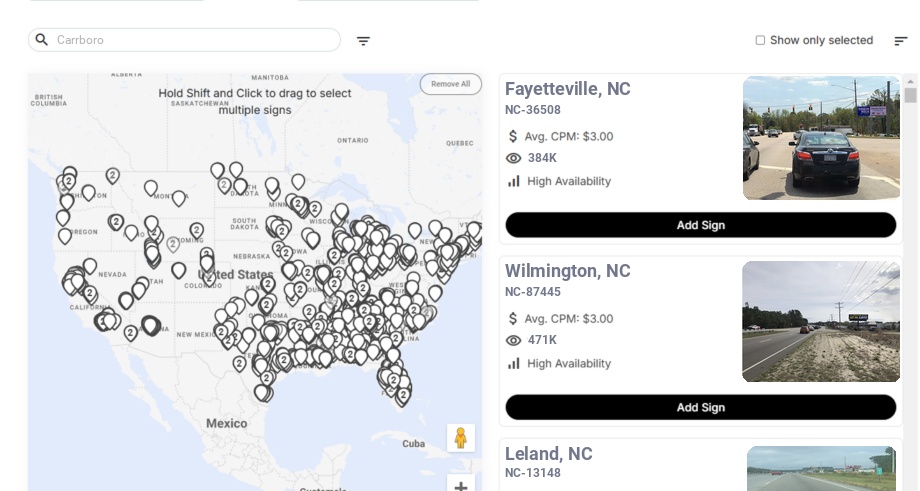
Blip has digital billboards in Carrboro. You can browse available locations on a map, choose the ones that fit your audience, and start advertising right away.
Still have questions? Launch a campaign in minutes — no contracts, no commitments.
Start Your CampaignCarrboro Billboard Advertising Guide
Carrboro 21,295 residents. In practice, we are reaching a tightly connected local core with 61,960 people in adjacent Chapel Hill, and a wider Orange County 148,696 residents, plus daily inflow from Durham, Research Triangle Park, and the rest of the Triangle. Although Carrboro is more walkable and bike-friendly than many North Carolina communities, most regional trips still happen by car on NC 54, US 15-501, NC 86, and I-40. We also benefit from year-round demand generated by UNC-Chapel Hill (about 32,000 students), UNC Health, sports (Kenan Stadium seats about 50,500 and the Dean E. Smith Center seats 21,750), live music, dining, and family travel.
Carrboro Market Overview for Billboard Advertising
Carrboro sits inside a larger Chapel Hill-Orange County trade area
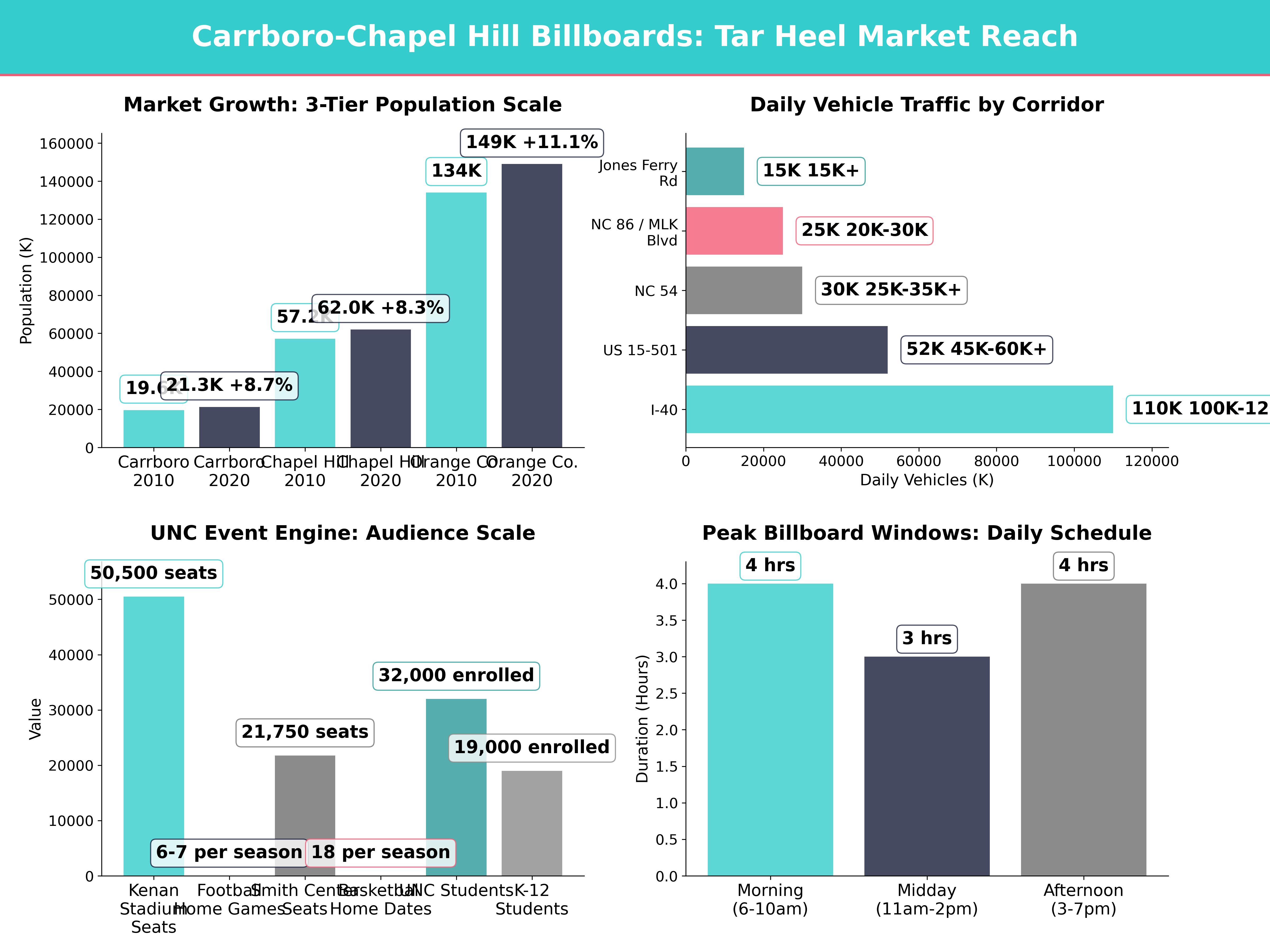
Carrboro is small on paper, but it punches above its size as part of a single Chapel Hill-Carrboro consumer market. The Town of Carrboro 21,295 residents in 2020, up from 19,582 in 2010, which was an 8.7% increase. Nearby Chapel Hill grew from 57,233 residents in 2010 to 61,960 in 2020, which was an 8.3% increase. Together, Carrboro and Chapel Hill total 83,255 residents, giving us a much deeper local audience than Carrboro’s municipal boundary suggests.
The broader county adds even more scale. Orange County 133,801 residents in 2010 to 148,696 in 2020, which was an 11.1% increase. That steady growth matters for billboard advertisers because it means we are working in a market with durable demand for healthcare, housing, education, food, retail, and professional services.
Carrboro’s economy is anchored by education, healthcare, and regional commuting
Carrboro’s economy is closely tied to UNC-Chapel Hill, UNC Health, local government, schools, hospitality, and the professional economy that stretches into Durham and Research Triangle Park. UNC alone enrolls about 32,000 students, and that university presence creates a continual flow of faculty, staff, parents, sports fans, alumni, researchers, and service workers.
The K-12 audience is also meaningful. Chapel Hill-Carrboro City Schools and Orange County Schools together educate roughly 19,000 students. That gives us a dependable family market for pediatric care, tutoring, after-school programs, home services, grocery, quick-service restaurants, and community events.
Carrboro is less car-dependent than many Southern towns, but it is not a no-car market. Local commuting profiles consistently show that roughly 6 in 10 employed Carrboro residents still get to work by private vehicle when we combine driving alone and carpooling. Once we widen our lens to the rest of Orange County and the Triangle commute shed, road-based travel becomes even more important. For billboard advertisers, that means digital boards still deliver reach and repetition, especially on approach routes where Carrboro residents mix with Chapel Hill shoppers, university traffic, hospital visitors, and inbound commuters.
What the numbers mean for advertisers in Carrboro
These local fundamentals give us several advantages.
- We can build frequency with residents because Carrboro, Chapel Hill, and the eastern Orange County commute network are tightly interwoven.
- We can reach high-intent audiences because many trips are tied to work, school, healthcare, shopping, and events rather than pure pass-through travel.
- We can stay visible year-round because university cycles, school calendars, and healthcare demand smooth out seasonality.
- We can market beyond town lines because many of the strongest billboard opportunities serving Carrboro sit on Chapel Hill gateways and regional corridors rather than inside the downtown street grid itself.
Key Traffic Corridors Around Carrboro
Carrboro’s travel pattern is shaped by a handful of dependable regional routes. NCDOT traffic counts vary by segment and year, but the hierarchy is clear, and that hierarchy tells us where different advertisers should concentrate their spend.
I-40 east of Carrboro
I-40 is the region’s biggest reach corridor for Carrboro advertisers. East of Chapel Hill, major segments commonly operate above 100,000 vehicles per day, and the busiest stretches toward Durham can push into the 120,000+ range. That puts I-40 in a different scale category than most local roads.
We should favor I-40 when we want broad regional awareness. This corridor works especially well for:
- Healthcare brands that want patients from multiple counties.
- Auto dealers, legal services, and insurance firms that need scale.
- Colleges, employers, and apartment communities recruiting across the Triangle.
- Entertainment and tourism campaigns tied to weekend travel.
Because Carrboro itself has limited large-road billboard inventory, I-40 often becomes the best way to extend a Carrboro campaign into the full Triangle trade area.
US 15-501 and Fordham Boulevard near Chapel Hill
US 15-501 is one of the most important Carrboro-serving corridors because it links Chapel Hill, Durham, I-40, major retail, and university traffic. Busy Chapel Hill segments often fall in the 45,000 to 60,000+ AADT range, especially near the I-40 interchange and the retail spine around University Place.
This is usually the best corridor for advertisers who need a blend of commuter reach and local purchase intent. We often like US 15-501 for:
- Medical offices, urgent care, and specialty clinics.
- Retail and dining brands targeting Chapel Hill and Carrboro households.
- Home services that want established homeowners and renters.
- Financial services, law firms, and business-to-consumer brands that benefit from repeated weekday visibility.
NC 54 between Carrboro, Chapel Hill, Durham, and RTP
NC 54 is one of the most useful commuter routes for Carrboro-focused campaigns because it connects west Chapel Hill and Carrboro to east Chapel Hill, Durham, and Research Triangle Park. Depending on the segment, volumes are often in the 25,000 to 35,000+ vehicles per day range. The route matters less for interstate-scale reach and more for high-value local and regional commuters.
We should think of NC 54 as a precision corridor. It is especially effective for:
- Employers recruiting office, clinical, and technical workers.
- Restaurants, coffee, fitness, and convenience brands targeting daily routines.
- Apartment communities and real estate campaigns aimed at movers choosing between Chapel Hill, Durham, and RTP.
- Family services that need to intercept school and work trips.
NC 86 and Martin Luther King Jr. Boulevard
NC 86, known in Chapel Hill as Martin Luther King Jr. Boulevard, is a vital north-south approach into the Chapel Hill-Carrboro area. Key sections often run roughly 20,000 to 30,000 AADT, and the corridor feeds retail, housing, schools, park-and-rides, and the I-40 connection.
This road is especially useful when we want a practical, local audience rather than a purely regional one. Campaigns for healthcare, grocery, childcare, senior services, banks, and neighborhood retail tend to fit well here because the audience skews toward residents handling everyday needs.
Jones Ferry Road, Main Street, and Franklin Street connectors
Closer to Carrboro proper, the street network becomes more local, but it still matters. Stronger segments of Jones Ferry Road and nearby connectors can top 15,000 daily vehicles, and the Carrboro-to-Chapel Hill connection remains one of the area’s most dependable local movements.
These boards are rarely about maximum scale. They are about relevance. We should use them for:
- Restaurants, breweries, coffee shops, and live music venues.
- Boutique retail, wellness brands, and local service businesses.
- Election campaigns, nonprofit events, and community messaging.
- Short-window promotions tied to downtown activity, including Cat’s Cradle The ArtsCenter, Carrboro Farmers’ Market, and Downtown Chapel Hill Partnership
Carrboro Audience Segments We Can Reach
Commuters and regional professionals
The first audience is the everyday commuter. Carrboro residents travel to Chapel Hill, Durham, and RTP, while nonresidents flow into the area for work, healthcare, education, and shopping. Even with strong local transit from Chapel Hill Transit GoTriangle
Students, faculty, and university visitors
The UNC-Chapel Hill audience is too large to ignore. With about 32,000 students, plus faculty, staff, researchers, sports fans, and visiting families, the campus economy creates constant movement. This audience responds well to food, healthcare, apartments, entertainment, technology, financial products, and local services that solve immediate needs.
We should remember that this is not only an undergraduate market. Graduate students, professional students, and university employees create a more mature, year-round consumer base than we see in purely undergraduate college towns.
Families and school households
Families are a major Carrboro advertising audience because the local public-school footprint is substantial. Chapel Hill-Carrboro City Schools and Orange County Schools together represent about 19,000 students, and those households drive recurring demand for healthcare, orthodontics, tutoring, extracurriculars, home improvement, grocery, and family dining.
For advertisers, this means Carrboro is not just a student market. It is a mixed household market with parents, professionals, and long-term residents who make repeat local purchases.
Sports fans, music lovers, and weekend visitors
Carrboro also benefits from event-driven traffic. Carolina Athletics brings 6 to 7 home football games to Kenan Stadium, which seats about 50,500 people. Men’s basketball adds roughly 18 home dates at the Dean E. Smith Center, which seats 21,750. Those crowds drive demand for food, lodging, transportation, bars, retail, and branded entertainment.
Beyond sports, Visit Chapel Hill, Carolina Performing Arts, Cat’s Cradle The ArtsCenter, Weaver Street Market, and downtown events keep the area lively on evenings and weekends. That mix gives us multiple reasons to advertise outside standard commuter hours.
Seasonal and Timing Opportunities in Carrboro
August and January are prime student-return windows
The two biggest student-reset periods arrive in August and January. These are ideal moments for apartment leasing, furniture, banking, internet, food delivery, urgent care, gyms, and retailers that help people restart routines. We often like to begin campaigns 2 to 3 weeks before classes resume so the message is already familiar during move-in and the first week of the semester.
Fall in Carrboro combines football, festivals, and back-to-school demand
Fall is one of the most advertiser-friendly seasons in the Carrboro area. School is back, football traffic is active, the weather improves, and downtown visitation rises. This is a smart season for restaurants, apparel, events, health services, and local retail.
Carrboro’s arts identity also matters in autumn. Music, markets, and downtown activity create a receptive audience for lifestyle brands, breweries, local causes, and entertainment promotions. If we are targeting weekend decision-making, Thursday through Saturday placements become especially useful in September and October.
Winter in Carrboro shifts attention toward basketball, indoor dining, and services
From November through March, basketball, indoor entertainment, and routine local spending create steady demand. With roughly 18 men’s basketball home dates, plus concerts and university events, winter is a good time for bars, restaurants, delivery, healthcare, and services that benefit from people staying closer to home.
Winter also works well for tax services, legal services, home improvement lead generation, and wellness campaigns. The audience may be smaller on some holiday weeks, but intent is often stronger.
Spring in Carrboro is powerful for graduations, moving, and healthcare
Spring is one of the best times to advertise in Carrboro because multiple demand cycles stack together. We have the run-up to graduation in May, apartment hunting for the next academic year, warm-weather home projects, outdoor dining, and healthcare needs tied to allergy season and annual checkups.
This is the season when we should be aggressive with campaigns for apartments, movers, storage, med spas, dentists, HVAC, landscaping, and celebratory dining. Parents and visitors also arrive for commencement, which widens the addressable audience beyond residents.
Summer in Carrboro still has value, even with fewer students
Summer is quieter, but it is not empty. Families remain active, UNC Health continues to draw patients, local residents keep spending, and visitors still come for campus tours, dining, and day trips promoted through Visit Chapel Hill. Summer also favors campaigns for camps, childcare, cold beverages, HVAC, roofing, and local attractions.
Billboard Design Tips for the Carrboro Market
We should use visual cues that feel local, not generic
Carrboro responds better to authentic Triangle imagery than to broad Southern clichés. Creative that nods to live music, local food, bikes, tree-lined streets, coffee culture, education, healthcare, and community events usually feels more native than rustic barn imagery or generic interstate visuals.
Soft blues, clean whites, greens, and modern typography often fit the local aesthetic well because the market is shaped by university culture, healthcare, and a progressive small-town identity. We should avoid official university logos or marks unless we are licensed to use them.
We should write for an educated, fast-moving audience
Carrboro and Chapel Hill contain a highly educated audience with limited patience for cluttered messaging. Clear value propositions, direct offers, and specific local references usually outperform vague slogans. Phrases like “Near Carrboro,” “Off NC 54,” “Minutes from Chapel Hill,” or “Book Today” are more actionable than broad brand statements.
Messages about expertise, wellness, sustainability, local sourcing, and convenience often resonate here. That is especially true for healthcare, higher education, natural foods, family services, and community-oriented brands.
We should tailor creative to the corridor
A commuter board on I-40 should look different from a board serving downtown nightlife. On I-40 and US 15-501, we should emphasize quick readability, major brand cues, and a single action. On NC 54 or NC 86, we can use more local relevance, including geographic cues and category-specific offers. On closer-in boards serving Carrboro nightlife or downtown traffic, we can lean into events, urgency, and personality.
We should localize language without overcomplicating the message
Carrboro audiences appreciate specificity. Using place names such as Carrboro, Chapel Hill, Franklin Street, Jones Ferry, or I-40 can make a billboard feel immediately relevant. Bilingual creative can also be useful for service categories that serve a broad regional workforce and diverse family base, as long as we keep the wording short and the offer unmistakable.
Regional Strategies for Carrboro and Nearby Areas
Downtown Carrboro and west Chapel Hill
This submarket is best for local loyalty and frequent repeat exposure. We should focus on restaurants, coffee, live music, wellness, boutiques, civic campaigns, and neighborhood services. Brands that benefit from identity and affinity do especially well here because the audience is highly local and culturally engaged.
Chapel Hill retail and campus gateways
The Chapel Hill side of the market gives us a broader mix of students, faculty, families, shoppers, and healthcare users. Corridors near University Place, East Franklin Street, and US 15-501 are often ideal for medical, retail, apartment, and family-service advertisers who need both reach and intent.
I-40, Durham-facing approaches, and RTP-bound traffic
When we need scale, we should move east. These routes reach Carrboro-area residents, but they also pull in Durham workers, RTP professionals, airport travelers, and multi-county consumers. This is where regional healthcare systems, major employers, large retailers, colleges, and awareness campaigns usually get the most value.
Hillsborough and western Orange County
If our customer base extends west, we should not ignore Hillsborough
Using Blip’s Tools Effectively in Carrboro
We can use Blip optimization to cover the full Carrboro trade area
Carrboro works especially well with a blended strategy because the practical billboard market spans several corridors. When our main goal is efficient reach, Blip’s optimized approach can distribute budget across I-40, US 15-501, NC 54, and other nearby digital inventory without forcing us to guess which one will outperform.
We can use manual selection when local geography matters most
If we are promoting a downtown restaurant, a Chapel Hill clinic, or an apartment community near campus, manual board selection becomes valuable. We can deliberately choose the approach routes that match our customer journey instead of buying broad awareness we do not need.
We can daypart around Carrboro’s actual rhythms
Carrboro is not a one-schedule market. Morning commuter windows around 6 to 10 a.m. matter on NC 54, US 15-501, and I-40. Midday windows around 11 a.m. to 2 p.m. can work for dining, healthcare, and retail. Afternoon and evening windows from 3 to 7 p.m. often capture parents, commuters, shoppers, and sports traffic. Entertainment campaigns may also benefit from Thursday-through-Saturday evening emphasis near downtown and campus routes.
We can rotate creative as the audience changes
Because Carrboro has clear academic, sports, and seasonal shifts, creative refreshes matter. We can run one version during August move-in, another during football season, and another during spring leasing or graduation. Blip’s reporting and artwork tools make it easier to test these seasonal swaps quickly instead of locking us into one static message.
Getting Started With Billboard Rental in Carrboro
We should start with the business goal
The best Carrboro campaign begins with the outcome we want. If we need broad awareness, we should prioritize I-40 and US 15-501. If we need daily local frequency, we should emphasize NC 54, NC 86, and the Chapel Hill-Carrboro connector network. If we need a student audience, we should lean into campus gateways and semester timing.
We should expect the strongest Carrboro-reaching boards to sit on approach routes
Carrboro is not a market where every effective billboard will sit inside downtown. Because the town is compact and sign controls are relatively careful, many of the most useful digital boards for Carrboro advertisers are on the roads that feed the market rather than in the center of it. That is not a drawback. It is often an advantage, because approach-route boards capture people before they make a decision about where to shop, eat, book, or visit.
We should evaluate each location with a simple checklist
When we compare locations, we should ask a few practical questions.
- We should ask whether the board reaches our ideal audience on a routine trip, such as commuting, school pickup, healthcare travel, or weekend entertainment.
- We should ask whether the direction of travel matches our offer, because inbound and outbound traffic can behave differently.
- We should ask whether the corridor supports awareness, immediate action, or both.
- We should ask whether our message fits the speed and context of the road.
- We should ask whether the timing aligns with the audience, such as August move-in, football weekends, or evening dining traffic.
We can launch faster in Carrboro with a test-and-learn approach
Traditional billboard buying often forces long commitments and fixed packages. Blip makes Carrboro easier because we can start with a focused test, watch results, and adjust quickly. We can begin with a commuter layer and a local-intent layer, compare performance, refine artwork, and then scale what is working.
That flexibility matters in a market like Carrboro, where university timing, local culture, and regional commuting all intersect. If we stay disciplined about corridor choice, seasonal timing, and locally resonant creative, Carrboro can deliver far more than a small-town audience.