Billboards in Cary, NC
No Minimum Spend. No Long-Term Contracts. Just Results.
Trusted by Leading Brands


Billboard advertising
in Cary has never been easier
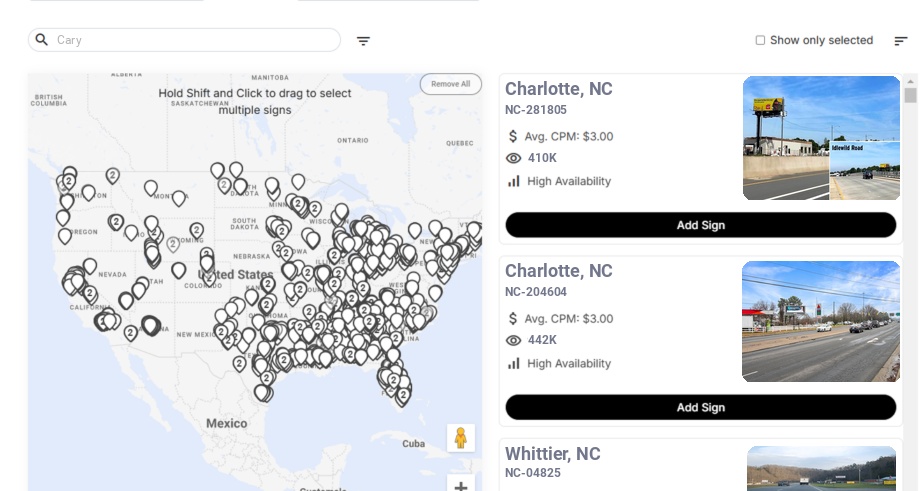



How much is a billboard in Cary?
Why Choose Blip for Billboard Advertising in Cary
-
Blip lets you buy Cary billboards self-serve and only pay when they run, perfect for I-40 and US-1 commuter traffic.
-
Set flexible budgets in Cary and test West Cary growth on NC-540 without contracts or long-term lock-ins.
-
Daypart with Blip in Cary to catch RTP commuters at rush hour and weekend families near Downtown Cary Park.
-
Use real-time analytics to shift Cary spend toward the routes driving more plays near RDU and WakeMed Soccer Park.
-
Create and update Cary creatives fast with Blip, tailoring messages for Cary Parkway, Kildaire Farm Road, and local shoppers.
Frequently Asked Questions About Billboard Advertising in Cary
How much does a billboard cost in Cary with Blip?
With Blip, billboard advertising in Cary is flexible and accessible because you only pay when your ad actually appears. Each “blip” is a 7.5-to-10-second display on a rotating digital billboard, and pricing starts at just $0.01 per display. Your daily budget helps Blip’s algorithm bid for open ad slots, so the cost per blip can vary based on time of day, location, and advertiser demand while still working to maximize your reach.
Where can I advertise with Blip in Cary to reach commuters?
Cary is still an auto-oriented market, and road exposure remains the dominant out-of-home opportunity in this market. The strongest billboard opportunities sit on commuter corridors that connect Cary to RTP, RDU, Raleigh, and fast-growing suburban trade areas, often carrying roughly 30,000 to 170,000+ vehicles per day. I-40 is Cary’s most important regional billboard corridor, and US-1 and NC-540 are also major routes.
Why is Cary a strong billboard market for Blip?
Cary is one of North Carolina’s strongest billboard markets because it combines suburban buying power with the regional traffic of the Research Triangle. The Town of Cary had 174,721 residents in 2020, and it sits inside Wake County, which had 1,129,410 residents the same year. Most trips in and around Cary still happen by car, with roughly 4 out of 5 workers commuting by car, truck, or van.
What kind of people can Blip reach with billboards in Cary?
With Cary billboards, we can reach commuters, families, visitors, and business travelers in one campaign. Cary benefits from Research Triangle Park, Raleigh-Durham International Airport, major universities with roughly 87,000 combined students, youth sports venues that can draw 10,000 fans, and fast-growing neighborhoods nearby. That mix makes the market useful for both weekday professionals and household decision-makers.
What are the best billboard areas in Cary for local traffic and new growth?
Busy segments of US-64/Walnut Street commonly run in the 35,000 to 55,000 vehicles-per-day range, while major surface routes such as Cary Parkway, Kildaire Farm Road, Tryon Road, and NC-55 often reach the 30,000 to 50,000-plus range on their strongest stretches. The Triangle Expressway and NC-540 system matter more every year for Cary advertising, especially on Cary’s western and southern edge. This is one of the best places to target growth, especially as Chatham County continue to add rooftops.
Do I need a contract to advertise with Blip in Cary?
No, Blip has no long-term contracts or minimum commitments. You can start, pause, or stop your campaign at any time.
How fast can I launch a billboard campaign with Blip in Cary?
You can have your campaign live in minutes. Create a free account, select your locations, set your budget, upload your design, and start running once approved.
Where can I advertise with Blip in Cary?
Blip has digital billboards in Cary. You can browse available locations on a map, choose the ones that fit your audience, and start advertising right away.
Still have questions? Launch a campaign in minutes — no contracts, no commitments.
Start Your CampaignCary Billboard Advertising Guide
Cary Research Triangle. The Town of Cary 174,721 residents in 2020, and it sits inside Wake County, which had 1,129,410 residents the same year. Most trips in and around Cary still happen by car, with roughly 4 out of 5 workers commuting by car, truck, or van, and that keeps digital billboards highly visible on the highways and arterial roads people use every day. With Research Triangle Park, Raleigh-Durham International Airport 87,000 combined students, youth sports venues that can draw 10,000 fans, and fast-growing neighborhoods nearby, we can use Cary billboards to reach commuters, families, visitors, and business travelers in one campaign.
Cary Market Overview
Cary’s growth and regional position
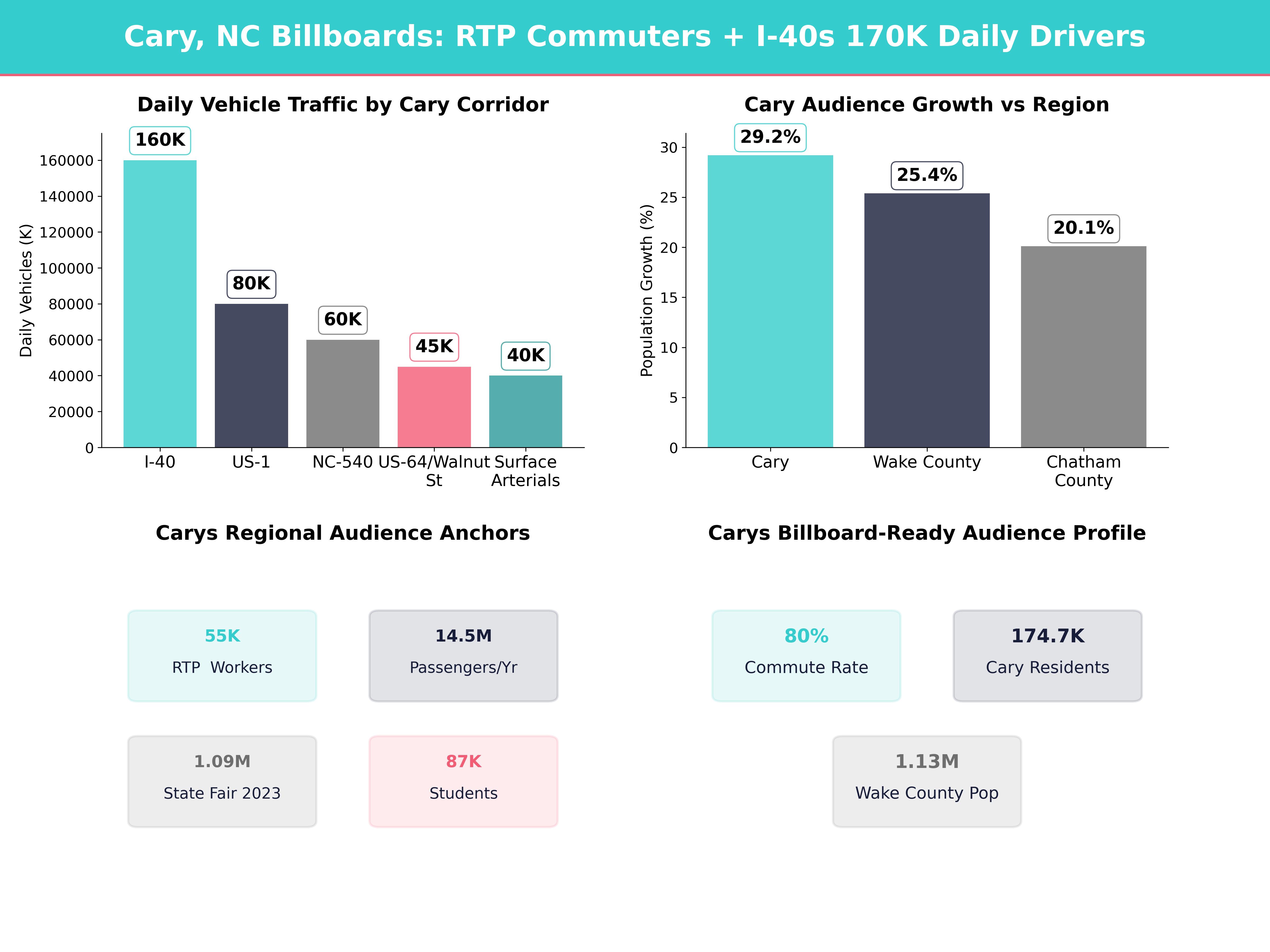
Cary sits between Raleigh, Durham, and Apex 228,417 residents in Wake County alone from 2010 to 2020. From 2010 to 2020, Cary grew from 135,234 residents to 174,721, which was an increase of 39,487 people, or 29.2%. Most of Cary is in Wake County, while newer western and southwestern sections extend into Chatham County 63,505 residents in 2010 to 76,285 in 2020, a gain of 20.1%. Wake County also expanded rapidly, climbing from 900,993 residents in 2010 to 1,129,410 in 2020, which was growth of 25.4%.
That population story matters for billboard advertisers because Cary is not an isolated suburb. It is part of a fast-growing metro pattern in which residents routinely cross town lines for work, shopping, school, sports, and entertainment. When we advertise in Cary, we are often reaching a broader Triangle consumer who moves fluidly between Morrisville, Raleigh, Durham, and Apex
Economic drivers that strengthen Cary billboard demand
Cary benefits from one of the Southeast’s most diversified regional economies. Nearby Research Triangle Park spans 7,000 acres, includes more than 300 companies, and supports about 55,000 workers. That concentration of employment helps billboard categories such as healthcare, recruiting, financial services, higher education, software, coworking, business travel, and quick-service food perform especially well.
The airport effect is also significant. Raleigh-Durham International Airport 14.5 million passengers in 2023, which gives Cary-area billboards exposure to residents, visiting families, conference attendees, and corporate travelers. Business groups such as the Cary Chamber of Commerce, the Greater Raleigh Chamber, and Visit Raleigh all promote a regional economy built on technology, life sciences, education, sports, and hospitality.
Mobility and what it means for advertisers
Cary is still an auto-oriented market. Local ACS-based profiles consistently show that roughly 4 out of 5 workers, or about 80%, commute by car, truck, or van. Services from GoCary and GoTriangle
For advertisers, that means Cary is a frequency market as much as it is a reach market. We can build repeated weekday impressions with commuter routes, and we can add weekend and evening visibility for retail, dining, family entertainment, medical services, and event-driven campaigns.
Key Traffic Corridors in Cary
Cary’s travel patterns are shaped by a handful of high-volume highways and arterial routes, with the strongest billboard opportunities sitting on commuter corridors that connect Cary to RTP, RDU, Raleigh, and fast-growing suburban trade areas, often carrying roughly 30,000 to 170,000+ vehicles per day. According to the North Carolina Department of Transportation, exact traffic counts vary by segment and year, but the pattern is clear: the strongest billboard opportunities sit on commuter corridors that connect Cary to RTP, RDU, Raleigh, and fast-growing suburban trade areas.
I-40 through Cary, RTP, and the airport zone
I-40 is Cary’s most important regional billboard corridor. NCDOT traffic-count maps regularly show Cary-area I-40 segments in the 150,000 to 170,000-plus AADT range, especially near the airport approaches and major interchanges. This route ties Cary directly to RDU Research Triangle Park, downtown Raleigh, and Durham.
This corridor works best when we want scale. It is especially strong for these advertisers:
- Healthcare systems can stay visible to a broad adult audience that makes recurring appointments across the Triangle.
- Universities, training programs, and employers can reach professionals and students during routine weekday travel.
- Hotels, attractions, and event venues can intercept visitors moving between the airport, Cary, and central Raleigh.
- Regional retail brands can build frequency because many drivers see the same corridor multiple times per week.
US-1 and the Raleigh-Apex approach to Cary
US-1 is a major north-south gateway for Cary-adjacent traffic. NCDOT counts on Cary-area US-1 segments typically land around 70,000 to 90,000-plus vehicles per day, with some interchanges pushing higher. It captures movement between south and southwest Wake County, Raleigh, and Apex
US-1 is a strong fit for advertisers that need regional shoppers rather than only local neighborhood traffic. We often like it for home services, auto dealers, legal services, healthcare groups, furniture, and destination retail because many trips on this corridor are intentional and purchase-oriented.
NC-540 and Cary’s western growth edge
The Triangle Expressway and NC-540 system 50,000 to 70,000-plus AADT, and those counts should keep rising as west Cary and Chatham County continue to add rooftops.
This is one of the best places to target growth, especially as Chatham County added 12,780 residents from 2010 to 2020. We should prioritize NC-540 when we want to reach:
- New movers and homeowners who are actively making decisions about healthcare, insurance, home improvement, flooring, landscaping, and internet service.
- Private schools, childcare, and tutoring brands that want visibility near family-heavy commuting patterns.
- Regional entertainment and dining concepts that depend on evening and weekend traffic from multiple suburbs.
US-64, Walnut Street, Cary Parkway, Kildaire Farm Road, and NC-55
Freeways drive scale, but Cary’s arterial network drives action. Busy segments of US-64/Walnut Street commonly run in the 35,000 to 55,000 vehicles-per-day range, while major surface routes such as Cary Parkway, Kildaire Farm Road, Tryon Road, and NC-55 often reach the 30,000 to 50,000-plus range on their strongest stretches.
These roads are ideal when we care about shorter decision windows and local conversion. We can use them for:
- Restaurants, gyms, urgent care, and dental practices because drivers are often close enough to act the same day.
- Grocery-anchored retail and family entertainment because these corridors line up with routine household trips.
- Community campaigns such as schools, churches, municipal events, and local nonprofits because the audience is highly neighborhood-based.
Cary Audience Segments Advertisers Can Reach
Cary commuters and office professionals
Cary is a commuter-heavy market with access to one of the country’s most employment-dense suburban regions. Research Triangle Park alone supports about 55,000 workers, and Cary is also home to major corporate campuses, including SAS. That creates a dependable weekday audience of professionals who value convenience, trust, time savings, and quality.
For this group, billboard categories such as financial services, telehealth, recruiting, continuing education, meal solutions, and premium consumer services often align well. The key is relevance during commute windows, especially early morning and late afternoon.
Cary families and household decision-makers
Cary is one of the Triangle’s most family-oriented communities, and that matters because family markets create recurring demand. The Wake County Public School System serves more than 160,000 students, and many Cary households are balancing school schedules, youth activities, healthcare appointments, grocery trips, and home maintenance.
That is why Cary billboards can work especially well for categories such as pediatric care, orthodontics, tutoring, swim lessons, youth sports, home services, family dining, warehouse clubs, and neighborhood retail. When we choose boards near major arterials instead of only freeway inventory, we often gain stronger proximity to those household decisions.
Students, faculty, and early-career adults around Cary
Cary also benefits from its position in a university-rich region. North Carolina State University 38,000 students, UNC-Chapel Hill enrolls more than 32,000, and Duke University enrolls roughly 17,000 students. Those audiences travel through Cary for airport trips, internships, concerts, jobs, sporting events, and weekend shopping.
For advertisers, that makes Cary useful for apartment communities, mobile carriers, entertainment brands, rideshare-related services, healthcare, graduate programs, and employers looking for early-career talent. We do not have to advertise directly beside campus to reach those consumers if our boards sit on the routes they already use.
Cary visitors, sports fans, and event travelers
Cary attracts visitors directly, and it also sits near some of the region’s biggest draw points. RDU 14.5 million passengers in 2023. WakeMed Soccer Park 10,000 fans. The USA Baseball National Training Complex in Cary has 4 fields and hosts a steady calendar of tournaments and national-team activity. Downtown Cary Park adds another year-round magnet with its 7-acre footprint in the center of town.
The regional event calendar amplifies that visitor traffic. The nearby North Carolina State Fair drew more than 1.09 million attendees in 2023, and PNC Arena adds concerts, hockey, and special events just east of Cary. This audience is especially valuable for hotels, restaurants, attractions, retail centers, urgent care, rental cars, and tourism-oriented brands.
Seasonal Opportunities in Cary
Spring in Cary
Spring is a strong launch period for Cary campaigns because household activity picks up across multiple categories at once. College graduation season at North Carolina State University UNC-Chapel Hill, and Duke University brings family travel, dining, apparel, gifting, and hospitality demand. Youth sports calendars accelerate at WakeMed Soccer Park USA Baseball National Training Complex, which creates opportunity for restaurants, hotels, sports medicine, and family entertainment.
Spring is also one of the best windows for home services in Cary. As temperatures rise, homeowners start scheduling HVAC work, landscaping, pest control, remodeling, flooring, and outdoor living projects. We often like to increase afternoon and early evening visibility during this season because that is when many households shift from work mode to errand mode.
Summer in Cary
Summer brings a mix of commuter continuity and leisure travel. RDU
This is a strong season for family attractions, camps, clinics, cold beverage brands, car washes, dentists, and quick-service restaurants. It is also a good time to run weather-aware creative. Bright colors and strong contrast matter in a market where hazy daylight, thunderstorms, and intense sun can reduce readability if creative is too soft.
Fall in Cary
Fall may be the single best advertising season in Cary because several demand waves stack together. Back-to-school routines reset spending patterns for families, youth sports remain active, and the North Carolina State Fair draws more than 1 million attendees to the Cary-Raleigh edge in October. Football, hockey, festivals, and hiring cycles all contribute to heavier movement and higher commercial intent.
This is an excellent period for retailers, healthcare, colleges, B2B recruiting, insurance, and entertainment brands. We should also consider heavier weekday commute dayparting in fall because office attendance and school-related driving patterns often become more predictable after summer.
Winter in Cary
Winter in Cary is not a shutdown season. The market still has steady commuter traffic, strong holiday retail demand, business travel through RDU PNC Arena and regional venues. Shorter daylight hours can actually improve the impact of digital boards because more impressions happen in dim or dark conditions.
Winter campaigns often work well for healthcare, tax services, gyms, streaming and telecom offers, home improvement financing, senior services, and restaurants. We usually recommend simpler, higher-contrast creative during this season because fog, rain, and early sunset favor bold, fast-reading messages.
Cary Billboard Design Tips
Use Cary-specific relevance instead of generic suburban messaging
Cary audiences are accustomed to polished brands, clear value propositions, and efficient communication. A vague slogan may look attractive, but a more specific headline often performs better here. Claims such as “Near RDU,” “Off US-1,” “Minutes from RTP,” “Now Open in West Cary,” or “Serving Cary, Apex, and Morrisville” feel local and useful.
This matters because Cary is full of high-intent travel. People are not simply wandering past a billboard. They are usually moving between home, work, school, and scheduled activities. We should respect that mindset with copy that helps them decide quickly.
Reflect the Triangle’s professional and multicultural identity
Cary is more diverse and internationally connected than many suburban markets, especially because of ties to Research Triangle Park, Morrisville, and the region’s university and tech workforce. Our imagery should look like present-day Cary. Multicultural families, professional settings, youth sports, parks, and clean modern design generally fit better than generic rustic or beach-heavy creative unless the offer truly calls for it.
We should also favor credibility markers. Awards, years in business, local locations, brand-recognition logos, and clear service categories often resonate well in a market with many engineers, healthcare professionals, and analytical buyers.
Match message length to Cary driving conditions
On I-40 and NC-540, we should keep the message extremely tight because speeds are high and attention is split across multiple lanes. A short headline, a bold brand mark, and one memorable offer usually work best. On Walnut Street, Cary Parkway, Kildaire Farm Road, and NC-55, we can sometimes support a second line of copy or a neighborhood cue because speeds are lower and drivers encounter more signals.
Local shorthand also helps. Cary drivers understand terms such as “Downtown Cary,” “RTP,” “RDU,” “540,” “Walnut,” “Tryon,” and “Kildaire.” When those labels are relevant, they can make a billboard feel immediately more useful and more trustworthy.
Highlight family utility, not only aspiration
Because Cary has such a strong family base, campaigns often benefit when they show practical household relevance. We should test offers tied to convenience, schedule relief, value, and quality of life. “Same-day care,” “After-school tutoring,” “Weekend brunch,” “New patient visits,” and “Free consultation” often fit the way Cary households make decisions better than abstract lifestyle language alone.
Regional Strategies Around Cary
East Cary and Raleigh-facing Cary routes
East Cary and the approaches toward Raleigh give us broad commuter reach and strong regional shopping traffic. This area is useful for retail, healthcare, entertainment, and service businesses that want a mix of Cary residents and pass-through Triangle travelers. Boards on or near I-40 and US-1 are especially valuable when brand awareness is the primary goal.
Central Cary and Downtown Cary
Central Cary is where community presence matters most. The rise of Downtown Cary Park and the continued strength of downtown dining and events make this submarket attractive for restaurants, boutiques, local healthcare, cultural organizations, and municipal campaigns. We usually approach central Cary with more neighborhood language and less purely regional branding.
West Cary, Morrisville, and the RTP edge
West Cary and the Morrisville side of town are ideal for reaching tech workers, airport travelers, and globally connected households. This is one of the best areas for B2B, recruiting, education, medical specialists, hotels, and premium consumer services. Messaging in this zone usually performs best when it is concise, polished, and credential-driven.
South Cary, Apex, and Chatham growth corridors
South Cary and the routes toward Apex
Using Blip Tools in Cary
Test multiple Cary corridors without overcommitting
Cary is a market where different roads serve very different purposes. Because Blip makes it easy to test placements flexibly, we can compare I-40 reach, US-1 regional traffic, and Walnut Street local intent without locking ourselves into one corridor too early. That is especially useful for advertisers who are still learning whether their best Cary audience is commuter-heavy, family-heavy, or visitor-heavy.
Daypart for Cary commuting and event patterns
Dayparting is especially powerful in Cary. We can emphasize weekday mornings and evenings for commuters, lunch and early evening for retail and restaurants, and weekends for youth sports, events, and family outings. A recruiting campaign near RTP does not need the same timing as a restaurant campaign near downtown Cary, and Blip lets us separate those strategies cleanly.
Rotate creative by submarket and season
Cary rewards localized messaging. We can run one version that says “Near RTP” on airport-side routes, another that says “Now Open in West Cary” near NC-540, and a third that highlights “Downtown Cary” for central-town traffic. We can also adjust creative by season, such as sports messaging in spring, back-to-school messaging in fall, and holiday retail or healthcare messaging in winter.
Use analytics to refine Cary campaigns quickly
Blip’s reporting makes Cary testing more practical because we can watch performance trends and shift budget toward the corridors that best match our goals. If one route is building broad awareness but another is better for store visits, we can rebalance instead of waiting through a long fixed billboard term. That agility is especially valuable in a market where commuting, school calendars, sports schedules, and rapid growth all influence demand.
Getting Started With Billboard Rental in Cary
Start with our real objective in Cary
Before we rent a billboard in Cary, we should define whether we want broad awareness, immediate local traffic, recruiting, event promotion, or a multi-location regional push. That choice should guide everything else. If our goal is market-wide visibility, I-40, US-1, and NC-540 usually deserve priority. If our goal is same-day action, arterial routes such as Walnut Street, Cary Parkway, Kildaire Farm Road, and NC-55 often matter more.
Choose Cary locations by decision window
The best Cary boards are not always the closest boards. They are the boards that match how much time our audience needs to act. A family deciding where to eat tonight can respond to a Walnut Street placement. A professional considering a new employer, specialist doctor, or university program may need repeated exposure over several days on I-40 or the RTP approaches.
We should evaluate each board with a few practical questions:
- Does the board sit on a route our audience already uses regularly?
- Is the direction of travel correct for the commute or errand pattern we want?
- Is the message something a driver can act on quickly, or something that benefits from repeated exposure?
- Does the surrounding area align with our ideal customer, such as families, office workers, visitors, or new homeowners?
Expect a simpler process than traditional billboard buying
Traditional billboard buying in a market like Cary often means longer sales cycles, fixed packages, and less flexibility when our needs change. Blip simplifies that process by letting us review available digital inventory on a map, choose the locations that fit our strategy, and adjust timing and budget as our campaign learns. That makes Cary easier to enter, especially for local businesses, regional brands, and franchise groups that want to move faster.
Build a smart first Cary campaign
For a first Cary campaign, we usually recommend starting with a small but intentional mix instead of trying to cover everything at once. A practical approach is to combine a high-reach commuter corridor with one or two action-oriented local routes. That gives us both awareness and conversion potential.
A strong starting framework often looks like this:
- We use I-40 or US-1 if we need broad regional reach.
- We add Walnut Street, Cary Parkway, or Kildaire Farm Road if we want local traffic and neighborhood relevance.
- We prioritize NC-540 if we are targeting west Cary growth and new households.
- We favor airport and RTP routes if our campaign is B2B, recruiting-focused, or travel-oriented.
Measure fit, then scale in Cary
Once our campaign is live, we should watch which locations line up with our actual business results. In Cary, the right answer is often a blend rather than a single board. The market is big enough to segment, but connected enough that one well-planned campaign can still reach multiple audience types. When we pair local knowledge with flexible digital buying, Cary becomes a highly efficient place to build awareness, drive action, and grow consistently.