Billboards in Raeford, NC
No Minimum Spend. No Long-Term Contracts. Just Results.
Trusted by Leading Brands


Billboard advertising
in Raeford has never been easier



How much is a billboard in Raeford?
Why Choose Blip for Billboard Advertising in Raeford
-
Blip lets you launch in Raeford fast and self-serve, reaching US 401 commuters and Fayetteville-bound traffic without buying through a rep.
-
Set flexible budgets in Raeford and only pay when ads flash, perfect for testing NC 211 shoppers, families, and Pinehurst-bound travelers.
-
No contracts with Blip means you can ramp up for Raeford PCS season, Carolina Horse Park events, or school-start traffic, then pause anytime.
-
Use real-time analytics in Raeford to see what hits on 401 vs. 211 and shift spend toward the routes driving more commuter reach.
-
Blip creative tools make it easy to tailor Raeford billboards for military families, local schools, or Sandhills leisure traffic with quick updates.
Frequently Asked Questions About Billboard Advertising in Raeford
How much does a billboard cost in Raeford with Blip?
With Blip, billboard advertising in Raeford can be surprisingly affordable because you only pay when your ad actually appears. Each “blip” is a 7.5-to-10-second display on a rotating digital billboard, starting at just $0.01 per display. Pricing is dynamic, so the cost per blip can change based on time of day, location, and advertiser demand, but you stay in control the whole time.
Where can I advertise with Blip in Raeford to reach commuters and families?
Raeford sits inside a regional consumer shed of 603,067 people, and it is a highly car-oriented part of the North Carolina Sandhills. US 401 is the main commuter spine and generally carries about 20,000 to 35,000 vehicles per day on the stronger segments in and east of town. NC 211 also moves east-west through Raeford and links the city to Aberdeen, Southern Pines, and Pinehurst.
Why is Raeford a strong billboard market for Blip ads?
Raeford is a strong billboard market because it combines steady local traffic with a much larger regional trade area of 603,067 people across Hoke, Cumberland, Moore, and Robeson counties. About 4 in 5 workers commute by driving alone and the average trip to work is roughly 31 minutes. With daily movement between Raeford, Fayetteville, Aberdeen, Southern Pines, and Pinehurst, digital billboards can reach commuters, military families, shoppers, students, and leisure travelers efficiently.
When is the best time to run billboard ads in Raeford with Blip?
Spring is one of the best times to advertise in the Raeford area because golf activity rises across Pinehurst, Southern Pines, and Aberdeen, and event traffic picks up around Carolina Horse Park. Late spring and summer are also important because military PCS season typically intensifies from May through August. Fall is another strong period for healthcare, home services, schools, and retail, and holiday campaigns usually need to start by early November.
What traffic routes in Raeford should I target with Blip billboard ads?
US 401 and NC 211 are the most important corridors for billboard advertising in Raeford. US 401 generally carries about 20,000 to 35,000 vehicles per day on the stronger segments, while central NC 211 segments usually see about 12,000 to 18,000 vehicles per day. Regional connectors like US 15-501 and I-95 can also add broader reach when a campaign needs more than just local frequency.
Do I need a contract to advertise with Blip in Raeford?
No, Blip has no long-term contracts or minimum commitments. You can start, pause, or stop your campaign at any time.
How fast can I launch a billboard campaign with Blip in Raeford?
You can have your campaign live in minutes. Create a free account, select your locations, set your budget, upload your design, and start running once approved.
Where can I advertise with Blip in Raeford?
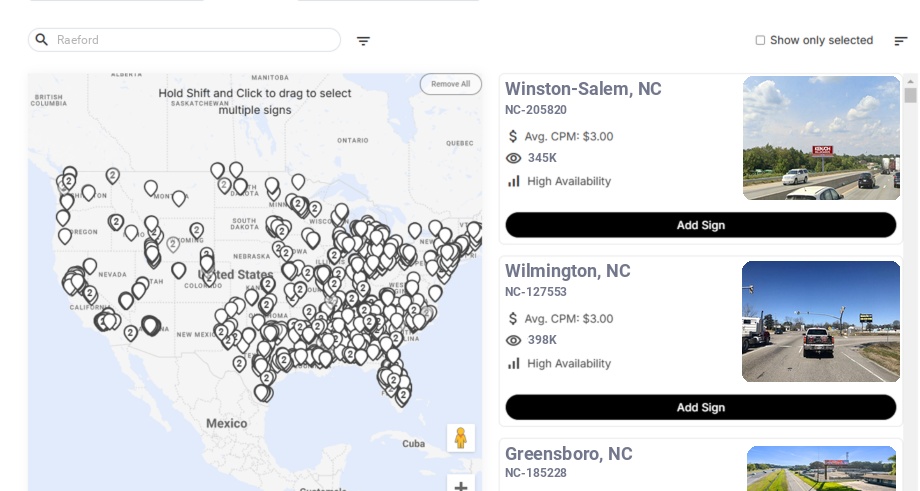
Blip has digital billboards in Raeford. You can browse available locations on a map, choose the ones that fit your audience, and start advertising right away.
Still have questions? Launch a campaign in minutes — no contracts, no commitments.
Start Your CampaignRaeford Billboard Advertising Guide
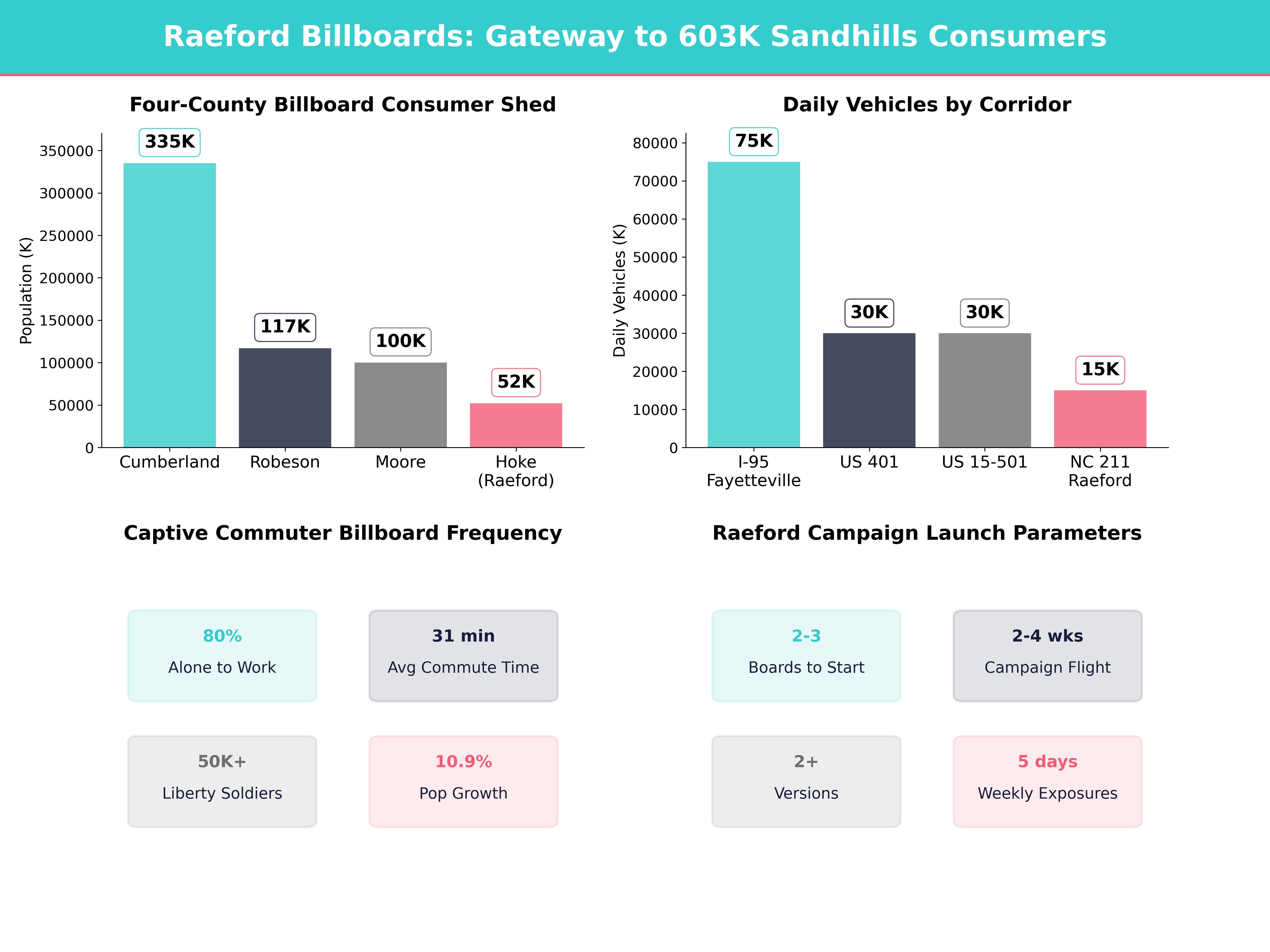
Raeford is a strong billboard market because it combines steady local traffic with a much larger regional trade area (603,067 people across Hoke, Cumberland, Moore, and Robeson counties). Hoke County 52,082 residents in 2020, and when we add nearby Cumberland County Moore County Robeson County, the surrounding population reaches 603,067. This is also a highly car-oriented part of the North Carolina Sandhills, where about 4 in 5 workers commute by driving alone and the average trip to work is roughly 31 minutes. With daily movement between Raeford, Fayetteville Aberdeen Southern Pines
Raeford Market Overview for Billboard Advertisers
Raeford sits in a growing county with a broad trade radius
Hoke County 46,952 residents in 2010 to 52,082 in 2020, which was an increase of 5,130 people, or about 10.9%. That growth matters because Raeford is not just serving its own city limits. It functions as a practical service hub for households moving between Hoke, Cumberland, Moore, and Robeson counties.
The nearby county populations show how much reach a Raeford campaign can pick up beyond town. Cumberland County 334,728 residents in 2020, Moore County 99,727, and Robeson County had 116,530. In other words, Raeford sits inside a regional consumer shed of 603,067 people, even though the immediate community feels smaller and more local.
That blend is useful for advertisers. We can build campaigns that feel community-specific in Raeford while still reaching people who shop, work, study, or seek healthcare across county lines.
Raeford’s economy is tied to commuting, military activity, and essential services
Raeford’s economy is influenced heavily by the broader Fayetteville Moore County more than 50,000 active-duty soldiers, plus thousands of civilian employees and military family members, which keeps housing, healthcare, auto services, financial services, recruiting, childcare, and dining in constant demand.
The county’s commute patterns make outdoor advertising especially relevant. About 80% of workers drive alone, and average travel time to work is around 31 minutes, which gives us repeated exposure opportunities on the same routes day after day. Raeford is about 20 miles from downtown Fayetteville 25 miles from Pinehurst 20 miles from Laurinburg, and roughly 30 miles from UNC Pembroke in Pembroke.
For billboard advertisers, that means we are not relying on one isolated downtown audience. We are working inside a commuter market where people routinely travel for work, school, medical appointments, shopping, and recreation.
Key Traffic Corridors in Raeford and Hoke County
Raeford’s traffic concentrates along a few dependable corridors, and those corridors tell us which billboard placements are most valuable. When we align the route with the audience’s trip purpose, our campaign gets more relevant and more efficient.
US 401 is Raeford’s main commuter spine
According to traffic counts from the North Carolina Department of Transportation, US 401, which runs through Raeford as Fayetteville Road and Laurinburg Road, generally carries about 20,000 to 35,000 vehicles per day on the stronger segments in and east of town. The heaviest approaches toward Cumberland County typically top 30,000 AADT, because this is the primary connection between Raeford, the Fayetteville market, and Fort Liberty.
US 401 is one of the best routes for advertisers that need consistent weekday frequency. This corridor works especially well for the following categories:
- Healthcare brands can reach residents heading toward Cape Fear Valley Health, local clinics, and specialty care in Fayetteville.
- Auto dealers, repair shops, and tire stores can reach drivers while they are already engaged in a car-based commute.
- Restaurants, convenience stores, and fuel brands can target morning and evening decision points.
- Recruiters, colleges, and staffing firms can reach military-connected households, trades workers, and commuting employees.
If our goal is daily repetition among people who move between Raeford and Fayetteville, US 401 should usually be the first corridor we evaluate.
NC 211 is the cross-county retail and tourism route in Raeford
NC 211 moves east-west through Raeford and links the city to Aberdeen Southern Pines 12,000 to 18,000 vehicles per day on central Raeford segments, with volumes tapering as the highway moves into more rural areas.
This route matters because its audience is more varied than a simple work commute. NC 211 carries local shopping trips, school traffic, healthcare travel, and westbound leisure movement toward the Sandhills golf and hospitality market. That makes it a strong choice for the following advertisers:
- Retailers and family services can reach households making practical in-town and cross-town trips.
- Medical practices can capture patients traveling between Hoke County and the Sandhills healthcare network, including FirstHealth of the Carolinas
- Hospitality and tourism brands can intercept visitors moving toward golf, resort, and event destinations in Moore County.
- Real estate and home services companies can target households exploring growth corridors between Raeford and Moore County.
If our customer base includes both local families and leisure travelers, NC 211 can be one of the most flexible billboard corridors in the market.
Regional connectors extend Raeford campaigns beyond town
Some campaigns need more than local frequency. They need regional pull. In those cases, we should think beyond Raeford’s city streets and use nearby feeder routes strategically.
US 15-501 through the Aberdeen Southern Pines 30,000-plus vehicles per day, and it reaches higher-spending golf, medical, and professional audiences in Moore County. I-95 through the Fayetteville 70,000 to 80,000 AADT range, making it useful for regional tourism, chains, event promotion, and brands that want visibility with long-distance travelers entering southeastern North Carolina.
We do not need every Raeford campaign to expand that far. However, when we want to pair local frequency with regional reach, a Raeford board plus a Fayetteville or Sandhills board often creates a much stronger path-to-purchase story than a single location alone.
Audience Segments We Can Reach in Raeford
Commuters and military households are the core Raeford audience
Raeford’s most dependable audience is the daily commuter. The county’s drive-alone rate sits around 80%, which is high enough to make road visibility a central media advantage. Many of those trips are connected directly or indirectly to Fort Liberty, Fayetteville employers, healthcare systems, schools, and retail centers.
Military households are especially important in this market. Fort Liberty supports more than 50,000 active-duty service members, and many families live, shop, or relocate across the Raeford-Fayetteville corridor. That audience responds well to straightforward messages about housing, storage, moving help, childcare, urgent care, banking, insurance, legal services, auto sales, and quick-serve food.
For these consumers, billboards work best when they answer an immediate question. We should ask whether the ad helps them save time, find a nearby option, trust a provider, or remember a brand on the next trip.
Families and school-related households are a major local buying block
Raeford is a family market, and the school footprint proves it. Hoke County Schools serves more than 8,500 students, which tells us the local audience includes a large number of parents, caregivers, and family decision makers. That dynamic supports advertisers in pediatric care, dental care, tutoring, youth sports, family restaurants, wireless plans, grocery, home improvement, and churches.
Because many families drive daily between home, school, work, and shopping, frequency matters as much as raw reach. A board seen 5 days a week on the school or work route often outperforms a theoretically larger but less relevant placement.
This audience also values clarity. In a market like Raeford, practical messaging usually beats abstract branding.
College students and young adults add regional reach
Raeford is not a classic college town, but it sits within everyday reach of several campuses. Fayetteville State University enrolls about 6,700 students, Methodist University 1,800, and UNC Pembroke serves around 8,000 students. Sandhills Community College also brings a steady stream of students and workforce learners into the western side of the trade area.
That adds up to a meaningful young-adult audience across the region. We can reach them with campaigns for apartments, financial services, mobile carriers, entertainment, healthcare, fast casual dining, and workforce training. We can also time creative around semester starts in August and January, when awareness and switching behavior tend to be higher.
Golf, equestrian, and event travelers create valuable destination traffic
Raeford benefits from nearby leisure demand, not only local errands. Pinehurst Resort 10 golf courses, and the broader Sandhills tourism economy draws visitors throughout the year. Carolina Horse Park in Raeford adds equestrian event traffic, while Visit Fayetteville Crown Complex, and Segra Stadium
This audience is different from the commuter audience. It is more weekend-oriented, more event-driven, and more likely to respond to dining, lodging, attractions, healthcare specialties, and premium retail.
Seasonal and Timing Opportunities in Raeford
Spring and summer are strong for relocation, tourism, and family services in Raeford
Spring is one of the best times to advertise in the Raeford area. Golf activity rises across Pinehurst Southern Pines Carolina Horse Park, and family outings increase around spring festivals, including the Dogwood Festival in Fayetteville.
Late spring and summer are also important because military PCS season typically intensifies from May through August. That is a prime window for apartments, homebuilders, storage, movers, urgent care, dental, banking, and local service businesses. If we want to reach new arrivals before they build habits, this is one of the best windows of the year.
Summer campaigns should also remember the local school cycle. Families start making back-to-school purchases well before classes return in August, so July can be just as important as August for retail and family-service advertisers.
Fall is ideal for schools, football, healthcare, and home services in Raeford
Fall brings another strong run of Sandhills travel because the weather is more comfortable and golf demand stays healthy. It is also a high-attention period for local routines. By September, work commutes, school schedules, and after-school traffic become more predictable again.
That makes fall especially effective for the following categories:
- Healthcare providers can promote primary care, urgent care, dental care, screenings, and specialty services as families reset routines.
- Home services brands can advertise HVAC, roofing, pest control, lawn, and remodeling before year-end projects close out.
- Retailers and restaurants can build frequency around football, community events, and holiday planning.
- Colleges and training programs can target students who are reconsidering enrollment after the first semester adjustment.
Holiday campaigns usually need to start earlier than many advertisers expect. In a market like Raeford, we often want awareness up by early November, not mid-December, because families make shopping and travel plans gradually.
Raeford’s weather supports year-round billboard use
The State Climate Office of North Carolina shows why this market works year-round. Summer highs in the Sandhills regularly reach around 90°F, while January highs are often in the mid-50s, so road travel remains steady in every season.
That mild winter profile helps outdoor media. We do not face long stretches of severe snow disruption, and even when tropical weather affects the region during the June through November hurricane season, traffic usually rebounds quickly. Flexible scheduling is valuable here because we can intensify campaigns around event weekends, storm recovery, tax season from January through April, and holiday shopping from November through December.
Billboard Design Tips for the Raeford Market
We should use local geography directly in the message
Raeford drivers respond well to location-specific copy because so many trips are practical and route-based. Phrases like “On 401,” “Off 211,” “Before Fayetteville,” “Toward Pinehurst,” or “Minutes from Raeford” feel more useful than broad brand slogans.
This matters because many approach roads speed up quickly outside town. On corridors where traffic often moves at 45 to 55 mph, we need messages that can be absorbed in one glance. Short, directional copy is especially effective for medical offices, restaurants, fuel stops, retailers, and service businesses with a clear next action.
When possible, we should name the local place the audience actually uses. “Raeford,” “Rockfish,” “Fayetteville,” “Aberdeen,” and “Pinehurst” usually perform better than vague references to “the region.”
We should speak to practical, family-oriented decision makers
Raeford is not a market where every campaign should look luxury-first or ultra-abstract. A large share of the audience is balancing work, family, school, commuting time, and household costs. Creative that emphasizes trust, convenience, value, and nearby access usually fits the local mindset better.
For example, healthcare brands should lean into reassurance and proximity. Home service brands should emphasize fast response and local credibility. Financial, legal, and insurance brands should focus on clarity and confidence rather than cleverness for its own sake.
In some categories, bilingual support can also help. Service advertisers that already work with Spanish-speaking households may benefit from simple dual-language cues, especially when the goal is accessibility rather than heavy copy.
We should match leisure creative to the Sandhills setting
When we target golf, equestrian, or weekend traffic, the creative should look like the Sandhills. Pine silhouettes, course imagery, horses, clean resort visuals, and polished but understated color palettes usually fit better than urban nightlife or beach-themed visuals.
This is especially true on westbound routes toward Southern Pines Carolina Horse Park, the ad should feel connected to that travel purpose.
Regional Billboard Strategies Around Raeford
Raeford’s in-town core is best for local frequency
Boards close to the US 401 and NC 211 crossroads are the best choice when we want repetition among local residents. These placements are strong for grocery, quick-service restaurants, auto repair, banks, urgent care, family entertainment, churches, and hometown retail.
In-town boards are not always the biggest reach plays, but they are often the best memory builders. If people see the same message several times each week while running errands, our local brand recall improves quickly.
Eastbound from Raeford toward Fayetteville is best for commuter intent
The eastbound Raeford-to-Fayetteville corridor is the most important route for many weekday campaigns. This is where we can reach commuters heading toward Fort Liberty, Cape Fear Valley Health, downtown Fayetteville
For this corridor, we should think in directional terms. Morning scheduling from 6:00 a.m. to 9:00 a.m. is ideal for eastbound commuter messaging, while evening scheduling from 3:00 p.m. to 7:00 p.m. works well for the return trip. Brands with immediate intent, such as coffee, breakfast, urgent care, legal services, and after-work dining, often benefit the most.
Westbound from Raeford toward Aberdeen, Southern Pines, and Pinehurst is best for higher-value leisure and service buyers
The westbound NC 211 strategy is different. This audience includes golfers, destination diners, specialty healthcare users, and households engaging with the higher-spending Sandhills market.
That makes westbound placements attractive for the following campaigns:
- Hospitality and tourism campaigns can target weekend and event traffic.
- Healthcare specialists can promote destinations patients will travel to intentionally.
- Real estate and homebuilding campaigns can reach households considering moves between counties.
- Premium retail and financial brands can connect with affluent Moore County crossover traffic.
For this route, we usually get the best results by adding Thursday-through-Sunday weight instead of treating it like a pure Monday-through-Friday commuter buy.
Southbound extensions help us capture regional service trade
Southbound routes toward Laurinburg, Robeson County, and UNC Pembroke can be valuable for advertisers with a wider footprint. These corridors are especially useful for regional healthcare groups, colleges, furniture stores, legal firms, staffing companies, and political campaigns.
The volumes are lower than the Raeford-Fayetteville spine, but the audience can still be high intent. If people are making a longer drive for a service, the purchase value is often higher.
Using Blip Tools Effectively in Raeford
We should build route-specific schedules instead of running every hour equally
Raeford rewards precise timing. On commuter boards, we can concentrate spend in the morning and late afternoon. On leisure-oriented boards west of town, we can shift more weight to Thursday, Friday, Saturday, and event weekends. On in-town family boards, we can emphasize midday and late afternoon errands.
This kind of scheduling matters because different Raeford routes do different jobs. A board on US 401 near the Fayetteville side is not serving the same audience as a board on NC 211 heading toward Moore County, even if both are technically “near Raeford.”
We should test creative and locations quickly, then optimize
Because Raeford sits between several distinct submarkets, it is smart to test rather than assume. We can launch one message for commuters, another for families, and a third for tourism or event traffic. We can also compare an in-town board against an eastbound commuter board to see which one creates more measurable action.
Blip’s map-based buying, flexible budgets, and analytics are particularly useful here because the market has more directional nuance than its size suggests. We can make fast adjustments around a Carolina Horse Park weekend, a school start, a holiday push, or a busy travel period around Pinehurst Resort
Getting Started with Billboard Rental in Raeford
We should choose billboard locations based on trip purpose, not just proximity
The right Raeford billboard depends on what we need the ad to accomplish. Before renting, we should decide whether our main goal is local frequency, commuter reach, regional visibility, or destination traffic.
When we evaluate locations, we should look at the following questions:
- Does the board sit on a route with the right trip purpose? A Fayetteville-bound board is different from a Pinehurst-bound board.
- Is the traffic volume strong enough for our goals? In Raeford, a 12,000 AADT board and a 30,000 AADT board can serve very different campaign types.
- Is the ad close enough to the decision point? For many local businesses, being within 1 to 3 miles of the destination can improve response.
- Will the audience see the ad repeatedly? For local services, repeat exposure across 5 weekdays often matters more than occasional reach.
- Does the travel direction match our business hours? Morning eastbound and evening westbound can perform very differently.
We should expect a simpler process than traditional billboard buying
Traditional billboard companies often center the process around fixed packages, long lead times, and limited flexibility after the campaign starts. In Raeford, that can be inefficient because the market has multiple audience flows that are worth testing before we commit heavily.
With Blip, we can usually approach the market more practically. We can pick digital boards on a map, launch with a modest budget, watch performance, and refine based on what we learn. That is especially helpful in Raeford because one advertiser may discover that weekday commuter traffic on US 401 is more valuable than expected, while another may find that weekend westbound traffic on NC 211 is the real opportunity.
A practical first campaign plan for Raeford usually works best
For many advertisers, a strong Raeford test campaign looks like this:
- We start with 2 to 3 boards instead of trying to blanket the whole area.
- We run for 2 to 4 weeks so we can capture enough repeat exposure.
- We use at least 2 creative versions if we are targeting different audiences, such as commuters and families.
- We schedule around the most likely response windows, such as 6:00 a.m. to 9:00 a.m., 3:00 p.m. to 7:00 p.m., or Thursday-through-Sunday leisure traffic.
- We measure results against calls, website visits, walk-ins, coupon use, or location-specific offers.
Raeford is a market where a thoughtful billboard plan can outperform a larger but less precise one. If we match the board to the route, the route to the audience, and the audience to the season, we can build campaigns that feel local, move efficiently, and scale well across the Sandhills region.