Billboards in Winterville, NC
No Minimum Spend. No Long-Term Contracts. Just Results.
Trusted by Leading Brands


Billboard advertising
in Winterville has never been easier



How much is a billboard in Winterville?
Why Choose Blip for Billboard Advertising in Winterville
-
Blip lets you launch in Winterville in minutes, reaching NC 11 commuters and Greenville-bound drivers with self-serve digital billboards.
-
Use Blip in Winterville to auto-place ads around US 264 and ECU traffic, stretching your budget across the right times and spots.
-
No contracts or minimums in Winterville mean you can test boards for ECU's 27,000+ students or Watermelon Festival crowds, then pause anytime.
-
Daypart Winterville ads for 6-9am and 4-7pm commuter peaks, plus lunch traffic on NC 11, so your message plays when locals are on the road.
-
Track Winterville campaign results in real time and shift fast for Greenville-area commute patterns, football weekends, or the 4-day Watermelon Festival.
-
Blip's creative tools make it easy to build clear Winterville billboards for busy roads like US 264, where 20-minute drives demand fast, simple messaging.
Frequently Asked Questions About Billboard Advertising in Winterville
How much does a billboard cost in Winterville with Blip?
With Blip, billboard advertising in Winterville is affordable and flexible because you only pay when your ad actually appears. Each “blip” is a 7.5-to-10-second display on a rotating digital billboard, and pricing starts at just $0.01 per display. You set a daily budget, and Blip’s algorithm uses it to bid for open ad slots, adjusting to factors like time of day, location, and advertiser demand to help stretch your spend.
Where can I advertise with Blip in Winterville to reach local commuters?
NC 11 is one of the most important roads for Winterville advertisers, with key segments in the Greenville-Winterville corridor carrying roughly 20,000 to 35,000 AADT. This route is ideal for advertisers that depend on repeated local frequency, including quick-service restaurants, banks, insurance agencies, home service companies, and healthcare providers. Because NC 11 carries people on practical, habitual trips, direct, offer-led, and location-specific creative works best here.
Why is Winterville a good billboard market for Blip advertisers?
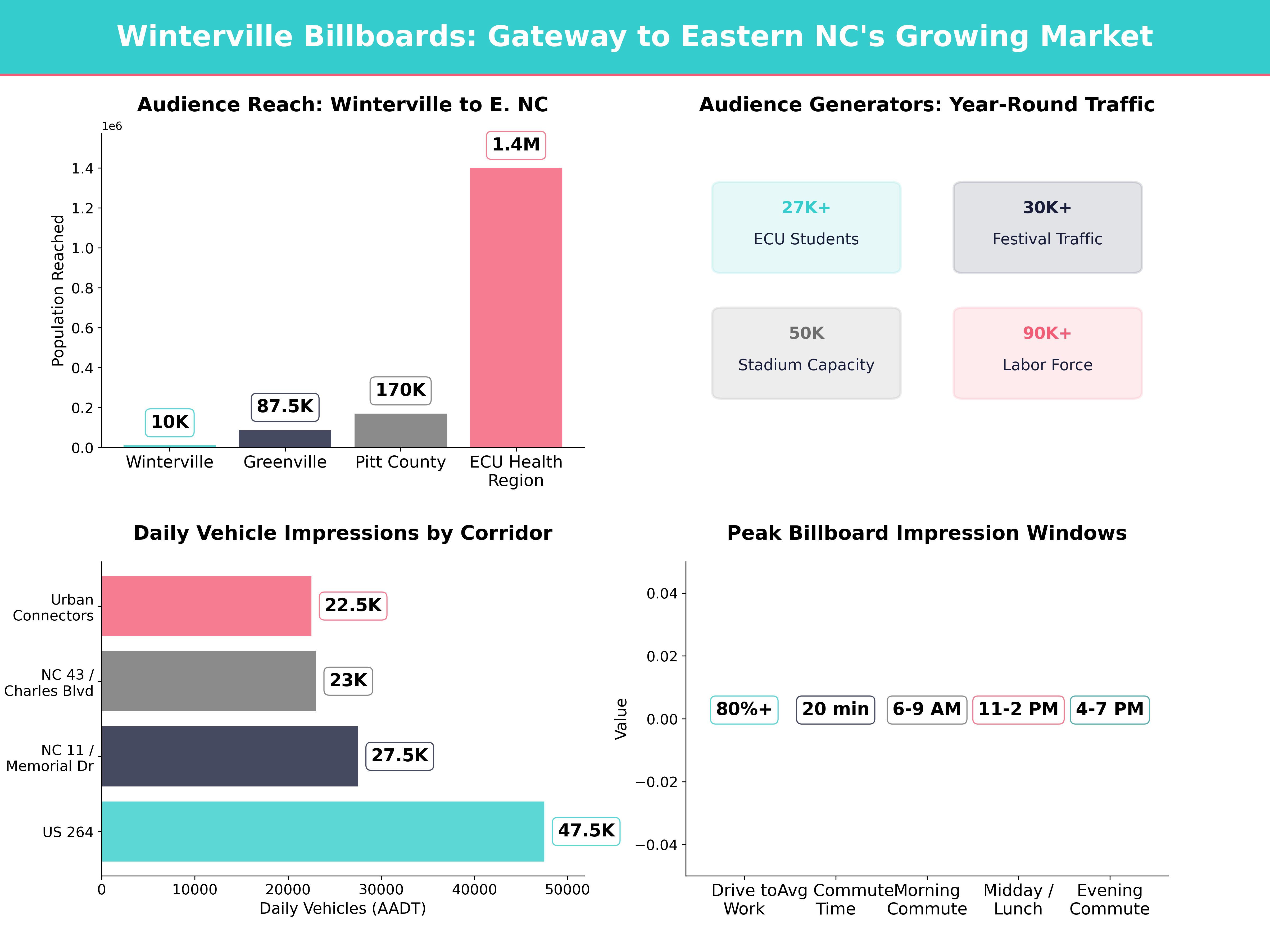
Winterville is a compelling billboard market because we are not advertising to an isolated small town. We are reaching a growing community of 10,000+ residents that sits immediately beside Greenville, a city of 87,521, inside Pitt County, which had 170,243 residents at the 2020 count. Daily life in this part of eastern North Carolina is strongly car-oriented, with well over 80% of workers commuting by car and average commute times around 20 minutes.
When is the best time to run Winterville billboard ads with Blip?
Late summer is one of the best billboard windows in the area because August combines back-to-school spending, ECU move-in traffic, and the Winterville Watermelon Festival, which brings 30,000+ attendees over 4 days. Fall stays strong because ECU football adds 6 to 7 home weekends in many seasons, and Dowdy-Ficklen Stadium can hold about 50,000 people. Thursday through Saturday scheduling often makes sense during football season, especially for bars, restaurants, hotels, and experiential events.
What kinds of audiences can Winterville Blip ads reach?
Winterville offers more audience variety than many towns of similar size, including commuters, students, faculty, healthcare workers, patients, families, and weekend visitors. East Carolina University enrolls 27,000+ students, and ECU Health Medical Center has 974 beds while the larger ECU Health network serves 29 counties and about 1.4 million residents. The result is a market where a Winterville campaign can influence people whose daily routines center on Greenville as well as the town itself.
Do I need a contract to advertise with Blip in Winterville?
No, Blip has no long-term contracts or minimum commitments. You can start, pause, or stop your campaign at any time.
How fast can I launch a billboard campaign with Blip in Winterville?
You can have your campaign live in minutes. Create a free account, select your locations, set your budget, upload your design, and start running once approved.
Where can I advertise with Blip in Winterville?
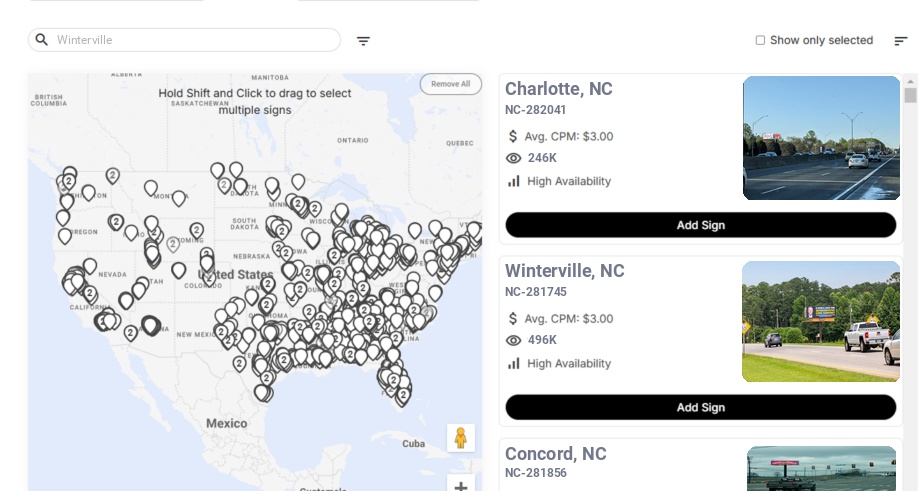
Blip has digital billboards in Winterville. You can browse available locations on a map, choose the ones that fit your audience, and start advertising right away.
Still have questions? Launch a campaign in minutes — no contracts, no commitments.
Start Your CampaignWinterville Billboard Advertising Guide
Winterville is a compelling billboard market because we are not advertising to an isolated small town. We are reaching a growing community of 10,000+ residents that sits immediately beside Greenville, a city of 87,521, inside Pitt County 170,243 residents at the 2020 count. Daily life in this part of eastern North Carolina is strongly car-oriented, with well over 80% of workers commuting by car and average commute times around 20 minutes, so messages placed on the right corridors can build frequency fast with commuters, students, families, and regional visitors. We also benefit from year-round movement tied to East Carolina University 27,000+ students, ECU Health 29 counties and roughly 1.4 million people, youth sports, and the Winterville Watermelon Festival, a 4-day event that draws 30,000+ visitors.
Market Overview for Winterville
Winterville works best when we think of it as part of a wider Greenville-area trade zone rather than as a stand-alone town. That wider market gives billboard advertisers access to suburban households, a major university audience of 27,000+ students, a medical referral hub anchored by a 974-bed hospital, and regional traffic flowing across eastern North Carolina.
Winterville's position in the Greenville-Pitt County market
According to the North Carolina Office of State Budget and Management and local municipal sources from the Town of Winterville, Winterville grew from 9,269 residents in 2010 to more than 10,000 by 2020. That growth matters because it reflects the town's role as a residential and service-oriented extension of Greenville.
Greenville itself is the real scale driver. With 87,521 residents, Greenville is the commercial, educational, and healthcare center for much of inland eastern North Carolina. Pitt County's 170,243 residents create a much larger effective audience than Winterville's town limits suggest, especially for advertisers selling healthcare, retail, home services, restaurants, financial services, and event tickets.
For billboard strategy, that means we can use Winterville-area inventory for both hyperlocal and regional goals. A dentist in Winterville can target nearby households, while a hospital system, furniture store, apartment community, or regional event can use the same geography to reach people moving between Winterville, Greenville, and surrounding towns.
Economic anchors and commuting patterns around Winterville
The local economy is anchored by several institutions that create steady traffic all year. East Carolina University 27,000 students, and that adds faculty, staff, parents, alumni, vendors, and game-day visitors to the local audience mix. ECU Health Medical Center 974-bed hospital, and ECU Health 29 counties and roughly 1.4 million people across eastern North Carolina.
The employment base is broad enough to support repeated consumer demand. County labor force data from the North Carolina Department of Commerce has generally kept Pitt County above 90,000 workers in recent periods, and local unemployment has often sat in the 3% to 5% range rather than at distressed levels. That is important for out-of-home advertising because healthy employment supports everyday spending on food, healthcare, autos, housing, fitness, education, and entertainment.
Commuting behavior also favors billboards. Winterville and southern Greenville function as a car market, not a transit-first market. Most resident workers commute by personal vehicle, and average commute times are around 20 minutes, which gives us repeated weekday exposure on a fairly concentrated street network. In practical terms, Winterville is the kind of market where a few well-chosen boards can create strong local mental availability.
Key Traffic Corridors for Winterville Billboards
The North Carolina Department of Transportation traffic count system is the best starting point for understanding local billboard value. Winterville does not rely on a giant interstate loop. Instead, visibility is concentrated along a handful of commuter and regional corridors that repeatedly connect homes, jobs, shopping, healthcare, and campus activity.
NC 11, Memorial Drive, and the Winterville-to-Greenville corridor
NC 11 is one of the most important roads for Winterville advertisers. NCDOT count maps regularly show key segments in the Greenville-Winterville corridor carrying roughly 20,000 to 35,000 AADT, with the busiest northern approaches climbing above 30,000 vehicles per day.
This route is ideal for advertisers that depend on repeated local frequency. Those advertisers include:
- Quick-service restaurants that want to capture lunch and dinner traffic between Winterville and Greenville.
- Banks, credit unions, and insurance agencies that benefit from consistent weekday commuting exposure.
- Home service companies such as HVAC, roofing, plumbing, and pest control firms that need suburban household reach.
- Healthcare providers such as urgent care, dental, vision, pediatrics, and physical therapy practices that want to stay top of mind for nearby families.
Because NC 11 carries people on practical, habitual trips, we should favor direct, offer-led, and location-specific creative here.
US 264 and the regional approach to Winterville
US 264 is Winterville's strongest regional access corridor. Around the Greenville area, NCDOT counts commonly place busy segments in the 40,000 to 55,000 AADT range, especially near major interchanges and urban approaches. That makes US 264 the best option when we need scale beyond town residents.
This corridor works especially well for:
- Regional healthcare systems that draw patients from multiple counties.
- Auto dealers that want to reach drivers before they enter the main retail trade area.
- Destination retailers such as furniture, appliance, and outdoor equipment stores.
- Tourism, sports, and event promoters that need to intercept visitors traveling into Greenville.
US 264 is less about hyperlocal errands and more about broad awareness, directional messaging, and regional brand building. If we want to reach drivers coming from Farmville, Washington, or farther afield, this is usually the first corridor we evaluate.
NC 43, Charles Boulevard, and the student-suburban connection
NC 43, along with Charles Boulevard and related south Greenville connectors, gives us access to one of the area's most useful blended audiences. Depending on segment, NCDOT traffic counts are often in the 18,000 to 28,000 AADT range. That traffic includes students, faculty, suburban households, service workers, and restaurant traffic.
We tend to like this corridor for advertisers that need a younger or more mixed audience, including:
- Apartment communities leasing around the academic calendar.
- Restaurants, coffee shops, and convenience brands targeting students and staff.
- Fitness, mobile phone, and consumer tech brands that perform well with younger adults.
- Part-time recruiting campaigns for retail, hospitality, healthcare support, and logistics employers.
This corridor is useful when we want to bridge Winterville families and the East Carolina University
Fire Tower Road, Arlington Boulevard, Evans Street, and medical district connectors
Winterville advertisers should not ignore the urban connectors inside Greenville. On roads such as Fire Tower Road, Arlington Boulevard, and Evans Street, traffic volumes often fall in the 15,000 to 30,000 AADT range, depending on location. These routes matter because they connect residential growth, shopping centers, and the medical district.
They are especially strong for:
- Specialty medical practices that want proximity to ECU Health Brody School of Medicine
- Retail and family entertainment brands targeting weekend shopping patterns.
- Hotels, attorneys, and personal services that benefit from being visible near major destinations.
- Event venues and civic organizations promoting time-sensitive attendance.
In Winterville, we usually get the best results when we choose corridors by trip purpose, not just by raw traffic.
Audience Segments in Winterville and Pitt County
Winterville offers more audience variety than many towns of similar size. The key is to separate who lives here from who travels through here for work, school, care, shopping, and events.
Commuters and everyday household decision-makers
The first major audience is the daily commuter. Because this is a vehicle-driven market, with well over 80% of workers traveling by car for their commute and average travel times around 20 minutes, billboards can deliver strong repetition without requiring dozens of locations.
This audience includes parents, homeowners, renters, office workers, municipal employees, healthcare workers, and service technicians. They are making frequent decisions about groceries, fuel, urgent care, childcare, dental care, insurance, fast food, and home repair. For these categories, repetition matters more than novelty, and Winterville is well suited to that kind of sustained exposure.
Students, faculty, and campus visitors in the Winterville orbit
East Carolina University 27,000+ students, ECU creates demand not only for nightlife and food, but also for apartments, furniture, internet, banking, healthcare, tutoring, job recruitment, and parent-focused lodging.
We should also remember that campus traffic is not limited to enrolled students. Faculty, staff, visiting families, guest lecturers, athletic fans, and prospective students add to the total. The result is a market where a Winterville campaign can still influence people whose daily routines center on Greenville.
Healthcare workers, patients, and referral traffic
Healthcare is one of the biggest reasons this market punches above its size. ECU Health Medical Center 974 beds, and the larger ECU Health 29 counties and about 1.4 million residents. That creates constant movement from employees, patients, family members, vendors, students, and specialists.
This audience is valuable for:
- Specialty care providers that need regional patient awareness.
- Hotels and short-stay lodging for visiting families.
- Pharmacies, rehab providers, and home health services that support ongoing care.
- Legal, insurance, and financial firms serving people during major life decisions.
For healthcare-adjacent advertisers, Winterville and Greenville boards can work together as awareness and reassurance media.
Families, festival crowds, and weekend visitors
Winterville is also a family-heavy suburban market. Pitt County Schools serves more than 22,000 students, which tells us how large the family audience is across the county. Those households create year-round demand for pediatric care, orthodontics, tutoring, youth programs, fast casual dining, grocery, and home improvement.
Seasonal events enlarge that audience. The Winterville Watermelon Festival is a 4-day event that draws 30,000+ visitors. On top of that, ECU Athletics brings large weekend attendance, and Dowdy-Ficklen Stadium seats about 50,000 fans. In a typical season, ECU football brings 6 to 7 home games that can sharply increase local traffic and hospitality demand.
That combination gives us a strong weekend audience for restaurants, retail, family attractions, churches, community organizations, and civic campaigns.
Seasonal and Timing Opportunities in Winterville
Winterville campaigns perform best when we align them with the area's calendar rather than running the same message all year. This market has very clear surges tied to school, sports, festivals, and weather.
Late summer and fall in Winterville
Late summer is one of the best billboard windows in the area. August combines back-to-school spending, ECU move-in traffic, and the Winterville Watermelon Festival, which brings 30,000+ attendees over 4 days. That is an ideal moment for restaurants, retail, urgent care, cellular providers, and local entertainment to increase share of voice.
Fall stays strong because ECU football adds 6 to 7 home weekends in many seasons, and Dowdy-Ficklen Stadium can hold about 50,000 people. Thursday through Saturday scheduling often makes sense during football season, especially for bars, restaurants, tailgate products, hotels, rideshare alternatives, and experiential events.
Spring opportunities around Winterville and Greenville
Spring is valuable for a different reason. We see more activity from graduation, apartment turnover, tax-refund spending, spring sports, and home improvement. Healthcare advertisers can also benefit from spring because specialty appointments, elective procedures, and family scheduling often increase before summer vacation begins.
For local service businesses, spring is a good time to shift creative from pure awareness to action. Dental practices, HVAC firms, lawn and landscape companies, tutoring centers, and wedding-related businesses can all benefit from that seasonal behavior.
Holiday retail, weather, and preparedness in Winterville
The holiday period matters because suburban households are already concentrated on recurring shopping routes. That supports strong billboard use for gift retail, grocery, furniture, jewelry, family dining, and charitable giving campaigns.
Weather also shapes timing. The North Carolina State Climate Office identifies eastern North Carolina as a warm, humid, storm-sensitive region. Greenville's average July high is around 89°F, and annual rainfall is roughly 50 inches. Hurricane season runs from June 1 through November 30, so insurance, generators, roofing, tree service, emergency restoration, and home-improvement advertisers can benefit from storm-preparedness timing from late spring through early fall.
Billboard Design Tips for the Winterville Market
Creative that works in Winterville should feel local, practical, and easy to process at speed. We do not need to make it flashy for the sake of being flashy. We need to make it immediately relevant.
Use visual cues that feel like Winterville and eastern North Carolina
The strongest Winterville creative usually reflects the area's actual identity. That can mean family-oriented imagery, healthcare trust cues, suburban convenience, or tasteful nods to local culture. In late summer, watermelon-themed creative can work well because the Winterville Watermelon Festival is so recognizable locally.
For student-facing campaigns, colors that feel energetic and bold often perform better than muted palettes. For healthcare, finance, and home services, cleaner palettes with blue, green, white, or high-contrast dark backgrounds often feel more credible. We should avoid generic beach imagery unless the offer is truly coastal or travel-related, because Winterville audiences are more likely to respond to local relevance than to tourism clichés.
Write for short drives and high repeat frequency
Because average commute times are around 20 minutes, many local trips are short and repetitive. That means we should keep copy tighter than we might on a long-haul interstate board. In this market, a 6- to 8-word headline, one strong benefit, and one simple call to action usually outperform more complicated messages.
Place names help. Messages that mention Winterville, Greenville, ECU, or a nearby road often feel more useful and believable than generic slogans. For example, local references such as “On NC 11,” “Near ECU Health,” or “Now Open in Winterville” can improve immediate recognition.
Match the design to the corridor
We should design differently for each route type. On NC 11, practical offers usually work best because drivers are often making errand, school, or work trips. On US 264, broader branding and directional messaging make more sense because the audience includes regional travelers. Near the medical district, credibility and clarity matter more than humor. Near ECU-oriented routes, brighter color, sharper offers, and event-led creative can be more effective.
The key Winterville principle is simple. We should make the board feel like it belongs on that road.
Regional Strategies for Winterville Campaigns
Winterville campaigns improve when we divide the geography into sub-areas instead of treating every board the same. The town sits inside a layered market, and each layer rewards different creative and budgeting choices.
Winterville core and the southern Greenville suburbs
The Winterville core is best for businesses that rely on neighborhood familiarity and repeat exposure. This includes dentists, pediatricians, chiropractors, churches, gyms, grocery stores, coffee shops, childcare providers, and home services.
If our service area is local, a 5- to 10-mile target radius is often enough. In that radius, we care more about frequency than raw regional reach. We want nearby households to see the same message on the roads they already drive several times a week.
Greenville medical, retail, and civic destinations
The Greenville core is where we lean into scale and destination intent. Boards near the medical district, major shopping corridors, and civic destinations are ideal for advertisers that need stronger intent-based visibility.
This is the best sub-market for:
- Healthcare systems and specialty practices.
- Hotels, restaurants, and visitor services.
- Attorneys, financial firms, and major consumer services.
- Regional events at the Greenville Convention Center or promotions supported by Visit Greenville, NC.
When we advertise here, we should assume the audience includes both locals and out-of-town visitors.
ECU and entertainment-oriented corridors
The ECU zone gives us a younger, faster-moving audience with different purchase patterns. Campaigns around student corridors work well for apartments, food, retail, apparel, wireless, entertainment, recruiting, and subscription services.
The best strategy is usually to rotate creative by the academic calendar. Messaging that works in August may not be the same messaging we want in October, January, or April.
Feeder towns and regional routes beyond Winterville
Winterville also benefits from proximity to surrounding eastern North Carolina communities. Routes connecting Ayden, Farmville, Kinston Washington, and New Bern help advertisers expand beyond one municipality.
This regional approach works especially well for hospitals, colleges, trade schools, auto dealers, political campaigns, furniture stores, and destination retailers. If we want Pitt County awareness plus surrounding-county consideration, we should combine Winterville-area boards with approach corridors rather than relying only on town-center inventory.
Using Blip Tools in Winterville
Blip fits Winterville well because this market rewards flexibility. Traffic peaks, event schedules, and audience mix can shift quickly, and we often want to adjust our plan without the friction of a traditional billboard buy.
How we can apply Blip locally in Winterville
If we want precision, we can use a manual campaign and choose boards around the corridors that matter most to us. For example, we might focus on NC 11 for suburban household reach, NC 43 for a student-suburban blend, or US 264 for regional awareness.
Dayparting is especially useful here. In Winterville, the most obvious windows are often 6 a.m. to 9 a.m., 11 a.m. to 2 p.m., and 4 p.m. to 7 p.m. That lets us emphasize commuter, lunch, and errand traffic without overpaying for lower-value hours. We can also weight Thursday through Sunday more heavily during festival periods and football weekends.
How Blip helps us scale across the wider Winterville market
If our goal is broader reach, Blip's optimization tools can spread budget across Winterville, Greenville, and nearby feeder routes more efficiently than a manual one-board-at-a-time approach. That is especially helpful when we are trying to reach multiple audiences at once, such as families, students, and regional visitors.
Real-time analytics also matter in this market. We can compare how local-service creative performs near Winterville versus how brand-led creative performs on regional approaches, and then shift budget accordingly. We can also swap artwork quickly for back-to-school, football season, holiday retail, or storm-preparedness messaging without rebuilding an entire campaign structure.
Getting Started with Billboard Rental in Winterville
Renting a billboard in Winterville is easiest when we begin with the audience and travel pattern, not with the board itself. The strongest locations depend on whether we need neighborhood frequency, campus energy, medical visibility, or regional scale.
Step 1: Define the real trade area for Winterville
If we are a local business, we should start by asking how far customers realistically travel. Many Winterville service businesses do best with a 5- to 10-mile focus that covers Winterville and southern Greenville. If we are a regional hospital, college, dealership, or event venue, we may need boards on regional approach routes as well.
This first decision prevents wasted spend. It tells us whether we should prioritize frequency on fewer local boards or spread wider across the metro and feeder corridors.
Step 2: Choose boards by trip purpose, not by intuition
Once we know the target area, we should evaluate each board using four filters:
- The board should face the direction our customers are actually traveling.
- The road should match the decision we want people to make.
- The surrounding land use should support our offer.
- The message should fit the driver's speed and attention level.
A home services company may get better value on NC 11 than on US 264, even if the freeway has bigger traffic numbers. A regional entertainment or healthcare brand may want the opposite.
Step 3: Test before we scale in Winterville
One of the smartest ways to start is with a limited test across 2 to 3 corridor types. We can run for 7 to 14 days, review results, refresh creative if needed, and then scale into a 30-day or seasonal plan. That approach is often much easier with Blip than with traditional billboard companies, which commonly involve fixed terms, manual sales negotiation, and slower creative changes.
In Winterville, testing is especially valuable because the audience mix can change quickly between school season, football weekends, festival traffic, and ordinary commuter periods.
Step 4: Measure success the right way
We should judge Winterville billboard performance against the actual business goal. For some advertisers, that means branded search lift. For others, it means website traffic, coupon redemptions, foot traffic, phone calls, or appointment requests. In a compact, vehicle-heavy market like Winterville, the right billboard usually works by increasing familiarity first and conversion second.
That is why flexibility matters so much here. When we can test corridors, tune schedules, refresh creative, and respond to the local calendar, Winterville becomes a very efficient digital billboard market.