Billboards in Selma, NC
No Minimum Spend. No Long-Term Contracts. Just Results.
Trusted by Leading Brands


Billboard advertising
in Selma has never been easier



How much is a billboard in Selma?
Why Choose Blip for Billboard Advertising in Selma
-
Blip lets you launch fast in Selma on I-95 and US 70—perfect for commuters and the 58K-65K daily drivers passing through town.
-
No contracts in Selma means you can test ads near Exit 97/98, then shift budget as outlet shoppers and road-trippers change.
-
Use Blip's dayparting in Selma to hit 6-9 a.m. commuters and Friday travel surges on I-95 when intent is highest.
-
Selma campaigns stay flexible with Blip's budget control, so you can start small and scale around Johnston County's 80% solo drivers.
-
Track Selma results in real time and optimize for local families on US 301 or travelers bound for Smithfield and Carolina Premium Outlets.
Frequently Asked Questions About Billboard Advertising in Selma
How much does a billboard cost in Selma with Blip?
With Blip, billboard advertising in Selma can fit a wide range of budgets because you only pay when your ad actually appears. Pricing starts at just $0.01 per display, and your daily budget is used to bid for available ad slots. Since cost per blip changes based on time of day, location, and advertiser demand, you stay in control while Blip works to stretch every dollar.
Where can I advertise with Blip in Selma, North Carolina?
Selma gives us a strong billboard market because it pairs small-town familiarity with major regional traffic exposure on Interstate 95, which carries roughly 58,000 to 65,000 vehicles per day near town. US 70 connects Selma with Smithfield, Clayton, and the western approach toward Raleigh, while US 301 serves local commerce and downtown access. NC 39 and connecting local arterials are useful for staying in front of Selma residents, school families, and repeat local shoppers.
Why is Selma, North Carolina a good place for billboard advertising with Blip?
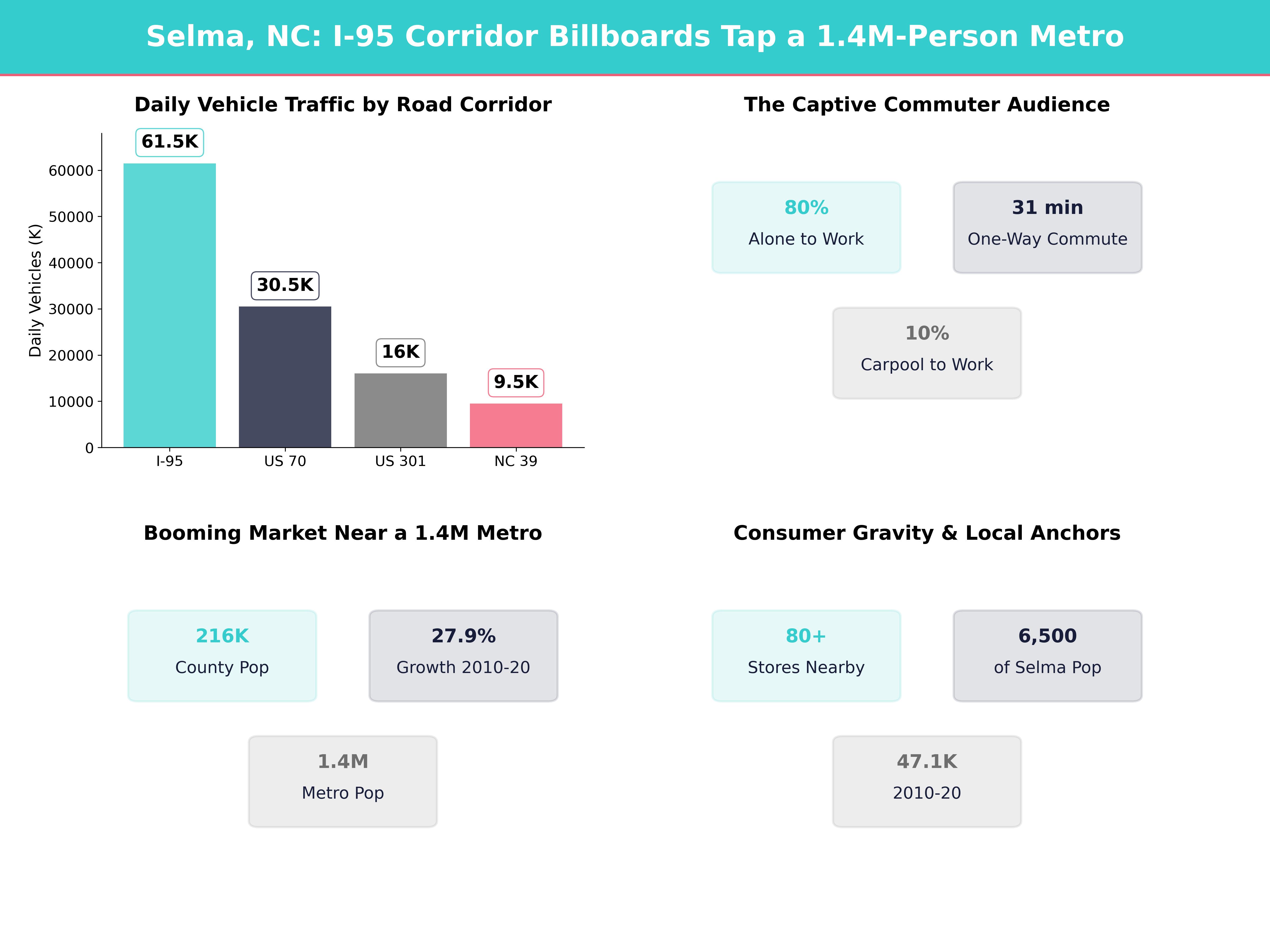
Selma sits inside Johnston County, which reached 215,999 residents in 2020 after growing 27.9% since 2010. It is also part of the broader Raleigh-Cary metropolitan footprint, which had more than 1.4 million residents in 2020. With neighboring Smithfield, Carolina Premium Outlets, and the wider Raleigh market less than 35 miles away, digital billboards here can reach both local customers and high-intent pass-through traffic.
When is the best time to run billboard ads in Selma, North Carolina with Blip?
Selma campaigns perform best when we respect both the travel calendar and the local calendar. Summer is when Selma’s I-95 advantage becomes especially valuable, while August and September are important because they reset local routine. November and December are excellent for retail, dining, giftable services, and outlet-related messaging.
What kind of people can my Selma, North Carolina billboard reach?
Selma’s billboard audience is broader than the town’s own population and includes daily commuters, interstate travelers, outlet shoppers, students, families, and workers moving between plants, warehouses, schools, and service jobs. Roughly 80% of workers in Johnston County drive alone to work, and the county’s average commute time is around 31 minutes. The market also includes more than 38,000 Johnston County Public Schools students and more than 15,000 Johnston Community College students annually.
Do I need a contract to advertise with Blip in Selma?
No, Blip has no long-term contracts or minimum commitments. You can start, pause, or stop your campaign at any time.
How fast can I launch a billboard campaign with Blip in Selma?
You can have your campaign live in minutes. Create a free account, select your locations, set your budget, upload your design, and start running once approved.
Where can I advertise with Blip in Selma?
Blip has digital billboards in Selma. You can browse available locations on a map, choose the ones that fit your audience, and start advertising right away.
Still have questions? Launch a campaign in minutes — no contracts, no commitments.
Start Your CampaignSelma Billboard Advertising Guide
Selma Interstate 95, which carries roughly 58,000 to 65,000 vehicles per day near town. The Town of Selma 6,500 residents, but it sits inside Johnston County, which reached 215,999 residents in 2020 after growing 27.9% since 2010. Most workers in the county still travel by car, with roughly 4 in 5 (80%) commuting alone, and Selma also benefits from heavy visitor flow on the North Carolina Department of Transportation network, especially Interstate 95. With neighboring Smithfield, Carolina Premium Outlets Raleigh market less than 35 miles away, we can use digital billboards here to reach both local customers and high-intent pass-through traffic.
Selma, North Carolina Market Overview
When we plan billboard campaigns in Selma, we are really planning for a crossroads market. Selma is a modest-size municipality, but it benefits from its position between the Raleigh metro, the Smithfield retail cluster, and the I-95 travel stream that connects the Northeast and the Southeast.
Selma’s scale inside a much larger growth market
According to the 2020 count, Johnston County added 47,121 residents from 2010 to 2020, which works out to 27.9% growth. That is a meaningful number for advertisers because it signals new rooftops, new household formation, and steady business expansion across the county. Selma also sits inside the broader Raleigh-Cary metropolitan footprint, which had more than 1.4 million residents in 2020, so local billboard inventory can influence both hometown buyers and regional travelers.
Selma’s location is one of its biggest advertising advantages. The town is roughly 30 miles southeast of Raleigh, about 30 miles west of Goldsboro, and about 50 miles north of Fayetteville
Commuting habits and what they mean for billboard reach
Recent survey data show that roughly 80% of workers in Johnston County drive alone to work, and about 1 in 10 (10%) carpool. The county’s average commute time is around 31 minutes, which is long enough for repeated billboard exposure to matter and short enough that route-based frequency stays efficient. In practical terms, that means we are advertising in a market where drivers see the same corridors again and again.
For advertisers, those patterns create several advantages:
- We can build frequency with commuters who use the same roads every weekday.
- We can target households that split shopping between Selma, Smithfield, and larger western Johnston County communities such as Clayton
- We can benefit from regional growth without paying core urban billboard rates in downtown Raleigh.
Selma also benefits from an economy that mixes local services, retail, logistics, agriculture, manufacturing, education, and healthcare. Organizations such as Johnston County Economic Development, Johnston Health Johnston Community College, and Visit Johnston County all reinforce the area’s role as more than a simple bedroom community. For billboard advertisers, that mix supports campaigns for retail, recruiting, healthcare, legal services, home services, quick-service restaurants, entertainment, and event promotion.
Key Traffic Corridors for Digital Billboards in Selma, North Carolina
Selma’s travel patterns are dominated by a few corridors that do very different jobs. Some roads capture long-distance travelers making quick decisions, while others capture shoppers, commuters, and residents who are already in market. When we choose locations carefully, we can match the message to the exact type of movement happening on that road.
Interstate 95 near Selma
Recent North Carolina Department of Transportation traffic count maps generally place I-95 near Selma in the high-50,000s to mid-60,000s AADT range, depending on the exact segment. That makes I-95 the highest-volume corridor in the immediate market by a wide margin. Selma’s visibility is helped by Exit 97 and Exit 98, which serve local retail, fuel, lodging, and food traffic.
This corridor works especially well for advertisers that need immediate action:
- Travel centers, convenience stores, and fuel brands perform well because drivers often make fast stop decisions within the next 1 to 3 miles.
- Hotels, urgent care providers, towing companies, and tire shops perform well because they solve immediate travel problems.
- Attractions, restaurants, and outlet retail can convert road-trippers who are already primed to stop near Selma or Smithfield.
Because I-95 traffic includes both locals and long-haul drivers, our creative here should be direct. Destination cues such as “Exit 97,” “Next Right,” or “5 Minutes to Shopping” are more useful than broad brand storytelling.
US 70 and the Selma-Smithfield retail spine
US 70 is the corridor that connects Selma with Smithfield, Clayton Raleigh. Recent NCDOT counts on nearby segments commonly fall in the 26,000 to 35,000 AADT range, especially around the retail-heavy Selma-Smithfield area. This is one of the best places in the market for businesses that need more than a split-second decision window.
US 70 is a strong fit for:
- Healthcare systems, dental practices, and specialty clinics that want repeated local exposure.
- Furniture, auto, and home improvement advertisers that benefit from comparison shopping behavior.
- Restaurants, grocery stores, and everyday retail that depend on local frequency rather than one-time interstate capture.
This corridor is also strategically important because North Carolina continues improving the US 70 route as part of the future I-42 system. As access improves over time, the Selma-Smithfield stretch should remain an important connector for both local residents and regional drivers.
US 301 through Selma
US 301 is a useful secondary corridor because it serves local commerce, legacy through-traffic, and downtown access. Recent traffic counts around Selma commonly run in the 14,000 to 18,000 AADT range. That is far below I-95, but it is still substantial for advertisers that need local relevance.
We often like US 301 for:
- Local banks, insurance agencies, and real estate firms.
- Community events, churches, schools, and political campaigns.
- Repair services, healthcare offices, and hometown restaurants that want Selma-area recognition.
US 301 is also valuable because it gives us a slower-speed environment than I-95. That slower pace can support slightly more detailed messages, stronger local references, and brand-building creative.
NC 39, East Anderson Street, and local connectors
NC 39 and connecting local arterials are smaller than the major highways, but they still matter for frequency. Recent counts on nearby local approaches often land around 8,000 to 11,000 AADT, depending on the segment. Those numbers are useful for campaigns that need to stay in front of Selma residents, school families, and repeat local shoppers.
These routes are especially helpful for:
- Pediatric, dental, and family healthcare advertisers.
- Local entertainment, events, and civic campaigns.
- Service businesses such as HVAC, plumbing, roofing, and legal services.
When we combine one high-volume corridor with one or two local-frequency corridors, we often get a stronger result than relying on a single billboard type alone.
Audience Segments We Can Reach in Selma, North Carolina
Selma’s billboard audience is broader than the town’s own population. The market includes daily commuters, interstate travelers, outlet shoppers, students, families, and workers moving between plants, warehouses, schools, and service jobs.
Commuters and regional drivers
The strongest everyday audience is still the driver. With roughly 80% of workers driving alone and an average commute near 31 minutes, Selma offers the kind of repeated road exposure that out-of-home advertising is built for. Many of these drivers are moving between Selma, Smithfield, Clayton Raleigh.
This group is ideal for:
- Healthcare, legal, and financial services.
- Home services with a wide service radius.
- Retail promotions that need several impressions before action.
Shoppers and visitors
The Carolina Premium Outlets 80-plus stores. That single retail concentration expands the practical audience for billboard campaigns far beyond Selma residents. Visitors who come for outlet shopping often also spend on dining, fuel, coffee, dessert, hotels, and impulse retail.
We can support this audience with messages for:
- Restaurants, cafés, bakeries, and specialty food.
- Apparel, beauty, and accessory brands.
- Entertainment and family attractions in nearby communities, including The Rudy Theatre, the Ava Gardner Museum Tobacco Farm Life Museum, and Hinnant Family Vineyards.
Students, parents, and education audiences
Johnston County Public Schools serves more than 38,000 students across 48 schools, which makes school-family traffic a major audience category. Johnston Community College also serves more than 15,000 students annually through curriculum and continuing education programs. Those numbers support campaigns for tutoring, childcare, youth activities, healthcare, family dining, financial services, and local events.
Back-to-school and school-year routines are especially useful for billboard advertisers because they create highly predictable travel patterns. Morning drop-off, afternoon pickup, after-school sports, and weekend family errands all increase the value of commuter-friendly digital placements.
Rail users, air travelers, and travel planners
Selma has a transportation asset that many towns its size do not have. The Selma-Smithfield station is served by 2 Amtrak routes, the Carolinian and the Palmetto, which together create 4 daily train calls. While rail volume is much smaller than highway volume, it reinforces Selma’s role as a legitimate regional stop rather than a purely local market.
The town also sits within roughly 45 minutes of Raleigh-Durham International Airport 14.5 million passengers in 2023. That regional air traffic does not all pass through Selma, but it helps explain why the broader market keeps attracting visitors, employers, and new residents.
Seasonal and Timing Opportunities in Selma, North Carolina
Selma campaigns perform best when we respect both the travel calendar and the local calendar. The market has a real seasonal rhythm driven by school schedules, road-trip months, holiday shopping, and community events.
Spring in Selma and Johnston County
Spring is a strong season for local events, regional leisure travel, and outdoor activity. The Bentonville Battlefield State Historic Site draws special attention each March, and nearby attractions across Johnston County begin to see more weekend visitors as temperatures improve. This is a good time for attractions, restaurants, nurseries, garden centers, healthcare providers, and home improvement advertisers.
Spring is also smart for service businesses because many households begin spending on repairs, landscaping, roofing, tax-related purchases, and elective healthcare before summer travel begins.
Summer road-trip season on I-95
Summer is when Selma’s I-95 advantage becomes especially valuable. Average July highs are typically in the upper 80s°F, around 88-89°F, which increases demand for cold drinks, ice cream, quick meals, family stops, car service, and indoor attractions. Interstate travel rises as vacationers move up and down the East Coast, and outlet shopping remains a major draw.
For summer campaigns, we usually like:
- Mid-morning through early evening schedules for I-95 travel services.
- Friday and Saturday emphasis for dining and entertainment.
- Directional creative that clearly states exit number, distance, and category.
Back-to-school and fall routines
August and September are important because they reset local routine. Johnston County Public Schools returns in August, Johnston Community College ramps up, and family schedules tighten. That makes late July through September a strong window for medical practices, tutoring, orthodontics, after-school programs, quick family dining, and retail.
Fall also brings harvest-season and heritage tourism energy. Events tied to the Tobacco Farm Life Museum, downtown Selma, and nearby communities such as Benson
Holiday shopping and winter service demand
November and December are excellent for retail, dining, giftable services, and outlet-related messaging. Carolina Premium Outlets
Winter in Selma is milder than in many inland markets, with average January highs in the low 50s°F, around 53°F. That means road visibility stays useful year-round. At the same time, annual rainfall is around 46 inches, and Atlantic hurricane season runs from June 1 to November 30, so preparedness, roofing, HVAC, restoration, and insurance-related campaigns can be timed to weather concerns as well.
Billboard Design Tips for Selma, North Carolina
Selma is not a market where one visual style fits every board. We should design differently for interstate speed, retail intent, and local trust.
Design for speed on Selma’s fastest roads
On I-95 and faster stretches of US 70, drivers have very little reading time. We should usually keep copy to one idea, one brand, and one action. In this market, practical wording such as “Exit 97,” “Next 2 Miles,” “Shop 80+ Stores,” or “Urgent Care Open Today” often works better than clever but vague slogans.
High-contrast combinations such as dark blue and white, black and yellow, or red and white tend to read well for fast traffic. Large numerals also help because distances, prices, and exit numbers are easy to process at highway speed.
Use local cues that feel real to Selma-area drivers
For local and regional boards, we can gain credibility by naming the places people actually use. “Selma,” “Smithfield,” “Johnston County,” and “I-95” are stronger than generic phrases such as “nearby” or “in your area.” If the business is close to a known landmark, we should say so plainly.
Visuals should also match the area’s identity. In Selma, imagery tied to families, travel stops, outlet shopping, healthcare, trades, agriculture, and small-business trust usually lands better than abstract metropolitan imagery.
Match the creative to the audience segment
Different Selma audiences respond to different cues:
- Interstate travelers respond to convenience, urgency, and navigation.
- Local families respond to trust, value, and familiarity.
- Job seekers respond to wages, schedule, training, and immediate openings.
- Shoppers respond to savings, variety, and seasonal offers.
If we are recruiting, work-ready visuals such as uniforms, equipment, or clean facility imagery often outperform polished stock scenes. If we are targeting families, warmth and clarity usually beat visual complexity.
Regional Strategies Around Selma, North Carolina
A smart Selma campaign does not always stop at the town line. The best regional strategy depends on whether we want local frequency, countywide coverage, or broader pass-through reach.
Downtown Selma and the immediate trade area
Downtown and local Selma placements are best for businesses that depend on recognition and repeat familiarity. That includes restaurants, salons, law offices, churches, clinics, and event venues. These boards are also useful when we want to support foot traffic tied to the town’s historic feel, the Rudy Theatre, or downtown events.
We usually favor this zone when the goal is community presence rather than regional scale.
The I-95 and outlet zone between Selma and Smithfield
The most powerful commercial submarket is the Selma-Smithfield interchange area around I-95 and US 70. This is where we can capture interstate travelers, outlet shoppers, hotel guests, and regional retail traffic in the same trip. If our business needs new-customer acquisition, this is often the first zone to test.
This zone is especially strong for:
- Hotels, fuel, and convenience retail.
- Family dining and quick-service restaurants.
- Tourist attractions and entertainment.
- Medical, urgent, and automotive services.
Western Johnston County expansion toward Clayton and Raleigh
If we need a broader commuter strategy, we should consider extending beyond Selma toward Clayton Raleigh. Clayton is roughly 20 miles west of Selma, and Raleigh is roughly 30 miles away. That western extension helps businesses with larger service areas, higher-ticket purchases, or recruiting needs.
This strategy works well for healthcare groups, colleges, staffing firms, and home services that can serve much of the county.
Eastern and southern extensions toward Goldsboro, Wilson, and Fayetteville
Selma also functions as a bridge point for eastbound and southbound movement. Goldsboro is about 30 miles east, Wilson 35 miles northeast, and Fayetteville 50 miles south. If we are promoting regional events, multi-location retail, or broad recruiting campaigns, adding boards in one or more of those directions can create a useful corridor strategy.
Using Blip Tools in Selma, North Carolina
Selma is a good fit for Blip because the market rewards precision. We do not always need to buy every hour or every location. We usually get better results by aligning time, place, and audience behavior.
Use dayparting to follow Selma’s real traffic patterns
Morning commuter hours such as 6 a.m. to 9 a.m. are strong for healthcare, recruiting, financial services, and home services. Midday windows such as 11 a.m. to 2 p.m. can work better for restaurants, shopping, and appointment-driven businesses. Late afternoon periods such as 4 p.m. to 7 p.m. are valuable for family dining, retail reminders, and after-work errands.
For I-95 boards, Friday afternoons, Saturdays, and holiday weekends often deserve extra weight because travel intent is higher.
Test corridor-specific creative instead of one generic ad
Because Selma has several distinct audiences, we can use Blip’s creative flexibility to run different artwork on different routes. We might use an exit-number message on I-95, a category-and-offer message on US 70, and a trust-based local message on US 301. That kind of route matching is often more effective than trying to make one ad speak to everyone.
Optimize quickly with real-time feedback
Blip’s analytics help us compare how Selma-area locations perform over time. If one board near the interstate is generating stronger lift than a local-frequency board, we can reallocate budget. If a local message works better during school-season months than during summer, we can adjust. The same logic applies to event timing, holiday bursts, and recruiting pushes.
Getting Started with Billboard Rental in Selma, North Carolina
Renting a billboard in Selma should start with a simple question. Do we want to reach locals, travelers, or both? The answer shapes nearly everything else, from location choice to creative style to schedule.
Start with the business goal
We should define whether the campaign is meant to drive immediate stops, build awareness, support a grand opening, recruit employees, or reinforce an existing customer base. A restaurant near I-95 needs a different plan than a dentist in Selma or a contractor serving all of Johnston County.
Evaluate each billboard by route behavior
When we compare Selma-area boards, we should look at five practical factors:
- We should ask how fast traffic is moving.
- We should ask whether the viewer is local or passing through.
- We should ask how close the business is to the board.
- We should ask whether the board sits before the decision point or after it.
- We should ask whether the campaign needs frequency, reach, or both.
A board on I-95 may be perfect for a hotel or travel plaza, but a local medical office may get better value from repeated exposure on US 70 or US 301.
Expect a simpler process than traditional billboard buying
Traditional billboard companies often expect larger commitments, longer timelines, and less flexibility. With Blip, we can start smaller, test more quickly, and adjust based on performance rather than waiting out a fixed contract. That is especially helpful in a market like Selma, where one advertiser may need a weekend traveler burst and another may need a year-round local presence.
Launch, measure, and refine
Our best Selma campaigns usually begin with a focused test. We can launch with a few high-fit boards, monitor results, rotate creative, and scale what works. In a market defined by I-95 travel, outlet shopping, commuter repetition, and Johnston County growth, that flexible approach gives us a practical way to turn local insight into measurable billboard performance.