Billboards in Mount Airy, NC
No Minimum Spend. No Long-Term Contracts. Just Results.
Trusted by Leading Brands


Billboard advertising
in Mount Airy has never been easier
How much is a billboard in Mount Airy?
Why Choose Blip for Billboard Advertising in Mount Airy
-
Blip's self-serve launch lets Mount Airy advertisers go live fast on US 52/Future I-74 or Rockford Street—no contracts, no fuss.
-
Use Blip to optimize Mount Airy reach across commuter traffic and festival spikes, from Mayberry Days to the Autumn Leaves Festival.
-
Mount Airy budgets stay flexible with Blip: start small, pause anytime, and pay only when your ad plays on the roads people already drive.
-
Daypart Mount Airy ads for 6-9 a.m. commutes or 3-6 p.m. errands, then adjust in real time as traffic shifts.
-
Blip's real-time analytics help Mount Airy campaigns learn fast on US 52, downtown, and winery-weekend routes.
-
Build Mount Airy billboard creative quickly with Blip's tools, tailoring ads for local healthcare, schools, and 40+ winery visitors.
Frequently Asked Questions About Billboard Advertising in Mount Airy
How much does a billboard cost in Mount Airy with Blip?
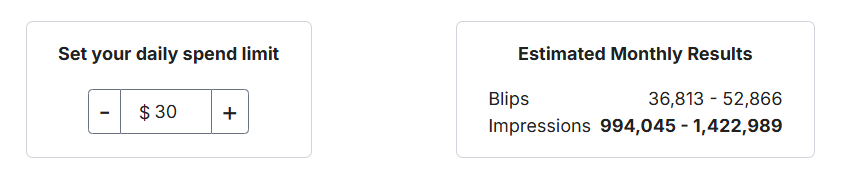
With Blip, billboard advertising in Mount Airy can be surprisingly affordable because you only pay when your ad actually displays. Each “blip” is a 7.5-to-10-second spot on a rotating digital billboard, with pricing starting at $0.01 per display. You set a daily budget, and Blip’s algorithm uses it to bid for open ad slots, with costs that can change based on time of day, location, and advertiser demand.
Where can I advertise with Blip in Mount Airy to reach the most drivers?
US 52, which is also part of the Future I-74 corridor, is Mount Airy’s signature billboard route. Recent NCDOT traffic-count maps show that Mount Airy segments of US 52 generally carry about 18,000 to 30,000+ vehicles per day, depending on the interchange and direction. Rockford Street along US 601 and Pine Street / NC 89 are also useful corridors for local-frequency advertising.
When is the best time to run a Mount Airy billboard campaign?
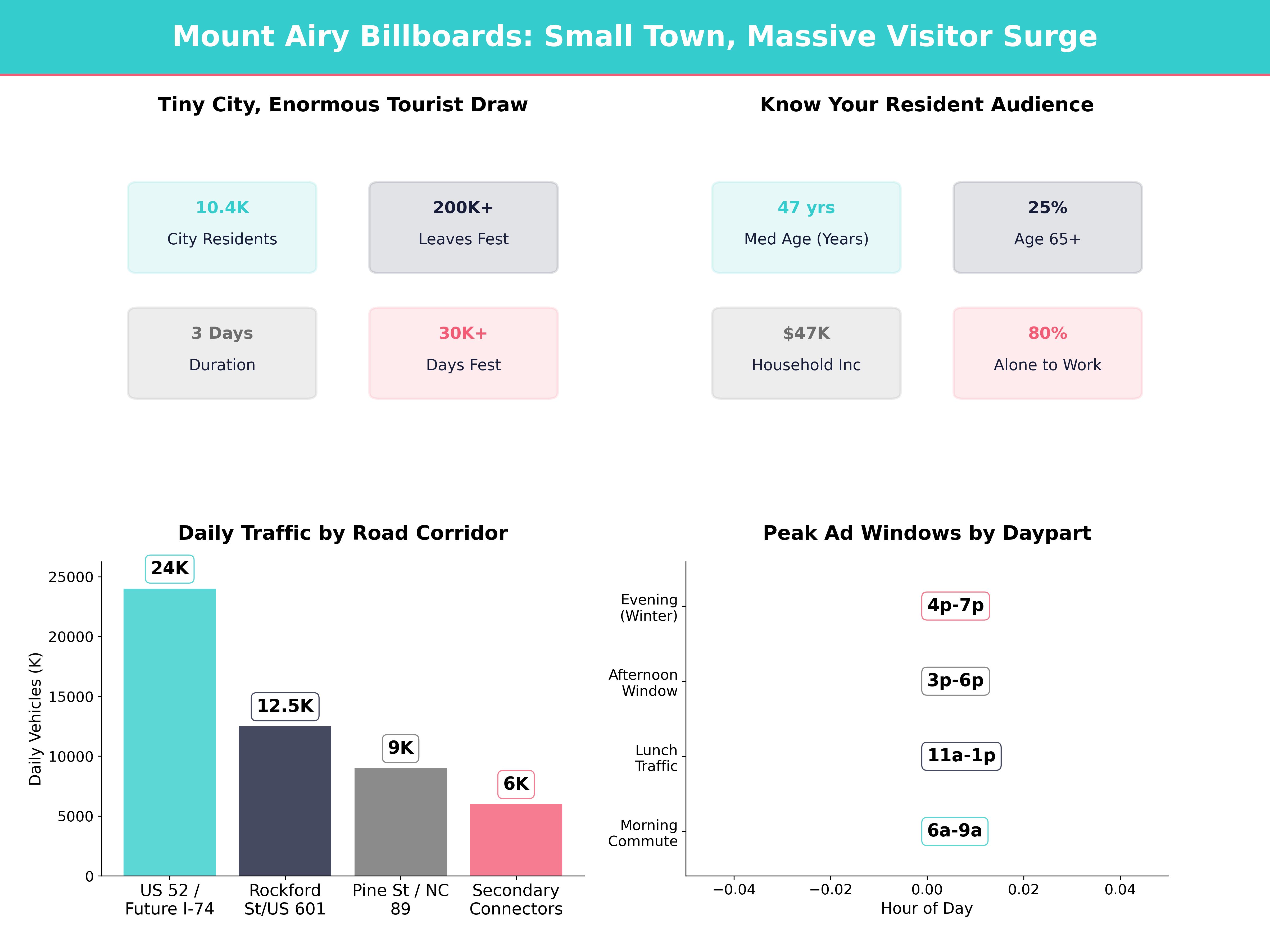
Fall is the biggest billboard window in the market. The combination of leaf color, Blue Ridge foothills travel, wine tourism, Mayberry Days, and the Autumn Leaves Festival creates a period when Mount Airy’s visibility expands dramatically beyond its resident base. We often focus winter schedules on early evening decision windows, roughly 4 p.m. to 7 p.m., when people are heading home, running errands, and making quick choices about what to buy or where to stop.
Why does Mount Airy work well for Blip billboard advertising?
Mount Airy gives us an unusually efficient billboard market because it combines a compact local population with regional drive-through traffic on US 52/Future I-74, event tourism, and a brand identity that many travelers already recognize. The city had 10,388 residents in the 2020 Census, while Surry County had 71,359, which means a meaningful countywide audience still funnels through a limited set of roads. The area is highly car-oriented, with roughly 80% of workers driving alone to work.
What kinds of businesses do well with billboard ads in Mount Airy?
That older-skewing profile often makes billboard campaigns work especially well for healthcare, hearing care, pharmacies, banking, insurance, home improvement, legal services, and value-driven retail. The local economy also supports a broad range of billboard categories, including manufacturing, healthcare, education, agriculture, retail, hospitality, and tourism. In a market like Mount Airy, straightforward messages about pay, hours, benefits, and location usually work better than broad employer-brand slogans.
Do I need a contract to advertise with Blip in Mount Airy?
No, Blip has no long-term contracts or minimum commitments. You can start, pause, or stop your campaign at any time.
How fast can I launch a billboard campaign with Blip in Mount Airy?
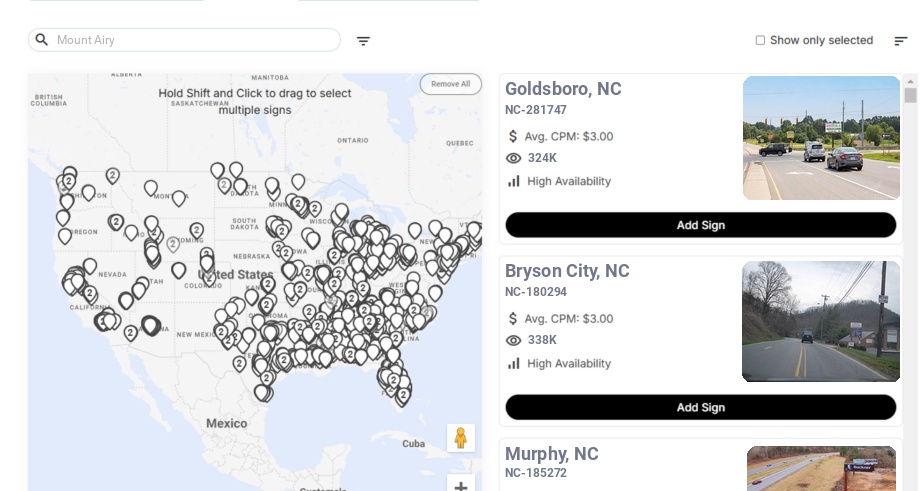
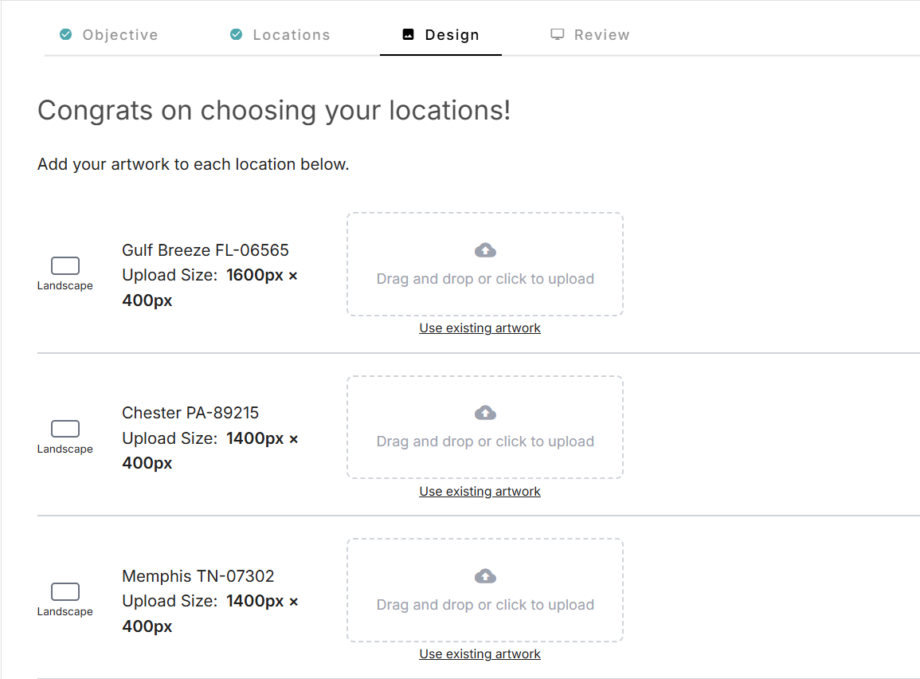
You can have your campaign live in minutes. Create a free account, select your locations, set your budget, upload your design, and start running once approved.
Where can I advertise with Blip in Mount Airy?
Blip has digital billboards in Mount Airy. You can browse available locations on a map, choose the ones that fit your audience, and start advertising right away.
Still have questions? Launch a campaign in minutes — no contracts, no commitments.
Start Your CampaignMount Airy Billboard Advertising Guide
Mount Airy 18,000 to 30,000+ vehicles per day on Mount Airy segments), event tourism ( Mayberry Days at 30,000+ visitors and the Autumn Leaves Festival at 200,000+ over 3 days), and a brand identity that many travelers already recognize. The City of Mount Airy 10,388 residents in the 2020 Census, while Surry County had 71,359, which means a meaningful countywide audience still funnels through a limited set of roads. The area is highly car-oriented, with roughly 80% of workers driving alone to work, and Mount Airy also benefits from visitor traffic tied to Mayberry tourism, foothills recreation, and wine-country weekends across 40+ wineries. That mix lets us use digital billboards to build steady local frequency, then scale quickly when tourism or event traffic rises.
Mount Airy Market Overview
Population scale and market shape in Mount Airy
Mount Airy sits just south of the Virginia line and about 40 miles north of Winston-Salem, which gives it both hometown reach and regional pass-through value. The market is not a sprawling metro, and that is actually an advantage for billboard advertisers because local trips tend to repeat on the same commercial routes. North Carolina demographic data shows that Mount Airy has remained a relatively stable city of roughly 10,000 to 11,000 residents in recent years, while Surry County remains above 71,000. Stability matters here because repeat exposure compounds faster in a market where people make the same grocery, school, healthcare, and work trips week after week.
Surry County includes 4 incorporated municipalities, Mount Airy Dobson Pilot Mountain Elkin, but Mount Airy is the best-known consumer brand because of its tourism identity and regional retail role. That gives us an advertising geography that is larger than the city limits but still centered on a recognizable place name.
Economic mix, age, and commuting behavior in Mount Airy
Mount Airy is not a flash-growth Sun Belt suburb, and we should not market it like one. Recent ACS-based demographic profiles place the city’s median age at about 47, and about 1 in 4 residents are 65 or older. That older-skewing profile often makes billboard campaigns work especially well for healthcare, hearing care, pharmacies, banking, insurance, home improvement, legal services, and value-driven retail.
Income levels also shape the creative that tends to perform best. Recent estimates put Mount Airy’s median household income around $47,000, while Surry County runs in the mid-$50,000s, depending on the source year. In practical terms, that means clear value propositions, convenience, trust, and local reputation usually outperform luxury signaling or abstract brand language.
Commuting is still overwhelmingly vehicle-based. Recent commuter profiles indicate that roughly 80% of workers drive alone to work, and average commute times are about 20 to 25 minutes. That is exactly the kind of pattern that keeps roadside media relevant. People here are not spending the bulk of their day on rail platforms or dense urban sidewalks. They are driving between towns, schools, work sites, stores, and medical appointments.
The local economy also supports a broad range of billboard categories. The Greater Mount Airy Chamber of Commerce and the Surry County Economic Development Partnership highlight a business base that mixes manufacturing, healthcare, education, agriculture, retail, hospitality, and tourism. Recent state labor reports place the county labor force in the mid-30,000s, which gives us a solid base for both consumer advertising and recruiting campaigns.
Key Traffic Corridors for Mount Airy Billboards
Mount Airy travel patterns are concentrated on a manageable set of roads, which is one of the market’s biggest advertising strengths. When we understand those corridors, we can choose boards that fit either broad regional reach or tighter local frequency.
US 52 / Future I-74 through Mount Airy
US 52, which is also part of the Future I-74 corridor, is Mount Airy’s signature billboard route. Recent North Carolina Department of Transportation traffic-count maps show that Mount Airy segments of US 52 generally carry about 18,000 to 30,000+ vehicles per day, depending on the interchange and direction. For a city this size, that is strong visibility.
This corridor matters because it connects Mount Airy to Virginia traffic to the north and the Winston-Salem and Piedmont Triad market to the south. It is the best fit for advertisers that need regional awareness, including:
- Auto dealers and tire retailers that benefit from high reach and repeated commuter exposure.
- Hospitals, urgent care providers, and specialty clinics that want to stay visible to patients across county lines.
- Hotels, restaurants, attractions, and tourism brands that need to intercept travelers before they choose an exit.
- Community colleges, trade schools, and employers that want both local workers and regional applicants.
If we only buy one type of board in Mount Airy, US 52 is usually where we start.
Rockford Street / US 601 in Mount Airy
US 601, especially along Rockford Street, is one of the most useful local-frequency corridors in Mount Airy. Recent NCDOT counts generally place this spine in the 9,000 to 16,000 vehicles per day range through the main retail areas. That is lower than freeway volume, but the audience quality is excellent because many of those trips are shopping, school, service, and appointment runs.
Rockford Street works especially well for:
- Grocery, pharmacy, and discount retail.
- Dental, vision, and family healthcare providers.
- Furniture, appliance, and mattress stores.
- Contractors, banks, attorneys, and insurance agencies.
- Restaurants that depend on repeated local awareness.
This is the corridor we use when we want Mount Airy residents to see a message several times a week.
Pine Street / NC 89 and Downtown Mount Airy
NC 89, including sections of West Pine Street and East Pine Street, usually runs around 7,000 to 11,000 vehicles daily on key in-town segments. This route is valuable because it connects neighborhoods, downtown activity, and everyday errands at more moderate speeds than US 52.
Boards on or near this corridor can be strong for Downtown Mount Airy
Riverside Drive, Stanley Street, Renfro Street, and neighborhood connectors
Mount Airy’s secondary connectors often look small on a map, but they still matter. Recent NCDOT counts put many of these links in the 4,000 to 8,000 AADT range. Those are not destination-blind travelers. They are concentrated local audiences moving between homes, schools, work sites, and service businesses.
These routes can outperform for categories that win through familiarity and trust, such as:
- HVAC, plumbing, roofing, and electrical services.
- Childcare, tutoring, and after-school programs.
- Churches, local nonprofits, and community events.
- Recruiting campaigns for local employers.
- Medical practices that serve repeat local patients.
In a market like Mount Airy, we usually get the best overall outcome by mixing at least one higher-reach corridor with one strong local-frequency corridor.
Audience Segments We Can Reach in Mount Airy
Commuters and cross-border drivers in Mount Airy
Mount Airy is a driving market first. With roughly 80% of workers driving alone and average commute times near 20 to 25 minutes, roadside advertising stays in front of people during the part of the day when they are most consistently mobile. Because Mount Airy sits near Virginia and well within the orbit of Winston-Salem, advertisers can also reach cross-border and regional drivers who are not counted in the city’s population but still use its roads.
This segment is a strong fit for employers, trade schools, financial services, legal services, healthcare providers, and quick-service restaurants.
Tourists, festivalgoers, and weekend trippers in Mount Airy
Tourism is where Mount Airy punches far above its population. Visit Mayberry, the Surry Arts Council Andy Griffith Museum 10,388 residents.
Two event numbers matter especially for advertisers:
- Mayberry Days 30,000+ visitors.
- The Autumn Leaves Festival attracts 200,000+ people over 3 days in October.
That seasonal audience is ideal for hotels, restaurants, tasting rooms, shops, museums, local transportation, and any business that benefits from impulse stops. It also helps regional brands because event weekends bring in visitors from outside the normal trade area.
Mount Airy also sits near the heart of Yadkin Valley Wine Country, which promotes 40+ wineries. The Yadkin Valley AVA was established in 2003, and wine tourism creates a steady weekend audience that often overlaps with dining, lodging, and event spending. Brands such as Shelton Vineyards Old North State Winery, and Mayberry Spirits Distillery reinforce that visitor economy.
Families, students, and healthcare audiences in Mount Airy
Weekday traffic in Mount Airy is heavily shaped by schools and healthcare. Mount Airy City Schools 4 schools, and Surry County Schools bring in additional parent, student, and staff traffic from across the county. Surry Community College Dobson
Healthcare is another major audience anchor. Northern Regional Hospital 133-bed hospital, and that gives Mount Airy consistent appointment-driven traffic for specialists, imaging, pharmacies, rehab, senior services, and related businesses.
This audience segment is often ideal for:
- Pediatric, dental, and family medical practices.
- Tutoring, childcare, and youth sports programs.
- Grocery, pharmacy, and family dining.
- Home services tied to household decision-makers.
Manufacturing, trades, and recruiting audiences across Surry County
The Mount Airy area also has a practical, blue-collar, and trades-oriented audience that responds well to clear recruiting and service messages. The county labor force is in the mid-30,000s, and local economic development efforts continue to emphasize manufacturing, logistics, agriculture, healthcare, and skilled work.
That makes billboard campaigns effective for:
- Hiring welders, drivers, technicians, and production workers.
- Advertising tools, workwear, trucks, and equipment.
- Promoting training programs, certifications, and career fairs.
- Reaching contractors and business owners with B2B offers.
In a market like Mount Airy, straightforward messages about pay, hours, benefits, and location usually work better than broad employer-brand slogans.
Seasonal and Timing Opportunities in Mount Airy
Spring leisure and early-summer travel in Mount Airy
Spring is when Mount Airy’s leisure economy starts to expand. Outdoor traffic increases around Pilot Mountain State Park, Hanging Rock State Park, winery routes, and downtown day trips. Graduation season also boosts demand for restaurants, florists, gift retailers, salons, and photography.
For spring campaigns, we like to launch 2 to 3 weeks before major weekends so frequency builds before people lock in plans. This timing is especially useful for dining, local attractions, short-stay lodging, and event promotion.
Fall festival season in Mount Airy
Fall is the biggest billboard window in the market. The combination of leaf color, Blue Ridge foothills travel, wine tourism, Mayberry Days
The most important seasonal numbers are worth repeating because they are so material to media planning:
- Mayberry Days brings more than 30,000 visitors.
- The Autumn Leaves Festival brings more than 200,000 visitors.
- Autumn Leaves runs across 3 days, which concentrates traffic and increases urgency.
If we advertise restaurants, lodging, shopping, attractions, or festival-adjacent services, this is when we should increase share of voice on US 52 and roads feeding Downtown Mount Airy
Holiday retail, winter services, and weather-driven campaigns in Mount Airy
From November through December, digital billboards benefit from early darkness and holiday travel. This is a strong time for retail, gift cards, restaurants, healthcare reminders, churches, and local entertainment. Winter is also practical-service season in the foothills, so HVAC, plumbing, auto repair, tire dealers, and urgent care brands can perform well.
We often focus winter schedules on early evening decision windows, roughly 4 p.m. to 7 p.m., when people are heading home, running errands, and making quick choices about what to buy or where to stop.
School-year timing and weekly rhythms in Mount Airy
The school calendar creates reliable weekday patterns from early August through late May. Morning commuting, around 6 a.m. to 9 a.m., works well for breakfast, coffee, recruiting, and healthcare reminders. Afternoon windows, around 3 p.m. to 6 p.m., are useful for family restaurants, after-school activities, tutoring, and grocery.
We should also watch community calendars from The Mount Airy News
Billboard Design Tips for the Mount Airy Market
Use local pride in Mount Airy without forcing nostalgia
Mount Airy responds well to authenticity. References to Mayberry, front-porch friendliness, old-time music, foothill scenery, vineyards, and downtown Main Street energy can feel immediately relevant here. At the same time, residents know their town well, so forced nostalgia can come across as generic. We should use local cues that feel earned, not cartoonish.
Words like “Mount Airy,” “Downtown,” “Mayberry,” “Wine Country,” and “Next Exit” often do more work than vague brand language.
Match copy length to Mount Airy road speeds
Road speed matters a lot in this market. On US 52, we should usually keep copy to 6 to 8 words, one clear visual idea, and a simple call to action. On Rockford Street, Pine Street, and other slower in-town roads, we can support the main headline with a second line, an offer, or a location detail.
That difference is important because Mount Airy trips happen across both highway and local contexts. A board that is perfect for freeway visibility can feel underwritten on a slower retail route, and a detailed local board can get lost on US 52.
Build Mount Airy creative around local categories and seasons
Creative should reflect the actual economy people see around them. Healthcare ads should emphasize trust, convenience, and appointment access. Trade and home-service ads should show real houses, crews, trucks, or tools, not generic city skylines. Tourism and winery ads can lean into green spring landscapes, deep burgundy vineyard cues, or gold and rust tones during fall foliage season.
Value messaging also matters. With city household income around $47,000, clear prices, financing, savings, or practical benefits often resonate better than prestige-only branding.
Refresh Mount Airy creative often enough to stay familiar
Because many drivers see the same local routes repeatedly, creative fatigue can set in faster than advertisers expect. We usually recommend refreshing local creative every 2 to 4 weeks during longer campaigns. In Mount Airy, that can mean one version for school season, one for festival traffic, and one for holiday demand.
Regional Strategies Around Mount Airy
Downtown Mount Airy and the in-town retail core
If our goal is foot traffic, repeat awareness, or neighborhood credibility, the in-town core matters most. Boards serving Downtown Mount Airy Mount Airy Museum of Regional History, the Surry Arts Council
This is where we should prioritize frequency over raw reach.
US 52 interchanges, Virginia traffic, and Triad reach from Mount Airy
If our goal is broader regional awareness, US 52 should carry more weight. Northbound boards capture Virginia-bound drivers and weekend leisure traffic. Southbound boards help us reach travelers headed toward Pilot Mountain Winston-Salem, and the wider Triad. This is the right strategy for attractions, lodging, healthcare systems, auto dealers, and destination retail.
Dobson, Pilot Mountain, Elkin, and wine-country routes around Mount Airy
Mount Airy works best as the anchor, but the wider regional strategy should reflect nearby submarkets. Dobson Surry Community College Shelton Vineyards Pilot Mountain Elkin expands reach toward the eastern side of Surry County and the broader Yadkin Valley Wine Country. These towns all sit within roughly 20 to 25 miles of Mount Airy, so regional advertisers can cover a lot of territory without spreading too thin.
Workforce and industrial recruiting across Surry County
Recruiting deserves its own regional approach. With a county labor force in the mid-30,000s and a strong skilled-trade base, work-route boards can be very effective for employers. We should time those messages around shift changes, emphasize pay or benefits when possible, and use practical language that respects the audience.
Blip Tools and Capabilities for Mount Airy Campaigns
Use manual selection when exact Mount Airy corridors matter
Manual selection is especially useful in Mount Airy when a specific route or event path matters. If we need to intercept festival visitors before they reach downtown, if we want only US 52 exposure, or if we need local repetition on Rockford Street, manual placement gives us that control.
Use Blip optimization for broader Mount Airy coverage
When our goal is efficient reach across the market, Blip optimization is a strong fit. It can help us balance freeway inventory with local-frequency boards and adapt as availability and pricing change. That is especially useful for longer runs during tourism season, healthcare awareness pushes, or countywide recruiting.
Use timing controls and analytics to sharpen Mount Airy performance
Mount Airy is a market where timing can materially change results. We can focus on 6 a.m. to 9 a.m. commuting, 11 a.m. to 1 p.m. lunch traffic, 3 p.m. to 6 p.m. errands, or Friday afternoon getaway windows. We can also compare how different boards perform, refresh artwork quickly, and scale spend into the corridors and dayparts that prove most efficient.
Getting Started with Billboard Rental in Mount Airy
Define the job our Mount Airy billboard needs to do
Before we choose any location, we should define the campaign objective. In Mount Airy, a tourism campaign usually needs US 52 visibility, weekend timing, and strong directional messaging. A local dentist, roofer, church, or restaurant usually needs repeated local exposure on in-town routes.
Build a practical first billboard test in Mount Airy
For many advertisers, the best first test is simple: 1 high-reach freeway board plus 1 or 2 local-frequency boards for 2 to 6 weeks. That approach lets us compare regional visibility against repeat local awareness without overcomplicating the launch.
Evaluate Mount Airy billboard locations the simple way
When we evaluate boards in this market, we should ask a few practical questions. Does the road carry through-travel, local errands, or both? Is the driver likely to make an immediate stop, or are we planting a future memory? Is the board near downtown, medical services, retail, schools, or event routes? Does the direction of travel match where our customers are actually going?
Those questions matter more in Mount Airy than chasing raw impression totals alone.
Scale what works in Mount Airy without getting locked in
Traditional billboard buying can be slow, rigid, and contract-heavy. Blip makes Mount Airy campaigns easier to test because we can start small, adjust timing, swap creative, and increase or reduce budget as we learn. That flexibility is especially valuable in a market with short, high-impact windows, such as a 3-day festival, a school registration push, or a 2-week holiday promotion.
When we match the right corridor to the right audience and message, Mount Airy can deliver billboard performance that feels much larger than its 10,388 city population would suggest.