Billboards in Wilson, NC
No Minimum Spend. No Long-Term Contracts. Just Results.
Trusted by Leading Brands


Billboard advertising
in Wilson has never been easier



How much is a billboard in Wilson?
Why Choose Blip for Billboard Advertising in Wilson
-
Use Blip in Wilson, NC to launch self-serve ads on I-95 and U.S. 264/I-587 fast—no sales calls, just map, upload, and go.
-
Wilson, NC commuters drive 24-minute routes and 80%+ commute by car; Blip helps you repeat your message where daily traffic already is.
-
No contracts in Wilson, NC means you can test Ward Blvd, U.S. 301, or N.C. 42 and shift budget as results come in.
-
Blip's real-time analytics help Wilson, NC advertisers track what works near Exit 121, downtown, and the medical corridor.
-
Use dayparting in Wilson, NC to hit 6-9 a.m. commuters, lunch errand traffic, or I-95 travelers when they’re most likely to stop.
-
Blip's creative tools make it easy to tailor Wilson, NC ads for Barton College, Wilson Medical Center, and Whirligig Festival crowds.
Frequently Asked Questions About Billboard Advertising in Wilson
How much does a billboard cost in Wilson, North Carolina with Blip?
With Blip, billboard advertising in Wilson is designed to be flexible and affordable. You set a daily budget, and Blip’s algorithm uses it to bid on open ad slots, so you only pay when your ad actually appears. Each “blip” is a 7.5-to-10-second display on a rotating digital billboard, with pricing that can start as low as $0.01 per display.
Where can I advertise with Blip in Wilson, North Carolina?
Wilson’s biggest traffic asset is I-95, where some stretches push beyond 60,000 AADT and the Exit 121 junction channels 50,000+ daily vehicles into the market. U.S. 264 / I-587 around Wilson commonly falls in roughly the 20,000 to 35,000 AADT range, and Ward Boulevard is the retail loop with busy commercial sections around 20,000 to 30,000 vehicles per day. These corridors are useful for both traveler reach and repeat local exposure.
Why is Wilson, North Carolina a good billboard market with Blip?
Wilson is a strong billboard market because it combines local repetition with regional pass-through traffic. The City of Wilson had 47,851 residents at the 2020 census, and Wilson County had 78,784 residents, giving a solid local base. Wilson also sits at the junction of I-95 and U.S. 264/I-587, where everyday errands, work trips, and interstate travel overlap.
When is the best time to run billboard ads in Wilson, North Carolina?
Wilson is a year-round market, but timing still matters. Morning visibility is strongest around 6 a.m. to 9 a.m., lunch and errand visibility often peaks from 11 a.m. to 2 p.m., and the return-home window matters most from 4 p.m. to 7 p.m. Fall is one of the best times to advertise because school, college, football, shopping, and civic events all intensify through October and November.
What kinds of businesses fit billboard advertising in Wilson, North Carolina?
Wilson’s economy is broader than many markets of similar size, with manufacturing, logistics, healthcare, agriculture, retail, and education all supporting billboard campaigns. The presence of Wilson Medical Center, a 294-bed hospital, and Barton College and Wilson Community College creates steady healthcare and education audiences. This makes the market a fit for hiring campaigns, healthcare, auto, home services, finance, restaurants, and events.
Do I need a contract to advertise with Blip in Wilson?
No, Blip has no long-term contracts or minimum commitments. You can start, pause, or stop your campaign at any time.
How fast can I launch a billboard campaign with Blip in Wilson?
You can have your campaign live in minutes. Create a free account, select your locations, set your budget, upload your design, and start running once approved.
Where can I advertise with Blip in Wilson?
Blip has digital billboards in Wilson. You can browse available locations on a map, choose the ones that fit your audience, and start advertising right away.
Still have questions? Launch a campaign in minutes — no contracts, no commitments.
Start Your CampaignWilson Billboard Advertising Guide
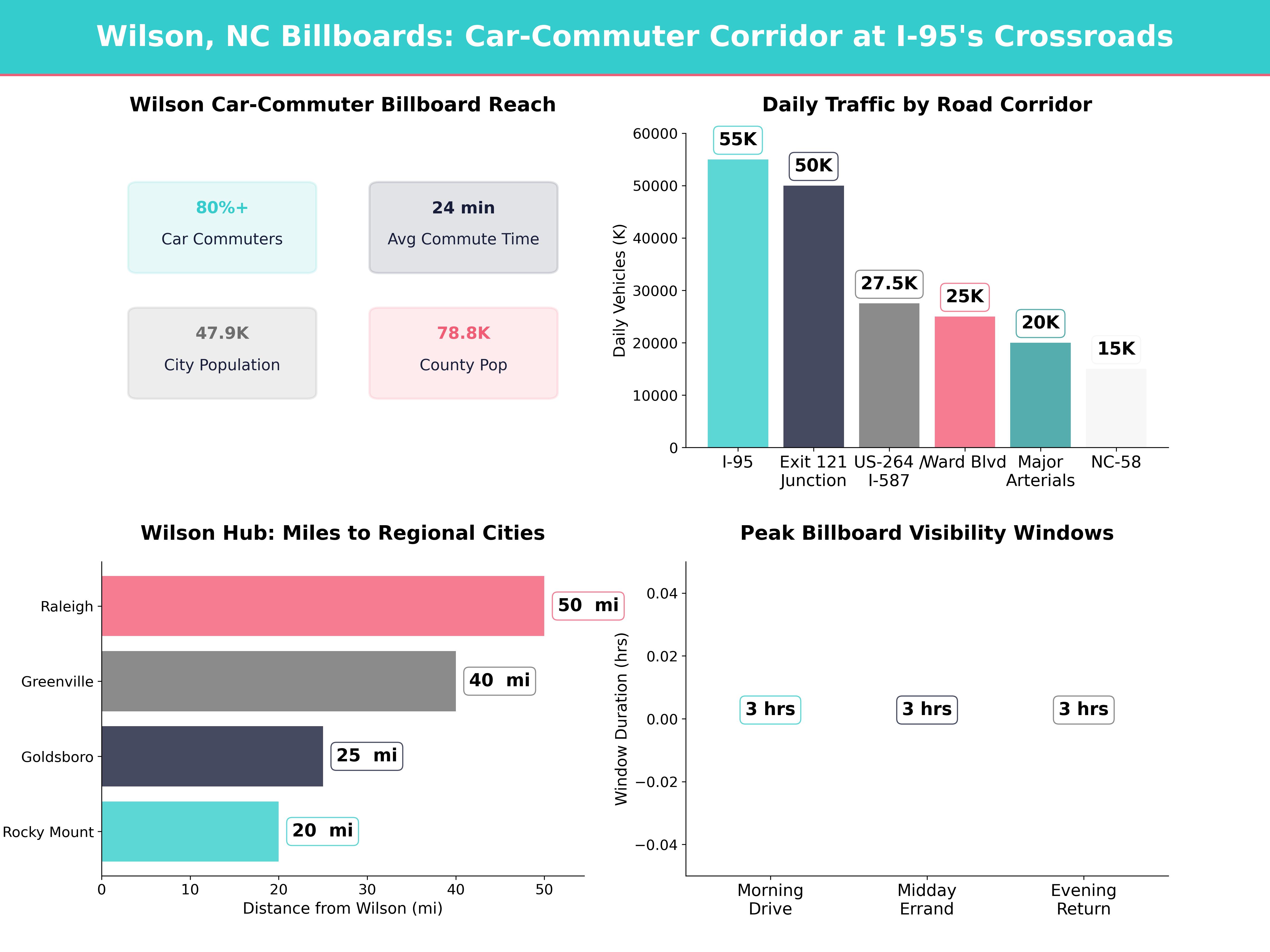
Wilson, North Carolina City of Wilson 47,851 residents at the 2020 census, and Wilson County 78,784 residents, which gives us a solid local base without the fragmentation of a much larger metro. We also benefit from Wilson’s position at the junction of I-95 and U.S. 264/I-587, where everyday errands, work trips, and interstate travel overlap. In a market where more than 80% of workers commute by car, digital billboards can deliver high-frequency visibility for both local brands and regional advertisers.
Wilson Market Overview
When we advertise in Wilson, we are working in one of eastern North Carolina’s most strategically placed small-city markets. Wilson sits about 50 miles east of Raleigh, about 20 miles south of Rocky Mount, about 25 miles north of Goldsboro, and about 40 miles west of Greenville. That geography matters because it lets us reach both Wilson residents and travelers moving between the Triangle, the I-95 corridor, and eastern North Carolina.
Wilson’s economy is broader than many markets of similar size. The Wilson Economic Development Council Wilson Medical Center, a 294-bed hospital, gives us a meaningful healthcare audience. The presence of Barton College 1902, and Wilson Community College, which traces its roots to 1958, gives us a steady student, faculty, and family audience throughout the academic year.
Wilson is also a practical market for out-of-home because it remains highly car-oriented, with more than 80% of workers commuting by car and average travel times of about 24 minutes. That is long enough for billboards to build frequency, and short enough that route choice stays predictable.
We also like Wilson because its identity is distinct. The city’s municipal broadband system, Greenlight 2008, helped Wilson build a reputation for being unusually forward-looking for a smaller market. That means our billboard campaigns can lean into both traditional local values and digitally savvy calls to action, especially for healthcare scheduling, ecommerce pickup, admissions, recruiting, and event promotion.
What Wilson’s market profile means for advertisers
When we look at Wilson from a billboard perspective, a few implications stand out.
- We should value frequency over sheer sprawl. Wilson is not a market where we chase endless suburban expansion. We win by showing up consistently on the roads people already use every week, especially corridors that can carry 20,000 to 30,000 vehicles per day.
- We should think in layers. Local drivers, county residents, and I-95 travelers all move through Wilson differently, so our creative and dayparts should reflect that.
- We should treat Wilson as a regional connector. Because Wilson sits between Raleigh, Rocky Mount, Goldsboro, and Greenville, one Wilson campaign can support broader eastern North Carolina awareness.
Key Traffic Corridors for Digital Billboards in Wilson
Wilson’s advertising value is closely tied to its roads. The corridor strategy here is straightforward: we use interstate inventory for regional reach, and we use urban commercial routes for repeat local exposure. The most useful traffic guidance comes from the North Carolina Department of Transportation, whose traffic counts consistently show that Wilson’s core roads carry meaningful daily volume for a city of this size, often from 10,000 to 30,000+ AADT on major arterials.
I-95 in Wilson County
I-95 is Wilson’s biggest traffic asset. On Wilson County segments of I-95, NCDOT counts are generally above 50,000 vehicles per day, and some stretches push beyond 60,000 AADT. That gives us one of the strongest traveler-oriented billboard opportunities in eastern North Carolina.
This corridor is especially effective for:
- Hotels, fuel stations, convenience stores, and quick-service restaurants, because travelers make stop decisions fast and often based on the next exit.
- Healthcare, urgent care, and pharmacy brands, because interstate traffic includes families, retirees, truck drivers, and sports travelers who may need immediate services.
- Tourism and attractions, because Wilson can convert pass-through traffic into short visits, meals, and overnight stays.
The key local detail is the connection to Exit 121, where I-95 meets U.S. 264/I-587 toward Wilson and Greenville, a junction that channels 50,000+ daily vehicles into the market. If we want to intercept travelers before they choose whether to stop, this is one of the most important decision points in the market.
U.S. 264 / I-587 around Wilson
U.S. 264, now signed as I-587 on the corridor west of Greenville, is Wilson’s east-west spine. Wilson-area counts on this route commonly fall in roughly the 20,000 to 35,000 AADT range, depending on the segment. This road links Wilson to I-95, to county communities, and to Greenville and Pitt County to the east.
We typically like this corridor for:
- Regional retail and automotive advertisers, because it captures drivers moving between multiple eastern North Carolina cities.
- Colleges, healthcare systems, and financial services, because the route ties together daily trips and planned destination visits.
- Recruiting campaigns, because manufacturing, logistics, and service employers can pull from a multi-county labor shed.
For advertisers that want a broader eastern North Carolina footprint without paying larger-metro rates, this corridor is often one of the smartest starting points.
Ward Boulevard, U.S. 301, and N.C. 42 in Wilson
Inside Wilson, Ward Boulevard is the retail loop we pay close attention to. On busier commercial sections, traffic volumes often land around 20,000 to 30,000 vehicles per day, with variation by segment. U.S. 301 and N.C. 42 also carry strong local traffic, often ranging from the low teens into the 20,000s AADT where development is denser.
These corridors are where we find Wilson’s everyday buying behavior. They are especially good for:
- Healthcare, dental, and medical specialty practices, because patients see the message repeatedly during routine weekly travel.
- Retail, grocery, furniture, and home improvement advertisers, because Wilson shoppers use these roads for errands rather than one-time trips.
- Local service businesses, including attorneys, HVAC companies, realtors, and insurance agencies, because awareness and recall matter more than one immediate click.
We also like these roads because they connect major local destinations such as Historic Downtown Wilson, Barton College Wilson Medical Center, and the city’s main commercial areas.
N.C. 58 and county approach routes
N.C. 58 and the approach roads from smaller towns help us reach Wilson County’s broader trade area. In developed stretches, N.C. 58 commonly carries 10,000 to 20,000 vehicles per day, and the county connectors feeding Wilson bring in workers, students, and shoppers from towns such as Elm City, Lucama Saratoga Stantonsburg
These routes are useful when we want to expand beyond the city proper without abandoning local relevance. They work well for farm supply, recruiting, healthcare, auto repair, churches, community events, and countywide service providers.
Audience Segments We Can Reach in Wilson
The strongest Wilson campaigns succeed because they match the route to the audience. This market is not only about “drivers” in the abstract. It is about different groups using the same roads for very different reasons.
Wilson commuters and errand traffic
Commuters are Wilson’s baseline audience. With more than 4 out of 5 workers commuting by car and average travel times around 24 minutes, we can build repetition quickly on weekday routes. Morning visibility is strongest around 6 a.m. to 9 a.m., lunch and errand visibility often peaks from 11 a.m. to 2 p.m., and the return-home window matters most from 4 p.m. to 7 p.m.
This audience is ideal for:
- Financial institutions and legal services, because trust builds with repeated exposure.
- Healthcare providers, because appointment scheduling often follows repeat message familiarity.
- Retail and restaurant brands, because routine trip patterns support timely offers and location reminders.
Wilson’s commercial geography helps us here. Residents may not drive far in absolute miles, but they revisit the same arterial roads again and again, especially those carrying 20,000 to 30,000 vehicles per day.
Wilson travelers and visitors
Traveler traffic is a major secondary audience in Wilson. I-95 gives us year-round pass-through volume, and Visit Wilson Vollis Simpson Whirligig Park, a 2-acre downtown park featuring 31 restored wind-powered sculptures. Nearby destinations such as Imagination Station Science & History Museum Wilson Arts, and Historic Downtown Wilson help turn Wilson from a highway stop into a short-stay destination.
This audience is especially useful for:
- Hospitality and food service advertisers, because travelers make same-day stop decisions.
- Attractions and event promoters, because Wilson’s visitor appeal is compact and easy to explain on a billboard.
- Regional healthcare and specialty services, because travelers include sports teams, families, and retirees passing through eastern North Carolina.
Students, families, and education-connected households in Wilson
Wilson’s education footprint creates dependable seasonal demand. Barton College 1902, and Wilson Community College, established in 1958, keep students, faculty, and visiting families moving across town. Wilson County Schools adds another layer through back-to-school shopping, sports seasons, tutoring, childcare, and family healthcare.
This segment matters for:
- Apartments, student-friendly retailers, and wireless providers, especially in late summer.
- Family healthcare, orthodontics, tutoring, and youth activities, especially from August through May.
- Food, coffee, and convenience brands, because regular school and campus trips create consistent route habits.
Wilson’s healthcare, industrial, and rural workforce
Wilson is also a work-market billboard town. The county’s mix of healthcare, industrial employment, logistics, and agriculture gives us audiences with early shifts, predictable routes, and high practical intent. Wilson Medical Center alone is a 294-bed institution, and Wilson Economic Development Council
This segment responds well to:
- Hiring and training campaigns, because shift workers and job seekers are already commuting by car.
- Auto, tire, and truck-related services, because vehicle dependence is high.
- Farm, industrial, and home service advertisers, because the county audience values reliability, availability, and straightforward offers.
Seasonal and Timing Opportunities for Wilson Billboard Campaigns
Wilson is a year-round market, but timing still matters. When we align our flights with school schedules, sports, weather, and traveler behavior, we can make a smaller market perform like a much bigger one.
Spring and early summer in Wilson
Spring is strong for healthcare, home services, retail, and events. School activities accelerate, graduation planning starts, and warmer weather pulls more people into parks, downtown, and weekend outings. It is also a good time to promote Barton College Wilson Arts programming, and downtown traffic tied to Historic Downtown Wilson.
Summer adds sports and leisure. The Wilson Tobs bring baseball attention to the market, and family entertainment campaigns tend to perform well from May through August. Restaurants, ice cream, attractions, youth camps, and cooling-related home services all benefit from that timing.
Summer travel and storm season around Wilson
Summer is also when Wilson’s interstate advantage becomes especially valuable. Vacation travel on I-95 increases the pool of drivers who can be converted into fuel, food, lodging, and attraction customers. For local brands, that means we can use Wilson boards not only for residents, but also for people who may visit only once and decide in a matter of minutes.
Weather adds another layer. According to the State Climate Office of North Carolina, eastern North Carolina summers routinely reach the upper 80s and lower 90s. The Atlantic hurricane season runs from June 1 to November 30, which creates natural relevance for roofing, generators, tree service, HVAC, insurance, pharmacies, and urgent care messaging.
Fall in Wilson means school rhythm, sports, and festivals
Fall is one of the best times to advertise in Wilson because several traffic patterns stack together at once. Wilson County Schools typically starts in late August, college life is fully active by September, and football, shopping, and civic events all intensify through October and November.
Wilson’s biggest signature event is the Whirligig Festival, which typically runs over 2 days in November. Even advertisers that are not event sponsors can benefit from the increased local attention and visitor traffic around downtown. Fall is also a strong window for healthcare enrollment campaigns, retail promotions, legal services, and family entertainment.
Holiday travel and year-end planning in Wilson
The holiday period is especially useful for Wilson boards near I-95 and the main retail corridors. Thanksgiving and Christmas bring heavier long-distance family travel, and local households are making repeated shopping trips at the same time. That combination is excellent for restaurants, gift retailers, churches, urgent care, and tax-prep brands preparing for the new year.
We also like year-end flights in Wilson because smaller markets often have lower noise levels than major metros. A clean, timely message can stand out more sharply here than it would in a crowded urban media environment.
Billboard Design Tips for the Wilson Market
Wilson rewards creative that is simple, direct, and tuned to the route. We should not use the same visual logic for a Ward Boulevard board that we use for an I-95 traveler board.
Wilson creative for I-95 and fast-moving traveler traffic
On interstate-facing placements, our best creative is immediate and transactional. We should lead with one clear offer, one brand, and one action. Exit-based language works especially well near Exit 121, because it matches how travelers actually make decisions.
Strong Wilson-area interstate creative usually includes:
- A recognizable logo and one core promise, because travelers do not have time to decode multiple claims.
- Distance or exit information, because “next exit,” “2 miles,” or “Exit 121” gives drivers practical context.
- High-contrast colors, because eastern North Carolina summer glare and fast speeds reward clarity over nuance.
This is where categories such as fuel, hotels, restaurants, urgent care, and attractions can win very quickly.
Wilson creative for local retail and community audiences
Inside Wilson, we can be a little more relational. The market responds well to messages that feel grounded, useful, and local. Visual references inspired by Vollis Simpson Whirligig Park, downtown brick architecture, community sports, and eastern North Carolina hospitality can feel more authentic than generic stock imagery.
We also find that Wilson creative works best when it emphasizes:
- Value and trust, because local buying decisions are often practical and reputation-driven.
- Specific local relevance, such as “Wilson,” “downtown,” “near Barton,” or “off Ward Blvd,” because familiarity matters.
- A short URL or simple phone number, because local audiences may actually remember and act later.
Wilson design for family, healthcare, and bilingual audiences
Wilson’s audience is diverse enough that clarity matters more than cleverness. For family, healthcare, and service campaigns, we generally do better with plain language than with elaborate brand copy. If our customer base includes Spanish-speaking households, Wilson is a market where bilingual or Spanish-language creative can make practical sense, especially for healthcare, legal services, retail, and community outreach.
Because drivers in Wilson often see the same boards repeatedly, we can rotate 2 or 3 creative variants over time instead of forcing every message into one layout.
Wilson design for industrial and recruiting campaigns
Hiring and industrial advertisers should lean into specificity. In Wilson, broad “Now Hiring” language is less persuasive than direct statements about shift type, training, certifications, benefits, or location. Industrial workers and tradespeople often respond to clarity, pay transparency when appropriate, and realistic commute cues.
Recruiting creative around Wilson should feel straightforward, not polished to the point of abstraction. Practical language performs well in a market with strong manufacturing, transportation, healthcare, and field-service audiences.
Regional Strategies Across Wilson and Wilson County
Wilson is not one homogeneous billboard zone. We get better results when we tailor our plan by sub-area and by travel purpose.
Wilson’s urban core and retail loop
The Wilson urban core gives us the best reach into recurring local behavior. Ward Boulevard, downtown approaches, Nash Street, and the medical and college corridors are where we build local familiarity. We use these boards for:
- Healthcare and professional services, because repeated weekly exposure builds recall.
- Retail and restaurant brands, because consumers pass these corridors during errands.
- Community institutions, because the message can feel more local and less transactional.
This is the right zone when our goal is not just reach, but durable awareness inside the Wilson trade area.
Wilson’s interstate gateway strategy
The I-95 and U.S. 264/I-587 interchange area is different. Here, we are speaking to drivers who may have no prior relationship with Wilson at all. The strategy should be built around immediate utility, directional clarity, and stop-conversion.
This zone is especially good for:
- Hospitality brands trying to capture pass-through travel.
- Restaurants and travel centers trying to convert the next stop decision.
- Attractions and downtown destinations trying to turn Wilson into more than a gas stop.
When we pair interstate creative with local-destination boards deeper in the market, we can create a simple traveler funnel.
Small-town Wilson County strategy
The rest of Wilson County matters more than many advertisers first assume. Routes serving Elm City, Lucama Saratoga Stantonsburg
If our service area includes surrounding counties such as Nash County Wayne County Pitt County Johnston County, Wilson can work as a central reinforcement market rather than a standalone buy.
Multi-city eastern North Carolina strategy anchored by Wilson
Wilson becomes even more valuable when we treat it as part of a regional network. Because it sits between Raleigh, Rocky Mount, Goldsboro, and Greenville, we can use Wilson to extend campaign continuity across eastern North Carolina.
This works especially well for hospitals, colleges, political campaigns, law firms, automotive groups, event promoters, and retail chains. Wilson helps us avoid a common regional mistake, which is leaving a gap between bigger-city buys.
Using Blip Tools for Wilson Campaigns
Wilson is an excellent market for a flexible digital approach because traffic patterns vary by corridor and by season. We do not need a one-size-fits-all plan here.
Wilson budget strategy with Blip
With Wilson inventory, we can start with a focused test instead of committing to a large static campaign. That matters in a market where a board near I-95 may serve a very different goal than a board near Ward Boulevard. We can put more weight behind the placements that align with our actual audience, then scale once the pattern is clear.
This is especially useful when we want to compare:
- Traveler-oriented boards versus local retail boards.
- Healthcare messaging versus recruiting messaging.
- Event creative versus evergreen branding.
Dayparting for Wilson traffic behavior
Dayparting is one of the easiest ways to make Wilson campaigns sharper. We usually think in four practical windows: 6 a.m. to 9 a.m., 11 a.m. to 2 p.m., 4 p.m. to 7 p.m., and weekend midday periods. That structure reflects commuter traffic, lunch errands, school pickup patterns, and leisure travel.
For example, a local breakfast or coffee advertiser may prioritize the morning commute, while a downtown restaurant may shift spend toward lunch and early evening. A hotel or fuel brand near I-95 may keep a broader all-day schedule because traveler flow is less dependent on the local workday.
Real-time optimization for Wilson creative
Wilson’s mix of local and pass-through traffic makes live testing especially valuable. We can rotate one creative version that emphasizes convenience, another that emphasizes price, and another that emphasizes location, then watch which message earns the strongest delivery and response pattern.
We can also adjust quickly around local events, school calendars, weather alerts, or festival weekends instead of waiting for a traditional contract cycle to end. In a market with a major fall event like the Whirligig Festival and a strong summer travel pulse, that flexibility is a real advantage.
Artwork support for Wilson-specific messaging
Wilson campaigns often perform better when the creative feels custom to the route. Blip’s artwork tools make it easier for us to build separate versions for I-95, downtown Wilson, and county commuters without turning production into a major project. Even a simple change in headline, color contrast, or location cue can make a Wilson board feel dramatically more relevant.
Getting Started With Billboard Rental in Wilson
Renting a billboard in Wilson is much easier when we begin with the geography instead of the format. The first question is not “Which board is cheapest?” The first question is “Which Wilson audience are we trying to reach?”
What to expect from Wilson billboard inventory
Wilson inventory typically falls into three broad groups: interstate-facing boards, urban commercial boards, and county connector boards. Interstate boards deliver scale and traveler exposure. Urban boards deliver local repetition. County boards help us reach the broader trade area that shops, works, studies, or receives care in Wilson.
When we evaluate Wilson boards, we usually look for:
- The corridor’s purpose, because a traveler board and a commuter board should not carry the same message.
- The nearby trip generators, such as hospitals, schools, retail clusters, and downtown destinations.
- The likely speed of traffic, because that affects how much information the creative can carry.
- The time of day that matters most, because Wilson traffic is not equally valuable at every hour.
How Blip simplifies Wilson billboard rental
Traditional billboard buying can be slow, inflexible, and hard to test in a market like Wilson where corridor differences matter. Blip makes Wilson easier because we can choose boards on a map, control timing, adjust spend, and change creative without being locked into a long commitment. That lets us behave more like a smart local operator and less like a buyer forced into a generic package.
We can also use Wilson as a test market. Because the city is large enough to produce meaningful traffic, but compact enough to read quickly, it is a practical place to learn what message resonates before we expand to other eastern North Carolina markets.
How we choose the right Wilson billboard for our goals
A simple Wilson selection framework usually works best.
- If our goal is immediate stop-conversion, we should prioritize I-95 and U.S. 264/I-587 placements.
- If our goal is local awareness and frequency, we should prioritize Ward Boulevard, U.S. 301, and other high-repetition urban corridors.
- If our goal is countywide reach, we should include approach routes that pull residents in from surrounding towns.
- If our goal is regional continuity, we should pair Wilson with nearby markets such as Rocky Mount, Goldsboro, and Greenville.
Wilson rewards advertisers who keep the plan simple, local, and route-aware. When we align the board, the audience, the daypart, and the creative, Wilson can produce the kind of efficient billboard performance that is often harder to achieve in bigger, noisier markets.