Billboards in Princeton, NC
No Minimum Spend. No Long-Term Contracts. Just Results.
Trusted by Leading Brands


Billboard advertising
in Princeton has never been easier
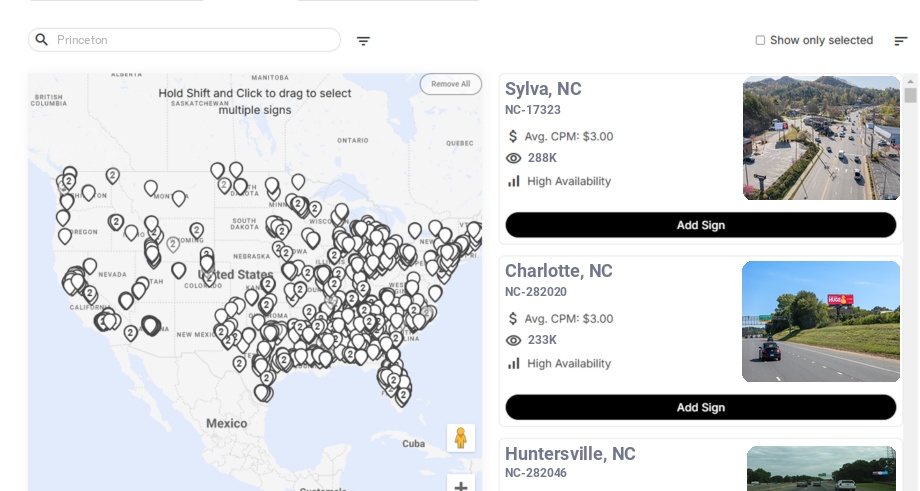



How much is a billboard in Princeton?
Why Choose Blip for Billboard Advertising in Princeton
-
Blip lets Princeton advertisers launch self-serve on US 70/Future I-42 in minutes—no back-and-forth, just pick a spot and go.
-
Set flexible budgets in Princeton to reach commuters, school traffic, and Smithfield shoppers without committing upfront.
-
Use dayparting in Princeton to hit 6-10 a.m. drives and 4-7 p.m. returns when Johnston County traffic is heaviest.
-
No contracts makes Princeton billboard testing easy—pause, tweak, or scale as regional demand shifts along US 70 and I-95.
-
Track Princeton campaigns in real time and shift spend toward the routes that drive more calls, clicks, and visits.
-
Blip creative tools help Princeton ads stay bold and clear for 55-70 mph traffic on US 70 and local connectors.
Frequently Asked Questions About Billboard Advertising in Princeton
How much does a billboard cost in Princeton, North Carolina with Blip?
With Blip, billboard advertising in Princeton can be surprisingly affordable because you only pay when your ad actually appears. Each “blip” is a 7.5-to-10-second display on a rotating digital billboard, and pricing starts at just $0.01 per display. Since the cost per blip changes based on time of day, location, and advertiser demand, you stay in control of what you pay.
Where can I advertise with Blip in Princeton, North Carolina?
Princeton sits on the US 70 / Future I-42 corridor between Smithfield, Selma, and Goldsboro, which lets us blend local frequency with pass-through reach. The page also highlights I-95 in the Smithfield and Selma area, I-40 near Benson, and local connectors such as NC 96 and US 70 Business. These routes give advertisers options for local relevance, commuter reach, and regional shopping or travel traffic.
Why is Princeton, North Carolina a strong market for billboard advertising with Blip?
Princeton gives us an unusually efficient billboard market because it combines small-town relevance with countywide growth and regional traffic. Johnston County had 226,623 residents in 2020, up from 168,878 in 2010, and roughly 83% of local workers commute by driving alone. Princeton also sits between major traffic and shopping draws, which helps campaigns reach both local residents and pass-through travelers.
What kinds of businesses work best for billboard ads in Princeton, North Carolina?
The page says Princeton-area billboards can do several jobs at once, including building repeated awareness with local residents, intercepting regional commuters, and capturing pass-through travelers. It specifically calls out quick-service restaurants, healthcare and urgent care, auto dealers, colleges and trade schools, hotels, travel centers, gas stations, retail, and legal or insurance services. The best fit depends on whether the goal is local frequency, commuter reach, or travel and shopping visibility.
When should I run a billboard campaign in Princeton, North Carolina with Blip?
Timing matters in Princeton because the market changes shape throughout the year, and the page recommends aligning campaigns with school calendars, festival weekends, travel surges, and weather-related needs. Spring works well for home services, healthcare, event marketing, and retail, while summer brings beach traffic, family travel, and storm-season messaging. The back-to-school window, holiday season, and early-year value messaging are also highlighted as strong opportunities.
Do I need a contract to advertise with Blip in Princeton?
No, Blip has no long-term contracts or minimum commitments. You can start, pause, or stop your campaign at any time.
How fast can I launch a billboard campaign with Blip in Princeton?
You can have your campaign live in minutes. Create a free account, select your locations, set your budget, upload your design, and start running once approved.
Where can I advertise with Blip in Princeton?
Blip has digital billboards in Princeton. You can browse available locations on a map, choose the ones that fit your audience, and start advertising right away.
Still have questions? Launch a campaign in minutes — no contracts, no commitments.
Start Your CampaignPrinceton Billboard Advertising Guide
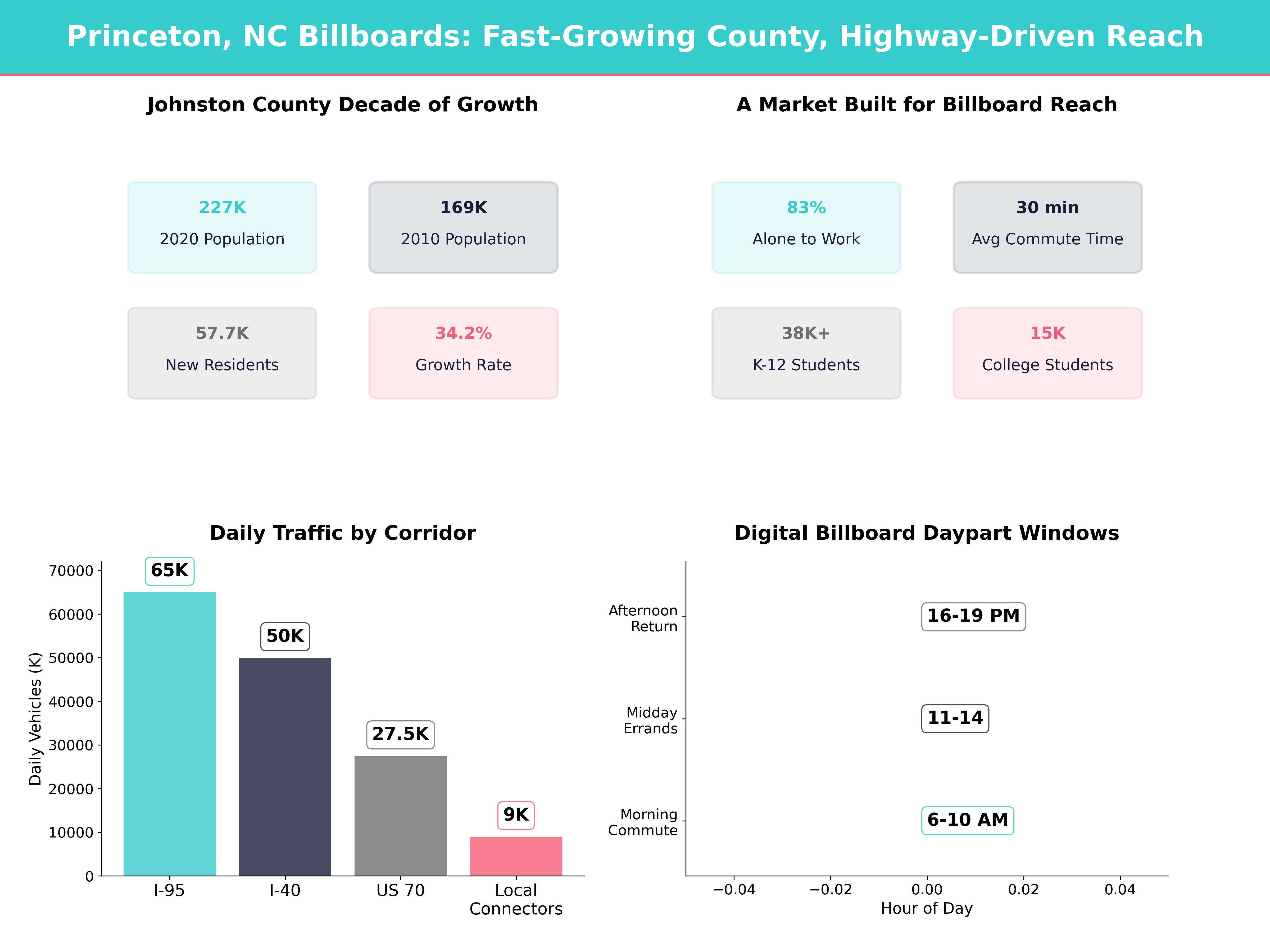
Princeton Johnston County had 226,623 residents in 2020, up from 168,878 in 2010, so the county added 57,745 people in one decade. Because roughly 83% of local workers commute by driving alone, roadside media remains central to how we reach households, workers, and shoppers. Princeton also sits on the US 70 / Future I-42 Smithfield, Selma, and Goldsboro, which lets us blend local frequency with pass-through reach.
Market Overview for Princeton, North Carolina
Princeton is a small town, but we should not think of it as a small advertising opportunity. We are buying into a broader Johnston County market that grew by 34.2% between 2010 and 2020, according to state demographic reporting from the North Carolina Office of State Budget and Management. That level of growth expands demand for healthcare, restaurants, home services, schools, financial services, and retail across the county.
The most important market fact for billboard advertisers is that Princeton sits inside a highly auto-oriented region. In Johnston County, roughly 83% of workers drive alone to work, and average commute time is about 30 minutes. That means our audience is not just present, but repeatedly exposed to roadside messages during long, habitual trips between home, work, school, shopping, and church.
The second major advantage is economic diversity. Johnston County Economic Development Johnston Health Johnston County Public Schools, Johnston Community College, and major private manufacturers create a steady flow of workers and service demand throughout the year.
We should also remember that Princeton benefits from nearby destination retail. Carolina Premium Outlets 80+ stores, which gives the western side of the county a significant shopping draw. When we add Princeton’s location between that retail cluster and the employment, education, and military-adjacent activity around Goldsboro, we get a market where billboard campaigns can serve both hyperlocal and regional goals.
For advertisers, the practical takeaway is straightforward. We can use Princeton-area digital billboards to do at least 3 different jobs at once: we can build repeated awareness with local residents who pass the same routes every week, we can intercept regional commuters moving between eastern Johnston County, western Wayne County
Key Traffic Corridors for Princeton, North Carolina
Princeton’s value is defined by a handful of powerful corridors. When we understand how each route functions, we can match billboard locations to the right customer behavior.
US 70 and Future I-42 Near Princeton
US 70 is the defining corridor for Princeton. As NCDOT continues work on the Future I-42 20,000 to 35,000 AADT range near Johnston and Wayne county communities.
For us, that traffic profile is ideal for businesses that want a mix of local and regional reach. We should favor this corridor for: Quick-service restaurants and convenience retail, because drivers are already in decision mode, Healthcare and urgent care, because families use US 70 for practical, repeat trips, Auto dealers, tire shops, and repair brands, because car-dependent households notice vehicle-related offers on commuting routes, and Colleges and trade schools, because the corridor connects residential areas with education and employment centers.
US 70 also tends to carry higher-speed traffic, often in the 55 to 70 mph range depending on the segment. That makes clean, high-contrast creative especially important.
I-95 in the Smithfield and Selma Area
A short drive west of Princeton, I-95 is the pure reach play. Around Smithfield, Selma, and the outlet district, NCDOT counts frequently land in the 60,000 to 70,000 AADT range. That is a very different audience than the one we get on Princeton’s local roads, because it includes tourists, truck traffic, long-distance travelers, and regional shoppers.
This corridor is especially strong for: Hotels, travel centers, gas stations, and restaurants, because drivers need immediate next-stop information, Attractions and events, because travelers often make same-day detours when a message is simple and timely, Regional retail, because Carolina Premium Outlets Downtown Smithfield, and nearby shopping areas already train drivers to stop, and Legal, healthcare, and insurance services, because repeated interstate exposure builds brand familiarity across multiple towns.
When we buy boards near the I-95 and US 70 interchange area, we gain access to both local retail traffic and through traffic. That combination is one of the strongest billboard advantages in the Princeton trade area.
I-40 Near Benson
Southwest of Princeton, I-40 around Benson 50,000 AADT on many segments. This route matters even if a business is based in Princeton, because I-40 broadens reach into the southern Johnston County and Triangle-bound travel pattern.
We should use I-40 placements when we want to expand awareness beyond the immediate Princeton market. The best fits usually include: Regional healthcare systems, because people will travel for specialty care, Home improvement and contractor brands, because service territories often cross county lines, Furniture, mattress, and large-ticket retail, because shoppers compare options across multiple towns, and Events and festivals, because weekend travelers can be pushed toward a destination with just one timely message.
NC 96, US 70 Business, and Local Connectors
Not every strong billboard has to sit on the biggest highway. NCDOT counts on local connectors such as NC 96, US 70 Business, and nearby feeder roads often fall in the 6,000 to 12,000 AADT range. Those roads give us less raw volume, but often more local relevance and stronger message repetition.
These placements are often best for: Churches, schools, and community events, because the audience is geographically close, Dentists, primary care, and local clinics, because trust builds through repeated local visibility, Farm supply, equipment, and service businesses, because rural and small-town traffic is highly targeted, and Local restaurants and shops, because drivers are close enough to act immediately.
If our goal is response instead of pure awareness, a lower-volume board at the right decision point can outperform a higher-volume board that reaches the wrong audience.
Audience Segments We Can Reach in Princeton, North Carolina
A strong Princeton campaign works because the market is not one-dimensional. We can reach several overlapping audiences with different motivations and schedules.
Commuters and Daily Errand Traffic
Commuters are the core billboard audience here. With roughly 83% of workers driving alone and average commute times around 30 minutes, Johnston County creates repeated exposure opportunities that favor outdoor advertising. Morning westbound traffic often reflects work and school movement, while afternoon and evening traffic captures return trips, errands, and family stops.
This segment works well for banks, healthcare, insurance, telecom, auto service, grocery, and quick dining. We should think in terms of repetition and convenience rather than one-time impulse.
Families and School Households
Johnston County Public Schools serves 38,000+ students, making family households one of the most valuable audience segments in the county. That creates reliable demand for pediatric care, orthodontics, after-school programs, family restaurants, youth sports, tutoring, and home services.
The family audience matters in Princeton because school, church, and extracurricular patterns are route-based. Parents drive the same roads several times per day, which makes billboard frequency especially effective. Messages tied to practical value, trust, safety, and convenience usually perform better than abstract branding in this segment.
College Students and Workforce Learners
Johnston Community College serves about 15,000 curriculum and continuing education students each year. Nearby, the University of Mount Olive enrolls roughly 3,000 students, and Wayne Community College expands the education audience to the east around Goldsboro.
Together, these institutions create a year-round market for apartments, internet service, financial services, healthcare, restaurants, bookstores, and employment recruiting. This audience responds well to concise offers and enrollment-driven timing. We should especially watch late summer, early semester starts, and workforce training cycles.
Shoppers, Tourists, and Weekend Visitors
Regional shopping and heritage tourism give Princeton more reach than its town size suggests. Carolina Premium Outlets 80+ stores, while the Bentonville Battlefield State Historic Site interprets the largest Civil War battle fought in North Carolina, involving nearly 80,000 troops.
Nearby downtown districts in Smithfield and Goldsboro also attract dining and event traffic. We can use this audience for hospitality, local attractions, dining, specialty retail, and event marketing. Weekend-focused creative often works better than weekday commuter creative for these placements.
Industrial, Agricultural, and Military-Adjacent Workers
Eastern Johnston County and neighboring Wayne County support agriculture, food processing, logistics, manufacturing, and military-adjacent activity. We do not need every campaign to target this audience, but we should recognize its value.
Shift-based workers notice early-morning and late-afternoon messages, and practical offers tend to resonate more than aspirational ones. This segment is strong for workwear, trucks, healthcare, staffing, training programs, legal services, and durable consumer products. In some corridors, bilingual creative is also worth testing when the customer base supports it.
Seasonal and Timing Opportunities in Princeton, North Carolina
Timing matters in Princeton because the market changes shape throughout the year. We can improve efficiency by aligning campaigns with school calendars, festival weekends, travel surges, and weather-related needs.
Spring in Princeton: Festivals, Heritage Tourism, and Home Projects
Spring is one of the most flexible seasons for Princeton campaigns. From March through May, eastern North Carolina picks up heritage tourism, outdoor activity, landscaping demand, and spring shopping. The Bentonville Battlefield State Historic Site is a natural spring attention point, and nearby events such as the North Carolina Pickle Festival in April and Benson Mule Days
This is a strong window for: Home services, because homeowners start repair, lawn, and renovation projects, Healthcare and wellness, because people reset routines after winter, Event marketing, because weekend travel picks up, and Retail and dining, because families are out more often.
We usually get better results when we launch spring campaigns 2 to 4 weeks before the event or seasonal need rather than waiting for the exact date.
Summer in Princeton: Beach Traffic and Family Travel
Summer brings a different audience mix. From Memorial Day to Labor Day, US 70 carries more leisure traffic heading east, and the Smithfield retail cluster continues to pull shoppers off I-95. Families are out of school, day trips rise, and restaurant and convenience spending becomes more spontaneous.
Summer campaigns are especially effective for: Travel-oriented businesses, because drivers are already in motion, Family attractions and restaurants, because parents are making same-day decisions, Auto care and roadside services, because road-trip season increases vehicle-related demand, and Retail with clear offers, because outlet and stopover shopping is more frequent.
Summer is also storm season. In North Carolina, hurricane season runs from June 1 to November 30, which makes this a good period for roofing, generators, tree service, HVAC, insurance, and emergency-preparedness messaging.
Back-to-School and Fall in Princeton
The back-to-school window is one of the most important local timing opportunities. Johnston County Public Schools typically return in mid-August, and the academic year runs into early June. That schedule gives us a predictable annual cycle for school services, internet providers, healthcare, orthodontics, tutoring, youth activities, and family dining.
Fall also brings stronger local identity and event traffic. Benson Mule Days September, Friday night football, church programming, and harvest-related activity all reinforce community travel patterns. We should prioritize community-rooted creative during this period, because audiences respond well to familiar local cues.
Holiday Retail and Early-Year Value Messaging
Holiday campaigns should start earlier than many advertisers expect. In this market, we often want holiday retail, dining, gift, and service campaigns live 6 to 8 weeks before the December peak, especially if we are targeting shoppers using the Carolina Premium Outlets
After the holidays, value messaging becomes more important. From January through March, tax-related and budget-conscious purchasing behavior can help auto service, discount retail, healthcare financing, furniture, and repair brands. Princeton is a practical market, so clear savings language tends to work well in the first quarter.
Billboard Design Tips for Princeton, North Carolina
Princeton does not need generic billboard creative. It needs creative built for local culture, local routes, and local motivations.
Use Place Names That Mean Something Locally
In Princeton, directional relevance matters. Copy that mentions Smithfield, Selma, Goldsboro, Mount Olive, or “US 70” often feels more actionable than broad regional language. People here think in routes and destinations, so our creative should do the same.
A strong Princeton-area billboard often includes: 1 clear location cue, 1 clear offer, and 1 simple call to action. That approach works especially well on faster highway segments.
Design for Highway Speed, Not Desktop Reading
On US 70 and I-95, many viewers are moving at 55 to 70 mph. We should use bold type, high contrast, and short lines that can be understood instantly. If a message depends on paragraphs, multiple prices, or detailed disclaimers, it is not built for this market.
Princeton-area drivers respond best to messages that answer one immediate question, such as “What is this,” “Where is it,” or “Why should I stop.” For example, “Urgent Care Next Exit,” “Smithfield Furniture Sale,” and “Goldsboro Classes Enrolling” all fit local driving behavior better than abstract brand slogans.
Lean Into Practical Value and Trust
This market responds well to straightforward promises. Family value, reliability, convenience, experience, and local reputation usually outperform overly polished luxury messaging. We should use images and wording that feel grounded in eastern North Carolina, including family scenes, food, home improvement, vehicles, agriculture-adjacent visuals, and clean local landmarks when appropriate.
For service businesses, trust markers are especially useful. Phrases such as “Serving Johnston County,” “Same-Day Appointments,” “Free Estimates,” or “Open Saturday” fit the expectations of this audience.
Build Seasonal Versions Instead of One Year-Round Ad
Princeton is a market where seasonal swaps are worth the effort. We should create spring, summer, back-to-school, and holiday versions rather than running one static design for 12 months. Seasonal relevance matters because the audience’s reason for being on the road changes throughout the year.
Examples that fit the local market include: A spring lawn-care or home-repair message, a summer travel, dining, or cold-drink message, a back-to-school healthcare, tutoring, or internet message, and a holiday shopping or family dining message.
Regional Strategies Around Princeton, North Carolina
We usually get better results when we treat Princeton as a hub inside a broader network rather than as a single isolated town. A 3-zone or 4-zone strategy often makes more sense than putting the entire budget into one corridor.
Princeton Proper and Eastern Johnston County
This zone is best for local frequency. We should focus on boards and routes that residents use repeatedly for school, church, errands, and healthcare. Lower traffic counts can still deliver strong outcomes here because the audience is highly relevant.
The best fits include local medical practices, dental offices, restaurants, funeral services, insurance agencies, banks, churches, and community events. If a business depends on nearby households rather than passing tourists, this zone should be our foundation.
Smithfield, Selma, and the I-95 Retail Cluster
This is the reach-and-shopping zone. We use it when we want broader county awareness, interstate travelers, and retail-minded audiences. It is especially effective for destination retail, hospitality, large healthcare systems, legal services, and time-sensitive promotions.
Because this cluster sits near I-95, US 70, Carolina Premium Outlets Downtown Smithfield, it works well for brands that can benefit from both impulse stops and multi-town recognition.
Goldsboro and the Wayne County Approach
Eastbound strategy matters in Princeton. The Goldsboro market brings employment, education, healthcare, downtown activity, and military-adjacent households into play. We should use this zone for hospitals, colleges, training programs, restaurants, and service businesses that draw from both Johnston and Wayne counties.
This area is also useful when we want to advertise to younger adults and working households connected to Wayne Community College, Visit Goldsboro, and the downtown district.
Benson, I-40, and the Southern Arc
This zone helps us catch regional through traffic and southern Johnston County movement. It is especially good for contractors, home improvement brands, agricultural suppliers, event promotion, and businesses with service areas that extend beyond Princeton.
If our customer base travels across multiple towns, this broader southern arc can add efficient reach without forcing us into a much more expensive metro-only strategy.
Using Blip Tools in Princeton, North Carolina
Princeton is a market where flexibility matters. We do not need to buy every board for every hour. We can use Blip’s tools to shape campaigns around the actual behavior of Princeton-area audiences.
Build a Multi-Corridor Test Instead of Guessing
We should usually begin with a small test across 3 to 5 carefully chosen boards rather than putting everything into one location. A smart first test might include: 1 board near Princeton for local frequency, 1 board on or near US 70 for commuter reach, and 1 board near Smithfield or Selma for regional shopping and travel traffic.
That structure tells us quickly whether our message works best as a local reminder, a commuter awareness play, or a travel-stop prompt.
Daypart Around Real Local Behavior
Dayparting is especially useful in Princeton because traffic purpose changes throughout the day. We can concentrate budget during: 6:00 to 10:00 a.m. for commuters and school traffic, 11:00 a.m. to 2:00 p.m. for lunch, errands, and retail stops, 4:00 to 7:00 p.m. for return commutes and family decisions, and Friday noon through Sunday evening for shopping, dining, and event traffic.
A Princeton dental office, for example, may want weekday commuter emphasis, while a restaurant or outlet-oriented retailer may want heavier weekend delivery.
Rotate Creative by Corridor
Blip makes it practical for us to run different creative on different roads. We should not show the same message on every corridor if the audience intent changes. A local board near Princeton can emphasize trust and neighborhood relevance, while an I-95 board should emphasize distance, convenience, and immediate action.
This is especially useful during event seasons. We can swap in festival, back-to-school, holiday, or weather-response creative without rebuilding the entire campaign.
Optimize With Short Review Cycles
In Princeton, we can learn a lot from a campaign in 14 days, and we usually have a solid first optimization read by 30 days. We should watch which boards align with website traffic, calls, coupon use, store visits, or appointment requests, then shift more budget toward the strongest routes.
Because Blip lets us adjust without the friction of traditional outdoor buying, we can treat Princeton as a live market test instead of a fixed bet.
Getting Started with Billboard Rental in Princeton, North Carolina
Renting a billboard in the Princeton area is easier when we start with strategy instead of inventory. The first question is not “Which board is cheapest.” The first question is “Which route matches our customer.”
Define the Job the Billboard Needs to Do
A Princeton billboard can do different jobs, and each job suggests different placements. We should decide whether the goal is: Local frequency among Princeton and eastern Johnston County residents, Commuter reach on US 70 and related connectors, Travel and shopping visibility near Smithfield, Selma, I-95, or I-40, and Regional brand lift across Johnston County and into Goldsboro.
When we define the job first, location selection becomes much easier.
Evaluate Each Billboard Like a Local Driver
The best Princeton-area board is not always the biggest one. We should evaluate each location based on direction of travel, approach speed, proximity to turns or exits, surrounding clutter, and whether the audience can act on the message soon after seeing it.
A few practical questions help: Is the board on the side of the road our audience actually uses, is the message visible before the decision point, not after it, is the traffic local, commuter, retail, or long-distance, and does the board fit our product’s timing and price point.
For example, a hometown service business may do better on a local feeder road, while a restaurant or hotel may benefit more from interstate exposure.
Start Small, Learn Fast, and Expand
We generally recommend starting with 2 to 4 weeks on a focused group of boards, then expanding based on response. In many cases, 3 strong locations outperform 10 scattered ones because message repetition and route relevance matter more than random reach.
Traditional billboard buying often involves back-and-forth availability checks, rigid terms, and less flexibility once a campaign starts. Blip simplifies the process by letting us compare boards on a map, set our budget around our actual goals, and make changes as we learn what works in Princeton.
Measure Success in Business Terms
The right evaluation method depends on the campaign objective. If we are promoting a local clinic, we should watch appointment calls and web visits. If we are driving foot traffic, we should track sales spikes, redemption codes, or store activity by daypart and location.
If we are building awareness, we should look for steady branded search and direct traffic growth over time. Princeton is a market where billboard advertising can work very well because the roads are habitual, the county is growing, and the audience is highly car-dependent. When we pair the right route, the right message, and the right timing, digital billboards around Princeton can become one of the most efficient ways to stay visible across Johnston County and the surrounding eastern North Carolina corridor.