Billboards in Linwood, NC
No Minimum Spend. No Long-Term Contracts. Just Results.
Trusted by Leading Brands


Billboard advertising
in Linwood has never been easier



How much is a billboard in Linwood?
Why Choose Blip for Billboard Advertising in Linwood
-
Blip lets you launch fast in Linwood on I-85's 65,000+ daily vehicles, so your message reaches commuters and pass-through travelers without hassle.
-
No contracts or minimums in Linwood mean you can test ads around Lexington, Thomasville, and the road-first Davidson County market, then scale what works.
-
Use Blip's dayparting in Linwood to hit weekday commuters at 6-9 a.m. and 4-7 p.m., or weekend lake traffic near High Rock Lake when it matters most.
-
Track your Linwood billboard performance in real time and shift budget toward the best routes, whether that's US 52 local shoppers or I-85 regional reach.
-
Blip's creative tools make it easy to refresh Linwood ads for barbecue season, back-to-school, or Lexington Barbecue Festival traffic with a clear, bold message.
Frequently Asked Questions About Billboard Advertising in Linwood
How much does a billboard cost in Linwood with Blip?
With Blip, billboard advertising in Linwood can fit a wide range of budgets because you only pay when your ad actually appears. Each “blip” is a 7.5-to-10-second display on a rotating digital billboard, and pricing starts at just $0.01 per display. You choose a daily budget, and costs can shift based on time of day, location, and advertiser demand.
Where can I advertise with Blip in Linwood, North Carolina?
Linwood is beside one of North Carolina’s most important travel corridors, I-85, which carries roughly 65,000 to 80,000+ vehicles per day in the Linwood-Lexington area. Nearby routes like US 52, I-285, NC 8, Business 85, US 29, US 70, and NC 47 also provide strong visibility across Lexington, Thomasville, and western Davidson County. Our campaigns here can reach local households, daily commuters, and pass-through travelers moving between Charlotte, Winston-Salem, and Greensboro.
What makes billboard advertising in Linwood good for Blip campaigns?
Linwood is a small community with outsized billboard value because it sits inside Davidson County’s road-first Lexington market and along a major highway corridor. More than 80% of workers drive alone and roughly 9 in 10 commute by car, truck, or van, so roadway exposure is part of everyday life. That makes digital billboards around Linwood effective for building frequency quickly and driving immediate action.
When is the best time to run billboards in Linwood, North Carolina?
Spring through early summer is strong for home services, landscaping, outdoor retail, real estate, and healthcare checkup campaigns. Summer weekends can be especially busy near High Rock Lake, while fall is one of the best billboard seasons because schools are back in session and the Lexington Barbecue Festival brings a major attention spike in October. Holiday months and the first quarter also create opportunities for tax, legal, financial, fitness, healthcare, and auto service advertisers.
Who should advertise on billboards in Linwood with Blip?
This is a strong market for advertisers that need practical, repeated visibility in a county of 168,930 residents and a labor force of more than 80,000 people. Healthcare providers, auto dealers, home services, colleges, restaurants, grocery stores, banks, insurance agencies, staffing firms, and event promoters all benefit from the market. Because the area is more car-dependent than transit-dependent, billboard recall tends to align well with actual purchase behavior.
Do I need a contract to advertise with Blip in Linwood?
No, Blip has no long-term contracts or minimum commitments. You can start, pause, or stop your campaign at any time.
How fast can I launch a billboard campaign with Blip in Linwood?
You can have your campaign live in minutes. Create a free account, select your locations, set your budget, upload your design, and start running once approved.
Where can I advertise with Blip in Linwood?
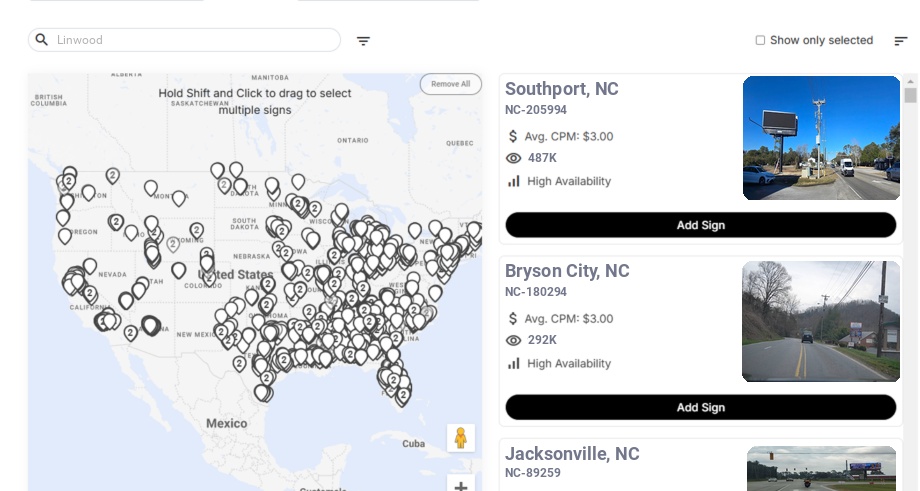
Blip has digital billboards in Linwood. You can browse available locations on a map, choose the ones that fit your audience, and start advertising right away.
Still have questions? Launch a campaign in minutes — no contracts, no commitments.
Start Your CampaignLinwood Billboard Advertising Guide
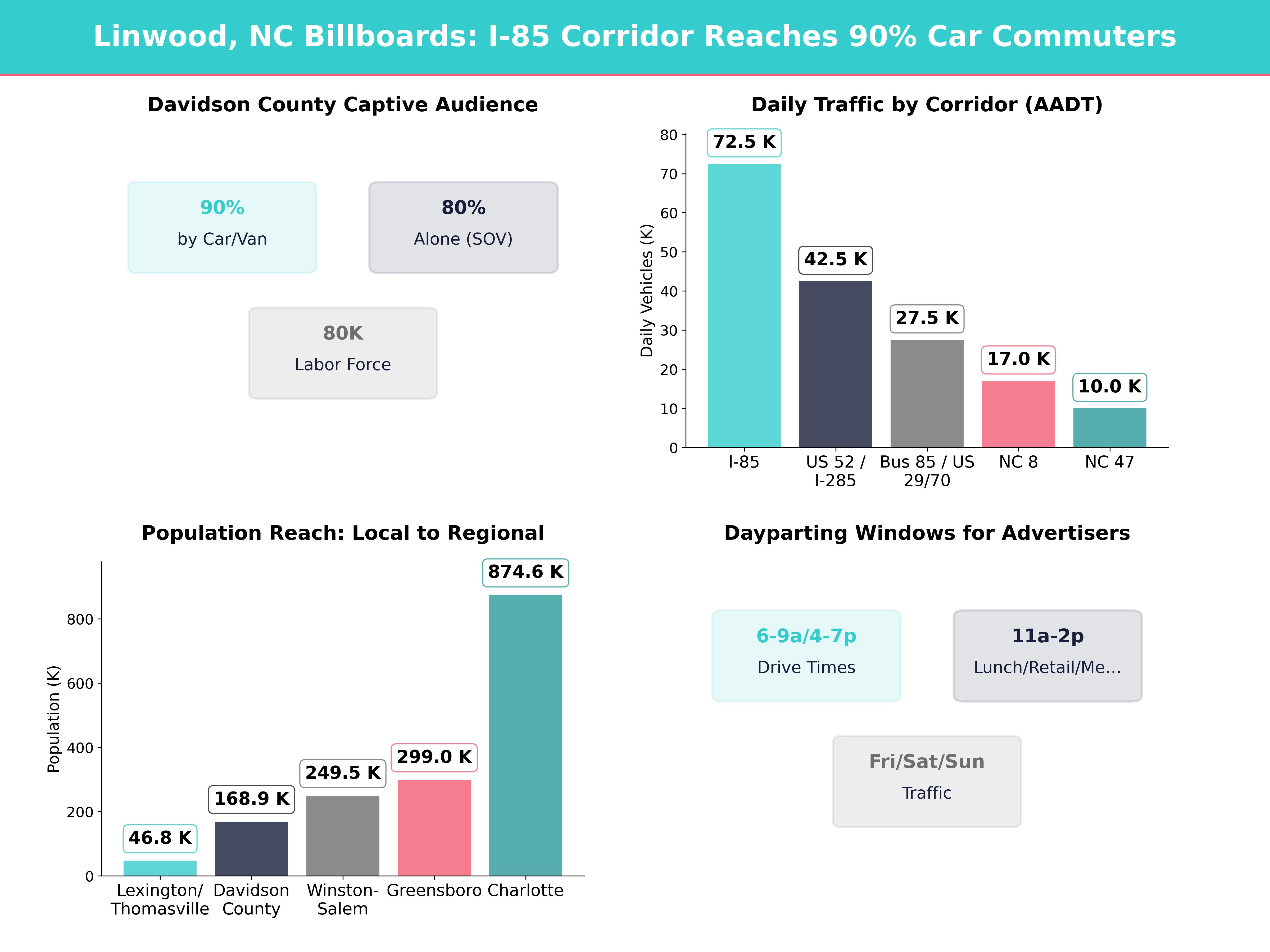
Linwood is a small community with outsized billboard value because it sits inside Davidson County’s road-first Lexington market and beside one of North Carolina’s most important travel corridors, I-85, which carries roughly 65,000 to 80,000+ vehicles per day in the Linwood-Lexington area. State population figures published by the North Carolina Office of State Budget and Management show Davidson County 168,930 residents in 2020, while nearby Lexington Thomasville 46,815 people inside their city limits. Our campaigns here can reach local households, daily commuters, and pass-through travelers moving between Charlotte, Winston-Salem, and Greensboro 80% of workers driving alone and roughly 9 in 10 commuting by car, truck, or van, digital billboards around Linwood can build frequency quickly and still drive immediate action.
Linwood Market Overview
Linwood works best when we treat it as part of a countywide and corridor-wide buying area rather than as a stand-alone small town. According to state-published population totals from the North Carolina Office of State Budget and Management, Davidson County 162,878 residents in 2010 to 168,930 in 2020. That was a gain of 6,052 people, or about 3.7% in a decade, which tells us the market is stable, growing, and still rooted in repeat local travel.
Population, geography, and regional reach in Linwood
The closest city anchors are Lexington 19,632 residents, and Thomasville 27,183 residents. Linwood also benefits from its position on the southern edge of the Piedmont Triad, which expands our practical advertising radius beyond one county. Nearby urban centers add even more scale, including 249,545 residents in Winston-Salem, 299,035 in Greensboro 874,579 in Charlotte.
That geography matters because Linwood advertisers are often selling to people who cross county lines for work, healthcare, dining, education, and recreation. A restaurant in Lexington, a medical office near US 52, or a retailer on the I-85 corridor is not limited to Linwood residents alone. We can use billboards here to capture both close-in demand and regional travel intent.
Demographics and economic patterns around Linwood
Davidson County’s economy is diversified enough to support many billboard categories. Manufacturing, logistics, healthcare, education, food, agriculture, recreation, and motorsports all play visible roles in the local economy, and county profile data from the North Carolina Department of Commerce show a labor force of more than 80,000 people. That gives us dependable weekday movement from morning through evening.
The commute pattern is especially favorable for outdoor advertising. In Davidson County, the drive-alone share is above 80%, and carpooling lifts total commuting by car, truck, or van to roughly 9 in 10 workers. For us, that means road exposure is not occasional. It is part of everyday life.
What Linwood’s market traits mean for billboard advertisers
This is a strong market for advertisers that need practical, repeated visibility in a county of 168,930 residents and a labor force of more than 80,000 people. Healthcare providers, auto dealers, home services, colleges, restaurants, grocery stores, banks, insurance agencies, staffing firms, and event promoters all benefit when audiences see the same message on familiar routes. Because the market is less transit-dependent and more car-dependent than larger downtown-heavy metros, billboard recall tends to align well with actual purchase behavior.
Key Traffic Corridors Around Linwood
Linwood’s advertising power comes from highway structure. When we understand which routes carry commuters, which routes carry regional travelers, and which routes capture local errands, we can match creative to real driving behavior instead of guessing.
I-85 through Linwood and Lexington
According to traffic count maps from the North Carolina Department of Transportation, the I-85 mainline through the Linwood-Lexington area generally carries about 65,000 to 80,000+ vehicles per day, depending on the segment. This is the corridor that gives Linwood its biggest billboard advantage because it connects the market to Charlotte, Salisbury, Lexington Thomasville Piedmont Triad.
We should favor I-85 when our goal is broad reach, regional brand awareness, or pass-through capture. This corridor is especially effective for these advertisers:
- Regional retail brands benefit because I-85 delivers repeat impressions across county lines.
- Quick-service restaurants, convenience stores, and travel services benefit because travelers make fast decisions near interchanges.
- Healthcare systems, colleges, and major attractions benefit because I-85 can introduce a destination before drivers choose an exit.
- Recruiting campaigns benefit because industrial workers, drivers, and shift employees often use this route daily.
US 52, I-285, and NC 8 around Lexington
Lexington’s north-south spine is just as important for local targeting. NCDOT counts typically place US 52 and the I-285 connection in the 35,000 to 50,000 AADT range through the Lexington area, while NC 8 generally lands around 14,000 to 20,000 AADT on key segments. These routes pull in residents from western Davidson County, central Lexington, and nearby communities that rely on the city for shopping, services, and healthcare.
We should use this corridor when we want a stronger local-intent audience. It is especially good for:
- Medical providers because patients often travel to Atrium Health Wake Forest Baptist Lexington Medical Center and surrounding offices via these routes.
- Restaurants and local retailers because lunch, dinner, and errand traffic is concentrated here.
- Community colleges and training programs because students and working adults pass through these roads regularly.
- Government, public service, and event campaigns because Lexington functions as a county hub.
Business 85, US 29, US 70, and NC 47 near Linwood and Thomasville
Business 85, US 29, and US 70 create another important layer of visibility across Lexington Thomasville 20,000 to 35,000 AADT range, which is lower than I-85 but often more valuable for destination businesses because vehicles are moving through local commercial zones. NC 47 near Linwood and Midway is typically lighter, but still meaningful, with many segments around 8,000 to 12,000 AADT.
These roads tend to support:
- Furniture, flooring, appliance, and home-improvement advertisers because shoppers are already in local retail mode.
- Schools, churches, and community events because the audience is more local and more likely to know the area.
- Auto service, insurance, legal, and financial advertisers because these categories rely on trust and repeated nearby exposure.
- Local dining and entertainment because directional copy can convert same-day traffic.
Audience Segments We Can Reach in Linwood
Linwood is effective because it is not a one-audience market. Our campaigns can layer local households with corridor travelers and seasonal visitors, which makes the area more versatile than its size might suggest.
Commuters and shift workers in Linwood
Commuters are the foundation audience. With more than 80,000 people in the county labor force and roughly 90% of workers using a car, truck, or van to get to work, roadway visibility is central to daily life. Manufacturing sites, distribution activity, healthcare facilities, schools, and service employers keep traffic moving even outside classic office-hour patterns.
This audience is especially useful for:
- Staffing and recruiting campaigns that need frequency across multiple days.
- Banks, insurance agencies, and healthcare providers that benefit from familiarity and trust.
- Convenience, coffee, breakfast, and lunch brands that depend on habitual weekday trips.
Families and household decision-makers near Linwood
Families are another core segment because everyday life in Davidson County is organized around schools, youth activities, healthcare appointments, grocery runs, and weekend errands. We can reach family audiences through the county’s 3 public school systems, including Davidson County Schools, Lexington City Schools, and Thomasville City Schools. Those systems create predictable traffic in August, at holiday breaks, and again in May and June.
This segment is valuable for:
- Pediatric, dental, vision, and urgent care providers that need local trust.
- Home services such as HVAC, plumbing, roofing, and pest control.
- Grocery, family dining, and value retail that win on convenience.
Visitors, tourists, and weekend travelers in the Linwood area
Weekend and leisure audiences matter more here than many advertisers assume. Visit Davidson County highlights High Rock Lake, which spans 15,180 acres and offers 365 miles of shoreline. The area also draws visitors to Childress Vineyards Lexington Barbecue Festival North Carolina Transportation Museum 60-acre site in nearby Spencer
This audience matters for:
- Restaurants, breweries, wineries, and specialty food brands that can capture visitors already in leisure mode.
- Marinas, lodging, campgrounds, and recreation businesses that depend on seasonal demand.
- Attractions and ticketed events that need a fast awareness boost before a weekend.
Students and education audiences around Linwood
Education is not the largest audience segment, but it is highly actionable. Davidson-Davie Community College serves the market with 2 campuses, including one in Thomasville. That creates recurring traffic from traditional students, working adults, parents, and continuing-education participants.
We can also reach families considering workforce training, healthcare programs, and short-term certificates. That makes billboards useful for colleges, trade schools, tutoring, and adult education campaigns, especially during enrollment pushes in summer and early fall.
Seasonal and Timing Opportunities in Linwood
Linwood campaigns work best when we respect the local calendar. Traffic is steady year-round, but audience intent changes sharply by season, by weekend, and by school cycle.
Spring and early summer in Linwood
From March through June, we usually see strong conditions for home services, landscaping, outdoor retail, real estate, and healthcare checkup campaigns. Warmer weather pulls people onto the road for spring sports, yard projects, and lake planning. Creative that emphasizes readiness, repairs, remodeling, or “book now” urgency tends to fit this window well.
This is also a strong period for wineries, wedding vendors, photographers, and event venues because Childress Vineyards
Summer weekends and lake traffic near Linwood
The busiest recreation window typically runs from Memorial Day through Labor Day. During that period, High Rock Lake can shift road demand toward boating, dining, fuel, ice, snacks, lodging, and family entertainment. We should consider heavier exposure on Fridays after 2 p.m., Saturdays from 8 a.m. to 1 p.m., and Sundays from 3 p.m. to 7 p.m. if our offer is tied to lake use or weekend travel.
Summer is also ideal for:
- Cold beverages, ice cream, patios, and casual dining because weather-responsive creative feels immediately relevant.
- HVAC, pool, and home-improvement brands because hot and humid Piedmont weather drives urgent service demand.
- Tourism and entertainment because families are already in drive mode.
Fall campaigns in Linwood and Lexington
Fall is one of the best billboard seasons in this market. Schools and colleges are fully back in session by August, football traffic builds in September, and the Lexington Barbecue Festival October. The festival has been a Lexington tradition since 1984, which gives us a strong anchor for food, hospitality, retail, parking, healthcare, and public-information messaging.
Fall also works for:
- Recruiting and education campaigns because people reset routines after summer.
- Healthcare and insurance enrollment messaging because planning behavior rises late in the year.
- Retail and dining because cooler weather increases event attendance and weekend outings.
Holiday and first-quarter opportunities in Linwood
We should not ignore November, December, January, and February. Holiday shopping, family travel, gift cards, catering, medical appointments, tax preparation, and new-year resolutions all create billboard opportunities. The North Carolina Transportation Museum
The first quarter is often especially good for:
- Tax, legal, and financial services that need quick recall.
- Fitness, wellness, and healthcare brands that align with new-year behavior.
- Auto repair, batteries, tires, and heating services that benefit from winter maintenance needs.
Billboard Design Tips for the Linwood Market
Creative in Linwood should look like it belongs on real roads used by practical drivers. This is not a market where abstract branding alone does all the work. We usually win when we pair clarity with local relevance.
Use route-based messaging in Linwood
Because so much traffic is highway and connector-road traffic, directional relevance matters. Messages such as “Next Exit,” “Off US 52,” “Near High Rock Lake,” or “Minutes from Downtown Lexington” often outperform softer brand language. If we know the exact route, adding an exit number or distance cue can make the ad feel immediately useful.
This is especially true on I-85, where drivers are deciding quickly whether to continue, exit, stop for food, or remember a brand for later.
Match Linwood creative to local culture
Davidson County responds well to creative that feels concrete, trustworthy, and rooted in place. Lexington
Effective local visual themes often include:
- Barbecue reds, charcoal blacks, and warm neutrals for food and hospitality campaigns.
- Lake blues and clean whites for recreation, healthcare, and summer retail.
- Deep greens and vineyard imagery for event venues, wineries, and premium local experiences.
- Straightforward product shots instead of overly conceptual lifestyle art for service businesses.
Build different Linwood creatives for different audiences
The same advertiser may need more than one version. Weekday commuter creative can emphasize convenience, speed, and reliability. Weekend creative can emphasize fun, family, or destination value. If we are targeting industrial, service, or bilingual audiences, selected placements near employment corridors may justify English-Spanish rotation as well.
We should also remember the viewing environment. A 7.5- to 10-second digital ad on a moving corridor needs one idea, one strong image, and one clear action.
Regional Strategies Around Linwood
The best Linwood campaigns usually use sub-area strategy rather than one broad message everywhere. Different roads in this market signal different intent.
Linwood and I-85 strategy
For boards closest to Linwood and the I-85 frontage, we should think in terms of scale and speed. This is where we reach pass-through drivers, regional commuters, truck traffic, and people making stop-or-go decisions. These placements are ideal for broad awareness, chain brands, driver recruiting, medical systems, attractions, and any business that can convert a traveler within the next few exits.
If the advertiser needs immediate visits, we should pair these boards with copy that includes distance, direction, or a nearby landmark.
Lexington strategy for local intent
Lexington is the practical center of the Linwood advertising area. Boards around US 52, I-285, NC 8, and major commercial streets are usually the strongest fit for hospitals, restaurants, local retail, auto dealers, schools, and community events. This is also where we can support downtown activity, county services, and recurring consumer habits.
We should prioritize Lexington when our goal is not just awareness, but action within the same day.
Thomasville and northern Davidson County strategy
Thomasville 27,183 residents, plus strong commuter links toward High Point, Winston-Salem, and the northern side of Davidson County. This area often works well for furniture, home goods, healthcare, family services, and recruiting. It can also complement Lexington buys if we want broader county coverage without jumping into a full metro-wide campaign.
A Linwood advertiser that serves the whole county often benefits from running both Lexington-facing and Thomasville-facing inventory at the same time.
High Rock Lake and leisure-corridor strategy
When the offer is recreational or hospitality-driven, we should treat the High Rock Lake side of the market as its own audience. Lake traffic is less about routine commuting and more about mood, timing, and immediate needs. That means marinas, restaurants, fuel, bait, vacation rentals, family attractions, and event venues can justify heavier weekend weighting and more seasonal creative.
In this submarket, our messaging should feel useful, timely, and easy to act on.
Using Blip Tools for Linwood Campaigns
Blip is especially useful in a market like Linwood because traffic intent changes by road, by season, and by day of week. We can use those differences instead of overbuying.
Use Blip budgets to test Linwood corridors
A smart Linwood launch often starts with 2 or 3 corridor clusters instead of one board in isolation. We can test one high-reach I-85 placement, one Lexington-focused placement, and one local connector placement, then compare how each fits our objective. That is much easier than committing the entire budget to a single traditional package.
Because Blip pricing is flexible and pay-per-play, we can learn the market with a smaller test and expand once the best roads become clear.
Daypart Linwood campaigns by actual travel intent
Dayparting is one of the most useful tools in this market. For commuter categories, we should emphasize 6 a.m. to 9 a.m. and 4 p.m. to 7 p.m. For lunch, medical, and retail categories, 11 a.m. to 2 p.m. can be highly efficient. For lake, dining, and event categories, Friday afternoon and weekend windows usually outperform a flat all-day approach.
This lets us align budget with behavior instead of paying equally for weak hours and strong hours.
Rotate creative for Linwood seasons and local moments
Linwood rewards creative rotation. We can run one message in spring for home services, switch to summer recreation or HVAC, then pivot to back-to-school or October event traffic. We can also maintain separate creative for commuters and for weekend leisure travelers without rebuilding the whole campaign from scratch.
That matters in a market where a modest shift in timing can outperform a much larger static buy.
Use analytics to refine Linwood coverage
Real-time reporting helps us see whether our spend is concentrating on the roads and times we intended. If Lexington boards are delivering stronger pacing than I-85 boards for a local business, we can reallocate quickly. If weekend lake traffic is outperforming weekdays, we can lean into those windows. If one creative version is clearly stronger, we can scale it across the rest of the market.
Getting Started with Billboard Rental in Linwood
Renting a billboard in Linwood is easiest when we start with the audience path, not the town boundary. Because Linwood is small, the right buy usually includes the roads people use before they arrive, not just the road directly in front of the business.
Start with the Linwood objective
Before we choose screens, we should define whether the goal is awareness, store visits, calls, event attendance, recruiting, or brand recall. A restaurant near I-85 may want immediate exit traffic. A healthcare provider may want countywide repetition. A lake business may want only weekend intent. That goal determines which corridor deserves the first dollars.
Choose Linwood billboard locations by travel behavior
The most useful question is simple: where is the audience 15 to 20 minutes before the action we want? If we need same-day response, we should prioritize boards within about 1 to 5 miles of the destination. If we need awareness, we should add I-85 or US 52 boards that reach people earlier in the trip.
When evaluating locations, we should look at:
- The road’s traffic volume and direction.
- The likely audience on that road at that time of day.
- The distance from the billboard to the business or event.
- Whether the message is awareness-oriented or directional.
Expect a simpler Linwood rental process with Blip
Traditional billboard buying often pushes advertisers into long commitments, fixed packages, and slower creative changes. Blip simplifies that process by letting us choose locations on a map, launch with flexible budgets, adjust dayparts, and update artwork without waiting for a full contract cycle. That flexibility is especially valuable in a market like Linwood, where campaign performance can differ sharply between I-85, Lexington, and lake-oriented traffic.
Launch, measure, and expand in Linwood
A practical Linwood test often runs for 2 to 4 weeks with at least 2 creative versions. From there, we can review which routes, times, and messages are generating the best traction. Then we can expand into nearby Lexington, Thomasville, or seasonal leisure corridors with more confidence.
For many advertisers, that is the real advantage of digital billboard rental in Linwood. We do not have to guess the whole market perfectly on day one. We can start with the roads that matter most, learn quickly, and build a local strategy that fits the way Davidson County actually moves.