Billboards in Hayesville, NC
No Minimum Spend. No Long-Term Contracts. Just Results.
Trusted by Leading Brands


Billboard advertising
in Hayesville has never been easier
How much is a billboard in Hayesville?
Why Choose Blip for Billboard Advertising in Hayesville
-
Blip lets you launch fast in Hayesville and target U.S. 64's repeat local traffic without contracts or long lead times.
-
Use Blip in Hayesville to daypart around summer lake travel, Thursday-Sunday rushes, and fall foliage visitors on N.C. 69.
-
Hayesville advertisers can start small with flexible budgets and pay only when ads run—ideal for a rural market that moves by car.
-
Track real-time results in Hayesville and shift spend between the U.S. 64 corridor and Lake Chatuge routes as demand changes.
-
Blip's creative tools make it easy to build clear, large-text ads for Hayesville's older audience, retirees, and cross-border shoppers.
Frequently Asked Questions About Billboard Advertising in Hayesville
How much does a billboard cost in Hayesville with Blip?
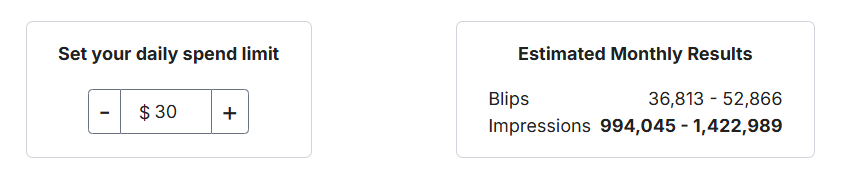
With Blip, billboard advertising in Hayesville can fit a wide range of budgets because you only pay when your ad actually displays. Each “blip” is a 7.5-to-10-second spot on a rotating digital billboard, and pricing starts at just $0.01 per display. Your daily budget helps Blip’s algorithm bid for open ad slots, and the cost per blip can change based on time of day, location, and advertiser demand.
Where can I advertise with Blip in Hayesville to reach local traffic?
U.S. 64 near Hayesville's retail core generally carries about 7,000 to 9,000 vehicles per day, depending on the exact segment and count year. N.C. 69 is the key north-south link between Hayesville and the north Georgia market, with counts generally in the 3,000 to 5,000 AADT range near Hayesville and toward the Georgia line. N.C. 175 and related roads around Lake Chatuge are lower-volume than U.S. 64, but they are highly targeted and meaningful in a rural destination market.
What kind of audience does Hayesville have for billboard advertising?
Recent ACS estimates place Clay County's median age at roughly 56, and about 1 in 3 residents are 65 or older. That is older than North Carolina overall, and it changes what resonates on a billboard. We can expect strong response categories in this market to include healthcare and wellness, home services, financial and legal services, and dining, grocery, and local retail.
When is the best time to run a billboard in Hayesville?
Seasonality matters a great deal in Hayesville, and we usually get the best results when we adjust message, geography, and dayparts to the mountain calendar. The biggest tourism window generally runs from Memorial Day to Labor Day, which is roughly 100 days of heightened opportunity, and traffic is often strongest from Thursday through Sunday. Leaf season is also one of the strongest branding windows, often from early October into early November.
What roads around Hayesville should I target with Blip for cross-border traffic?
Southbound N.C. 69 is the key north-south link between Hayesville and the north Georgia market, tying Hayesville to Hiawassee, Young Harris, and the wider Lake Chatuge basin. Westbound U.S. 64 toward Murphy captures casino traffic, school traffic, and regional retail movement, while eastbound U.S. 64 toward Franklin reaches medical travelers, service seekers, and through-drivers. For some advertisers, the best Hayesville strategy includes nearby boards outside Clay County because the road is the medium in a mountain market.
Do I need a contract to advertise with Blip in Hayesville?
No, Blip has no long-term contracts or minimum commitments. You can start, pause, or stop your campaign at any time.
How fast can I launch a billboard campaign with Blip in Hayesville?
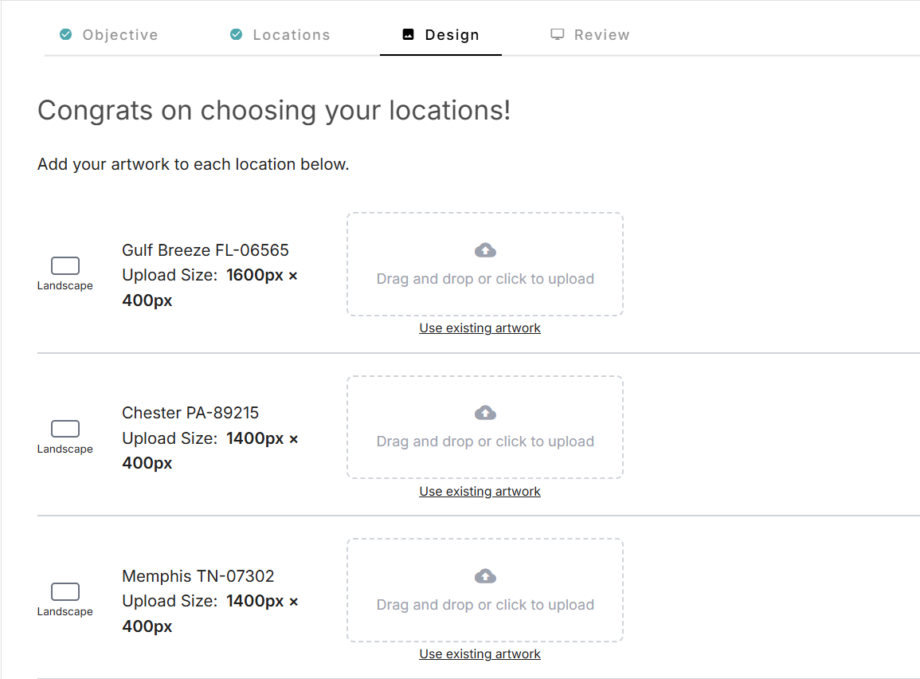
You can have your campaign live in minutes. Create a free account, select your locations, set your budget, upload your design, and start running once approved.
Where can I advertise with Blip in Hayesville?
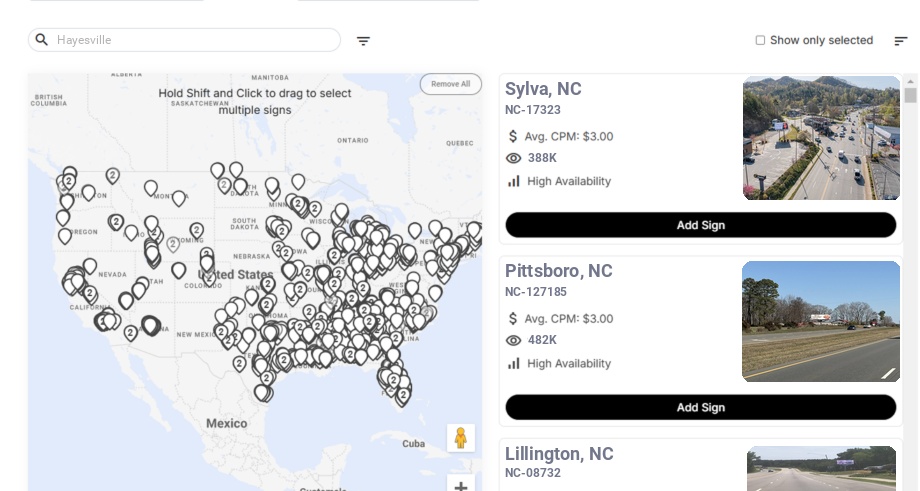
Blip has digital billboards in Hayesville. You can browse available locations on a map, choose the ones that fit your audience, and start advertising right away.
Still have questions? Launch a campaign in minutes — no contracts, no commitments.
Start Your CampaignHayesville Billboard Advertising Guide
Hayesville Clay County recorded 11,089 residents in the 2020 Census, and when we add nearby Towns County Union County, Georgia, the close-in regional population reaches about 48,214. Most daily movement happens by car on a short list of roads, especially U.S. 64 and N.C. 69, where traffic counts commonly run in the 7,000 to 9,000 AADT and 3,000 to 5,000 AADT ranges, so impressions concentrate rather than scatter across a big urban grid. That combination of road dependence, repeat local trips, and tourism around Lake Chatuge gives us a strong billboard environment even though Hayesville itself has only about 311 residents inside town limits.
Market Overview for Hayesville
Hayesville works best when we think beyond the town boundary and focus on the broader western North Carolina and north Georgia trade area. In a market like this, billboard performance depends less on sheer city population and more on who uses the same roads again and again.
Hayesville's regional scale and trade area
Clay County is small, but it is not isolated. Hayesville sits roughly 20 miles east of Murphy 11 miles north of Hiawassee 40 miles west of Franklin, which means local businesses often draw from multiple counties and from both sides of the North Carolina-Georgia line.
That regional math matters. The 2020 Census counted 11,089 people in Clay County, 12,493 in Towns County, 24,632 in Union County, 28,549 in Cherokee County, and 37,014 in Macon County 113,777 people, and many of them use Hayesville-area roads for shopping, healthcare, recreation, and cross-border errands.
For billboard advertisers, that means we should not judge Hayesville by town limits alone. We should judge it by trading patterns, lake traffic, and the fact that a small number of roads carry a large share of the region's movement.
Demographics and what they mean for advertisers
Recent ACS estimates place Clay County's median age at roughly 56, and about 1 in 3 residents are 65 or older. That is older than North Carolina overall, and it changes what resonates on a billboard.
We can expect strong response categories in this market to include:
- Healthcare and wellness, because older audiences often need primary care, specialty care, vision, hearing, physical therapy, and pharmacy reminders.
- Home services, because retirees, second-home owners, and lake households frequently need HVAC, roofing, plumbing, landscaping, pest control, and remodeling.
- Financial and legal services, because retirement planning, estate work, insurance, and tax support are highly relevant.
- Dining, grocery, and local retail, because repeat errand traffic is steady and road-based.
The age profile also influences creative. We usually perform better with larger text, stronger contrast, and very clear calls to action in Hayesville than we do with dense, image-heavy layouts.
Hayesville's car dependence and local economy
Clay County is an overwhelmingly road-driven market. ACS commuting data shows that roughly 4 in 5 workers commute by driving alone, and average travel time is about 25 minutes. Public transportation options are limited, so the practical path to visibility is the roadway network.
That is helpful for billboard advertisers because repeated driving patterns build frequency fast. A local resident may pass the same board while commuting, grocery shopping, going to a doctor visit, and heading to church or school activities, all within the same week.
The economy is also service-oriented in ways that support billboard use. Local spending revolves around healthcare, government, education, home services, real estate, construction, dining, recreation, and small-business retail. County labor reports from the North Carolina Department of Commerce typically place local unemployment in the 3% to 5% range under normal conditions, which points to a working regional economy even though the county is rural and older.
Key Traffic Corridors in Hayesville
Hayesville does not have an interstate, and that is actually useful for us. Traffic compresses onto a handful of corridors, so billboard placement can be highly efficient when we align it with the right audience.
U.S. 64 through Hayesville
According to traffic count maps from the North Carolina Department of Transportation, U.S. 64 near Hayesville's retail core generally carries about 7,000 to 9,000 vehicles per day, depending on the exact segment and count year. Approaches farther east or west in the county more often sit in the 5,000 to 7,000 AADT range.
This is Hayesville's most important advertising corridor because it connects local services, county government activity, and regional travel. It also links western destinations toward Cherokee County and Harrah's Cherokee Valley River Casino & Hotel, and eastern destinations toward Franklin and Macon County
Advertisers that benefit most from U.S. 64 include:
- Retailers and restaurants, because they can reach residents on recurring errand trips.
- Healthcare providers, because medical, dental, and therapy visits often route through the corridor.
- Banks, insurance firms, and professional services, because frequency matters more than novelty in those categories.
- Home-service brands, because property owners repeatedly travel this road for supplies and appointments.
N.C. 69 south toward Georgia
N.C. 69 is the key north-south link between Hayesville and the north Georgia market. NCDOT counts on this route generally fall in the 3,000 to 5,000 AADT range near Hayesville and toward the Georgia line, again depending on the segment and year.
This corridor matters because it ties Hayesville to Hiawassee, Young Harris Chatuge Regional Hospital, which is a 25-bed critical access hospital, to Young Harris College Georgia Mountain Fairgrounds
This is one of the best routes for:
- Healthcare advertisers, because patients routinely cross the state line for care.
- Event and entertainment brands, because fairgrounds concerts and festivals create concentrated waves of travel.
- Hospitality and dining, because visitors moving between the lake and nearby towns use this road repeatedly.
- Auto dealers and service centers, because cross-border shoppers are already in driving mode and comparing options.
N.C. 175 and the Lake Chatuge loop
N.C. 175 and related roads around Lake Chatuge are lower-volume than U.S. 64, but they are highly targeted. Counts often run around 1,500 to 3,000 AADT on key sections, which is meaningful in a rural destination market because the traffic is often affluent, intentional, and seasonal.
Lake Chatuge itself is one of the area's biggest audience builders. The lake covers about 7,000 acres and has roughly 132 miles of shoreline, so boating, vacation rentals, marinas, lakefront communities, and second homes create spending well beyond the county's year-round population.
This corridor is especially valuable for:
- Real estate and vacation rental companies, because buyers and renters are physically moving through the exact geography they are considering.
- Marine, outdoor, and recreation brands, because relevance is immediate.
- Contractors and home-maintenance companies, because lake homes need ongoing service.
- Dining and attractions, because destination decisions are often made in the car.
Regional extensions beyond Hayesville
For some advertisers, the best Hayesville strategy includes nearby boards outside Clay County. Westbound U.S. 64 toward Murphy captures casino traffic, school traffic, and regional retail movement. Eastbound U.S. 64 toward Franklin reaches medical travelers, service seekers, and through-drivers. Southbound routes into north Georgia help us reach visitors going to the lake, concerts, campus events, and seasonal festivals.
This is why we often recommend planning around travel sheds rather than a single zip code. In a mountain market, the road is the medium.
Audience Segments for Hayesville Billboard Campaigns
A good Hayesville campaign works when we match the board location and timing to the people most likely to be on that road. The market is small enough to be focused, but diverse enough to support several distinct audiences.
Daily commuters and errand traffic in Hayesville
Commuters matter here, but so do non-work trips. In a county-seat town like Hayesville, many road users are traveling for groceries, pharmacies, schools, county offices, church, healthcare, and family visits rather than a downtown office commute.
That is why billboard frequency works so well. If we place messages along U.S. 64 or N.C. 69, we can often reach the same person several times per week without needing a huge network.
This audience is ideal for:
- Quick-service restaurants and coffee shops, because they can capture habitual stops.
- Grocery, pharmacy, and retail, because the purchase cycle is frequent.
- Service businesses, because repeated visibility builds trust before the customer is ready to call.
Retirees, healthcare users, and homeowners
The older age profile is one of Hayesville's clearest advertising advantages. With a median age around 56 and roughly 33% of residents age 65+, the market is highly responsive to messaging about health, convenience, trust, safety, and local reputation.
We should think broadly about this audience. It includes full-time retirees, seasonal retirees, caregivers, adult children visiting parents, and people managing second homes or future retirement properties.
This segment is especially strong for:
- Primary care, specialty care, hearing, vision, and rehab providers.
- Insurance, financial planning, and legal services.
- Roofing, HVAC, plumbing, pest control, landscaping, and remodeling.
- Furniture, appliances, generators, and internet providers.
Tourists, second-home owners, and outdoor recreation visitors
Hayesville has a visitor audience that is larger than the population count implies. Visit NC Smokies, the Lake Chatuge Chamber of Commerce, the Georgia Mountain Fairgrounds John C. Campbell Folk School, and the Appalachian Trail Conservancy
These travelers often spend in clustered categories. They need lodging, food, fuel, entertainment, outdoor gear, groceries, and sometimes real estate information. They also tend to be highly responsive to directional and time-sensitive creative, especially when they are already on the road.
We can reach this audience well with messages for:
- Hotels, cabins, campgrounds, and vacation rentals.
- Restaurants, breweries, bakeries, and specialty food.
- Boat rentals, marinas, outfitters, and lake services.
- Attractions, festivals, galleries, and live music.
Families, students, and cross-border households
Families are a smaller share of the market than in younger metros, but they still matter. Clay County Schools creates a predictable calendar from roughly August through May, and regional education institutions like Tri-County Community College and Young Harris College
This audience becomes especially visible during back-to-school, sports seasons, graduations, move-in periods, and holiday breaks. In Hayesville, family targeting also often overlaps with cross-border targeting because many school, shopping, dining, and healthcare trips cross county and state lines.
Seasonal and Timing Opportunities in Hayesville
Seasonality matters a great deal in Hayesville. We usually get the best results when we adjust message, geography, and dayparts to the mountain calendar rather than running one static plan all year.
Spring in Hayesville
Spring campaigns should usually begin in March or April. This is when second-home owners start reopening properties, landscapers and contractors pick up demand, and residents begin planning outdoor projects.
Spring is an excellent window for:
- Home improvement and maintenance.
- Lawn, garden, and pest control services.
- Real estate listings and open houses.
- Preventive healthcare and wellness appointments.
Because weather can shift quickly in the mountains, we usually recommend clean, high-contrast creative in spring rather than subtle seasonal imagery.
Summer lake season in Hayesville
The biggest tourism window generally runs from Memorial Day to Labor Day, which is roughly 100 days of heightened opportunity. Traffic is often strongest from Thursday through Sunday, and holiday weeks deserve extra budget.
This is the season when Lake Chatuge, cabins, campgrounds, concerts, and outdoor recreation all reinforce each other. The Georgia Mountain Fairgrounds July.
Summer campaigns should favor:
- Restaurants and attractions.
- Marinas, rentals, and recreation.
- Lodging and vacation offers.
- Emergency and convenience services, such as urgent care, towing, internet, and grocery.
Fall foliage and event season in Hayesville
Leaf season is one of the strongest branding windows in the area. In many years, the most valuable stretch runs from early October into early November, giving us about 4 to 6 weeks of highly motivated scenic travel.
Visitors in fall are often slower-paced than summer lake travelers, and they respond well to charming, local, and experience-driven creative. This is a great time for galleries, gift shops, restaurants, cider or bakery concepts, fall events, and real estate brands selling the mountain lifestyle.
We can also use fall to speak to homeowners preparing for winter, especially with roofing, heating, insulation, generators, and chimney services.
Winter and holiday timing in Hayesville
Winter is quieter, but it is not empty. Holiday shopping builds from late November through December, and January brings needs around tax prep, healthcare, heating service, and indoor projects.
Mountain weather also changes how people drive. Rain, fog, and occasional snow make readability even more important, and daytime scheduling can outperform late-night placement for some categories. In winter, we often do well by shifting budget toward dependable local audiences instead of purely visitor-focused impressions.
Billboard Design Tips for the Hayesville Market
Creative that works in Charlotte or Atlanta will not automatically work in Hayesville. We should design for mountain roads, an older audience, and a place where trust and local relevance matter.
Design for rural mountain driving conditions
Many Hayesville-area routes involve curves, elevation change, and 45 to 55 mph travel outside town. That shortens comfortable reading time, so we should simplify aggressively.
The best Hayesville creative usually follows these principles:
- We keep the message to one main idea.
- We use large type and bold contrast.
- We make the brand name readable first, not last.
- We avoid tiny disclaimers, long URLs, and small QR codes.
This is especially important because a large share of the local audience is older. If a design is merely stylish, but not instantly legible, we lose the advantage of the market.
Use visual cues that feel local to Hayesville
Hayesville responds well to imagery that feels true to the place. Lake water, blue sky, mountain ridgelines, forest greens, docks, porches, fall color, trout streams, and small-town hospitality all fit the emotional setting better than generic city visuals.
For example, these creative directions tend to feel locally grounded:
- Lake-focused blues and clean whites for marinas, vacation rentals, and summer dining.
- Deep greens, tans, and warm neutrals for home services, real estate, and financial brands.
- Orange, red, and gold accents for fall events and retail.
- Local directional language such as “On U.S. 64,” “Near Lake Chatuge,” or “South of Hayesville.”
If a business can honestly claim “family-owned,” “serving Clay County,” or a real local tenure like “since 1998,” that kind of trust marker often carries more weight here than flashy slogans.
Tailor the message to the season and audience
We should not show the same creative to lake visitors in July and retirees in January. Hayesville rewards seasonal rotation.
A few strong local examples include:
- Summer: “Boat, dine, and stay on Lake Chatuge.”
- Fall: “Leaf-season cabins booking now.”
- Winter: “Schedule your heating tune-up before the next cold snap.”
- Year-round local: “Appointments this week on U.S. 64.”
In a market with short, repeated exposures, a clear seasonal promise usually beats a vague brand statement.
Regional Strategies Around Hayesville
The most effective Hayesville campaigns usually segment the region rather than treating every road the same. The right message for the town core is not always the right message for the lake or the Georgia line.
Hayesville core and the U.S. 64 commercial area
This is our year-round frequency zone. We should use it for local awareness, recurring services, healthcare, retail, and anything that depends on repeat visibility among residents.
Boards here are often best when the goal is steady share of mind. If we want people to remember a clinic, a contractor, or a restaurant every time they head into town, this is where we start.
Lake Chatuge communities and second-home routes
Around the lake, we should think like a destination marketer. The audience is more seasonal, more leisure-oriented, and often more affluent than the county average.
This zone is a strong fit for:
- Vacation rentals and hospitality.
- Realtors and builders.
- Marine services and outdoor recreation.
- Upscale dining, galleries, and lifestyle brands.
We usually get stronger results here when we concentrate budget from Thursday to Sunday and around holiday periods.
Southbound N.C. 69 and the north Georgia connection
This corridor is where Hayesville becomes a cross-border market. Traffic between Clay County and north Georgia is part of everyday life, so advertisers should not hesitate to use boards that support movement toward Hiawassee Young Harris Blairsville
This is especially smart for businesses that serve a regional audience, including healthcare, colleges, events, furniture, auto, and home improvement. The state line is real on a map, but it is not a strong barrier in local behavior.
West toward Murphy and east toward Franklin
Some campaigns should extend beyond Clay County. Westbound placements can intercept casino visitors, regional shoppers, and Cherokee County traffic. Eastbound placements can support longer-range awareness toward Franklin and Macon County.
We typically recommend these extensions when the advertiser has a larger service area, wants to own the route before the customer reaches Hayesville, or wants to defend share against competitors in neighboring towns.
Using Blip Tools in Hayesville
Blip is especially useful in Hayesville because the market rewards flexibility. We often do better by tuning a campaign to road patterns and seasons than by locking into one static schedule.
Match dayparts to Hayesville travel behavior
We can use morning hours for commuters, late morning and early afternoon for retirees and errands, and late-week schedules for tourist and second-home traffic. In summer, we often want stronger presence from Thursday through Sunday. In winter, weekday daytime can become more efficient.
That kind of timing is valuable in a market where the same road can carry very different audiences at 8 a.m., 1 p.m., and 6 p.m.
Build seasonal flights instead of one-size-fits-all campaigns
Hayesville is a place where a spring home-services message, a summer lake message, and a fall foliage message can all be right for the same business. We can use Blip's artwork tools to swap creative quickly and keep the board relevant without rebuilding the entire campaign.
This is also a good market for budget flexibility. A local advertiser might spend more during the 100-day summer surge, scale back during slower shoulder weeks, and then come back strong for fall.
Test regional variations and compare results
Because the trade area crosses county and state lines, we can test a Hayesville-centered message against a north Georgia message and see which geography performs better. We can also compare resident-heavy routes against visitor-heavy routes.
That matters in a market where “best board” depends on the goal. A healthcare clinic may prefer repeat local routes, while a restaurant may prefer visitor corridors around Lake Chatuge and the fairgrounds.
Keep the creative simple for 7.5-to-10-second exposures
Blip's short digital spots fit Hayesville well as long as we keep the design disciplined. For a 7.5-to-10-second display, we should prioritize the one fact or offer most likely to matter on that road at that moment.
Getting Started with Billboard Rental in Hayesville
Renting a billboard in Hayesville is usually simpler when we begin with geography, not just inventory. The first question is not “Which board is cheapest?” The first question is “Which road carries the audience we want?”
Define the real Hayesville service area
Most advertisers should start by deciding whether they want to reach:
- Clay County residents only.
- The Lake Chatuge and second-home audience.
- Cross-border traffic from north Georgia.
- A larger regional audience that includes Murphy or Franklin.
That decision shapes everything else, including board choice, schedule, and creative.
Evaluate each billboard by purpose
When we compare Hayesville-area boards, we should ask a few practical questions.
- Is this a repeat local route or a visitor route?
- Does the board face the direction our customer is traveling?
- Is the message directional, or is it broader brand awareness?
- Will drivers have enough time to read it on that stretch of road?
In a concentrated rural market, the right board often wins because of context, not because it has the biggest raw traffic number.
Start with a focused test, then optimize
A 2-to-4-week test is usually enough to see whether a route, daypart, or message is promising. We can launch with a modest budget, watch performance, rotate artwork, and expand the boards that match our goals.
That is one of the biggest practical advantages of using Blip in a market like Hayesville. Traditional billboard buying often pushes long commitments and fixed packages, while Blip lets us start smaller, change faster, and pay only when the ad runs, with prices starting at $0.01 per display.
Expect repetition to do the heavy lifting
Hayesville is not a mass-volume market. It is a frequency market. The win comes from showing up where people already drive every week and where visitors naturally funnel during lake season, school activity, and fall travel.
If we choose boards on U.S. 64, N.C. 69, and the right regional extensions, billboard advertising in Hayesville can be unusually efficient. We get a focused audience, concentrated roads, and a steady mix of residents, retirees, visitors, and cross-border shoppers who are already moving through the exact places local businesses need to own.