Billboards in Mooresville, NC
No Minimum Spend. No Long-Term Contracts. Just Results.
Trusted by Leading Brands


Billboard advertising
in Mooresville has never been easier
How much is a billboard in Mooresville?
Why Choose Blip for Billboard Advertising in Mooresville
-
Blip lets you launch in Mooresville fast, reaching I-77 commuters near Exits 31-36 without contracts or minimums.
-
Use Blip's dayparting in Mooresville to hit Charlotte-bound mornings and Lake Norman weekend traffic when they're most likely to act.
-
Set a flexible budget in Mooresville and pay only when ads play—ideal for testing NC 150 and local arterial traffic.
-
Track real-time results in Mooresville and shift spend as traffic changes between race weekends, school seasons, and lake trips.
-
Mooresville brands can use Blip's creative tools to make quick billboard versions for commuters, lake visitors, and motorsports fans.
Frequently Asked Questions About Billboard Advertising in Mooresville
How much does a billboard cost in Mooresville with Blip?
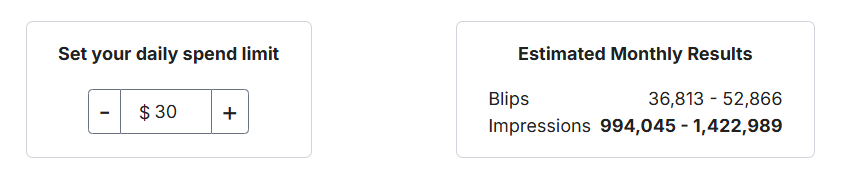
With Blip, billboard advertising in Mooresville can fit a wide range of budgets because you only pay when your ad actually displays. Each “blip” is a 7.5-to-10-second spot on a rotating digital billboard, and pricing starts at just $0.01 per display. You set a daily budget, and Blip’s algorithm uses it to bid for open ad slots, helping maximize your reach based on time of day, location, and advertiser demand.
Where can I advertise with Blip in Mooresville, North Carolina?
I-77 is the single most important corridor in the market, with Mooresville segments carrying roughly 78,000 to more than 100,000 vehicles per day. NC 150 is the next essential route, with major sections in the roughly 27,000 to 45,000 vehicles per day range. US 21 and NC 115, along with roads such as Brawley School Road and Williamson Road, also help reach more local circulation and lake-access traffic.
Why is Mooresville, North Carolina a strong market for billboard ads with Blip?
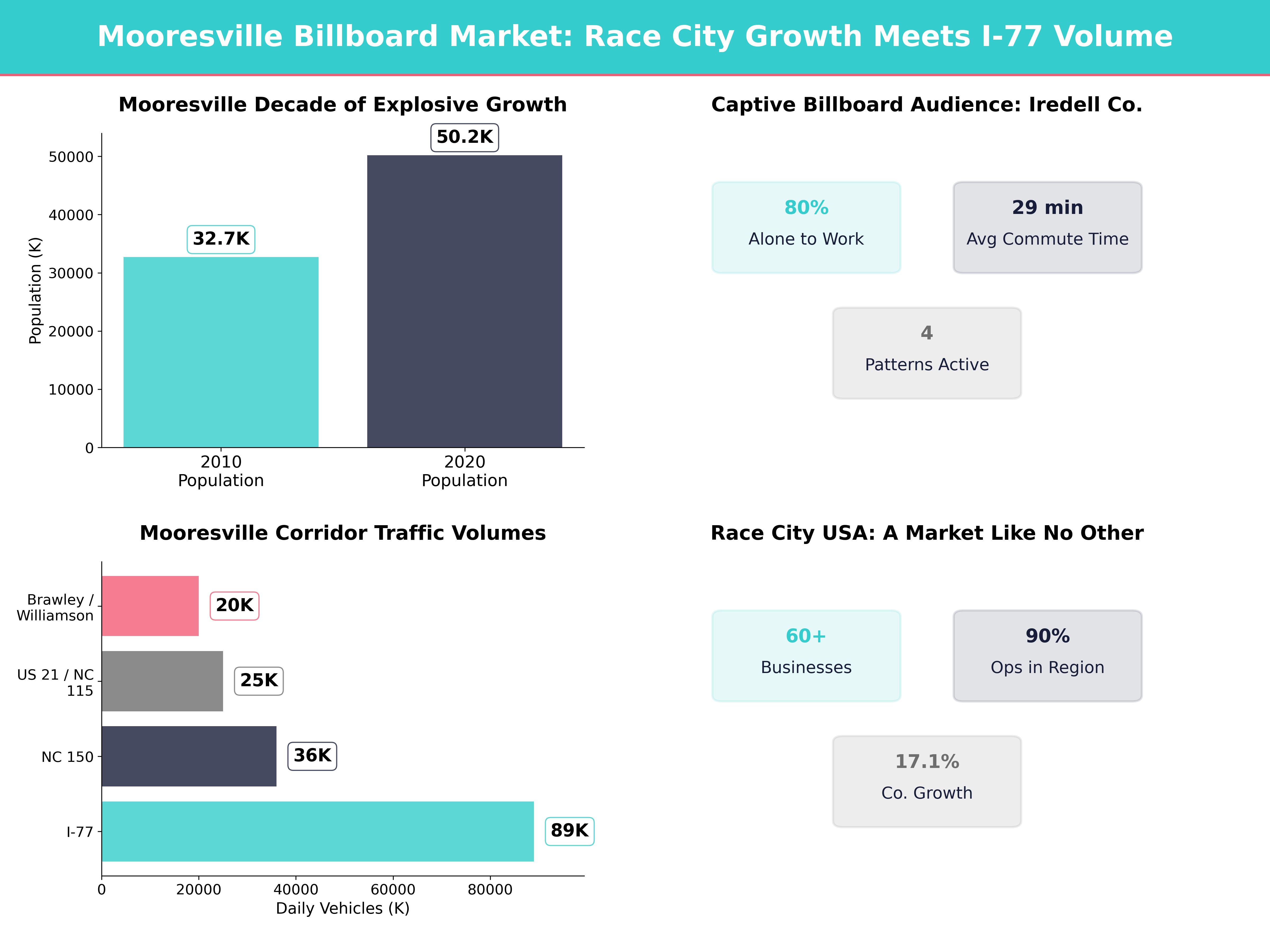
Mooresville gives us a rare combination that billboard advertisers love: fast population growth, strong auto dependence, and year-round visitor traffic tied to Lake Norman’s 32,510 acres and roughly 520 miles of shoreline, motorsports, and the northern edge of the Charlotte market. The Town of Mooresville counted 50,193 residents in 2020, up from 32,711 in 2010, which equals a striking 53.4% growth rate in one decade. We also benefit from Mooresville’s location about 30 miles north of Uptown Charlotte, directly on Interstate 77.
When is the best time to run billboard ads in Mooresville, North Carolina?
Spring is one of the best times to increase visibility because the weather improves, weekend movement rises, and motorsports attention ramps up around events at Charlotte Motor Speedway, including the Coca-Cola 600 weekend in May. From Memorial Day through Labor Day, lake traffic reshapes the market and hotels, restaurants, marinas, event venues, entertainment businesses, and retail near the water all benefit. Fall adds race traffic again, football viewing occasions, festival activity, and the lead-in to holiday shopping.
Do I need a contract to advertise with Blip in Mooresville?
No, Blip has no long-term contracts or minimum commitments. You can start, pause, or stop your campaign at any time.
How fast can I launch a billboard campaign with Blip in Mooresville?
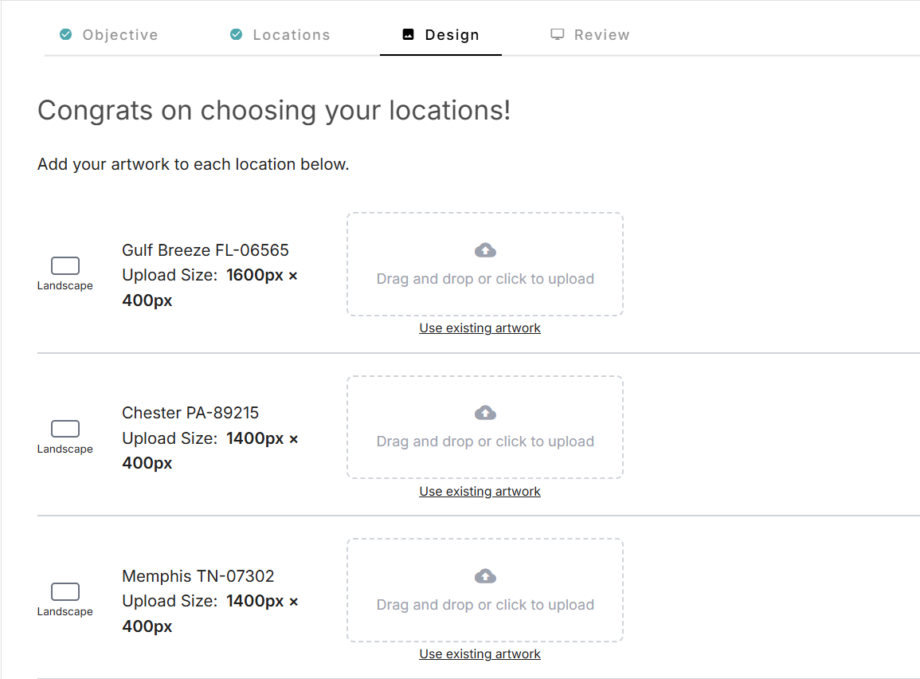
You can have your campaign live in minutes. Create a free account, select your locations, set your budget, upload your design, and start running once approved.
Where can I advertise with Blip in Mooresville?
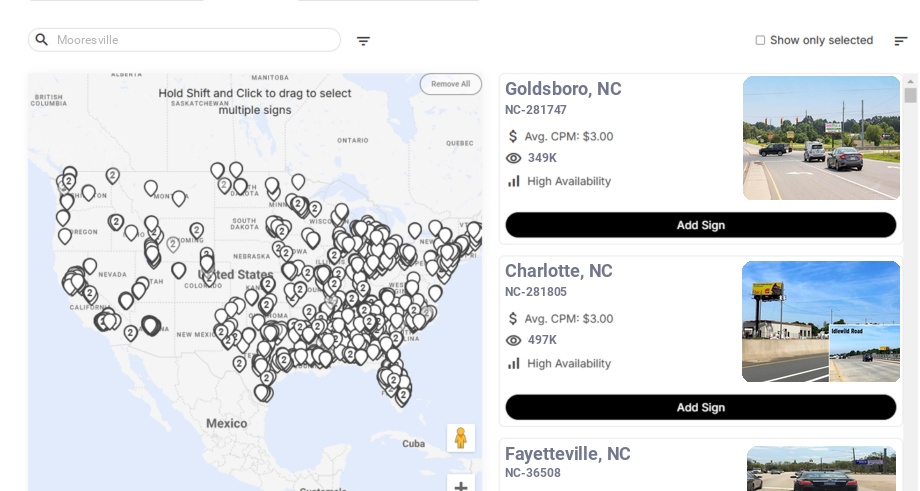
Blip has digital billboards in Mooresville. You can browse available locations on a map, choose the ones that fit your audience, and start advertising right away.
Still have questions? Launch a campaign in minutes — no contracts, no commitments.
Start Your CampaignMooresville Billboard Advertising Guide
Mooresville gives us a rare combination that billboard advertisers love: fast population growth, strong auto dependence, and year-round visitor traffic tied to Lake Norman’s 32,510 acres and roughly 520 miles of shoreline, motorsports, and the northern edge of the Charlotte market. The Town of Mooresville counted 50,193 residents in 2020, up from 32,711 in 2010, which equals a striking 53.4% growth rate in one decade. We also benefit from Mooresville’s location about 30 miles north of Uptown Charlotte, directly on Interstate 77, which keeps local boards in front of both daily commuters and regional travelers. When we add in Lake Norman’s 32,510 acres, roughly 520 miles of shoreline, and tourism-driven weekend traffic, Mooresville becomes a highly efficient market for flexible digital billboard campaigns.
Mooresville Market Overview
Mooresville is growing faster than many advertisers realize
Mooresville sits in southern Iredell County 186,693 residents in 2020, up from 159,437 in 2010. That countywide gain of 17.1% matters because it tells us Mooresville is not an isolated growth pocket. It is part of a broader north Charlotte expansion corridor that keeps adding households, rooftops, and consumer demand.
For billboard strategy, that population momentum gives us two advantages. First, we can reach long-time residents who already know local businesses and simply need a reminder to act. Second, we can reach newer residents who are still choosing doctors, banks, home service providers, gyms, churches, restaurants, schools, and retail routines.
We also see a diversified economy around Mooresville, with headquarters and major operations tied to Lowe’s MSC Industrial Supply
Car travel dominates daily life in Mooresville
Mooresville is fundamentally a drive market. Recent North Carolina Department of Commerce county profile data place drive-alone commuting in Iredell County 80%, and average travel time to work is about 29 minutes. Those two numbers are exactly what we want to see for billboard advertising because they mean people spend meaningful time on the road and repeatedly pass the same high-value locations.
Local transit options are limited compared with larger metros, so most consumer trips still happen by personal vehicle. That pattern makes digital billboards especially effective for categories that benefit from repeated exposure, including healthcare, legal services, auto dealers, quick-service restaurants, entertainment, retail, and home services.
Lake Norman and the Charlotte orbit expand the market beyond town limits
Mooresville’s audience is larger than its town population because it sits at the top of the Lake Norman trade area and inside the northern orbit of the Charlotte region. Lake Norman is about 34 miles long, and it pulls in boaters, diners, weekend visitors, event attendees, and second-home traffic from across the Carolinas. At the same time, southbound commuters move daily toward Huntersville Charlotte, and Mecklenburg County job centers.
For us, that means a Mooresville billboard buy can serve multiple goals at once. We can build local frequency with residents, intercept regional shoppers headed to Exit 36 retail, and capture leisure traffic moving to and from the lake.
Key Traffic Corridors in Mooresville
Mooresville’s travel patterns are concentrated on a handful of roads that do most of the work for the local economy. When we choose boards along those routes, we are not guessing where attention will be. We are aligning with the way the market actually moves.
Interstate 77 is Mooresville’s primary billboard spine
I-77 is the single most important corridor in the market. North Carolina Department of Transportation traffic maps regularly show Mooresville segments of I-77 carrying roughly 78,000 to more than 100,000 vehicles per day, with the heaviest counts clustering near the town’s busiest interchanges. Those volumes make I-77 the best choice when we need broad reach, high repetition, and visibility to both residents and visitors.
This corridor is especially valuable around Exits 31, 33, 35, and 36. Exit 36, where I-77 meets NC 150, functions as a retail and service gateway for much of the town and the lake area.
On I-77, these advertiser types usually perform well:
- Consumer services perform well because daily commuters see the same message repeatedly and remember it when a need arises.
- Retail and restaurants perform well because travelers often make decisions based on upcoming exits and visible destination cues.
- Healthcare, urgent care, dental, and specialty practices perform well because households routinely travel this corridor for work, errands, and appointments.
- Tourism, events, and entertainment perform well because visitors to Lake Norman, race-related attractions, and nearby venues rely heavily on I-77.
NC 150 connects retail Mooresville, Downtown, and the lake market
NC 150 is the next essential route. NCDOT counts typically place major Mooresville sections of NC 150 in the roughly 27,000 to 45,000 vehicles per day range, depending on the segment. That is substantial arterial traffic, and it represents a different kind of audience than interstate traffic. On NC 150, we usually reach people closer to the point of purchase.
This route matters because it ties together the I-77 interchange, major shopping clusters, local neighborhoods, and connections toward the lake. If we want to influence near-term decisions, such as where to eat tonight, where to shop this afternoon, or which clinic to call this week, NC 150 placements are often more actionable than pure interstate reach.
We often recommend NC 150 for:
- Restaurants and retail centers because people on this road are already in shopping mode.
- Healthcare and wellness brands because the route carries local errand traffic and family trips.
- Home improvement and home services because the audience includes established homeowners in fast-growing neighborhoods.
- Community events and seasonal offers because the corridor combines local familiarity with strong frequency.
US 21 and NC 115 help us reach local circulation and value-conscious traffic
US 21 and NC 115 operate as important local alternatives to I-77. Mooresville-area traffic counts on these routes commonly fall in the 18,000 to 32,000 vehicles per day range, depending on the section. That is lower than I-77, but the audience is often more local, more deliberate, and more likely to be making in-town stops.
These routes are useful when we want to target residents who may bypass interstate congestion, move between neighborhoods and downtown, or make regular routine trips. We often like these boards for service businesses that depend on trust and local recall rather than impulse decisions alone.
Brawley School Road, Williamson Road, and lake-access routes capture high-intent movement
Mooresville’s west side and lake-facing road network matter more than many advertisers expect. NCDOT maps often show roads such as Brawley School Road and Williamson Road carrying approximately 14,000 to 26,000 vehicles per day on key segments. Those are meaningful counts for roads that skew toward affluent households, lake recreation, dining, and destination retail.
We typically use these routes when we want a more lifestyle-oriented audience. Evening dining, real estate, medical aesthetics, elective healthcare, premium home services, marinas, and lake-adjacent entertainment can all benefit from these placements.
Mooresville Audience Segments
A strong Mooresville billboard plan works best when we think in audience layers rather than in one generic “local consumer” bucket. The market gives us commuters, lake visitors, motorsports professionals, families, and students, and each group responds to different timing and message strategies.
Commuters and Charlotte-bound professionals
Mooresville’s position on I-77 makes it a natural commuter market. Many residents travel south toward Huntersville Charlotte in the morning, then return north in the evening. Because drive-alone commuting is about 80% and the average trip to work is about 29 minutes, we can use directional boards and dayparting to meet people at predictable moments.
This segment is excellent for:
- Financial services, healthcare, legal services, and insurance because those categories benefit from repeated trust-building exposure.
- Fitness, meal services, and quick-service restaurants because commute windows are strong times for habit-based decisions.
- Home services because homeowners often notice and remember providers during repeated weekday travel.
Lake Norman visitors, weekenders, and recreation spenders
Lake Norman is one of the region’s biggest audience multipliers. Its 32,510 acres, 520 miles of shoreline, and 34-mile length create a broad recreational draw that extends far beyond Mooresville residents. We reach boaters, anglers, families, wedding guests, hotel visitors, and people making seasonal day trips.
This audience is especially useful for:
- Restaurants, breweries, and entertainment venues that want weekend demand.
- Marine, sporting goods, and outdoor brands that align with lake activity.
- Real estate, home improvement, and luxury services because lake-area visitors often include higher-income households and prospective movers.
- Hospitals, urgent care, and pharmacies because visitor traffic still generates practical service needs.
Motorsports professionals, fans, and technical students
Mooresville’s “Race City USA” identity is real and commercially relevant. The Charlotte Regional Business Alliance has long noted that the Charlotte region contains about 90% of NASCAR teams and related operations, and Mooresville is one of the core hubs of that ecosystem. The town is home to more than 60 racing teams and motorsports-related businesses, alongside destinations such as the North Carolina Auto Racing Hall of Fame and NASCAR Technical Institute
That audience gives us a distinct advantage for brands that want performance, precision, speed, engineering, or automotive credibility in their message. It also creates event-driven traffic before major race weekends at Charlotte Motor Speedway.
This segment is especially valuable for:
- Auto dealers, tire shops, repair brands, and performance parts sellers because the message naturally fits the market.
- Trade schools, technical employers, and staffing firms because the area attracts mechanically inclined students and workers.
- B2B suppliers because motorsports and advanced manufacturing buyers are part of the local business mix.
Families, students, and homeowner households
Mooresville is also a family-heavy suburb with strong school-centered routines. Mooresville Graded School District serves roughly 6,000 students, and Iredell-Statesville Schools serves more than 20,000 students countywide. We also have adult learners and workforce students connected to Mitchell Community College NASCAR Technical Institute
For advertisers, this audience supports dependable year-round demand in categories such as pediatric care, orthodontics, tutoring, after-school programs, family dining, grocery, home improvement, churches, and youth recreation. Because many of these decisions are routine and local, billboard frequency matters as much as sheer reach.
Seasonal and Timing Opportunities in Mooresville
Mooresville is not a market where we should run the same campaign all year and hope for the best. The calendar changes traffic patterns in clear ways, and digital billboards let us match that rhythm.
Spring in Mooresville brings race energy and outdoor traffic
Spring is one of the best times to increase visibility. The weather improves, weekend movement rises, and motorsports attention ramps up around events at Charlotte Motor Speedway, including the Coca-Cola 600 weekend in May. Spring is a strong season for home services, outdoor living, landscaping, medical practices, and event venues because consumers are more active and more willing to act on what they see.
Summer in Mooresville belongs to Lake Norman
From Memorial Day through Labor Day, lake traffic reshapes the market. Hotels, restaurants, marinas, event venues, entertainment businesses, and retail near the water all benefit when we shift spend toward afternoons, evenings, and weekends. Summer creative should feel local to the lake rather than generic to North Carolina.
Nearby Piedmont climate normals from the State Climate Office of North Carolina put average January highs around 51 to 52°F and average July highs around 89 to 90°F. That relatively mild climate helps keep road activity strong for much of the year, especially compared with colder northern recreation markets.
Back-to-school season drives family and routine spending
Late July and August are key reset months for local households. School calendars at Mooresville Graded School District and Iredell-Statesville Schools push families back into structured weekday patterns, which is ideal for healthcare reminders, tutoring, children’s activities, family restaurants, and retail offers tied to routine purchases.
Fall and holiday campaigns should target both residents and visitors
Fall adds race traffic again, football viewing occasions, festival activity, and the lead-in to holiday shopping. Downtown Mooresville and the broader Lake Norman area become especially attractive for dining, events, specialty retail, and local gift campaigns. We often see strong performance when we increase frequency from mid-November through late December and keep messaging simple, directional, and time-sensitive.
Billboard Design Tips for the Mooresville Market
Good design in Mooresville should feel like it belongs here. We do not need generic stock creative when the market gives us such recognizable visual themes.
Design for speed on Mooresville’s high-velocity roads
I-77 traffic often moves at 65 to 70 mph, so our creative needs to be absorbed almost instantly. We usually recommend 6 to 8 words of primary copy, a single clear offer, one dominant visual, and a strong brand mark. If we overload the board, we lose the commuter before the message lands.
In Mooresville, practical directional cues also help. Exit numbers such as 31, 33, 35, and 36 are familiar shorthand for local drivers, so “Next Exit,” “Exit 36,” or “2 Miles Ahead” can outperform more abstract calls to action.
Use visual language that matches Mooresville’s identity
Motorsports cues can work extremely well here when they fit the brand. Black, white, red, metallic gray, checkered patterns, and performance-oriented typography can feel native to Mooresville because of the town’s racing culture. We should use those cues selectively, though, so they reinforce the message rather than turn into decoration.
For lake-oriented audiences, blue water tones, clean white space, dock, boat, and sunset imagery, and relaxed premium language often perform better than aggressive retail shouting. A board aimed at LangTree Lake Norman, waterfront dining, or real estate should feel different from a board aimed at morning commuters.
Lean into trust for family and homeowner categories
Mooresville’s growth has created many neighborhoods full of families still choosing their preferred local providers. For pediatric care, dentistry, home services, insurance, legal help, and education, we usually do better with friendly, direct messaging than with edgy branding. Words such as “same-day,” “local,” “trusted,” “family,” “licensed,” and “near you” are especially useful when the goal is conversion rather than pure awareness.
Regional Strategies Across Mooresville and Lake Norman
A smart campaign does not treat all of Mooresville the same. Different sub-areas support different objectives, budgets, and creative styles.
Exit 36 and central retail Mooresville for broad consumer demand
If we want the town’s highest general-intent audience, we usually start with the I-77 and NC 150 area near Exit 36. This zone works well for healthcare, restaurants, gyms, financial services, and retail because it captures a mix of commuters, errand traffic, and visitors entering town.
South Mooresville toward Huntersville for commuter frequency
Southbound routes are excellent when our goal is repeat weekday exposure to people who work in the Charlotte direction. We should favor morning and late-afternoon scheduling for offices, service businesses, and any advertiser that benefits from habit formation or deferred action.
West Mooresville and the lake side for lifestyle and premium offers
The west side of town, including routes serving waterfront neighborhoods and destinations near Lake Norman, is where we like to place higher-end lifestyle messaging. Real estate, elective healthcare, restaurants, entertainment, and premium home services often perform well here, especially on Thursdays through Sundays.
Northbound reach toward Statesville
Mooresville also sits on a larger logistics path leading north toward Statesville
Using Blip Tools in Mooresville
Mooresville is a market where flexible planning really matters because traffic purpose changes by corridor and by time of day. We can use Blip’s map-based board selection to separate interstate reach from local intent instead of buying every available face and hoping for the best.
Dayparting is especially useful here. We can emphasize southbound commuter periods on weekdays, shift spend to northbound evening return traffic, and then move more budget to weekends when lake and leisure demand rises. We can also increase presence around major Charlotte Motor Speedway weekends, school start dates, or holiday shopping periods without rebuilding the entire campaign.
Creative variation also matters in Mooresville. We can run one message for weekday commuters, another for Saturday lake traffic, and a third for race-week visitors. Because Blip campaigns are digital, we can test multiple headlines, offers, and visuals, then use performance data to keep the strongest version in market.
Blip’s shorter 7.5- to 10-second ad format also fits Mooresville well because this is a high-speed road environment. If we keep the artwork simple and local to the corridor, we can generate strong recall without needing a giant traditional commitment. For newer advertisers, the ability to start with modest spend, sometimes from $0.01 per display, makes it easier to test Mooresville strategically instead of overcommitting on day one.
Getting Started with Billboard Rental in Mooresville
Renting a billboard in Mooresville works best when we begin with the audience, not the format. We should first decide whether we need commuters, lake visitors, local families, race-related traffic, or a broad cross-section of the market. That choice will usually tell us whether to prioritize I-77, NC 150, local arterials, or west-side lake routes.
Next, we should evaluate each location by decision distance. A restaurant, retailer, or urgent care center often needs a board that appears 1 to 3 miles before the relevant exit or turn. A branding campaign for a bank, hospital, attorney, or home services company can succeed farther from the destination because awareness is the main job.
We should also think about directionality. In Mooresville, a southbound morning board and a northbound evening board can perform very differently even when they sit on the same highway. If our customers tend to act during the workday, the morning direction may be stronger. If they decide after work or on the way home, the evening return route may be the better buy.
Traditional billboard companies often make this process feel slower and more rigid than it needs to be. By contrast, Blip lets us choose boards directly, set a budget that fits our goals, upload artwork, and adjust timing as we learn. That flexibility is particularly useful in Mooresville because the market has at least four distinct demand patterns at once: daily commuting, local errand traffic, lake leisure travel, and motorsports-related visitation.
For most advertisers, we recommend a practical launch plan:
- We should start with a clear objective, such as awareness, foot traffic, calls, bookings, or event attendance.
- We should pick 2 to 4 strategic locations instead of scattering budget too widely.
- We should run for at least 2 to 4 weeks so frequency can build with local drivers.
- We should track simple outcomes, such as calls, promo code use, booked appointments, or website lift by geography.
- We should optimize after the first flight by shifting budget toward the corridors, times, and messages that produce the best response.
Mooresville rewards advertisers who respect how the town actually moves. If we pair the right corridor with the right audience, season, and message, billboard advertising here can do far more than generate impressions. It can become a reliable driver of local awareness, regional reach, and measurable action.