Billboards in Smithfield, NC
No Minimum Spend. No Long-Term Contracts. Just Results.
Trusted by Leading Brands


Billboard advertising
in Smithfield has never been easier
How much is a billboard in Smithfield?
Why Choose Blip for Billboard Advertising in Smithfield
Blip lets you launch on Smithfield's I-95 exits fast, so your ad reaches 70,000-80,000 AADT travelers without a long setup.
Set flexible budgets in Smithfield and only pay when your ad plays—great for testing outlet shoppers, commuters, and downtown traffic.
No contracts in Smithfield means you can shift spend between US 70, Market Street, and Bright Leaf Boulevard as traffic patterns change.
Daypart Smithfield campaigns for 6-8 a.m., 2-6 p.m., or weekend outlet rushes to match commuters, families, and visitors.
Track Smithfield performance in real time and adjust creative as I-95, schools, and festival traffic create new demand.
Use Blip's creative tools to tailor Smithfield ads for the Ham & Yam Festival, Carolina Premium Outlets, or quick-stop exit messaging.
Frequently Asked Questions About Billboard Advertising in Smithfield
How much does a billboard cost in Smithfield, North Carolina with Blip?
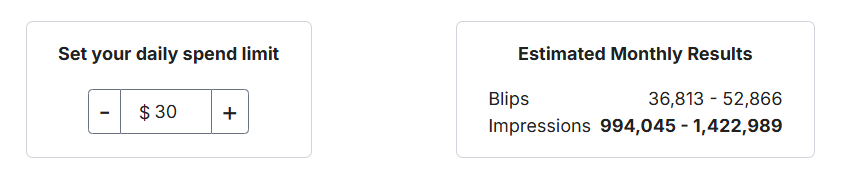
With Blip, billboard advertising in Smithfield can fit a wide range of budgets because you only pay when your ad actually displays. Pricing starts at just $0.01 per display, and you set a daily budget while Blip’s algorithm competes for open ad slots based on time of day, location, and advertiser demand. Your total cost is simply the sum of your individual blips over time.
Where can I advertise with Blip in Smithfield, North Carolina?
Smithfield has strong billboard opportunities along I-95, especially around Exits 95, 96, and 97, where traffic commonly reaches 70,000 to 80,000 AADT. US 70 and the future I-42 corridor are also important, with major segments often in the 30,000 to 40,000 AADT range. In-town routes like US 70 Business, Market Street, and Bright Leaf Boulevard are useful for local reach and repeat exposure.
Why is Smithfield, North Carolina a good market for Blip billboard advertising?
Smithfield is a strong billboard market because it combines a local population of 11,292 with a fast-growing county population of 226,623 and nonstop interstate visibility along I-95. Johnston County grew by 34.2% from 2010 to 2020, and local mobility remains heavily car-oriented, which is exactly the environment where digital billboards build repetition. The market also includes outlet retail, tourism, healthcare, and commuter traffic that create multiple audience layers.
What kinds of people can Blip reach in Smithfield, North Carolina?
Blip can reach Johnston County commuters and working households, shoppers and pass-through travelers, families and students, and heritage tourists and downtown visitors. Johnston County Public Schools serves about 38,000 students, and Carolina Premium Outlets has 80+ stores, which expands the audience beyond the town population alone. The area also draws visitors to Downtown Smithfield, the Ava Gardner Museum, and nearby heritage destinations.
When is the best time to run billboards in Smithfield, North Carolina with Blip?
Timing matters in Smithfield because the audience changes by season, daypart, and event calendar. Back-to-school season is a strong planning window, with heavier scheduling in the 6 to 8 a.m. and 2 to 6 p.m. blocks, while summer weekends can make the 11 a.m. to 8 p.m. window especially valuable. Spring and fall also bring event-driven traffic from festivals, heritage travel, and holiday shopping.
Do I need a contract to advertise with Blip in Smithfield?
No, Blip has no long-term contracts or minimum commitments. You can start, pause, or stop your campaign at any time.
How fast can I launch a billboard campaign with Blip in Smithfield?
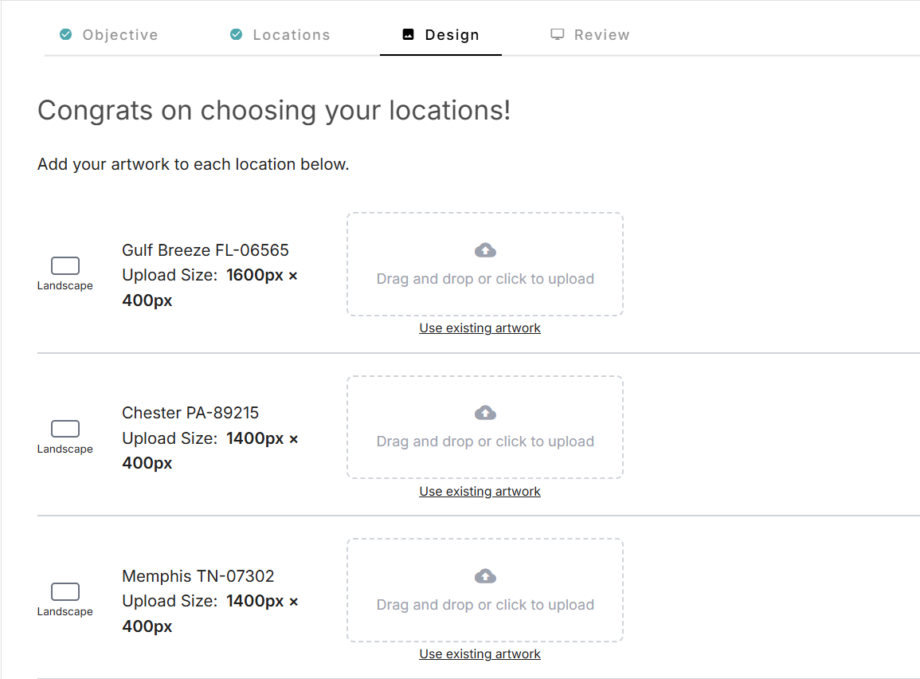
You can have your campaign live in minutes. Create a free account, select your locations, set your budget, upload your design, and start running once approved.
Where can I advertise with Blip in Smithfield?
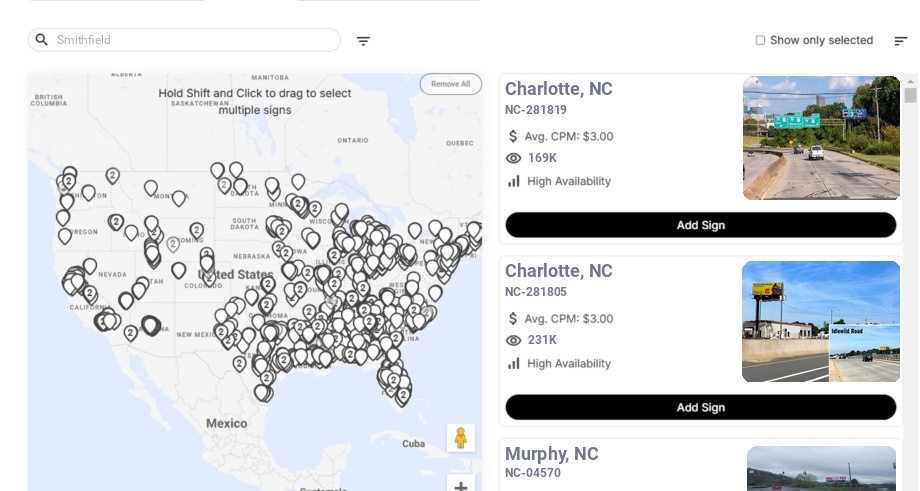
Blip has digital billboards in Smithfield. You can browse available locations on a map, choose the ones that fit your audience, and start advertising right away.
Still have questions? Launch a campaign in minutes — no contracts, no commitments.
Start Your CampaignSmithfield Billboard Advertising Guide
Smithfield is a strong billboard market because it combines a local population of 11,292 with a fast-growing county population of 226,623 and nonstop interstate visibility along I-95, where traffic around the Smithfield exits commonly reaches 70,000 to 80,000 AADT. We sit at the crossroads of travel patterns shaped by Smithfield, Johnston County, and the highway network maintained by the North Carolina Department of Transportation, so our campaigns can reach daily commuters, outlet shoppers, and long-distance East Coast travelers in the same buy. Johnston County grew by 34.2% from 2010 to 2020, and local mobility remains heavily car-oriented, which is exactly the environment where digital billboards build repetition. Tourism also matters here, thanks to Carolina Premium Outlets 80+ stores, Downtown Smithfield Development Corporation Johnston County Visitors Bureau.
Smithfield Market Overview
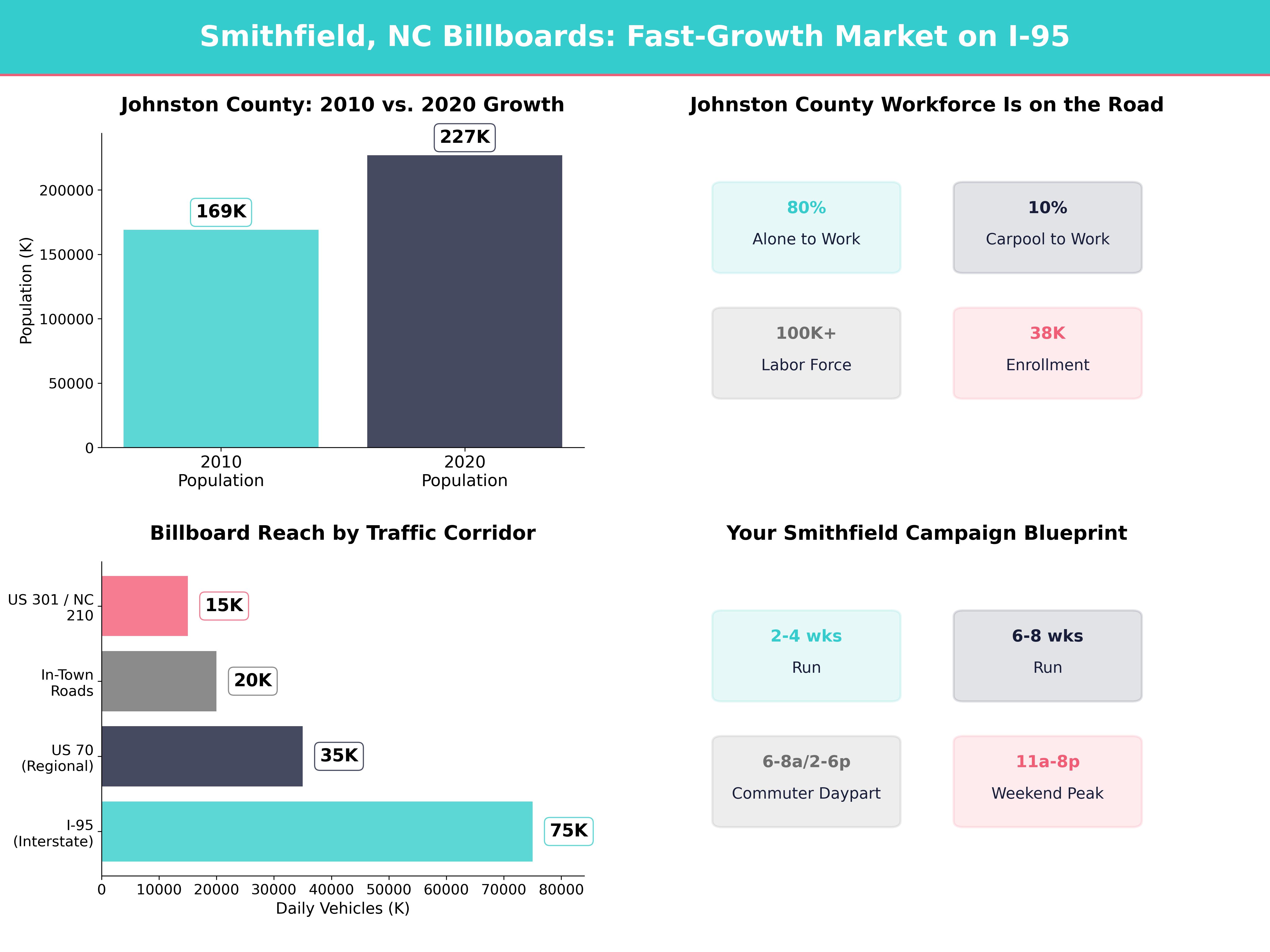
The North Carolina Office of State Budget and Management reports that Johnston County had 226,623 residents at the 2020 count, up from 168,878 in 2010. That was an increase of 57,745 people, or 34.2%, in one decade. Smithfield itself counted 11,292 residents in 2020, but the practical billboard market is much larger because the town functions as the county seat, a retail stop, a healthcare hub, and an interstate service center.
We also benefit from geography. Smithfield is roughly 30 miles southeast of Raleigh, which means our ads can tap into both local Johnston County movement and Triangle spillover traffic. The county includes 11 municipalities, and the strongest billboard trade area around Smithfield often overlaps with Clayton Selma, Benson Four Oaks, and the unincorporated communities that feed those towns.
From an advertiser’s perspective, Smithfield works because the economy is diversified enough to support many campaign goals at once. We see county government activity, healthcare demand, education traffic, outlet retail, hospitality, construction, manufacturing, and logistics all intersecting here. The N.C. Department of Commerce has placed Johnston County’s labor force above 100,000 in recent years, which reinforces that this is not just a small-town awareness play. It is a working market with repeat drivers.
The local commute profile favors out-of-home media. Recent county commuting profiles generally put drive-alone commuting at around 80%, with roughly another 10% carpooling. That means close to 9 in 10 workers are still road-based commuters in some form, even before we add shopping trips, school pickups, medical visits, and interstate travel. For billboard advertisers, that translates into consistent weekday frequency and meaningful weekend reach.
Retail and family demand are especially important in Smithfield. Carolina Premium Outlets 80+ stores, which creates a steady draw from both locals and travelers. Johnston County Public Schools serves about 38,000 students, which expands the audience for healthcare, grocery, restaurants, telecom, tutoring, automotive, and family entertainment. UNC Health Johnston Johnston Community College, and the Smithfield-Selma Area Chamber of Commerce
Key Traffic Corridors for Smithfield Billboards
Smithfield’s advertising power comes from a few very clear travel corridors. When we understand which roads move tourists, commuters, shoppers, and local residents, we can match the right board to the right business objective.
I-95 through Smithfield
According to traffic count mapping from the North Carolina Department of Transportation, segments of I-95 around Smithfield’s major interchanges, especially Exits 95, 96, and 97, commonly land in the 70,000 to 80,000 AADT range. That is the highest-volume billboard environment in the area, and it is where we can reach long-distance travelers, truck traffic, road-trip families, and regional pass-through visitors at scale.
This corridor is best for advertisers that benefit from immediate action or broad awareness.
- Quick-service restaurants, fuel brands, and convenience retailers can use I-95 boards to convert drivers within the next 1 to 3 miles.
- Hotels, outlet retail, and attractions can use exit numbers, distance cues, and “open now” messaging because many viewers are making in-the-moment decisions.
- Personal injury firms, roadside assistance providers, urgent care clinics, and emergency service brands can benefit from the corridor’s mix of tourists, truckers, and unfamiliar drivers.
Because I-95 viewers are moving fast, creative needs to be extremely direct. In Smithfield, that often means pairing a brand with a clear travel benefit, such as outlet shopping, food, lodging, or a fast stop near the next exit.
US 70 and the future I-42 corridor near Smithfield
US 70 is the other major spine we should take seriously. In the Smithfield and Selma area, NCDOT count maps commonly show major segments of US 70, including bypass segments tied to the future I-42 corridor, in the 30,000 to 40,000 AADT range. This is lower than I-95, but it is often more targeted because it carries a heavier share of regional commuters and everyday Johnston County drivers.
We typically use this corridor for advertisers that want repeated exposure instead of just pass-through impressions.
- Healthcare systems can use US 70 boards to reach residents traveling between Smithfield, Selma, Clayton, and the wider county.
- Auto dealers, home improvement companies, furniture stores, and regional retailers can benefit from a corridor where shoppers are often headed to a destination rather than simply passing through.
- Schools, workforce recruiters, financial services firms, and community organizations can use US 70 placements to build familiarity over multiple drives per week.
The long-term advantage here is growth. As the US 70 corridor continues its transition toward Interstate 42, we should expect it to remain one of Johnston County’s most important development and mobility corridors.
US 70 Business, Market Street, and Bright Leaf Boulevard in Smithfield
Inside town, the best local-reach opportunities usually come from US 70 Business, Market Street, Bright Leaf Boulevard, and the surrounding commercial streets. Depending on the segment, NCDOT counts on these in-town routes commonly fall in the 15,000 to 25,000 AADT band. Those are meaningful local numbers because speeds are lower, drivers are more likely to notice detail, and trip intent is often tied to errands, work, appointments, dining, or school activity.
These roads are ideal for brands that need local trust and repeat exposure rather than split-second interstate reaction.
- Banks, insurance agencies, dental offices, and clinics can use in-town boards to reinforce familiarity.
- Restaurants, grocery stores, local shops, and event promoters can benefit from closer proximity to where people actually stop and spend.
- Civic organizations, public events, museums, and downtown businesses can use these corridors to invite visits from residents already in market.
Boards here can also support county-seat traffic. People regularly drive into Smithfield for courthouse business, healthcare visits, shopping, and school-related errands, and those trips often funnel through the same commercial arteries.
US 301 and NC 210 approaches around Smithfield
US 301 and parts of NC 210 matter more than many advertisers expect. Depending on the segment, these roads often show traffic counts in the 10,000 to 20,000 AADT range in the broader Smithfield area. That is not interstate scale, but it is excellent for local frequency, especially when we want to reach residents from smaller communities before they enter the busiest retail cluster.
These approach routes work especially well for:
- Trades, home services, agricultural suppliers, and local retail that want to speak to county residents before they choose where to shop.
- Employers that want to recruit industrial, warehouse, and service workers moving between towns.
- Healthcare, pharmacy, and family-service brands that rely on repeated local recognition rather than one-time traveler stops.
When we combine an I-95 board for awareness with a US 301 or NC 210 board for local reinforcement, Smithfield campaigns often feel larger than the budget would suggest.
Smithfield Audience Segments We Can Reach
Smithfield works best when we think in audience layers instead of assuming every board should do the same job.
Johnston County commuters and working households
The first layer is the county’s everyday resident base. Johnston County has 226,623 residents, and a large share of workers commute by car. With around 80% of workers driving alone and roughly 10% carpooling, road-based media remains one of the simplest ways to reach working adults repeatedly.
This audience is especially valuable for:
- Healthcare providers.
- Grocery, discount retail, and restaurants.
- Financial services, insurance, and legal services.
- Home improvement, roofing, HVAC, and other service businesses.
Because many households make repeated trips between school, work, shopping, and appointments, frequency matters in Smithfield. We do not always need one perfect board. We often need a smart set of boards that appears in the same routines week after week.
Shoppers, pass-through travelers, and outlet visitors
The second layer is the visitor economy. Carolina Premium Outlets 80+ stores, and its location near I-95 gives Smithfield a retail profile that is much stronger than its town population alone would suggest. Travelers who stop for shopping also need food, fuel, lodging, coffee, pharmacies, and family services.
This audience is ideal for:
- National and regional chains that want to intercept traffic already in spending mode.
- Local restaurants and attractions that can persuade travelers to extend their stop.
- Hotels and service providers that need same-day decisions.
We should also remember the airport connection. Raleigh-Durham International Airport 14.5 million passengers in 2023, and Smithfield is about 45 minutes away by car. That helps feed a wider stream of regional visitors, business travelers, and rental-car users into eastern North Carolina road trips.
Families, students, and education-connected households
The third layer is the school-and-family audience. Johnston County Public Schools serves about 38,000 students, and Johnston Community College brings in additional curriculum and continuing-education traffic from across the county. In practical terms, that means a large number of Smithfield-area drivers are making routine trips around school calendars, youth activities, and family errands.
This audience is especially responsive to:
- Pediatric, dental, vision, and urgent care services.
- Back-to-school retail, internet, mobile, and tutoring brands.
- Family dining, entertainment, and community events.
- Automotive, grocery, and value-oriented services.
When we align our billboards with school-year rhythms, we can speak to one of the county’s most reliable repeat-traffic audiences.
Heritage tourists, downtown visitors, and outdoor recreation users
The fourth layer is Smithfield’s cultural and leisure audience. Downtown Smithfield Development Corporation Bentonville Battlefield State Historic Site brings heritage travelers into the county, and Howell Woods 2,800 acres, adding outdoor recreation appeal.
This audience is useful for:
- Restaurants, boutiques, and local hospitality.
- Events, museums, and tourism-related campaigns.
- Real estate, retirement, and community branding efforts that benefit from a positive lifestyle message.
These visitors are not always huge in raw count compared with interstate traffic, but they are often highly engaged and more likely to act on a leisure-oriented message.
Seasonal and Timing Opportunities in Smithfield
Timing matters in Smithfield because the audience changes meaningfully by season, by daypart, and by event calendar.
Spring in Smithfield
Spring is a strong setup season for local campaigns. The Downtown Smithfield Development Corporation 4th Saturday in May, and spring heritage travel also increases around destinations like Bentonville Battlefield State Historic Site. We like spring for restaurants, home services, garden centers, medical providers, real estate, and community events because households are more active and travel conditions are easy.
Summer on the Smithfield interstate and outlet routes
From Memorial Day through Labor Day, the I-95 corridor becomes even more important. Family road trips, outlet shopping, and warm-weather weekend travel all strengthen the case for boards near the interstate and outlet district. We often see the best fit here for food, fuel, cooling products, hospitality, and family-friendly attractions. For advertisers who want travel traffic, the 11 a.m. to 8 p.m. window can be especially valuable during summer weekends and holiday periods.
Back-to-school in Smithfield and Johnston County
Back-to-school season is one of the clearest planning windows in this market because of the county’s 38,000-student public school system. We usually recommend school-oriented campaigns from late July through September, with heavier scheduling in the 6 to 8 a.m. and 2 to 6 p.m. blocks when school and parent trips stack up. This is a strong period for pediatric care, orthodontics, internet service, tutoring, value retail, and family dining.
Fall festivals and holiday shopping near Smithfield
Fall has two distinct advantages. First, local events ramp up, including the Bright Leaf Hoedown 1st Saturday in October, and nearby Benson Mule Days
Billboard Design Tips for the Smithfield Market
Smithfield does not reward generic creative. The best designs acknowledge whether we are talking to a fast-moving interstate traveler, a county resident, or a local shopper already close to downtown.
Use interstate language on Smithfield’s highest-speed boards
For I-95 placements, we should design for speed and immediate decisions. That usually means 7 to 10 words of core copy, one visual idea, one brand mark, and one directional instruction. In Smithfield, exit numbers matter. A message like “Outlet Deals at Exit 95,” “Hot Breakfast at Exit 96,” or “Hotel Tonight at Exit 97” is usually stronger than a vague awareness line.
Distance also matters. If the destination is close, we should say so. “Next right,” “1 mile,” or “2 miles ahead” gives travelers a reason to act now rather than later.
Lean into local credibility on Smithfield town routes
In-town boards can carry a little more context because traffic moves more slowly and trip intent is more local. Here, we often benefit from using Smithfield-specific cues such as downtown identity, county service language, healthcare trust, or local heritage. References to Downtown Smithfield Development Corporation
For example, these themes tend to fit the local market well:
- “Trusted by Johnston County families.”
- “Minutes from Downtown Smithfield.”
- “Shop after the outlets.”
- “Local care, right here in Smithfield.”
Those lines work because they match how residents navigate the town.
Match the imagery to the audience Smithfield actually delivers
Smithfield sits between outlet retail, heritage tourism, and a working county economy, so imagery should reflect that mix.
- Family-service brands usually perform best with friendly, practical visuals rather than luxury-only styling.
- Outlet-adjacent messages can use fashion, shopping, savings, and convenience cues because viewers already associate the area with retail stops.
- Recruitment and industrial campaigns can use clean workforce imagery, clear pay or shift language when appropriate, and a dependable tone that respects the county’s manufacturing and logistics base.
- Tourism and downtown campaigns can borrow from Smithfield’s historic and cultural character, including polished vintage aesthetics that feel at home with the Ava Gardner Museum
Design for eastern North Carolina weather and light
Smithfield drivers deal with bright summer sun, heavy rain, and earlier winter darkness. High-contrast layouts, strong color separation, and large type help more than muted palettes do. For this market, we usually prefer bold blues, reds, whites, and deep dark backgrounds over low-contrast earth tones, especially on highway boards. If we are advertising a local event or boutique brand, we can still keep the design attractive, but legibility has to come first.
Regional Strategies Across Greater Smithfield
A Smithfield campaign becomes stronger when we divide the market into distinct zones instead of treating every billboard as interchangeable.
The Smithfield-Selma interchange and outlet zone
This is our best zone for broad reach and traveler conversion. Boards around the I-95 and US 70 interchange area can speak to outlet shoppers, hotel guests, restaurant traffic, and pass-through drivers. We use this zone when we want scale, speed, and immediate action. Travel services, chain retail, legal services, and healthcare all fit well here.
Downtown Smithfield and the civic-medical core
This zone is better for local trust and frequency. Boards closer to downtown, UNC Health Johnston
West Johnston commuters moving toward Clayton and Raleigh
The western county pull toward Clayton Raleigh matters for weekday strategy. Commuter-oriented boards on US 70 can help us reach workers moving between home and the Triangle. We especially like this zone for recruitment, healthcare systems, higher education, auto, telecom, and home services. Dayparting can be useful here because weekday commute periods are more valuable than overnight hours.
South and east county approaches from Benson, Four Oaks, and rural communities
Approach routes from Benson Four Oaks, and smaller communities are valuable for local-service frequency. These drivers may not generate I-95-scale counts, but they are often exactly the households that local businesses need. We use these routes for trades, farm and garden, community banks, medical providers, pharmacies, and locally owned retail.
Using Blip Tools in Smithfield
Blip’s biggest advantage in a market like Smithfield is that we can build a more precise local mix instead of overcommitting to one guess.
We can test Smithfield corridor strategy before scaling it
Because Smithfield has distinct audience zones, we can start by testing a small group of boards instead of buying the whole market at once. We might run one interstate-focused message near I-95, one commuter message on US 70, and one local-trust message closer to town. From there, we can compare performance over a 14-day test window and scale the best-performing mix into a 30-day flight.
We can daypart around Smithfield travel behavior
Dayparting is especially useful here. We can emphasize 6 to 8 a.m. and 2 to 6 p.m. for school-and-commuter traffic, midday and evening for outlet and dining traffic, and weekend blocks for tourism and events. In a market with such different traveler types, that flexibility helps us match spend to real-world behavior.
We can localize creative by zone
Smithfield benefits from creative variation. We can run 2 to 3 versions of artwork at the same time, using exit-number creative on I-95, family-service creative on local roads, and event or downtown creative near Smithfield’s core. Blip’s workflow makes that kind of market-specific adaptation much easier than treating every board as a static one-size-fits-all placement.
Getting Started with Billboard Rental in Smithfield
Renting a billboard in Smithfield is simplest when we start with a clear objective and then choose locations based on how people actually move through the area.
Start with one main goal for Smithfield
We usually see three common goals in this market. The first goal is traveler conversion, which fits I-95 and the outlet zone. The second goal is local frequency, which fits in-town Smithfield roads and county approach routes. The third goal is regional commuter awareness, which fits US 70 and the Clayton-Raleigh direction of travel. Once we know the goal, the board choice becomes much easier.
Evaluate each Smithfield board by speed, distance, and intent
We should ask three practical questions before choosing a location.
- How fast is the traffic moving?
- How close is the board to the business or action point?
- Is the viewer a traveler, a commuter, or a local resident?
If the answer is “fast-moving interstate traffic,” we should keep the message very short and place the board within 1 to 3 miles of the destination whenever possible. If the answer is “local repeat traffic,” we can prioritize frequency, trust, and proximity to schools, retail, healthcare, or downtown destinations.
Set expectations for timing and measurement
In Smithfield, we often recommend 2 to 4 weeks for an initial proof-of-concept campaign and 6 to 8 weeks for more seasonal or brand-building campaigns. That gives us enough time to see whether the location, creative, and dayparting are aligned. We should measure success with practical signals such as calls, bookings, store traffic, coupon redemption, and branded search lift rather than expecting one billboard to do every job by itself.
Use Blip to simplify the Smithfield rental process
Compared with traditional billboard buying, Blip lets us get into Smithfield faster and adjust as we learn. We can select boards on a map, focus spend on the times that matter most, refresh creative for school season or festival weekends, and react to performance without waiting through a long contract cycle. In a market like Smithfield, where I-95 travelers, local families, and Johnston County commuters all behave differently, that flexibility is more than convenient. It is often the difference between a billboard campaign that simply appears and one that actually fits the market.