Billboards in Denver, NC
No Minimum Spend. No Long-Term Contracts. Just Results.
Trusted by Leading Brands


Billboard advertising
in Denver has never been easier



How much is a billboard in Denver?
Why Choose Blip for Billboard Advertising in Denver
Blip lets you self-serve Denver, NC billboards fast — perfect for NC 16 and NC 73 commuters heading to Charlotte or Lake Norman.
With flexible budgets and no contracts, Denver, NC businesses can test lake-season traffic on NC 150 and pause anytime.
Daypart with Blip in Denver, NC to match 6-9 a.m. commuters and weekend Lake Norman visitors without wasting spend.
Blip's real-time analytics help Denver, NC advertisers see what works on I-77 spillover routes and adjust quickly.
Use Blip's creative tools to build Denver, NC ads for families, homeowners, and East Lincoln shoppers in one clean billboard.
Frequently Asked Questions About Billboard Advertising in Denver
How much does a billboard cost in Denver, North Carolina with Blip?
Each 7.5-to-10-second display, called a “blip,” starts at just $0.01, and your daily budget helps Blip’s algorithm bid for open ad slots on rotating digital billboards. Since pricing changes based on time of day, location, and advertiser demand, the total cost is simply the sum of the blips you receive over time. There are no minimums or contracts, so you can start with a small budget, adjust it anytime, or pause whenever you want.
Where can I advertise with Blip in Denver, North Carolina?
Denver's billboard value is defined by a small set of roads that carry a very large share of local movement. NCDOT traffic count maps consistently show that Denver's strongest ad opportunities cluster around NC 16, NC 73, NC 150, and the regional spillover routes that connect to I-77. The best billboard for a Denver campaign may sit on NC 16, NC 73, NC 150, or even an I-77 approach outside the CDP.
Why is Denver, North Carolina a good market for Blip billboard advertising?
Denver itself remained small at 3,612 residents, but it sits on the west side of Lake Norman, inside a commuter shed tied to Charlotte, Huntersville, Cornelius, Mooresville, and Lincolnton. That mix of population growth, drive-alone commuting above 80% in Lincoln County, and lake-driven visitation gives digital billboards in Denver repeated exposure to commuters, shoppers, homeowners, and seasonal visitors. Denver works best when we think beyond the CDP boundary and focus on the broader west-Lake Norman trade area.
What kind of traffic and commuters does Denver, North Carolina have for billboards?
Denver is a classic drive market. Recent ACS-based local profiles generally put drive-alone commuting in Lincoln County above 80%, and local travel behavior is overwhelmingly auto-based because Charlotte Area Transit System does not operate routine fixed-route local service in Denver. Commute times also support billboard use because many Denver households travel toward Charlotte-area job centers, and Charlotte-bound commutes commonly run 30 minutes or more depending on destination and congestion.
When is the best time to run Blip billboard ads in Denver, North Carolina?
Denver rewards advertisers that time campaigns to the lake calendar, school calendar, and Charlotte event calendar. From March through May, we typically see momentum in boating, real estate, home improvement, landscaping, outdoor furniture, and family services. Memorial Day to Labor Day creates Denver's clearest leisure window, and August and September reset household routines.
Do I need a contract to advertise with Blip in Denver?
No, Blip has no long-term contracts or minimum commitments. You can start, pause, or stop your campaign at any time.
How fast can I launch a billboard campaign with Blip in Denver?
You can have your campaign live in minutes. Create a free account, select your locations, set your budget, upload your design, and start running once approved.
Where can I advertise with Blip in Denver?
Blip has digital billboards in Denver. You can browse available locations on a map, choose the ones that fit your audience, and start advertising right away.
Still have questions? Launch a campaign in minutes — no contracts, no commitments.
Start Your CampaignDenver Billboard Advertising Guide
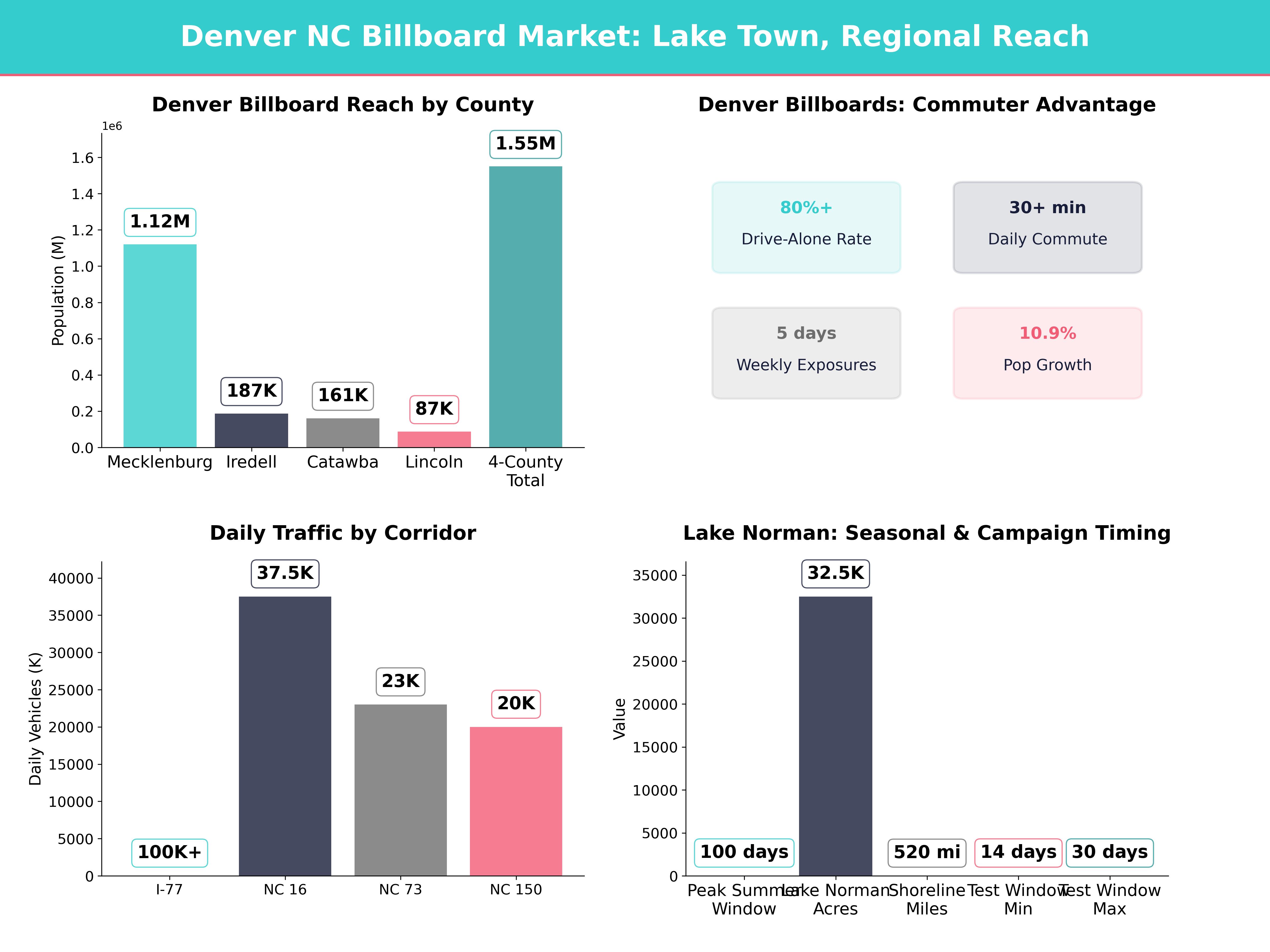
Denver Lincoln County 8,545-person growth from 78,265 in 2010 to 86,810 in 2020. The North Carolina Office of State Budget and Management reports that Lincoln County 86,810 residents in the 2020 Census, up from 78,265 in 2010, which equals 10.9% growth over the decade.
Denver itself remained small at 3,612 residents, but it sits on the west side of Lake Norman, inside a commuter shed tied to Charlotte, Huntersville Cornelius, Mooresville, and Lincolnton 80% in Lincoln County, and lake-driven visitation gives digital billboards in Denver repeated exposure to commuters, shoppers, homeowners, and seasonal visitors.
Denver, North Carolina Market Overview
Denver works best when we think beyond the CDP boundary and focus on the broader west-Lake Norman trade area, where the surrounding four-county base reaches about 1.55 million residents. Denver is part of Lincoln County Mecklenburg County, Iredell County Catawba County. In 2020, those counties counted 1,115,482 residents in Mecklenburg, 186,693 in Iredell, and 160,610 in Catawba, which gives us a nearby four-county base of about 1.55 million people when we include Lincoln County.
Why Denver's Growth Pattern Matters
Denver has grown as a residential and lifestyle market more than as a traditional downtown center. That matters because billboard demand here follows roads, retail nodes, school traffic, and lake access points instead of a single urban core. The area is also highly influenced by Lincoln Economic Development Association recruitment efforts, Charlotte-area employment, and household migration into East Lincoln.
We also benefit from the scale of the lake economy. Duke Energy lists Lake Norman at 32,510 acres with 520 miles of shoreline, which supports boating, dining, vacation rentals, and second-home activity. Those lake-oriented trips expand the audience well beyond Denver's resident count.
What Car Dependence Means for Billboard Advertising in Denver
Denver is a classic drive market. Recent ACS-based local profiles generally put drive-alone commuting in Lincoln County above 80%, and local travel behavior is overwhelmingly auto-based because Charlotte Area Transit System does not operate routine fixed-route local service in Denver. We should expect billboard performance here to come from frequency and route dominance, not from walk-by traffic.
Commute times also support billboard use. Many Denver households travel toward Charlotte-area job centers, and Charlotte-bound commutes commonly run 30 minutes or more depending on destination and congestion. That creates repeated daily impressions on the same drivers, which is ideal for awareness, retail reminders, healthcare messaging, and home-service calls to action.
The Regional Economy Around Denver
Denver sits between multiple employment engines. Charlotte Douglas International Airport handled more than 53.4 million passengers in 2023, which shows the scale of business and visitor movement feeding the greater Charlotte market. Closer to Denver, we see manufacturing and logistics activity in Lincoln County, corporate employment in the north Charlotte area, healthcare demand tied to Atrium Health Lincoln and Lake Norman Regional Medical Center
For advertisers, that means Denver can support several categories at once:
- Home services perform well because the area keeps adding rooftops and homeowners need recurring maintenance.
- Healthcare brands benefit because families travel by car for primary care, urgent care, specialty visits, and hospital services.
- Retail, dining, and entertainment benefit because Denver residents routinely cross county lines for shopping and recreation.
- Professional services benefit because long commute patterns give us repeated weekly reach among established households.
Key Traffic Corridors for Denver, North Carolina Billboards
Denver's billboard value is defined by a small set of roads that carry a very large share of local movement. NCDOT traffic count maps consistently show that Denver's strongest ad opportunities cluster around NC 16, NC 73, NC 150, and the regional spillover routes that connect to I-77.
NC 16 and NC 16 Business in Denver
NC 16 is the backbone corridor for Denver. NCDOT counts in the Denver area typically place major NC 16 segments in the roughly 30,000 to 45,000 vehicles per day range, and that makes it the clearest high-frequency route for commuter-facing campaigns. NC 16 connects Denver south toward Charlotte and north toward Lincolnton
NC 16 Business matters for local intent because it passes closer to Denver's established commercial zones, schools, and neighborhood-serving retail. We generally prefer this route for advertisers that want local action rather than broad commuting reach.
The strongest categories on NC 16 and NC 16 Business include the following uses:
- Auto dealers, tire shops, and repair brands benefit because drivers are already in vehicle mode and often make service decisions close to their route.
- Banks, insurers, and legal services benefit because they need repeated name recognition across weeks, not just one-time attention.
- Home-service companies benefit because Denver's homeowner base is large enough to reward frequency-driven branding.
NC 73 Across the Lake Norman Belt
NC 73 is Denver's east-west connector to Huntersville Cornelius, and the eastern side of the lake region. NCDOT counts on this corridor are commonly in the 18,000 to 28,000 vehicles per day range near the Denver market, which makes it a strong choice when we want to reach families, restaurant traffic, and cross-lake shoppers. It is also one of the most useful routes for businesses trying to pull households from both Lincoln and Mecklenburg counties.
This corridor is especially effective for:
- Restaurants and retail centers, because many trips on NC 73 are discretionary or errand-based.
- Medical, dental, and wellness brands, because households on this route often compare providers across multiple towns.
- Private schools, charter schools, and enrichment programs, because families moving through East Lincoln and north Mecklenburg are highly schedule-driven.
NC 150 and Lake-Crossing Traffic
NC 150 is essential when we want to reach the Mooresville side of the lake or intercept drivers moving between west-Lake Norman neighborhoods and I-77. Depending on the segment, NCDOT counts are often in the 15,000 to 25,000 vehicles per day range around the broader Denver trade area. Traffic tends to feel especially commercial near major intersections and bridge approaches.
This route is useful for advertisers that need a blend of local and regional shoppers. We often like NC 150 for furniture, grocery, home improvement, urgent care, and family entertainment because people on this road are commonly in active purchase mode.
I-77 Spillover and South Lake Norman Reach
Even though I-77 is east of Denver, it is still part of Denver strategy. South Lake Norman segments of I-77 carry well above 100,000 vehicles per day, and the exits from roughly 25 through 36 connect directly to Huntersville Cornelius, Davidson Mooresville. Exit 36 is especially important because NC 150 funnels west toward Denver.
We use this spillover strategy when we want Denver households plus regional volume. It works well for larger healthcare systems, destination retailers, colleges, entertainment venues, and brands that serve both sides of the lake. The presence of NC Quick Pass express lanes also tells us that this corridor is built around long-distance commuter movement, which supports broader awareness campaigns.
Audience Segments We Can Reach in Denver, North Carolina
Denver's strength is not just traffic volume. It is the variety of audiences moving through the same corridor system.
Charlotte-Bound and Huntersville-Bound Commuters
The first major segment is weekday commuters. These drivers travel toward Charlotte, Huntersville Cornelius, and Mooresville for work, shopping, healthcare, and errands. Because the same households repeat these trips multiple times each week, digital billboards can build recognition fast.
This is an especially strong segment for service businesses, healthcare, financial services, staffing, and auto-related categories. We do not need stadium-level foot traffic when the same commuter sees a message 5 days a week.
Lake Norman Visitors and Leisure Traffic
The second major segment is leisure traffic tied to Lake Norman. A lake with 32,510 acres and 520 miles of shoreline creates demand for marinas, restaurants, boat dealers, vacation rentals, landscaping, outdoor living, and home maintenance. Visit Lake Norman also promotes the area as a regional destination, which helps bring in weekend traffic from beyond Lincoln County.
This segment grows in value from spring through early fall, and it is particularly good for hospitality, recreation, dining, real estate, and retail.
Families, Schools, and Household Decision-Makers
Denver is deeply family-oriented. Lincoln County Schools serves the wider county, and Lincoln Charter School gives the area an additional K-12 draw. Families in this part of the region are highly responsive to convenience, trust, safety, and local identity, which makes billboard messaging around healthcare, tutoring, childcare, grocery, home services, and community events especially effective.
Because households often make decisions jointly, billboard creative here should speak to practical value. We generally do better with messages that feel helpful and local than with messages that feel abstract or purely brand-driven.
Students and Young Adults in the Regional Orbit
Denver is not a college town, but it sits close enough to several higher-education audiences to matter. UNC Charlotte enrolls more than 31,000 students, and Davidson College enrolls nearly 2,000 students. Those student populations influence weekend dining, service jobs, event attendance, healthcare, and apartment demand across the wider north Charlotte region.
This audience matters most when we extend from Denver into Huntersville, Davidson, Cornelius, or Mooresville-facing corridors. It is useful for employers, colleges, apartments, entertainment venues, and quick-service brands.
Motorsports, Sports, and Event Audiences
Regional event traffic adds another layer of opportunity. Charlotte Motor Speedway is a 1.5-mile speedway, and its signature Coca-Cola 600 covers 600 miles on Memorial Day weekend. That motorsports calendar brings visitors, hotel demand, restaurant demand, and heavy road movement across the north Charlotte area.
For Denver advertisers, these event windows are useful even if the business is not in Concord. We can still benefit from regional travel patterns, especially when promoting dining, lodging, tourism, retail, or event-adjacent services.
Seasonal and Timing Opportunities in Denver, North Carolina
Denver rewards advertisers that time campaigns to the lake calendar, school calendar, and Charlotte event calendar.
Spring in Denver and Lake Norman
From March through May, we typically see momentum in boating, real estate, home improvement, landscaping, outdoor furniture, and family services. This is the season when households start spending for decks, docks, patios, HVAC maintenance, and spring recreation. It is also a strong season for medical screenings, dental campaigns, and moving-related services as families plan around summer.
We like spring campaigns on commuter routes because they catch both weekday routines and weekend prep spending.
Summer Lake Season in Denver
Memorial Day to Labor Day creates Denver's clearest leisure window, and that span is roughly 100 days of high-value summer behavior. Traffic rises around boat launches, lake dining, retail corridors, and routes that feed weekend homes and short-term rentals. This is the best time of year for marinas, boat dealers, restaurants, beverage brands, outdoor recreation, and entertainment.
Summer also changes what creative works. We usually get better response from bright visuals, lake imagery, and simple convenience messages such as proximity, reservations, or same-day availability.
Back-to-School and Fall Event Timing
August and September reset household routines. Lincoln County Schools and nearby colleges restart schedules, families lock in childcare and activities, and commuters return to steadier weekday patterns. That makes late summer and early fall strong for healthcare, after-school programs, orthodontics, tutoring, fitness, banks, and family retail.
Fall also brings regional event demand. Charlotte Motor Speedway hosts major NASCAR events again, and football season increases weekend movement across the Charlotte region. If we serve restaurants, sports bars, entertainment, or ticketed events, fall is worth treating as its own media season.
Holiday and Winter Advertising in Denver
November and December are valuable for local retail, gift-driven categories, dining, and family entertainment. Holiday campaigns do especially well when they reference convenience, local pickup, extended hours, or event timing. Winter also supports healthcare, tax services, legal services, and gyms because household priorities shift from recreation to planning.
Denver's weather patterns can change quickly in winter and during stormy periods, so digital flexibility matters. We can swap messaging for weather-sensitive services, seasonal promotions, or urgent offers without rebuilding an entire traditional campaign.
Billboard Design Tips for the Denver, North Carolina Market
Creative that works in Denver usually feels local, practical, and visually clean. We should design for drivers who know the roads, the lake, and the rhythm of suburban family life.
Use Lake Norman and East Lincoln Visual Cues
Denver creative often performs better when it looks like west Lake Norman rather than uptown Charlotte. Blue water, docks, patios, boats, shoreline sunsets, trees, and family-oriented outdoor imagery fit the market naturally. We also tend to do well with strong blues, greens, whites, and warm summer tones because they match the area's lake-and-lifestyle identity.
For home-service and healthcare advertisers, polished but approachable visuals usually beat flashy city-style creative. Denver households respond well to trust and convenience.
Speak the Local Geography Clearly
Local shorthand matters. Messaging that references "Lake Norman," "Denver," "East Lincoln," "Hwy 16," or "NC 73" often feels more relevant than a generic Charlotte-area claim. If a business is easy to reach from a major route, we should say so plainly.
We should also avoid creative that assumes everyone identifies first with Charlotte. Many Denver residents think in terms of the lake, their side of the county line, or their commute corridor. That is why geography-led copy works so well here.
Match Creative to Road Speed
Denver includes both local commercial roads and faster commuter corridors. On 45 to 55 mph roads like busy local arterials, we can use a little more detail, especially for retail or restaurant messaging. On 65 mph commuter routes and regional connectors, we should stay disciplined with fewer words, larger type, and a single action.
Short URLs, memorable brand names, and simple offers work better than dense copy. We generally avoid QR-heavy creative on high-speed routes because the audience is driving, not browsing.
Reflect the Categories That Actually Win Here
Specific creative angles tend to fit Denver particularly well:
- Home services should emphasize speed, trust, and local service area language.
- Healthcare should emphasize proximity, same-day access, family care, or specialty expertise.
- Real estate and homebuilding should emphasize lake access, schools, lifestyle, and commute convenience.
- Restaurants and retail should emphasize route-based convenience, not abstract branding alone.
Regional Strategies Around Denver, North Carolina
Because Denver is unincorporated, many of the best boards that reach Denver households are not technically inside the CDP. Our strategy should follow movement patterns, not mailing boundaries.
South Denver and the Charlotte Commute
If our goal is weekday awareness, we should prioritize NC 16 and the southbound commute. This strategy is best for brands that need high repetition among employed adults, including healthcare, financial services, home services, legal services, and auto categories.
Morning and evening directionality matters here. Southbound impressions tend to be strongest for awareness, while northbound evening impressions can be stronger for action-oriented messages like dining, retail, and appointments.
The Central Denver Retail and Errand Zone
If our goal is immediate local action, we should focus on Denver's retail corridors around NC 16 Business, NC 73, and nearby shopping clusters. This area is ideal for urgent care, restaurants, grocery, pharmacies, gyms, and community events because people are already in decision mode.
This is also the right strategy for small and midsize businesses that rely on repeat local trips rather than full regional reach.
East-Lake Norman Crossover Strategy
If we want both Denver and east-side lake audiences, we should pair west-lake placements with boards that intercept drivers toward Huntersville Cornelius, Davidson Mooresville. This is where healthcare systems, destination retail, colleges, tourism brands, and larger service-area businesses can outperform a single-town plan.
The key advantage is audience overlap. One campaign can reach Denver residents at home and again as they travel east for work, school, or shopping.
West and North Toward Lincolnton and Catawba County
If our target is broader household reach in the western half of the market, we should not stop at Denver. Lincolnton Catawba County widen the audience for healthcare, furniture, colleges, and regional employers. This strategy is useful when we need scale without relying entirely on Mecklenburg County impressions.
Using Blip Tools in Denver, North Carolina
Blip is especially useful in Denver because the market rewards precision. We do not need to blanket the entire Charlotte region at once if our audience mostly lives along a few predictable corridors.
We Can Test Denver by Corridor
Instead of committing all spend to one route, we can test NC 16, NC 73, and a regional spillover board near I-77 at the same time. That approach helps us learn whether our best response comes from weekday commuters, local shoppers, or cross-lake traffic.
We Can Daypart for Directional Traffic
Denver is a great market for dayparting. We can emphasize 6 to 9 a.m. for southbound commute messaging, 3 to 7 p.m. for northbound return traffic, and weekend midday blocks for lake, dining, and retail campaigns. That lets us line up the message with actual behavior instead of paying evenly for every hour.
We Can Rotate Creative by Season
Because Denver changes so much between spring, summer, school season, and holidays, we should rotate creative more often than we would in a static rural market. A lake-focused summer message and a back-to-school family message should not look the same, even when they promote the same business.
We Can Optimize With Real Performance Signals
Once the campaign is live, we can use Blip's reporting to compare boards, times, and creative versions. In a corridor-driven market like Denver, small changes in route, timing, or direction can make a noticeable difference, so optimization matters.
Getting Started With Billboard Rental in Denver, North Carolina
Renting a billboard in Denver is easier when we begin with the audience and route, not with the town name alone. Because Denver households move across county lines so often, the best billboard for a Denver campaign may sit on NC 16, NC 73, NC 150, or even an I-77 approach outside the CDP.
Start With One Clear Goal
We should decide whether the campaign is mainly about awareness, store visits, lead generation, event attendance, or recruiting. That single goal will tell us whether we need commuter reach, local retail reach, or regional lake traffic.
Evaluate Boards by Movement, Not Just Address
When we compare locations, we should ask four practical questions:
- Which direction is the audience traveling when they see the board? This question matters because morning commuters and evening errand traffic respond differently.
- How fast is the road? This question determines how simple the creative must be.
- How close is the board to our location or decision point? This question matters most for dining, urgent care, retail, and event campaigns.
- Is the route used every day or mainly on weekends? This question affects the right schedule and message.
Expect a Faster, Simpler Process Than Traditional Buying
Traditional billboard buying often involves back-and-forth proposals, long holds, and limited flexibility once creative is posted. Blip simplifies that process because we can review available digital inventory, choose the boards that match Denver travel patterns, and adjust the campaign as we learn. That is especially valuable in Denver, where road choice and timing often matter more than buying the biggest possible footprint.
Launch Small, Measure, and Scale
A practical Denver test often starts with 2 boards, 2 creative versions, and a 14 to 30 day learning window. After that, we can look at website traffic, branded search lift, calls, foot traffic, appointment volume, or promo-code use to decide what deserves more budget. In this market, scaling the right corridor usually works better than spreading spend too thinly across the whole region.
If we approach Denver with a route-first mindset, local creative, and seasonally timed messaging, we can turn a relatively small community into a very efficient billboard market.