Billboards in Sanford, NC
No Minimum Spend. No Long-Term Contracts. Just Results.
Trusted by Leading Brands


Billboard advertising
in Sanford has never been easier



How much is a billboard in Sanford?
Why Choose Blip for Billboard Advertising in Sanford
-
Blip lets Sanford advertisers launch fast on US 1 and Horner Boulevard, reaching commuters and errands-driven drivers without a sales cycle.
-
Set any budget in Sanford and pay only when your ad plays — ideal for testing local reach across Lee County's 80% solo drivers.
-
No contracts in Sanford mean you can time ads for rush-hour traffic, school return, or downtown events and pause anytime.
-
Track Sanford campaigns in real time, then shift spend toward US 1 or NC 87 as commuter, contractor, and regional traffic changes.
-
Use Blip's creative tools to tailor Sanford billboards for healthcare, manufacturing, and family audiences with quick, clear messages.
Frequently Asked Questions About Billboard Advertising in Sanford
How much does a billboard cost in Sanford with Blip?
With Blip, billboard advertising in Sanford can fit a wide range of budgets because you only pay when your ad actually runs. Each “blip” is a 7.5-to-10-second display on a rotating digital billboard, with prices starting at just $0.01 per display. Your daily budget guides Blip’s algorithm as it bids for open ad slots, and the cost per blip can change based on time of day, location, and advertiser demand.
Where can I advertise with Blip in Sanford for the most traffic?
Sanford’s travel patterns are shaped by a small number of high-value corridors, and recent traffic-count maps show major Sanford-area segments of US 1 commonly in the 30,000 to 45,000+ AADT range. Urban Sanford segments tied to US 421 and Horner Boulevard commonly run around 15,000 to 25,000 AADT, while NC 87 around Sanford often falls in the 10,000 to 20,000 AADT range. On roads such as Tramway Road, Jonesboro Road, and other commercial connectors, recent counts often fall in the 8,000 to 15,000 AADT range.
Why is Sanford a strong billboard market for Blip?
Sanford is a strong billboard market because it combines a compact city center with regional highway exposure that reaches far beyond city limits. The City of Sanford has roughly 31,000 residents, while Lee County is around 65,000, which gives a meaningful local base and a larger surrounding trade area. Sanford’s position at the crossroads of routes managed by the North Carolina Department of Transportation keeps drivers in front of digital billboards every day.
What kinds of audiences can Blip reach in Sanford?
Sanford works well for billboard advertisers because the audience is not one-dimensional. We can reach commuters, families, students, shift workers, visitors, and regional leisure travelers in a relatively compact geography. Lee County is very family-oriented, and Sanford also benefits from the presence of Central Carolina Community College, which serves a 3-county area.
When is the best time to run a Sanford Blip campaign?
Sanford rewards advertisers that plan around the calendar, and the strongest campaigns usually line up with school rhythms, downtown events, golf travel, and seasonal needs. August through October is especially productive for school-related retail, pediatric and family healthcare, internet providers, tutoring, after-school programs, and fast-casual dining. From November through December, holiday retail, giftable services, restaurants, and entertainment venues benefit from strong frequency.
Do I need a contract to advertise with Blip in Sanford?
No, Blip has no long-term contracts or minimum commitments. You can start, pause, or stop your campaign at any time.
How fast can I launch a billboard campaign with Blip in Sanford?
You can have your campaign live in minutes. Create a free account, select your locations, set your budget, upload your design, and start running once approved.
Where can I advertise with Blip in Sanford?
Blip has digital billboards in Sanford. You can browse available locations on a map, choose the ones that fit your audience, and start advertising right away.
Still have questions? Launch a campaign in minutes — no contracts, no commitments.
Start Your CampaignSanford Billboard Advertising Guide
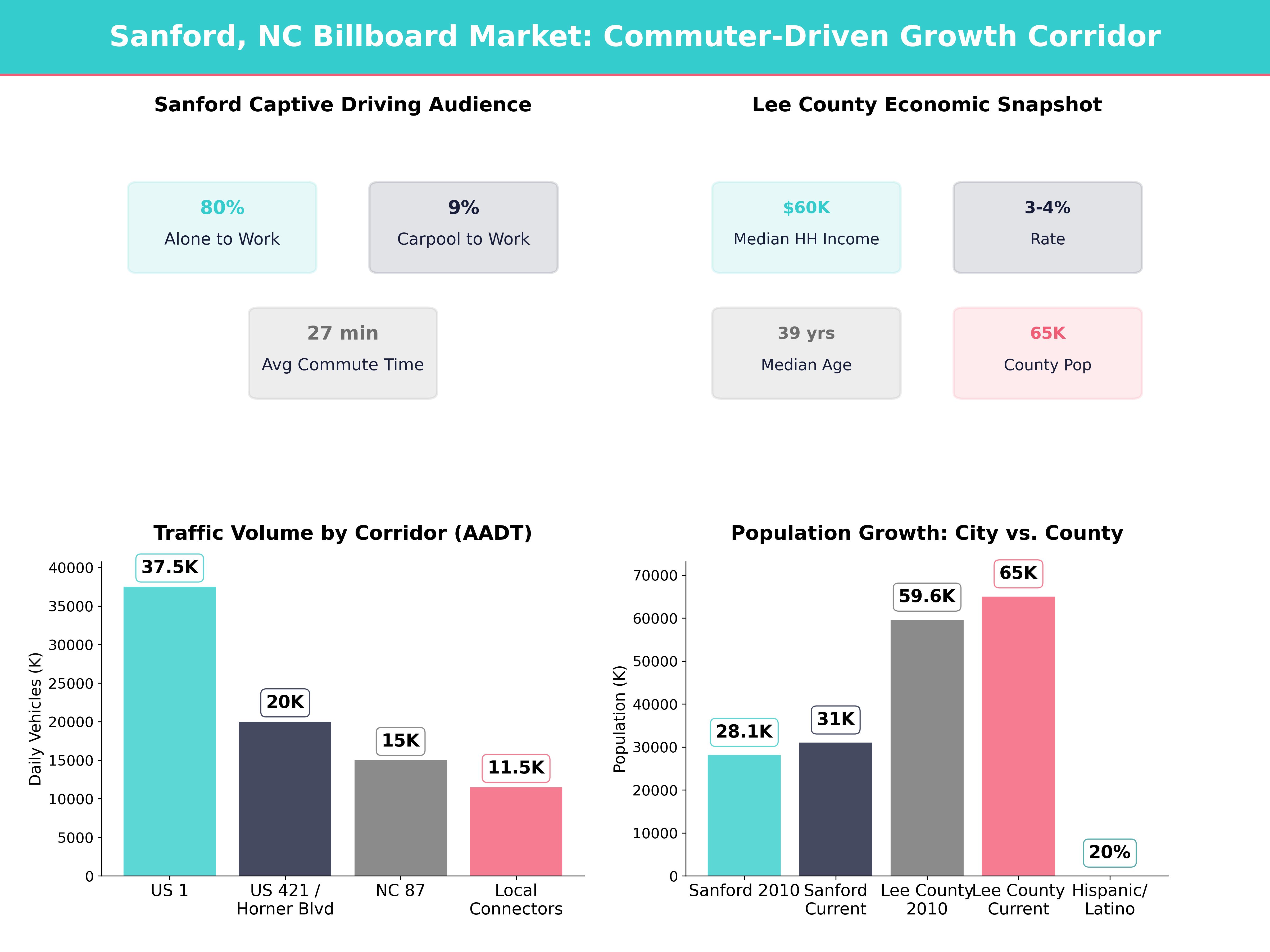
Sanford North Carolina Office of State Budget and Management puts the City of Sanford 31,000 residents, while Lee County is around 65,000, which gives us a meaningful local base and a larger surrounding trade area. Travel here is overwhelmingly car-based, with about 80% of workers driving alone and about 9% carpooling, and Sanford’s position at the crossroads of routes managed by the North Carolina Department of Transportation keeps drivers in front of digital billboards every day on corridors that commonly see 10,000 to 45,000+ AADT depending on the segment. We also benefit from Sanford’s mix of manufacturing, healthcare, downtown revitalization, and visitor traffic tied to golf, dining, and regional events.
Sanford Market Overview
Sanford sits in one of North Carolina’s most useful in-between positions. We are close enough to the Town of Apex City of Raleigh (roughly 30 to 45 miles away) to capture commuter and contractor traffic, but we also serve as a self-contained market for Lee County households and regional shoppers.
From 2010 to recent state estimates, Sanford grew from 28,094 residents to about 31,000, while Lee County rose from 59,616 to around 65,000. That works out to roughly 10% growth for the city and roughly 9% growth for the county over a little more than a decade. For advertisers, that matters because steady growth usually means new rooftops, more retail demand, and more competition for local attention.
Lee County’s median age is about 39, which is a useful middle ground for advertisers. We can reach young families, mid-career professionals, and older residents without designing for only one life stage. The county is also diverse, and more than 1 in 5 residents is Hispanic or Latino, or roughly 20% of the population, which creates real opportunity for bilingual or culturally tailored billboard creative.
Economic fundamentals support consistent outdoor advertising as well. Lee County median household income is around $60,000, and recent monthly unemployment readings reported by NC Commerce have often been in the 3% to 4% range. The Sanford Area Growth Alliance
The commuting story is especially important. Based on recent ACS commuting data, about 80% of workers drive alone, about 9% carpool, and the average commute is roughly 27 minutes. That tells us Sanford is a classic out-of-home market where repeated road exposure can build recall for employers, healthcare providers, retailers, restaurants, schools, and home-service brands.
Key Traffic Corridors for Sanford Billboard Campaigns
Sanford’s travel patterns are shaped by a small number of high-value corridors. When we understand how each route behaves, we can choose billboard placements that match the advertiser’s real audience instead of simply buying the biggest road on the map.
US 1 Through Sanford
Sanford’s travel patterns are shaped by a small number of high-value corridors. When we understand how each route behaves, we can choose billboard placements that match the advertiser’s real audience instead of simply buying the biggest road on the map.
Recent traffic-count maps from the North Carolina Department of Transportation show major Sanford-area segments of US 1 commonly in the 30,000 to 45,000+ AADT range, depending on the exact segment. This is Sanford’s regional visibility corridor. It connects the city with Broadway, the Triangle-side communities of Apex Raleigh, and the Sandhills side toward Southern Pines
We typically like US 1 for advertisers that need broad reach and repetition. Healthcare providers perform well on US 1 because repeated commuter exposure helps patients remember urgent care, specialty clinics, imaging centers, and hospital brands. Home services and contractors benefit because homeowners traveling between Sanford and the Triangle respond well to convenience, speed, and local credibility. Employers and recruiters benefit because US 1 reaches workers moving between Lee County and neighboring job centers.
US 421 and Horner Boulevard in Sanford
Urban Sanford segments tied to US 421 and Horner Boulevard commonly run around 15,000 to 25,000 AADT on recent NCDOT count maps. This is Sanford’s local frequency spine. Drivers on this route are often making practical trips for groceries, school pickup, banking, dining, medical visits, and everyday retail.
We usually recommend this corridor for advertisers that need immediate trade-area action. Restaurants and quick-service brands benefit because the audience is already in shopping mode and close to purchase. Retail, banking, and insurance brands benefit because frequent local exposure builds familiarity with nearby locations. Event venues and entertainment brands benefit because Horner Boulevard catches residents planning evening and weekend activities.
NC 87 North and South of Sanford
Recent NCDOT maps show NC 87 around Sanford often in the 10,000 to 20,000 AADT range, again depending on the segment. This route gives us a north-south connection toward Pittsboro
This corridor is especially useful when we want to balance local reach with regional intent. Education brands benefit because NC 87 connects households to Central Carolina Community College and other training opportunities. Legal, medical, and financial services benefit because consumers on this route are often traveling for purposeful errands rather than casual browsing. Value retail and automotive services benefit because the route captures practical decision-makers from a broad service area.
Sanford’s Local Connectors and Commercial Feeders
On roads such as Tramway Road, Jonesboro Road, and other commercial connectors, recent counts often fall in the 8,000 to 15,000 AADT range. These are not always the biggest numbers on paper, but they can be extremely productive for neighborhood-level brands because the audience is close to where it shops and lives.
We often use these locations when the goal is conversion rather than regional awareness. Local healthcare, dental, and veterinary practices benefit because proximity is often the deciding factor for households. Auto repair, tire, and oil-change brands benefit because need-based purchases are strongly tied to convenience. Grocers, fitness brands, and family entertainment benefit because these boards reach repeat local traffic several times per week.
Audience Segments We Can Reach in Sanford
Sanford works well for billboard advertisers because the audience is not one-dimensional. We can reach commuters, families, students, shift workers, visitors, and regional leisure travelers in a relatively compact geography.
Commuters and Regional Workers in Sanford
The commuting base is the first audience we should understand. With about 80% of workers driving alone, about 9% carpooling, and an average commute of roughly 27 minutes, Sanford produces the kind of windshield time that digital billboards need. We are also positioned within about 1 hour of Raleigh, Cary Apex Southern Pines
This audience is ideal for staffing campaigns, healthcare reminders, financial services, automotive offers, and home improvement brands.
Families, Students, and Household Decision-Makers in Sanford
Lee County is very family-oriented. Roughly 1 in 4 residents is under 18, and Lee County Schools serves about 10,000 students. That creates reliable demand for pediatric care, tutoring, after-school activities, family restaurants, grocery, back-to-school retail, and household services.
Sanford also benefits from the presence of Central Carolina Community College, which serves a 3-county area and maintains major campuses in Sanford, Pittsboro Lillington. That gives us a steady student and adult-learner audience for colleges, workforce training, apartments, technology, banking, and affordable dining.
Healthcare, Industrial, and Service Workers in Sanford
Healthcare is a major audience and advertising category in Sanford. Central Carolina Hospital 137-bed acute care hospital, and the city supports a broad local ecosystem of clinics, specialists, pharmacies, and urgent-care demand. Billboards can work especially well here because healthcare decisions often start with familiarity and trust rather than immediate clicks.
Sanford also has a strong industrial identity. The Sanford Area Growth Alliance
Business travel adds another layer. The county-owned Raleigh Executive Jetport 6,500-foot runway, which is notable for a market this size and supports a professional audience tied to industrial visits, corporate travel, and regional investment.
Visitors, Downtown Patrons, and Golf Travelers in Sanford
Sanford is not just a pass-through community. It has a real visitor economy. Downtown Sanford has become a stronger dining, shopping, and event district, and Visit Sanford actively promotes breweries, murals, antiques, and local experiences.
Cultural and recreation assets matter here. Temple Theatre 1925, San-Lee Park 177 acres, and Carolina Trace Country Club offers 2 golf courses. That means we can effectively reach weekend visitors, date-night audiences, golfers, and short-stay regional travelers, especially in spring and fall.
Seasonal and Timing Opportunities in Sanford
Sanford rewards advertisers that plan around the calendar. The city is active year-round, but the strongest campaigns usually line up with school rhythms, downtown events, golf travel, and the practical needs of a climate with hot summers and relatively mild winters.
Spring in Sanford
From March through May, Sanford sees strong conditions for home improvement, landscaping, patio dining, healthcare checkups, and golf-related travel. This is also when the broader Sandhills and central North Carolina leisure market feels most active. Brands tied to outdoor living, garden centers, roofing, HVAC tune-ups, allergy care, and recreation tend to benefit from spring visibility.
Spring is also a good time to lean into weekend visitor traffic. Downtown Sanford and Visit Sanford regularly promote seasonal events, which helps restaurants, boutiques, and entertainment brands.
Summer in Sanford
From June through August, we usually see strong relevance for family entertainment, summer camps, cooling services, auto travel services, and value dining. Summer creative should acknowledge the family schedule shift that comes when school is out.
This is also a strong window for event-based advertising. Sanford’s downtown calendar typically includes summer festivals, outdoor gatherings, and fireworks-related activity, which can help us drive attendance for local attractions, live events, and promotions aimed at evening traffic.
Back-to-School and Fall in Sanford
The local school cycle creates one of the most important annual ad windows. Lee County Schools generally returns in August, and Central Carolina Community College also ramps up in late summer. That makes August through October especially productive for school-related retail, pediatric and family healthcare, internet providers, tutoring, after-school programs, and fast-casual dining.
Fall remains strong through September through November because Sanford’s weather is favorable for festivals, downtown visits, and golf travel. Recruiting campaigns also tend to perform well in fall as employers push to fill roles before the holiday season.
Holiday and Winter Opportunities in Sanford
From November through December, holiday retail, giftable services, restaurants, and entertainment venues benefit from strong frequency. Sanford’s downtown district helps here because local shoppers still make visible, car-based trips even when the days are shorter.
January and February can work well for practical categories. We often see winter campaigns succeed for tax preparation, fitness, healthcare appointments, HVAC and plumbing, staffing, and financial services. Because Sanford is not a deep-winter market, road activity stays comparatively steady, which keeps billboard exposure useful after the holidays.
Billboard Design Tips for the Sanford Market
Creative that works in Sanford usually feels local, direct, and easy to process at speed. The best designs respect the fact that much of the audience is driving familiar routes rather than strolling through a dense urban core.
Use Plainspoken Messaging for Sanford Drivers
Sanford is a commuter and errand-driven market, so we should write for quick reads. On faster corridors such as US 1, we generally want 6 to 8 words in the main message, one strong visual, and one obvious call to action. Messages such as “Now Hiring in Sanford,” “Exit for Urgent Care,” or “Golf, Dining, Stay Local” tend to fit the market better than abstract branding.
Distance and location cues are especially powerful here. Drivers respond to copy that tells them the business is close, easy, and local.
Consider Bilingual Creative in Sanford
Because more than 1 in 5 Lee County residents is Hispanic or Latino, bilingual or Spanish-language creative deserves serious consideration. We do not need to make every board bilingual, but we should consider it for healthcare, retail, financial services, education, and recruiting campaigns where clarity and inclusion can improve relevance.
In Sanford, culturally aware creative often works better than direct translation alone. We should make sure the offer, image, and tone fit the intended audience.
Reflect Sanford’s Identity Without Overcomplicating the Design
Sanford has a distinctive visual personality. Historic brick storefronts, pine landscapes, manufacturing precision, golf imagery, and family-centered community life all feel more authentic here than slick big-city stock art. If we are advertising a downtown restaurant, a local event, or a boutique service, imagery that echoes Downtown Sanford can feel more credible than generic national creative.
Color can also be localized. Brick reds, dark charcoals, pine greens, and clean sky blues often feel at home in Sanford’s visual environment, especially when paired with high contrast for daylight readability.
Match the Creative to the Corridor
We should not run the same message everywhere. On US 1, we usually want broad, high-speed messaging focused on awareness, hiring, healthcare, or major promotions. On Horner Boulevard and nearby retail roads, we usually want action-oriented messages tied to dining, shopping, and local convenience. On NC 87 and industrial-serving routes, we often want recruiting, service, automotive, education, or practical household messaging.
That route-specific approach usually outperforms one-size-fits-all creative in a market like Sanford.
Regional Strategies Across Sanford and Lee County
Sanford performs best when we treat it as several overlapping micro-markets rather than one uniform city. Different parts of the area support different billboard goals.
Urban Sanford and the Horner Boulevard Retail Spine
The central Sanford trade area is our best zone for local frequency. Boards near Horner Boulevard, downtown approaches, and major shopping clusters are strong for restaurants, healthcare, retail, banking, and event promotion. This is where we want repeated visibility in front of residents making the same trips each week.
If the goal is foot traffic or same-day response, the urban core should usually be the first place we look.
North Sanford, Broadway, and the US 1 Path to the Triangle
Northbound US 1 gives us Sanford’s commuter-growth story. Traffic moving toward Broadway, Apex Raleigh is useful for home services, healthcare systems, workforce recruiting, and regional retail. This strategy is especially effective when we want to reach residents who live in Lee County but think and shop across a broader central North Carolina footprint.
South and Southwest Sanford Toward Golf and Sandhills Travel
Southbound strategies can work well for hospitality, recreation, dining, and lifestyle brands. Travelers moving toward Southern Pines Carolina Trace Country Club households or nearby neighborhoods can also benefit from boards that signal quality and convenience.
East-West Regional Reach From Sanford
Sanford also functions as a hub for people traveling to Pittsboro Lillington, and Siler City 15 to 30 miles for the purchase, these regional connectors deserve real attention.
Using Blip Tools in Sanford
Blip works especially well in Sanford because the market has clear traffic patterns, distinct dayparts, and several audience types that respond to different creative.
Build Sanford Dayparts Around Real Driving Windows
We should align schedules with how people actually move through the city. Morning commuter and shift traffic is often strongest from about 6:00 to 9:00 a.m. Lunch visibility often matters from about 11:00 a.m. to 1:00 p.m., especially near retail and dining corridors. Afternoon and early evening exposure is usually strongest from about 4:00 to 7:00 p.m. when workers, parents, and shoppers are back on the road.
That kind of timing works especially well for healthcare reminders, restaurants, staffing, schools, and local service businesses.
Split Sanford Creative by Audience and Season
Sanford is a good market for creative rotation. We can run one version for commuters on US 1, another for retail traffic near Horner Boulevard, and a bilingual version for family-focused or recruiting campaigns. We can also shift creative between spring home-improvement offers, summer family promotions, and fall back-to-school messaging without rebuilding the whole campaign.
Test Multiple Sanford Corridors Without Overcommitting
Because Sanford has a manageable number of meaningful routes, we can test a smart mix instead of guessing. A practical starting point is often a cluster across 2 to 3 corridor types, such as one commuter-heavy route, one local retail route, and one regional connector. That lets us compare where recall and response seem strongest.
Use Analytics to Tighten the Sanford Plan
After the first 7 to 14 days, we should review delivery and make adjustments. If one route is generating better visibility during weekday mornings, we can lean harder there. If weekend timing near downtown looks stronger for an event or restaurant campaign, we can shift budget accordingly. Sanford is small enough that these refinements can make a noticeable difference quickly.
Getting Started with Billboard Rental in Sanford
Renting a billboard in Sanford should start with strategy, not inventory. The best location is the one that matches our actual customer path, budget, and message.
Start With a Clear Sanford Objective
We should define whether the campaign is meant to build awareness, drive store visits, recruit employees, increase patient volume, or promote an event. A Sanford restaurant will usually want a different board mix than a regional hospital, manufacturer, or community college. Clear goals make every later decision easier.
Choose Sanford Billboards by Travel Behavior
When we evaluate Sanford locations, we should look at how people are moving, not just where the board sits on the map.
- We should favor high-speed corridors such as US 1 when the goal is broad awareness or recruiting.
- We should favor local commercial routes when the goal is immediate visits and neighborhood frequency.
- We should pay attention to direction of travel, proximity to turn points, and whether the message is readable in the available dwell time.
For many local businesses, boards within about 3 to 5 miles of the location are especially useful. For healthcare, education, automotive, and regional services, a larger catchment of 15 to 30 miles can make more sense.
Launch Small, Learn, and Expand in Sanford
A smart Sanford campaign does not need to start big. We can begin with a focused test, watch how different corridors behave, and scale what fits the objective. In practice, a 2- to 4-week learning period is often enough to see which routes and dayparts deserve more budget.
That flexibility is where Blip is especially helpful compared with traditional billboard buying. Instead of waiting through sales calls, fixed packages, and rigid commitments, we can choose locations, adjust timing, update creative, and respond to Sanford’s local patterns as we learn.
What to Expect From the Sanford Rental Process
Most advertisers entering Sanford for the first time should expect three things. First, commuter routes will often look better for awareness than for immediate local conversion. Second, retail and medical corridors usually win on frequency and convenience. Third, the strongest campaigns are usually the ones that match message to route, season, and audience instead of trying to say everything on every board.
If we keep those principles in mind, Sanford gives us a very workable billboard market. It is large enough to support meaningful reach, small enough to optimize quickly, and connected enough to deliver value well beyond city limits.