Billboards in Salisbury, NC
No Minimum Spend. No Long-Term Contracts. Just Results.
Trusted by Leading Brands


Billboard advertising
in Salisbury has never been easier



How much is a billboard in Salisbury?
Why Choose Blip for Billboard Advertising in Salisbury
Blip’s self-serve platform lets you launch in Salisbury fast and target I-85, Julian Road, or Jake Alexander Blvd without a sales cycle.
Set any daily budget in Salisbury and Blip only spends when ads play, ideal for testing commuter-heavy and countywide reach.
Use Blip-optimized campaigns in Salisbury to auto-place ads around I-85, U.S. 70, and event traffic like Cheerwine Festival.
Daypart Salisbury ads for rush hour, lunch, or weekend lake trips to High Rock Lake; Blip helps match timing to real traffic.
No contracts in Salisbury means you can pause or scale for school calendars, college traffic, or downtown events anytime.
Track Salisbury performance in real time and use Blip creative tools to quickly refresh ads for commuters, students, and visitors.
Frequently Asked Questions About Billboard Advertising in Salisbury
How much does a billboard cost in Salisbury with Blip?
With Blip, the cost of billboard advertising in Salisbury is flexible and easy to control. You set a daily budget, and Blip’s algorithm uses it to bid for open ad slots on rotating digital billboards, so you only pay when your ad actually plays. Pricing starts at just $0.01 per display, with the cost per blip changing based on time of day, location, and advertiser demand.
Where can I advertise with Blip in Salisbury along I-85 and the main roads?
Interstate 85 is Salisbury’s biggest regional billboard spine, with Salisbury-area segments regularly showing more than 70,000 vehicles per day and some counts rising into the 80,000s near busier interchanges. Julian Road is another strong retail node, often in the 20,000 to 25,000 AADT range, and Jake Alexander Boulevard and U.S. 601 also deliver useful local circulation. Innes Street, which carries U.S. 70 through Salisbury, connects downtown, west Salisbury, and county traffic.
Is Salisbury a good market for Blip billboard ads if I want local and county reach?
Salisbury is not an isolated small city, because it functions as the commercial and institutional center for a broader county audience that includes Spencer, East Spencer, Granite Quarry, Rockwell, Faith, and China Grove. Salisbury and Rowan County both grew over the decade, giving advertisers a solid local base plus a larger county trade area. In practice, that means a billboard in Salisbury can reach city residents, county residents, and drivers moving between the Charlotte region and the central Piedmont.
When is the best time to run billboard ads in Salisbury with Blip?
Spring is one of the best advertising windows in Salisbury because downtown activity rises, college campuses are active, and community events build toward May. Summer works well for lake traffic and weekend travel, while fall brings back-to-school patterns and college traffic. Morning, midday, and late afternoon dayparts also matter because Salisbury is a commuter-heavy market with repeated daily exposure opportunities.
Who can Salisbury billboard ads reach besides local residents?
Salisbury has a meaningful education footprint, with Catawba College, Livingstone College, Rowan-Salisbury Schools, and Rowan-Cabarrus Community College adding students, parents, faculty, and staff to the audience mix. The city also draws visitors for the Cheerwine Festival, Bell Tower Green, High Rock Lake, and the NC Transportation Museum. Healthcare users, corporate staff, and regional commuters also add a practical daytime audience.
Do I need a contract to advertise with Blip in Salisbury?
No, Blip has no long-term contracts or minimum commitments. You can start, pause, or stop your campaign at any time.
How fast can I launch a billboard campaign with Blip in Salisbury?
You can have your campaign live in minutes. Create a free account, select your locations, set your budget, upload your design, and start running once approved.
Where can I advertise with Blip in Salisbury?
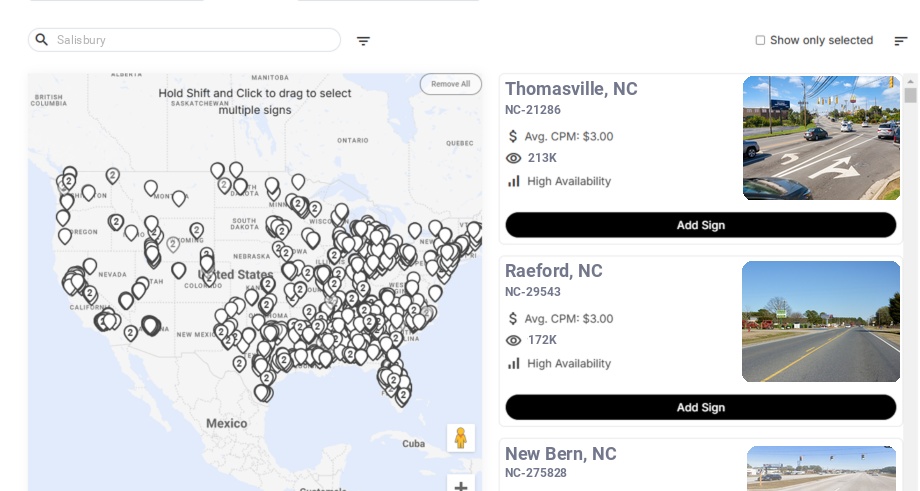
Blip has digital billboards in Salisbury. You can browse available locations on a map, choose the ones that fit your audience, and start advertising right away.
Still have questions? Launch a campaign in minutes — no contracts, no commitments.
Start Your CampaignSalisbury Billboard Advertising Guide
Salisbury is one of those North Carolina markets where billboard advertising can work harder than the market size alone might suggest. The City of Salisbury had 35,580 residents in 2020, and Rowan County 146,875, giving us a solid local base plus a larger county trade area. We also benefit from Salisbury’s position on Interstate 85, roughly 45 miles northeast of Charlotte and about 55 miles southwest of Greensboro Cheerwine Festival, the NC Transportation Museum High Rock Lake
Salisbury Market Overview
Salisbury and Rowan County give us both local reach and corridor reach.
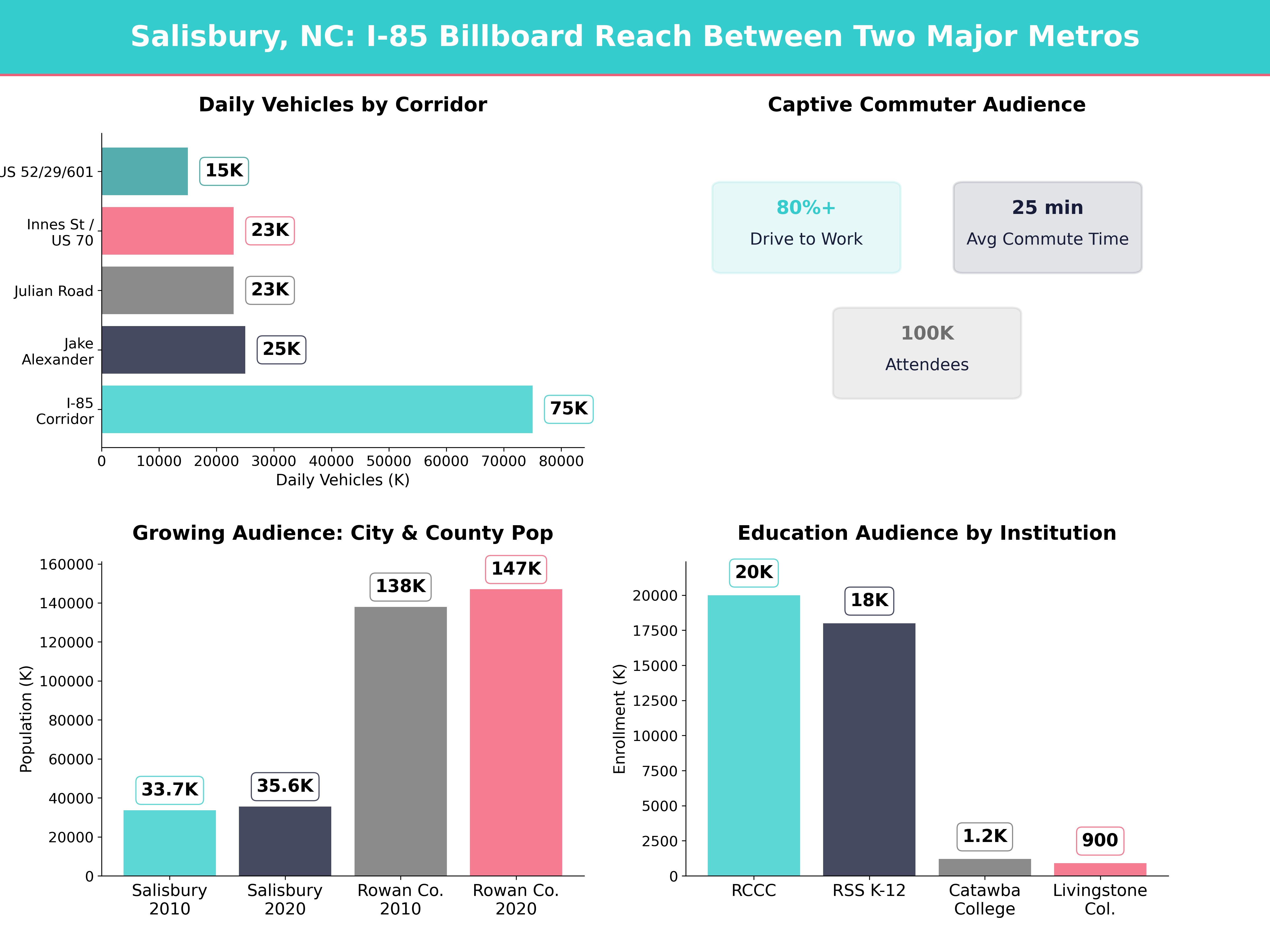
According to population data compiled by the North Carolina Office of State Budget and Management, Salisbury grew from 33,663 residents in 2010 to 35,580 in 2020. That was a gain of 1,917 people, or about 5.7% over the decade. Rowan County grew from 138,428 residents in 2010 to 146,875 in 2020, which was an increase of 8,447 people, or about 6.1%.
That pattern matters for advertisers because Salisbury is not an isolated small city. It functions as the commercial and institutional center for a broader county audience that also includes Spencer East Spencer Granite Quarry Rockwell, Faith China Grove Charlotte region and the central Piedmont.
Salisbury is still a strongly auto-oriented market.
For billboard advertisers, Salisbury’s mobility pattern is a major advantage. Planning work from the Salisbury-Rowan Metropolitan Planning Organization North Carolina Department of Transportation point to an overwhelmingly car-based market, with well over 80% of workers commuting by private vehicle. Typical commute times are in the mid-20-minute range, or about 25 minutes, which gives us repeated exposure opportunities on the same corridors day after day.
That is especially useful for categories that benefit from frequency rather than one-time impressions. Healthcare providers, attorneys, colleges, restaurants, home services, auto dealers, retail centers, and local events all gain from seeing the same audience multiple times each week on familiar routes.
The local economy mixes headquarters, healthcare, education, manufacturing, and logistics.
Salisbury has a practical, work-oriented economy that supports straightforward billboard messaging. Food Lion 1,100 stores across 10 states, and that gives the city a visible corporate anchor. Novant Health Rowan Medical Center 268-bed hospital, which supports healthcare traffic from Salisbury and surrounding communities.
Education also expands the audience mix. Catawba College enrolls roughly 1,200 students, and Livingstone College enrolls roughly 900 students. Rowan-Salisbury Schools serves more than 18,000 students, and Rowan-Cabarrus Community College 20,000 curriculum and continuing education students annually across its service area.
For advertisers, that means Salisbury is not a one-note market. We can reach year-round residents, young adults, parents, healthcare users, county workers, and regional commuters in a compact geography.
Key Traffic Corridors for Digital Billboards in Salisbury
Interstate 85 is Salisbury’s biggest regional billboard spine.
If we want broad reach, Interstate 85 is the first corridor to evaluate. NCDOT traffic count maps regularly show Salisbury-area I-85 segments above 70,000 vehicles per day, with some counts rising into the 80,000s near busier interchanges. That gives us exposure to local commuters, commercial traffic, and travelers moving between Charlotte, Salisbury, Lexington, and the Triad.
This corridor works especially well for several advertiser types. Quick-service restaurants, travel centers, and hotels benefit because I-85 drivers are actively deciding where to stop. Regional healthcare, colleges, and legal services benefit because the interstate reaches households far beyond Salisbury city limits. Tourism and attractions benefit because I-85 brings in weekend travelers headed to downtown Salisbury, High Rock Lake Kannapolis, and the Charlotte Motor Speedway.
Julian Road and the I-85 retail district are strong for high-intent consumer spending.
The Julian Road interchange area is one of Salisbury’s clearest retail nodes. NCDOT counts commonly show sections of Julian Road above 20,000 AADT, often in the 20,000 to 25,000 AADT range, which is substantial for a city this size. This area captures local shoppers, meal traffic, and drivers exiting I-85 for retail, fuel, and errands.
For billboard planning, Julian Road works best when we want consumers who are already close to a purchase decision. Local restaurants, furniture stores, urgent care clinics, dental groups, wireless providers, and family entertainment brands usually fit well here because the audience is already in shopping mode.
Jake Alexander Boulevard and U.S. 601 deliver all-day local circulation.
Jake Alexander Boulevard is one of Salisbury’s most useful local frequency routes. Depending on the segment, NCDOT counts often place this corridor in the 20,000 to 30,000 AADT range. Because it loops around key commercial areas and connects to major streets, it is excellent for advertisers who need repeat impressions instead of only pass-through reach.
We usually like this corridor for healthcare and professional services, because residents use it for routine trips. We usually like this corridor for home services, because homeowners see the same message on recurring errands. We usually like this corridor for local retail and grocery-adjacent offers, because the road ties together everyday trip patterns.
Innes Street and U.S. 70 connect downtown, west Salisbury, and county traffic.
Innes Street, which carries U.S. 70 through Salisbury, is another high-value corridor. Busier commercial segments often exceed 20,000 AADT, generally around 20,000 to 25,000 AADT, and the route links downtown Salisbury with western retail areas and county travel beyond the city. That makes it a good fit for businesses that need both local awareness and practical wayfinding.
This is a particularly strong corridor for event promotion. If we are advertising a downtown festival, performing arts event, church event, seasonal sale, or medical practice, U.S. 70 gives us both neighborhood relevance and broader cross-town reach.
U.S. 52, U.S. 29, and southeastern approaches matter for industrial and commuter audiences.
Salisbury also benefits from the cluster of routes feeding industrial, warehouse, and county travel patterns. U.S. 52, U.S. 29, and U.S. 601 connect Salisbury with Granite Quarry, Spencer, China Grove, and other Rowan County communities. On these roads, traffic counts vary more by segment, but many sections fall in the 10,000 to 20,000 AADT range, with higher counts closer to major junctions.
These routes are useful when we want to reach shift workers and industrial employees traveling at fixed times each day. These routes are useful when we want to reach county residents who do not spend much time downtown, but still shop or work in Salisbury. These routes are useful when we want to reach blue-collar household decision makers for categories like HVAC, roofing, tires, banking, fast food, and discount retail.
Audience Segments We Can Reach in Salisbury
Salisbury commuters are the core year-round audience.
Our base audience in Salisbury is the daily driver. More than 4 out of 5 local workers commute by personal vehicle, and many of them use the same routes every weekday. That gives us a classic billboard advantage: frequency.
For local brands, this audience responds well to practical messages. Price-point offers, convenient locations, same-day appointments, phone numbers with memorable patterns, and directional cues all perform well because commuters are already thinking about errands and services.
Salisbury’s student audience is larger than many advertisers assume.
Salisbury has a meaningful education footprint for a city of 35,580. Catawba College, founded in 1851, and Livingstone College, founded in 1879, bring in students, faculty, staff, visiting families, and alumni traffic. We also have Rowan-Salisbury Schools with more than 18,000 students, and Rowan-Cabarrus Community College 20,000 students annually across its broader service area.
That creates several useful billboard audiences. Traditional college students respond to apartments, food, entertainment, banking, and healthcare. Parents of K-12 students respond to family services, tutoring, pediatric care, and seasonal retail. Faculty, staff, and visiting families respond to restaurants, hotels, real estate, and event promotion.
Salisbury also has a strong visitor and event audience.
Tourism in Salisbury is not only about long vacations. It is heavily event-driven and weekend-oriented, which is ideal for short, timed digital billboard flights. The Cheerwine Festival in downtown Salisbury has drawn more than 100,000 attendees. Bell Tower Green adds a 15-acre downtown gathering space that keeps events, concerts, and community programming visible.
The county’s leisure assets widen the catchment further. High Rock Lake 15,180 acres and offers roughly 365 miles of shoreline, which creates warm-weather visitation from across the region. The NC Transportation Museum 57-acre site in Spencer, and the former Spencer Shops once employed about 3,000 workers at their peak, giving the attraction deep regional recognition.
Healthcare, distribution, and regional workers add a practical daytime audience.
Salisbury’s daytime population is shaped by work trips. Healthcare users travel to Novant Health Rowan Medical Center Food Lion 350-acre North Carolina Research Campus in Kannapolis. That flow is useful for B2C advertisers, but it also works for B2B messaging, workforce recruitment, training programs, and local business services.
Seasonal and Timing Opportunities in Salisbury
Spring in Salisbury is ideal for events, healthcare, and home services.
Spring is one of the best advertising windows in Salisbury because local calendars get busy fast. Downtown activity rises, college campuses are active, and community events build toward May. The Cheerwine Festival gives us a clear seasonal anchor, and commencement season at Catawba College and Livingstone College adds family travel.
We often like to launch spring campaigns 4 to 6 weeks before major events. That timing works especially well for restaurants, boutiques, financial services, real estate, med spas, urgent care, and home improvement brands.
Summer in Salisbury is about lakes, weekends, and heat-driven spending.
From Memorial Day through Labor Day, Salisbury benefits from leisure traffic to High Rock Lake
This is also a good season to target Friday afternoon and Saturday daytime traffic. If we want recreational or dining audiences, we can daypart more heavily into the 11 a.m. to 7 p.m. window instead of buying evenly across every hour.
Fall in Salisbury gives us a dense mix of school, sports, and routine traffic.
Back-to-school season resets local travel patterns in a big way. Rowan-Salisbury Schools typically return in August, and college calendars bring students back to Catawba College and Livingstone College. That makes late July through September one of the best periods for family retail, healthcare, tutoring, internet providers, apartment marketing, and food brands.
Fall also brings football weekends, downtown programming, and county events. If we want to reach regional sports and entertainment traffic, Salisbury sits within an easy drive of Concord Charlotte Motor Speedway, which is roughly 30 miles south. That regional movement can support hotels, restaurants, bars, and event-related creative.
Winter in Salisbury favors holiday retail, healthcare, and destination messaging.
Late November and December are strong for retail and family entertainment. The NC Transportation Museum Downtown Salisbury, Inc. and local partners.
After the holidays, January and February are often better for practical categories than aspirational ones. Tax services, healthcare, fitness, legal services, banking, insurance, and value-oriented retail usually fit the post-holiday mindset well.
Salisbury Billboard Design Tips for the Local Market
In Salisbury, local familiarity usually beats slick generic creative.
Salisbury has a proud local identity, and we should respect that in our billboard design. The market responds well to visuals that feel rooted in place, such as downtown brick architecture, train heritage, lakeside recreation, campus life, and family-centered community scenes. We do not need to be overly nostalgic, but we should look authentic.
This is also a city with recognizable local symbols. Cheerwine, founded in Salisbury in 1917, is part of the city’s public identity, even for people who are not visiting the festival. Creative that uses bold reds, deep blues, heritage-inspired fonts, or classic Carolina imagery can feel more natural here than ultra-minimal luxury styling that looks imported from a much larger metro.
We should design for speed on I-85 and repetition on local arterials.
On interstate-facing inventory, we need concise creative because drivers are moving at 65 to 70 mph. In most cases, 6 to 8 words is a better target than a full sentence. A strong brand mark, one clear offer, and one simple action usually outperform more complicated layouts.
On city and county arterials, we can get slightly more specific because speeds are lower and frequency is higher. That is where address cues, directional language, neighborhood references, and short promotional copy can work. In Salisbury, the audience often sees the same board repeatedly, so consistency matters as much as novelty.
Family value, convenience, and trust tend to resonate in Salisbury.
Because Salisbury blends working families, students, retirees, and county residents, trust-oriented creative often performs well. Messages like “Same-Day Appointments,” “Open Late,” “Minutes Off I-85,” “Locally Trusted,” and “Now Leasing” fit the market well. So do straightforward price or savings claims, especially in healthcare, food, retail, and home services.
If we are speaking to students or younger adults, we can shift slightly toward energy and urgency. If we are speaking to county households or older commuters, clarity and usefulness usually win.
We should tailor imagery by sub-audience.
For student audiences, imagery that reflects real campus and young-adult life near Catawba College and Livingstone College is more effective than generic stock images. For heritage and tourism audiences, train imagery, historic streetscapes, lake scenes, and downtown event visuals fit naturally. For industrial and commuter corridors, bold typography, directional cues, and service-driven messaging tend to work best.
Regional Strategies Across Salisbury and Rowan County
Downtown Salisbury works best for events, dining, healthcare, and brand-building.
Downtown Salisbury is the right fit when we want people who already spend time in the urban core. This is where proximity to Bell Tower Green, Downtown Salisbury, Inc., Historic Salisbury Foundation, college campuses, and civic destinations matters most. Creative here can be more community-oriented because the audience is closer to the destination.
We usually prefer downtown-oriented inventory for restaurants, boutiques, civic campaigns, healthcare groups, banks, apartments, entertainment venues, and event organizers.
The I-85 and Julian Road zone is Salisbury’s best conversion corridor.
If our goal is to capture high-intent shoppers, travelers, and drivers looking for a stop, the I-85 and Julian Road area is usually the top choice. This part of Salisbury catches both local demand and out-of-market traffic. It is especially strong for hotels, chain restaurants, gas and convenience brands, urgent care, retail, and any advertiser that benefits from “next exit” behavior.
When we evaluate boards here, we should think carefully about travel direction. Northbound and southbound drivers often have different intent, especially around meal periods and weekend traffic.
Spencer and East Spencer give us heritage, attraction, and neighborhood relevance.
Spencer East Spencer NC Transportation Museum
This submarket is particularly effective when we want to catch weekend visitors heading to museum events, rail-themed programming, and holiday experiences.
Granite Quarry, Faith, Rockwell, and China Grove help us extend beyond the city core.
The eastern and southern sides of the market matter because many county households do not spend all of their time downtown. Granite Quarry Faith Rockwell, and China Grove
South of Salisbury, the connection to Kannapolis, Concord Mooresville strengthens the case for regional campaigns. If our service area runs beyond Rowan County, we should think of Salisbury as part of a broader I-85 and NC 150 movement pattern rather than a stand-alone city.
Using Blip Tools in Salisbury
Manual placement works well when we know the exact corridor we want.
Salisbury is compact enough that a manual campaign can be very efficient. If we know we want I-85 travelers, downtown event-goers, or county commuters on a specific route, we can hand-pick a focused set of digital billboards and keep the campaign tight. That is useful for openings, event countdowns, weekend promotions, and localized lead generation.
Blip-optimized campaigns are useful when our audience is broader than one neighborhood.
If our goal is countywide awareness, or if we also serve Kannapolis, Concord
Dayparting matters in Salisbury because travel intent changes by hour.
In a commuter-heavy market like Salisbury, the hour of the day changes the audience. Morning runs, roughly 6 a.m. to 9 a.m., are strong for coffee, breakfast, healthcare reminders, colleges, and employer branding. Midday, roughly 11 a.m. to 2 p.m., can be better for restaurants, retail, and errands. Afternoon and early evening, roughly 4 p.m. to 7 p.m., are ideal for home services, dinner, family entertainment, and urgent care.
Because Salisbury also has event spikes, we can shift budget around specific weekends instead of staying flat all month. That is one of the biggest advantages of digital buying in this market.
Real-time learning is especially valuable in a mid-sized market.
Salisbury is large enough to show meaningful traffic patterns, but compact enough that changes become visible quickly. That means we can test one creative concept against another, compare commuter-heavy boards against retail-heavy boards, and learn where engagement appears strongest. We should treat the first 2 to 4 weeks as a structured test period, then refine based on results.
Getting Started with Billboard Rental in Salisbury
We should start by matching the location to the business goal.
The easiest way to choose a Salisbury billboard is to decide what we want the board to do. If we need broad awareness, we should lean toward I-85 and major arterial routes. If we need immediate customer action, we should prioritize retail and service corridors close to the business. If we need event attendance, we should focus on the roads that feed downtown Salisbury, Bell Tower Green, and key attraction zones.
In Salisbury, proximity often beats sheer volume.
A board with lower traffic can still be the better choice if it sits directly on the route our customer uses before a purchase. That is why local service businesses should not evaluate boards only by the largest traffic number. In many Salisbury campaigns, the best-performing locations are the ones that combine solid traffic, repeated exposure, and clear connection to the destination.
We should evaluate each board using four simple filters.
- Audience fit should come first, because commuters, students, lake visitors, and downtown event-goers do not use the same roads.
- Travel direction should come second, because inbound and outbound traffic can imply different intent.
- Speed and read time should come third, because interstate creative needs to be simpler than city-street creative.
- Distance to action should come fourth, because boards closer to an exit, business, or event often convert better.
Blip makes Salisbury billboard rental easier to test and refine.
Traditional billboard buying often forces us into longer commitments, slower approvals, and less flexibility than a mid-sized market really needs. Salisbury is a place where seasonality, event timing, and corridor selection matter, so flexibility is valuable. With Blip, we can launch quickly, adjust creative when school or event calendars change, pause underperforming boards, and shift spend toward the corridors that are proving themselves.
For many advertisers, the best first move is a modest Salisbury test campaign with a clear objective, a tight geography, and 1 or 2 creative variations. Once we see which corridors and time windows perform best, we can scale confidently across Salisbury and the rest of Rowan County.