Billboards in Lillington, NC
No Minimum Spend. No Long-Term Contracts. Just Results.
Trusted by Leading Brands


Billboard advertising
in Lillington has never been easier
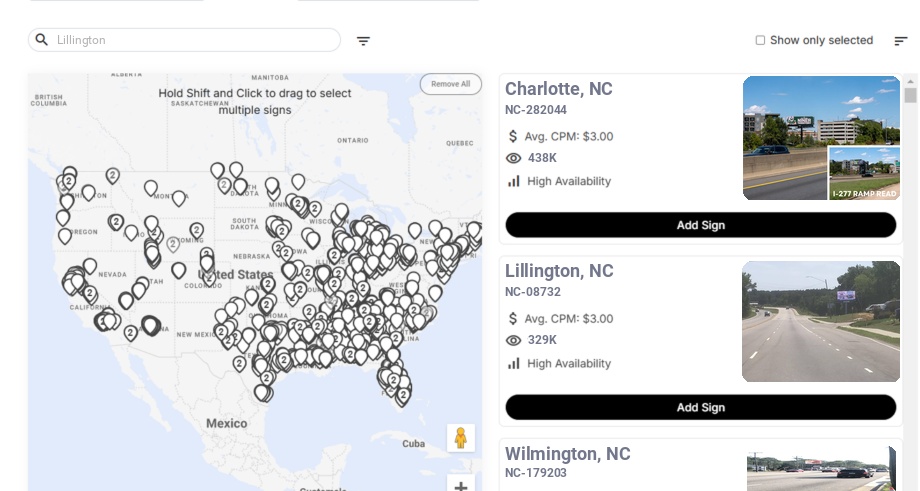



How much is a billboard in Lillington?
Why Choose Blip for Billboard Advertising in Lillington
-
Blip lets you self-serve Lillington billboards in minutes, ideal for US 401 and US 421 commuters who drive the same routes daily.
-
In Lillington, flexible Blip budgets help you test ads near Campbell University and Raven Rock State Park without long-term contracts.
-
Use Blip dayparting in Lillington to hit morning and evening traffic on NC 210, NC 27, and US 401 when drivers are most attentive.
-
Lillington campaigns on Blip stay nimble: pause, adjust, or scale as Harnett County growth and cross-county travel patterns shift.
-
Real-time Blip analytics show what works in Lillington, so you can refine creative for commuters, students, and weekend visitors fast.
-
Blip's creative tools make it easy to build Lillington ads with clear local messages like '5 Minutes from Campbell' or 'On US 401.'
Frequently Asked Questions About Billboard Advertising in Lillington
How much does a billboard cost in Lillington with Blip?
Pricing starts at just $0.01 per display. Each “blip” is a 7.5-to-10-second display on a rotating digital billboard, and the cost per blip can change based on time of day, location, and advertiser demand while still aiming to maximize your reach. Your daily budget helps Blip’s algorithm bid on open ad slots, and your total cost is simply the sum of the blips your ad earns over time.
Where can I advertise with Blip in Lillington?
Lillington’s movement pattern is highway-led rather than transit-led, and the main routes shaping the market are US 401, US 421, NC 210, NC 27, and the eastern pull of I-95. US 401 connects Lillington to Fuquay-Varina, Raleigh, and the Fayetteville area, while US 421 ties it to Campbell University in Buies Creek, Sanford, Dunn, and I-95. These corridors create repeated exposure because many local trips flow onto a limited set of highways.
Why is billboard advertising in Lillington good for reaching local drivers?
Recent census estimates consistently place drive-alone commuting above 80%, and mean travel times are around 30 minutes. That tells us many people here spend real time in the car and make the same trips on the same roads day after day. This is exactly the kind of environment where digital billboards can deliver both reach and repetition.
What kinds of audiences can Blip reach in Lillington?
Lillington is a layered market where commuters, students, families, and weekend visitors all use overlapping roads for different reasons. Campbell University adds a steady education audience, Harnett County Schools serves about 20,000 students, and Raven Rock State Park brings hikers, campers, paddlers, and day-trippers into western Harnett County. That mix gives campaigns both local consistency and regional spillover.
When is the best time to run billboard ads in Lillington?
The most effective campaigns often change by season rather than running the same creative all year. Spring is one of the strongest local advertising windows, summer supports family schedules and travel habits, and fall is another prime window because school and campus routines become more structured. From November through January, retail, restaurants, gift-oriented services, churches, and charitable campaigns often perform well.
Do I need a contract to advertise with Blip in Lillington?
No, Blip has no long-term contracts or minimum commitments. You can start, pause, or stop your campaign at any time.
How fast can I launch a billboard campaign with Blip in Lillington?
You can have your campaign live in minutes. Create a free account, select your locations, set your budget, upload your design, and start running once approved.
Where can I advertise with Blip in Lillington?
Blip has digital billboards in Lillington. You can browse available locations on a map, choose the ones that fit your audience, and start advertising right away.
Still have questions? Launch a campaign in minutes — no contracts, no commitments.
Start Your CampaignLillington Billboard Advertising Guide
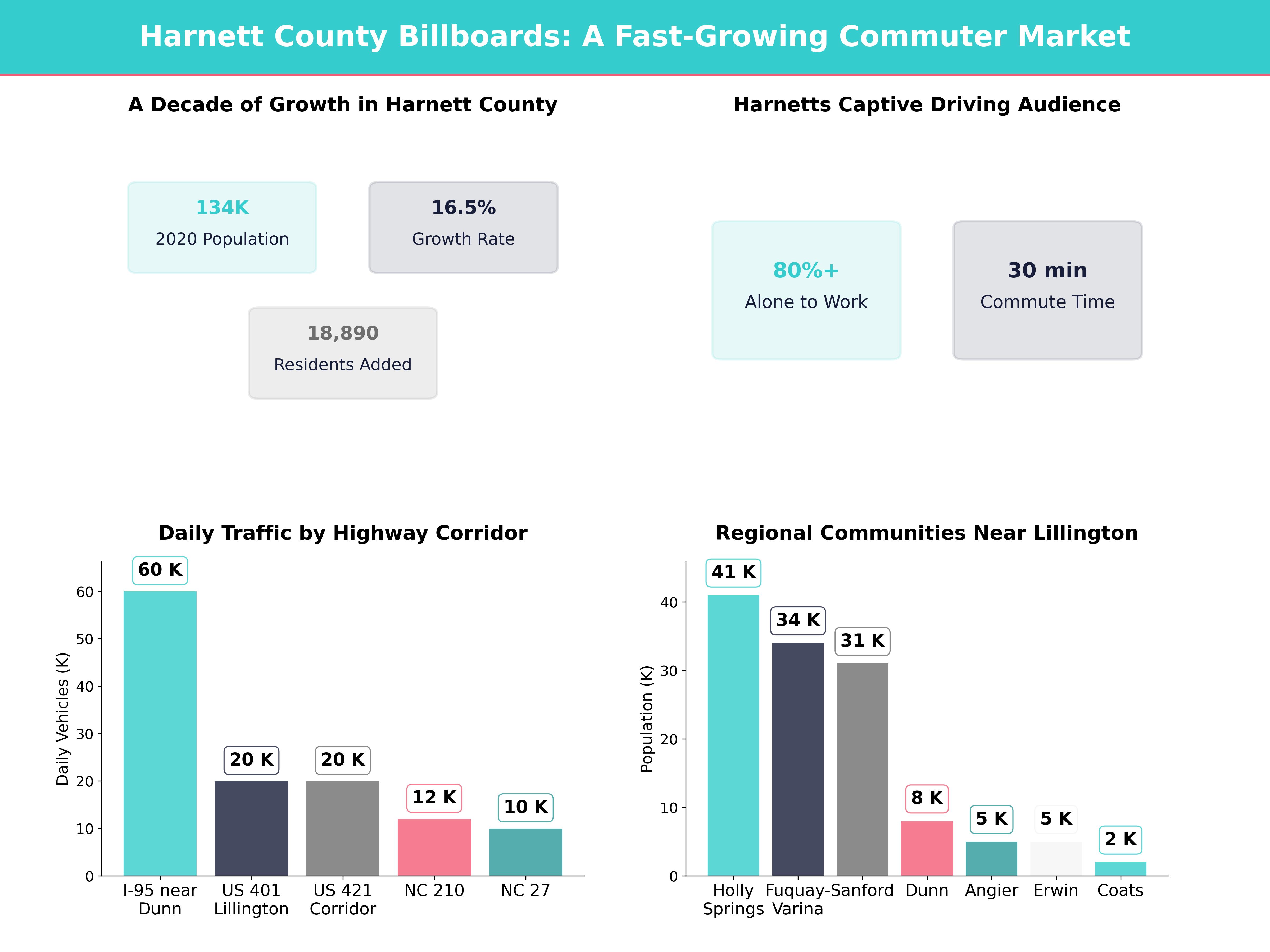
Lillington may be modest in size, but it sits at the center of one of central North Carolina’s most useful billboard trade areas. Harnett County counted 133,568 residents in 2020, up from 114,678 in 2010, which means the county added 18,890 people in one decade for growth of about 16.5%. Because daily life here depends heavily on driving, with recent census estimates showing drive-alone commuting above 80%, roadside advertising can build frequency quickly. We also benefit from a mix of county-seat activity, Campbell University, and outdoor visitation tied to Raven Rock State Park, which gives campaigns both local consistency and regional spillover.
Lillington Market Overview
Lillington works best when we think beyond the town limits and focus on the wider Harnett County trade area. The county stretches across 601 square miles, so trips for work, school, shopping, healthcare, and recreation naturally flow onto a limited set of highways. That pattern gives billboard advertisers an advantage, because repeat travel on the same roads creates repeated exposure.
The local market is stronger than many advertisers expect. Harnett County sits between Wake County, which had 1,129,410 residents in 2020, Cumberland County 335,509, and Lee County, which had 63,285. That position matters because Lillington is not only a county seat, but also a connector between the fast-growing south Wake corridor and the Fayetteville region.
Nearby communities add meaningful reach. Angier had 5,265 residents in 2020, Dunn had 8,446, Erwin had 4,695, Coats 2,149, Sanford 30,542, Fuquay-Varina 34,152, and Holly Springs 41,239. Those numbers show why Lillington campaigns can serve both local and regional objectives.
The economic base is varied enough to support many advertiser categories. Harnett County Economic Development actively markets the county for manufacturing, logistics, agribusiness, and life sciences. The county seat brings government and legal traffic into Lillington during the workweek, Campbell University adds a steady education audience, and healthcare draws residents toward providers in Lillington, Dunn, Sanford, Raleigh, and Fayetteville
For billboard advertisers, the commuting pattern is especially important. Recent census estimates consistently place drive-alone commuting above 80%, and mean travel times are around 30 minutes, which tells us two things. First, people here spend real time in the car. Second, many of them make the same trips on the same roads day after day. That is exactly the kind of environment where digital billboards can deliver both reach and repetition.
Key Traffic Corridors for Digital Billboards in Lillington
Lillington’s movement pattern is highway-led rather than transit-led. Exact traffic counts vary by segment and year on North Carolina Department of Transportation maps, but the hierarchy of roads is clear: US 401, US 421, NC 210, NC 27, and the eastern pull of I-95
US 401 in Lillington
US 401 is one of the most important billboard corridors for Lillington because it connects the town to Fuquay-Varina Raleigh, and the Fayetteville area. On busier Lillington-area segments, NCDOT traffic counts commonly fall in the 15,000 to 20,000 vehicles-per-day range, with volumes generally climbing as the route approaches larger suburban retail areas.
That makes US 401 especially strong for advertisers that benefit from repeated weekday exposure.
- Healthcare, dental, and urgent care providers can stay visible to residents who commute north or south for work and errands.
- Home services, auto repair, and legal firms can use the corridor’s repetition to build name recognition before a need becomes urgent.
- Quick-service restaurants, convenience retailers, and fuel brands can target immediate action with location-based messaging.
US 421 through Lillington, Buies Creek, and toward Dunn
US 421 is the second core route because it ties Lillington to Campbell University in Buies Creek, to Sanford Dunn and I-95 to the southeast. Depending on the segment, NCDOT counts in the broader corridor often range from roughly 10,000 to 20,000+ vehicles per day.
This route is ideal when we want to blend local frequency with broader market circulation.
- Restaurants, coffee shops, apartments, and student services can reach the Campbell audience and nearby residents.
- Regional healthcare systems, including Cape Fear Valley Health and Central Carolina Hospital, can use the corridor to influence patients who compare providers across county lines.
- Retail, entertainment, and event advertisers can capture leisure traffic heading between communities on evenings and weekends.
NC 210 and NC 27 in the Lillington trade area
NC 210 and NC 27 matter because they collect smaller but highly relevant trips. In growing Harnett segments, NC 210 often runs around 8,000 to 12,000 vehicles per day, while NC 27 commonly falls in the 6,000 to 10,000 range on busier approaches. Those are not interstate-style counts, but they are very useful volumes for local advertisers because the audience is highly concentrated in household decision-makers.
We usually like these roads for:
- Schools, childcare, family dining, and grocery-adjacent retail, because these routes capture practical daily errand traffic.
- Churches, community organizations, and local events, because the audience is geographically close to the message.
- Insurance, financial services, and real estate, because familiarity matters in smaller communities.
I-95 access through Dunn and eastern Harnett County
Even when our business is based in Lillington, eastern Harnett County can extend a campaign’s reach. Near Dunn, I-95 carries well over 50,000 vehicles per day on many segments, and some counts push into the 60,000-plus range. That traffic is less local and more transient, but it is valuable for categories that benefit from travelers, truckers, and regional movement.
We should prioritize I-95-linked placements when we want to reach:
- Hotels, gas stations, travel centers, and restaurants that win business from pass-through drivers.
- Personal injury firms, emergency care, and roadside services that need scale and urgency.
- Attractions and family destinations that can pull visitors off the interstate and into Harnett County.
Audience Segments We Can Reach in Lillington
Lillington is not a one-audience market. It is a layered market where commuters, students, families, and weekend visitors all use overlapping roads for different reasons.
Commuters and cross-county workers in Lillington
Commuters are the backbone of billboard reach here. Harnett County’s 133,568 residents sit within practical driving distance of jobs in Wake County, Cumberland County Lee County. With drive-alone commuting above 80% and average travel times around 30 minutes, we can expect many workers to see the same boards several times per week.
This is a strong audience for:
- Financial institutions, because commuting households often make long-term decisions about banking, lending, and insurance close to home.
- Medical and dental providers, because repeated exposure improves recall when an appointment is needed.
- Home improvement, auto sales, and repair brands, because these categories benefit from familiarity and trust.
Students, faculty, and campus visitors near Lillington
Campbell University is one of the area’s most important audience generators. The university traces its history to 1887, and its total enrollment is more than 5,000 students across undergraduate, graduate, and professional programs. The main campus in Buies Creek sits only about 6 miles south of downtown Lillington, which means the school’s daily influence extends directly into the Lillington corridor.
This audience responds especially well to billboard campaigns for apartments, restaurants, coffee, banking, healthcare, technology services, and campus-adjacent retail. It also creates timing opportunities around move-in, homecoming, sports seasons, and graduation. When Campbell Athletics
Families and household decision-makers in the Lillington area
Families are a major part of the market. Harnett County Schools serves about 20,000 students, and family-oriented communities such as Angier, Coats Erwin, and Lillington generate steady demand for healthcare, groceries, childcare, tutoring, home services, recreation, and fast casual dining.
For this segment, billboard advertising works best when we connect the message to convenience. Phrases like “Open Saturday,” “5 Minutes Ahead,” and “Appointments This Week” usually fit the local decision pattern better than abstract branding alone.
Outdoor visitors and weekend leisure traffic around Lillington
Outdoor recreation adds a distinct weekend audience. Raven Rock State Park is famous for its 150-foot rock formation above the Cape Fear River, and it brings hikers, campers, paddlers, and day-trippers into western Harnett County. Visit Harnett also promotes the county’s river access, local dining, and small-town experiences.
This audience is valuable for restaurants, specialty retail, agritourism, event venues, and local attractions. Weekend-focused messaging can work especially well when we pair it with direction-based placements on approach routes.
Seasonal and Timing Opportunities in Lillington
Seasonality matters in Lillington because the market blends school calendars, outdoor recreation, commuting habits, and weather-driven demand. The most effective campaigns often change by season rather than running the same creative all year.
Spring billboard opportunities in Lillington
Spring is one of the strongest local advertising windows. Milder weather increases visitation to Raven Rock State Park, and tax-refund season often boosts spending on vehicles, furniture, healthcare, and home upgrades. This is also the run-up to graduation, with college and K-12 households making decisions in April and May.
We typically like spring for:
- Outdoor recreation and hospitality campaigns.
- Home improvement, lawn care, and garden retailers.
- Graduation-related retail, dining, and photography offers.
Summer demand in Lillington
From June through August, local campaigns should reflect heat, family schedules, and travel habits. Summer is a strong season for HVAC, cold beverages, pools, quick-service dining, entertainment, and healthcare reminders before school resumes. If we want to capture road-trip traffic, summer is also the right time to expand into Dunn and I-95-oriented inventory.
Summer is also part of Atlantic hurricane season, which runs from June 1 through November 30. That timing can support practical messaging for generators, storm cleanup, roofing, insurance, pharmacies, and hardware retailers.
Fall timing around schools and sports in Lillington
Fall is another prime window because daily routines become more structured. Harnett County Schools return in August, and Campbell University brings students back at roughly the same time. From late August through November, football and fall events add extra weekend movement.
This is a great season for:
- Back-to-school healthcare, eye care, tutoring, and family retail.
- Campbell-area dining, housing, and student services.
- Political, civic, and community messaging when local awareness matters.
Winter and holiday campaigns in Lillington
From November through January, we usually see stronger performance from retail, restaurants, gift-oriented services, churches, and charitable campaigns. Early January through April also works well for tax services, legal firms, wellness offers, and New Year resolution categories like fitness or primary care.
Because daylight is shorter in winter, high-contrast digital creative becomes even more important. Messaging should stay crisp, bright, and easy to read from a distance.
Billboard Design Tips for the Lillington Market
Creative that works in Lillington usually feels practical, local, and direct. We are speaking to people who drive for work, who know the region well, and who often make decisions around convenience and trust.
Lead with practicality, value, and proximity in Lillington
Lillington audiences often respond better to clear utility than to abstract brand language. We should emphasize what we offer, where we are, and why the stop is easy. Distance-based copy is especially useful here because drivers think in terms of roads, exits, and minutes.
Strong local-style approaches include:
- “5 Minutes from Campbell.”
- “On US 401 in Lillington.”
- “Open Saturdays.”
- “Same-Week Appointments.”
- “Family Meals Ahead.”
These messages fit the county’s road-oriented behavior better than slogan-only creative.
Use imagery and colors that feel native to Lillington
Local relevance matters. Outdoor brands can lean into greens, blues, and natural imagery that echoes the Cape Fear River corridor and Raven Rock State Park. Campus-oriented creative can borrow the energy of fall sports and the orange-and-black palette associated with Campbell University, as long as we avoid implying an official school endorsement.
For family and home-service categories, polished big-city visuals can feel out of place. We usually do better with approachable photography, straightforward typography, and warm community cues that reflect small-town trust.
Match the design to speed and route purpose
A board on a corridor moving at 45 to 55 mph should not carry the same message as a board near a slower retail approach. On faster roads, we should keep the message to one idea, one brand, and one action. On local connectors, we can be a little more specific, especially if the board is close to the business.
For Lillington specifically, we like to tailor creative by corridor:
- On commuter routes, we emphasize speed, convenience, financing, or appointments.
- On campus routes, we emphasize food, housing, events, and student life.
- On leisure routes, we emphasize discovery, dining, family fun, and weekend plans.
Regional Strategies Around Lillington
The smartest billboard strategy in Lillington is usually not one-size-fits-all. Different sub-areas behave differently, and our creative should reflect that.
Downtown Lillington and the county-seat core
The core of Lillington works well for services tied to daily civic life. County government, legal traffic, banks, restaurants, and healthcare all benefit from being visible near the seat of county activity. If we want credibility and familiarity among local residents, this is the first area we should evaluate.
This submarket is especially good for:
- Law firms and insurance agencies.
- Local restaurants and coffee shops.
- Clinics, pharmacies, and service businesses.
North from Lillington toward Angier, Fuquay-Varina, and Wake County
The northbound strategy is about growth and commuting. Angier at 5,265, Fuquay-Varina 34,152, and Holly Springs 41,239 create a meaningful suburban arc that feeds into larger Wake County employment centers. This is where we should concentrate if our goal is to reach people with rising household formation, long commute habits, and strong family spending.
Morning and evening dayparts matter here. Southbound boards can work well in the evening return commute, while northbound boards can be effective in the morning.
South and southeast from Lillington toward Buies Creek, Erwin, Dunn, and I-95
This strategy combines campus traffic, working-class household traffic, and long-distance travel. Erwin at 4,695 and Dunn at 8,446 extend reach into eastern Harnett County, while I-95 adds a much broader pool of pass-through drivers.
We should use this region when we want:
- Student and visitor traffic near Campbell.
- Restaurant, fuel, hotel, and travel-oriented demand.
- Broader regional visibility than Lillington alone can provide.
West from Lillington toward Sanford and Lee County
The western strategy helps when our offer competes in a broader regional market. Sanford 30,542 residents, and Lee County has 63,285. This corridor can be productive for healthcare, industrial recruiting, equipment dealers, and destination retail because people already travel between the areas for work and services.
Blip Tools and Capabilities for Lillington Campaigns
Blip is especially useful in a market like Lillington because we can shape a campaign around how people actually move instead of committing to a rigid one-size-fits-all schedule.
Use Blip dayparting for Lillington traffic rhythms
We can align boards with the audience instead of buying every hour equally. For example, we can prioritize 6:00 to 9:00 a.m. and 4:00 to 7:00 p.m. on commuter-heavy routes like US 401, add midday visibility near county-seat services, and shift more budget to weekends for Raven Rock or dining-focused campaigns.
That approach is helpful because Lillington traffic has clear purpose-based patterns. Commuters, students, and leisure travelers do not move at the same time, so our schedules should not be identical.
Build separate creatives for separate Lillington audiences
Blip makes it practical to version creative by corridor. We can run one message near Campbell University that highlights food, housing, or student services, another on commuter routes that focuses on convenience or financing, and another near Dunn that emphasizes immediate traveler action.
We can also test hyperlocal copy such as “Lillington,” “Buies Creek,” “Dunn,” or “Fuquay-Varina” to see which geography cue produces better response. In a market where trust and proximity matter, that kind of localization can improve results quickly.
Use flexible budgets and analytics to learn the Lillington market
Because Blip lets us buy short 7.5- to 10-second digital placements and pay only when the ad displays, even modest tests are realistic. Campaigns start at $0.01 per display, so we can learn with a small budget before scaling. Real-time reporting also makes it easier to compare corridors, refine schedules, and shift spending toward the boards that best match our goals.
Getting Started with Billboard Rental in Lillington
Renting a billboard in Lillington is easiest when we start with the market shape, not just the map pin. The town itself is small, but the useful advertising geography is much larger.
Define our Lillington radius before we rent
We should decide whether our real target is local, countywide, or regional.
- A 5- to 10-mile radius is best for restaurants, clinics, banks, gyms, and other businesses that depend on nearby households.
- A 15- to 25-mile radius is better for countywide services, healthcare systems, colleges, event venues, and destination retail.
- A broader regional strategy should add commuter routes toward Wake County or travel routes toward Dunn and I-95.
When we define the radius first, we make better billboard choices.
Evaluate each billboard by the action it can drive
The best Lillington billboard is not always the one closest to town. We should ask whether the board reaches the right direction of travel, whether drivers have time to read it, and whether the location is close enough to the business to support action.
We usually evaluate boards using these practical questions:
- Is the board on the correct side of the commuter flow?
- Is the message close enough to a turn, exit, or destination?
- Is the audience local-repeat traffic or pass-through traffic?
- Does the nearby land use match our category, such as retail, healthcare, campus, or travel?
Launch small, optimize quickly, and scale what works in Lillington
Traditional billboard buying can be slow, contract-heavy, and difficult to adjust. Blip simplifies the process by letting us choose inventory on a map, upload creative, set the schedule, and refine the campaign without waiting through a long sales cycle. In a place like Lillington, where different roads serve different audiences, that flexibility is a real advantage.
A smart starting plan is usually simple. We can launch with 2 to 3 boards, run 2 creative versions, monitor results for the first 7 to 14 days, and then expand into the best-performing corridors. If our goal is local action, we should favor high-frequency commuter routes. If our goal is regional awareness, we should widen the net toward Dunn, Sanford, or the Wake County edge.
Lillington rewards advertisers who respect how the market actually moves. When we match the message to the road, the audience, and the season, billboard advertising here can feel much bigger than the town’s footprint suggests.