Billboards in Enid, OK
No Minimum Spend. No Long-Term Contracts. Just Results.
Trusted by Leading Brands


Billboard advertising
in Enid has never been easier



How much is a billboard in Enid?
Why Choose Blip for Billboard Advertising in Enid
-
Blip's self-serve setup lets you launch fast in Enid, targeting U.S. 412/Owen K. Garriott and U.S. 81 without the usual billboard hassle.
-
Set flexible daily budgets in Enid and only pay when your ad plays, so you can test east-side retail or west-side ag traffic without contracts.
-
Use dayparting on Blip to hit Enid's 6-9 a.m. commuters and 4-7 p.m. shoppers on Van Buren and Garriott when they’re most likely to act.
-
Enid campaigns stay nimble with no minimums or contracts, so you can pause, adjust, or scale around harvest, back-to-school, and event weekends.
-
Track Enid performance in real time and shift spend toward the corridors driving results, from hospitals and schools to the downtown event scene.
-
Blip's creative tools help tailor Enid ads for drivers on 412, 81, and west-side freight routes with clear, fast-read messages that stand out.
Frequently Asked Questions About Billboard Advertising in Enid
How much does a billboard cost in Enid with Blip?
With Blip, the cost of billboard advertising in Enid is designed to be flexible and approachable. You set a daily budget, and Blip only charges you when your ad actually appears as a 7.5-to-10-second blip on a rotating digital billboard, starting at just $0.01 per display. Because pricing is dynamic, your cost per blip can vary based on time of day, location, and advertiser demand.
Where can I advertise with Blip in Enid for the best billboard reach?
Enid’s busiest urban portions of U.S. 412 through Owen K. Garriott Road sit in the 20,000-plus AADT class, making it the city’s most important east-west commercial spine. U.S. 81, primarily Van Buren Street, is the main north-south artery and serves both through traffic and local circulation. On the west side, U.S. 60 and related industrial approaches carry important freight, agricultural, and work-trip traffic.
Why is Enid a strong billboard market for Blip?
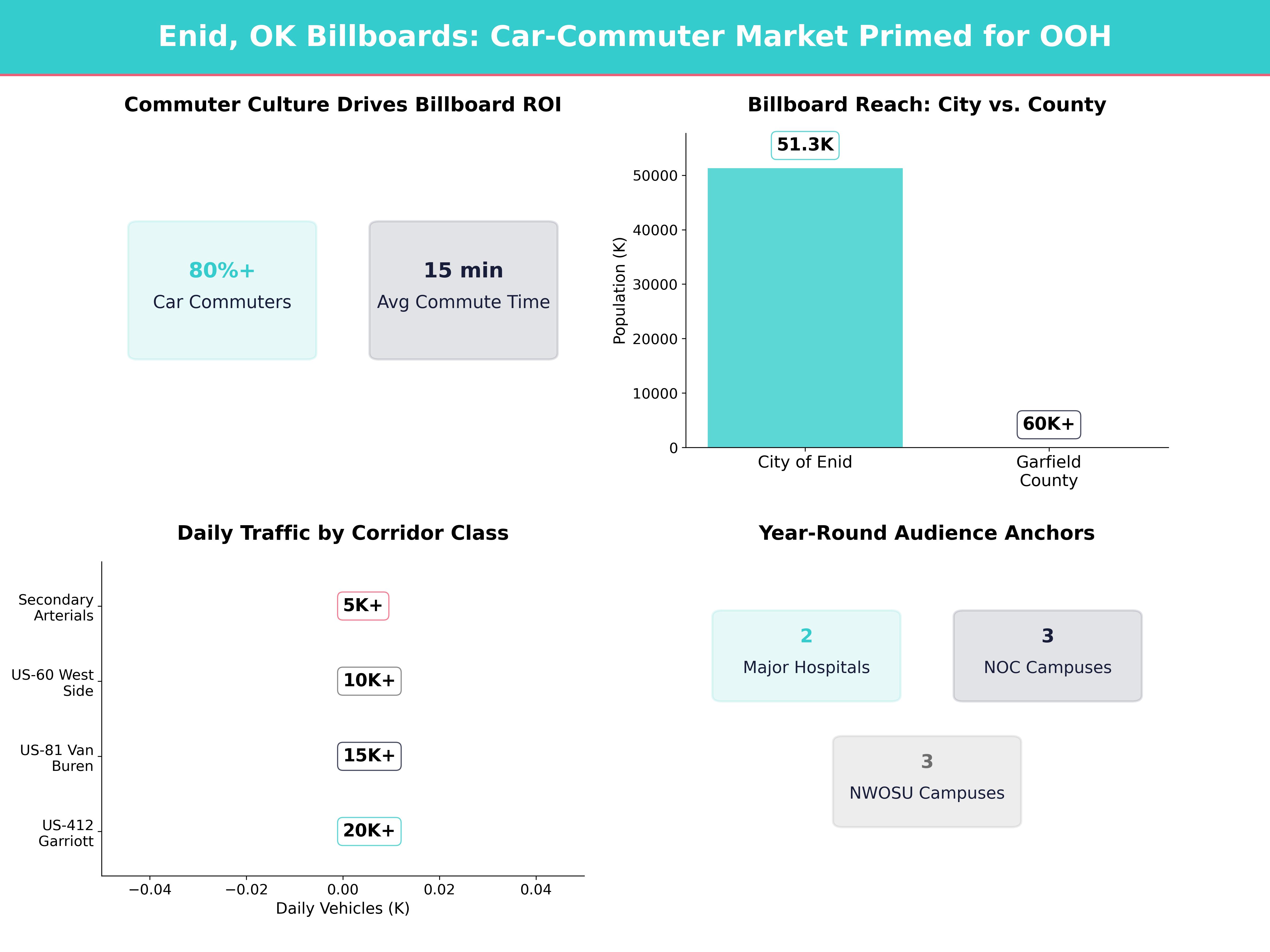
Enid is a strong billboard market because it combines the scale of a regional hub with the travel habits of a highly drive-oriented community, serving 51,308 residents in the city and a 60,000-plus county audience. Roughly 8 in 10 workers commute by car, and average travel time to work is about 15 minutes. That combination is ideal for outdoor advertising because it creates repeated exposures on familiar routes rather than one-off impressions.
What kinds of audiences can I reach in Enid with billboard advertising?
Enid’s value is not just traffic volume, it is audience variety. We can reach daily commuters and errand drivers, regional shoppers and family households, students and education-focused households, military and aviation households, healthcare users and caregivers, and eventgoers. That mix makes Enid a good market for restaurants, retail, healthcare, hiring, and local events.
When is the best time to run billboard ads in Enid with Blip?
Seasonality matters in Enid because agriculture, school schedules, weather, and community events all influence local travel and spending. Strong windows include January through February for tax prep and healthcare, March through May for home projects and graduations, May and June for wheat harvest, and June through August for family activity and back-to-school. Fall is also one of Enid’s best outdoor advertising seasons, with school routines, sports, and holiday ramp-up.
Do I need a contract to advertise with Blip in Enid?
No, Blip has no long-term contracts or minimum commitments. You can start, pause, or stop your campaign at any time.
How fast can I launch a billboard campaign with Blip in Enid?
You can have your campaign live in minutes. Create a free account, select your locations, set your budget, upload your design, and start running once approved.
Where can I advertise with Blip in Enid?
Blip has digital billboards in Enid. You can browse available locations on a map, choose the ones that fit your audience, and start advertising right away.
Still have questions? Launch a campaign in minutes — no contracts, no commitments.
Start Your CampaignEnid Billboard Advertising Guide
Enid 51,308 residents in the city and a 60,000-plus county audience. The City of Enid 51,308, up from 49,379 in 2010, which means the city added 1,929 residents and grew by about 3.9% during the decade.
We also benefit from Enid’s role as the commercial center for Garfield County
Enid Market Overview for Billboard Advertisers
Enid is the largest city in northwest Oklahoma, and that matters for billboard strategy. We are not just speaking to city residents. We are speaking to a broader trade area that comes to Enid for retail, healthcare, education, events, and services.
Enid’s population, growth, and trade-area role
The City of Enid 51,308 residents in 2020. That compares with 49,379 in 2010, which is a net gain of 1,929 people. Garfield County still sits at more than 60,000 residents, so the city functions as the dominant local center for a county-scale audience as well as nearby rural communities.
That structure is useful for us as advertisers because it creates two layers of reach:
- City reach from residents making daily work, school, shopping, and appointment trips.
- Regional reach from people driving in for specialist care, major retail, dining, entertainment, and community events.
Enid’s economy is diversified enough to support recurring campaigns
Enid’s economy is broader than many markets of similar size. The Oklahoma Department of Commerce and local development organizations consistently point to agribusiness, aerospace and defense, healthcare, education, retail, logistics, and manufacturing as key pillars. In practical terms, that means we are not relying on just one audience type.
Several sectors are especially relevant for billboard advertisers:
- Agriculture and agribusiness, because Enid is closely tied to wheat, grain handling, farm inputs, equipment, and related services.
- Aviation and military training, because Vance Air Force Base brings a steady flow of trainees, staff, contractors, and visiting families.
- Healthcare, anchored by INTEGRIS Health Enid Hospital St. Mary’s Regional Medical Center.
- Education, through Enid Public Schools, Autry Technology Center Northern Oklahoma College, and Northwestern Oklahoma State University.
- Regional shopping and entertainment, supported by destinations such as Stride Bank Center, Leonardo’s Children’s Museum and Adventure Quest, and the Cherokee Strip Regional Heritage Center.
Enid is an auto-oriented market, which is excellent for billboards
For billboard advertising, Enid’s transportation pattern is one of its biggest advantages. Roughly 8 in 10 workers commute by car, and average travel time to work is about 15 minutes. That combination is ideal for outdoor advertising because it creates repeated exposures on familiar routes rather than one-off impressions in a transit-heavy environment.
We also see an employment picture that has generally stayed stable by state standards. Garfield County unemployment has recently been in the 3% to 4% range according to the Oklahoma Employment Security Commission. For advertisers, that usually means a healthier environment for ongoing consumer spending, hiring campaigns, home services, healthcare promotion, and local retail.
The big implication is simple. In Enid, billboards do not need to depend on a massive freeway web to work. They work because a large share of local and regional movement funnels into a few dependable corridors over and over again.
Key Traffic Corridors in Enid
Enid’s roadway network is straightforward, and that is good news for media planning. Instead of spreading our budget across dozens of disconnected commuter options, we can focus on the handful of routes that carry the city’s daily traffic and regional inflow.
U.S. 412 and Owen K. Garriott Road
According to traffic count mapping from the Oklahoma Department of Transportation, the busiest urban portions of U.S. 412 through Enid, especially along Owen K. Garriott Road, sit in the 20,000-plus AADT class. This is Enid’s most important east-west commercial spine.
This corridor is valuable because it connects major retail, restaurants, hotels, and service businesses. It is especially strong for:
- Retail and restaurants, because drivers are often already in shopping mode.
- Healthcare and urgent care, because visibility near commercial nodes supports recall when people need same-day services.
- Entertainment and events, because this route captures visitors heading to or circulating near activity centers.
- Consumer services, such as banks, insurance, legal services, fitness, and cell providers.
If our goal is broad local reach in a short time, U.S. 412 is usually one of the first corridors to evaluate.
U.S. 81 and Van Buren Street
U.S. 81, primarily Van Buren Street in Enid, is the city’s main north-south artery. ODOT counts place key segments in the 15,000-plus AADT range through major commercial stretches.
This route is effective because it serves both through traffic and local circulation. It connects residential areas, service businesses, medical destinations, and regional traffic moving north toward Kansas or south toward central Oklahoma. We typically like this corridor for:
- Auto dealers and repair shops, because the audience is already traveling a practical north-south route.
- Home services, because residential neighborhoods feed directly into the corridor.
- Professional services, because repeat weekday exposure builds familiarity.
- Hiring campaigns, especially for logistics, healthcare, and trades.
Van Buren is often a smart choice when we want frequency with workers and households rather than purely retail impulse traffic.
U.S. 60 and the west-side freight approaches
On the west side of Enid, U.S. 60 and related industrial approaches carry important freight, agricultural, and work-trip traffic. Near the city, ODOT counts commonly move into the 10,000-plus vehicles per day range.
This part of the market has a different character from Owen K. Garriott Road. The audience here skews more toward:
- Agriculture and farm supply
- Industrial services and equipment
- Trucking, fleet, and diesel services
- Manufacturing and skilled-trade recruiting
- B2B finance, safety, and staffing
If we are advertising seed, feed, equipment, metal fabrication, workforce recruiting, or industrial maintenance, west-side and freight-oriented placements often make more sense than pure retail boards.
Secondary city arterials and downtown connectors
Enid’s secondary arterials, including roads such as 30th Street, Willow Road, Randolph Avenue, and downtown connectors, often fall into the 5,000 to 10,000 daily vehicle range depending on the exact segment. Those counts are lower than the highway spines, but the context is often more targeted.
These placements are especially useful when we want:
- Neighborhood awareness
- School and family visibility
- Downtown event promotion
- Medical, legal, and local service branding
- Message alignment with shorter, slower local trips
We should not dismiss these roads just because the counts are lower. In a market like Enid, relevance often beats raw volume.
Audience Segments We Can Reach in Enid
Enid’s value is not just traffic volume. It is audience variety. We can reach several distinct groups without leaving the same city.
Daily commuters and errand drivers
Because roughly 80% or more of workers commute by car and average commute times are around 15 minutes, Enid is a classic frequency market. We can reach the same people on the same roads multiple times per week, which is ideal for:
- Restaurants
- Retail promotions
- Insurance
- Healthcare
- Home services
- Financial services
- Local events
Short commute times also mean we should focus on high-relevance locations near where decisions get made, not just on distance traveled.
Regional shoppers and family households
Enid serves as a shopping and services hub for surrounding communities. Families come in for big-box retail, school shopping, dining, healthcare appointments, and attractions such as Leonardo’s. That makes Enid especially effective for campaigns tied to:
- Weekend retail offers
- Seasonal promotions
- Back-to-school shopping
- Family entertainment
- Pediatric and family healthcare
- Furniture, mattresses, and home improvement
The family audience is reinforced by the scale of Enid Public Schools and the steady local calendar of school, sports, and community activity.
Students, parents, and education-focused households
Education is one of Enid’s strongest audience anchors. The city has K-12 traffic, career-tech traffic, and higher-education traffic layered together.
We can plan around:
- Enid Public Schools, which drives daily parent and student travel patterns.
- Autry Technology Center
- Northern Oklahoma College, which operates 3 campuses.
- Northwestern Oklahoma State University, which also operates 3 campuses, including its Enid site.
That mix makes Enid a good market for apartments, banking, internet service, healthcare, restaurants, workforce training, and degree-completion messaging. The academic calendar also gives us predictable bursts in August, January, and May.
Military and aviation households
Vance Air Force Base creates a year-round audience of military personnel, civilian employees, contractors, students, and visiting relatives. We do not need a federal link to understand the advertising value here. This audience tends to be highly mobile, deadline-driven, and responsive to practical messaging.
Good billboard categories for this segment include:
- Housing and storage
- Automotive services
- Quick-service restaurants
- Banking and wireless
- Healthcare and dental
- Fitness
- Local entertainment
Military-related creative often performs best when it is respectful, direct, and time-specific.
Healthcare users and caregivers
Enid functions as a medical center for the surrounding region, with 2 major hospitals, INTEGRIS Health Enid Hospital St. Mary’s Regional Medical Center, plus clinics, specialty practices, imaging, rehab, and senior-care services.
That gives us a strong healthcare audience that includes:
- Patients
- Caregivers
- Medical staff
- Traveling specialists
- Families from nearby communities
Healthcare billboard messaging in Enid often benefits from location clarity, same-day availability, and trusted local branding.
Eventgoers, culture fans, and downtown visitors
Enid’s cultural and civic calendar is stronger than many outsiders expect. Stride Bank Center brings concerts, sports, family shows, and conventions into the market. Downtown institutions such as Gaslight Theatre, the Cherokee Strip Regional Heritage Center, and local arts programming keep evening and weekend traffic active. The Enid News & Eagle also helps illustrate how often local events shape the city’s conversation.
These audiences are ideal for:
- Restaurants and bars
- Event promotion
- Downtown retail
- Tourism and attractions
- Local sponsorships
- Cause marketing
Seasonal and Timing Opportunities in Enid
Seasonality matters in Enid because agriculture, school schedules, weather, and community events all influence local travel and spending.
Winter in Enid: practical messaging wins
The Oklahoma Mesonet shows that Enid averages about 35 inches of precipitation per year, with winter bringing colder temperatures and periodic weather disruptions. Average January highs are in the upper 40s, so winter creative should lean practical.
From January through February, strong categories include:
- Tax preparation
- Healthcare
- Auto service
- HVAC and plumbing
- Fitness and wellness
- Financial services
Winter boards work well when we keep the message simple and urgent.
Spring in Enid: storm season, graduations, and home projects
Spring is one of the busiest windows for local advertisers. Weather shifts quickly, severe weather awareness increases, and households start spending on outdoor projects and seasonal services.
From March through May, we often see strong demand for:
- Roofing and restoration
- Pest control
- Lawn and landscape
- Home improvement
- Graduation gifts and celebrations
- Family dining and events
Graduation-related campaigns are especially relevant because K-12 and college calendars converge in May.
Late spring and early summer: wheat harvest matters
In the Enid area, wheat harvest activity typically intensifies in May and June. That affects not only agricultural businesses, but also the broader economy.
During this period, advertisers in the following categories often benefit from targeted billboard visibility:
- Equipment and parts
- Fuel and lubricants
- Banking and crop finance
- Ag insurance
- Workwear and boots
- Quick meals and convenience offers
- Trucking and logistics services
Even non-ag brands can win during harvest if they recognize the pace and work ethic of the season.
Summer in Enid: heat, family activity, and move season
Enid’s average July highs are in the mid-90s, so summer creative needs high contrast and immediate readability. Summer is also a strong family and mobility season.
From June through August, we should consider:
- Family attractions and camps
- Cold drinks and restaurant promotions
- HVAC and home comfort services
- Real estate and moving
- Back-to-school retail
- College and career-tech recruitment
Back-to-school messaging usually starts in late July and ramps hard through August. That timing is especially important near school-heavy and retail-heavy corridors.
Fall in Enid: heritage, football, and holiday ramp-up
Fall is one of Enid’s best outdoor advertising seasons. School routines are back, sports attendance rises, and the weather is generally more comfortable for local activity.
A signature local date is September 16, when Enid’s Cherokee Strip heritage becomes especially visible through community programming and historical interest. Fall is also strong for:
- Football-season promotions
- Community events
- Retail launches
- Healthcare enrollment
- Hunting and outdoor categories
- Early holiday shopping
From mid-November through December, we usually shift toward holiday retail, restaurants, gifting, and year-end healthcare spend.
Enid Billboard Design Tips for the Local Market
Good creative in Enid should feel local, practical, and easy to process at driving speed. The market rewards clarity more than cleverness.
Design for bright light, open skies, and practical driving
Enid’s roads sit in a landscape with big skies, strong sun, and frequent weather variation. Because summer highs reach the 90s°F and local arterials often run 35 to 45 mph, we should prioritize:
- High-contrast color pairs, such as navy and white, black and yellow, or red and white.
- Very short headlines.
- One image, one promise, and one action.
- Large type that reads fast.
Detailed layouts usually underperform here. Strong local boards are often the simplest ones.
Use imagery that feels authentic to Enid
The best-performing concepts usually reflect Enid’s real identity. Depending on the brand, that can mean imagery tied to:
- Wheat and open plains
- Pickup trucks and work gear
- Aviation and training culture
- Family recreation
- Local sports and school pride
- Downtown events and regional hospitality
We should avoid generic stock visuals that could belong to any city. Enid responds better when the ad clearly belongs in northwest Oklahoma.
Write copy that respects a direct audience
Enid is a market where straightforward copy often beats abstract branding. Phrases such as “Now Open,” “This Weekend,” “Same-Day Appointments,” “Hiring in Enid,” and “Just Off 412” tend to fit local behavior better than vague slogans.
Specificity helps. We should name:
- Enid
- Northwest Oklahoma
- Major route references, such as 412 or 81
- Time cues, such as today, this week, or before harvest
That extra context makes the billboard feel immediately useful.
Match the tone to the audience segment
Creative near Vance Air Force Base should feel disciplined and efficient. Creative on agribusiness routes should feel durable and work-oriented. Creative near retail and family destinations can be warmer, more colorful, and more promotional.
In other words, we should not run one generic citywide message if the audience context clearly changes from corridor to corridor.
Regional Strategies Across Enid and Garfield County
Enid works best when we treat it as a set of micro-markets instead of one uniform city.
East Enid retail strategy
The east-side retail corridor around Owen K. Garriott Road is the strongest zone for broad consumer promotions. This is where we usually prioritize:
- Restaurants
- Retail
- Entertainment
- Seasonal offers
- Medical walk-in services
- Holiday campaigns
If our goal is foot traffic or same-week action, this is often the most efficient place to start.
Downtown Enid strategy
Downtown Enid works best for credibility, event awareness, and local-brand presence. Campaigns tied to Stride Bank Center, civic events, dining, law firms, finance, and arts organizations can perform well here because the audience is more destination-driven.
We like downtown-oriented placements for:
- Event countdowns
- Sponsorship recognition
- Restaurant and nightlife promotion
- Community campaigns
- Professional services
West Enid and industrial-route strategy
West Enid is where we focus more heavily on workforce, freight, and agriculture. This zone is particularly strong for:
- Ag suppliers
- Industrial services
- CDL and skilled-trade recruiting
- Equipment rental
- Safety and workwear brands
- Fleet maintenance
If our customer is a business owner, farm operator, plant worker, or contractor, west-side strategy often outperforms pure retail placements.
North-south service corridor strategy
Boards along U.S. 81 and connected arterials are excellent for service brands that need repetition. We often use these placements for:
- Insurance
- Legal services
- Healthcare
- Dentistry
- Auto repair
- Home services
- Staffing
This is where frequency really matters, because the same drivers see the message repeatedly during weekday routines.
Using Blip Tools in Enid
Blip fits Enid particularly well because the market rewards timing, flexibility, and route relevance more than long, inflexible buys.
Use dayparting to match Enid’s daily rhythm
In Enid, we can align campaigns with very practical windows:
- 6:00 to 9:00 a.m. for commuter and school traffic.
- 11:00 a.m. to 1:00 p.m. for lunch, errands, and retail decisions.
- 4:00 to 7:00 p.m. for post-work shopping, dining, and appointment traffic.
That approach is especially useful for restaurants, urgent care, events, and quick-turn promotions.
Build separate campaigns for separate intents
Instead of running one broad campaign everywhere, we can split Enid into use cases. For example, we can run one campaign on U.S. 412 for retail conversion, another on U.S. 81 for weekday service awareness, and a third on west-side routes for recruiting or B2B visibility.
That structure gives us cleaner learning when we review performance.
Use short test windows, then scale
Enid is a great market for testing. We can start with 7- to 14-day flights around:
- Back-to-school
- Harvest
- Concert weekends
- Healthcare pushes
- Hiring surges
- Holiday promotions
Once we see which corridor and time block works best, we can shift budget quickly instead of waiting out a rigid schedule.
Refresh creative by audience and season
Blip’s artwork tools make it easier for us to localize creative without rebuilding a campaign from scratch. In a place like Enid, that matters because the audience mood changes from May-June harvest, to August school traffic, to September-December fall event and holiday traffic.
Even small creative changes can help, such as swapping a generic headline for a route-specific or season-specific version.
Getting Started With Billboard Rental in Enid
Renting a billboard in Enid is easiest when we begin with a clear local objective. The city is compact enough that placement choice matters a great deal.
Step 1: Decide what result we want
We should first decide whether our campaign is trying to achieve:
- Broad awareness
- Immediate foot traffic
- Event attendance
- Recruiting
- Regional reach
- Repeat reminder frequency
That decision shapes everything else.
Step 2: Match the objective to the route
In Enid, route selection is often more important than sheer board count.
A simple way to think about it is:
- Choose U.S. 412 / Owen K. Garriott Road for retail, restaurants, and family-oriented consumer traffic.
- Choose U.S. 81 / Van Buren Street for services, healthcare, and weekday frequency.
- Choose west-side U.S. 60 and industrial approaches for ag, freight, manufacturing, and recruiting.
- Choose downtown-oriented locations for events, civic visibility, and professional branding.
Step 3: Start with a focused location set
In many Enid campaigns, we do not need an oversized footprint to learn what works. Starting with 3 to 5 boards is often enough to test corridor fit, creative response, and timing.
We should evaluate each candidate location by asking:
- Is the audience relevant?
- Is the board near a decision point?
- Will drivers see it repeatedly?
- Does the surrounding context match our offer?
- Is the timing aligned with when people act?
Step 4: Keep the message local and actionable
For Enid campaigns, we usually get better results when the ad includes one clear action. That action might be visiting a store, calling for an appointment, attending an event, or applying for a job.
Useful local cues include:
- “In Enid”
- “Off 412”
- “This Weekend”
- “Now Hiring”
- “Book Today”
We should also remember that a digital billboard display is brief, so the message needs to land immediately.
Step 5: Monitor, adjust, and expand
One advantage of using Blip rather than a traditional billboard process is that we can react faster. Instead of waiting through a slower inventory and revision cycle, we can review results, swap creative, shift timing, and test new areas while the campaign is live.
That matters in Enid because local conditions move quickly. Retail peaks, event weekends, harvest timing, weather, school traffic, and hiring needs can all change inside a single month. When we use that flexibility well, Enid becomes a very efficient market for digital billboard advertising.