Billboards near Moore, OK
No Minimum Spend. No Long-Term Contracts. Just Results.
Trusted by Leading Brands


Billboard advertising
near Moore has never been easier
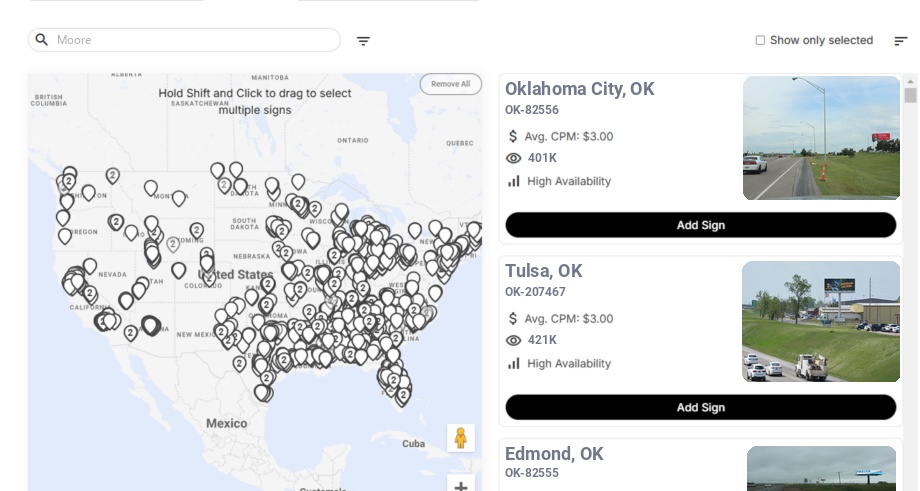



How much is a billboard near Moore?
Why Choose Blip for Billboard Advertising near Moore
-
Blip lets you launch fast on Moore's I-35 corridor, reaching 100,000+ daily vehicles without traditional buying barriers.
-
Set a flexible budget in Moore and target commuter peaks, OU game days, or school-run traffic when decisions happen on the road.
-
No contracts means Moore advertisers can test spring storm-season or fall football demand, then pause or scale anytime.
-
Track Moore campaigns in real time and shift spend as traffic flows change between Oklahoma City, Norman, and the Moore area.
-
Use Blip's creative tools to build bold, readable ads for Moore's high-speed I-35 audience and busy family shoppers.
Frequently Asked Questions About Billboard Advertising near Moore
How much does a billboard cost in Moore, Oklahoma with Blip?
Blip makes billboard advertising in the Moore area flexible and affordable. You only pay when your ad actually appears, with each 7.5-to-10-second display called a “blip,” starting at just $0.01 per display. Because pricing is dynamic, the cost per blip can change based on time of day, location, and advertiser demand.
Where can I advertise with Blip in Moore, Oklahoma?
Our inventory includes 8 digital billboards serving the Moore area, all located near Moore in Norman, within 10.0 miles of the city, with the closest listed at 9.9 miles. The single most important corridor serving the Moore area is I-35, which regularly moves above 100,000 vehicles per day on busy segments through south Oklahoma City, Moore, and Norman. State Highway 9 in Norman and busy Norman arterials also help reach local and regional traffic.
Why is Moore, Oklahoma a strong market for Blip billboard advertising?
Moore is one of the strongest suburban advertising markets in central Oklahoma because the community sits on the busy Interstate 35 spine between Oklahoma City, Moore, and Norman. Nearby segments regularly carry 100,000+ vehicles per day, and the city counted 62,793 residents in 2020, up roughly 14% from 2010. Advertisers also benefit from neighboring Norman, Cleveland County, and the Oklahoma City metro population of roughly 1.43 million.
What kinds of customers can I reach in Moore, Oklahoma with Blip?
The Moore area works as a suburban decision-making market rather than a purely tourist market. Suburban audiences make frequent purchases in categories such as healthcare, home services, automotive, restaurants, education, retail, insurance, and financial services. The area also has a strong family profile, with Moore Public Schools serving more than 25,000 students.
When is the best time to run Blip ads in Moore, Oklahoma?
Spring is one of the best advertising windows serving the Moore area, especially from March through June when severe weather, hail, heavy rain, and storm awareness are part of everyday conversation. Fall is also highly active, with OU football from September through November creating repeated surges of 80,126-seat stadium traffic into Norman. Holiday advertising should begin earlier than many advertisers expect, often by mid-November rather than waiting until December.
Do I need a contract to advertise with Blip near Moore?
No, Blip has no long-term contracts or minimum commitments. You can start, pause, or stop your campaign at any time.
How fast can I launch a billboard campaign with Blip near Moore?
You can have your campaign live in minutes. Create a free account, select your locations, set your budget, upload your design, and start running once approved.
Where can I advertise with Blip near Moore?
Blip has digital billboards near Moore. You can browse available locations on a map, choose the ones that fit your audience, and start advertising right away.
Still have questions? Launch a campaign in minutes — no contracts, no commitments.
Start Your CampaignMoore Billboard Advertising Guide
Moore is one of the strongest suburban advertising markets in central Oklahoma because the community sits on the busy Interstate 35 spine between Oklahoma City, Moore, and Norman, where nearby segments regularly carry 100,000+ vehicles per day. The City of Moore counted 62,793 residents in 2020, up roughly 14% from 2010, and advertisers serving the Moore area also benefit from neighboring Norman, with 128,026 residents, Cleveland County 295,528 residents, and an Oklahoma City metro population of roughly 1.43 million. Our inventory includes 8 digital billboards serving the Moore area, all located near Moore in Norman, within 10.0 miles of the city, with the closest listed at 9.9 miles. We like this market because it combines repeat commuter exposure, strong family-household demand, and major event traffic tied to the University of Oklahoma, whose Norman campus serves more than 27,000 students and whose football stadium seats 80,126 fans.
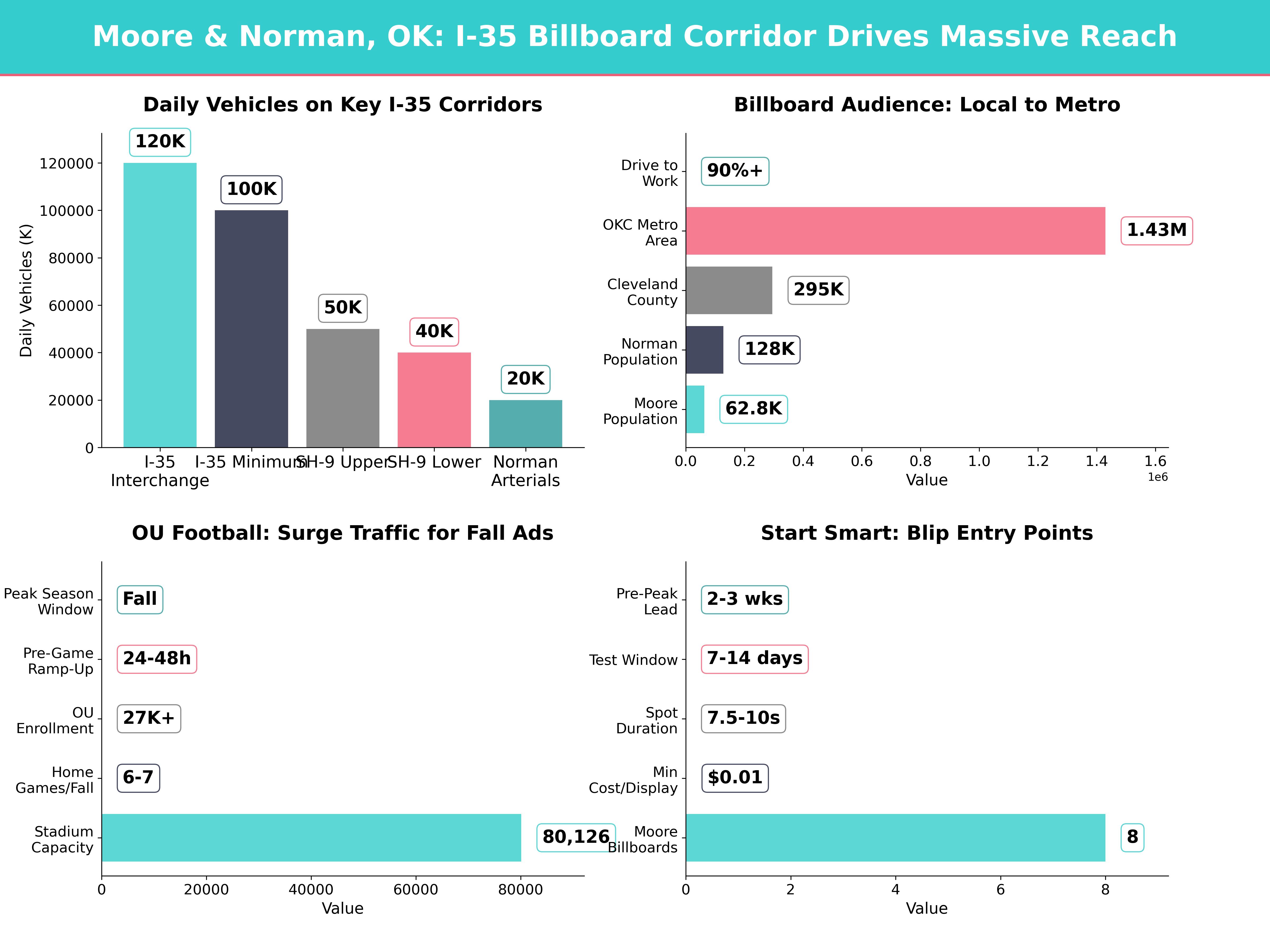
Moore area market overview
Population scale and regional context near Moore
The Moore area works as a suburban decision-making market rather than a purely tourist market. That matters because suburban audiences make frequent purchases in categories such as healthcare, home services, automotive, restaurants, education, retail, insurance, and financial services.
The City of Moore has 62,793 residents, which gives advertisers a substantial local base by Oklahoma standards. Nearby Norman adds 128,026 residents, and Cleveland County 295,528 residents, which means brands serving the Moore area are talking to a much broader south-metro audience than city limits alone might suggest. Oklahoma City contributes another 681,054 residents, and the wider metro totals about 1.43 million people. When we advertise near Moore, we are really tapping a connected regional market that moves north and south every day.
Economically, the Moore area benefits from proximity to employers and institutions across south Oklahoma City and Norman. The regional economy is supported by higher education at the University of Oklahoma, healthcare through Norman Regional Health System, retail and hospitality around Visit Norman destinations, and broader metro logistics and business growth tracked by the Greater Oklahoma City Chamber 700,000, which gives Moore-area advertisers access to a large working population with daily driving routines.
Commuting and mobility patterns serving the Moore area
For outdoor advertising, the biggest Moore-area advantage is simple: people drive. In this part of central Oklahoma, combined driving alone and carpooling account for well above 90% of commuting, while public transit represents well under 1%. Typical commute times in the south-metro corridor are about 20 to 25 minutes, which gives us enough time for repeated exposure across the same routes on the same days.
That auto orientation makes billboard messaging more effective because people in the Moore area are accustomed to making decisions from the road. They see restaurants before dinner, urgent care before a stop on the way home, and home-service reminders while thinking about errands, schools, or repairs. This is also a market where frequency matters. A commuter who travels a route 5 days a week can see the same campaign multiple times before taking action.
The Moore area also has a strong family profile, which makes practical, trust-based messaging work especially well. Moore Public Schools serves more than 25,000 students, so school-year routines shape traffic, retail patterns, and household decision making. When we plan campaigns near Moore, we should assume that many drivers are not only workers, but also parents, caregivers, and household purchase influencers.
Moore area key traffic corridors
Interstate 35 near Moore
The single most important corridor serving the Moore area is I-35. According to traffic data published by the Oklahoma Department of Transportation, busy I-35 segments through south Oklahoma City, Moore, and Norman regularly move above 100,000 vehicles per day, and some nearby segments around major interchanges push beyond 120,000 daily vehicles. That is the corridor we want if our goal is broad reach, repeated impressions, and daily commuter frequency.
I-35 matters because it serves several audiences at once. It reaches Moore-area residents heading north toward Oklahoma City jobs, Moore-area shoppers heading south toward Norman retail and entertainment, university traffic tied to the University of Oklahoma, and regional travelers moving through the south metro. It is also a high-speed reading environment, with traffic often moving at 65 mph or higher outside congestion, so creative must stay clean and direct.
For many advertisers, I-35 is the best first buy because it delivers the largest total pool. If we are promoting healthcare, auto sales, insurance, legal services, restaurants, or home services, I-35 gives us both reach and repetition near Moore.
State Highway 9 and Norman connectors serving the Moore area
The second major corridor serving the Moore area is State Highway 9 in Norman. ODOT counts near the I-35 interchange commonly land around 40,000 to 50,000 vehicles per day, which is strong for an east-west route. This corridor matters because it connects west Norman neighborhoods, OU-related trips, retail, and medical destinations.
Key Norman surface streets also help our campaigns reach the Moore area, especially when our billboards are positioned to intercept local trip chaining. Busy Norman arterials such as 12th Avenue, 24th Avenue, and Lindsey Street often exceed 20,000 daily trips on active segments. Those volumes are lower than interstate traffic, but they can deliver strong contextual value when we want audiences closer to shopping districts, campus traffic, or local service destinations.
When we combine interstate exposure with interchange and arterial strategy, we get a fuller Moore-area plan. Interstate boards build broad awareness, while Norman connectors help us reach people when they are closer to making a purchase.
Audience segments in the Moore area
Commuters and daily decision makers near Moore
Commuters are the most dependable audience serving the Moore area. The combination of a 62,793-resident city, a metro of about 1.43 million, and car-based commuting above 90% creates exactly the kind of recurring traffic pattern that digital billboards are built for. We can use that routine to reinforce brands over time instead of relying on one impression.
This audience is ideal for practical categories. Healthcare clinics, urgent care, dentists, banks, credit unions, grocery stores, quick-service restaurants, car washes, oil-change shops, HVAC companies, roofers, and local events all fit the Moore-area commuter pattern. These buyers are often deciding what to do after work, where to eat, whom to call, or which store to visit that same day.
Students, faculty, and game-day visitors serving the Moore area
The University of Oklahoma adds a major second audience. The Norman campus enrolls more than 27,000 students, and its calendar shapes traffic patterns far beyond campus itself. Parents, faculty, staff, alumni, vendors, and visiting fans all move through the same nearby routes that serve the Moore area.
Sports amplify that opportunity. Sooner Sports lists Gaylord Family - Oklahoma Memorial Stadium at 80,126 seats, which creates enormous fall traffic surges on home football weekends. Lloyd Noble Center adds another venue with 11,528 seats for basketball and other events. On those weekends and event nights, advertisers near Moore can reach fans heading south toward Norman, returning north afterward, or making pregame and postgame stops.
This audience is especially useful for restaurants, hotels, retail, entertainment, beverage brands, ticketed events, healthcare, mobile apps, telecom, and regional attractions. Event traffic is not constant every day, but it is predictable enough that we can plan around it.
Families, homeowners, and regional shoppers near Moore
The Moore area is also a strong family and homeowner market. The scale of Moore Public Schools, with more than 25,000 students, points to a large number of households with school-age children. That is why messages about family dining, pediatric care, tutoring, orthodontics, grocery, home improvement, seasonal promotions, and recreation tend to make sense near Moore.
Regional shopping and travel add another layer. Will Rogers World Airport 4 million passengers annually, and many south-metro residents use it as their primary airport. Destinations such as Riverwind Casino, Visit Norman attractions, and Visit OKC entertainment also generate cross-market trips that overlap with Moore-area commuting routes.
Seasonal and timing opportunities near Moore
Spring weather and home-service timing near Moore
Spring is one of the best advertising windows serving the Moore area. From March through June, severe weather, hail, heavy rain, and storm awareness are part of everyday conversation across central Oklahoma. The presence of the National Weather Center
That seasonal reality makes spring especially strong for roofers, HVAC companies, insurers, contractors, restoration services, tree care, urgent care, pharmacies, and hardware retailers. If we sell a service tied to protection, repairs, or preparedness, spring is the time to increase presence near Moore. Tax season from February through April can also support financial services, auto dealers, medical practices, and major-purchase promotions.
Summer travel and back-to-school opportunities serving the Moore area
Summer campaigns work well when we match them to family movement and travel behavior. Graduation season arrives in May, road-trip and leisure traffic build through June, July, and August, and back-to-school planning accelerates in late July and early August. College-related traffic also rises as OU students prepare to return for fall classes.
This is a good season for retail, restaurants, healthcare, recreation, sports programs, storage, moving services, wireless offers, and community events. If our business depends on parents making seasonal decisions, we should not wait until school has already started. Starting campaigns 2 to 3 weeks before peak decision dates usually gives us a better chance to build recall.
Fall football, fairs, and holiday spending near Moore
Fall is the Moore area’s most event-heavy season. OU football runs from September through November, and a typical home slate of 6 to 7 games can bring repeated surges of 80,126-seat stadium traffic into Norman. That creates ideal timing for restaurants, retailers, fuel and convenience brands, hotels, bars, entertainment, healthcare, and local attractions.
Fall also includes local events such as the Cleveland County Fair Visit Norman and the Norman Music Festival
Holiday advertising should begin earlier than many advertisers expect. In the Moore area, we often see smarter results when brands begin holiday messaging by mid-November rather than waiting until December. That timing works especially well for retailers, family entertainment, gift businesses, healthcare enrollment, and restaurants promoting gatherings or catering.
Billboard design tips for the Moore area
Creative choices that fit Moore-area geography
The Moore area is a fast-driving, weather-aware market, so creative needs to be instantly readable. On corridors where traffic may be moving at 65 to 75 mph, we should usually keep copy to 6 to 8 words, use 1 dominant image, and focus on 1 call to action. Anything more complicated asks too much of drivers.
High contrast works well here because Oklahoma skies can be bright, hazy, gray, or storm-dark depending on the day. We generally like bold combinations such as dark blue and white, black and yellow, red and white, or green and white for service categories. If we are aligning with fall sports energy near Norman, a tasteful crimson-forward palette can feel timely without needing to say too much.
We should also respect the tone of the market. Moore-area audiences respond well to clarity, trust, practicality, and urgency. Messages like “Same-Day Repair,” “Open Late,” “Family Care,” “Storm Damage Help,” “Game Day Specials,” or “Apply Today” tend to fit the rhythm of local needs better than abstract brand language.
Messaging approaches that resonate near Moore
Specificity matters near Moore. A billboard that says “Serving the Moore Area,” “Minutes from I-35,” or “Near Norman and South OKC” gives drivers a clearer mental map than a vague slogan. If our location or offer depends on convenience, we should make that convenience obvious.
We also recommend rotating 2 or 3 creative versions across a campaign. One version can emphasize awareness, one can push a seasonal offer, and one can reinforce location or urgency. In a market with repeated commuter exposure, small creative changes help fight ad fatigue without losing recognition.
Regional strategies serving the Moore area
Directional strategy by commute flow near Moore
Because our 8 digital billboards serving the Moore area are located near Moore in Norman, direction of travel matters.
- If we want to reach Moore-area commuters heading toward Oklahoma City jobs, we should emphasize morning visibility from about 6:00 to 9:00 a.m. on northbound patterns.
- If we want to reach households deciding on dinner, errands, or services after work, we should lean into southbound and evening periods from about 4:00 to 7:00 p.m.
- If we want to reach OU-related demand, we should increase presence on Fridays, Saturdays, and event evenings, especially before and after kickoff or major arena events.
- If we want to reach family buyers, we should remember that weekday afternoons and early evenings often align better with school pickup, sports, shopping, and dinner planning than late-night hours.
This is why nearby Norman inventory can perform so well for the Moore area. It sits on the routes people already use when moving between home, school, work, shopping, and entertainment.
Commercial and event-driven zones near Moore
Not every Moore-area campaign should chase the same geography. We usually think about three distinct zone types.
- Interstate reach zones work best for broad awareness, brand lift, and high-frequency commuter categories.
- Interchange zones near I-35 and SH-9 work best when we want to connect with OU traffic, event visitors, and active shoppers.
- Local commercial zones near Norman retail, Norman Regional Health System, Riverwind Casino, and other destination clusters work best for context-heavy purchases and shorter decision windows.
A home-service advertiser may prioritize commuter reach first, then add weather-driven bursts. A restaurant may focus on lunch, dinner, and game weekends. A university-adjacent service may concentrate around the semester start, move-in, and football season. The strongest regional strategy is the one that matches route, timing, and audience intent.
Blip tools and capabilities for Moore area campaigns
Using Blip strategically near Moore
Blip works well for the Moore area because this market rewards timing and flexibility. We can choose from the 8 digital billboards serving the Moore area, set daily budgets, and focus spending on the specific hours that matter most for commuters, families, or event crowds.
That flexibility is especially useful near Moore because traffic demand changes by daypart and season. We can emphasize weekday commutes, add Friday night pushes, increase exposure 24 to 48 hours before home games, or lean harder into storm-season windows from March through June. We can also upload new creative quickly when offers, weather, or schedules change.
Blip’s pay-per-play model is useful for testing. Since pricing starts at $0.01 per display and each blip lasts 7.5 to 10 seconds, we can launch focused campaigns without overcommitting up front. We can then review results and decide whether to broaden, narrow, or retime the buy.
Optimizing Moore-area campaigns with data
The Moore area is a good market for experimentation because traffic patterns are consistent enough to show clear differences. We often recommend testing 2 to 3 creative versions, separating commute-focused schedules from event-focused schedules, and watching which combinations deliver the best performance.
For example, a healthcare advertiser might run one campaign for weekday mornings, another for evenings, and a third around sports weekends. A retailer might compare family-value messaging against urgency-based sale messaging. A home-service brand might hold a steady baseline, then spike budgets during storm-driven demand. Because Blip campaigns can be edited in real time, we do not have to wait through a long print cycle to improve what is working.
Getting started with billboard rental near Moore
How to choose the right billboard locations serving the Moore area
Before we rent any billboard near Moore, we should answer a few practical questions. We should identify whether our real goal is broad awareness, immediate visits, lead generation, or event support.
We should choose boards based on the routes our customers already drive, not just the routes we personally notice. We should think about direction of travel, because a northbound morning board and a southbound evening board can behave very differently. We should ask whether our product fits a commuter decision, a family errand, a game-day stop, or a seasonal purchase. We should make sure our creative can be understood in 2 to 3 seconds, even though the full blip lasts 7.5 to 10 seconds.
For many advertisers, the smartest starting point is a short test across several of the 8 nearby digital billboards serving the Moore area. A 7- to 14-day test often tells us a great deal about which routes and times deserve more budget.
What to expect from the rental process near Moore
Traditional billboard companies often rely on manual proposals, fixed availability, and longer 4-week posting structures. That model can work, but it is not ideal for every Moore-area advertiser, especially if we want to react to weather, school calendars, football weekends, or shifting promotions.
Blip simplifies the process because we can manage the campaign ourselves. We can select locations on a map, upload artwork, set a daily budget, choose time and day targeting, and make changes whenever the market changes. That means we can start small, learn quickly, and scale only where the results justify it.
As we evaluate performance, we should look at more than raw impressions. We should ask whether the location reaches the right route, whether the timing matches buyer intent, whether the creative is simple enough for high-speed travel, and whether our offer is strong enough for the local moment. When those pieces line up, billboard advertising near Moore can become a highly efficient part of a regional media mix.
For Moore-area advertisers, the core strategy is straightforward. We should stay close to the routes people already drive, tailor timing to commuter and event behavior, and keep the message clear enough to register at a glance. With that approach, nearby digital billboards can do an excellent job serving the Moore area.