Billboards in Morristown, TN
No Minimum Spend. No Long-Term Contracts. Just Results.
Trusted by Leading Brands


Billboard advertising
in Morristown has never been easier
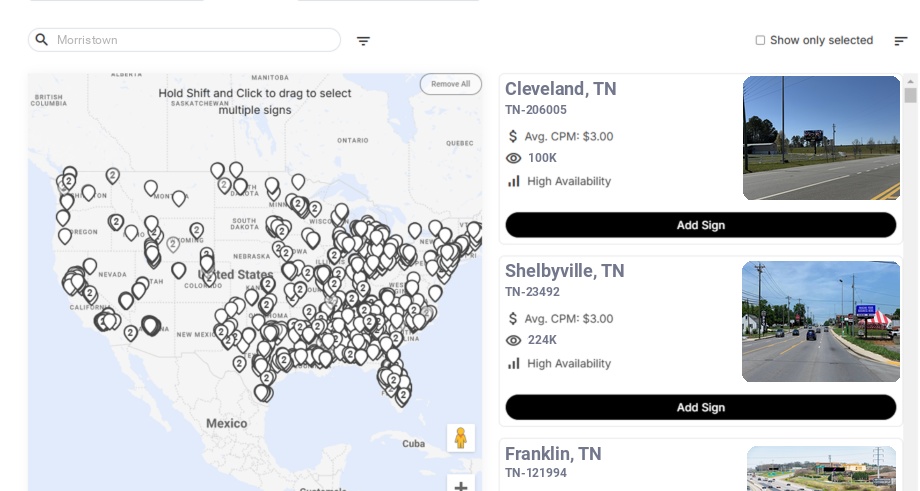



How much is a billboard in Morristown?
Why Choose Blip for Billboard Advertising in Morristown
Blip lets you launch Morristown billboards in minutes, reaching I-81 travelers and US-11E shoppers without traditional media barriers.
Set flexible daily budgets in Morristown and focus spend on peak traffic by College Square Mall, Morris Blvd, or Cherokee Lake weekends.
No contracts means you can test Morristown's 11E and 25E commuter routes, then scale what works for workers and plant shifts.
Use Blip dayparting in Morristown to hit weekday school runs, afternoon let-out, or late-night shift traffic when it matters most.
Track Morristown performance in real time, then shift ads toward stronger corridors, summer lake traffic, or holiday shopping bursts.
Blip's creative tools make it easy to run bold, local Morristown ads—great for bilingual messages and quick-value offers on busy highways.
Frequently Asked Questions About Billboard Advertising in Morristown
How much does a billboard cost in Morristown, Tennessee with Blip?
With Blip, you control exactly what you spend on Morristown billboards by setting a daily budget that can be as modest or ambitious as you like, and Blip automatically keeps your campaign within that limit. Each blip is a brief 7.5–10 second ad on rotating digital billboards in Morristown, Tennessee, and you only pay for the blips you receive. Pricing varies based on when and where your ads run and on advertiser demand, so you can choose peak times or stretch your budget during quieter hours.
Where can I advertise with Blip in Morristown, Tennessee to reach the most traffic?
The most effective Morristown campaigns usually anchor around I-81, US-11E, US-25E, Morris Boulevard, and the downtown city core. I-81 carries regional reach and long-distance travelers, US-11E is the main commercial strip with retail and daily errands traffic, and US-25E and Morris Blvd channel commuters and industrial traffic. Downtown Morristown boards are also useful for festivals, local businesses, and civic campaigns.
What kind of audience do Morristown, Tennessee billboards with Blip reach?
Morristown sits at the crossroads of East Tennessee commerce, manufacturing, and outdoor recreation, with roughly 30,200 residents in the city and about 64,500 in Hamblen County. The broader Micropolitan area draws from nearby communities and includes a mix of local workers, regional commuters, shoppers, students, and tourists. This makes Morristown billboard advertising relevant for brands serving multiple counties.
When is the best time to run Blip ads on Morristown, Tennessee billboards?
Traffic patterns in Morristown make weekday mornings, midday, afternoon school let-out, and evening shopping hours especially valuable. Weekday volumes can be 10–20% higher than weekend volumes on commuter routes, while weekend peaks shift toward retail and recreation areas. Blip lets you bid higher during the most valuable windows and drop bids or pause when traffic value is lower.
Why is Morristown, Tennessee a strong market for billboard advertising with Blip?
Morristown has one of the more diverse populations in East Tennessee for a city its size, including roughly 20–21% Hispanic/Latino residents. Manufacturing is a major employer, and retail, healthcare, education, and tourism all contribute to steady traffic and spending activity. The market’s mix of blue-collar and middle-income white-collar workers, families, and retirees makes direct, value-focused billboard creative especially effective.
Do I need a contract to advertise with Blip in Morristown?
No, Blip has no long-term contracts or minimum commitments. You can start, pause, or stop your campaign at any time.
How fast can I launch a billboard campaign with Blip in Morristown?
You can have your campaign live in minutes. Create a free account, select your locations, set your budget, upload your design, and start running once approved.
Where can I advertise with Blip in Morristown?
Blip has digital billboards in Morristown. You can browse available locations on a map, choose the ones that fit your audience, and start advertising right away.
Still have questions? Launch a campaign in minutes — no contracts, no commitments.
Start Your CampaignMorristown Billboard Advertising Guide
Morristown, Tennessee sits at the crossroads of East Tennessee commerce, manufacturing, and outdoor recreation. With roughly 30,200 residents in the city and about 64,500 in Hamblen County, this compact market punches well above its weight in daily traffic volumes, regional draw, and purchasing power. When we layer those fundamentals onto Blip’s flexible, pay-per-blip model, digital billboards become a highly efficient way to reach both local residents and the constant flow of commuters and lake-bound visitors who pass through Morristown every day. For many advertisers, Morristown billboards are a cost-effective bridge between local brand awareness and regional reach.
Understanding the Morristown Market
Morristown is the economic hub of Hamblen County and a key center for surrounding counties including Jefferson, Grainger, Cocke, and Hawkins. According to the most recent available data:
-
Population
- City of Morristown: about 30,400 residents (2023 estimate)
- Hamblen County: roughly 64,500 residents
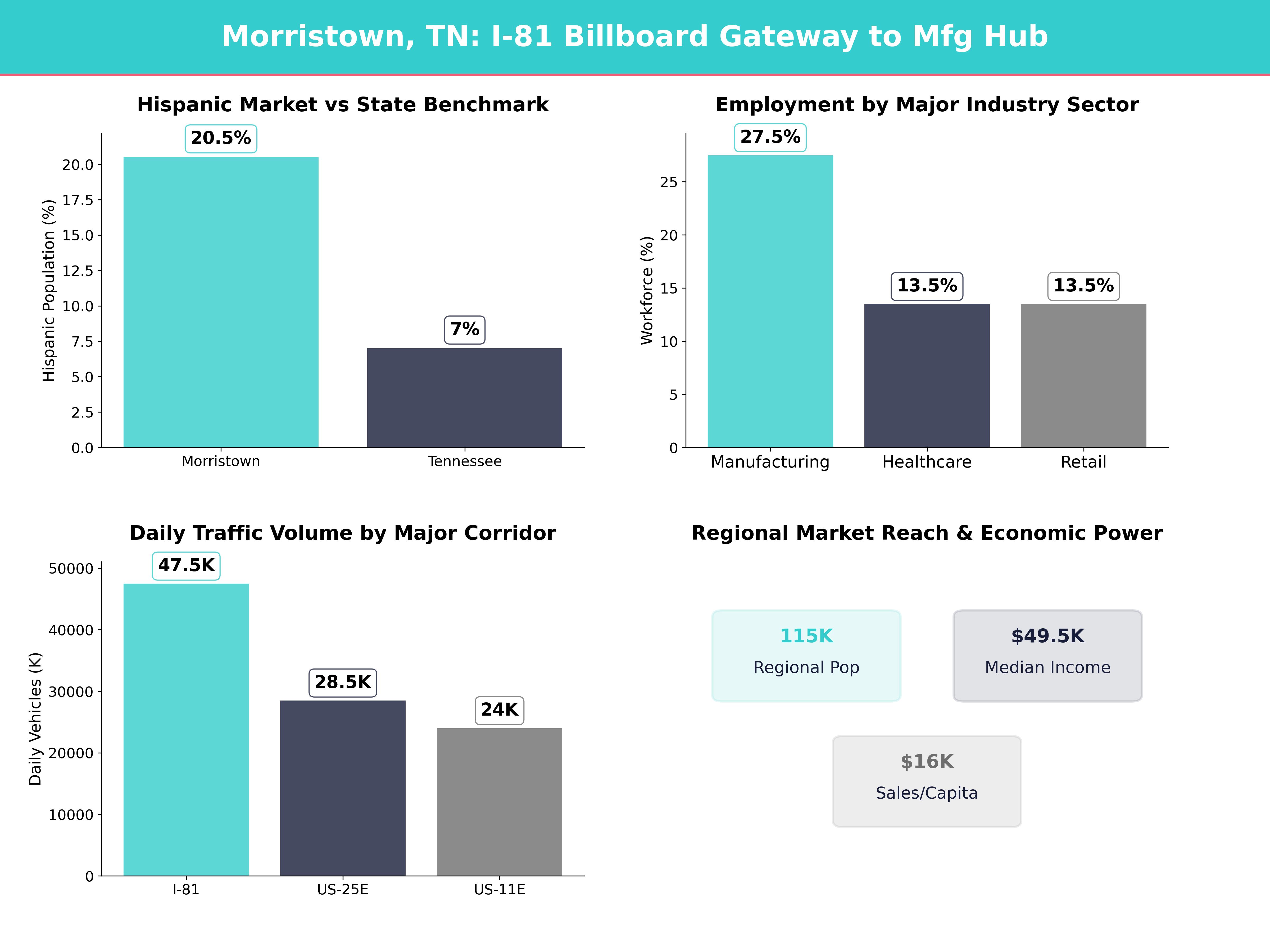
- Morristown Metro/“Micropolitan” area: around 115,000 people within a typical 25–30 minute drive, drawing from nearby communities like Jefferson City, White Pine, Bean Station, and Greeneville. This broader trade area is what makes Morristown billboard advertising relevant even for brands serving multiple counties.
-
Age and household makeup
- Median age in Morristown is around 38–40 years, similar to the Tennessee median of about 39.
- Roughly 25–30% of households have children under 18, giving family-focused advertisers a substantial audience.
- Seniors (65+) make up about 17–19% of residents, while about 60% are in prime working age (18–64), reflecting a strong base for healthcare, retirement, and employment messaging.
- Average household size runs around 2.5–2.6 people, typical of a family-oriented small city.
-
Income and spending
- Hamblen County’s median household income is in the mid‑$40,000s to low‑$50,000s (roughly $47,000–$52,000 depending on the data year).
- The cost of living index in the Morristown area is typically 10–15% below the national average, meaning residents’ dollars go further than in many U.S. metros.
- Around 55–60% of occupied housing units are owner‑occupied, supporting a strong market for home services, furniture, and improvement retailers.
- Retail sales per capita in Hamblen County consistently exceed $15,000–$17,000 annually, signaling strong local purchase activity relative to population size.
-
Diversity and language
- Morristown has one of the more diverse populations in East Tennessee for a city its size.
- Hispanic/Latino residents represent roughly 20–21% of the city’s population, compared with about 7% statewide, creating a meaningful bilingual advertising opportunity.
- In many neighborhoods and schools, Spanish is spoken in 15–25% of households, particularly relevant for grocery, financial, auto, and healthcare advertisers.
-
Economic base
- Manufacturing is a major employer, accounting for roughly 25–30% of all jobs in the Morristown Micropolitan area—more than double the national manufacturing share.
- Key sectors include automotive parts, metals, plastics, packaging, and logistics, with multiple industrial parks supported by the City of Morristown and Hamblen County government.
- Healthcare and social assistance represent about 12–15% of employment, backed by facilities such as Morristown‑Hamblen Healthcare System
- Education, including Walters State Community College and the Hamblen County Department of Education, employs several thousand staff and faculty across K‑12 and higher education.
- Retail trade (often 12–15% of local jobs) is concentrated along US‑11E and US‑25E, with anchors like College Square Mall and multiple national chains.
- Tourism: Cherokee Lake and the “Lakeside of the Smokies” region, promoted by Visit Morristown Lakeside of the Smokies / Jefferson County tourism
This mix of blue‑collar and middle‑income white‑collar workers, families, and retirees implies billboard creative that is direct, value‑focused, and highly practical tends to perform best—offers, savings, and clear “next steps” (call, visit, exit number) are especially effective for billboards in Morristown.
Who You’ll Reach on Morristown Billboards
To make the most of Blip’s hyper‑flexible scheduling and budgeting, it helps to visualize who is actually driving by your boards each day and what that means for Morristown billboard advertising strategy.
Daily traffic flows (approximate average daily traffic counts):
(Counts based on recent Tennessee Department of Transportation
- I‑81 corridor near Morristown: 45,000–50,000 vehicles per day near key exits serving Morristown and Cherokee Lake
- US‑11E (Andrew Johnson Hwy) through Morristown: 20,000–28,000 vehicles per day in key commercial segments, with some choke points approaching 30,000
- US‑25E (Davy Crockett Pkwy / Morris Blvd area): 25,000–32,000 vehicles per day, combining commuter and regional through‑traffic
- Major city surface streets (e.g., Morris Blvd, West Andrew Johnson Hwy, East Morris Blvd): 10,000–20,000 vehicles per day in busy stretches, particularly near retail clusters and school zones
Even within a relatively small city footprint, these numbers add up to well over 1 million vehicle trips every 3–4 weeks on some corridors, equating to millions of monthly impressions when you factor in multi‑person vehicles and repeat exposures. For advertisers considering billboard rental in Morristown, this density of recurring trips is a major advantage.
Some key audience segments you can reliably reach:
-
Local workers
- Thousands of residents commute daily to industrial parks, logistics facilities, and healthcare campuses.
- In Hamblen County, labor force participation typically runs around 60–63%, and unemployment often tracks below 4–5%, keeping roads busy during traditional commute windows.
-
Regional commuters
- A significant share of workers commutes across county lines—many residents of Jefferson, Grainger, Hawkins, and Cocke counties travel to Morristown for work and shopping.
- Within a 30‑minute drive radius, you can access a combined labor shed of well over 80,000–90,000 employed adults.
-
Shoppers and errand‑runners
- Traffic concentrates around retail nodes like College Square Mall, Walmart Supercenters, and large auto corridors.
- College Square Mall alone typically reports several hundred thousand shopper visits annually, and big‑box clusters on 11E and 25E generate steady, all‑day traffic.
-
Students and staff
- Walters State Community College enrolls roughly 6,000–7,000 students across campuses, with a substantial base in Morristown.
- Add in more than 10,000 K‑12 students in the Hamblen County school system plus teachers, bus drivers, and staff, and school‑related trips generate a large share of weekday travel.
-
Tourists and lake‑goers
- Cherokee Lake spans more than 30,000 surface acres with over 400 miles of shoreline, attracting anglers, boaters, and campers from Knoxville, the Tri‑Cities, and neighboring states.
- Regional tourism offices report that the “Lakeside of the Smokies” (Cherokee and Douglas Lakes) draws visitors heavily from May through October, with summer weekends often running at or near full capacity in major campgrounds and marinas.
- A sizable portion of this traffic arrives via I‑81 and US‑25E, making those corridors prime for hospitality and recreation advertisers.
Because Blip allows us to bid by the display and choose specific boards and time windows, we can tailor campaigns to target weekday workers, evening shoppers, weekend lake traffic, or any combination along Morristown billboards.
Key Corridors and Placement Strategy
The most effective Morristown campaigns usually anchor around a few core corridors. When we think about Blip board selection, these are the areas we consider first for billboard rental in Morristown:
I‑81: Regional Reach and Long‑Distance Travelers
I‑81 is the primary regional artery past Morristown, connecting Knoxville to the Tri‑Cities and carrying significant freight and vacation traffic. On some sections in East Tennessee, truck traffic alone can account for 25–35% of vehicles, making it especially important for B2B, logistics, and industrial messages.
Use I‑81 boards when:
- Your target customers include out‑of‑town visitors (hotels, attractions, restaurants, marinas).
- You want to reach logistic firms, trucking traffic, or B2B buyers across East Tennessee.
- You’re offering reasons to exit toward Morristown (e.g., “Exit now for X” messages).
- You serve regional travelers headed toward destinations promoted by Tennessee Vacation and local tourism partners like Visit Morristown
Advertising strategy:
- Keep copy extremely short—drivers are moving fast, often 65–70 mph. Seven words or fewer is ideal.
- Use strong directional cues: “Exit 8 – Turn Right,” “Next 2 Exits,” or “Only 3 Miles Ahead.”
- Emphasize big‑brand visuals (logo, product photo, or simple icon) and high contrast.
- Consider “distance + benefit” framing (“Food & Gas 1 Mile – Open 24/7”).
US‑11E / West & East Andrew Johnson Highway: Retail & Daily Errands
US‑11E is the main commercial strip, connecting Morristown’s western neighborhoods to downtown and extending to Jefferson City. Segments of 11E in Morristown carry 20,000–28,000 vehicles per day, with high retailer density and many signalized intersections that slow traffic and increase dwell time, which benefits many types of Morristown billboard advertising.
Traffic is dense around:
- Major retail centers and restaurants
- Automotive dealers and service shops
- Grocery and big‑box stores
- School zones and athletic facilities
Use 11E boards when:
- You’re promoting retail sales, restaurants, auto services, or local events.
- You want high frequency among residents making daily trips.
- You need to support a grand opening or short‑term promotion with heavy, localized visibility.
- You want to reach visitors staying at hotels and short‑term rentals along the main highway.
Advertising strategy:
- Highlight value and urgency: “This Weekend Only,” “Today,” “Ends Friday.”
- Include specific shopping cues: “Next to Walmart,” “Across from College Square Mall.”
- Use clear calls to action: “Text MORRIS to 55555,” “Book at YourBrand.com.”
- Rotate creative for weekday vs. weekend offers to match changing traffic patterns.
US‑25E / Davy Crockett Parkway & Morris Boulevard: Commuters and Industrial Traffic
US‑25E and Morris Blvd channel commuters between industrial zones, neighborhoods, and retail areas. Average daily traffic commonly ranges from the mid‑20,000s to low‑30,000s on key stretches, and much of that volume is recurring local commuters.
Use boards along 25E and Morris when:
- You need to reach shift workers and plant employees.
- You’re hiring or staffing (manufacturing, logistics, warehouses).
- You offer essential, repeat‑use services: quick care, dental, auto repairs, payday or personal loans, convenience stores.
- You want to catch drivers headed toward Cherokee Lake access points, campgrounds, or marinas.
Advertising strategy:
- Time Blips for shift changes (e.g., 5–8 a.m., 2–5 p.m., 10 p.m.–1 a.m. depending on plants).
- Promote hiring bonuses, hourly wages, or convenience (“Open 24/7,” “Walk‑ins Welcome”).
- Use large, simple numbers (pay rates, discounts, phone numbers).
- Consider bilingual “Now Hiring / Se Necesita Personal” creatives in plants drawing heavily from Hispanic/Latino workers.
Downtown & City Core
Downtown Morristown has seen ongoing revitalization, supported by the City of Morristown and Morristown Area Chamber of Commerce
- Downtown festivals and events can draw hundreds to several thousand attendees per weekend.
- The iconic elevated Skywalks and renovated Main Street storefronts attract visitors from around the region, boosted by coverage from outlets like the Citizen Tribune and Knoxville stations such as WATE
Use central boards to:
- Promote downtown events, festivals, and live music.
- Support local boutiques, cafes, and service businesses.
- Build brand awareness for professional services (law, finance, insurance, real estate).
- Reinforce city‑sponsored initiatives and civic campaigns run by the City of Morristown or Hamblen County.
Advertising strategy:
- Lean into local pride: references to Crockett, the “Skywalk” downtown, or Cherokee Lake.
- Feature recognizable downtown visuals or landmarks.
- Push people to specific event times and dates.
- Use countdown messaging for major events (“3 Days Until Downtown Street Fest”).
Timing Your Campaign in Morristown
Blip lets us control when ads display, so we match dayparts and seasons to local behaviors. Thoughtful timing can make Morristown billboards feel especially relevant to drivers’ daily routines.
Day of Week and Daypart Patterns
Traffic studies consistently show that in smaller metros like Morristown, weekday volumes can be 10–20% higher than weekend volumes on commuter routes, while weekend peaks shift toward retail and recreation areas. We use these patterns to guide scheduling:
-
Weekday mornings (6–9 a.m.):
- Commuters heading to factories, offices, schools; school buses on the roads.
- Best for employment ads, coffee and breakfast spots, medical reminders (“Schedule your checkup”), and school‑related messaging.
- Expect strong flows on 11E, 25E, and near school zones managed by the Hamblen County Department of Education.
-
Midday (11 a.m.–2 p.m.):
- Lunch traffic, errands, shift changes—often 15–25% of total daily traffic on major arterials.
- Strong for quick‑service restaurants, banking, and healthcare walk‑ins.
- Good window for senior‑focused services, as older adults often schedule appointments mid‑day.
-
Afternoon school let‑out (2:30–4:30 p.m.):
- Parents and school staff on the roads; student drivers on key corridors.
- Great for family attractions, tutoring, after‑school programs, and churches.
- Tie into local sports and band programs frequently covered by the Citizen Tribune.
-
Evening (4–8 p.m.):
- Prime shopping and dining window; many retailers see 30–40% of weekday sales after 4 p.m.
- Use for retail promotions, restaurants, auto services, and grocery.
- Also effective for promoting church services, community meetings, and local entertainment.
-
Late night (8 p.m.–midnight):
- Shift workers, hospitality, emergency/urgent services.
- Good for urgent care clinics, pharmacies, late‑night dining, and entertainment.
- Traffic is lighter, but impressions can be cheaper and highly targeted with Blip’s bidding tools.
With Blip, we can bid higher during the most valuable windows and drop bids (or pause) when traffic value is lower, stretching your budget.
Seasonal Considerations
Morristown’s climate brings four distinct seasons, each with different traffic and purchasing patterns:
-
Spring (March–May):
- Cherokee Lake activity ramps up as water levels rise; fishing and boating tournaments promoted by Visit Morristown Lakeside of the Smokies
- Home improvement projects jump—nationally, hardware and garden sectors can see 20–30% sales lifts over winter months, and Morristown’s high homeownership mirrors this trend locally.
- Align campaigns for landscaping, home services, marinas, boat dealers, and outdoor events.
- Promote spring sports, graduations, and school events tied to Hamblen County schools and Walters State.
-
Summer (June–August):
- Peak tourism, family outings, and lake traffic. Many campgrounds and marinas on Cherokee Lake report weekend occupancies at or near 100% during July and early August.
- Utility data often shows residential electricity use 20–30% above spring levels, underscoring the need for HVAC, home repair, and energy‑efficient upgrades.
- Critical window for attractions, restaurants, hotels, campgrounds, boat rentals, and retail.
- Focus boards on routes from I‑81 and US‑11E toward lake access points and popular lodging.
-
Fall (September–November):
- Back‑to‑school and football‑driven routines: school events, high school sports, and regional festivals.
- Retailers typically see back‑to‑school spikes in apparel, electronics, and services; local schools educate over 10,000 students, creating a large base for these categories.
- Great for education‑related services, apparel, and healthcare (flu shots, checkups).
- Fall foliage and outdoor events, including those promoted by Visit Morristown
-
Winter (December–February):
- Holiday shopping and end‑of‑year healthcare visits drive major spending in December; many retailers can see 20–30% of annual sales in the last quarter.
- Shorter daylight hours make illuminated digital boards more visible and impactful during commute times.
- Financial services, tax prep, and healthcare can use New Year messaging (“Use Your Benefits Before 12/31,” “Plan for Tax Season”).
- Restaurant and entertainment traffic shifts toward weekends and event nights; coordinate bursts around parades and holiday festivals covered by outlets like WATE
Crafting Effective Creative for Morristown
In a smaller metro like Morristown, the best‑performing billboard creative tends to be:
-
Simple and bold
- Limit to 1 main image, 1 headline, and 1 call‑to‑action.
- Use large fonts (at least 12–18 inches in physical scale; big and bold on screen).
- High contrast colors (dark backgrounds with light text or vice versa).
- Aim for messages that can be understood in 3 seconds or less; research across U.S. markets shows that shorter messages consistently boost recall rates by 20–40%.
-
Locally grounded
- Reference Morristown or Hamblen County by name.
- Use familiar terms like “By College Square Mall,” “On 11E,” or “Near Cherokee Lake.”
- When appropriate, tie into coverage from local outlets like the Citizen Tribune or WATE’s local news page for Morristown
- Consider partnering with civic campaigns backed by the City of Morristown or Morristown Area Chamber of Commerce
-
Value‑focused
- Many residents are price‑conscious; in markets with median incomes in the $45,000–$50,000 range, ads featuring clear savings often outperform generic branding.
- Showcase concrete offers: “Oil Change $39.99,” “$0 Down,” “Kids Eat Free Tuesdays.”
- Use numbers and deadlines—studies routinely show that limited‑time offers can lift response rates 10–20%.
-
Bilingual when relevant
- Morristown has a sizable Hispanic/Latino community (roughly 20% of city residents).
-
For industries serving this audience (grocery, auto, financial services, healthcare, churches), consider English + Spanish creatives:
- Example: “Financiamiento Fácil” or “Se Habla Español” as a second line.
- Local churches, tiendas, and bilingual clinics that advertise in Spanish across billboards, radio, and social media often report stronger word‑of‑mouth growth within these neighborhoods.
-
Data‑friendly
-
If you plan to measure response, include trackable elements:
- Unique short URLs (e.g., YourBrand.com/11E)
- Billboard‑only phone numbers or extensions
- Simple QR codes (effective at stoplights or low‑speed corridors, but avoid on high‑speed interstate boards)
- In many campaigns, even basic tracking like unique URLs can reveal 10–30% differences in performance between creative versions, providing quick insight into what resonates.
-
If you plan to measure response, include trackable elements:
Strategies by Industry
Because Blip allows unlimited creative swaps and time‑based bidding, we can design highly tailored strategies by vertical that maximize the value of billboards in Morristown.
Local Retail & Restaurants
- Focus boards on US‑11E, 25E, and high‑traffic retail nodes near College Square Mall, Walmart, and main grocery clusters.
- Run lunch specials heavily 10:30 a.m.–1:30 p.m.; dinner promos 4–8 p.m.
- Rotate creatives by day of week (e.g., “Taco Tuesday,” “Friday Fish Fry”).
- Mention landmarks (“Across from Walmart,” “Near College Square Mall”).
- Tie‑in with city and tourism calendars on Visit Morristown
Automotive Dealers & Service
- Use boards at incoming corridors to town and near existing dealerships on 11E and 25E.
- Promote specific price points or financing offers (“As low as 1.9% APR,” “Payments from $299/mo”).
- Time campaigns around tax refund season (Feb–Apr) and back‑to‑school (Aug–Sep), when down‑payment cash and family travel needs increase.
- Consider bilingual creatives where appropriate; in markets with 20%+ Hispanic population, Spanish‑inclusive campaigns often see noticeably higher engagement across auto categories.
- Reinforce service reminders tied to mileage or season (“Free A/C Check Before July Heat”).
Healthcare, Dental, and Vision
- Emphasize convenience, same‑day appointments, and urgent care; nearly 1 in 4 urgent care visits nationally occur during evenings and weekends, aligning well with key billboard dayparts.
- Target morning and evening commute windows plus weekends on 11E, 25E, and near major clinics and hospitals.
- Highlight insurance acceptance or “No insurance? Ask about payment plans.”
- Promote seasonal needs: flu shots in fall, sports physicals late summer, allergy care in spring.
- Coordinate with community‑health initiatives publicized by the City of Morristown or local hospital systems.
Home Services (HVAC, Plumbing, Roofing, Landscaping)
-
Focus on weather‑related messaging:
- Spring/fall HVAC tune‑ups (“System Check $79 Before Summer Heat”).
- Summer emergency A/C repairs—Tennessee’s July average highs in the upper 80s to low 90s make cooling messages especially urgent.
- Storm‑related roofing or tree work after high‑wind and heavy‑rain events.
- Invest in boards along commuter routes through residential neighborhoods (11E, 25E corridors).
- Use bold phone numbers and simple service icons to make recall easy when homeowners need urgent help.
- Tie your brand to community rebuilding efforts if storms or flooding affect the region; stories like these often gain coverage in the Citizen Tribune, boosting brand goodwill.
Hiring & Workforce Recruitment
- Morristown’s manufacturing base means talent competition is real; in some years, manufacturing job openings in the micropolitan area outnumber available workers, especially for skilled trades.
- Target boards near industrial parks and commuter routes.
- Display wage rates, shift differentials, and bonuses in large type (“$20/hr + $1.50 Night Shift Differential,” “$1,000 Sign‑On Bonus”).
- Align your Blip schedule with specific shift‑change windows.
- Promote your workplace culture and benefits; local employers highlighted by the Morristown Area Chamber of Commerce
Using Blip’s Tools in Morristown
Blip’s platform is well‑suited to Morristown because it lets us buy only the impressions we want, exactly when we want them. This flexibility is what makes digital billboard rental in Morristown accessible for both small and large advertisers.
Key tactics to leverage:
-
Board‑level targeting
- Choose specific Morristown‑area boards closest to your business or to key traffic sources (e.g., I‑81 for tourists; 11E for shoppers; 25E for commuters).
- For multi‑location brands, split impressions proportionally across boards near each store—e.g., 40% near your Morristown location, 30% near Jefferson City, 30% near Greeneville.
- Use publicly available traffic data from the Tennessee Department of Transportation
-
Dayparting
-
Align campaign spend with high‑value dayparts, like:
- Restaurants: 11 a.m.–2 p.m. and 4–8 p.m.
- Retail: 10 a.m.–8 p.m.
- Healthcare: 7–10 a.m. and 3–7 p.m.
- Hiring: 5–9 a.m., 2–5 p.m., 10 p.m.–12 a.m. (depending on shifts)
- Consider separate schedules for weekdays vs. weekends, as traffic patterns and shopping behaviors shift.
-
Align campaign spend with high‑value dayparts, like:
-
Budget control
- Start with a modest daily budget (for example, $10–$30/day) across one or two boards—enough to generate hundreds to a few thousand daily impressions, depending on bids and competition.
- Increase bids on days or times that generate more response (weekends for tourism, weekdays for B2B and hiring).
- Use seasonal adjustments—allocate more budget to your industry’s “make‑or‑break” months (holiday season for retail, summer for lake‑based recreation, tax season for finance).
-
Creative rotation
-
Test 2–4 variations of creative at the same time:
- Different offers (percentage off vs. dollar‑off vs. bonus item)
- Different headlines (value‑focused vs. urgency‑focused)
- English‑only vs bilingual versions
- Pause low performers and scale high performers based on response metrics.
- Over a 4–8 week period, even a few hundred measurable responses (calls, form fills, coupon redemptions) can reveal clear winners in a market of Morristown’s size.
-
Test 2–4 variations of creative at the same time:
-
Event‑based bursts
-
Use short, intense bursts of impressions around:
- City or chamber events promoted by the Morristown Area Chamber of Commerce
- Holiday parades and festivals listed on Visit Morristown
- Local sports tournaments or school events highlighted by the Hamblen County school system and local media
- Start teasing major events 1–2 weeks ahead, then switch to “Today” or “This Weekend” messaging during the event window.
- After events, briefly run “Thank You, Morristown!” creatives to build goodwill and brand recognition.
-
Use short, intense bursts of impressions around:
Measuring and Optimizing Your Morristown Campaign
To keep improving ROI, we match Morristown’s on‑the‑ground realities with clear measurement.
Practical ways to track impact:
- Promo codes: Use Morristown‑specific codes such as “MORRIS10” and ask new customers where they heard about you. In many small‑market tests, simple promo codes can account for 10–25% of trackable coupon redemptions when promoted consistently.
- Call tracking: Set up a phone number unique to your billboard campaign and monitor call volume and conversions. Even a 10–15% increase in calls during active flight weeks is a strong signal that your placements and creative are working.
- Landing pages: Drive web traffic to a Morristown‑specific URL and watch traffic spikes by hour and day. Comparing website sessions by location can show if certain corridors (I‑81 vs 11E vs 25E) drive higher‑value visitors.
- Store traffic observation: Compare sales and foot traffic for weeks with higher Blip budgets to weeks with lower budgets. In many cases, advertisers see noticeable lifts—5–20%—in in‑store visits during periods of heavy billboard support.
We then refine:
- Shift impressions toward the corridors and times that correlate with increased calls, web sessions, or store visits.
- Pause underperforming creatives, double down on messages that clearly move the needle.
- Adjust for seasonality—more impressions in peak periods (tourism, holidays, tax season) and lower‑frequency brand awareness in slower months.
- Coordinate campaigns with local calendars from sources like Visit Morristown City of Morristown, and local news outlets such as the Citizen Tribune and WATE
By combining Morristown’s traffic patterns, local demographics, and economic strengths with Blip’s precise scheduling and budget control, we can build billboard campaigns that are both cost‑efficient and highly visible. Whether you’re a single‑location shop on Andrew Johnson Highway or a regional brand drawing travelers off I‑81, the key is to pair clear, locally resonant creative with smart placement and timing. With that foundation, digital billboards become one of the most powerful levers to grow your business in Morristown and across East Tennessee, and Morristown billboards can anchor your broader regional marketing strategy.