Billboards near Red Bank, TN
No Minimum Spend. No Long-Term Contracts. Just Results.
Trusted by Leading Brands


Billboard advertising
near Red Bank has never been easier
How much is a billboard near Red Bank?
Why Choose Blip for Billboard Advertising near Red Bank
Blip lets you launch Red Bank billboards in minutes and reach US-27 commuters heading to Chattanooga without traditional sales delays.
Set flexible daily budgets for Red Bank and scale up for peak traffic on Dayton Boulevard, school runs, and weekend retail trips.
No contracts means you can test Red Bank messaging around Chattanooga events, then pause or pivot when traffic shifts by season.
Use Blip's real-time analytics to track Red Bank performance and adjust bids for commute windows on US-27 and I-24/I-75 feeders.
Upload and tailor creatives for Red Bank families, outdoor visitors, and Signal Mountain drivers with Blip's easy design tools.
Frequently Asked Questions About Billboard Advertising near Red Bank
How much does a billboard cost near Red Bank, Tennessee with Blip?
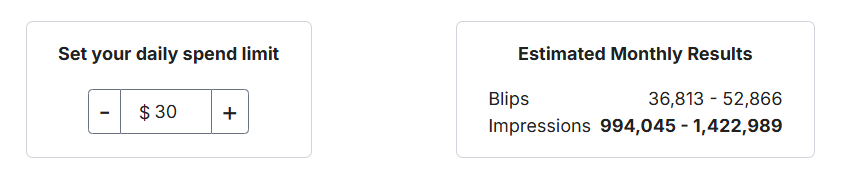
With Blip, you control exactly what you spend on Red Bank billboards by setting a daily budget that can be adjusted at any time, making it easy to stay within your comfort zone while reaching people in the Red Bank area. Each ad is a short “blip,” a 7.5 to 10-second display on rotating digital billboards, and you only pay for the blips you receive. Pricing for billboards near Red Bank, Tennessee is based on when and where your ads appear and current advertiser demand, so you can start small and scale as you see results.
Where can I advertise with Blip in Red Bank, Tennessee?
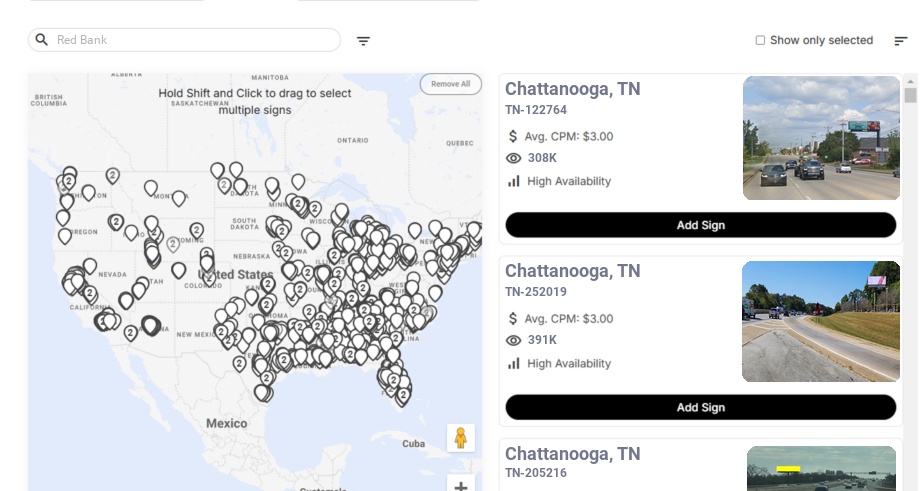
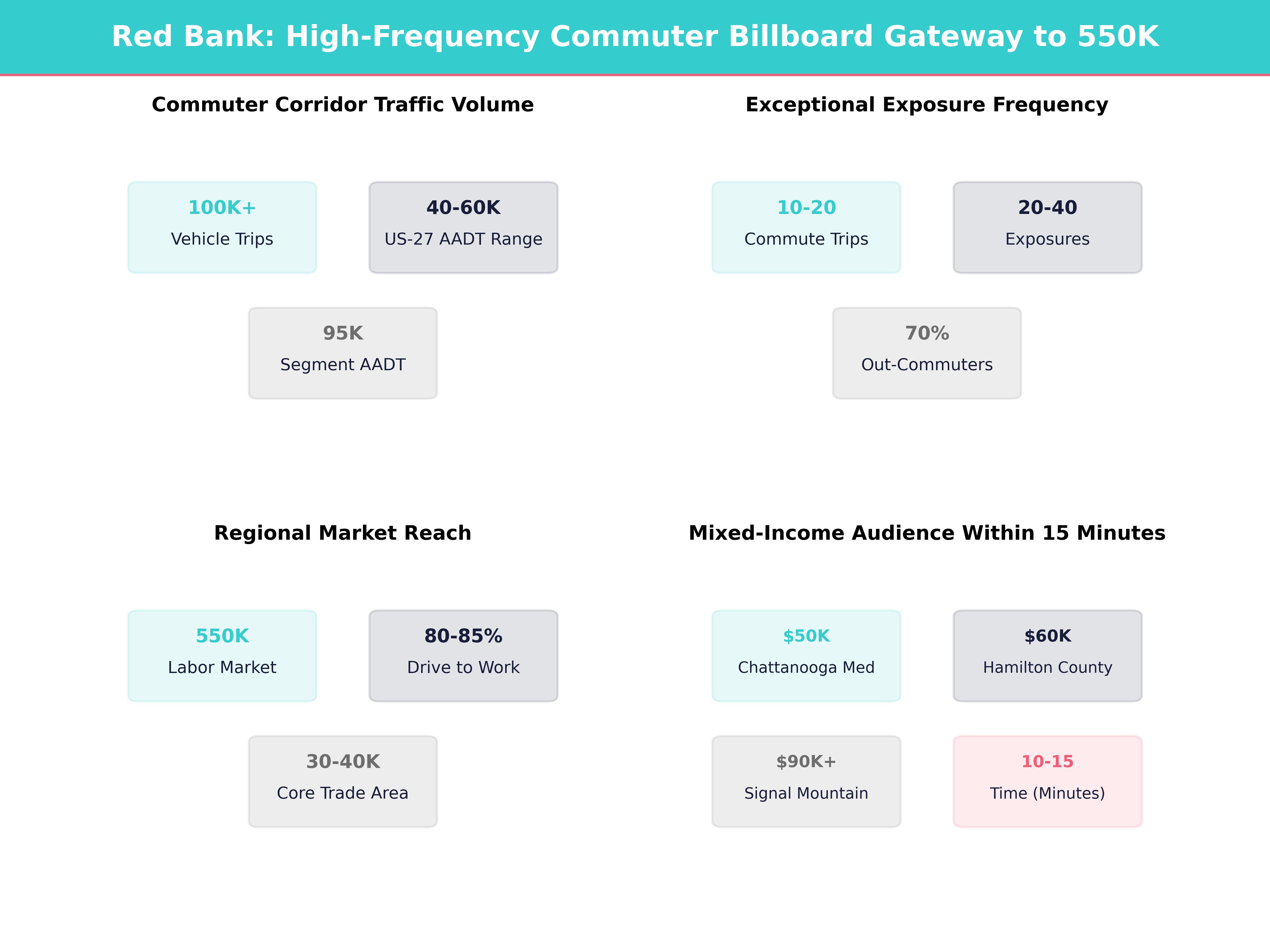
Our 42 digital billboards serving the Red Bank area are located in Signal Mountain, TN (about 2.1 miles from Red Bank) and Chattanooga, TN (about 4.8 miles from Red Bank). In practical terms, this coverage touches a core local trade area of roughly 30,000–40,000 residents when you combine Red Bank, Signal Mountain, and adjacent neighborhoods of Chattanooga. A daily commuter stream can easily exceed 100,000 vehicle trips moving between the northwest suburbs, Chattanooga’s downtown, and the I‑24/I‑75 corridors.
What kinds of people see Red Bank, Tennessee billboards with Blip?
Red Bank’s location between Chattanooga’s urban core and outdoor destinations like Signal Mountain creates distinct audience segments you can speak to. A large share of Red Bank and Signal Mountain residents commute into Chattanooga for work, and many of these commuters are professionals employed in healthcare, education, logistics, manufacturing, and corporate services. Families in the Red Bank area also make multiple short car trips per day, which can add up to 10–15 weekly passes by the same billboard for many households.
What are the busiest roads for billboard advertising in Red Bank, Tennessee?
US‑27 is the primary north–south freeway running past the Red Bank area into downtown Chattanooga, and volumes near the Red Bank area often fall in the 40,000–60,000 AADT range. Dayton Boulevard is a key north–south surface route through the Red Bank area, and local counts often show busy neighborhood arterials handling anywhere from 10,000–20,000 vehicles per day. Even though Red Bank sits northwest of the interstates, much regional traffic also funnels through Chattanooga’s I‑24 / I‑75 corridor before spreading to neighborhoods including the Red Bank area.
When should I run Red Bank, Tennessee billboard ads with Blip?
Travel peaks typically 7:00–9:00 a.m. and 4:00–6:30 p.m. Monday through Friday, with Friday afternoon volumes often 5–10% higher than mid-week as people head to weekend activities. For dining and entertainment, emphasize 3–8 p.m. on Thursdays–Saturdays, and for family services, focus on school commute windows and early evenings. The Chattanooga–Red Bank region also has strong seasonal shifts, with tourism peaking in summer and commuting patterns becoming especially predictable in fall.
Do I need a contract to advertise with Blip near Red Bank?
No, Blip has no long-term contracts or minimum commitments. You can start, pause, or stop your campaign at any time.
How fast can I launch a billboard campaign with Blip near Red Bank?
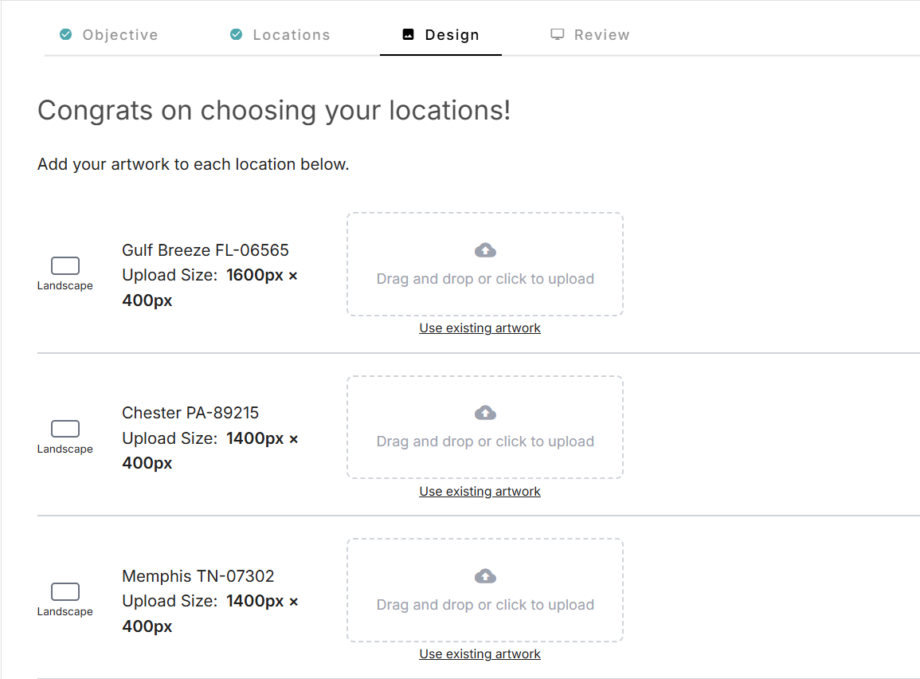
You can have your campaign live in minutes. Create a free account, select your locations, set your budget, upload your design, and start running once approved.
Where can I advertise with Blip near Red Bank?
Blip has digital billboards near Red Bank. You can browse available locations on a map, choose the ones that fit your audience, and start advertising right away.
Still have questions? Launch a campaign in minutes — no contracts, no commitments.
Start Your CampaignRed Bank Billboard Advertising Guide
Nestled just northwest of Chattanooga, Red Bank, Tennessee blends small-city feel with big-city access. With 42 digital billboards serving the Red Bank area from nearby Signal Mountain and Chattanooga, we can reach commuters, families, and outdoor enthusiasts right where they live, shop, and drive. This guide walks through how to use digital billboards with Blip to effectively tap into that demand and how to think strategically about billboards near Red Bank as part of your broader marketing mix.
Understanding the Red Bank Area Market
Red Bank is a compact, heavily traveled community in Hamilton County. A few key stats help frame your strategy and the potential of Red Bank billboards:
- Red Bank’s population was about 12,222 in 2020, and local estimates put the city at roughly 12,500–13,000 residents today as infill housing continues to grow (City of Red Bank planning reports note steady residential permitting since 2020). Within Hamilton County’s approximately 375,000–380,000 residents, Red Bank accounts for roughly 3–4% of the county’s population.
- Nearby Chattanooga, just 4.8 miles away, has around 180,000 residents and functions as the employment and entertainment hub for the region. Greater Chattanooga’s functional labor market pulls from more than 550,000 people across Hamilton and surrounding counties, which expands your billboard reach well beyond Red Bank’s city limits.
- Local and regional transportation planning data for the Chattanooga metro consistently show that roughly 80–85% of workers commute by personal vehicle, with transit share typically under 3% and walking/biking making up a small but growing share. This car‑centric pattern means roadside media and billboard advertising near Red Bank are among the most reliable ways to reach working-age adults on a daily basis.
- Hamilton County’s median household income sits in the mid‑$60,000s, while Chattanooga’s is slightly lower in the low‑ to mid‑$50,000s. Many Red Bank and nearby Signal Mountain households trend above the county median, with some Signal Mountain ZIP codes reporting median household incomes well over $90,000. This gives advertisers a mix of working-class and middle‑ to upper‑middle‑income audiences within a 10–15‑minute drive.
Local context sources worth reviewing as you plan:
- City of Red Bank
- City of Chattanooga
- Hamilton County, TN
- Regional tourism: Visit Chattanooga
- Local news and consumer trends:
Taken together, this means campaigns near Red Bank have access both to a tight-knit local audience and a much larger Chattanooga metro market, all within a 10‑mile billboard radius and a regional drive-time catchment of roughly 30–45 minutes.
Where Our 42 Billboards Reach the Red Bank Area
Our 42 digital billboards serving the Red Bank area are located in:
- Signal Mountain, TN (about 2.1 miles from Red Bank)
- Chattanooga, TN (about 4.8 miles from Red Bank)
In practical terms, this coverage touches:
- A core local trade area of roughly 30,000–40,000 residents when you combine Red Bank, Signal Mountain, and adjacent neighborhoods of Chattanooga.
- A daily commuter stream that can easily exceed 100,000 vehicle trips moving between the northwest suburbs, Chattanooga’s downtown, and the I‑24/I‑75 corridors.
This cluster of signs allows you to:
- Capture daily commuters traveling between Red Bank, Signal Mountain, and Chattanooga, many of whom make 10–20 one-way trips per workweek along the same routes.
- Reach shoppers and diners heading to Chattanooga’s core retail areas such as Northshore, Hixson, and downtown riverfront districts, where weekend visitation can spike 20–40% above weekday levels during peak seasons.
- Influence visitors traveling through the region on their way to downtown attractions or outdoor destinations like Signal Mountain, the Tennessee River, and parks managed by Hamilton County Parks & Recreation.
By selectively choosing boards on key feeder roads and arterial routes, we can create high‑frequency coverage around typical daily patterns—morning commutes toward Chattanooga, midday shopping, and evening returns toward Red Bank and Signal Mountain. With 42 boards to choose from, it’s common to build clusters that can deliver multiple daily exposures per driver on core corridors, effectively turning billboards near Red Bank into a consistent, always-on presence for your brand.
Traffic Patterns and High-Value Corridors
To get the most from digital billboards, we need to align placements with the way people actually move:
1. US‑27 / Corridor into Chattanooga
- US‑27 is the primary north–south freeway running past the Red Bank area into downtown Chattanooga.
- Tennessee Department of Transportation (TDOT)
- North of downtown, volumes near the Red Bank area often fall in the 40,000–60,000 AADT range—still heavy enough to ensure consistent impressions for frequent commuters.
- Boards positioned along feeder routes into US‑27 or near on/off ramps around Chattanooga can deliver repeated impressions to the same commuters twice daily, translating into 20–40 potential exposures per driver per month for well‑placed, consistently scheduled campaigns.
Use this corridor to:
- Promote citywide brands, regional services, hiring campaigns, and healthcare providers that draw from a broad 20–30‑mile radius.
- Build awareness for Red Bank area businesses that need to attract customers from multiple ZIP codes across Hamilton County and beyond with prominent Red Bank billboards.
You can explore TDOT traffic counts and planning documents through the TDOT website
2. Dayton Boulevard and Local Arterials
Dayton Boulevard is a key north–south surface route threading through the Red Bank area, connecting residential neighborhoods, local businesses, and side streets leading toward Signal Mountain Road and Chattanooga.
- Local counts and city transportation studies often show busy neighborhood arterials like Dayton Boulevard handling anywhere from 10,000–20,000 vehicles per day, depending on segment and season.
- Traffic composition on these roads skews more local, with a higher share of residents, repeat shoppers, and school‑related travel than you see on the interstate system.
While we do not place boards directly on every local street, billboards near Signal Mountain and Chattanooga that intersect with these routes catch:
- Local shoppers making short trips for groceries, banking, and personal services.
- Parents on school runs to nearby Hamilton County Schools, which collectively enroll more than 45,000 students countywide, creating predictable morning and afternoon traffic pulses.
- “Errand” traffic to grocery stores, auto shops, and services, which often spikes 15–25% on Saturdays compared with mid‑week days.
Creatives aimed at this audience should be hyper-local (“5 minutes ahead,” “next exit,” “Red Bank family-owned since 1995”) and emphasize convenience and proximity. This is where targeted billboard advertising near Red Bank can feel especially relevant and drive quick detours.
3. I‑24 and I‑75 Influence
Even though Red Bank sits northwest of these interstates, much regional traffic from surrounding counties funnels through Chattanooga’s I‑24 / I‑75 corridor before spreading to neighborhoods including the Red Bank area.
- I‑24 near downtown Chattanooga has segments exceeding 100,000 vehicles per day, according to TDOT corridor reports, with truck traffic often making up 15–25% of total volume.
- I‑75 east of Chattanooga regularly records 90,000+ AADT on certain segments, reflecting its role as a major north‑south interstate linking Tennessee, Georgia, and beyond.
- Select boards on Chattanooga’s side of the metro can catch visitors and commuters before they branch off toward the Red Bank area, giving you a first touchpoint 10–20 minutes before they enter your core trade area.
These placements are particularly valuable for:
- Tourism, attractions, events, and nightlife that depend on out‑of‑town visitors and day‑trippers.
- Medical or professional services drawing from a multi‑county area, where patients may be traveling 30–60 minutes for appointments.
- Franchises or multi-location retailers that want to establish regional presence, not just neighborhood visibility, using a coordinated network of Red Bank billboards and Chattanooga‑area displays.
Audience Segments in the Red Bank Area
Red Bank’s location between Chattanooga’s urban core and outdoor destinations like Signal Mountain creates distinct audience segments you can speak to:
Commuters and Professionals
- A large share of Red Bank and Signal Mountain residents commute into Chattanooga for work. In many Chattanooga‑area ZIP codes, more than 70% of employed residents work outside their home municipality, and typical one‑way commute times run 20–25 minutes.
- Travel peaks typically 7:00–9:00 a.m. and 4:00–6:30 p.m. Monday through Friday, with Friday afternoon volumes often 5–10% higher than mid‑week as people head to weekend activities.
- Many of these commuters are professionals employed in healthcare, education, logistics, manufacturing, and corporate services—key sectors in the Chattanooga economy supported by institutions like Erlanger Health System, CHI Memorial, Hamilton County Schools, and regional employers highlighted by the Chattanooga Chamber
Target these drivers with:
- B2B services (IT, payroll, legal, accounting).
- White-collar recruiting (“Now hiring engineers,” “Tech jobs in Chattanooga”) aligned with typical hiring surges in Q1 and late summer.
- Financial services and insurance products that benefit from repeated exposure before and after tax season.
- Professional education and certification programs tied to local campuses and training centers.
Families and Local Residents
Hamilton County Schools and nearby private schools generate consistent family-oriented travel patterns. Families in the Red Bank area:
- Tend to frequent local dining, after-school programs, youth sports, and weekend entertainment. With more than 45,000 students and thousands of staff members, the school system alone creates tens of thousands of daily trips tied to school schedules and extracurricular activities.
- Often make multiple short car trips per day—school, work, errands, and youth sports—which can add up to 10–15 weekly passes by the same billboard for many households.
- Value convenience, price, and community reputation, paying close attention to trusted local names they see repeatedly.
Focus messaging on:
- Local restaurants (“Kids eat free Tuesday,” “Family pizza night 2 miles ahead”).
- Childcare, tutoring, and youth athletics programs that align with enrollment windows and sports seasons.
- Churches and faith-based organizations promoting series, VBS weeks, and holiday services.
- Community events and seasonal festivals hosted or promoted by entities like Red Bank City Hall, Chattanooga Parks & Outdoors, and Visit Chattanooga.
Stay updated on school calendars and local family activities through Hamilton County Schools. When you know when families are on the road, you can schedule billboard advertising near Red Bank to match those predictable flows.
Outdoor and Recreation Enthusiasts
The Red Bank area is a gateway to:
- Signal Mountain and Walden’s Ridge recreation, with trailheads, overlooks, and climbing areas within a 10–20‑minute drive.
- Hiking, climbing, and river activities promoted heavily by Visit Chattanooga, which consistently highlights outdoor experiences as a top reason people visit the region.
Visit Chattanooga has reported that the greater Chattanooga area welcomes millions of visitors each year, with tourism generating well over $1 billion in annual economic impact when you combine lodging, food, attractions, and retail. A substantial share of these visitors participate in outdoor or nature‑related activities, especially from late spring through early fall.
Use this to promote:
- Outdoor gear and apparel retailers located in or near Red Bank and downtown.
- Guides and outfitters offering climbing, paddling, hiking, and biking experiences.
- Breweries, restaurants, and lodging that serve weekend adventurers and overnight guests.
Align creatives with weather and seasonality—kayaking and hiking in warmer months, indoor attractions and dining in colder or rainy periods. Weather‑triggered campaigns can shift copy based on conditions (heat, rain, cold snaps) to keep messages timely and relevant.
Seasonality and Event-Driven Opportunities
The Chattanooga–Red Bank region has a strong events calendar that shifts traffic and attention, with visitor patterns and local travel volumes changing by season:
Spring (March–May)
- Rising temperatures and earlier daylight drive more afternoon and weekend activity. Local parks and greenways can see usage increase 30–50% compared with winter months.
- College and minor league sports, as well as community festivals, increase trips into downtown Chattanooga and surrounding neighborhoods. The University of Tennessee at Chattanooga enrolls over 11,000 students, and home games and campus events add concentrated bursts of evening and weekend traffic.
Advertising ideas:
- Launch campaigns 2–4 weeks before major events promoted on Visit Chattanooga’s events calendar.
- Feature limited-time offers or event tie-ins (“Show ticket stub for 15% off”).
- Emphasize outdoor dining, landscaping, home improvement, and spring services when household spending on such categories typically rises.
Summer (June–August)
- Tourism peaks, with families visiting attractions like the Tennessee Aquarium
- Red Bank area residents take road trips and regional vacations, increasing interstate and US‑27 traffic. Friday and Sunday volumes along major corridors can be noticeably higher—sometimes 10–20% above mid‑week.
Advertising ideas:
- Target boards on major routes into Chattanooga for hotels, attractions, restaurants, and family entertainment venues.
- Use bright, high-contrast imagery that stands out in strong sun and during long daylight hours.
- Schedule more impressions on Fridays and weekends when leisure travel spikes, and consider heavier late-morning and mid-afternoon rotations when vacationers and day‑trippers are on the move.
Fall (September–November)
- School routines stabilize; commuting patterns become predictable and highly repeatable, making this a strong season for frequency-based campaigns.
- Football season at local high schools and the University of Tennessee at Chattanooga creates evening and weekend surges in and around stadiums and popular gameday gathering spots. Home games can draw crowds in the thousands, increasing nearby traffic volumes before and after kick‑off.
Advertising ideas:
- Promote education services, after-school programs, and fall home services (roofing, HVAC tune-ups, gutter cleaning) as homeowners prepare for colder weather.
- Run game-day promotions for bars and restaurants, especially on Thursdays, Fridays, and Saturdays.
- Use Blip scheduling tools to emphasize Thursday–Saturday evenings and pre-game windows 2–3 hours before kick‑off.
Winter (December–February)
- Holiday shopping and events drive traffic to retail corridors and downtown, with December often one of the highest retail sales months of the year. Weekend traffic volumes at key retail centers can jump 20–30% relative to non‑holiday months.
- Shorter daylight hours mean more drive time in the dark, when digital displays are especially visible and can stand out more than static signage.
Advertising ideas:
- Increase impressions in the late afternoon and early evening, when commuters and shoppers are most active and daylight is limited.
- Use simple, high-contrast holiday offers with clear deadlines (“Through Dec. 24,” “New Year’s Eve only”).
- Post-holiday: shift messaging to fitness, healthcare checkups, financial planning, and tax preparation services, which see natural demand surges in January–April.
For event calendars that help time your campaigns, monitor:
- Visit Chattanooga
- Chattanooga city events
- Local news event listings from outlets like the Chattanooga Times Free Press
Creative Best Practices for the Red Bank Area
To stand out on digital billboards serving the Red Bank area, we recommend:
1. Hyper-Local References
Use location cues:
- “Just 5 minutes from the Red Bank city limits.”
- “On Dayton Blvd near [Landmark].”
- “Next to [well-known grocery or anchor store] in the Red Bank area.”
This reassures drivers that the message is relevant to where they are going right now. In local surveys and case studies, ads that include clear proximity language (“2 miles ahead,” “next exit”) often see significantly higher recall and response than ads without it, especially when paired with instantly recognizable Red Bank billboards along regular commute routes.
2. Clear Calls-to-Action for Drivers
At 55–65 mph, drivers only have a few seconds to process your message. Aim for:
- 7 words or fewer of main copy (studies of out‑of‑home effectiveness consistently show readability drops sharply beyond 7–10 words).
- 1 main image or icon that can be understood at a glance.
-
1 call-to-action (CTA) such as:
- “Exit now.”
- “Apply today at [short URL].”
- “Text REDBANK to 55555.”
Keep phone numbers to 7–10 digits max, and favor vanity URLs or short codes that can be remembered after just 1–2 seconds of viewing.
3. Visual Contrast for Varied Conditions
Weather in the Chattanooga–Red Bank area brings bright sun, fog, and rain across the year. Design for visibility:
- High contrast (light text on dark background or vice versa) can improve legibility at a distance by 20–40% compared with low-contrast combinations.
- Bold, sans-serif fonts at large sizes (think highway sign clarity) help ensure readability at 300–500+ feet.
- Minimal fine detail or thin lines that can disappear at a distance, especially at night or in rain.
Remember that in winter, a greater share of impressions occur in low-light conditions; in summer, midday glare is more of a factor. Testing creatives in both bright and dark mockups helps ensure year‑round performance.
4. Tailored Messaging by Board Location
Because our boards are distributed between Signal Mountain and Chattanooga, adjust creatives:
-
Near commuter corridors into Chattanooga:
- Brand awareness, employment, major services.
- “Serving the Red Bank and Chattanooga areas.”
- Emphasize speed (“Interviews this week,” “Same-day appointments”) and regional reach.
-
Near shopping and dining destinations:
- Offers, discounts, and “turn now” messaging.
- Lunchtime and evening specials timed to 11 a.m.–2 p.m. and 4–8 p.m. rotations.
-
Near routes toward outdoor areas:
- Weekend packages, equipment rentals, casual dining, and craft beverage promotions targeting Friday–Sunday traffic.
With Blip, you can upload multiple creatives and assign them to specific boards and time slots, so each piece speaks directly to the audience on that road. Advertisers often see stronger results when they run 2–4 tailored creatives rather than one generic design across all locations, especially when pairing commuter‑focused Red Bank billboards with downtown Chattanooga units.
Using Blip’s Flexibility for Red Bank Area Strategy
Blip’s pay-per-“blip” and scheduling capabilities are ideal for a mixed urban-suburban market like the Red Bank area:
1. Dayparting Around Commutes
Focus spend when your audience is most concentrated:
-
Professional services and recruiting:
- Heavier morning (7–9 a.m.) and evening (4–6:30 p.m.) spends Monday–Friday.
- Consider small test budgets in the 6–7 a.m. and 6:30–8 p.m. edges for shift workers.
-
Dining and entertainment:
- Emphasize 3–8 p.m. on Thursdays–Saturdays, when dining and nightlife activity tends to peak.
- Use lunch-focused messaging in the 11 a.m.–1 p.m. window on weekdays for downtown and corridor‑adjacent boards.
-
Family services:
- School commute windows (7–8:30 a.m., 2:30–4 p.m.) and early evenings, when parents are planning meals and activities.
We can test different dayparts over 1–2 weeks and adjust budget toward the best-performing windows based on your own KPIs (calls, clicks, store visits, appointment requests).
2. Geographic Clustering
Within our 42 digital billboards serving the Red Bank area:
- Start with a cluster of 5–10 boards on your highest-value corridors (for example, primary commuting routes into Chattanooga via US‑27 and key arterials).
- Expect that a well‑built cluster can reach tens of thousands of unique drivers each week, with many seeing your message multiple times.
- Add or swap boards based on campaign performance, new store openings, or shifts in your target audience (e.g., expanding from local to regional customers).
This approach balances frequency (same drivers seeing your ad multiple times) with reach (different drivers on different roads), a core principle in out‑of‑home planning. When approached this way, billboard rental near Red Bank becomes a flexible lever you can pull up or down as demand changes.
3. Budget Scaling
Because Blip operates on a flexible, bid-based model:
- Local businesses can start with modest daily budgets (for example, $10–$20/day) focused on a few high-traffic boards, often enough to secure dozens to hundreds of daily “blips” depending on competition and time of day.
- Regional or multi-location brands can scale up to saturate the Red Bank–Chattanooga commute with higher bids and broader board lists, driving thousands of daily impressions.
- Seasonal advertisers (events, attractions, tax prep, lawn care) can ramp budgets up 2–4x during peak weeks and then taper back as demand normalizes.
The key is to set a clear goal—awareness, store visits, hiring, event attendance—and scale impressions until you see impact in your own internal metrics (store traffic, website visits, call volume, applications).
Industry-Specific Strategies in the Red Bank Area
Different sectors can leverage local dynamics in unique ways:
Retail and Restaurants
- Use proximity messaging: “1 mile ahead on [Street], Red Bank area.” Proximity tags like “next exit” and “5 minutes away” help drivers decide quickly, especially when combined with a clear offer.
- Run lunch specials aimed at commuters and workers heading into or already in Chattanooga; downtown and nearby employment hubs collectively host tens of thousands of daytime workers.
- Promote weekend brunch or dinner for Signal Mountain and Red Bank families, focusing heavier rotations on Friday evenings and Saturdays when dining traffic is highest.
- Tie promotions to local events listed on Visit Chattanooga and Chattanooga Times Free Press event calendars to capture increased downtown and corridor traffic. Strategic billboard advertising near Red Bank during these peaks can redirect visitors to your location before or after events.
Healthcare and Dental
The Chattanooga region is a medical hub, with major systems and specialty offices serving surrounding communities:
- Highlight convenience for Red Bank area residents: “Closer than downtown,” “Same-day appointments,” and drive-time claims like “10 minutes from Red Bank City Hall.”
- Target boards on main inbound routes from suburban neighborhoods, especially those feeding into medical clusters near downtown and Hixson.
- Sequence creatives over a campaign: symptom awareness → solution → contact info, so frequent commuters see a narrative over time.
- Emphasize preventive care during Q1 and Q3, when many families schedule checkups and elective procedures.
Home Services (HVAC, Roofing, Landscaping, Auto Repair)
-
Time campaigns with seasonal change:
- HVAC before peak summer/winter temperatures, when utility bills and comfort become top-of-mind.
- Roofing and tree services after major storm seasons common to the Tennessee Valley.
- Use trust-building copy: “Serving Red Bank area homeowners since [year],” “Locally owned & operated,” or “Rated 4.8★ by your neighbors.”
- Feature strong visuals of completed work and local testimonials (short and bold), and consider rotating creative that focuses on financing or same‑day service options.
Education, Churches, and Nonprofits
- Promote enrollment periods, VBS weeks, preschool registrations, or special events 3–6 weeks in advance, aligning with common decision windows for parents and attendees.
- Time heavier spend 3–4 weeks before application or event deadlines to build strong awareness and urgency.
- Use simple contact cues: short URLs, easy phone numbers, or recognizable social handles.
- For nonprofits, highlight clear impact metrics (“$25 feeds a family,” “100% local impact in Hamilton County”) to encourage response.
Hiring and Workforce Campaigns
With many residents commuting into Chattanooga, hiring campaigns can tap this mobile workforce:
-
Feature wages, benefits, and location succinctly:
- “Warehouse jobs $18/hr – 10 min from Red Bank area.”
- “RN bonuses up to $10,000 – apply today.”
- Use different creatives for morning vs evening to test response—morning commuters might respond more to benefits and schedule stability, while evening viewers may be more focused on pay and commute time.
- Emphasize local employers and commute time over generic benefits: “Off US‑27, 8 minutes from downtown,” or “On your way home to Red Bank and Signal Mountain.”
- Align heavier hiring pushes with known seasonal labor needs (spring construction, summer hospitality, holiday retail). Pairing these with highly visible billboards near Red Bank helps keep your openings top-of-mind for qualified local talent.
Measuring and Optimizing Campaigns
To ensure your investment in the Red Bank area performs:
-
Set specific, measurable goals
- “Increase weekday dinner covers by 15% within 8 weeks.”
- “Receive 50 job applications per week from the Red Bank area.”
- “Boost website traffic from Hamilton County by 30% over 60 days.”
- “Drive 200 redemptions of a billboard-only promo code during our 4‑week campaign.”
-
Align tracking with your goals
- Use unique URLs, promo codes, or QR codes (for slow-moving traffic locations, such as near shopping centers or long intersections).
- Monitor Google Analytics geographic reports for Chattanooga‑area ZIP codes, breaking out key areas like Red Bank, Signal Mountain, and downtown Chattanooga.
- Track call volume and lead sources internally, training staff to ask, “How did you hear about us?” and logging “billboard” as a distinct channel.
- For events, track ticket sales or RSVPs before vs after your billboard flight dates.
-
Run A/B tests with creatives and schedules
- Test two headlines or offers on the same set of boards: for example, “Kids eat free Tuesday” vs “Family of 4 dinner for $25.”
- Shift impressions between morning and evening for two weeks each and compare performance against your metrics.
- Try different CTAs (“Order online,” “Call today,” “Visit us at [short URL]”) to see which drives the best response.
- Keep winning elements and drop underperformers, refining every 2–4 weeks.
-
Iterate monthly
- At least once a month, adjust your board list, bids, and creatives based on what you see in your own metrics and what’s happening locally (new events, school schedules, seasonal changes).
- Factor in local news and development—new road projects, retail openings, or closures reported by outlets like the Chattanooga Times Free Press and NewsChannel 9—to shift focus where traffic and demand are growing.
- Review major event calendars from Visit Chattanooga and Chattanooga city events to plan short, high‑impact bursts around festivals, tournaments, and holidays.
By combining local insight about how people live and move in the Red Bank area with Blip’s flexible, data-friendly platform, we can build campaigns that don’t just look good on a screen—they move real people to take action, from everyday commuters on US‑27 to weekend visitors exploring Chattanooga’s riverfront and mountain views. Thoughtful use of Red Bank billboards and scalable billboard rental near Red Bank can turn that local movement into measurable results for your business.