Billboards in Loretto, TN
No Minimum Spend. No Long-Term Contracts. Just Results.
Trusted by Leading Brands


Billboard advertising
in Loretto has never been easier



How much is a billboard in Loretto?
Why Choose Blip for Billboard Advertising in Loretto
Blip lets you launch fast in Loretto on U.S. 43, reaching north-south drivers in minutes with self-serve control.
Use Blip-optimized campaigns in Loretto to balance U.S. 43 commuters, Alabama-bound traffic, and weekend Shoals travelers automatically.
No contracts in Loretto means you can test local, countywide, or cross-border reach and shift budget anytime.
Daypart your Loretto ads for 6-8 a.m. and 4-7 p.m. commutes, plus Friday-Sunday leisure traffic near the Shoals.
Track Loretto campaign results in real time, then adjust creative or timing as Lawrence County traffic patterns change.
Frequently Asked Questions About Billboard Advertising in Loretto
How much does a billboard cost in Loretto with Blip?
Each 7.5-to-10-second display, or “blip,” starts at just $0.01, and your daily budget tells Blip’s algorithm how to bid for open ad slots on rotating digital billboards. Since pricing is dynamic, the cost per blip can change based on time of day, location, and advertiser demand, helping maximize your reach for what you spend. There are no minimums or contracts, so you can set a budget, adjust it anytime, or pause when you want.
Where can I advertise with Blip in Loretto, Tennessee?
Loretto sits on U.S. 43, the main north-south corridor between Lawrenceburg, the Alabama line, and the broader Shoals tourism region. According to traffic-count maps from the Tennessee Department of Transportation, the U.S. 43 segment around Loretto generally operates in the 8,000 to 11,000 AADT range, depending on the exact point. State Route 98 also matters for reaching households in eastern Lawrence County and travelers moving between Loretto and rural communities beyond town.
What makes billboard advertising in Loretto a good fit for Blip?
Loretto works best when we view it as a corridor market instead of only a city market. The local population is small, but Loretto sits inside a county of 44,159 residents and along a highway that pulls in traffic from multiple communities every day. That makes the market more regional than it first appears.
What kinds of businesses should advertise in Loretto, Tennessee?
The local economy is shaped by manufacturing, agriculture, small business, healthcare, education, and cross-border retail activity. For billboard advertisers, the most important fact is mobility, because well over 90% of commuting and errand travel happens by personal vehicle. That means outdoor advertising is meeting people where daily life already happens.
When is the best time to run a Blip billboard campaign in Loretto?
From March through August, outdoor movement increases across south-central Tennessee, making spring and summer especially useful for tourism, lawn and garden, powersports, HVAC, farm supply, restaurants, and convenience retail. Late July and August are excellent for back-to-school messages, and fall creates a second strong window from September through November. From November through February, we especially like the 6 to 8 a.m. and 4 to 7 p.m. windows because the ad has stronger visual contrast during the commute.
Do I need a contract to advertise with Blip in Loretto?
No, Blip has no long-term contracts or minimum commitments. You can start, pause, or stop your campaign at any time.
How fast can I launch a billboard campaign with Blip in Loretto?
You can have your campaign live in minutes. Create a free account, select your locations, set your budget, upload your design, and start running once approved.
Where can I advertise with Blip in Loretto?
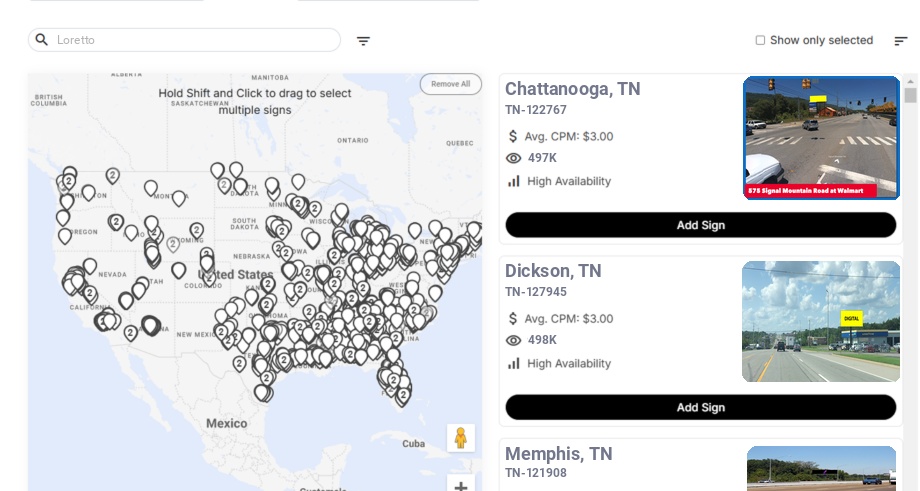
Blip has digital billboards in Loretto. You can browse available locations on a map, choose the ones that fit your audience, and start advertising right away.
Still have questions? Launch a campaign in minutes — no contracts, no commitments.
Start Your CampaignLoretto Billboard Advertising Guide
Loretto, Tennessee is a small city with outsized billboard value because it sits on U.S. 43, the main north-south corridor between Lawrenceburg, the Alabama line, and the broader Shoals tourism region. The city itself has roughly 1,700 residents, but the surrounding county had 44,159 people in 2020 across roughly 618 square miles, which gives advertisers a much larger real trade area than the city limits suggest.
Market Overview for Loretto Billboard Advertising
Loretto’s size, growth, and trade area
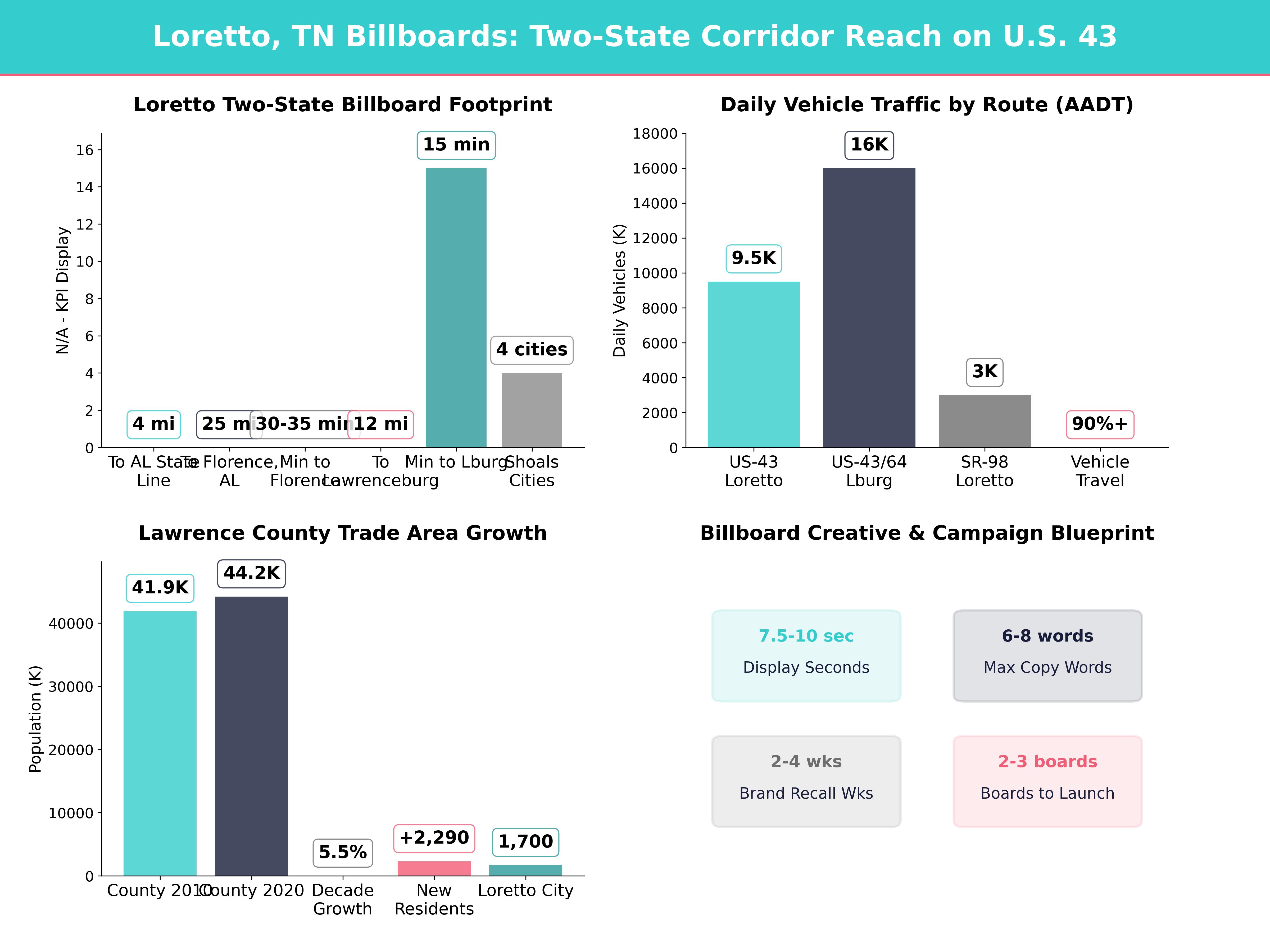
Loretto works best when we view it as a corridor market instead of only a city market. The local population is small, but Loretto sits inside a county of 44,159 residents and along a highway that pulls in traffic from multiple communities every day. Lawrence County grew from 41,869 residents in 2010 to 44,159 in 2020, which was an increase of 2,290 people, or about 5.5%. That is meaningful growth for a rural south-central Tennessee county.
Geography also helps. Loretto is about 12 miles south of Lawrenceburg, roughly 25 miles north of Florence, Alabama, and only about 4 miles from the Tennessee-Alabama state line. That makes the market more regional than it first appears. A business in Loretto can attract customers from several nearby communities, and a business outside Loretto can use the town’s corridor traffic to build awareness in both states.
What the local economy means for advertisers in Loretto
The local economy is shaped by manufacturing, agriculture, small business, healthcare, education, and cross-border retail activity, which aligns well with the rural-growth priorities often highlighted by the Tennessee Department of Economic and Community Development. Southern Tennessee Regional Health System Lawrenceburg Lawrenceburg, and education providers such as Columbia State Community College, The University of North Alabama, and Northwest-Shoals Community College all contribute to steady regional travel patterns.
For billboard advertisers, the most important fact is mobility. In a rural market like this one, well over 90% of commuting and errand travel happens by personal vehicle. There is no large urban fixed-route transit system, and mobility depends heavily on cars, trucks, and demand-response service from South Central Human Resource Agency. That means outdoor advertising is not competing with a subway ride or a dense pedestrian district. It is meeting people where daily life already happens.
Key Traffic Corridors Around Loretto
U.S. 43 / State Route 6 through Loretto
According to traffic-count maps from the Tennessee Department of Transportation, the U.S. 43 segment around Loretto generally operates in the 8,000 to 11,000 AADT range, depending on the exact point. That is strong volume for a town this size because most north-south travel funnels through the same spine. The corridor carries local residents, county traffic, and Alabama-bound drivers on one route.
This corridor is especially effective for several advertiser types.
- Quick-service restaurants, convenience stores, and fuel brands can capture drivers who are often within 5 to 10 minutes of a stop opportunity.
- Auto service, tires, oil change, and dealerships benefit because repeated commuter mileage creates constant vehicle-maintenance demand.
- Healthcare, dental, vision, and urgent care providers benefit because frequency on the same route builds recall before appointments are needed.
U.S. 43 and U.S. 64 in Lawrenceburg
As we move north toward Lawrenceburg, the commercial intensity rises. TDOT counts on the higher-volume urban segments of U.S. 43 and nearby U.S. 64 commonly climb into the 12,000 to 20,000+ AADT range, depending on the intersection and retail node. That is where countywide shopping, medical trips, banking, and employer traffic concentrate.
For many advertisers, this is the scale play within the Loretto market. If we need broader reach across Lawrence County, the Lawrenceburg cluster is often the best complement to a Loretto board. It is especially strong for:
- Furniture, grocery, home improvement, and financial services, because many households already travel there for planned purchases.
- Regional healthcare systems and specialty practices, because patients from smaller communities often drive into town for appointments.
- Employers and workforce recruiting, because traffic includes both local residents and commuters from surrounding communities.
State Route 98 east from Loretto
State Route 98 matters even though it is lower volume. TDOT maps typically place this route in the 2,000 to 4,000 AADT range on many segments, which is much smaller than U.S. 43 but still valuable. Lower-volume roads can be highly productive when they carry destination traffic instead of anonymous pass-through traffic.
SR 98 is useful when we want to reach households in eastern Lawrence County and travelers moving between Loretto and rural communities beyond town. We especially like this corridor for home services, HVAC, farm supply, building materials, insurance, and businesses that rely on local trust rather than impulse stops.
Southbound traffic toward Alabama and the Shoals
The southbound U.S. 43 story is one of Loretto’s biggest advantages. Florence is only about 30 to 35 minutes away, and the Shoals market includes 4 core cities, namely Florence, Muscle Shoals, Sheffield, and Tuscumbia. That gives advertisers a practical two-state audience even if the campaign starts in Tennessee.
This route works well for regional businesses that serve both Lawrence County and north Alabama. It also helps Tennessee businesses recruit Alabama workers, and Alabama attractions recruit Tennessee visitors. If our message is broad enough, southbound inventory can stretch the value of a Loretto campaign far beyond local city limits.
Audience Segments We Can Reach in Loretto
Loretto commuters and cross-border workers
Loretto’s commuter audience is regional, not purely local. A driver can reach Lawrenceburg in about 15 minutes, Florence in about 30 minutes, and a wider Shoals employment base in roughly 35 to 40 minutes. Because those trips repeat on the same core roads, billboard frequency becomes very efficient.
We can use this audience for:
- Workforce recruiting, especially for manufacturing, logistics, healthcare, and skilled trades.
- Payroll, tax, insurance, and financial services, because commuters are usually household decision-makers.
- Food and retail offers, because same-route repetition can influence lunch, fuel, and after-work shopping decisions.
Loretto families, homeowners, and everyday shoppers
Lawrence County’s 44,159 residents support a practical, family-driven consumer market. People make frequent trips for groceries, school drop-offs, church, youth sports, healthcare, and home needs. In smaller markets, those recurring trips often matter more than occasional big-event traffic.
For this audience, local relevance matters. Messages that mention Loretto, Lawrenceburg, or the exact service area often outperform broad generic branding. We usually recommend creative that clearly names the town, the road, or the immediate destination, especially for ZIP-focused businesses serving 38469 in Loretto or 38464 in Lawrenceburg.
Loretto tourists, outdoor visitors, and weekend explorers
Tourism in Loretto is not giant-metro tourism, but it is meaningful and highly intentional. Nearby David Crockett State Park Tennessee State Parks 1,319 acres and includes a 40-acre lake. That creates seasonal demand for dining, lodging, camping supplies, fishing, outdoor retail, and family entertainment.
The area also benefits from weekend travel related to Amish-country visits in Ethridge, outdoor recreation, and music-and-dining trips toward the Shoals. Regional tourism promotion from the Tennessee Department of Tourist Development and Florence-Lauderdale Tourism reinforces the idea that this corridor serves both local residents and leisure travelers.
Students, parents, and education audiences in Loretto
We can reach 3 different education audiences from a Loretto campaign. The first audience is local K-12 families served by the Lawrence County School System. The second audience is college students and parents connected to Columbia State Community College. The third audience is the southbound higher-education audience linked to The University of North Alabama and Northwest-Shoals Community College.
This segment matters most in August and January, when college terms start, and in late summer when K-12 routines restart. Advertisers in healthcare, wireless, food service, apparel, tutoring, automotive, and banking all benefit from those decision windows.
Seasonal and Timing Opportunities in Loretto
Spring and summer in Loretto
From March through August, outdoor movement increases across south-central Tennessee. That makes spring and summer especially useful for tourism, lawn and garden, powersports, HVAC, farm supply, restaurants, and convenience retail. Weekend visibility becomes more valuable as families head to David Crockett State Park
For leisure-oriented brands, we often like heavier delivery from 10 a.m. to 6 p.m. on Fridays, Saturdays, and Sundays. For commuter-oriented brands, weekday morning and late-afternoon exposure still matters more than all-day rotation.
Back-to-school and fall in Loretto
Late July and August are excellent for back-to-school messages, youth sports sponsorships, clinics, dentists, urgent care, apparel, fast food, and telecom offers. Fall then creates a second strong window from September through November. That period is ideal for heating service, trucks, tires, hunting and outdoor categories, and early holiday retail.
The outdoor culture matters here. Seasonal activity from the Tennessee Wildlife Resources Agency, plus Friday-night football and church-community calendars, keeps road traffic active even when pure tourism slows down. Fall is often one of the best periods for local relevance and hometown-pride messaging.
Holiday and winter timing in Loretto
From November through February, darker mornings and earlier sunsets make digital illumination stand out. We especially like the 6 to 8 a.m. and 4 to 7 p.m. windows for winter campaigns because the ad has stronger visual contrast during the commute. This season is well suited for healthcare, tax prep, insurance, furniture, legal services, and gift-driven retail.
Winter also rewards direct-response copy. People are making practical decisions about heating, repairs, finances, and medical needs, so clear offers often beat image-only branding.
Billboard Design Tips for the Loretto Market
Creative choices that fit Loretto’s local culture
In Loretto, practical usually beats abstract. We generally get better results when we show the product, the service, or the destination plainly rather than relying on clever visuals alone. A single strong image of the truck, burger, roof, clinic, or storefront usually works better than a collage of 4 or 5 smaller images.
The roadside environment matters too. Much of the year, the corridor is lined with green trees and darker rural backgrounds, so high-contrast color combinations such as navy and white, black and yellow, or red and white often stand out better than muted earth tones. If the service area crosses the state line, we should say that directly with lines such as “Serving Lawrence County and the Shoals” or “Tennessee and Alabama Service.”
Copy styles that work on Loretto roads
On Loretto roads, location should appear early. We like to put the town name, route name, or directional cue in the first 2 to 3 words whenever possible. Examples such as “Loretto Tires,” “Lawrenceburg ER,” “On U.S. 43,” or “2 Miles Ahead” feel immediately useful to drivers.
Because a digital blip lasts about 7.5 to 10 seconds, we usually aim for 6 to 8 readable words, one dominant image, and a logo that remains visible at a glance. In this market, neighborly language often performs better than irony or edgy humor. Loretto and Lawrence County buyers tend to respond well to clarity, trust, family cues, and local proof.
Regional Strategies for Loretto and Nearby Communities
Loretto proper and the immediate U.S. 43 corridor
We use Loretto proper for frequency and familiarity. In a city of roughly 1,700, brand recognition can build quickly when the same visual system repeats over 2 to 4 weeks. This zone is excellent for restaurants, auto service, dental offices, pharmacies, local events, and small businesses that depend on repeat exposure.
If the business is located in town, proximity matters. A board that is only 5 to 10 minutes from the storefront can move more real customers than a theoretically larger audience farther away.
Lawrenceburg as Loretto’s retail and service hub
Lawrenceburg sits only about 12 miles north, and it functions as the county’s main retail, medical, and professional-services center. We use this submarket when the advertiser wants countywide awareness instead of only Loretto familiarity. It is often the best place to scale a campaign after proving creative in Loretto itself.
This area is especially strong for higher-ticket categories. Southern Tennessee Regional Health System Lawrenceburg
Ethridge, rural north-county, and destination travel from Loretto
The north-county destination pattern is different from the Loretto commute pattern. Traffic moving toward Ethridge and rural attractions may be lower, but it is often more intentional. Many of those travelers are making specific weekend decisions about shopping, dining, outdoor recreation, or sightseeing.
For that reason, destination businesses should emphasize clear wayfinding, simple offers, and strong town naming. On a route where many drivers are about 10 to 15 minutes from the next decision point, the message should answer the question, “Why stop there instead of somewhere else?”
Alabama-line and Shoals expansion from Loretto
The state line is only about 4 miles away, which makes Loretto unusually useful for two-state advertising. Businesses active with employers and institutions in Lawrence County, the Shoals Chamber, The University of North Alabama, and regional healthcare or service networks can use Loretto inventory to bridge Tennessee and Alabama audiences.
If we are advertising across the border, we should localize the copy. One version can say “Lawrenceburg,” while another says “Florence.” One can say “Tennessee,” while another says “Alabama.” That small adjustment often improves relevance without changing the overall campaign strategy.
Using Blip Tools in Loretto
Manual campaign selection for Loretto corridors
Manual selection works best when we know exactly which movement pattern we want. If we want northbound commuters on U.S. 43, countywide reach in Lawrenceburg, or weekend traffic near outdoor destinations, we can choose those boards intentionally on the map and control when they run.
This approach is especially useful in a market like Loretto because a difference of 10 miles can completely change the audience. One board may feel hyper-local, while another reaches county shoppers, and another plays to cross-border traffic.
Blip-optimized campaigns for broader Loretto reach
When our goal is efficient reach across Loretto, Lawrenceburg, and the border corridor, a Blip-optimized campaign is often the better fit. It can spread budget where open inventory and timing are strongest without requiring us to manually balance every board.
That is valuable in a market with distinct traffic rhythms. Morning northbound demand, afternoon southbound demand, and weekend leisure movement do not always peak in the same places. Optimization helps us adapt faster than a fixed traditional buy.
Measuring and refining Loretto campaigns
Real-time reporting helps us learn whether the 6 to 9 a.m. commute performs better than the 3 to 6 p.m. return trip, and whether Loretto or Lawrenceburg inventory produces more useful exposure for the same offer. We can test 2 headlines, update artwork every 4 to 6 weeks, and keep the stronger variant in market.
Blip’s artwork tools also make localization easier. We can create one version for Loretto, one for Lawrenceburg, and one for the Alabama-side audience without rebuilding the campaign from scratch.
Getting Started with Billboard Rental in Loretto
Step 1: Match the Loretto billboard to the business goal
We should begin by defining the real objective. If the goal is immediate foot traffic, we should prioritize boards within 5 to 10 minutes of the business. If the goal is countywide awareness, we should combine Loretto with Lawrenceburg. If the goal is recruitment or regional branding, we should include the border corridor and southbound travel pattern.
That simple decision prevents wasted spend. In small markets, relevance beats raw map coverage.
Step 2: Evaluate each Loretto location like a local driver
We recommend asking four questions before choosing any billboard. Which direction is the viewer traveling? How fast is the traffic moving? What decision comes next? Is the offer useful within the next 1 to 15 miles?
Those questions matter more than abstract audience size in a place like Loretto. A board that reaches fewer people can outperform a busier one if it matches the next logical stop on the route.
Step 3: Launch small in Loretto, learn fast, and scale
A focused 2-week or 4-week test across 2 to 3 strategically different boards is usually the smartest way to start. We can compare corridor performance, daypart performance, and creative performance before adding budget. Once we see what resonates, we can scale the winners and pause the rest.
That process is much easier with Blip than with traditional billboard buying, which often involves slower inventory checks, larger commitments, and less flexible creative changes. In Loretto, where local context matters and travel patterns are easy to map, that flexibility is a genuine advantage.