Billboards in Clarksville, TN
No Minimum Spend. No Long-Term Contracts. Just Results.
Trusted by Leading Brands


Billboard advertising
in Clarksville has never been easier
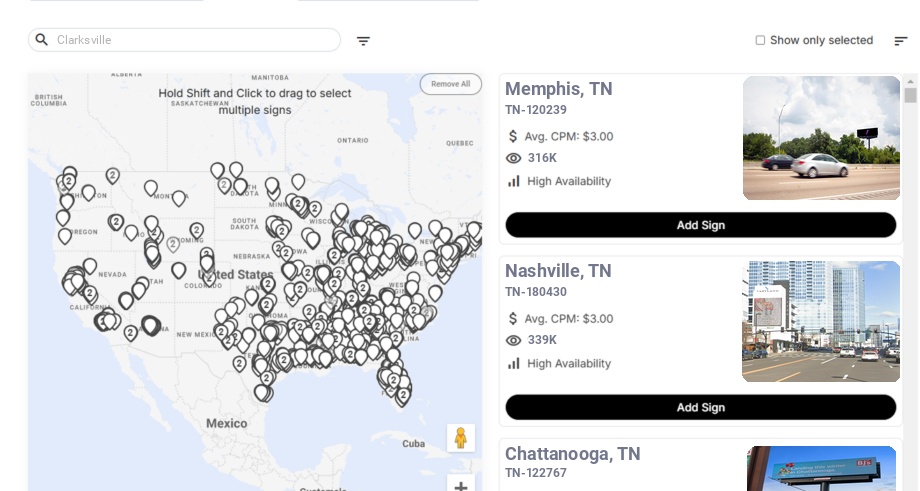



How much is a billboard in Clarksville?
Why Choose Blip for Billboard Advertising in Clarksville
Choose Blip in Clarksville to self-serve digital billboards near I-24 and Exit 4, where 70k+ AADT keeps your message in front of commuters fast.
Clarksville advertisers get flexible budgets with Blip, so you can test Fort Campbell Boulevard or Wilma Rudolph traffic without locking into a long contract.
Daypart your Clarksville campaign around school runs, lunch at Exit 4, or evening Downtown Commons crowds for more relevant reach.
Track Clarksville performance in real time and shift spend toward the Fort Campbell and APSU routes that drive the best response.
Use Blip's creative tools to tailor ads for Clarksville's military families, APSU students, and growth corridors like Tiny Town and Trenton Road.
Frequently Asked Questions About Billboard Advertising in Clarksville
How much does a billboard cost in Clarksville with Blip?
The cost of billboard advertising in Clarksville is flexible and built to fit your budget. You set a daily budget, and Blip’s algorithm uses it to bid for open ad slots on rotating digital billboards, so you only pay when your ad actually displays. Pricing starts at just $0.01 per display, and the cost per blip changes based on time of day, location, and advertiser demand.
Where can I advertise with Blip in Clarksville?
Clarksville gives us one of Tennessee’s strongest billboard environments because it combines rapid population growth, heavy everyday driving on corridors that often carry 20,000 to 75,000+ vehicles per day, and a mix of local and regional audiences. Key areas include I-24, Wilma Rudolph Boulevard, Fort Campbell Boulevard, Tiny Town Road, Trenton Road, and 101st Airborne Division Parkway. These routes reach commuters, military households, students, families, and weekend visitors.
What makes billboard advertising in Clarksville a strong market?
Clarksville is Tennessee’s 5th-largest city and its population grew 25.4% from 2010 to 2020. The market is anchored by Fort Campbell, Austin Peay State University, and a broad mix of retail, healthcare, manufacturing, and logistics activity. More than 80% of workers drive alone, so billboard advertising can reach the people moving through the city every day.
When is the best time to run Blip ads in Clarksville?
Summer is one of Clarksville’s most important billboard seasons because military relocation activity often ramps up from May through August. Fall is also strong, with school returning in August and events like the Montgomery County Fair in August and Clarksville Riverfest in September. The holiday season matters too, especially when Christmas on the Cumberland runs from late November through January.
Which Clarksville roads are best for reaching drivers with billboard ads?
I-24 is the region’s dominant traffic spine, with Clarksville-area segments commonly carrying about 60,000 to 75,000+ vehicles per day. Wilma Rudolph Boulevard is Clarksville’s signature commercial strip, while Fort Campbell Boulevard is especially important for military access traffic. Tiny Town Road, Trenton Road, and 101st Airborne Division Parkway are also strong commuter and errand routes serving fast-growing neighborhoods.
Do I need a contract to advertise with Blip in Clarksville?
No, Blip has no long-term contracts or minimum commitments. You can start, pause, or stop your campaign at any time.
How fast can I launch a billboard campaign with Blip in Clarksville?
You can have your campaign live in minutes. Create a free account, select your locations, set your budget, upload your design, and start running once approved.
Where can I advertise with Blip in Clarksville?
Blip has digital billboards in Clarksville. You can browse available locations on a map, choose the ones that fit your audience, and start advertising right away.
Still have questions? Launch a campaign in minutes — no contracts, no commitments.
Start Your CampaignClarksville Billboard Advertising Guide
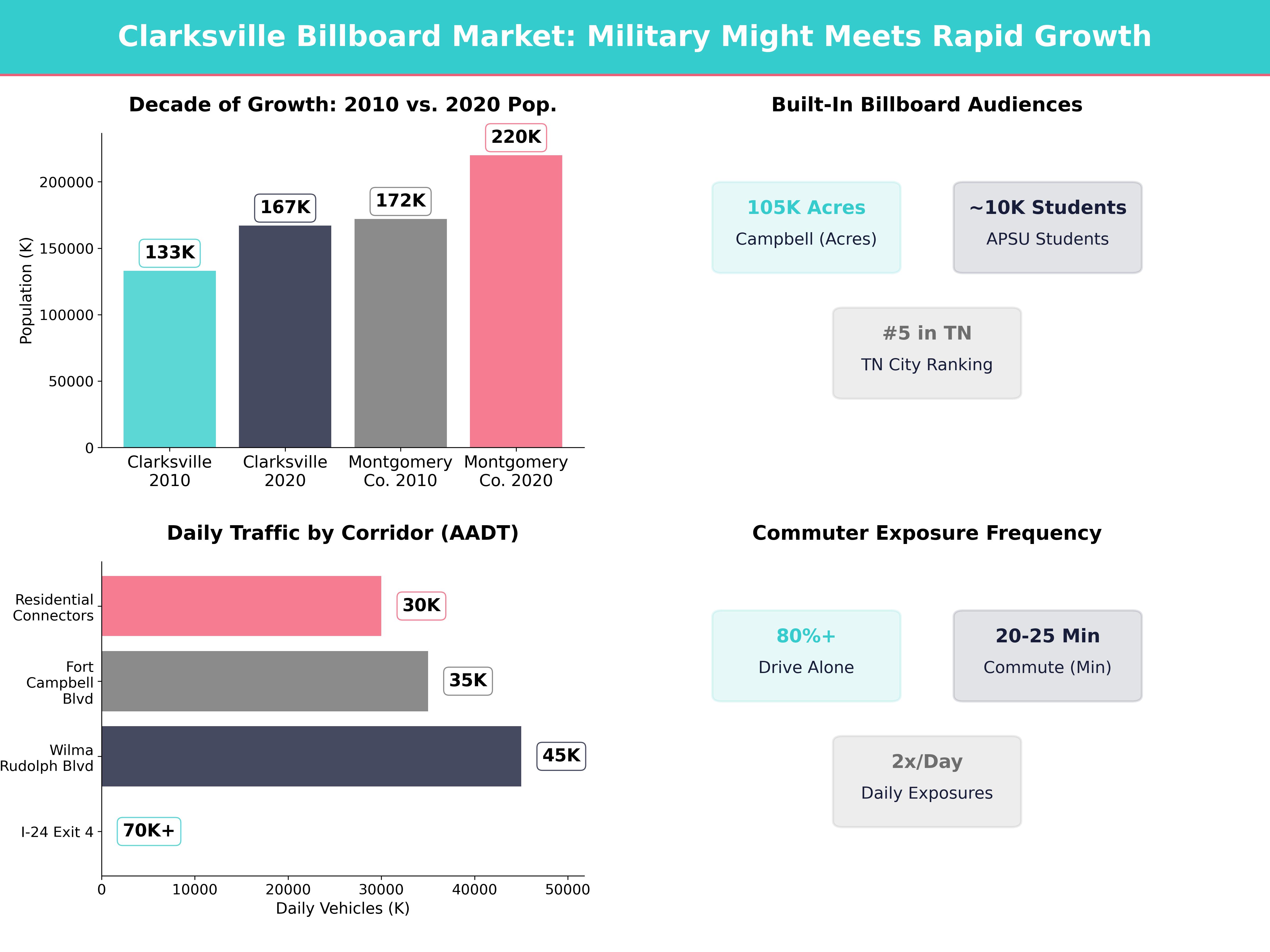
Clarksville gives us one of Tennessee’s strongest billboard environments because it combines rapid population growth, heavy everyday driving on corridors that often carry 20,000 to 75,000+ vehicles per day, and a mix of local and regional audiences anchored by a 105,068-acre military installation and a university with roughly 10,000 students. According to the Tennessee State Data Center City of Clarksville 166,722 residents in 2020, while Montgomery County reached 220,069. We also benefit from Clarksville’s position on Interstate 24, its close relationship with Fort Campbell, and the steady draw of Austin Peay State University. For advertisers that want to reach commuters, military households, students, families, and weekend visitors in one market, Clarksville offers unusual depth for a city of its size.
Market Overview for Clarksville Advertisers
Clarksville is not a small secondary outpost anymore. It is Tennessee’s 5th-largest city, and it sits roughly 50 miles northwest of Nashville 2010 to 2020, Clarksville’s population increased from 132,929 to 166,722, which equals 25.4% growth. Over the same decade, Montgomery County grew from 172,331 to 220,069, which equals 27.7% growth.
Clarksville’s growth changes the billboard equation
That level of growth matters because billboard advertising works best where daily movement keeps expanding. In Clarksville, we are not depending on a single downtown district or a single employer to generate impressions. We can reach residents moving between St. Bethlehem
Clarksville is especially useful for advertisers that need repeated exposure instead of one-time awareness. Local planning and commuter data consistently show that more than 80% of workers in the area drive alone, and typical one-way commute times run about 20 to 25 minutes. Because the Clarksville Transit System
Clarksville’s economy is broad enough for many advertiser types
We also like Clarksville because the economy is diversified. Fort Campbell drives a large defense-connected audience, Austin Peay State University contributes roughly 10,000 students plus faculty and visitors, the Clarksville Area Chamber of Commerce Clarksville-Montgomery County Economic Development Council
That mix creates room for many kinds of billboard campaigns.
- Retail and restaurants can capture daily spend around Exit 4, Wilma Rudolph Boulevard, and Fort Campbell Boulevard.
- Healthcare brands such as Tennova Healthcare - Clarksville and TriStar Clarksville Medical Center
- Home services and real estate benefit from ongoing residential growth across Sango, Tiny Town Road, Trenton Road, and surrounding neighborhoods.
- Hiring campaigns work well because Clarksville combines military transitions, college talent, healthcare workers, retail labor, and industrial recruiting needs.
Key Traffic Corridors in Clarksville
Clarksville’s travel patterns are concentrated enough that the right boards can do a lot of work. When we understand where people enter town, shop, commute, and head back home, we can choose placements that align with actual intent rather than broad geography.
I-24 and Clarksville’s major exits
According to the Tennessee Department of Transportation, I-24 is the region’s dominant traffic spine, and Clarksville-area segments commonly carry about 60,000 to 75,000+ vehicles per day. The busiest sections near the Exit 4 area are often around 70,000 AADT or higher. Exits 1, 4, 8, 11, and 19 are especially important because they function as Clarksville’s front doors for both residents and visitors.
This corridor is ideal for advertisers that need scale.
- Regional retail, hotels, and quick-service restaurants benefit because I-24 drivers are actively deciding where to stop, eat, or stay.
- Healthcare, legal services, and colleges benefit because repeated interstate exposure builds recall before a later search or visit.
- Tourism, events, and entertainment benefit because the route carries weekend visitors from Nashville, Kentucky, and nearby trade areas.
Wilma Rudolph Boulevard and the St. Bethlehem retail core
Wilma Rudolph Boulevard is Clarksville’s signature commercial strip. TDOT counts on key stretches regularly clear 35,000 to 45,000+ AADT, especially near the Exit 4 retail district, Governor’s Square Mall
We usually recommend this corridor for advertisers that want high-intent local traffic rather than pure pass-through reach.
- Restaurants, grocery, apparel, and specialty retail perform well here because drivers are already in shopping mode.
- Urgent care, dentistry, and specialty clinics benefit because the corridor is easy to navigate and already associated with errands.
- Entertainment brands such as The City Forum, F&M Bank Arena
Fort Campbell Boulevard and the military access corridor
Fort Campbell Boulevard is one of the most important roads in the Clarksville market because it connects the city to Fort Campbell and serves dense everyday commercial traffic. Core commercial sections often run roughly 25,000 to 35,000+ AADT, depending on the segment and proximity to the gates. The road is especially valuable near Gate 4 approaches, where commuter relevance and military household visibility overlap.
This is where we like direct, practical offers.
- Storage, moving, auto service, and housing-related brands fit the military-adjacent audience especially well.
- Financial services, insurance, wireless, and tax services work because convenience and trust matter to households on the move.
- Restaurants, convenience brands, and childcare providers benefit from repeated weekday frequency.
Tiny Town Road, Trenton Road, and 101st Airborne Division Parkway
Clarksville’s residential growth has pushed more traffic onto connectors such as Tiny Town Road, Trenton Road, and 101st Airborne Division Parkway. On many stretches, TDOT counts show 20,000 to 30,000+ AADT, while parts of the 101st corridor often exceed 25,000 AADT. These are not just neighborhood streets anymore. They are major commuter and errand routes serving fast-growing subdivisions, schools, and everyday retail.
We often use these roads for campaigns that need relevance over raw interstate volume.
- Pediatric, dental, and family healthcare campaigns fit because these routes serve household routines.
- Home improvement, pest control, HVAC, and roofing campaigns fit because the surrounding neighborhoods are full of owner-occupied homes and newly built communities.
- Private schools, childcare, tutoring, and youth activities fit because parents pass through these corridors repeatedly.
Audience Segments We Can Reach in Clarksville
One of Clarksville’s biggest advantages is audience variety. We do not have to choose between commuters and destination traffic, or between local families and transient consumers. We can reach all of them if we match location and timing correctly.
Commuters and everyday errand traffic in Clarksville
Commuters are the core audience for most Clarksville billboard campaigns. More than 80% of workers commute by driving alone, and the market’s most used roads support daily repetition. That repetition matters because brands often need several exposures before someone acts on a restaurant visit, a healthcare search, a home service call, or a retail trip.
This audience works well for:
- Daily-use brands, because frequency supports recall.
- Time-sensitive offers, because commute traffic peaks at predictable hours.
- Directional messaging, because many Clarksville trips are practical and destination-based.
Military households and defense-connected workers near Clarksville
Fort Campbell gives Clarksville a distinctive audience mix that many similarly sized cities cannot match. The installation spans 105,068 acres, and its presence shapes housing, retail, education, auto, and service spending across the north side of the market. We see especially strong relevance for advertisers that solve everyday needs quickly and clearly.
This audience is a strong fit for:
- Storage, moving, apartments, and real estate during relocation periods.
- Banks, credit unions, insurance, and tax prep when trust and convenience are central.
- Auto dealers, repair shops, tire stores, and oil change brands because vehicle dependence is high.
- Family services such as childcare, tutoring, urgent care, and dentistry.
Students, young adults, and downtown eventgoers in Clarksville
Austin Peay State University adds another important audience layer with roughly 10,000 students, plus faculty, staff, and visiting families. Downtown Clarksville has also become a stronger entertainment node thanks to F&M Bank Arena 5,500-seat venue that opened in 2023, and surrounding destinations such as the Roxy Regional Theatre, Downtown Commons Customs House Museum & Cultural Center.
We typically target this audience with campaigns for:
- Concerts, sports, and ticketed events that need short-run bursts.
- Coffee, casual dining, nightlife, and delivery-oriented brands that benefit from younger adult traffic.
- Career, education, and recruitment messaging that aligns with a student and early-career audience.
Families in Clarksville’s growth neighborhoods
The family audience is large and growing. The Clarksville-Montgomery County School System 40,000 students, which makes it one of Tennessee’s largest districts. Combined with a 27.7% decade-long county population increase, that gives us a strong base for household-focused advertising.
This audience responds well to:
- Healthcare, orthodontics, pediatrics, and urgent care messaging.
- Grocery, restaurant, and value-driven retail messaging.
- Home services, because household decision-makers are driving these routes every week.
- Family entertainment, including destinations such as The City Forum, Dunbar Cave State Park Historic Collinsville
Weekend visitors and leisure traffic in Clarksville
Clarksville is close enough to Nashville for day trips and weekend spillover, and it has enough attractions to keep local leisure traffic moving. Visit Clarksville promotes destinations such as Beachaven Vineyards & Winery, Old Glory Distilling Co.
Seasonal and Timing Opportunities in Clarksville
Clarksville is not a market where we want to run the same creative the same way all year. The military calendar, school calendar, tourism calendar, and weather all create predictable windows when certain messages work harder.
Spring in Clarksville
Spring is strong for home services, healthcare, landscaping, allergy care, and outdoor leisure. As the weather improves, drivers head back to parks, patios, downtown events, and local attractions. This is also a good time to promote graduation-related offers tied to Austin Peay State University and local schools.
We also like spring because it begins the event-heavy stretch that carries into summer. Advertisers tied to wineries, distilleries, entertainment, and family outings can start building frequency before the busiest leisure months.
Summer in Clarksville
Summer is one of Clarksville’s most important billboard seasons. Military relocation activity often ramps up from May through August, which creates timely demand for storage, apartments, movers, furniture, internet service, insurance, and car care. Beachaven Vineyards & Winery also runs its Jazz on the Lawn series from May through October, which helps support evening and weekend leisure traffic.
Summer is also ideal for:
- Hotels and restaurants near I-24, because road trips increase.
- Family entertainment campaigns, because school is out and routine driving shifts toward activities.
- Cooling, pool, lawn, and pest-control services, because the offer is immediately relevant.
Fall in Clarksville
Fall gives us one of the best combinations of commuter consistency and event momentum. The Clarksville-Montgomery County School System August, and that immediately increases school-run, retail, and after-school activity. Montgomery County Fair activity also centers in August, and Clarksville Riverfest September, creating strong visibility opportunities for restaurants, sponsors, and local attractions.
This is also a strong recruiting and service season. Employers can lean into hiring, colleges can promote enrollment, and healthcare brands can emphasize checkups, flu shots, and year-end insurance utilization.
Holiday and winter timing in Clarksville
The holiday season matters more in Clarksville than many advertisers assume. Christmas on the Cumberland late November through January, which supports downtown visits and seasonal family traffic. Retail, dining, gift cards, events, healthcare, and tax-related services can all use this period effectively.
We also like to think about payday timing in Clarksville. Campaigns aimed at military households often benefit from extra emphasis around the 1st and 15th of the month, when many service members receive pay. That timing can be especially useful for restaurants, value retail, financial services, and limited-time offers.
Billboard Design Tips for the Clarksville Market
Clarksville creative works best when it feels local, practical, and easy to process from the road. We do not need to overcomplicate the design when the audience is moving quickly and often already knows the city’s shorthand.
Use Clarksville place names that drivers instantly understand
Clarksville drivers respond well to familiar local anchors such as “Exit 4,” “Gate 4,” “Downtown,” “Sango,” “Tiny Town,” and “APSU.” Those cues do more than describe place. They tell drivers that the offer is nearby and relevant to the route they are already on.
We can make this even stronger with distance-based messaging. A line such as “Lunch at Exit 4 in 2 Miles” works better than a vague slogan because it gives the driver a decision point. A line such as “Storage Near Gate 4” works better than a generic moving message because it matches real behavior.
Match the tone to Clarksville’s audience mix
Military families, students, and suburban households all live in this market, so we usually recommend creative that emphasizes usefulness, value, speed, and trust. Patriotic themes can work near Fort Campbell, but they should feel respectful and restrained rather than cliché-driven. Family-oriented creative should emphasize convenience and affordability. Student-oriented creative can be more event-focused and social, especially near downtown and the university.
Build for Clarksville’s road speeds
Design should change based on the road. On I-24, where posted speeds are typically 70 mph, we should keep the message to one main idea, one brand cue, and one clear next step. On slower retail roads such as Wilma Rudolph Boulevard, we can support a slightly denser message with a price point, an exit number, or a same-day offer.
We usually recommend that Clarksville advertisers think in road contexts.
- On interstate boards, we should prioritize brand, offer, and location.
- On retail corridor boards, we can add urgency, price, or a short directional cue.
- On event-oriented boards, we should emphasize date, venue, and simple call-to-action language.
Use imagery that reflects how Clarksville actually lives
Clarksville is not just a highway market. It is a military market, a family market, a student market, and an outdoor-leisure market. Creative that reflects real local behavior often performs better than generic stock imagery.
We often see strong local fit when ads visually reference:
- Family outings, because Clarksville households spend heavily on weekends and after school.
- Outdoor or riverfront activity, because downtown, parks, and seasonal events matter here.
- Food, entertainment, and convenience, because many billboard decisions in Clarksville are immediate and practical.
Regional Strategies Across Clarksville
Clarksville is large enough that one strategy rarely fits the whole market. We usually get better results when we divide the city into functional zones and match each zone with the right objective.
Downtown Clarksville and the Riverside area
Downtown is the best fit for entertainment, dining, arts, nightlife, and event promotion. Campaigns tied to F&M Bank Arena Roxy Regional Theatre, the Customs House Museum & Cultural Center, Downtown Commons
St. Bethlehem and the Exit 4 retail district
This is Clarksville’s highest-intent shopping zone. If our goal is store visits, restaurant traffic, hotel demand, or medical appointment awareness, this is usually the first submarket we evaluate. The combination of interstate access, lodging, retail clustering, and strong arterial traffic makes it one of the most productive zones for direct-response billboard campaigns.
North Clarksville and Fort Campbell access routes
This zone is ideal for military-adjacent categories. We especially like it for storage, moving, apartments, auto services, financial services, wireless, childcare, and fast casual dining. Messaging should be practical, easy to read, and close to the action.
Sango and east I-24 commuter suburbs
Sango gives us a more suburban, household-oriented audience. This is where healthcare, dental, home services, real estate, insurance, and premium everyday retail often fit best. Boards serving eastbound and westbound commuter flow can build strong weekday frequency.
Tiny Town Road, Trenton Road, and growth-belt neighborhoods
These corridors are useful for brands that want neighborhood relevance. Urgent care, youth activities, local restaurants, telecom providers, gyms, and service businesses can all perform well when they stay close to the routines of parents and household decision-makers.
Using Blip Tools in Clarksville
Clarksville is exactly the kind of market where Blip’s flexibility becomes strategically useful. Because traffic patterns differ so much between I-24, Exit 4 retail, downtown, and Fort Campbell routes, we can learn quickly by testing multiple zones instead of betting everything on one board.
Daypart around Clarksville’s real traffic peaks
We usually recommend matching time of day to the audience.
- Morning and late afternoon are strongest for commuters on I-24, Fort Campbell Boulevard, Tiny Town Road, and Trenton Road.
- Late morning and lunch work well for restaurants, retail, and healthcare on Wilma Rudolph Boulevard.
- Evenings and weekends are best for downtown entertainment, arena events, wineries, distilleries, and family activities.
Because a Blip ad appears in 7.5- to 10-second bursts, timing matters as much as location. We can concentrate spend when traffic is most relevant instead of paying for broad, less efficient coverage.
Test corridors instead of guessing
Clarksville has clear route-based behavior, so we can compare boards near Exit 4, Fort Campbell Boulevard, and neighborhood connectors with real performance data. If one corridor drives stronger engagement, we can shift budget there quickly. If another works only on weekends or around payday, we can narrow the schedule instead of dropping the market altogether.
Localize creative without rebuilding the whole campaign
Blip makes it practical to swap creative by corridor. We can use one version that references “Exit 4,” another that references “Gate 4,” and another that pushes an event downtown. That kind of localization is especially valuable in Clarksville because the audience changes meaningfully from one zone to the next.
We can also start small. Since campaigns can begin at $0.01 per display, we can test message, timing, and geography before scaling.
Getting Started with Billboard Rental in Clarksville
Renting a billboard in Clarksville works best when we start with the outcome, not the board. A restaurant wants meal-period traffic. A medical practice wants appointment consideration. An event wants attendance during a short window. A home service brand wants repeated residential exposure. Once we know the goal, the geography becomes much easier to evaluate.
Define what success looks like in Clarksville
We recommend choosing one primary objective first.
- If we want broad awareness, we should start with I-24 and major retail corridors.
- If we want store visits, we should favor boards close to the destination, especially within 1 to 3 miles of an exit or turn.
- If we want military or neighborhood relevance, we should prioritize Fort Campbell Boulevard, Tiny Town Road, Trenton Road, and similar local connectors.
- If we want event attendance, we should build around downtown approaches, arena nights, and weekend timing.
Evaluate boards by direction, speed, and proximity
Not every high-traffic board is equally useful. In Clarksville, we want to ask practical questions. Is the board facing inbound or outbound traffic. Is the road moving at interstate speed or stop-and-go retail speed. Is the destination decision happening immediately, or is this more of a recall-building placement.
That is why a board near Exit 4 can be excellent for a hotel, restaurant, or urgent care, while a neighborhood connector may be better for pest control, dentists, or youth programs.
Start with a test, then expand what works
Traditional billboard buying often pushes advertisers toward longer commitments before they have enough local learning. In Clarksville, we usually get better results by running a focused 2- to 4-week test across 2 or 3 strategic areas, reviewing performance, and then expanding the placements and times that fit the goal best.
Blip simplifies that process because we can choose boards on a map, adjust schedules around real traffic patterns, revise creative for different Clarksville submarkets, and optimize without waiting through a long contract cycle. For advertisers entering the market for the first time, that is often the fastest way to discover whether their strongest opportunity is interstate reach, military adjacency, suburban household traffic, or downtown event visibility.