Billboards in Lawrenceburg, TN
No Minimum Spend. No Long-Term Contracts. Just Results.
Trusted by Leading Brands


Billboard advertising
in Lawrenceburg has never been easier
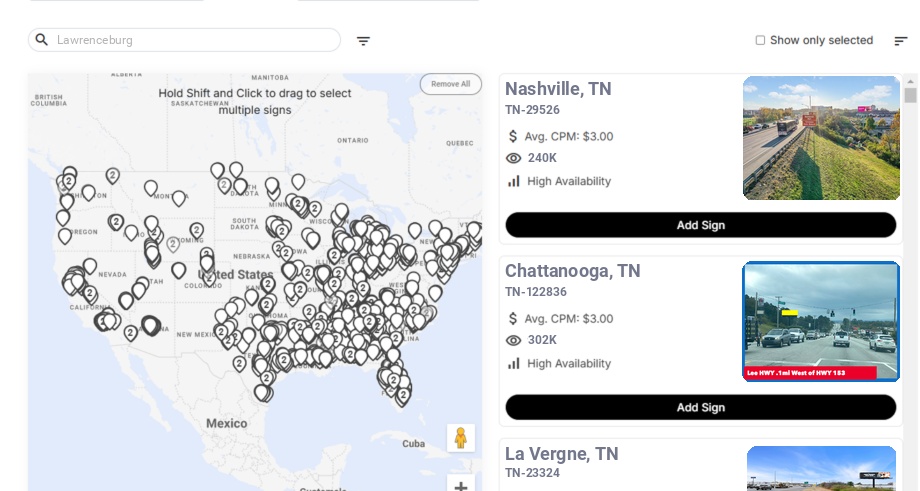



How much is a billboard in Lawrenceburg?
Why Choose Blip for Billboard Advertising in Lawrenceburg
Blip lets you launch fast in Lawrenceburg and target U.S. 43/U.S. 64 commuter traffic with no contracts or minimums.
Set flexible daily budgets in Lawrenceburg to reach shoppers and healthcare visitors on the busy 15,000-20,000 AADT corridors.
Use dayparting on Blip to hit Lawrenceburg's 6-9 a.m. and 4-7 p.m. commute windows when local traffic is strongest.
Track real-time results in Lawrenceburg and shift spend toward fair season, David Crockett State Park trips, or weekend traffic.
Blip's creative tools make it easy to refresh Lawrenceburg ads for back-to-school, tourism, or U.S. 64 route messaging.
Frequently Asked Questions About Billboard Advertising in Lawrenceburg
How much does a billboard cost in Lawrenceburg with Blip?
With Blip, billboard advertising in Lawrenceburg is designed to fit a wide range of budgets. Each “blip” is a 7.5-to-10-second ad, and pricing starts at just $0.01 per display. Because cost per blip changes based on time of day, location, and advertiser demand, Blip works to stretch your budget for the most reach possible.
Where can I advertise with Blip in Lawrenceburg?
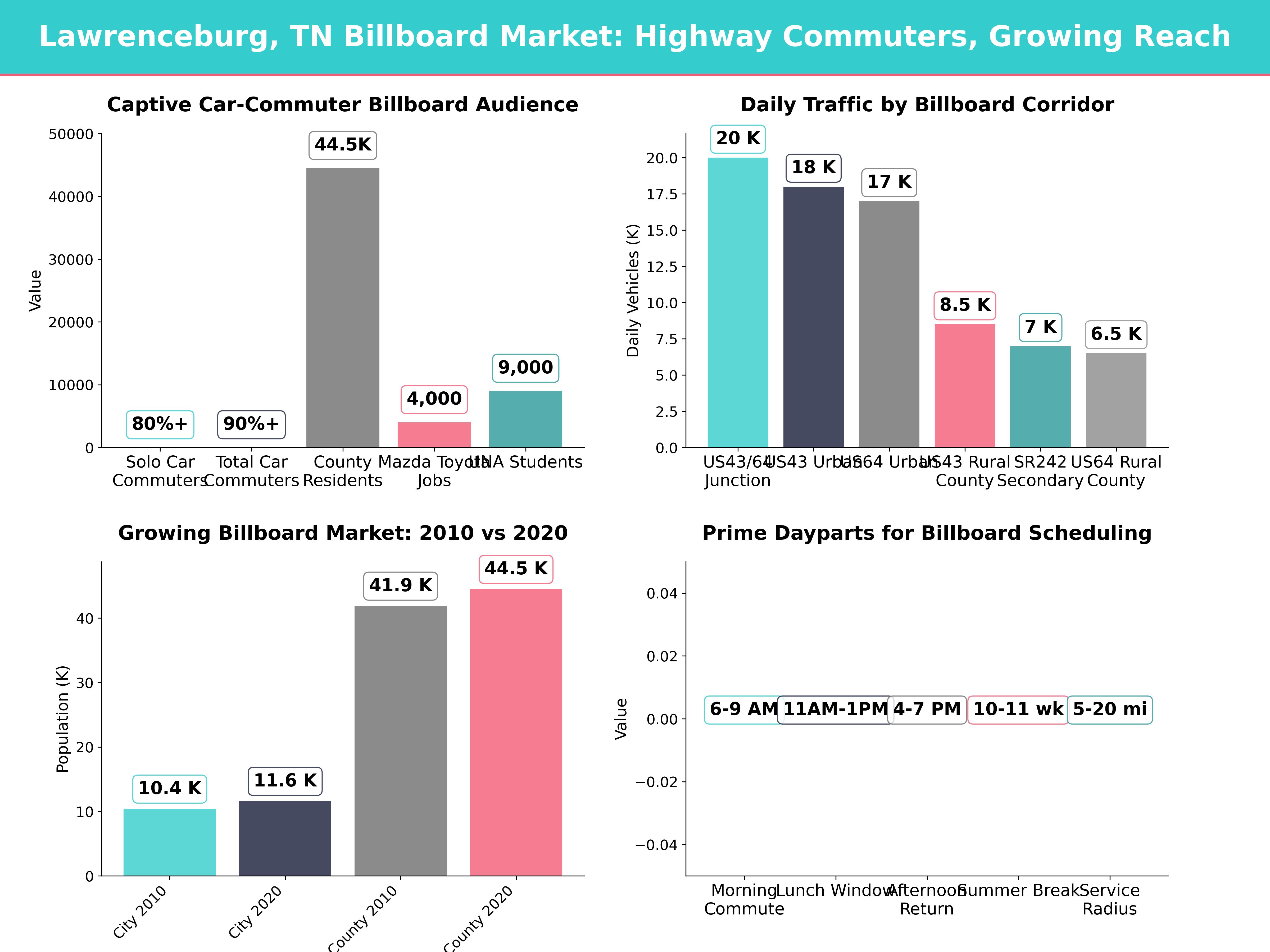
Lawrenceburg gives us a strong billboard market because it combines a reliable local base with steady regional pass-through traffic, with key in-town stretches of U.S. 43 and U.S. 64 carrying roughly 15,000 to 20,000 AADT. The busiest in-town stretches of U.S. 43 generally run above 18,000 AADT, and the strongest nodes near the U.S. 64 junction push into the 20,000-plus range. U.S. 64 in and around Lawrenceburg typically lands around 15,000 to 19,000 AADT in the urban segments.
Why is Lawrenceburg a good market for billboard advertising with Blip?
Lawrenceburg is a classic drive market, and well over 80% of workers commute alone by car, with more than 90% usually reaching work by car when carpools are included. The city had a 2020 population of 11,633, and Lawrence County reached 44,517, which is large enough to support repeated local exposure without the clutter of a major metro. Lawrenceburg also sits in a useful regional position, roughly 80 miles south of Nashville and about 40 miles north of Florence, Alabama.
When is the best time to run billboards in Lawrenceburg?
In Lawrenceburg, timing matters almost as much as location, and morning commuter windows from 6 to 9 a.m., lunch periods from 11 a.m. to 1 p.m., and afternoon return trips from 4 to 7 p.m. are usually the first places to test. Spring from March through May is one of the best times to advertise because people start moving more, spending tax refunds, and planning outdoor projects. Fall is also a strong season, especially around school returns in August and the Middle Tennessee District Fair in late September.
What kinds of businesses work best for billboards in Lawrenceburg with Blip?
The local economy is diversified enough to support many billboard categories, including manufacturing, agriculture, healthcare, education, retail, and local services. Healthcare advertisers, retail and restaurant brands, recruiting campaigns, auto dealers, and tourism advertisers can all benefit from the traffic patterns in Lawrenceburg. The city core is especially strong for restaurants, healthcare providers, urgent care, retail, financial services, and local events because the audience is already close to the point of purchase.
Do I need a contract to advertise with Blip in Lawrenceburg?
No, Blip has no long-term contracts or minimum commitments. You can start, pause, or stop your campaign at any time.
How fast can I launch a billboard campaign with Blip in Lawrenceburg?
You can have your campaign live in minutes. Create a free account, select your locations, set your budget, upload your design, and start running once approved.
Where can I advertise with Blip in Lawrenceburg?
Blip has digital billboards in Lawrenceburg. You can browse available locations on a map, choose the ones that fit your audience, and start advertising right away.
Still have questions? Launch a campaign in minutes — no contracts, no commitments.
Start Your CampaignLawrenceburg Billboard Advertising Guide
Lawrenceburg gives us a strong billboard market because it combines a reliable local base with steady regional pass-through traffic, with key in-town stretches of U.S. 43 and U.S. 64 carrying roughly 15,000 to 20,000 AADT. Lawrenceburg had a 2020 population of 11,633, and Lawrence County reached 44,517, which is large enough to support repeated local exposure without the clutter of a major metro. The market is highly car-oriented, with most work, school, shopping, and healthcare trips flowing along U.S. 43 and U.S. 64 on corridors that carry roughly 15,000 to 20,000 AADT in the urban core. Tourism drivers such as David Crockett State Park 1,107 acres, heritage travel near Ethridge’s Amish communities, and the annual Middle Tennessee District Fair
Lawrenceburg Market Overview
Population, growth, and geographic reach in Lawrenceburg
Lawrenceburg is the commercial and civic center of a county that covers about 617 square miles, or roughly 72 residents per square mile, so even a modest population creates a broad trading area. The city grew from 10,428 residents in 2010 to 11,633 in 2020, which is an increase of roughly 11.6%. Lawrence County grew from 41,869 residents in 2010 to 44,517 in 2020, which is about 6.3% growth across the decade.
Those numbers matter because they show two things at once. First, Lawrenceburg is not a static small town. Second, the city captures a disproportionate share of county activity because roughly 1 in 4 county residents live inside Lawrenceburg itself (about 26%), while many more drive into town for errands, work, school, and appointments.
Lawrenceburg also sits in a useful regional position. It is roughly 80 miles south of Nashville 40 miles north of Florence, Alabama Columbia Pulaski, and Huntsville. For billboard advertisers, that means our campaigns can influence both hometown decisions and cross-market trips.
What Lawrenceburg’s economy and travel habits mean for advertisers
Lawrenceburg is a classic drive market. Tennessee Department of Economic and Community Development community profile data for rural Tennessee counties consistently shows that well over 80% of workers commute alone by car, and more than 90% usually reach work by car when carpools are included. In practical terms, that means billboard visibility is not a side channel here. It is part of the daily routine.
The local economy is diversified enough to support many billboard categories. Manufacturing, agriculture, healthcare, education, retail, and local services all matter in Lawrence County. Institutions such as Southern Tennessee Regional Health System Lawrenceburg, Lawrence County School System, and Columbia State Community College bring people into Lawrenceburg repeatedly across the week.
Regional employment also expands the audience. Mazda Toyota Manufacturing in Huntsville is designed for up to 4,000 team members, and University of North Alabama serves roughly 9,000 students in the Shoals region. Even when those institutions are not physically in Lawrenceburg, they influence commuting, shopping, dining, healthcare, and weekend travel patterns across southern Middle Tennessee and north Alabama.
For advertisers, the takeaway is simple. Lawrenceburg rewards consistency, local relevance, and directional convenience. If we offer a useful service within 5 to 20 miles of the viewer’s route, digital billboards can drive real consideration.
Key Traffic Corridors for Lawrenceburg Billboards
Lawrenceburg travel is concentrated on a few high-value routes, which is excellent for out-of-home planning. When we understand where traffic compresses, slows, merges, or repeats, we can choose boards that deliver both reach and recall.
U.S. 43 in Lawrenceburg
U.S. 43, which is also State Route 6, is Lawrenceburg’s north-south backbone. According to TDOT traffic count maps, the busiest in-town stretches of U.S. 43 in Lawrenceburg generally run above 18,000 AADT, and the strongest nodes near the U.S. 64 junction push into the 20,000-plus range. Farther out in Lawrence County, traffic usually eases into the 7,000 to 10,000 AADT band.
This corridor matters because it connects Lawrenceburg with Columbia
- Healthcare advertisers benefit because county residents repeatedly use U.S. 43 for medical appointments, pharmacy stops, and follow-up care.
- Retail, restaurants, and convenience brands benefit because the route captures daily errands, lunch trips, and after-work decisions.
- Recruiting campaigns benefit because the corridor reaches both local workers and regional commuters moving across the Tennessee-Alabama line.
U.S. 64 through Lawrenceburg
U.S. 64, which is also State Route 15, is Lawrenceburg’s east-west spine. TDOT counts show that the strongest urban segments in and around Lawrenceburg typically land around 15,000 to 19,000 AADT, while county stretches farther from the city are more often in the 5,000 to 8,000 range.
This route carries shoppers, service seekers, agricultural traffic, and regional travelers moving between Lawrenceburg, Pulaski, and western points such as Waynesboro. It is especially valuable for advertisers whose offers are destination-based rather than impulse-based.
- Auto dealers, tire shops, and repair centers perform well on U.S. 64 because drivers are already in a transportation mindset.
- Farm, home, and hardware businesses perform well because the corridor serves rural households and landowners making planned purchases.
- Tourism and hospitality advertisers perform well because the route captures weekend visitors heading to parks, events, and scenic drives.
State Route 242 and Lawrenceburg’s secondary approaches
State Route 242 is not as large as U.S. 43 or U.S. 64, but it plays an important feeder role on the northeast side of the Lawrenceburg area. TDOT counts on these secondary approaches are typically lower, often around 6,000 to 8,000 AADT, but the audience is still valuable because much of it is hyperlocal and repetitive.
That makes secondary corridors useful for advertisers who care more about neighborhood penetration than countywide scale.
- Home services benefit because these routes reach homeowners close to the service area.
- Schools, child care, and family businesses benefit because parents repeat the same routes at consistent times.
- Banks, insurance agencies, and legal services benefit because local trust-building usually comes from repeated exposure rather than one-time reach.
Downtown Lawrenceburg and commercial cluster strategy
The Lawrenceburg core, especially where U.S. 43 and U.S. 64 intersect near established retail and civic destinations, gives us the highest-intent audience in the market. Speeds are lower, stopping frequency is higher, and decision-making is immediate. That is where “turn here,” “next light,” “open today,” and “same-day appointments” work especially well.
For many local businesses, the best boards are not necessarily the farthest-reaching boards. They are the boards that sit closest to the final decision point.
Audience Segments We Can Reach in Lawrenceburg
Lawrenceburg commuters and county residents
The base audience starts with Lawrence County’s 44,517 residents and Lawrenceburg’s 11,633 city residents. Because the county is spread across about 617 square miles, many households drive into Lawrenceburg regularly for groceries, school, medical care, financial services, and government errands.
This audience is ideal for year-round campaigns from local brands. We can reach them with steady weekday presence, especially during the 6 to 9 a.m. and 4 to 7 p.m. commute windows. Insurance agencies, clinics, restaurants, banks, retailers, and service businesses all benefit from that repetition.
Regional workers and cross-border employment audiences
Lawrenceburg is not just a local errand market. It is also part of a broader labor shed connected to southern Middle Tennessee and north Alabama. Regional employers such as Mazda Toyota Manufacturing, with capacity for 4,000 team members, shape commuting and consumer behavior beyond county lines.
That opens opportunities for several advertiser types.
- Staffing firms and employers can promote hiring during morning and afternoon drive times.
- Colleges and training programs can target adults considering certificates, trades, or career changes.
- Auto finance, wireless, and financial services brands can reach workers who commute longer distances and make practical, value-driven purchase decisions.
Families, students, and school-year routines in Lawrenceburg
Family scheduling is a major part of Lawrenceburg traffic. The Lawrence County School System runs on a school year that generally spans about 10 months, beginning in early August and ending in late May. That calendar creates predictable spikes for back-to-school shopping, sports, after-school meals, tutoring, healthcare, and family entertainment.
The education audience also extends beyond K-12. Columbia State Community College serves the region, and University of North Alabama enrolls roughly 9,000 students. That supports billboard demand for apartments, workforce training, healthcare, wireless services, restaurants, and retail.
Outdoor visitors, heritage travelers, and event audiences
Tourism in Lawrenceburg is not a giant convention-market story. It is a road-trip and weekend-travel story, which fits digital billboards very well. David Crockett State Park 1,107 acres, bringing campers, anglers, hikers, and family visitors into the area across the warmer months and during fall color season.
Lawrenceburg also benefits from heritage and event travel. The Middle Tennessee District Fair Mule Day in Columbia
Seasonal and Timing Opportunities in Lawrenceburg
Spring campaigns in Lawrenceburg
Spring is one of the best times to advertise in Lawrenceburg because people start moving more, spending tax refunds, and planning outdoor projects. From March through May, we see stronger demand for lawn care, landscaping, outdoor power equipment, home improvement, and travel-related services.
This is also a smart window for park and heritage travel messaging. Routes tied to David Crockett State Park Columbia
Summer opportunities in Lawrenceburg
Summer works well for categories tied to family mobility. School is generally out for about 10 to 11 weeks, which changes traffic patterns from rigid weekday commuting to a mix of family errands, recreation, and weekend travel.
That is the right time to emphasize:
- Family dining and quick-service restaurants, because group decisions happen on the road.
- Cooling, HVAC, and auto A/C services, because weather-driven need is immediate.
- Outdoor recreation, tourism, and hospitality, because park and regional travel are strongest from May through August.
Friday afternoon and Saturday daytime scheduling usually becomes more valuable during summer than it is in winter.
Fall timing in Lawrenceburg
Fall is the most layered season in Lawrenceburg advertising. School returns in August, football and community events build routine in September and October, and harvest activity adds rural movement. The Middle Tennessee District Fair September, creating a concentrated visibility opportunity for food, retail, healthcare, entertainment, and political advertisers.
This is also a strong season for local identity messaging. Creative that feels tied to the county, the fair, outdoor recreation, and familiar family routines often performs better than generic brand copy during the fall months.
Winter and early-year strategy in Lawrenceburg
Winter in Lawrenceburg is less about tourism surges and more about utility. From November through January, holiday shopping, healthcare appointments, automotive needs, and year-end financial decisions become stronger themes. Shorter daylight hours can help digital boards stand out visually during the 4 to 7 p.m. commute.
Early January and February are also strong for practical-service categories. Tax preparation, fitness offers, healthcare enrollment reminders, and repair services all fit the post-holiday mindset.
Lawrenceburg Billboard Design Tips
Use Lawrenceburg-specific geography in the message
Lawrenceburg audiences respond well when the ad clearly belongs to their market. We should use route references, local landmarks, and practical wayfinding such as “On U.S. 43,” “Just off U.S. 64,” “Near the hospital,” or “Only 2 miles ahead.” In a market where many purchases are destination-driven, location clarity is persuasive.
We can also lean into recognizable local travel language. Phrases like “north of town,” “on the way to Columbia,” or “before you hit Florence” feel more native than abstract lifestyle slogans.
Lead with value, convenience, and trust in Lawrenceburg
Lawrenceburg is not a market where overly polished luxury messaging always wins. Straightforward value usually performs better. Price points, financing terms, urgency, and availability cues are useful because they match how people shop in a practical regional market.
Examples of high-readability approaches include these tactics:
- We should use large numerals such as “Open 7 days,” “Save 20%,” or “Appointments this week.”
- We should emphasize speed and reliability with phrases such as “Same-day service” or “Call before 5 p.m..”
- We should use the local 931 area code when phone response matters, because local familiarity increases trust.
Reflect Lawrenceburg’s culture and visual tone
Lawrenceburg creative should feel grounded in the area’s identity. Earth tones, deep greens, denim blues, barn reds, and high-contrast whites often fit local expectations better than flashy nightclub palettes. For tourism, outdoor recreation, and family brands, imagery inspired by state park scenery, fall color, fishing, trails, county fairs, and rural landscapes can feel especially natural.
For healthcare, banking, education, and legal services, we should keep the tone calm, clear, and reassuring. Lawrenceburg audiences often reward brands that feel dependable more than brands that feel trendy.
Keep copy short for high-speed routes
On U.S. 43 and U.S. 64, our best-performing creative is usually very concise. A good target is 6 to 8 words of primary copy, plus the logo and a directional or call-to-action element. In slower in-town locations, we may have room for one extra line, but even there simplicity wins.
Regional Strategies for Lawrenceburg Advertisers
Lawrenceburg city core strategy
The city core is the best choice when our goal is immediate action inside Lawrenceburg. These placements work well for restaurants, healthcare providers, urgent care, retail, financial services, and local events because the audience is already close to the point of purchase.
In the city core, frequency matters more than broad geography. If residents see the same message several times each week on normal errands, recall rises quickly.
U.S. 43 north strategy from Lawrenceburg toward Columbia
The northbound U.S. 43 corridor is important because it connects Lawrenceburg with Columbia 45-mile corridor to Columbia, so advertisers on this route can influence both outbound local trips and inbound regional visits.
This corridor is especially strong for healthcare systems, car dealers, financial services, home improvement brands, and event promotions. It is also effective for businesses that want to intercept spending before consumers leave town.
U.S. 43 south strategy from Lawrenceburg toward the Shoals
The southbound side of Lawrenceburg points toward Florence 40 miles away and Huntsville at roughly 70 miles away, depending on the route. That makes it useful for regional recruiting, education, healthcare, entertainment, and retail advertisers that draw from both Tennessee and Alabama.
When we advertise on southbound approaches, it helps to speak to intent. Messaging like “Before the state line,” “On your way home,” or “Worth the stop in Lawrenceburg” can fit the audience mindset.
U.S. 64 east-west strategy across Lawrence County
U.S. 64 supports a different pattern. Many trips on this corridor are purposeful, including farm supply runs, family errands, school travel, and planned shopping. That means U.S. 64 creative should often be more offer-led than brand-led.
We should use these boards when we want to reach:
- Rural homeowners who need practical services.
- Agriculture and equipment buyers who make planned purchases.
- Regional destination shoppers who will respond to strong value, inventory, or financing messages.
Rural Lawrence County strategy beyond the city
Advertisers serving the full county should remember that rural reach and urban reach are not the same thing. Outlying communities may produce fewer impressions, but those impressions are often highly relevant. If our business draws customers from across the county, a mix of one strong city board and one corridor board can be more effective than clustering everything in downtown Lawrenceburg.
Using Blip Tools in Lawrenceburg
Align dayparts with Lawrenceburg traffic rhythms
In Lawrenceburg, timing matters almost as much as location. Morning commuter windows from 6 to 9 a.m., lunch periods from 11 a.m. to 1 p.m., and afternoon return trips from 4 to 7 p.m. are usually the first places we should test. Those windows line up with work travel, school-related movement, and last-minute shopping decisions.
For fair season, event weekends, and tourism pushes, we can also shift heavier budget into Thursday through Saturday patterns. That lets us match local behavior instead of paying for flat delivery across low-value hours.
Use flexible budgets to test Lawrenceburg corridors
Lawrenceburg is a great market for practical testing because the route structure is simple. We can start on one board along U.S. 43, compare it with one board on U.S. 64, and see which corridor better supports our goal. If our brand needs broad awareness, we can scale the stronger route. If our brand needs action near a store, we can prioritize the board closest to the turn.
Blip’s pay-per-play model also helps us handle seasonal spikes without locking into a rigid schedule. We can increase coverage around the fair, spring travel, or back-to-school, and then return to a steady baseline after the peak passes. Since displays can start at $0.01 per play, testing is approachable even for smaller local advertisers.
Refresh creative for Lawrenceburg seasons and segments
Lawrenceburg is not a one-message market. We should rotate creative across the calendar. A park-season message in June should not look the same as a fair-season message in September or a tax-service message in January.
Blip’s artwork tools make that easier. We can create route-specific versions, seasonal versions, and audience-specific versions without rebuilding the whole campaign each time.
Use analytics to improve local relevance
Once a Lawrenceburg campaign is live, we should look for practical optimization signals. If commute windows deliver better visibility, we can weight those hours more heavily. If U.S. 43 outperforms U.S. 64 for our category, we can reallocate budget.
If a tourism message works only on weekends, we can stop overfunding weekday delivery. In a market this route-driven, even small adjustments can make a campaign feel much more local and much more efficient.
Getting Started With Billboard Rental in Lawrenceburg
Start with the real goal in Lawrenceburg
Before we rent a billboard in Lawrenceburg, we should define the radius and the audience. Are we trying to own mindshare within 10 miles of town, or are we trying to pull customers from 30 to 50 miles away across the county and into north Alabama. Those are different strategies, and they require different boards.
A local clinic, restaurant, or bank often needs city-core frequency. A college, employer, festival, or regional retailer may need corridor reach.
Evaluate Lawrenceburg billboard locations with a local lens
When we compare boards, we should ask a few practical questions.
- Is the board on U.S. 43, U.S. 64, or a feeder route that matches our audience.
- Is the direction of travel relevant to the store, office, or event.
- Is the message asking for immediate action, or is it building recognition over repeated trips.
- Is the board close enough to a turn, destination, or district to support response.
Lawrenceburg is small enough that every mile matters. A board that is only 2 to 5 miles closer to the business can outperform a higher-traffic board if it captures people near the decision point.
Expect a simpler process than traditional billboard buying
Traditional billboard companies often require longer sales conversations, fixed packages, and less flexibility once a campaign is in motion. Blip simplifies that process by letting us choose digital boards on a map, control budget directly, upload creative quickly, and adjust timing without waiting through a long revision cycle.
That matters in Lawrenceburg because local conditions change fast. We may want to add spend for a 2-week sale, pause after an event ends, or swap in a hiring message when staffing needs spike. A self-serve workflow fits those realities better than a rigid contract model.
Launch, measure, and expand inside Lawrenceburg
Our best starting plan is usually straightforward. We launch with one or two well-matched boards, run a clean creative concept, watch delivery and business response, and then expand only after we know what is working. In Lawrenceburg, that often means comparing one city-core placement with one corridor placement.
If the campaign generates calls, web visits, foot traffic, or stronger local recognition, we can extend the run, add seasonal creative, or widen into additional routes. That approach keeps billboard rental practical, measurable, and aligned with how Lawrenceburg consumers actually move through the market.