Billboards in Jefferson City, TN
No Minimum Spend. No Long-Term Contracts. Just Results.
Trusted by Leading Brands


Billboard advertising
in Jefferson City has never been easier



How much is a billboard in Jefferson City?
Why Choose Blip for Billboard Advertising in Jefferson City
Blip lets you launch fast in Jefferson City and target U.S. 11E or I-40/I-81 commuters without contracts.
Set flexible budgets in Jefferson City and stretch spend across Carson-Newman students, families, and lake visitors.
Daypart Jefferson City ads for 6-9 a.m. and 3-7 p.m. commuter peaks, or Thu-Sun Cherokee Lake traffic.
Track Jefferson City performance in real time and shift creative between campus season, retail runs, and travel routes.
Use Blip's creative tools to build bold Jefferson City billboards for 70 mph interstate drivers or 11E retail traffic.
Frequently Asked Questions About Billboard Advertising in Jefferson City
How much does a billboard cost in Jefferson City with Blip?
With Blip, billboard advertising in Jefferson City can be surprisingly affordable because you only pay when your ad actually appears. Pricing starts at just $0.01 per display, and each “blip” is a 7.5-to-10-second display on a rotating digital billboard. Total cost is simply the sum of the blips your ad earns over time, and there are no minimums or contracts.
Where can I advertise with Blip in Jefferson City to reach local drivers?
U.S. 11E, also known as Andrew Johnson Highway, is the everyday commercial spine of Jefferson City and typically carries about 18,000 to 24,000 AADT, with the busiest retail stretches approaching 25,000 vehicles per day. State Route 92 links Jefferson City with Dandridge, lake communities, and the interstate system, and TDOT traffic counts on this route typically fall in the 10,000 to 15,000 AADT range. I-40 and I-81 also capture long-distance travelers, regional commuters, freight movement, and weekend recreation traffic.
Why is Jefferson City, Tennessee a strong market for Blip billboard ads?
Jefferson City is a strong billboard market because we can combine a compact city audience with the wider movement of Jefferson County drivers, students, lake visitors, and interstate travelers. Jefferson City counted 8,419 residents in the 2020 census, and Jefferson County reached 56,460, so even a local campaign can speak to a broader county trade area that is about 6.7 times larger than the city itself. That mix of repeat local impressions and steady pass-through traffic gives us a practical, affordable environment for digital billboard advertising.
When is the best time to run billboard ads in Jefferson City?
Summer is the clearest seasonal billboard window in the market, from Memorial Day through Labor Day, when Cherokee Lake activity rises and weekend travel increases. Spring is also one of the best times to increase visibility, from March through May, and fall supports back-to-school, football, and routine commuter traffic from August through November. The last 6 weeks of the year are useful for gift-driven retail, holiday dining, healthcare enrollment, and service reminders.
What kind of people can Jefferson City billboards reach?
More than 9 in 10 local workers commute by vehicle, with about 85% driving alone and 11% carpooling, so billboard advertising aligns closely with actual behavior. Carson-Newman University adds students, faculty, staff, athletic visitors, and visiting families, while Jefferson County’s 56,460 residents include families, homeowners, and service buyers across the county. The market also reaches lake visitors, anglers, weekend travelers, and healthcare audiences around the 58-bed hospital and local clinics.
Do I need a contract to advertise with Blip in Jefferson City?
No, Blip has no long-term contracts or minimum commitments. You can start, pause, or stop your campaign at any time.
How fast can I launch a billboard campaign with Blip in Jefferson City?
You can have your campaign live in minutes. Create a free account, select your locations, set your budget, upload your design, and start running once approved.
Where can I advertise with Blip in Jefferson City?
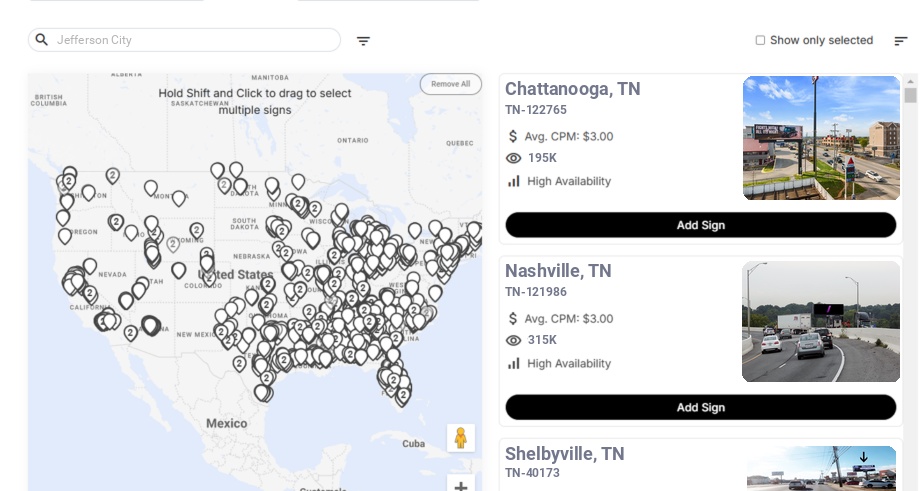
Blip has digital billboards in Jefferson City. You can browse available locations on a map, choose the ones that fit your audience, and start advertising right away.
Still have questions? Launch a campaign in minutes — no contracts, no commitments.
Start Your CampaignJefferson City Billboard Advertising Guide
Jefferson City Jefferson County Jefferson City 8,419 residents in the 2020 census, and Jefferson County 56,460, so even a local campaign can speak to a broader county trade area that is about 6.7 times larger than the city itself. Travel here is overwhelmingly car-based, with residents using U.S. 11E, State Route 92, and nearby I-40 and I-81 for daily errands, commuting, and regional shopping. That mix of repeat local impressions and steady pass-through traffic gives us a practical, affordable environment for digital billboard advertising.
Jefferson City Market Overview
Population, growth, and trade area reach in Jefferson City
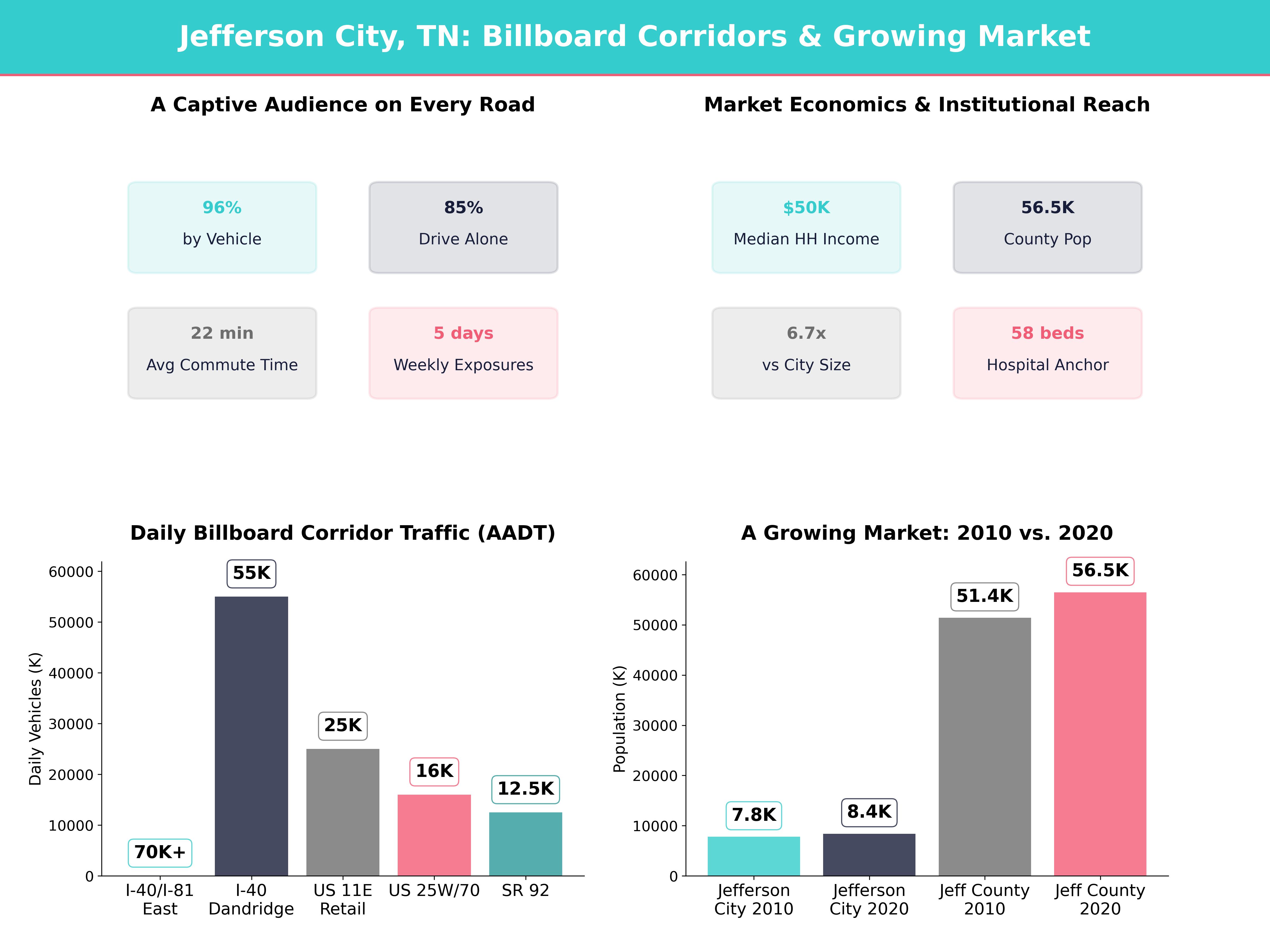
Jefferson City works for outdoor advertising because the market is small enough for efficient repetition, yet connected enough to reach far beyond the city limits. The Tennessee State Data Center 7,760 residents in 2010 to 8,419 in 2020, which is an 8.5% increase. Over the same period, Jefferson County grew from 51,407 to 56,460, which is a 9.8% gain, adding 5,053 residents countywide. Those growth rates matter because they signal new households, more local spending, and a larger countywide audience using the same core roads every week.
Location also helps. Jefferson City sits about 30 miles east of Knoxville 15 miles of Morristown, so we are not planning in an isolated rural pocket. We are planning in a corridor where residents routinely move between education, healthcare, shopping, work, and recreation. That makes billboard advertising especially useful for businesses that draw from multiple towns instead of only one ZIP code.
Economic anchors and mobility patterns in Jefferson City
Jefferson City has more institutional weight than its population alone suggests. Carson-Newman University 1851, gives the city a steady flow of students, faculty, staff, athletic visitors, and visiting families. Jefferson Memorial Hospital 58-bed healthcare anchor that supports year-round traffic for clinics, pharmacies, urgent care, rehabilitation, and related services. The Jefferson County Chamber of Commerce Tennessee Department of Economic and Community Development
Recent ACS-based profiles indicate that about 85% of Jefferson City workers drive alone, roughly 11% carpool, and only a small single-digit share work from home or use another mode, meaning roughly 96% commute by vehicle. Average travel time to work is around 22 minutes, which is long enough for repeated visual exposure and short enough that many residents repeat the same route day after day. ACS-based profiles also place the city’s median household income around $50,000, which makes clear pricing, financing, convenience, and trust-based messages especially effective. For advertisers, that means Jefferson City rewards consistent, practical messaging more than abstract brand campaigns with no local relevance.
Key Traffic Corridors for Billboard Advertising in Jefferson City
I-40 and I-81 near Jefferson City
According to Tennessee Department of Transportation traffic-volume maps I-40 through the Dandridge side of Jefferson County generally carries about 50,000 to 60,000+ vehicles per day, and the combined I-40/I-81 segments farther east in the county climb into the 70,000+ AADT range. These are the biggest-reach faces in the local market because they capture long-distance travelers, regional commuters, freight movement, and weekend recreation traffic. Traffic usually moves at 70 mph, so creative has to be bold, short, and instantly understandable.
This corridor is especially useful when we want broad awareness rather than hyperlocal frequency.
- Regional healthcare, higher education, and legal services benefit because interstate traffic includes people traveling from multiple counties for appointments, admissions, or consultations.
- Tourism, lodging, attractions, and restaurants benefit because the interstate carries visitors moving across East Tennessee, including travelers headed toward Sevierville, Pigeon Forge, and Dollywood.
- Auto dealers, financial services, and chains with multiple locations benefit because the interstate gives us scale beyond Jefferson City itself.
U.S. 11E / Andrew Johnson Highway in Jefferson City
U.S. 11E, also known as Andrew Johnson Highway, is the everyday commercial spine of Jefferson City. TDOT counts place much of U.S. 11E through Jefferson City in the 18,000 to 24,000 AADT range, with the busiest retail stretches approaching 25,000 vehicles per day. This is where we reach routine behavior, including grocery trips, school drop-offs, healthcare visits, banking, fast food, and errands tied to the workday. Speeds are generally closer to 45 to 55 mph here, so drivers can absorb slightly more detail than they can on the interstate.
This corridor is ideal for advertisers that depend on repeated local exposure.
- Restaurants, convenience stores, and retailers benefit because they can catch residents close to the point of purchase.
- Banks, insurance agencies, medical practices, and urgent care providers benefit because proximity and familiarity are often the deciding factors in smaller markets.
- Auto service, home services, and local event promotions benefit because U.S. 11E reaches both Jefferson City residents and neighboring county drivers passing through town.
State Route 92 between Jefferson City and Dandridge
State Route 92 matters because it links Jefferson City with Dandridge, lake communities, and the interstate system. TDOT traffic counts on this route typically fall in the 10,000 to 15,000 AADT range, depending on the segment. That is smaller than U.S. 11E, but the audience intent is valuable because many of these drivers are moving between home, recreation, and regional travel connections.
This route is especially effective for advertisers that want to blend local relevance with lake and visitor traffic.
- Real estate agents, mortgage lenders, and builders benefit because the corridor reaches both established residents and people exploring the county.
- Marinas, campgrounds, restaurants, and outdoor recreation brands benefit because the route carries warm-weather and weekend traffic.
- HVAC, plumbing, landscaping, and pest-control companies benefit because SR 92 serves households spread between Jefferson City, Dandridge, and nearby residential areas.
U.S. 25W/70 and county connector routes around Jefferson City
U.S. 25W/70 through Dandridge and toward New Market functions as an important county connector. TDOT counts on these segments generally fall in the 12,000 to 20,000 AADT range, depending on location. We should not ignore those roads just because they are smaller than the interstate, because they often deliver highly relevant county residents with predictable travel patterns.
This part of the network helps when our goal is broader Jefferson County coverage.
- Farm supply, outdoor equipment, and home-improvement advertisers benefit because these routes serve more rural and semi-rural households.
- Churches, schools, nonprofits, and civic campaigns benefit because county connectors reach established community audiences repeatedly.
- Furniture, flooring, appliance, and regional retail brands benefit because shoppers often travel across town lines for larger purchases.
Audience Segments We Can Reach in Jefferson City
Daily commuters and regional workers in Jefferson City
The first audience is the most obvious and the most valuable. More than 9 in 10 local workers commute by vehicle, with about 85% driving alone and 11% carpooling. That means billboard advertising aligns closely with actual behavior rather than with theoretical foot traffic. In Jefferson City, people move west toward Knoxville, east toward Morristown, south toward Dandridge and I-40, and across the county for schools, healthcare, retail, and industrial jobs.
This is why employment ads, healthcare messages, financial services, quick-service restaurants, and automotive campaigns can perform well here. Repetition matters in a market where people often see the same corridor 5 days a week or more. If we stay visible on the routes they already use, we can build familiarity without requiring a huge number of boards.
Students, faculty, and visiting families in Jefferson City
Carson-Newman University August, January, and May, when move-in, new semesters, and graduation bring extra traffic. Athletic events, admissions visits, and campus programming bring additional bursts of family visitation during the year.
This audience is valuable for apartments, banks, restaurants, healthcare providers, wireless brands, churches, and event venues. It is also valuable for regional brands that want to build early loyalty with young adults while still reaching parents and relatives in the same campaign. In a small market, a university can add disproportionate advertising value, and Jefferson City benefits directly from that effect.
Families, homeowners, and service buyers across Jefferson County
Jefferson County’s 56,460 residents are spread across Jefferson City, Dandridge, lake communities, and rural neighborhoods, which makes the area especially useful for service-based advertisers. County growth of 9.8% from 2010 to 2020 suggests steady household formation and residential demand. Jefferson County Schools add another layer of family-driven mobility tied to school days, sports, and after-school activities.
This audience responds well to messages about convenience, trust, affordability, and local reputation. Home services, healthcare, grocery, telecom, hardware, insurance, and family entertainment all fit well. When we want to reach parents and homeowners, boards on U.S. 11E and key county connectors usually outperform a generic regional approach.
Lake visitors, anglers, and weekend travelers near Jefferson City
The outdoor audience is a major plus for this market. The Smoky Mountain Lakeway 28,780 acres of water and roughly 400 miles of shoreline. That creates seasonal demand from anglers, boaters, campers, second-home owners, and weekend visitors who may not live in Jefferson City but still spend money in the county. The county also benefits from leisure stops such as Glenmore Mansion Bush’s Beans visitor draw in Chestnut Hill.
This segment is excellent for restaurants, marinas, boat dealers, convenience stores, real estate, campgrounds, short-term lodging, and outdoor apparel. It also helps local healthcare and retail brands because weekend visitors still need gas, food, pharmacy items, and emergency services. When we plan for lake season correctly, we are not only buying local reach. We are buying seasonal spending.
Healthcare and community audiences in Jefferson City
Jefferson City is also a strong fit for public-facing service campaigns. A 58-bed hospital, multiple clinics, schools, churches, and community organizations create steady demand for awareness advertising. In smaller markets, community recognition often matters as much as pure scale, and billboards are especially good at reinforcing names people may need to remember later.
This audience is useful for healthcare systems, specialty practices, mental health providers, senior care, schools, charities, and election campaigns. It is also valuable for local governments and event organizers that need broad awareness without depending solely on social media reach. When the message is simple and the route is familiar, Jefferson City boards can do that job very efficiently.
Seasonal and Timing Opportunities in Jefferson City
Spring advertising opportunities in Jefferson City
Spring is one of the best times to increase visibility in Jefferson City. From March through May, we can align campaigns with tax season, home improvement, lawn care, allergy care, graduation planning, and early tourism. Warmer weather also brings more recreational traffic toward the lake and more event traffic at venues such as Glenmore Mansion May.
Spring creative should feel active and timely. We should emphasize openings, schedules, promotions, and seasonal services. This is also a smart window for healthcare screenings, landscaping, pest control, home remodeling, and wedding-related advertising.
Summer lake season and travel timing near Jefferson City
Summer is the clearest seasonal billboard window in the market. From Memorial Day through Labor Day, Cherokee Lake activity rises, weekend travel increases, and regional road movement becomes more noticeable. This is when SR 92, U.S. 11E, and the I-40 gateway can work together especially well. We should lean harder into Thursday through Sunday scheduling for lake-oriented, restaurant, retail, and entertainment campaigns.
This is also the season when travelers moving across East Tennessee become more valuable. If we want to capture recreation traffic, fuel and food stops, or spontaneous dining decisions, summer is the time to do it. Creative should reference lake days, family weekends, cold drinks, outdoor fun, or easy access from the highway.
Fall campus, football, and foliage opportunities in Jefferson City
Fall gives us another strong cluster of demand. Late July and early August are important for back-to-school and campus move-in messaging, and August through November supports football, school activity, and routine commuter traffic after summer travel normalizes. Outdoor advertisers can also benefit from East Tennessee fall travel, especially on routes that feed visitors moving through the region.
This season works well for apparel, restaurants, healthcare, banking, student housing, tutoring, church outreach, and local entertainment. It is also a great period for hiring campaigns because employers can speak to both returning students and stable year-round workers. When we want a campaign to feel energetic and community-oriented, fall is often the easiest season in Jefferson City to activate.
Holiday retail and winter service campaigns in Jefferson City
The last 6 weeks of the year are useful for gift-driven retail, holiday dining, healthcare enrollment, and service reminders. Winter weather is less tourism-heavy than summer, but it creates urgency for heating, plumbing, urgent care, tires, and battery service. January also brings another campus reset, which makes January a practical month for fitness, financial, education, and self-improvement messaging.
For winter campaigns, we should focus less on scenic imagery and more on dependable service. Messages about same-day appointments, open enrollment deadlines, warmth, safety, and convenience tend to fit the market well. In smaller cities, dependable utility often beats flashy branding during the coldest months.
Billboard Design Tips for Jefferson City Campaigns
Make Jefferson City creative feel local
The strongest Jefferson City creative usually sounds like it belongs here. We should use recognizable references such as 11E, Dandridge, Carson-Newman, Cherokee Lake, or “minutes from I-40” when those references are true. Drivers in smaller East Tennessee markets often navigate by highways, landmarks, and town names more than by formal street addresses. A message that says “On 11E in Jefferson City” usually feels more useful than a message that only gives a brand slogan.
We should also remember that Jefferson County audiences include city residents, rural households, and visitors. Naming nearby communities such as Jefferson City, Dandridge, and Morristown can signal regional relevance quickly. That matters when we want the ad to feel familiar instead of generic.
Design for the actual speeds around Jefferson City
Speed and approach angle should shape our design choices. On I-40 and I-81, where traffic often moves at 70 mph, we should keep copy extremely short, ideally around 6 to 8 words plus a brand mark. On U.S. 11E and SR 92, where speeds are closer to 45 to 55 mph, we can add a little more context, such as a location cue, a short offer, or a directional phrase.
We should avoid clutter in both cases. Long URLs, dense disclaimers, and QR-dependent calls to action are usually poor fits for moving traffic. In Jefferson City, fast recognition beats detail almost every time.
Use East Tennessee imagery thoughtfully in Jefferson City campaigns
Local creative should reflect the real feel of the market. Water, docks, green hills, trucks, family outings, brick campus architecture, and Friday-night-light energy all fit naturally in Jefferson County. If we are speaking to lake visitors, we should show a Cherokee Lake-type experience, not a generic beach image that feels disconnected from East Tennessee. If we are speaking to families, we should use warm, practical imagery rather than polished big-city visuals that feel imported.
Color matters too. East Tennessee audiences are comfortable with bold orange, blue, green, black, and white combinations, but contrast still matters more than regional familiarity. Orange can work well here, yet it needs clean pairing and strong type to avoid blending into roadside visual noise.
Lead with value, trust, and convenience in Jefferson City
Jefferson City is a market where practical promises often outperform clever wordplay. Messages about financing, same-day service, family ownership, insurance acceptance, short drive times, and simple prices usually fit the audience well. That does not mean the creative has to be plain. It means the benefit should be obvious in the first second or two.
For example, healthcare ads should emphasize access and confidence. Restaurant ads should emphasize craving and convenience. Home-service ads should emphasize reliability and speed. The market responds well when we remove uncertainty and make the next step feel easy.
Regional Strategies for Jefferson City and Jefferson County
Jefferson City core and campus-adjacent strategy
Boards closest to Jefferson City’s core are best when we need repetition among residents, students, and local service users. This is where restaurants, banks, apartments, healthcare, and campus-related messaging can build familiarity quickly. Traffic is smaller than on the interstate, but the audience is highly relevant and often repeats the same routes multiple times a week.
For local businesses, these placements can be the foundation of the campaign. We do not always need the market’s largest traffic count if the board sits near the exact audience we want to reach. In Jefferson City, frequency near daily habits often wins.
U.S. 11E retail spine strategy in Jefferson City
If we want the broadest local commercial reach, U.S. 11E is usually the first corridor to evaluate. It captures shoppers, commuters, healthcare traffic, and routine errand behavior in one buy. For many advertisers, this is the most balanced mix of volume and relevance in the market.
We should think of U.S. 11E as the everyday decision corridor. Promotions, openings, seasonal services, quick dining, and appointment-based businesses all fit well here. If our goal is to move people from awareness to action, this route often gives us the best local leverage.
Dandridge and I-40 gateway strategy for Jefferson City advertisers
When we need reach beyond the city, the Dandridge and I-40 gateway becomes more important. These boards help us speak to countywide residents, regional travelers, and leisure traffic at the same time. They are especially useful for attractions, colleges, healthcare systems, destination dining, regional retail, and legal services.
This strategy works best when the message is simple and directional. On gateway boards, we should prioritize brand recognition, a single benefit, and a location cue. Interstate traffic gives us scale, but only if we respect the speed of the road.
Countywide strategy across Jefferson City, White Pine, and rural connectors
A countywide strategy makes sense when the advertiser serves all of Jefferson County instead of only Jefferson City. In those cases, we should combine a Jefferson City board with placements that reach Dandridge traffic, I-81 movement near White Pine
In practical terms, 2 or 3 well-chosen boards can often outperform a scattered regional buy. Jefferson County is large enough to require thoughtful coverage, but compact enough that a focused multi-corridor plan can still feel dominant. Our job is to match each board to a travel purpose, not simply to chase the biggest number on the map.
Using Blip Tools and Capabilities in Jefferson City
Match Jefferson City budgets and dayparts to real local behavior
Jefferson City rewards timing discipline. We usually get better efficiency when we concentrate local boards during commuter periods such as 6:00 to 9:00 a.m. and 3:00 to 7:00 p.m., then shift to midday or weekend emphasis for restaurants, healthcare, and retail. For lake and entertainment campaigns, Thursday evening through Sunday often deserves heavier weight than a flat weekly schedule.
Because the market is smaller than Knoxville, we can test intelligently instead of overspending from the start. We can begin with the corridors that align closest to our goal, then add reach only after we see what is working. That makes the platform’s flexible pacing especially useful in Jefferson City.
Build different creative for different Jefferson City corridors
One of the best uses of digital billboards here is creative separation by route. We should not force the same ad to do the job of an interstate brand board, a U.S. 11E retail board, and an SR 92 lake board at the same time. Instead, we can run one version for 70 mph interstate recognition, another for 45 to 55 mph retail traffic, and another that leans into weekend recreation or campus timing.
Blip’s artwork tools make that easier than traditional billboard workflows. We can create a simple highway version, a slightly more detailed local version, and a seasonal variation without turning the campaign into a production project. In a market with distinct travel behaviors, that flexibility is not just convenient. It is strategic.
Use analytics to optimize Jefferson City campaigns
Jefferson City is a good market for iterative optimization because travel patterns are consistent enough to show differences over time. We can compare performance between U.S. 11E and the interstate gateway, between weekday and weekend schedules, and between campus-season creative and general community creative. We can also adjust campaigns around move-in, graduation, lake weekends, and holiday retail periods without waiting on a long contract cycle.
This matters because small-market billboard buying should be precise. If one corridor is clearly better for walk-in traffic and another is better for broad awareness, we should treat them differently. Real-time visibility helps us make those decisions based on performance rather than assumption.
Getting Started with Billboard Rental in Jefferson City
Choose Jefferson City billboard locations by campaign goal
The easiest way to start is to define what success means in this market. Different goals point to different boards.
- If our goal is repeated exposure among Jefferson City residents, we should start with boards on U.S. 11E and other city approaches.
- If our goal is countywide or regional awareness, we should add I-40 and I-81 gateway boards near Dandridge and the broader interstate corridor.
- If our goal is to reach lake visitors and weekend spenders, we should prioritize SR 92 and warm-weather timing.
- If our goal is to reach students, parents, and university visitors, we should look for boards tied to campus routes and the August, January, and May calendar peaks.
Expect a simpler process than traditional billboard buying in Jefferson City
Traditional billboard buying often means long lead times, fixed terms, limited flexibility, and slower creative changes. Digital billboard rental in Jefferson City is easier to manage when we can select boards on a map, launch quickly, and adjust based on what the market is telling us. That flexibility matters in a place where timing can shift around lake season, campus events, hiring needs, and weather-driven service demand.
We should still evaluate each board carefully. Traffic volume matters, but so do direction of travel, distance from the decision point, surrounding land use, and whether the message fits the likely driver mindset. A slightly smaller board close to our storefront or service area can outperform a bigger-count board that is too far from the action.
Evaluate success in practical Jefferson City terms
In a market this size, success is usually visible in concrete business outcomes. We should watch for increases in calls, appointment requests, walk-in traffic, branded search volume, event attendance, admissions inquiries, or coupon redemptions from Jefferson County. We should also pay attention to message-market fit. If a board is being seen but not moving people, the issue may be the creative or the offer rather than the location.
Jefferson City does not require a complicated billboard strategy. It requires a local one. When we match the right roads, the right timing, and the right message to how Jefferson County actually moves, billboard rental here becomes straightforward, measurable, and highly practical.